Interlude: A word from God

Blog359

While nothing like Cyclone Idai that hit southern Africa recently, we had some terrible storms here in the north of England last weekend. The thunder woke me just after 2 a.m., each peal shaking the house, and with the flashes of lightning, it felt frighteningly apocalyptic.

And then it hit me: the Lord was sending a sign! He was angry about something we’d done! Maybe same-sex marriage, though as we’ve had that for a while now in the UK, I’d have thought he’d be used to that particular idea by now. So, maybe he was upset about abortion again. That could be it, though again, a bit late in the day. Still, with God a day is as a thousand years (and vice versa), so you never know. Maybe it’s Brexit. Perhaps the Lord’s angry we’re coming out of Europe. Or, perhaps he’s angry we aren’t coming out fast enough. Back in the 1970s, when Britain first joined the European Economic Community (as it was called then), he told his representatives here on Earth it was a Very Bad Thing, because it was like a recreation of the old Roman Empire and a sure sign of the End Times. He disapproved, but told only a few of his Chosen Ones how he felt and completely forgot to mention it to anyone else.

Christ! Don’t you just get fed up with religiously fixated nutjobs coming up with this sort of crap every time there’s a storm or a tsunami or an eclipse? Every natural disaster, every human catastrophe, every phenomenon in the night sky has to be interpreted as a message or warning from a deity who is otherwise as dumb as a rock. Only when weather does what weather is prone to do does he start communicating with us – incoherently and in code. Only a special few, those who’ve appointed themselves as his prophets and mouthpieces, are capable of telling us what he’s really saying. It’s a miracle if two or three of them ever agree about what that is.

If you need evidence there’s no God, then this is it. If he were real, we would have independent knowledge of him; knowledge that isn’t filtered through human messengers or delivered, garbled, by the weather or by a seriously flawed and obviously human book. He would be apparent; he wouldn’t need to be interpreted, explained and represented by people who give every impression of making stuff up as they go along.

What we have instead is a God who is very evidently human. It’s humans who interpret weather conditions, claim to know what God’s saying and declaim his messages and warnings. It is impossible to know anything, either about or from him, other than what humans – very often ones with very little brain and a penchant for self-promotion – tell us.

If there really were a God, I’d ask him to stop communicating with us through extreme weather, disasters and massacres, and instead to miraculously lift the curse of religion from the 7.7 billion of us here on Planet Earth. But there isn’t, so we’re stuck with it – with religion and those who have a vested interest in perpetuating its nonsense.

Pearl of Great Price

Blog358

Once Born Again™, I became involved with a local church, where my friend Simon took it upon himself to play Cupid, fixing me up with Jane. I was more than a little surprised a girl could be interested in me, but figured, in my flight from myself, that as she was interested, I should make the most of it. Sex wasn’t much of a problem: as good Christians we may’ve played about a little, but we stayed away from what the church liked to call ‘pre-marital intercourse’.

It wasn’t long, though, before Jane wanted to marry – she really wanted to get married. I wasn’t so sure and told her about my escapades with Sam, adding of course that I had since renounced such sin. She said that as long as it never happened again, she had no problem with my past transgressions. I felt pretty sure it wouldn’t happen again. After all, Jesus and his Holy Spirit were taking care of my old nature.

So Jane and I married and over time had three children. While I was very much involved with their upbringing, I would often feel I was ‘letting the Lord down’. When, as happened on holiday once, a group of younger men came round a corner minus their shirts, I found myself instinctually admiring them. What self-crucifying shame I would feel after occasions like these. I would even confess such ‘sins’ to a senior work colleague, a devout and very genuine older lady. I’d spare her the details of how exactly I’d ‘let the Lord down’, of course; I could never have brought myself to say I’d been turned on by naked male torsos. But somewhere deep within me I longed for intimacy and closeness with another man. I knew this was strictly forbidden so buried my desires deeper and deeper, suppressing and subjugating something vital about myself. I was on course, though I didn’t recognise it, to making myself ill. I was convinced that I was doing the right thing – for myself, for my marriage and for God.

My marriage, however, was in trouble. Jane seemed to have lost interest in our children, which hurt me greatly (and didn’t do them a lot of good either.) This and pressures at work, where my boss’ affair with a female colleague was creating some serious problems, made me question whether God really cared. When I needed him most, petitioning him for the wisdom to deal with these problems, the heavens, as the scripture almost says, were as brass. God, it seemed, just wasn’t interested. Perhaps, I started to wonder, he wasn’t even there. Added to this was the internal pressure I was still subjecting myself to; the tension and stress of sublimating my true nature. I was deeply unhappy. While the situation at work was eventually ‘resolved’ (by my finding a better job) I had become chronically depressed and remained so for several years.

Ultimately, once I had reached my fifties and the children were grown, Jane and I separated. I knew I couldn’t go on suffocating my feelings; the mind is not designed to be a pressure cooker – something has to give. I started to accept, though not yet embrace, my innermost nature. The relief was immediate and tremendous. I felt I had found myself and I didn’t care that society might not particularly like what I had I found. I had to be me, and not the uptight, miserable person I had become by denying my essential self. I squared up to the exciting yet daunting prospect of starting over, and acknowledged that if I were to have a new relationship it would be with another man. And so it was.

Over time I came to like myself – imagine that! All I’d felt for most of my life, since the time at the YMCA, was self-hatred. That was what Christianity, what Jesus, had done for me. Arguably, it had also ensured, by keeping me firmly in the closet, that I hadn’t died prematurely during the AIDs crisis of the 1980s. Perhaps though I’m giving it too much credit.

I’m ‘out’ now, in every sense: to my wonderfully supportive children, to you who read this blog (obviously) and to friends. Match-maker Simon, he who suggested going to the YMCA all those years ago, cut me off about a decade ago. As a born-again Christian, he regarded homosexuality as beyond the pale. His ‘principles’ meant more to him than our long-standing friendship. I still miss him, very much.

I don’t miss God. He has gone entirely and I’ve long recognise that he was never there to begin with. Instead, I have a sense of authenticity and my energy goes into living, not denial. I’ve become involved with the local LGBT Centre and I’m seeing a very nice man who I’m going to call Thomas, to spare his blushes. I’m very happy and feel, at long last, I really know what life’s about.

If you can stand it, I’ll tell you more next time.

Heaven’s Above

Blog356

I was struggling for inspiration this week with the homework assignment from my writing group. The title was ‘Heaven’s Above’ (or maybe ‘Heavens Above’, without the apostrophe) and possibly I was having difficulty with it because I don’t believe in a Heaven above, on account of there not being one.

The other night, in a local bar, this young guy came over to talk to my friends and me. He was a doctor from a nearby practice, and he started by asking how, when the time comes, we’d like to die. While perhaps not be the best way to start a consultation, his question provoked some interesting responses.

Then, having somehow detected that my friends and I had reached a certain level of maturity (we’re in our 60s), the young doctor asked what we felt was the point of life. He had, he said, a real need to know this, because having achieved all he wanted at 28, he was left wondering if there was any purpose beyond 30. I like to think we all gave him good answers. There’s life in these old dogs yet! For me, it was falling in love (yes, it happens to old people too) together with friends, lovers and other relationships, particularly those with my grown-up children and beautiful grandchildren. There’s also – though I didn’t bore him with the details – achieving authenticity, accepting yourself and living true to that self. Then there’s all the other things that make life worthwhile; being open to change, having new experiences, learning, helping others, reading, writing, conversation, music, walking… You will, I’m sure, have your own list.

I know that Sartre claimed that ‘Hell is other people’ and Lee Marvin thought much the same thing when he rumbled in Wand’rin’ Star that ‘Hell is in hello’, but Heaven is in these same things; in friendship and our other relationships. There may be some who think it’s easy for me to say all this. ‘After all,’ they say, without knowing me, ‘you have a good life. It’s pretty easy to feel positive about something that’s already going well,’ which is true. Except my life has had its share of traumas, problems and pains, and still does. But life is good and worthwhile in spite of these, and it’s purposeful too without recourse to God or Jesus. Who needs these two old frauds? We make our own Heaven here, now, in our own lives.

Am I saying count your blessings? Yes, I suppose I am, but not, I hope, in a glib way. There are so many good things in most of our lives; all we have to do is make them our own. ‘Lay hold on life,’ as the old hymn says, ‘and it shall be, thy joy and crown eternally.’ Maybe not eternally, but certainly beyond the age of 30.

What have reason and logic to do with faith?

Blog355

Last time I considered the Christian claim that reason and logic can only derive from God, and that non-believers’ use of them is nothing more than a illicit hijacking of powers supplied by the God they deny. Why is it important to modern day Christians to attribute reason to their God? After all, the bible only ever speaks disparagingly of reason. It is, it says, the path to self-delusion; Proverbs 3.5 warns ‘trust not in your own understanding,’ while faith, according to Paul far surpasses the limitations of reason and rationality. More than this, as I discuss here, the God of the bible is far from reasonable and logical himself. His response to every issue is the death penalty, mass murder and blood sacrifice.

According to Christians, human reasoning makes no sense if it is ‘merely’ the product of evolution. A random and undirected process cannot produce a reliable rationality on its own. Naturally, they are never entirely clear why this is the case; evolution has, after all, led to other distinctly human characteristics on which we regularly depend, imperfect though they may be: language, memory, social bonding and creativity among them.

However, having singled out reason and dismissed evolution as its cause, Christians then jump to the conclusion that the human capacity to think must come from God. According to Tim Keller, rationality is a ‘clue’, planted in every human being, to God’s existence.* It has evidently never occured to Keller that, by the same token, the human capacity for unbounded irrationality is likewise a ‘clue’ to the non-existence of any rational deity.

Human reasoning – and there’s no other kind – is, like every other evolved characteristic, flawed. It is only as secure as the premise from which it proceeds. Get that wrong, by adopting a premise with an insufficiency of evidence (such as ‘God is a God of Reason’) and human cognition will only ever abandon us in the blind alley of faith.

*The Reason For God, p141

Why logic, reason and truth have nothing to do with any god

Blog354

I’ve recently encountered again the ‘argument’ (it’s actually no more than an assertion) that without God logic and reason would not exist.

Here’s how ‘Liam’ puts it in a comment on Escaping Christian Fundamentalism:

If anything, the illogical nature of a godless universe is a massive pointer to a God, without Whom there is no reason or truth or logic…

To a degree this is right; if God made the universe and everything in it, including reason and truth and logic then, yes, they would owe their existence to him.

But it all hinges on that word ‘if’.

Equally, if God doesn’t exist, it follows he could not have created the universe and everything in it – including logic, rationality and truth.

One cannot take these things and say they are evidence that God exists and also that they only exist because God made them. Not unless you’re happy with a tautology – a feedback loop where each assumption is its own conclusion. Demonstrate, on the other hand, that God exists independently from the human imagination and then maybe you might be able to make the case that he created logic and reason. As it is, pointing to human attributes like logic and reason doesn’t ‘prove’ that God exists; it demonstrates only that these attributes are characteristics of the human mind. Logic, truth, reason (and mathematics), like God himself, have no independent existence outside of human cognition. They are ways of explaining life and the universe; they are not life and the universe themselves.

If, as seems probable, God doesn’t exist, then evidently, logic, truth and reason did not originate with him. Indeed, they took billions of years of slow evolution to develop. We know of no other way for intelligence to arise; and only intelligence produces logic, reason and truths. No God required


How many angels can dance on the head of a pin?

Blog337Crap

Back when I was a teacher, in a distant, previous life, there were kids who couldn’t grasp the concept that multiplying a number by zero always results in zero. No matter how often I told them, ‘it doesn’t matter how much nothing you have, it’s still nothing,’ some of them just couldn’t see it.

Those who did understand regarded it as almost magical – they were young children – and would challenge each other with the likes of, ‘What’s 47 trillion, 56 billion, 95 million, 34 thousand, 8 hundred and 22 multiplied by zero?… Zero!’

I imagine these smart kids now say things like, ‘What’s Superstition multiplied by New Testament scholarship, theology and the intellectualised analysis of doctrine?… Superstition!’

It is immaterial how rigorous the scrutiny of the non-existent is, the non-existent will only ever be non-existent.

No matter how much nothing you have, it’s still nothing.

Give me some of that ol’… New Testament scholarship?

Blog336JC&Kids

Roger E. Olson has deigned to reply to me! He says that every fule know there are multiple Jesuses in the New Testament. All the same, Rog is sure he has a pretty clear picture of the real one, even if this is only in his own head. Then I hit the jackpot! Rog treats me to one of the Christian apologist’s top retorts: those with dissenting views know nothing about New Testament scholarship.

Here’s his response in all its glory:

I hear your suggestion, but I’m not sure what it has to do with atheism. All serious New Testament scholars–including the most conservative Christian ones–already know and admit that the gospel portraits of Jesus differ somewhat from each other. But very early in Christian history all attempts to reduce them to one portrait (one united gospel stitched together from the four in our New Testament) were rejected as heretical. We Christians already know what you say and it doesn’t bother us. I have read numerous biographies of Abraham Lincoln, for example, and the “man himself” stands out in spite of differences of description from different points of view. Your point is simplistic and displays that you know little or nothing about New Testament scholarship.

My reply to this, which Roger hasn’t seen fit to post:

So you think one has to be fully cognizant with New Testament scholarship to be a Christian? Funny, I don’t find any of the Jesuses in the bible saying that. Doesn’t one of them suggest we ‘become as little children’? Still, I expect you’re right: if you need a level of understanding that’s the equivalent of a doctorate to follow Jesus, then I guess I don’t qualify.

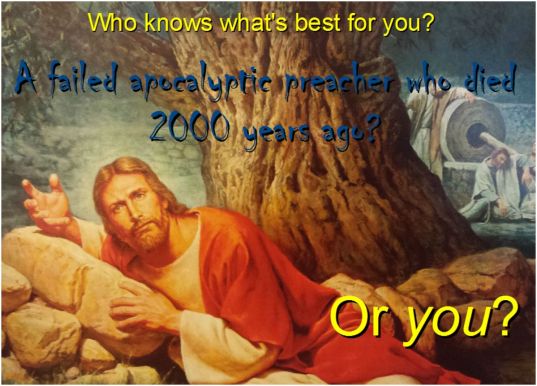
As for what my comment has to do with atheism, you were the one who said we see God most clearly in Jesus. I responded by saying I don’t see God in any of the interpretations. If Jesus is the best reflection we have of God, as you suggest, then his failed prophecies, false promises and general ignorance make it probable that the God he, and you, promote doesn’t exist.

If you can cherry-pick which bits of the bible are relevant to your understanding of the divine, Roger (you dismiss, for example, the barbarity of the Old Testament), then it is not unreasonable for others to do the same, even if we aren’t as well versed in Christian mumbo-jumbo theology as you.

God is revealed in Jesus… or not


Blog335CompositeOn his blog-site, humbly named after himself, Roger E. Olson trots out the tired old cliche that there’s no such thing as atheism. Atheists, Rog tells us, know in their hearts that God exists, they just choose to ignore him. As a result, Rog has little time for atheism. (I discovered Roger’s wonderfully smug site through Bruce Gerenscer’s excellent one.)

Rog says that if we want to see what this heart-implanted God looks like, then we shouldn’t look to the Old Testament and the tribal warlord we find there – goodness me, no; we can safely discard him! That God just doesn’t match up to our twenty-first century sensibilities. No, if we want to see God then what we must do is look at Jesus, for in Jesus we see what God is really like.

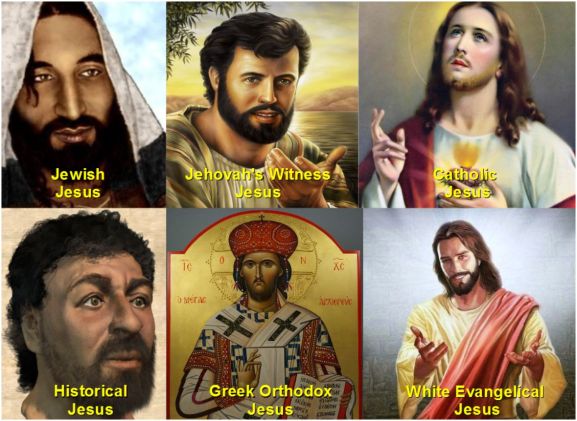
Oops! We’re right back at the problem I’ve been discussing these last few posts: just which Jesus are we talking about? There are so many. There’s the Jesus of the synoptic gospels (though he’s neither consistent nor pleasant), who is nothing like the self-obsessed Jesus of John’s gospel. Paul’s Christ is different again; he’s a complete invention, much like the Jesus of Hebrews who has morphed into a Jewish High Priest. The Jesus of Revelation meanwhile is an Evil Mutant straight out of the Marvel Universe, what with swords coming out of his mouth and all. So which Jesus has Rog got in mind? I think we should be told.

There are so many discrepancies in the various interpretations of Jesus in the New Testament, that it’s hard to see a clear, consistent picture of anything, let alone God, in such a shifting kaleidoscope of images. I’ve recommend that Rog should take atheism a little more seriously; the often incompatible Jesuses of the bible don’t reveal ‘the true nature of God’ anywhere as clearly as he claims. I’d go further: none of them show – can possibly show – what the non-existent is ‘really’ like. What they reveal instead are ideas about a God and a saviour made entirely in the image of the men who tasked themselves with creating them.

Hearing things

Blog332Pray

Don Camp has responded to my previous post, Voices In The Head, with a longish essay that he posted on Debunking Christianity. I want to use what he says to debunk the foolish notion that God speaks directly to people via their own  thoughts.

Those of us who do not believe in a God have, Don says, no ‘philosophical context’ for his speaking and are bound to ‘have trouble’ with the idea. I have to say, in fact, that I have no trouble at all with it. It’s easy: no God = no God speaking.

The rational thing to do, Don goes on, is for skeptics to fit those reports of God speaking into a context we do have, such as self-talk or schizophrenic delusions. This is another statement of the obvious; with no supernatural to account for such voices there can only be a rational explanation for this most irrational of phenomena.

Don then tries an analogy: ‘trying to explain God speaking to those who have no way to make sense of it is like explaining the color and beauty of a sunset to someone with no eyes.’ This is less than convincing. Those who are sceptical about God speaking (or doing anything) do have ‘eyes’: their rationality and critical faculties. A more accurate parallel for trying to persuade others the Almighty sends messages into his followers’ heads would be claiming that the events of a dream you had last night really happened in the world as we know it. ( I’ll have more to say about dreams later.)

‘I’ve said clearly,’ says Don, ‘what God speaking to people is not. It is not self-talk.’ Alas, Don does not tell us how he knows this.

‘Those who hear God speaking do not mistake it for self-talk,’ which is a pity because that’s what it is; Christians might choose to relabel it ‘God’ but that doesn’t mean it is. ‘It is also not schizophrenic delusions.’ It is a delusion though; I haven’t actually said that Don’s inner voice represents schizophrenia (he brought up the term) but I can’t see any difference between the voice he hears and those experienced, perhaps in more severe form, by schizophrenics.

‘Schizophrenic delusions, in which the sufferer either sees things that aren’t there or hears voices no one else hears, are characterized by self-isolation behavior, delusions, disorganized speech, bizarre behaviors, and flat affect. (see https://medical-dictionary…. )’ Whereas those hearing God’s voice gather together in self-contained enclaves separated, by choice, from ‘the World’. At other times they withdraw to talk to an imaginary super-being on their own and, according to Don, have him speak to them. If they’re really lucky, they’ll even get to see things that aren’t there. Obviously this kind of bizarre behaviour bears no resemblance to the true schizophrenic.

Don again: ‘Schizophrenic behaviors are very self-focused and their delusions are sometimes fearful or hateful and sometimes violent. It is the last that we see when people afflicted with schizophrenia pick up a gun and shoot up a school or a church or behead a girlfriend, as in the case you’ve noted in Mt. Vernon, Washington.’ Of course, schizophrenia is the same as most human behaviours; it exists on a spectrum. The Christian’s inner voice may not be as extreme or anti-social as that of the schizophrenic, but hearing it is on the same spectrum, perhaps at the safe end. Until it’s not, of course, as in the examples Don refers to.

‘But what about the person who hears God speak telling him that he should build a hospital in the Congo for AIDS patients or reach out to help the homeless? That is not the behavior of someone who suffers from mental illness. But that is the sort of thing that characterizes the lives of those ordinary Christians who report hearing God speak. So inner voices sometimes tell Christians to do good things. So what? This isn’t evidence they’re from God. What Don’s really arguing here, is that a ‘good’ message proves the Christian’s inner voice is God. And how do they know it’s God and not just self-talk? Because the message is ‘good’. This is circular and self-fulfilling, and doesn’t take into account all those instances when ‘God’ commands people to do bad things. According to the Old Testament it was the Lord himself who commanded Moses, Joshua and Samuel to massacre neighbouring tribes, the Lord who told Abraham to execute his own son in an especially cruel ‘test’. Doesn’t God do this any more? Has the unchanging God changed in this respect? Believers don’t just hear God telling them to do good things; the evidence is right there in the bible that (they imagine) he tells them to do wicked things too.

‘Does that kind of selfless compassion and determined service to mankind come from schizophrenic delusion or a disordered mind disconnected from reality? I do not think so. But that and many, many similar things are the result people having truly heard God speak.’ No, it’s the result of people interpreting an inner prompting as God. Interpreting it as such does not mean it is.

‘No physician would diagnose the many millions of ordinary Christians who report God speaking to them as schizophrenic.’ As I’ve already suggested, Don is creating a false dichotomy here: it isn’t necessary to be a diagnosed schizophrenic. It’s possible those hearing ‘helpful’ voices are much lower down on the delusional spectrum. They may never be schizophrenic in the medical sense, but this does not mean their voices are not self-generated.

‘But if God speaking is NOT self-talk or delusional, what is it?’ It is both of these things and Don hasn’t demonstrated otherwise. Still, let’s humour him and press on:

‘I think that J. Warner Wallace has as good an explanation as any. It is far more than voices in our heads. You can read his article here http://www.foxnews.com/opin…Fox News? Don really is in trouble.

‘What is significant for those who are convinced that there is no God out there to speak is that their conclusion contrasts with the experience (of) many billions of people over a very long time. It was the experience of those who wrote the Bible and many of those they wrote about. It has been the experience of billions since.’ Aah, now we’re playing the numbers game: ‘lots of people think this so it must be true.’ Well, okay, but many more billions dream while they’re asleep, and those dreams must come from somewhere; they can only be from God – there’s even biblical support for the idea that they are. So, if numbers of people demonstrate God’s involvement in our psyches then dreams are far more numerous than God merely speaking directly. However, God doesn’t create or speak through dreams, even though the bible suggests in places that he does. People may interpret them as God speaking but, as I’ve already said, interpretation is not evidence – and numbers prove nothing.

And now, having failed to present any sort of persuasive evidence that his inner voices are from God, Don leaps to this conclusion: ‘it is not really helpful for skeptics, who consider themselves in some way more grounded in reality than the rest of mankind, to Wave off this God speaking thing as delusional.’ Do we skeptics consider ourselves more grounded in reality – yes, I think perhaps we do. We look at evidence, not at what people believe they’re experiencing nor the numbers who believe, nor to the supernatural as an explanation for human phenomena. Voices in the head are generated by the brain; as Don concedes the mind commonly does this when we create a dialogue with ourselves. The nature of this dialogue is influenced and altered in those whose minds are saturated with religious ideas and mythology to the extent it is (mis)interpreted as the voice of God. This is the reality. I know, I’ve been there.

‘You need to consider,’ says Don in his coup de grace, ‘if there is not more to reality than you believe’? Do we? Do I? When a perfectly adequate explanation exists for voices in the head, why should any of us consider an alternative that relies on the supernatural? Actually though, I’ve done that too; for a long time I believed there must be ‘more to reality’ than we humans could conceive of or comprehend. So far, however, there is absolutely no evidence – zero, zilch – that what we don’t understand is Supernatural. Whether I ‘believe’ this or not is immaterial; it is a demonstrable fact. The Creator of everything-there-is cannot therefore be the source of voices in the head, dreams, visions or any other damn thing.

So, Don, a final point: if you stick, as I’m sure you will, with your belief that the voices you and other Christians hear are from God, then perhaps you could tell us why he says different things to different Christians – completely contradictory things (as I’ve written about here)? How do you account for God whispering one thing to you and the opposite to a fellow-believer? Do you dismiss as schizophrenic those who say God tells them not to commit massacres, but to shun gay people, control the weather, take possession of a new jet or prepare for the ‘great persecution‘ to come? Are these fellow Christians deluded? Maybe misinterpreting the voices in their head? If you dismiss them as deluded, muddle-headed or schizophrenic then you can perhaps see how we skeptics view you.

Hearing Voices

Blog331Moses

I’ve been having a little exchange with the super-spiritual Don Camp over on Debunking Christianity. Don is convinced that the Holy Spirit speaks to him directly. He argues that all true Christians™ can hear the Spirit inside their heads, and seems to think this direct contact is as important as, possibly more important than, what it says in God’s Holy Word®.

There are, of course, many Christians who disagree with him, who think hearing voices in your head is flirting with demonic deception and apostasy (Yes, we’re in pot and kettle territory, but isn’t this what internecine squabbling is all about?) Don says he knows it’s the Spirit who talks to him, however, because what it has to say is in keeping with ‘the tenor’ of the New Testament. Here’s how the discussion went, with my contribution in italics:

Don’s opening salvo: Actually, if you ask people who do have God speak or if you look through the Bible and read the experiences of those to whom God spoke, it is rarely that the Spirit speaks what we want to hear. Do you think Paul want to hear that Jesus was lord? Do you think Abraham wanted to hear God tell him to sacrifice his son? Do you think Moses wanted to hear God tell him to return to Egypt? Do you think Jeremiah wanted to hear God’s message of destruction for Jerusalem? Or Jonah that he was to go to Nineveh? Or Isaiah that he musty preach, but no one would listen?

That in fact is one of the tests. If the “voice” tells you what you want to hear, be careful.

Me: Just reading over on Friendly Atheist of the guy who said the Lord told him to behead his partner because she didn’t repent. It doesn’t say whether he ‘wanted’ to hear this or not, but he went ahead anyway. Luckily for him (though not his partner) there were some bible verses that confirmed what the Lord had told him direct.

This the kind of thing you’re talking about, Don?

Don (below): Nope (a good solid argument! John Loftus threatened at this point to ban Don from Debunking Christianity as he’s had enough of his proselytising and lack of argument. Consequently, after another question from me, Don answered more fully.)

Me: Why not? Why is the voice in your head the real deal while this other nutjob’s isn’t? How can you possibly distinguish? He had bible verses to support what he thought the Lord was telling him, just like you do.

You see, Don, there is no way to distinguish between the two because, like yours, the Lord whispering in this guy’s cerebral cortex is exactly the same as the one whispering in yours. They’re both the product of brains suffering from a surfeit of religiosity.

Don:How can you possibly distinguish?’

Pretty much everyone can identify self-talk. No Christian mistakes the Spirit speaking with self-talk.

‘He had bible verses to support what he thought the Lord was telling him, just like you do.’

It is not simply a matter of finding a verse somewhere and yanking it out of context so that it can mean whatever you wish. That is superstitious and dishonest to the Bible. The question is whether what you feel the Spirit saying to you is is in conformity to the general tenor and tone of Scripture and in particular with the general tenor and tone of the New Testament. I say that because the general tone and tenor is incomplete until we come to the New Testament.

In the case you refer to, I cannot find anything in the New Testament that would allow beheading anyone for any reason. Rather I find a lot that tells us to love our enemy and to love the sinner, repentance or not.

Find me one place where Jesus said anything that would allow one of his followers to take another person’s life. What he said was love others, love the sinner, treat with kindness those who disrespect and even purposefully misuse you.

Find me one place where Paul said anything that would allow a Christian apart from acting under the authority of the state to take another’s life.

Both he and Jesus allow that an unrepentant person who claims to be a follower of Jesus might be excluded from the fellowship of Christians. But nowhere is there any warrant for beheading anyone anywhere.

The person who finds such warrant is misreading and misusing the Scripture

Me: ‘Pretty much everyone can identify self-talk. No Christian mistakes the Spirit speaking with self-talk.’ Though not, apparently, the guy who decapitated his partner. How about the preacher (Steven Anderson) who says the Spirit tells him LGBT people should be executed? Or those who say this self-same Spirit tells them to welcome gay people? Why does the same ‘Spirit of Truth’ provide such contradictory messages?

I feel the Spirit telling me right now, Don, that the voices in your head are nothing more than self-generated delusions.

As for New Testament verses (why you suddenly excluding the blood-soaked Old Testament?) that advocate violence, how about Matthew 10.34-36 where Jesus says he came to bring not peace but a sword? Or Matt 3.10-12 where he says that those who bear bad fruit will be ‘cut down’ and burned ‘with unquenchable fire.’? Or Matt 5.25-30 where he advocates cutting off hands and gouging out eyes when they ‘offend’? There are many more such verses attributed to Jesus; violence is easily justified with the words of your ‘peace-loving’ fraud, Don.

As for Paul, how about Romans 1.31-32 or 1 Thessalonians 1.10? Do you ever read this damnable book for yourself, Don, or do you just rely on hearing voices in your head telling you what you want to hear?

Don:How about the preacher (Steven Anderson) who says the Spirit tells him LGBT people should be executed?’

He is wrong. And everyone I know

‘how about Matthew 10.34-36 where Jesus says he came to bring not peace but a sword?’

The sword would be that which would be directed against them – as it was of Jesus.

‘Or Matt 3.10-12 where he says that those who bear bad fruit will be ‘cut down’ and burned ‘with unquenchable fire.’?’

It is not Christians who will do this. This is God’s final judgment. The King who has that authority will judge.

‘Or Matt 5.25-30 where he advocates cutting off hands and gouging out eyes when they ‘offend’?’

This is a metaphor. It is neither your hands or eye that offends. Evil comes from the heart (the inner person).

As for Paul, how about Romans 1.31-32′

It is not Christians who will judge the sins listed here. This is God’s judgment.

‘or 1 Thessalonians 1.10?’

This also is God’s judgment.

I said, if you recall, that Christians are never called to behead anyone anywhere, that they are to love their enemies and to do good to them rather than harm. There will be no “voice in the head” from God that tells a Christian to do harm – except as the agent of a government, which does have the God-given right to enforce justice.

Christians are called to follow Jesus. And he picked up no stone or sword to do violence to anyone.

But I did not say that God would not judge evil. That is his right and prerogative. He will certainly do so.

Me: All neatly side-stepped with the usual ‘he didn’t really mean what he clearly says.’ (Your response to the sword quote is particularly ludicrous: Jesus has just told the disciples to bring their swords to the garden in anticipation of his arrest; Peter actually uses his!)

I guess this kind of self-deception – you’re fooling no-one else – is why you can suggest Steven Anderson ‘and everyone I know’ is wrong. Only you are right, Don; the voice in your head says so.

Don:You can suggest Steven Anderson ‘and everyone I know’ is wrong. Only you are right, Don’;

Sorry. The failure to complete the sentence was a fault of not proof reading. It should read “everyone I know” agrees. (I knew this really.)

So let me say this carefully. I personally know of no Christian who condones Anderson’s act of beheading his partner. We all find it totally out of step with the words and character of Jesus. In a word, Anderson is a nut job on the order of a terrorist or atheist who walked into a Texas church and shot 20 plus people. They are all carried along by some passion that the rest of us would find far over the edge.

Me: Well, as you say it carefully that you and your buddies know personally that these other guys are wrong, I guess I’m convinced.

Unfortunately, the other fruitloops I’ve mentioned are as convinced as you are that the Lord (of Murder and Genocide) is really speaking to them. You see how subjective it all is, Don?

Btw, Steven Anderson isn’t the Christian who decapitated his partner; Anderson is your brother in the Lord – a preacher no less – who says the Holy Spirit has told him that gay people deserve death (because the bible says so.)

Don: ‘the other fruitloops I’ve mentioned are as convinced as you are that the Lord (of Murder and Genocide) is really speaking to them. You see how subjective it all is, Don?’

Self-talk, whether positive or negative, is subjective. No one else hears your internal talking to yourself. BTW there is nothing wrong with self-talk. We all do it.

Schizophrenia delusions (see https://www.aristada.com/wh… are also subjective. In this case almost everyone who is not schizophrenic can identify the unreality of the messages and hallucinations of a schizophrenic.

My own experience with schizophrenics is that they rarely if ever act in positive ways. They are fearful and troubled and riven people. Far more often their delusions cause them to act in anti-social and even violent ways. I would say that the person who beheaded his partner seems schizophrenic. I wonder if many of the mass shooters are not schizophrenic. We certainly know that some have been.

Schizophrenics can mix religious talk into their delusions. But we should not imagine that these are meaningful any more than the delusions they see.

Neither self-talk nor schizophrenic delusions describe the kind of God-speaking believers experience. They are different in kind not merely in degree.

‘Anderson . . . says the Holy Spirit has told him that gay people deserve death (because the bible says so.)’

The Bible says that we all deserve death. I deserve death. You deserve death. Romans 6:23 “The wages of sin is death, but the gift of God is eternal life through Christ Jesus our Lord.”

But that fact is not a mandate for any follower of Jesus to kill another person.

I do not know what Anderson did with his word from the Lord. If he organized a lynch mob, he is violating the word and tenor of the New Testament. If he argued that gay people should be denied their civil rights or in any way treated as enemies of Christians (yes, this what Anderson advocates, as well as the state execution of gay people), he is violating the word and tenor of the New Testament. If I remember right, Jesus was a friend of sinners not their executioner. And I do not know of any instance in which Jesus made a distinction between me as a heterosexual sinner and any homosexual sinner. We are all the same.

Jesus message to every sinner – and that was everyone he met – was repent and and seek the kingdom of God.

Me: This is the last time I’m going to respond to this nonsense. I have a godless life to be getting on with.

So, let me see if I’ve got this right: anyone who hears a different voice from yours, or receives a message from the Lord that’s at odds with your highly selective, rose-colored perspective of the bible, is schizophrenic.

You sure you’re not in two minds about this, Don?

Which all just goes to show how pointless it is arguing with someone in whom the Delusion is very strong.

I want to return to Jesus’ advocacy of violence and self-harm soon. These parts of his  inspirational teaching are so overlooked, don’t you think?