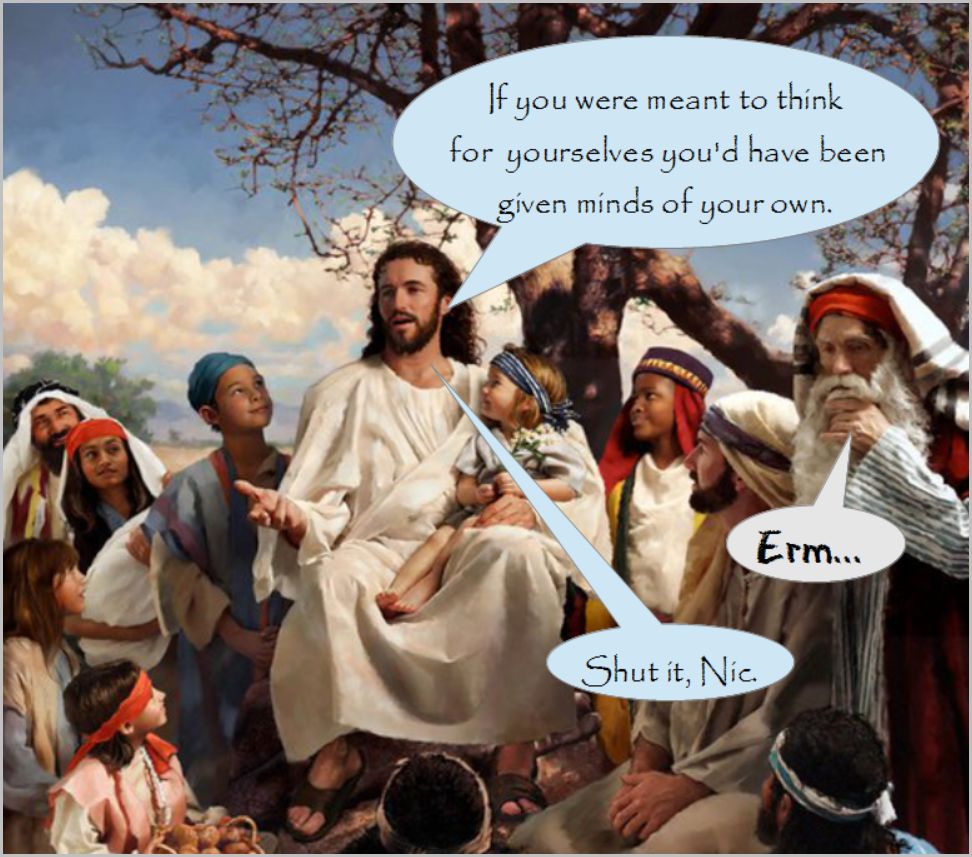
In the Wrong Body

prayer3What to do about those people who feel they don’t belong in the body they were born with? Those who disparage the vehicle that carries them through life? Should we ban them, shun them? Prevent them from using the same bathrooms – to use that ridiculous euphemism for places never known to include baths – as those of us who accept the body we’ve got? Should they be side-lined, castigated and ridiculed?

Well, no. Let’s go easy on Christians who believe they are somehow separate from the bodies that house them; who regard their bodies are inferior to the spiritual being God intends them to be. Christians who look forward to the day when they’ll be relieved of their physical bodies, which will then be transformed into spiritual ones, and who, in preparation for this miraculous change, claim to resist the demands of the body – the lusts of the flesh as the Bible puts it (1 John 2.16). Yes, those Christians, the same ones who disparage people who find themselves in the wrong bodies and want them to conform to the sex they know themselves to be; transgender people.

The Christians are wrong on every level of course:

  • They are not designed to be spiritual beings;
  • None of us is separate from our bodies;
  • The illusion of the self is a product of the brain and wider society, and we demonstrably do not have souls or spirits;
  • Bodies, while frail and susceptible to illness, injury and ageing, are all we’ve got; they don’t survive death and are not refurbished or replaced after it.
  • The demands of the body can be managed but not entirely ignored, not even by Christians who eat, drink, have sex, sleep, defecate and generally indulge their carnality in the same way the rest of us do.

Still, none of this prevents Christians from thinking they’re prisoners of a temporary yet  strangely inhospitable body while here on Earth. You’d think that would make them empathetic to people who are also in the wrong bodies, but you’d be wrong. They ridicule them and tell them that they’re sinful aberrations; they object to their use of the ‘bathroom’ that corresponds to the gender they know themselves to be.

What was it someone once said? ‘Let he who is without sin cast the first stone’. There sure seem to be a lot of sinless Christians about these days.

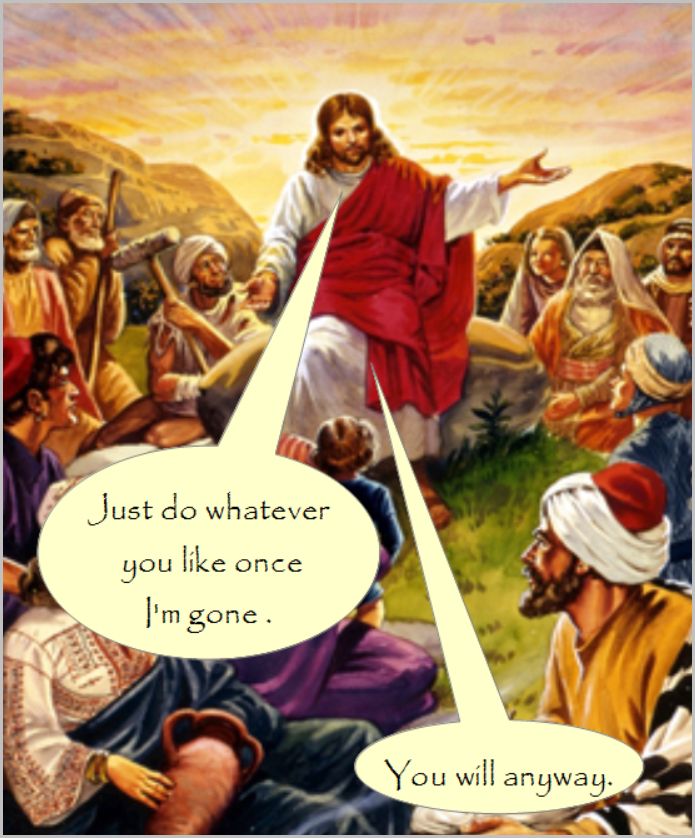
The Stuff Christians Say… (part two)

Balaam

Atheists don’t behave as evolution says they should: This ridiculous accusation is often slung at atheists by Christians who seem to see it as some sort of stinging rebuke. Answers In Genesis is very fond of it; the Hamster’s drones and other Christians seem to believe – without ever thinking it through (plus ca change) that because those who acknowledge the veracity of evolution don’t behave according to its principles they are somehow inconsistent in their ‘beliefs’ – hypocritical even. They seriously propose that because natural selection and the survival of the fittest (not one of Darwin’s phrases) are cruel, uncaring processes, then that is how, for the sake of consistency, atheists ought to behave too. We shouldn’t care, they say, when a child develops cancer or someone dies. We shouldn’t attempt to cure illness or work to prevent suffering because these are nature’s way and part of the mechanism of evolution.

While it’s true they are, it’s been a long time since our behaviour, our existence and continued success as a species has been solely determined by what nature does. Humans regularly override its mechanisms, natural selection included; every time we use birth control, show compassion for the weak, heal the sick, develop medicines, engineer genes and preserve life. And so we should.

Christians seem unable to comprehend that evolution is not a pattern to be followed. It is not a set of instructions for living, a prescription or a set of (a)moral guidelines. It is the best explanation, supported by considerable amounts of evidence, of how life developed on the Earth. As such it makes no ethical claims nor does it demand that its principles be blindly followed (that’d be religion). Are Christians truly unable to detect this difference?

Atheists have no reason to be moral: I’ve looked at this ignorant claim before. Of course we have reason to behave morally. We’re human, we live in human society. Morals help us do so while doing the least damage to ourselves and others. They may also enable us to bring some happiness or comfort to those around us. Atheists don’t look to an imaginary God to tell us how to be good; our morals come from our culture, upbringing and education. Christians’ morals do too, whatever else they may claim. They certainly don’t get them from that most immoral of books, the Bible.


to be continued…

Do No Harm

sermon2

If religions took ‘do no harm’ to heart (as the Hippocratic Oath does) and their adherents were made to comply with it, what a better place this world would be. There’d be –

No more religiously-motivated suicide bombers and terrorist atrocities;

No more murder in the name of the Lord (whichever);

No more children molested by priests and pastors;

No churches attempting to cover up their crimes;

No more child deaths as a result of ‘faith-healing’;

No religiously-sanctioned denigration and abuse of women;

No more ritualistic mutilation of children’s and young women’s genitals;

No more religious scams and shams;

No more religiously-inspired vitriol directed at gay and transgender people;

No more barbaric executions of ‘minorities’, like gay men, women and those of other faiths.

Of course, even without these, the world would still not be perfect. Awful things would still happen. But the principle of doing no harm would eliminate much of the trauma inflicted on people by the proponents of irrational superstition.

On paper at least, the Abrahamic religions have expectations that are more demanding than simply doing no harm:

Love your neighbour as yourself (Leviticus 19:18; Judaism);

Love your enemies; treat others as you would like to be treated’ (Matthew 7.12 and 5.44; Christianity);

…compete with each other in doing good (Surat al-Ma’ida, 48; Islam).

However, these are just too damned hard for so many religionists. They disregard them and opt instead for the spiteful paranoia of the same holy books. Perhaps the simpler injunction of ‘do no harm’ would be easier for them. But until the preachers of judgement and hatred find it in themselves to promote such a principle, we will all continue to suffer the destructive effects of the ‘great’ faiths.

So, how long until the next terrorist attack? The next church child-abuse cover-up? The next rape scandal? The next persecution of gay people?

      Not long at all.

           Praise the Lord (whichever)!


Con Texting

Cross2Pastor Chris Linzey didn’t like my previous post. He attacked its shoddy journalism(?), complained I exercised faulty hermeneutics and was upset I quoted bits of the Bible ‘out of context’. What he didn’t do, of course, was address the point made in the post, that Christians are selective about the parts of the New Testament they’ll accept, nor did he answer my question about how they decide which commands to follow and which not. Ironic, really, for someone whose blog has the strap line ‘Turning the Bible into Behavior’.

Christians are inherently dishonest about which parts of the supposed ‘Word of God’ – the New Testament specifically – they’ll acknowledge, believe and apply to their own lives. They mask this dishonesty, from themselves as much as anyone else, with a sleight of hand they mistake for hermeneutics (more on this in two post’s time) and by wilfully misinterpreting those who draw attention to their inconsistency. Pastor Chris didn’t seem to understand the fairly simple points I made in ‘Pick and Mix’ so came up with a couple of avoidance strategies. First, he took a swipe or two at my writing style (fair enough, though no-one was compelling him to read it) before, secondly, setting up strawman arguments to attack. They certainly weren’t my arguments he was tilting his lance at, that’s for sure. I guess this is what Christians mean by putting on the armour of God; you gotta deflect criticism by whatever means possible.

I’d like here to address though, Chris’s claim that I was quoting the Bible ‘out of context’. I have to say I find this one of the most unconvincing rejoinders – it hardly qualifies as an argument – that Christians offer in defence of their beliefs, right up there with ‘you wouldn’t dare say this about Islam’.

A quotation from any source, not just the Bible, is necessarily out of context no matter how much of it one uses. There is no way round this, even if one resorts to quoting extensive amounts of material, which I do when the meaning isn’t apparent from a short quotation, like here, for example. Nonetheless, a lengthy quotation is still decontextualised, from its letter or gospel as well as from the original time, place and culture in which it was written. In addition, while long quotations might be appropriate for longer academic papers (I have some experience of these and even there, great chunks are rarely necessary) they’re not always suitable for short, pithy blog posts.

In any case, the objection really only has validity if quoting ‘out of context’ somehow distorts the meaning. If it doesn’t, if the meaning is apparent from the lines referenced, then quoting more isn’t necessary. Readers who have any doubts can always check the source material for themselves – I always provide chapter and verse – to gain a sense of the wider context for themselves. Remarkably, the verses I cite invariably turn out to have the same meaning in their greater context as they do when quoted in isolation. The Christian objection to them being ‘out of context’ is usually nothing more than a smoke screen to avoid addressing the point being made.

What of Christians themselves? Do they ever take ‘scripture’ out of context? Oh my, yes, and they’ve been doing it from the very beginning. The gospel writers, particularly Matthew, wrenched snippets from the ‘Old Testament’ to make ‘fulfilled’ prophecy out of verses that weren’t prophecy to begin with, and, as we’ll see next time, Jesus too lifted lines from their original context to allow him to make theological points.

Nor are Christian bloggers and apologists today averse to doing the same. Then there are those devotional posters with a single, ‘comforting’ verse of scripture on them (like the one I used to have that said, ‘Heaven and earth will pass away but my words will never pass away’); the placards that surround street preachers with ‘For God so loved the world he gave his only begotten Son’ and ‘Ye must be born again’; the banners at marches and parades that declare ‘Repent or Perish’ or ‘Christ died for the Ungodly’. Each and every one out of context. I suppose if the original sense is more or less preserved then these might be seen as legitimate (if not entirely useless) but evidently taking scripture ‘out of context’ is something Christians are allowed do but others shouldn’t. Yet another case of do as I say, not as I do.

Next time, we’ll take a closer look at how believers ease their cognitive dissonance – between what the Bible says they should believe and do and what they actually believe and do – by disregarding context when it suits them.


What Does Atheism Have To Offer? (Part Three)

Celia17. Atheism offers knowledge instead of belief
‘But you must,’ Christians have said to me, ‘believe in something greater than yourself’ and ‘You can’t deny your spiritual needs.’ Well of course there are things greater than me and of all of us. The universe for a start; love, beauty, friendship, music, great art, nature, the night sky – sex even. Who hasn’t had a spiritual experience through their appreciation of these things? The fact they exist though, makes ‘belief’ in them redundant. We only need ‘believe’ in those things for which there is no evidence – which is why you can’t ‘believe’ in evolution; you can only know it as fact. Similarly, atheists know there are greater things than themselves. They don’t, as a rule, worship them, but appreciate them, often in awe and wonder, for what they are. As for such experiences being ‘spiritual’, we do not, of course, have ‘spirits’ either to nurture or express. We are emotional creatures and the value we find in those things greater than ourselves often stimulates sublime emotional responses. Nothing wrong with that, of course, but our responses reflect conditions within us, not the supernatural without.

8. Atheism offers the embrace of reality
Part of the inherent honesty of atheism is its recognition that this life is all there is. Atheism faces up to the fact that we are organic beings and like all organic beings our lives come to an end; there is nothing in us, no part of us, that survives death. Knowing heaven and eternal life are impossibilities atheism promises neither. Religions do, of course, and that is their great selling point but no-one, apart from atheists, seems to notice that they never actually deliver what they promise (because they can’t.)

Christians also tell atheists that it takes more faith not to believe in God than it does to believe in him. They need only look to their own experience to realise this cannot be so: they don’t need faith not to believe in Allah, Santa Claus or any number of other mythical beings. Equally atheists don’t exercise any faith at all not believing in Yahweh.

9. Atheism offers, unfortunately, an unsatisfactory name
One thing I wish atheism made possible but doesn’t – not yet anyway – is a better term for one who is unencumbered by gods, the supernatural and superstition. I have no wish to be defined by what I’m not, which is how ‘atheist’ works. It also implies that being a theist is somehow the default position and that any other is an aberration. I quite like ‘humanist’, but that doesn’t quite capture it either, but I’m not keen at all on Richard Dawkins’ suggestion of ‘bright’. The tide is turning though and once absence of belief becomes the norm, the right name for the true default will present itself.

10. Atheism offers a sense of well-being
Happiness, tranquility, peace perhaps don’t come from atheism per se, but they do stem from it: the opportunity for the consciousness I think of as ‘me’ to experience life in the here and now. I know many are not able to enjoy being here to the same extent that I and many in the west are able to, but this only makes it more important that we all do something to help improve the lot of others. As the nineteenth-century atheist Robert Ingersoll expressed it, ‘the time to be happy is now, the place to be happy is here, and the way to be happy is to make others so,’

As I write, Queen’s ‘Who Wants To Live Forever?’ is playing on the radio. It hardly matters who wants to; we can’t and we don’t. And – same group, different song – it’s true that ‘nothing really matters’. Really, it doesn’t, and so we are free to get on with living instead of trying to impose our beliefs on others, exterminating those we don’t like or squandering our one and only life because we think there’s a better one waiting. Atheism is far from nihilistic – it allows us to see the value of this life and helps us live it to the full.

So, what has atheism to offer? Freedom, honesty, meaning, contentment. Or, to put it another way, and to paraphrase what somebody or other once said, atheism really is the truth that can set you free.

What Does Atheism Have To Offer? (Part Two)

Think4. Atheism offers genuine morality
Having no magic book to tell them how to behave (not that Christians derive their morals from theirs) atheists work out their own morality. They don’t do this in a vacuum, however, recognising that morality is culturally derived, evolving as the means by which primates with complex social arrangements relate to one another. It’s likely they adhere to their moral codes imperfectly, as do believers of various stripes. Not having an ideology they feel compelled to impose on others, they don’t regard their fellow human beings as mere conversion fodder. The atheists’ world is big enough to embrace all, though they lament the damage wreaked on it by religion. Atheist terrorists are a much rarer breed than their religious counterparts, while secular societies are among the most peaceful and prosperous in the world today (with the more religious generally at the opposite end of the spectrum.) Nor do atheists attribute their behaviour to supernatural forces; neither god nor the devil inspires them to act. Rather they recognise and take personal responsibility for what they do.

5. Atheism offers authenticity
An atheist is free to be him or herself. There is no striving to maintain the imagined standards of an imaginary god, no need to represent the perspective of a ‘sacred’ book or to defend the indefensible. The atheist does not see themselves or other people as lost, worthless, sinners, suppressors of truth, goy, infidels or any of the other disparaging terms used of non-believers in so-called holy books. The atheist can be a free-spirit, possessed of self-respect, and true to themselves and their nature, whatever that may be. Here’s how pastor-turned-atheist Ryan Bell put it in a recent blog post:

I don’t have secrets anymore, which is a huge mental and moral relief. I also wrestle with less cognitive dissonance than ever. All of this means I’m more at peace and more comfortable in my own skin. I give far fewer fucks about what people think of me and my decisions. My ire is raised, from time to time, by unfair attacks, and I will probably always struggle with my tendency to be a people pleaser, but I am in recovery. I’m learning to tell the truth on a more regular basis and trust that people can handle the truth (whether they actually can or not). I’m learning to trust myself and what I know while remaining open to critique and able to say I was wrong.

6. Atheism offers free thought
Having no dogma to represent or promulgate, no myths to restrict them and no cult leaders, shaman or gurus dictating to them, atheists are free to think for themselves. Religion demands that its adherents begin with myth or dogma, which the facts are then forced to fit. When they don’t, which is invariably the case, the believer is compelled to dismiss the facts to preserve the fantasy (if you think not, you’ve never visited Answers In Genesis). The atheist, on the other hand, can begin with the evidence and reason from it to make up their own mind about ethics, the issues of the day and the human condition.

to be continued…

We owe it all to Jesus

MarySo the UK is a Christian country. Prime minister Dave Cameron has decreed it. In his hallowed Christmas message he proclaims that Britain derives all of its values from Christianity:

As a Christian country, we must remember what (Jesus’) birth represents: peace, mercy, goodwill and, above all, hope. I believe that we should also reflect on the fact that it is because of these important religious roots and Christian values that Britain has been such a successful home to people of all faiths and none.

‘Peace, mercy, goodwill, hope and tolerance’. Doesn’t it warm your heart? This country of ours has these wonderful sentiments at its core and all of them derive from the baby Jesus. I’m not sure about where our other values – capitalism, colonialism, democracy, free-thought and expression – originate but no doubt Dave will tell us they too spring from our ‘religious roots’.

What about the values he mentions though? Do they originate with Jesus as Dave claims?

Peace we covered last time: Christianity have not brought peace into the world, ever. Dave seems to have forgotten that Britain is currently at war; the so-called ‘war on terror’ Is he now suggesting that as a ‘Christian country’ we should turn the other cheek and propose peace, because that’s what Jesus would want? I doubt it, somehow.

Mercy? Here’s the kind of mercy Jesus proposed: ‘But those enemies of mine who did not want me to be king over them – bring them here and kill them in front of me’ (Luke 19:27). Nice.

Goodwill? Jesus always extended goodwill to others. Like here: ‘It is not right to take the children’s bread and toss it to the dogs (non-Jews)’. And here: ‘Do not give dogs what is holy, and do not throw your pearls before pigs (non-Jews again), lest they trample them underfoot and turn to attack you’ (Matthew 15.26 & Matthew 7.6).

Hope? The Bible does speak about hope – hope that this will all soon be over and God will consign non-believers to hell, set up his kingdom on earth and put Jesus in charge (Matthew 19:28 & 24.51). Is this what Cameron means by hope?

Tolerance? Paul on tolerance: ‘do you not know that wrongdoers will not inherit the kingdom of God? Do not be deceived: Neither the sexually immoral nor idolaters nor adulterers nor men who have sex with men’ (1 Corinthians 6:9). It’s difficult to see how modern notions of equality and acceptance can derive from bigotry like this.

No, Britain does not get its values from Christianity or the Bible or baby Jesus. It has worked them out for itself, principally through social progress and the reforms of modern times.

The UK is not a Christian country in any other sense either. Christians are required to turn the other cheek (Matt. 5.38–42), give all they have to the poor (Luke 14.33) and buy into a convoluted salvation scam plan (2 Timothy 1.9 etc). Can a country do these things? It would be unthinkable for it to give away its wealth, accede to other countries’ demands and respond non-aggressively to attack. Individual Christians don’t or won’t do these things and it would be nothing short of suicidal for a country to attempt to; yet this is what Jesus insists is involved in following him. It’s impossible for individuals to live this way, let alone entire nations.

Cameron can’t even claim that the majority of the population subscribes to the great salvation plan either. A recent government poll showed that only 49% of the population admits to being Christian and in any case, the plan is designed for individuals, not countries. So let’s hope (hah!) the Prime Minister will stop fawning over Christians, fatuously pretending that the UK is a Christian country when it isn’t. Let’s hope too he understands that our values, whatever they are, do not derive from an ancient, expired superstition. The UK is not a Christian country in any sense. Let us rejoice in that fact.

Sin Nevermore

Second

Remember the old hit Spirit in the Sky? It had the line, ‘never been a sinner, I never sin, ‘cos I got a friend in Jesus’. It doesn’t seem likely, does it? I don’t mean that Norman Greenbaum, who wrote the song, never sinned (he was Jewish, not a Christian) but that friends of Jesus are entirely sin-free. The idea that Christians never sin would be preposterous.

But actually, it’s true; Christians never sin. How do we know? Because the Bible tells us so. 1 John 3.6 says,

No one who abides in Christ sins; no one who sins has either seen him or known him.

And just in case we miss the point, the writer of the letter (almost certainly not the same John who wrote the gospel, nor the John who came up with the trippy Revelation) repeats it in verse 9:

Those who have been born of God do not sin, because God’s seed abides in them; they cannot sin, because they have been born of God.

Christians love to say that awkward bits of scripture like these have been taken out of context, so please feel free to read them in context – you’ll find they say exactly the same thing. What John is claiming – without a glimmer of irony – is that anyone who really knows God/Christ ‘cannot sin’.

So next time you see Christians shooting people at family planning clinics, committing adultery, lying or even just judging others, remember they’re not really sinning. Yes, they may be behaving immorally, uncharitably or despicably but they are most definitely not sinning. That would be impossible because they’re incapable of it.

However, Christians are all too aware that they sin (that’s their choice of word, by the way; I’d prefer to say they sometimes – often – behave as badly as those of us who are not ‘saved’.) So where does this leave us or, more importantly, them? How do they square their capacity for sin with what the Bible says here? Does their behaviour demonstrate that God’s Word has it wrong? Or are they not really Christians, not really people who ‘abide in Christ’, not really born of God?

What a dilemma. Either the Word of God™ is wrong here, like it is in so many other places, or Christians are not as saved as they like to think they are. Perhaps it’s both.

Definitely it’s both.


Human Sacrifice

Swanson

Mesoamerican cultures would ritually kill other human beings to appease their gods. Thousands were sacrificed either willingly or under compulsion.

Thank goodness we have progressed beyond this. We no longer allow superstition to dictate that others should be deprived of their lives to curb gods’ anger and bless us instead.

Unless we’re Christians like pastor Kevin Swanson, pastor Phillip Kayser, Ted Shoebat (loony name, loony guy!) and pastor Rob Gallaty, who call for the execution of LGBT people. It’s gay people, they say, who are bringing down’s God’s wrath on the world because of their wicked ways. Judgement, destruction and death shall surely befall us – or America, anyway, as that’s the only place God has any interest in – because of the gay peril. Unless homosexuals repent, they must be put to death. Only then is God likely to back off.

And just in case you think I might be misrepresenting them, here are those loving, gentle Christian folk to tell you all about it in their own words:

Swanson:

Homosexuals are worthy of death… It’s not so much an issue of the death penalty. It’s an issue of God’s judgement that’s hanging upon this nation today.

This, Swanson says, is ‘the gospel of Jesus Christ’ of which he is not ashamed.

Kayser:

And if we love our country and we don’t want to see God’s intense wrath falling upon it, we cannot ignore the abominations found in the radical LGBTQ movement. It is not just the sinfulness of homosexuality that is known, but also the justice of the death penalty for homosexuality.

In fairness, Kayser also wants the death penalty for breaking the Sabbath, blasphemy and cursing God publicly, publicly sacrificing to other gods and apostasy. He’s nothing if not fair-minded.

Shoebat:

The sodomite, the atheist, the fanatic feminist, the Muslim — all such must be deemed as criminals and enemies to civilization, for they war against the Faith, promote death and hate life…
They should be told to leave their wicked ways under coercion, and if that does not work, then death and strong suppression is the only solution.

Gallaty:

God said that the sins of the people had infected the very land in which they live. So what happens to people who engage in this activity, this sexual immoral activity? Go to Leviticus 20, God gives us the punishment for engaging in these sins… ‘If a man sleeps with a man as with a woman, they have both committed a detestable thing. They must be put to death. And their blood is on their own hands.’

These enlightened men, and others, advocate a return to primitive, barbaric practices like that of the Aztec and Mayan cultures that sacrificed humans to imaginary gods. They have much in common with ISIS and the Taliban too, who are also motivated by religion to murder others. Perhaps we haven’t made as much progress as we like to think.

With or without religion, you would have good people doing good things and evil people doing evil things. But for good people to do evil things, that takes religion.

Steven Weinberg

Loose Threads

FamilyPick a thread. Any thread. And start pulling. Gently does it, no need for force. A gentle pull on any of the loose ends of faith and the whole fabric will come apart quickly.

Here, pull on this one marked ‘the infallibility of the Bible‘. See how easily it comes loose as soon as you realise that most of it, Old and New Testament alike, was written long after the events it purports to describe, some of it by imposters and forgers.

Or this one – the salvation thread, much of it stitched into place by an excitable chap prone to hallucinations. Pull it and see how its pattern is nothing like the one proposed by the man it claims to be about.

Pull the magic threads, the ones about Gods, supernatural beings, heaven and hell, eternal life. Watch them disintegrate in your fingers once they’re teased out into the real world.

Take hold of the threads about Resurrections, Second Comings, Raptures and Judgements; so fragile, these break away as soon as they’re touched. The only miracle is that they’ve lasted this long.

Then there’s the promises threads, about how believers are going to do fantastic miracles and heal the sick and raise the dead. Imaginative and colourful, these have never really fitted in.

Then there’s the prayer threads, whose embroidery tells us how prayer works, how God will give us whatever we ask for. Downright embarrassing, these – yank ’em out.

And how about the strands that those who say they love the cloth pick out themselves and throw away? You know the ones; the threads which tell them how to live their lives that they just don’t like the look of and think spoil the overall effect. These have definitely got to go.

What about the threads that weren’t originally there – the ones about ‘defending God’s standards‘ and having a ‘relationship‘ with a dead person? These grubby, greasy threads have been added in to replace the ones those who love the cloth have pulled out for themselves.

Choose any number of other threads – the ones that clash with other bits of the pattern, the ugly brutal ones, the fantastic, the ignorant – and give them a tug. Oh, look. They come away too.

And before you know it, the entire fabric has come apart in your hands. All that’s left is a pile of worthless, brittle threads, good for nothing but throwing in the bin.