Just Like Jesus

Some parts of this post have appeared before.

Early in the first letter of John, we read,

By this we know that we have come to know Him, if we keep His commandments. The one who says, “I have come to know Him,” and does not keep His commandments, is a liar, and the truth is not in him; but whoever keeps His word, in him the love of God has truly been perfected. By this we know that we are in Him: the one who says he abides in Him ought himself to walk in the same manner as He walked. (1 John 2: 3-6)

Isn’t that interesting? John, whoever he was, says that Christians can know they’re saved because they keep Jesus’ commands and ‘walk’ as he walked. Likewise, others should be able to see these traits too because, as Jesus is (later) made to say, cult members can be recognised by their ‘fruits’ (Matthew 7:16).

Just what are Jesus’ commands that converts can’t help but demonstrate? Here’s a few:

  • Cutting themselves off from family – hating their parents, in fact – just to follow him (Luke 14.26);
  • Deny everything about themselves (Matthew 16.24-27);
  • Forsaking home, job, wealth, status, credibility and comfort to help bring about God’s Kingdom on Earth (Mark 10.29-31 etc);
  • Slaving tirelessly in the service of others (Mark 10.43-44; Matthew 23.11 etc);
  • Selling their possessions so that they can give the proceeds to the poor (Matthew 19.21; Luke 14.33);
  • Turning the other cheek, repeatedly going the extra mile and giving away the shirt and coat from off their backs– if they’ve still got them after giving everything away – (Matthew 5.38-40);
  • Welcoming the stranger, feeding the hungry, clothing the naked and visiting those in prison (Matthew 25.35-40);
  • Forgiving again and again and again (Matthew 18.21-22);
  • Avoiding judging others so that they won’t  be judged in turn (Matthew 7.1-3);
  • Loving their enemies (Matthew 5.44);
  • Regarding persecution and injustices as blessings (Matthew 5.11);
  • Doing miracles even more impressive than Jesus’ own (Mark 16.17-18; John 14.12);
  • Healing the sick, raising the dead and casting out demons (Matthew 10.7-8);
  • Asking for anything in prayer, which will be given to them (Mark 11.24; Matthew 21.22);
  • Telling others that the world is about to end (in the first century) and that only Jesus can save them from God’s wrath (Matthew 28.29-34; Matthew 28.16-20).

How many of these things do we see Christians doing? How many of these commandments are Christians compelled to ‘keep’, as letter writer John puts it? Some, it’s true, make attempts with the last (if only they wouldn’t) and a very limited few have a go at a couple of the others. But as far as most Christians are concerned, these commandments may as well not exist. They don’t see Jesus’ instructions as applying to them. I know from experience that they have ready made excuses for not obeying them, let alone feeling an inner compulsion to realise them in their own lives.

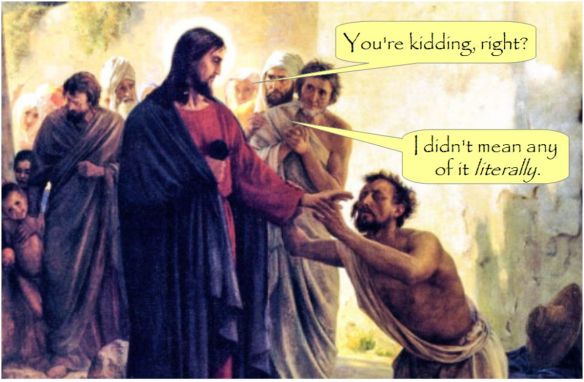
Their excuses necessitate them reinterpreting Jesus’ words. They’re metaphorical, they say. ‘He didn’t really mean give everything away because where would that leave us?’ – or they insist his commands have been taken out of context, or have only a spiritual meaning

Which is to say, nothing Jesus said is to be taken literally, even though the most straight forward reading of his pronouncements is that this is how he meant them. It’s how his early followers, the people who preserved or created his words in the gospels, understood them. Why record them otherwise?

But Jesus’ moralising is inconvenient, impractical, exacting, extreme; ridiculous, in fact, and Christians know this. Still his commands must be dealt with somehow. So the Righteous™ work round them or ignore them completely, replacing his priorities with ones of their own: worshipping him; defending his reputation; striving for power; complaining about secular society; whining about the media;  promoting aggression; acquiring wealth (there should be no such thing as a millionaire Christian); claiming persecution; equating faith with guns; trying to control others’ behaviour; interfering in their sex lives; suppressing LGBT people; arguing that religious rights trump those of minorities; opposing abortion.

None of these figured in Jesus’ agenda. Some are even in direct opposition to what he’s made to say in the gospels.

When we see Christians doing the things Jesus tells them they should be doing – what God’s love perfected in them compels them to do – maybe then we’ll listen to what they have to say. When they demonstrate credibility rather than hypocrisy, maybe they’ll have earned the right to be heard. But as there’s not much chance of that happening any time soon, it’s way past time we ignored them, and their superstition, in much the same way they ignore their Lord and Savior™.

A Christian Writes

A Christian commenter writes –

…there is only one issue of primary importantance. That is is Jesus the Son of Man and the Son of God and my/your Savior. If so, every other issue pales.

Neil, you and many other atheists seem to think Christianity is broken up into a multitude of pieces that do not agree and do not get along because of disagreements on doctrine and practice. That is actually untrue. When it gets right down to it, only the one issue is important. And that means there are billions of Christians in fellowship. That is the church.

If you missed that in your time as a Christian, I wonder if you really were or whether you were merely religious. Now, among the religious there are significant differences and divisions. Religious Roman Catholics disagree with religious Baptists, and Pentecostals with Greek Orthodox and so on. But that is religion. Christians in all those denominations agree and can have wonderful fellowship when it is about Jesus.

And I respond –

This is nothing more than the No True Scotsman fallacy: ‘those who don’t practise Christianity in the way I (or my sect/church) approves of are not true Christians; they’re merely ‘religious’.’ Having thus discounted those who ‘disprove’ the rule, the rule now gives every impression of working. Brilliant!

You assert that ‘only one issue is important… is Jesus… my/your Savior?’ No, he’s not. He’s nobody’s. Just because Paul and those who came after him decided he was doesn’t mean he is. He’s long gone. Dead. Even so, he doesn’t claim in the synoptic gospels that he came to be anyone’s personal Savior. For synoptic Jesus the only thing of ‘importantance’ was working towards the Kingdom of God on Earth. ‘Seek ye first the Kingdom of Heaven, and his righteousness, and all these other things shall be added unto you.’ For some in the early church, the ‘only issue of importance’ was obeying Jesus’ commands, including, presumably, seeking first the Kingdom on Earth (1 John 2:3-6).

The evidence shows, however, that Christians have never managed to do this (not even after discounting those they disagree with). Just look at Paul’s first letter to the Corinthians. The church has been an unholy mess since the very beginning. It continues to be to this day: take a look at Christian Research Network, which denounces fellow Jesus-lovers on a daily basis.

You delude yourself if you think the ‘true’ church, then as now, is in complete harmony, enjoying blissful love-ins with Jesus while everything else, differences in doctrine and practice included, conveniently fade away. But then, you’ve already bought into one of the most perfidious delusions ever foisted on human beings so I don’t suppose another one matters all that much.


Ring-a-ding-ding

Don has responded to my challenge that I set him in the last post. His full response is in the comments section but I’m going to address what he says here:

It is not the fine points of doctrine but the essential points of doctrine that John is talking about…

Really, Don? Where does John say this? Certainly not in the following verse which you cite. Be honest, you just made it up.

This issue rose when you proposed that the Book of Mormon could just as easily by received as scripture as the Bible.

Well, not quite. I asked you why you are not a Mormon, given that the Book of Mormon has, superficially at least, as much credibility as the Bible, perhaps more, given its supposed origin and the eye-witnesses who affirmed its creation. (I’m not a believer in its baloney, just as I’m not in the Bible’s.)   

When I read BoM I do not find a Jesus that is like the Jesus of the Bible. That is sufficient to reject it. I don’t have to worry about baptisms or temples or anything else. If Jesus in the BoM is not the Jesus of the Bible, nothing else matters.

The same is true of the Ken Hams, Douglas Wilsons, and Dillon Awes and Neil Robinsons. If they proclaim a Jesus who is not the Jesus of the Bible, what they have to say about creation, women, homosexuality, or the return of the Lord makes no difference. If they agree with the Bible about Jesus, then we might get down to using out God-given ability to read and interpret. And we might differ. And that won’t matter. Wherever we land on these issues, they are far less important than who Jesus is.

And here we hit some real problems.

You fudge around the issue of whether you agree with the preachers and teachers I quoted, eventually implying that you don’t. (Don’t you get tired of being the only one in step, Don?) You insist that interpretations of Bible verses and the claims Christians make must always be measured against Jesus. But which Jesus is this, Don? The one in your imagination: the meek and mild Mr. Nice Guy that you’ve constructed in your head from a lifetime of conditioning and cherry-picking the Bible? Because if we compare the Jesus in the gospels and the version of him that supposedly inspired Paul and the other NT writers, we find the prattling and general ignorance of Awes, Ham and Wilson matches up perfectly.

For example, Jesus – the man who reputedly said ‘love your enemies’ – tells us what he’d like to do to his own enemies:

But as for these enemies of mine, who did not want me to reign over them, bring them here and slaughter them before me. (Luke 19.27)

And according to Revelation 9, he’ll do just this when he returns with his sword in his mouth. He will unleash plagues of locusts to torment and torture non-believers. However,

(those) not killed by these plagues still did not repent of the work of their hands; they did not stop worshiping demons, and idols of gold, silver, bronze, stone and wood—idols that cannot see or hear or walk. Nor did they repent of their murders, their magic arts, their sexual immorality or their thefts.

Later, while the Son of Man watches on, these poor souls get trampled to death:

The angel swung his sickle on the earth, gathered its grapes and threw them into the great winepress of God’s wrath.  They were trampled in the winepress outside the city, and blood flowed out of the press, rising as high as the horses’ bridles for a distance of 1,600 stadia. (Revelation 14.19-20)

Not hard to see how Ames can justify what he’d like to see done to LGBT+ people, is it. Murderous-Jesus endorses him.

(I know Don, these are among ‘the fine points of doctrine’ your anointed lie-detector doesn’t work on, so you ignore them. Alas, crackpots like Awes do not.)

What about Ham’s contention that dinosaurs and humans co-existed? He’s made a career, not to mention an ark, out of believing such crap. Does your cuddly-Jesus endorse him? Why, yes, he does. He believed in a literal Adam and Eve and a six day creation (Mark 10.6). If he’d have known about dinosaurs, which of course he didn’t, he would have had to fit them into this scenario, just like Ham does.

And how about Jesus’ views of women? While he side-lines them in his pronouncements about divorce (also Mark 10) he consistently ‘reveals’ to Paul and other NT writers that women must submit in all things. The word and its derivatives occur in almost all the passages that discuss women – ‘submit’ and ‘submission’. Easy to see how Wilson believes this applies to sex as well as every other context. Unless of course the Jesus in your head has told you differently. 

So there we have it. Any extremist, despicable view can be justified by appeal to Jesus. To say these differences don’t matter because only Jesus matters is laughably disingenuous. Jesus supports any and all claims made in his name. To paraphrase Paul, he is all things to all men. 

As for me, I’m always careful when discussing Jesus to quote the gospels, as I do above, and where relevant other parts of NT. I realise you don’t like this, because I don’t have your imaginary supernatural radar, but I’m happy to show Jesus in his true light and use his own words to condemn him.


Don’s Dynamic Lie-Detector

But you have an anointing from the Holy One, and all of you know the truth. I do not write to you because you do not know the truth, but because you do know it and because no lie comes from the truth.

1 John 2:20-21 as quoted by Don Camp.

Our resident, regularly banned God-botherer, Don Camp, claims that he has a special way of reading and interpreting spiritual writing. No, he hasn’t got a pair of magic rocks, but an inner ‘anointing’ with what Don calls his ‘lie-detector’. (You might have a similar device yourself, known more commonly as a bull-shit detector. Its alarm may well have been a-ring-a-ding-dinging when you read Don’s comment.)

Anointing, if you’re interested, is the ancient Jewish custom of initiating a king or priest by daubing oil on their head. Don has no evidence that he has been inwardly ‘anointed’ by an unseen spirit that helps him understand scripture better than anyone else. There is no evidence, outside of subjective feelings and one tautological bible verse, that any religious believer has had this done to them. (Read 1 John 2.20-21 again, Don, and you’ll see that a tautology is what it is: ‘the truth is the truth is the truth,’ is really all it says.)

On the contrary, we find that different Christians interpret given scriptures in a variety of different ways (I’ll get to examples in a minute). They differ too on which bits of the Bible are relevant to them and their church or sect. They disregard or explain away verses that don’t suit their purposes.

Don does this himself. His anointing Spirit doesn’t lead him to interpret verses like Matthew 16:27-28; 24:27, 30-31 & 34, Romans 13, 11 & 12, 1 Peter 4:7, 1 John 2:18, Revelation 22.20 etc at face value. He cannot countenance the fact that Jesus, Paul, John and all those other early fanatics were wrong about when the end of the age would happen – they are all very clear they thought it was imminent – so he reinterprets what they say to mean something they clearly and unequivocally do not. Don’s interpretation has them meaning, despite what they say, that the end of the age and all that goes with it would be thousands of years in their future. Should you challenge him on this, Don tells you that how you see it is wrong because you don’t have the special anointing he has. As he puts it in his comment, you’re lacking the right ‘dynamic’ (ring-a-ding-ding!) and as a result, you are incapable of interpreting scripture in the right way (i.e. his way).

In fact, Don does not have a way of understanding scripture that he can call his own. Rather, he interprets it with preconceptions he’s acquired elsewhere; that it is God’s Word, that it is Truth, that the spiritual world it describes is real, that it relates an historical resurrection, and so on. He comes to it with these presuppositions that he has learnt from preachers, teachers, commentaries, devotional books and other Christian propaganda he’s been exposed to. He is completely unable to take a step back to look at what he’s reading objectively. He knows what it says before he reads it – ‘truth’ as far as the Bible is concerned, ‘lies’ when it’s the Book of Mormon – and imposes that meaning onto it. This ‘dynamic’ enables him too to smooth over all of the Bible inconsistencies and allows him to see it as one seamless garment when it evidentially is not. He’s not alone in doing this, of course. Most evangelical (‘anointed’) Christians do it. I know I did.

Now for those examples, and a challenge for Don:

1. A few days ago, Holy Spirit anointed, preacher Dillon Awes used his dynamic lie-detector to interpret the Bible’s declarations about homosexuality like this:

What does God say is the answer, is the solution, for the homosexual in 2022, here in the New Testament, here in the Book of Romans (1:26-27)

That they are worthy of death! These people should be put to death!

Every single homosexual in our country should be charged with the crime, the abomination of homosexuality, that they have. They should be convicted in a lawful trial. They should be sentenced with death. They should be lined up against the wall and shot in the back of the head! That’s what God teaches. That’s what the Bible says.

2. Similarly, over the weekend, Ken Ham interpreted Genesis 1 to mean that dinosaurs and humans lived at the same time. After all, he ‘reasoned’, Genesis says God created ‘everything’ in those first six days, so that must include dinosaurs as well as Adam and Eve.

3. Pastor Douglas Wilson who featured recently on Bruce Gerencser’s blog, interpreted the assertion in Ephesians 5:22-24 that wives should be submit to their husbands, even if it entails rape:

…We have forgotten the biblical concepts of true authority and submission, or more accurately, have rebelled against them… However we try, the sexual act cannot be made into an egalitarian pleasuring party. A man penetrates, conquers, colonizes, plants. A woman receives, surrenders, accepts. This is of course offensive to all egalitarians, and so our culture has rebelled against the concept of authority and submission in marriage.

My question to you, Don, is: do you interpret Romans 1:26-27, Genesis 1 and Ephesians 5:22-24 the same way as these other Holy Spirit directed interpreters of scripture? If not, why not, when it’s the same Holy Spirit that equips you with your dynamic lie-detector, that also leads them into all truth?

These is not a rhetorical question; we all want to know. But be warned, Don, our bullshit detectors are primed and ready.


How We Got The New Testament

Recycled pictures, new post.

Once upon a time, there was, possibly, a bloke called Yeshua Bar Yosef. Maybe there was, maybe there wasn’t, but either way, a couple of other blokes, one called Simon (or maybe Cephas or maybe Peter), came to believe that Yeshua had returned from the dead and had appeared to them, alive. This was probably all in their heads and what they saw was at most a blinding light, if they saw anything at all. This was certainly the case for a different bloke, Saul (or maybe Paul) who came along later. He wrote about his experiences and admitted they were all in his mind.

This Simon-Peter-Cephas and maybe one or two others convinced themselves that Yeshua was God’s special emissary and would save them from something, somehow or other. They told other people this and, being gullible, some of these other people believed that Simon-Peter-Cephas and his mates really had seen Yeshua alive again. They started to believe Yeshua would save them too. Saul-Paul, meanwhile, wrote letters to the people he’d persuaded to believe in his version of events – it was a bit different from what Simon-Peter-Cephas and co believed – and, writing in Greek, rendered Yeshua as Iesous (‘Jesus’ came much later when the ‘J’ was invented in the 16th century.) Paul thought Iesous was a celestial being he called ‘the Christ’. He taught that this Christ would soon be coming down to the Earth to set up God’s Kingdom here. Even though they were obviously a bit rubbish, Saul-Paul’s letters were copied multiple times by hand, which is when errors began to creep in. In some places, the letters were deliberately altered.

Other people wanted to get in on the act, so they wrote letters too, pretending they were Saul-Paul. Sometimes these letters said the exact opposite of what the real Saul-Paul wrote. His weren’t the only letters to be forged either. Fifty or more years after the entire scam had got underway, someone pretending to be Simon-Peter-Cephas sent letters as if they were from the man himself. Needless to say there were cultists daft enough to believe it. There were others who wrote letters too, people like James and John. James didn’t see eye-to-eye with Saul-Paul and contradicted many of the things he said.

About 40 years after Simon-Peter-Cephas thought he’d seen the dead-but-alive Yeshua-Iesous-Jesus, somebody in a different country decided to write a back story for the character. He didn’t know much about Yeshua-Iesous-Jesus, what he’d said and done and whatnot, but that didn’t deter him. He borrowed bits from Saul-Paul’s letters and Greek myths and set about it. He scoured the Jewish scriptures for anything that sounded like it might be a prediction of Yeshua-Iesous-Jesus and his supposed escape from death. He made up episodes for him based on these completely unrelated scraps of scripture. He forgot to sign his work, however, and it wasn’t until years later that someone else decided this author’s name should be ‘Mark’.

A couple of other anonymous dudes liked what ‘Mark’ had done when inventing his Yeshua-Iesous-Jesus story but thought they could make a better job of it themselves. The first of these, who would later be called Matthew, lifted most of Mark’s effort (which is how we know ‘Matthew’ wasn’t an eye-witness; an eye-witness wouldn’t plagiarise most of the story from someone who wasn’t) and then went overboard with the prediction/prophecy thing that Mark had started. He found even more spurious bits of scripture and made up a whole lot of new stories about Yeshua-Iesous-Jesus from them. Later still, ‘Luke’ wrote his version of the story, using Mark and Matthew’s accounts and inventing a few new episodes himself. This same person went on to write a fabricated history of the Yeshua-Iesous-Jesus cult, making up stories and speeches for caricatures of Simon-Peter-Cephas and Saul-Paul.

The fourth person to try his hands at writing a script for Yeshua-Iesous-Jesus decided to completely reimagine the character. Strictly speaking, this ‘gospel’ was produced not by a single person but by a collective of cult members. Their Jesus was nothing like the one in the other three gospels. He was more a super-hero, whose special power was boasting about himself. This is the Jesus that, 70 years on, the cult wanted to believe in. Eventually, the name John would be attached to this fantasy, though this isn’t the same John who wrote letters nor the one who created the hallucinatory nightmare that would become the final book of the Bible.

These various letters and stories circulated round the Roman Empire wherever members of the new cult met. Eventually, someone hit upon the idea of collecting them together as one volume. The first we hear of this is when a guy called  Marcion produced his own collection, round about AD140. Stupidly, he didn’t include the right ‘books’ and it wasn’t until AD367 that the collection we now know as the New Testament was first mentioned. This was ratified later that century by a group of men who had elevated themselves to positions of authority in the Church, as the cult was now calling itself. Despite claiming they had been guided by the Holy Spirit, these learned men endorsed the inclusion of several forgeries. Neither did they see fit to arrange the books in the order they’d been written, giving the impression that the accounts of Yeshua-Iesous-Jesus’ life existed before Simon-Peter-Cephas and Saul-Paul’s innervisions that had sparked the whole thing in the first place.

Jump forward a few hundred years and the New Testament, as it was now known, had come to be regarded, by some, as the infallible, inerrant and authoritative Word of God, which clearly it is not. These epithets stuck, however, and are still held to be accurate descriptors of the New Testament by people who have stopped thinking for themselves.

So there we have it: how we got the New Testament –

  • It wasn’t written by eye-witnesses.
  • Its accounts of Jesus’ life are largely fictional.
  • It owes much to fanatics who were prone to visions.
  • It is given to wild speculation, offered without a scrap of evidence.
  • It contradicts itself.
  • It includes many fakes and forgeries.
  • It was banged together by men who didn’t really know what they were doing.

And after that, everyone lived delusionally ever after. The End.

Battle Of The Magic Books

Don Camp replies (in blue) to my previous post. My responses are in black.

There are multiple reason for rejecting Mormonism. The primary reason is similar to discerning between a fake $20 bill and the real thing. The fake just doesn’t feel like the real thing. Of course, that test requires that one knows what a $20 bill feels like. Anyone who does not know is easily fooled.

In fact, if you don’t know what the real thing is like, it is impossible to identify a fake. You might notice an ink smudge and a difference in paper, but who is to say one is fake and the other is not?

This presupposes that your version of Christianity is ‘the real thing’. For a Jew, Judaism is the real thing and Christianity the Johnny-come-lately fake. All you’re saying here is that you ‘feel’ your version of Christianity is the real thing and you ‘feel’ Mormonism isn’t. This isn’t persuasive. I know, for reasons other than intuition, that Christianity isn’t the real thing. To use your analogy, it is the twenty dollar bill received in change when in the UK a twenty pound note is the ‘real thing’.

But since you have a knowledge of literature, Neil, why not apply those standards? Nice concession there, Don. The Bible is indeed literature and as such deserves to have the same standards applied to it as any other work of fiction.

Is the Bible and the narrative in the Bible coherent?? No. Its central character is ridiculously inconsistent. Described as an unchanging God, he changes from book to book and most noticeably between the Old and New Testaments. As someone commented on Debunking Christianity recently, it’s as if he ate a Snickers bar between the two. (He does get hungry again towards the end of the NT, when he reverts to being an omnipotent Putin.)

As the protagonist undergoes his major rewrite, the plot also suddenly deviates, becoming a completely different story. It starts by being about this poorly conceived character’s ‘everlasting covenant’ with his chosen people, but then two thirds of the way through, this everlasting covenant is scrapped and replaced with a new, largely incoherent deal involving a human sacrifice that the unchanging God has previously said he finds abhorrent.

Does it stick together and develop a single theme across the whole? No, it doesn’t ‘stick together’, not unless you ignore the gaping inconsistencies in character and plotting, and its overall implausibility.

Do you know what the theme of the Bible is, Neil? Yes, thank you, Don. Condescending of you to ask. Any apparent consistency is because the writers of the second part of the story had access to the first part. They plundered it for their own purposes, drastically altering it so that it suited their new theme. That is why much of the Jesus story appears to be foreshadowed in the Old Testament. The Jesus story – and it is a story – is built on events and episodes they found there.

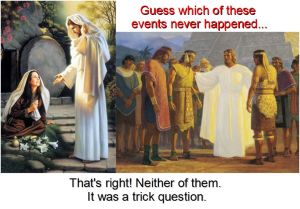
Remember that the Mormons tell us that the Book of Mormon is an extension of the Bible and that the people of the Americas were related to the Jews and held to the basic truths of the Jews. (Remember also the Mormons believe that Jesus appeared to these people in the New World shortly after his resurrection.) So if you put the Torah and the Book of Mormon together, is the narrative coherent? Does it develop a single theme? The Old testament and the New Testament are a coherent whole, but I do not think the Old Testament and the Book of Mormon are. As you can tell, I dispute that the Old and New Testament are a coherent whole. The Old Testament and the Book of Mormon aren’t either. That lack of coherency becomes even more obvious when we compare God in the Old Testament with God in the Book of Mormon. The person of Jesus is also inconsistent in the Book of Mormon with the Bible.

But they’re inconsistent within the Bible too, Don. Compare John’s Jesus with Mark’s. Compare Paul’s beatific Christ with Revelation’s grotesquely super-powered warlord.

Of course, the standard explanation by Latter Day Saints is that the Bible has not been adequately translated, though I know of no place where they can demonstrate that claim. There are significant translation problems with the Bible, which mainstream scholars consider at length. Mormon desperation to resolve these conflicts is the same as that demonstrated by Christian theologians.

Finally, there is a matter of provenance. We know in very good detail where the Bible came from.

We do? We know who Matthew, Mark, Luke and John actually were? No, we don’t nor do we know where they wrote or what their sources were. We don’t have the autographs (originals) of any of the New Testament documents but we do know some of them are forgeries and others have been tampered with.

There are many copies, especially for the New Testament, and there are many commentaries of both the OT and NT from very early in the their history. Proving what? Only that they were copied, frequently inaccurately. The copies are all much later than the probable time of composition. The commentaries are similarly far removed from them; there are commentaries on the Book of Mormon much closer to its composition.

What is the provenance of the Book of Mormon? It apparently appeared magically out of nowhere pretty recently. No mention in any other literature of its existence. It did appear magically! Oh ye of little faith! God sent an angel, like he does numerous times in the Bible, and told Joseph Smith to translate the golden tablets. The NT books were similarly created, with God breathing his word into cult followers as they wrote. God, angels, Holy Spirit, magic – all of a muchness, don’t you think?

No copy is available to examine. Nor of the original copies of anything in the Bible.

That is not to speak of the total lack of any archaeological evidence for the Mormon claims of Jews in the Americas. Mormons dispute this, of course. There are similar problems with some locations mentioned in the Bible. More fatally, most of what the Bible promises has proven false. For example: Jesus’ imminent return, his guarantee of miracles, believers becoming new creations. (Paul spends much of his time ticking off these ‘new creations’ who remain resolutely unreformed.)

So, I would say the Book of Mormon fails on all levels.

I would too. As does the Bible for the reasons I’ve outlined, and despite your special pleading. You don’t apply the same rigour in your consideration of the Bible that you do to Latter Day Saint fiction. Why is this, Don?

The Trouble With Atheists: A Christian Sets Us Straight

My friend Bruce Gerencser was good enough to repost my previous post on his blog. It prompted a comment from someone calling himself James Thompson, who Bruce says used a fake email address and quite possibly a false name. (These Christians; so fearless and honest in all their doings!) Here’s what ‘James’ had to say:

It’s because that’s what you live to do argue the truth. You’re not “atheists”. Antitheists yes. Agnosticism yes. A true atheist would not give a rip about the discussion on this blasphemous blog.

And atheists don’t go out seeking to remove Mickey Mouse from everything.

Or Buddha or Mohammed.

But they do Jesus Christ because Satan knows he is the only one who can bring salvation

I did respond to James on Bruce’s blog but wanted to address his garbled points, such as they are, more fully here. They’re typical of the low level thinking Christians and others use to defend their beliefs.

It’s because that’s what you live to do argue the truth.

Amazingly James has an uncanny insight into the minds of atheists; we live only to argue the truth, by which he means, presumably, critiquing his pet deity and magical saviour. Most of the time, most atheists barely give these two mythical beings a second thought; neither do I when I’m not blogging. I live for entirely different things.

You’re not “atheists”. Antitheists yes. Agnosticism yes.

But wait! People who don’t believe in his God aren’t, according to the omniscient James, atheists; they’re anti-theists. Okay, I concede; I am opposed to the notion that there’s a loving God somewhere out there who is interested in us and has made it possible for us to know him by, according to James and other deluded souls, making his only son a blood sacrifice. I dispute this silly idea, which has no evidence to support it, and is, as Jesus is made to say in Matthew 11.25, irrational and illogical. So yes, I’m an anti-theist. I’m also anti-theist because of what believers in the one true God (in his various guises) do terrible things to each other and to non-believers. And when they’re not doing that, they’re parading their ignorance, propagating their book of myths and spells, denying evolution, dumbing down children’s education, suppressing LGBT+ people and threatening everyone who doesn’t subscribe to their superstition with eternal damnation. I mean, what’s not to like?

 A true atheist would not give a rip about the discussion on this blasphemous blog.

And then James returns to his mind reading act. How does he know what a ‘true atheist’ might think of Bruce’s blog? There are plenty of atheists who comment there; whether they are ‘true’ atheists apparently only James knows.

And atheists don’t go out seeking to remove Mickey Mouse from everything.

It is true atheists (which we’re not, according to James) don’t seek to remove Mickey Mouse from everything, whatever this means. But then Mickey Mouse doesn’t start wars, condemn everyone as wicked sinners or try to control their sex lives. Disneyworld would quickly go out of business if he did. (That Donald Duck is a different kettle of fish however.)

Or Buddha or Mohammed.

James then scrapes the bottom of the cliché barrel: ‘You wouldn’t dare criticise the revered characters of other religions’. Yes, we would. As I said in my post, which evidently James didn’t read, there is no supernatural. All gods, ghosts, spirits, angels, demons, heaven and hells, from whichever religion or superstition they emanate, are figments of the imagination.

But they do Jesus Christ because Satan knows he is the only one who can bring salvation

These two as well. The Christ and his evil doppelganger, Satan, are human inventions. As fantasy figures they are open to as much ridicule and ‘removal’ as any other imaginary being. Perhaps more, given the damage they’ve caused and continue to cause.

James has been sold salvation snake-oil and thinks that because he’s been duped, everyone else should be too. Or at the very least should respect his delusion. Ain’t gonna happen, Jimmy boy. You need to grow up a little. And maybe also learn some grammar.

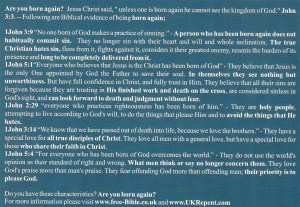
Are You Born Again?

Someone handed me the above card in town yesterday. ‘Are you born again?’ No, mate, and neither are you. As Bart Ehrman shows in Jesus Interrupted, and as I’ve written about before, the story of Jesus and Nicodemus in John 3 is a literary construct (as are the gospels in general.) The pun between ‘born a second time’ and ‘born from above’ only works in the Greek, where ἄνωθεν (anothen) can mean either ‘again’ or ‘from above’ (though it’s usually the latter.) Unfortunately, it is highly unlikely Jesus spoke Greek. Here’s Ehrman:

  In the Gospel of John, chapter 3, Jesus has a famous conversation with Nicodemus in which he says, ‘You must be born again.’ The Greek word translated ‘again’ actual has two meanings: it can mean not only ‘a second time’ but also ‘from above.’ Whenever it is used elsewhere in John, it means ‘from above’ (John 19:11, 23). That is what Jesus appears to mean in John 3 when he speaks with Nicodemus: a person must be born from above in order to have eternal life in heaven above. Nicodemus misunderstands, though, and thinks Jesus intends the other meaning of the word, that he has to be born a second time. ‘How can I crawl back into my mother’s womb?’ he asks, out of some frustration. Jesus corrects him: he is not talking about a second physical birth, but a heavenly birth, from above. (Jesus Interrupted, p155)

So Nicodemus is made to misunderstand Jesus, confusing ‘born again’ with ‘born from above’, and Jesus has to tell him what a twit he is. Translators of this chapter haven’t understood the point of the story either, making Jesus say, in John 3.3, ‘you must be born again’, when the rest of the narrative makes clear he means, ‘you must be born from above’ (i.e: be renewed by God who sits in Heaven on high.) 2000 years later, Christians, thanks to these translators, still make the same mistake.

There’s even more poppycock on the back of the card. The born again, it seems, avoid sin like the plague. Sure they do. Just ask all those kids molested by priests, preachers and Christian youth workers.

So Long, Jesus – the new book is here!

My new book, marking a final farewell to Jesus and his cult, is available now from all Amazon outlets. So Long, Jesus and Other Lessons From Life collects together the religiously-themed posts that have appeared on this blog over the past three years. A great Christmas present for those of your friends who might be considering saying their own farewell to Christian mumbo jumbo. This is the book you’ve been waiting for! 

So Long, Jesus and Other Lessons From Life – get it before the rapture!

Jesus writes…

Image: Caleb Havertape (https://www.pinterest.co.uk/calebhavertapei/_saved/)

Ubi Dubium has posed the question, ‘why didn’t Jesus write his own gospel?’ It’s a good question. What better way to ensure his ideas were conveyed precisely without any margin for error or misinterpretation, than to do it himself? If he hadn’t the time or the ability to do so, why didn’t he dictate his message to one of his literate disciples (surely one of them could write) who could then, as an eye-witness, finish off the story accurately once Jesus himself had returned to Heaven. Why, instead, did he leave it to people he’d never met, most of whom wouldn’t be about for another few decades?

It seems to me there are three possible answers.

  1. Jesus believed the world as he knew it was soon to end. He was convinced God was about to intervene and sweep away the old order and inaugurate the Kingdom of God on Earth. If the gospels that have come down to us are to believed, this was the core of his teaching. Jesus mentions its imminence repeatedly across the synoptic gospels and the morality he proposes, wholly impractical in the long term, is designed for the ‘shortness of the hour’. In this scenario, Jesus and his followers had no interest in writing anything down for posterity. There was no posterity; the end was very truly nigh.

  2. God didn’t want his Son to write his own story. He wanted the job left to people whom Jesus never met, who were little more than children during his lifetime and who lived hundreds of miles from where events occurred. God was sure this was the best way to create a record of his Son’s visit to Earth, without inaccuracies, inconsistencies and contradictions. 

  3. The creator of Mark’s gospel bought into Paul’s celestial Saviour, his illusory ‘Lord Jesus Christ’. Mark set about creating a ‘what if’ back story for him, set in Palestine in the recent past and constructed from Paul’s ’revelations’ and Old Testament ‘prophecy’. Mark highlighted Paul’s teaching that the Christ, whom he calls the Son of Man in his gospel, would soon be coming to the Earth (not a second coming or a return) to rescue his Chosen and reset reality.

Are there any other possibilities? I can’t think of any, nor have I read of any. So which of the three is the most plausible?

Scenario 1 leaves us with a Son of God not knowing what he was talking about. This Jesus was wrong about when the Son of Man would appear, wrong about the End of the Age, wrong about the traumatic nature of God’s intervention, wrong about the Final Judgement, wrong about the fate of the unrighteous and wrong about the Kingdom of God being established on the Earth. This scenario gives us a Jesus who is a failure as both a prophet and Messiah. It’s a wonder anything at all was written about such a loser, let alone narratives that preserved his hopeless predictions about the Kingdom’s arrival.

Scenario 2 is of course ridiculous, though it is the one most Christians buy into, more or less. As well as its inherent implausibility, it relies on the hypothetical document Q, for which no evidence exists let alone any extant copy (or even fragment). It, and a supposedly reliable oral tradition, are speculative, needed only to counter the improbability of this scenario.

Scenario 3, while contentious, makes most sense of why neither Jesus nor any of his contemporaries wrote down or otherwise recorded a single thing he said or did. Mark’s gospel, created shortly after 70CE, was the first anyone had heard of a Jesus on Earth. The three subsequent gospels were all based, to varying degrees, on Mark’s fable. In this scenario there was no real Jesus, and no dozy disciples, to have recorded his exploits and teaching.

What you think, Ubi?