The Day After The Rapture

Are you still there?

Either the rapture didn’t happen or there aren’t many True Christians round where I live. I watched all day for them jetting into the sky to meet Jesus but didn’t see a single one.

What went wrong? That South African preacher Joshua Mhlakela who saw Jesus surely can’t have been mistaken. Jesus told him clearly that yesterday, or maybe today, would be when he’d be back to collect his Chosen and judge the great multitude of sinners. I even turned on the TV last night to see if it had happened elsewhere. I thought the Final Judgement was underway with some dude ticking off the UN. Turned out just to be some big orange guy, not Jesus in disguise.

So what now? I think I can guess. Jesus’ message to Joshua Mhlakela will be reinterpreted: it wasn’t that the Rapture was going to happen yesterday, or today. It’s the events leading up to the rapture that he promised would kick off this week. That’ll be it. The Rapture itself is still some time off, as it always is.

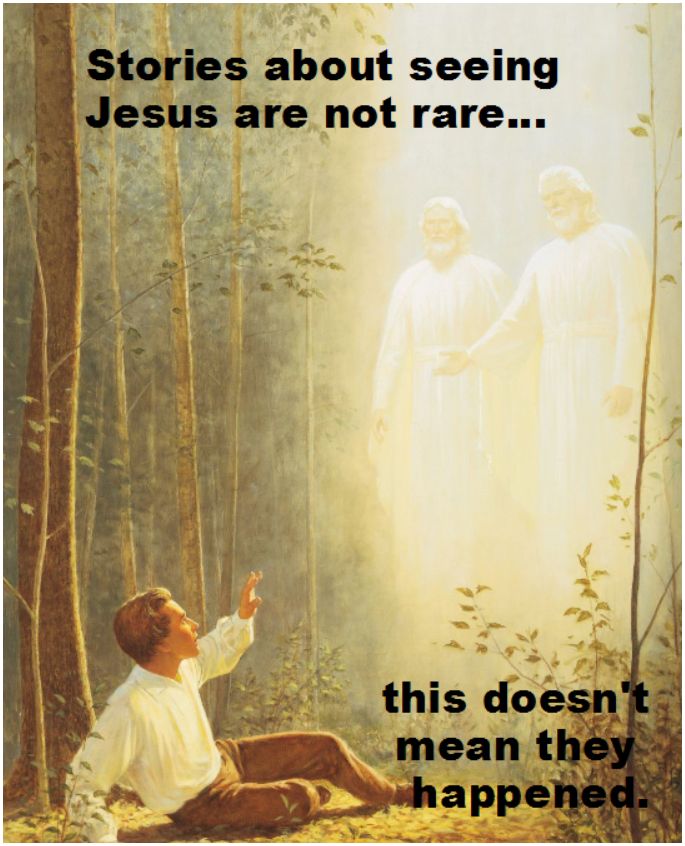
Mhlakela’s vision of Jesus was no different from the ones the earliest Christian believers had: those character with fake names like Peter and Paul. Dismiss the good pastor’s vision of the Lord and what JC purportedly said and you have to dismiss the visions of those early fanatics who operated under aliases. Visions, dreams and hallucinations have no bearing on reality, as Mhlakela and the thousands who believed him have demonstrated yet again. Christianity and many other faiths are founded on such imaginings. As Luke puts it in Acts 2:17 during ‘the Last Days’ of 2,000 years ago:

And it shall come to pass in the last days, says God, that I will pour out of My Spirit on all flesh; your sons and your daughters shall prophesy, your young men shall see visions, your old men shall dream dreams (misquoting Joel 2: 28-29)

This is the basis of the Christian delusion, and every other.

Dear Christian…

I’m seriously considering converting but need some help figuring what I should believe. Can any Christians out there help me out?

1. As a Christian, what will happen when I die? Will I –

a) Go immediately to heaven like my pastor says;

b) Go into suspended animation until Christ’s coming and the final judgement, as it says in 1 Thessalonians 4:13-16;

c) Just cease to exist like my atheist friends tell me?

2. Can you clear up for me how long was Jesus in the grave?

a) Was it about 36 hours (Friday evening till early Sunday morning);

b) Three whole days like he predicts in Matthew 12:40;

c) Was he not really in the grave but down in hell like it says in the Apostles’ Creed?

3. Where can I find information in Paul’s letters about

a) Jesus’ miraculous birth;

b) Jesus’ parables, teaching and miracles;

c) The Empty Tomb?

4. How often did Paul refer to Jesus’ second coming?

a) In all of his letters

b) 2 or 3 times

c) Never

5. Can you tell me how often Jesus referred to his second coming? Was it –

a) Once or twice;

b) Frequently;

c) Never because it was someone called the Son of Man who was going to come?

6. Can you clear up my confusion about when Paul says the Messiah will be coming to the Earth? Is it –

a) While Paul was still alive;

b) Thousands of years later;

c) Any day now?

7. When did Jesus say this Son of Man would be coming to the Earth?

a) He didn’t

b) Thousands of years in the future

c) While those he was talking to were still alive

8. What is the Word of God? I’ve heard the term used for –

a) The Bible

b) The Church

c) Jesus

9. Help me out: which was written first?

a) Mark’s gospel

b) Acts of the Apostles

c) Paul’s letters

10. Can you clarify what it’s referring to when the Bible talks about ‘the Scriptures’?

a) Ancient Jewish writings;

b) The whole of the Bible as we now know it;

c) The New Testament.

11. How does the New Testament writers prove Jesus was the Messiah?

a) By claiming the scriptures predicted he would be;

b) By pointing to his miracles;

c) By quoting things he said

12. How would Jesus want me to spend my time?

a) By witnessing to atheists on the internet;

b) By worshipping him;

c) By feeding the hungry, healing the sick and helping the weak

(I know which I’d prefer.)

Just suppose…

Let’s imagine that the gospels were all written by eye-witnesses or the associates of eye-witnesses. Let’s suppose that prior to their composition there was a vibrant oral tradition that accurately preserved the Jesus story and his teaching in particular. Let’s suppose that Paul learnt what he knew of Christianity initially from the early believers he persecuted and then, following his miraculous conversion, from his meetings with the disciples. Let’s suppose that the later books of New Testament were written by people who knew Jesus personally or were really by Paul. Let’s suppose that everything in the bible was inspired by God and is truly his word. Let’s imagine that as result of all this, everything predicted and prophesied in the gospels, in Paul’s letters and the later ones by apostles, came to pass.

Because we’d have to imagine this. Even if everything we’ve supposed was true, none of the prophesies, predictions or promises have materialised in reality. Not one. No Son of Man beaming down from heaven while the disciples and Pilate were still alive, (as he promises in Mark 9:1 and Mark 14:62 respectively), no visit from the Messiah while Paul and his acolytes were living (1 Thessalonians 4:17), no final judgement, no Kingdom of heaven on Earth, no Christians performing miracles greater than those attributed to Jesus. Not even any ‘new creations’ imbued with the Holy Spirit (‘by their fruits shall ye know them.’)

Apologists put a lot of effort into explaining away these failures, some even arguing the Kingdom is actually with us now (how incredibly disappointing it is if this is the case!) Most disappointing of all is that no Christian has ever resurrected from the dead. Not Paul, not Peter, Mary Magdalene nor any other early follower, and no-one since: not Martin Luther, Charles Wesley, C. S. Lewis, Billy Graham nor any bishop, minister or evangelist who has ever lived. All have remained resolutely dead, just like everyone else who has ever ‘fallen asleep’ and everyone who will in the future.

However much Christians want to insist the Bible is true, accurate and God-breathed, in the end it simply doesn’t deliver.

No God and the Domino Effect

This a response to Don Camp’s comment on my post The Evil of Christianity, in which he tries to isolate ‘the crux’ of our disagreement about the Faith.

You start, Don, from the assumption that there is a God. I, on the other hand, have considered the evidence and concluded that in all probability there isn’t one. Certainly not the Christian God. There may be a god out there somewhere that has no interest in human beings and their affairs, though I doubt it. As far as we humans are concerned such a deity is as good as non-existent, being entirely hypothetical. If it is out there, it certainly won’t be offended at my saying so.

Once I realised some years ago that a personal God did not exist a number of other things followed (or rather, collapsed):

No God means no Son of God or God Incarnate, no Saviour or Christ.

No God means no resurrection (which Paul makes clear was a work of God).

No God means no Holy Spirit.

No Holy Spirit means no regeneration of individuals to become new creations in God (you only have to look at Christians today to see this is the case.)

No God means no grand Salvation plan.

No God means no Heaven, no Final Judgement, no Kingdom of Heaven of Earth, no Eternal Life.

No God means the universe can’t have been created by him.

No God means no manipulation of evolution, no intervention in human history and no prophecy of things to come.

No God means that the world would be just as we find it: messy, beautiful, dangerous, turbulent, indifferent.

No God means prophecy is man-made and comes to pass at no greater rate than chance allows (i.e. practically zero.)

No God means conversations with ‘him’, revelations from him and visions of him are all imagined, generated by and within the human brain, which works in mysterious ways.

No God means no God-given morality. Morality is, as you say, culturally determined and so may and does change over time. (You can see this in the Bible itself where morality supposedly handed down by God for all time evolves throughout the Old Testament and into the new.)

No God means there is neither Sin nor Righteousness. These are religious concepts. The whole spectrum of human behaviour, from destructive to altruistic, is demonstrated by believers and non-believers alike.

No God means assertions like ‘the issue turns on what I perceive as good for me versus what God declares is good for me’ are illusory. What is good for you is what you have worked out, even if you think God had a hand in it. A supernatural being who doesn’t exist cannot be responsible for your well-being, though your church and the bible undoubtedly contributed to your conditioning.

No God means individuals must work out their own meaning and purpose. Some do, some don’t, as you observe, Don. This is as true of believers as it is for non-believers. Many atheists have managed it, or not, without having it imposed by religion. And despite what you say, Christianity is a religion. It is the epitome of religion.

No God means none of the Abrahamic religions are true and therefore Christianity and its ‘holy’ book, being based on an invalid premise, must be false. Most of the posts on this here blog are about demonstrating this fact.

No God means all gods are man-made, not all gods except one.

The crux of the matter is you believe in God while I see how unlikely it is that there is one. I’d agree with you if I could, Don, but then we’d both be wrong.

If The Resurrection Had Really Happened

Somehow this repost unposted itself after the first few comments. I’m reinstating it and will post something new soon

Don thinks I ‘exaggerate’ when I bring up what the New Testament says are supposed to be the direct consequences of the resurrection. As he seems to have no knowledge of the things Paul and others promised would follow, I offered to provide him with chapter and verse. The easiest way to do that is to republish this post, slightly amended, from 2018. (Alternatively, there’s this rather more flippant take on the subject.)

I’m willing to bet Don now tells me I don’t know how to interpret prophecy like an ancient Jew would, that the promises are really metaphors and despite being written for members of the nascent cult they’re really meant for people thousands of years in the future. 

The Christian faith rests entirely on the resurrection of Jesus. As Paul says in 1 Corinthians 15.17 & 19:

 …If Christ has not been raised, your faith is futile; you are still in your sins. Then those also who have fallen asleep in Christ are lost. If only for this life we have hope in Christ, we are of all people most to be pitied.

Of course neither Jesus nor Paul’s invention, the Christ, were raised from the dead; those encounters with him, described in the gospels are, like Paul’s, visions and sensations of his presence (later ‘the Holy Spirit’) embroidered in the 40 or more years between when they occurred and when they were recorded.

Let’s though, suppose that Jesus really did rise from the dead and work backwards from there. What difference did it make? More specifically, what does the bible say were the results and consequences of Jesus being raised?

The Coming of the Kingdom

According to the New Testament (Matthew 25.34; Romans 15.12; Revelation 20.4-6), the resurrection was a clear sign that the Final Judgement and Yahweh’s Kingdom was finally arriving on Earth. Jesus is made to predict it:

Was God’s wonderful reign established here on Earth back in the first century? Was there a final judgement then? Were all wrongs righted, the social order inverted, and war and suffering abolished (Mark 10.31; Matt 5.2-11; Rev 21.4)? New Testament writers believed that following the resurrection, all of this would be happening –

in reality, none of it happened; not then and not since.

The Resurrection of the Dead

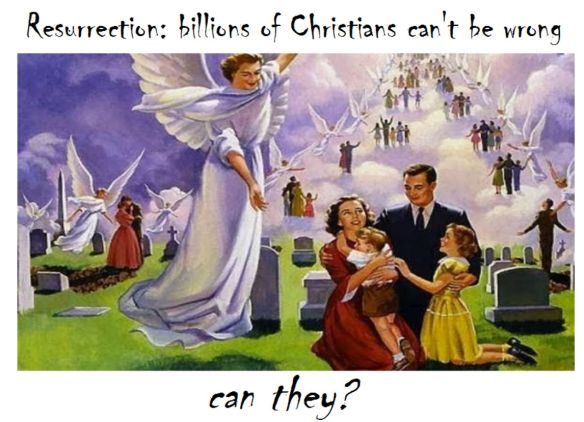
Did Jesus’ resurrection result in even more people rising from the dead? Paul said it would; he said Jesus was the ‘first fruits’, meaning the first of many, with others following him in being raised from the dead (1 Corinthians 15.20-21). Has any ordinary person – anybody at all – ever returned from the dead, long after they passed away? Not one; never mind the hundreds or thousands Paul and other early cultists had in mind. No Pope, no shining example of Christian piety, no activist or worker in the Lord’s vineyard has ever been resurrected during Christianity’s entire history. The dead have always remained stubbornly dead.

So no, this didn’t happen either.

New Creatures

Did the resurrection result in those who believed becoming ‘new creatures’? Paul said it would (2 Corinthians 5.17). He also said members of the new cult would be loving, forgiving and non-judgemental (1 Cor 5.12 & 13.14). There’s no evidence, from his letters, that they were, nor is there evidence from the long and often cruel history of the church. Christians today don’t always radiate loving-kindness either. Those who are caring and gentle before they become Christians remain so; those who are self-gratifying, vindictive or exploitative find a new context in which to be so. As I’ve said before, religion is like excess alcohol; it exaggerates the essential characteristics of a person, for good or for bad.

What it doesn’t do is make shiny ‘new creatures’.

So, what conclusions can we draw from this? Perhaps that nothing went to plan in post-resurrection Christianity. The promised results all failed to materialise. If the effects of the resurrection were and are not what they should have been, what does this say about their supposed cause?

If a storm is forecast and yet, when the time comes, there is no rain, wind or damage, wouldn’t we say that there was no storm?

If a woman said she was pregnant but during the ensuing nine months there was no physical evidence of pregnancy and ultimately no baby, wouldn’t we say she wasn’t pregnant at all?

If God’s Kingdom on Earth, brand new creatures, the resurrection of ordinary believers and the final judgement failed to materialise, wouldn’t we say there can have been no resurrection? The supposed causal event of all these non-effects really can’t have happened. Jesus died and like all dead people stayed dead. The visions, dreams and imaginings of his early followers gave rise to a cult in his name, one that, ultimately failed on all levels to deliver what it promised.

There was no resurrection.

Assertions

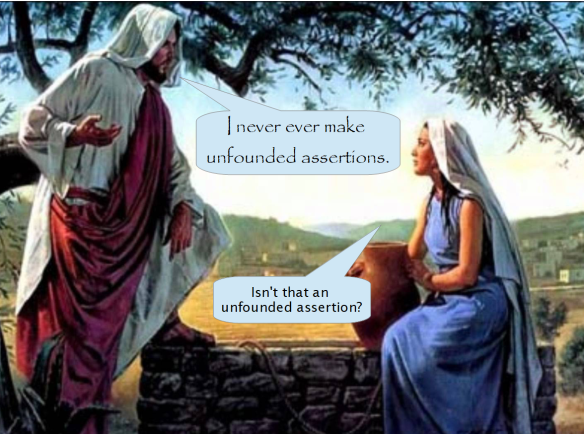
Don likes to take me to task for what he says are assertions in my arguments. I do make assertions, as do we all, because not all points in an argument need to be demonstrated every time they’re used. Indeed, not all assertions can be.

There are assertions that we all accept are likely to be true: the sun will ‘rise’ tomorrow; the Earth is a sphere; evidence is better than no evidence and so on. There are those who dispute these assertions but the onus is then on them to provide the evidence or argument that their counter-assertion is true. Yes, there may come a day when the sun doesn’t rise but it is statistically improbable; the Earth is demonstrably not flat; faith is not an reliable substitute for evidence. There is abundant evidence and sound argument why these things are not the case. But – and this is my point – this evidence does not have to be trotted out every time an argument relies on such probabilities; they can be asserted.

I write, and indeed live my life, on the basis of the fact (‘assertion’) that the supernatural does not exist. Over the last ten years, I’ve posted several arguments why this is the case. I frequently provide a link to these arguments when asserting that, outside of the human imagination, gods, spirits, angels, devils, demons, powers, principalities, ghosts, avatars, heaven and hell do not exist. These arguments form the backbone of any subsequent assertion that the supernatural is not real.

Nonetheless, the onus to ‘prove’ that this is the case does not rest with me. First, because it is impossible to prove a negative. Consider, for example, the Christians challenge to prove their God doesn’t exist. While there is plenty of circumstantial evidence that this is the case, there is no absolute ‘proof’ of God’s non-existence (as I’ve argued before, it all comes down to probability, or, in God’s case, improbability.) Absence of evidence is invariably evidence of absence.

The onus instead lies with the one making the incredible claim. Those who take it as fact that the supernatural and God are real need to demonstrate to the rest of us that this is the case. They have, in my long experience, failed to do this. The best they can do are the various arguments (the ontological, Kalam cosmological, teleological, fine-tuning and the argument from design) that suggest the possibility of the supernatural but fall far short of convincing evidence that the supernatural is real, and further still that the Christian God exists. They depend in the end on the feelings they have in their heads and the Bible (or some other holy book.) This is wholly inadequate

Consequently, I’ll continue to operate from and make my assertion that the supernatural does not exist until such time as Don or any other of his co-religionists demonstrate the probability that it does.

From my assertion, backed up, remember, by earlier arguments, a number of other facts follow:

With no supernatural, there are no gods; YHWH in all his incarnations is a God, therefore YHWH does not exist.

Much follows from this:

If YHWH does not exist, Jesus cannot have been either his avatar, Son or incarnation;

Jesus cannot have been raised from the dead by a being who doesn’t exist;

Stories that he did so must therefore be merely that: stories;

The celestial, eternal Jesus who sits at the right hand of God in heaven is not real;

Any experience people have of this being is entirely within their own imaginations;

The Bible is based on such imagined encounters with these imagined characters;

There is no after-life or judgment;

The Christian faith, including my own, cannot be explained in terms of the supernatural;

Only explanations that are rooted in naturalism, as in science, have any validity.

There are more implications that can be drawn from the premise that there is no supernatural, including the fact that the world makes much more sense (if it makes any sense at all) without drawing gods and demons into it.

Consequently, I shall continue to make my assertions, like those above, supported as always by previous argument. Any religious believer who wants to challenge them is welcome to do so, but must do more than point out the obvious, that they are assertions. They must provide the evidence for the supernatural, and all that follows from it, independent of the goings on in their heads and without reference to holy books written by those with similar subjective feelings.

What if… the resurrection really happened?

Smith

The Christian faith rests entirely on the resurrection of Jesus. As Paul says in 1 Corinthians 15.17 & 19:

…If Christ has not been raised, your faith is futile; you are still in your sins. Then those also who have fallen asleep in Christ are lost. If only for this life we have hope in Christ, we are of all people most to be pitied.

Of course neither Jesus nor Paul’s invention, the Christ, were raised from the dead; those encounters with him, described in the gospels are, like Paul’s, visions and sensations of his presence (later ‘the Holy Spirit’) embroidered in the 40 or more years between when they occurred and when they were recorded.

Let’s though, suppose that Jesus really did rise from the dead and work backwards from there. What difference did it make? More specifically, what does the bible say were the results and consequences of Jesus being raised?

The Coming of the Kingdom

According to the New Testament (Matthew 25.34; Romans 15.12; Revelation 20.4-6), the resurrection was a clear sign that Yahweh’s Kingdom was finally arriving on Earth.

Was God’s wonderful reign established here on Earth back in the first century? Were all wrongs righted, the social order inverted, and war and suffering abolished (Mark 10.31; Matt 5.2-11; Rev 21.4)? New Testament writers believed that following the resurrection, all of this would be happening –

in reality, none of it happened; not then and not since.

The Resurrection of the Dead

Did Jesus’ resurrection result in even more people rising from the dead? Paul said it would; he said Jesus was the ‘first fruits’, meaning the first of many, with others following him in being raised from the dead (1 Corinthians 15.20-21). Has any ordinary person – anybody at all – ever returned from the dead, long after they passed away? Not one; never mind the hundreds or thousands Paul and other early cultists had in mind. No Pope, no shining example of Christian piety, no activist or worker in the Lord’s vineyard has ever been resurrected during Christianity’s entire history. The dead have always remained stubbornly dead.

So no, this didn’t happen either.

After-life in Heaven

Did the resurrection result in people going to heaven after they died? This seems to be the view held by many Christians today. Unfortunately, it is not what the New Testament offers. Its writers believed that the Kingdom of Heaven would be coming to Earth in their very near future, not that ordinary mortals would invade God’s home post-mortem. Granted there are traces of this view emerging in the later books of the New Testament (given the failure of earlier predictions about the Kingdom coming to the Earth), but it is not what the founders of Christianity believed and hoped for.

In any case, who has ever died, again from the billions who have lived, and gone to heaven? No-one. Predictably, Christians now say that this transition won’t happen until the final judgement, scheduled for some unspecified time in the future (looks like God is as limited by time as we are.) That’s Christianity for you: always winter but never Christmas, everything in an ever-distant future.

No-one has gone to heaven as a result of the resurrection and no-one ever will.

New Creatures

Did the resurrection result in those who believed becoming ‘new creatures’? Paul said it would (2 Corinthians 5.17). He also said members of the new cult would be loving, forgiving and non-judgemental (1 Cor 5.12 & 13.14). There’s no evidence, from his letters, that they were, nor is there evidence from the long and often cruel history of the church. Christians today don’t always radiate loving-kindness either. Those who are caring and gentle before they become Christians remain so; those who are self-gratifying, vindictive or exploitative find a new context in which to be so. As I’ve said before, religion is like excess alcohol; it exaggerates the essential characteristics of a person, for good or for bad.

What it doesn’t do is make shiny ‘new creatures’.

So, what conclusions can we draw from this? Perhaps that nothing went to plan in post-resurrection Christianity. The promised results all failed to materialise. If the effects of the resurrection were and are not what they should have been, what does this say about their supposed cause?

If a storm is forecast and yet, when the time comes, there is no rain, wind or damage, wouldn’t we say that there was no storm?

If a woman said she was pregnant but during the ensuing nine months there was no physical evidence of pregnancy and ultimately no baby, wouldn’t we say she wasn’t pregnant at all?

If God’s Kingdom on Earth, brand new creatures, the resurrection of ordinary believers, the final judgement and eternal life in heaven failed to materialise, wouldn’t we say there can have been no resurrection? The supposed causal event of all these non-effects really can’t have happened. Jesus died and like all dead people stayed dead. The visions, dreams and imaginings of his early followers gave rise to a cult in his name, one that, ultimately failed on all levels to deliver what it promised.

There was no resurrection.