The Anunciation: A Ghost Story for Advent

The Nativity in Matthew and Luke begins long before Jesus’ birth. Matthew introduces Mary and Joseph once the former has been impregnated with The Holy Sperm. He doesn’t go into any detail about how this happened, he just drops in, in Matt 1:18, that the deed is done. Mary has had sex with a ghost.

This isn’t good enough for Luke though, who after reading Matthew’s tall tale, decides it needs some expansion. A lot of expansion, in fact. He takes the story back to before Mary’s non-consensual encounter with the Holy Spirit and picks on Elizabeth and Zechariah, an elderly couple well past the age of having kids. All the same, they do enjoy a tumble in the sack every now and then, and the Lord – ever the voyeur – decides he’ll bless one such union with fruitfulness. (There is much wrong with the details of this unbelievable yarn, some of which I consider here; I won’t reiterate them now for fear of awakening any amateur theologians who might be lurking here in the wings.)

Suffice to say, Luke – for it is he, lest we forget, who is making this stuff up – decides that Elizabeth is a long lost cousin of Mary’s, like in one of those soaps where long lost relatives pop up all the time, usually to no good end. In this particular episode, however, all goes well and Mary visits Elizabeth, whose baby is, in a strange twist of fate, destined to be John the Baptist from the earlier two gospels. In this story his embryonic self jumps for joy inside his mother once he realises his uterine Saviour has come to visit.

But were getting ahead of ourselves. First Mary has to go through the rigmarole of getting pregnant. Obviously as a good Catholic girl she can’t have sex with her betrothed prior to their wedding and just when she’s considering when that might be, an angel appears unto her. It’s Gabriel who has quite a bit to do in the Nativity story as a whole. As angels do, he annunciates to Mary all about the pregnancy part of the plot and she acquiesces to the Lord getting her with child by magically transferring his seed into her womb. I’m guessing it was by magic. It’s possible some sort of actual rumpy-pumpy occurred but Luke delicately passes over the intimate parts. As apparently the Holy Spirit does too.

Mary is so overjoyed to be pregnant before her 13th birthday that she bursts into song on the spot and spontaneously produces a hymn based on the Psalms and the future teaching of the baby she has only just conceived. It’s hard to believe that no actual time travel was involved. It is instead, a miracle, as her impromptu ditty flourishes into the literary masterpiece now known as The Magnificat, which is not, it turns out, a feline super-hero. Fortunately, she can remember it all, word for word, decades later when Luke decides he needs to invent record it. Honestly, the whole thing puts Cole Porter to shame.

You’d think then Mary would dash off to tell her betrothed, Joseph, the wonderful news that she is pregnant without his or any other man’s assistance, but Luke makes no mention of it. Luckily, it’s covered by Matthew, where an angel drops in on Joseph, a person of great gullibility faith. On hearing what the angel has to say, he swallows the story hook, line and stinker.

Then it’s back to where we came in. Mary’s sets off down the road to see the cousin, the wonderful bearer of John. She pitches up there for three whole months, perhaps to avoid Joseph, who, it turns out, was not as gullible as she thought.

**********************************************

Honestly, this is really what happened. Would I lie to you? No, but someone would, and did. We’ll see what else he has in store in his over-worked imagination, next time.

**********************************************

PS. Don, I know you like indulging in a bit of biblical exegesis. If you’d like to borrow this totally respectful effort for your blog, get in touch and we’ll work something out.

Two Ways of Knowing

A Christian friend told me recently that there are two ways of knowing: science and faith. I don’t agree with him of course and, while I expressed my scepticism, I didn’t argue. It seemed unlikely he would change his mind.

Faith and science have different, incompatible concepts of reality. The first – and faith was first historically – is that there is an invisible realm beyond this one, populated by powerful beings who influence and manipulate the humans who live here below. This reality, though invisible and largely undetectable, is actually more real than the one we see around us. Glimpses have been had of it, however, by those finely attuned to it, in dreams, visions and messages delivered during heightened emotional states. These visionaries – prophets – then pass on to others what the beings of the hidden realm expect of them. Life is then to be lived according to the instructions so conveyed, which usually consist of attempts to appease these gods by doing their bidding. In return for this obsequience, you’re allowed to believe you will live on after death

The other epistemology – actually the only true epistemology in this instance – is empirical, knowledge-based science. A later arrival, historically speaking, than the gods of the invisible realm. The scientific method is the best tool we have for sifting knowledge from superstition and emotion. These, particularly the latter, often impede us in our pursuit of knowledge, which is why science strives to eliminate them from its investigations, taking an objective approach to evidence. Unfortunately, the findings of science are occasionally contradictory (can a man become a woman or not?) and very often misinterpreted by non-scientists. Politicians and the media frequently over-simplify science’s findings and interpret them in ways that suit their own agendas.

Then there are those who masquerade as scientists but are not. During the pandemic, the UK was locked down for almost two years on the basis of computer predictions of what might happen if certain conditions prevailed. These predictions were taken as a scientific conclusion when in fact they were hypotheses, which by their very nature, could not be tested. Needless to say, they turned out to be drastically wrong. Computer projections are not, in themselves, science.

Science, through its practical offspring, medicine and technology, has undoubtedly been a boon to humankind, in a way religion never has. It has also sometimes been a curse too, inflicting us with, amongst other things, an arsenal of ever deadlier weapons, the means of destroying the environment and Covid itself. Science is a tool and like any tool can be wielded both constructively and destructively.

So, perhaps the gods will save us from our own folly after all. If only they and their invisible realm existed. Alas (or thankfully) they don’t; there is zero evidence for them, and visions, dreams and wishful thinking as reliable means of knowing about them. We’re on our own. Science is the best hope we’ve got, our only sure-fire way of knowing. If only politicians and the media understood it more than they seem to.

Heretic

Let me recommend a film to you: Heretic starring Hugh Grant, Sophie Thatcher and Chloe East (opens in the US today.) Ostensibly a horror film, it’s actually a dissection of religious faith: what we believe, why we believe it, its origins and how we might break free from it.

While there are a couple of grisly bits in it, it is actually a psychological thriller, with Grant’s character, Mr Reed, intent on breaking down the faith of two Mormon missionaries who have the misfortune to pay him a visit. Despite the hapless women being LatterDay Saints, his arguments apply to all religious belief. The film is a vehicle for this breakdown and demolition of faith. It veers into unpleasantness only in its final quarter, after taking a cynical swipe at the idea of resurrection.

I’m usually averse to horror films and only went to see this one because of the plaudits Hugh Grant’s alternately fatherly and menacing performance received from critics. He really is superb and Sophie Thatcher and Chloe East are excellent as the missionaries, sustaining a Mormon sensibility until it becomes, well, unsustainable. Scott Beck and Bryan Woods’ script is incisive and engaging (if you like your religion ruthlessly dissected and exposed.) Heretic is highly recommended.

The Golden Age of Christian Values

If only we could get back to the golden age of Christian Values. The one that existed when I was young, before things changed so much and when life was so much better. People believed in God, went to church every Sunday and had good old fashioned, biblical values. The troubles of today could so easily have been averted if only we’d stayed true to those beliefs.

Yes, If only we could go back…

‘Let me take you there,’ says a disembodied voice.

‘That you Jesus?’ I ask.

‘If you like,’ it replies, ‘but I’d rather think of myself as the Spirit of Times Gone By. Let’s you and I return to some of them together and see if we can’t find the Golden Age of Christian Values.’

I feel him take my hand and suddenly we’re travelling through a vortex in time, away from the 2020s and into the past. As we do so, my smartphone disappears from my pocket, as if it had never existed. Disconcertingly, my Fitbit does the same. I’m sure going to miss them.

‘Take a look here,’ says the voice as a vista opens up on front of us. ‘Behold, 2003.’

‘Yes,’ I say. ‘Things were so much better even just 20 years ago. No wokeness, no talk of irreversible climate change… and no one had heard of gender identity or drag queen story hours!’

‘Really?’ my guide says. ‘That’s how you remember it? America was still reeling from 9/11, a Christian president was about to invade a country that had nothing to do with the attack and there were a record number of tornadoes across the US. Things weren’t that great for a whole load of people, especially the ordinary folk of Iraq.’

‘I guess not,’ I concede. ‘Maybe we need to go further back. Find that special time when we hadn’t abandoned God and he hadn’t left us to our own devices.’

‘Let’s do that,’ my host says, as once again we take to the swirling vortex, emerging seconds later in what he says are the early 1990s.

‘Much better,’ I say. ‘No destructive social media, no same-sex marriage anywhere. The Berlin wall has come down and the Second Gulf War is set to be a great success.’

I can feel my guide staring down at me, though oddly I can’t quite make out the details of his face. ‘Really?’ he says again. ‘I’m surprised you mention that. There’s also the Siege of Sarajevo on the horizon, racial unrest following the beating of Rodney King and in Bangladesh 138,000 people have just been killed by an earthquake. Plus, as you say no social media to speak of. You do remember, don’t you, how much you like arguing with atheists on it. I’m not sure this is the time we’ve been looking for either.’

I have to agree it isn’t, as once again he takes my hand and we return to the vortex, emerging mere seconds later… when?

‘The ’80s,’ he announces. ‘AIDs, the Iran-Contra scandal, acid rain, Chernobyl. I don’t see any Christian Golden Age here.’

‘Oh, I don’t know,’ I reply. ‘At least there was the Moral Majority, a genuinely Christian president and in England, a Prime minister with Christian principles. She even quoted the Bible sometimes. We had politicians of real integrity in this time period.’

I feel him raise an eyebrow even though I can’t see him. ‘A Christian president who left thousands to die,’ he remarks.

‘They brought it on themselves. God’s judgement on a sinful generation,’ I tell him, pleased to score a point.

We move on. ‘The 1960s,’ he declares. ‘Could this be your Golden Age?’

‘If there’s one thing I know for sure, it’s that the 1960s were not the Golden Age. Definitely not. That’s when everything started to go wrong. Moral relativism, Women’s Lib, Civil Rights riots, Stonewall, psychedelic drugs…’ I stop to catch my breath. ‘Long hair, promiscuity, nudity, abortion, decadent music. Oh Lord, it was awful and it paved the way for the depravity and dissolution that was to come. If ever there was a decade in need of God it was this one.’

‘Let’s not forget Assassinations and Vietnam,’ he adds.

‘For sure. That’s what comes of abandoning God.’

‘It looks like the 1960s were nearly as bad as you say 2023 is. Maybe things don’t really change as much as you think.’

‘Maybe,’ I concede. I haven’t really thought about it before.

‘You know, says my companion, I’m beginning to think we’re further than ever from the Golden Age you seek. But I’m prepared to give it one more shot if you are.’

I agree and we’re off again, emerging this time in the 1950s. ‘This is it!’ I exclaim, ‘This is Christianity’s Golden Age! People going to church, looking after their neighbors; there’s prayer in school and real Christian standards. This is where it all happened and it’s here where we should all return.’

‘I see what you’re saying,’ the figure beside me replies, ‘but it wasn’t good for everyone, was it.’

‘What do you mean?’ I ask incredulously.

‘Well,’ he says, ‘it wasn’t a great time if you were black. There was segregation and I assume you know there were still lynchings in this era.’

‘I didn’t say it was perfect,’ I object.

‘No?’ he says. ‘In this Golden Age, women were expected to keep house, raise children and serve their husbands, just like it says in the Bible. Too bad if they wanted a life beyond that.’

I can’t see a problem with this but something stops me from saying so.

‘And of course it was illegal to be gay back here. Fines, imprisonment and ruin were the price to be paid. Staying hidden was the only option for many.’

‘Not a bad thing,’ I murmur.

‘Then there was the Korean War in which 2.5 million people died, including 36,000 American servicemen; the Cold War with its ever present threat of nuclear annihilation; McCarthyism, the paranoia of The Red Scare and the persecution of those presumed to have left wing views… Need I go on?’

‘No, no. I take your point. Perhaps this isn’t the Christian Golden Age I’m looking for after all.’

‘You still don’t get it, do you?’ my companion says. There is no Christian Golden Age. If we were to go back another ten years we’d find the Second World War and the Holocaust when 6 million of God’s Chosen People and 5 million others were brutally, senselessly murdered.’

‘I guess,’

‘You guess? And even if we were to go back to the start of your Faith you would find the infighting, corruption and immorality prevent even that from being a Golden Age.’

‘Oh, I think you’re wrong there. It says in Acts…’

But he cuts me off: ‘My friend, your Golden Age has never existed.’

‘I’m sure we could find it somewhere,’ I mumble.

‘No,’ he says. ‘This is it. This, here in the ‘50s is as good as it gets. But only for some. This is where we stop. This is where you stay.’

‘Stay? I don’t want to stay here. I need to get back to my own time, to my family and my technology. I’ve atheists to argue with online.’

I see his eyes glow high above me. ‘The only way you’ll get back is to live your life from this point on, through the decades you’ve dismissed, and see how far you get. But it’s unlikely you’ll get back to 2023. Life expectancy in the 1950s is much shorter than where you’ve come from. And you’re no spring chicken to begin with.’

‘No, please,’ I stammer. ‘You can’t. I don’t belong here. This isn’t a Christian Golden Age after all.’

But I was on my own. My companion, like my shaky beliefs, had simply vanished.


10 Reasons Why

I wonder what are the reasons those of you who were once Christians gave up on faith? Believers who know me far better than I know myself have attributed to me a whole range of motivations. Here’s a top ten of the reasons I rejected Jesus according to these spiritually astute know-it-alls:

In at 10 it’s…

You must have been hurt/had a bad experience of Christians. To which I answer, not particularly, though I did find the people I encountered in churches to be much like those I encountered in any other organisation I’ve been involved with. No different. Certainly no better, and in some ways worse when they squabbled or were petty and judgemental. Not sufficiently worse to make me abandon faith, but perhaps enough to make me ask whether Christianity really ‘worked’. Shouldn’t Christians who are new creatures, reformed in the image of Christ. be so much better than the rest of us?

At 9… You went to the wrong church. If so I must’ve attended several ‘wrong’ churches as I moved around the north of England with work. My wife and I always sought out churches with sound biblical teaching, so it wasn’t the lack of solid food that caused me to backslide (to use the Christian jargon.)

8. You wanted to wallow in your own sin. As I’ve said facetiously before, I like a good wallow as much as the next man and preferably with him. Back in the days of my struggling with faith, however, I didn’t find myself drawn to ‘sin’. I was trying to raise three children, do a demanding job and deal with the fallout from my boss’s affair with a colleague. My own sin was the last thing on my mind.

Related to this is the accusation that an apostate such as I wants, in some unfathomable way, to be God. Certainly I want to be fully human and to take charge of my own life, but aren’t these laudable intentions? It doesn’t mean I aspire to be God; I don’t want to be worshipped, don’t want to laud it over others, blame them for my deficiencies or send them to hell. That’s what God does, right? But it’s not me. 

7. You rejected Christ because you’re gay and didn’t like the constraints faith placed on your sexual behaviour. See above. I didn’t admit I was gay until several years after I ditched faith and it was several more after that before I came out, yet more until I did anything about it. But okay, if you want to reverse the order of events, I gave up on religion because I was latently gay. But not really, though certainly the abandonment of faith was a liberation; I could think for myself and was free, over a long period of time, to finally become myself.

6. You read the wrong books. I certainly did: C. S. Lewis (I still have my collection of his books), John Stott, John Piper, John Bunyan, Bonhoeffer, Joni Erickson, Corrie Ten Boom, Billy Graham, David Wilkerson… and the Bible. So yes, I wasted a lot of time reading this sort of thing, but I’m guessing that’s not what my Christian accusers mean. I read more widely as I moved away from faith which helped me break out of the Christian bubble, but this wasn’t the reason I left the faith. I was well on the way by this time.

5. You were never a true Christian. Your faith was intellectual or habit or emotional but not deeply personal. Of course I was a true Christian. Just ask Jesus. Oh… you can’t. I’ve written about this before as you’ll see here. I was as real a Christian as those who claim they’re the real deal now.

4. You were in thrall to non-Christian writers. Not in thrall, no, but these writers – Ehrman, the so-called New Atheists, science writers (Dawkins’ science books particularly), Pagels, Barker, Loftus, Alter and, yes, Carrier – make a lot more sense than those who write from the perspective of faith. These authors don’t seem to mind, indeed they relish that their readers think critically about the evidence they present. Mumbo-jumbo isn’t passed off as erudition.

3. You have no awareness of the spiritual; you think that only that which can be measured is real. This is true, but it is not why I gave up Christianity. It is a consequence of doing so. I have seen no evidence of a spiritual realm that exists outside the human imagination. If anyone is able to present evidence that it does have independent existence, I’m open to it. Until then I will continue to live with the understanding that angels, devils, demons, heaven, hell, celestial saviours and gods, like unicorns, dragons and Shangri-La, do not exist. It follows that as non-existent beings they cannot communicate with us nor await us as our final destination.

2. Your heart has been hardened by Satan. See above; there is no Satan. Hardening of the heart is a metaphor for those who don’t fall prey to Christianity’s fraudulent claims or at last see through them.

1. You gave up on faith because you realised none of it was true. Yes. Finally. This is why I rejected Christianity. It simply isn’t true, as I’ve attempted to demonstrate on this blog for the last 12+ years. Its third-rate fantasies, fake promises and failed prophecies are all evidence of its falsity.

But wait. None of the telepathic Christians who ‘know’ why I’m no longer a believer ever make this accusation. They would never concede that most (all) of what they believe simply isn’t true. But my life experience and my reading as I began to suspect Christianity was nothing more than a con have borne this out. Christianity is demonstrably untrue, theChristian God a fraud and supernatural-Jesus a fiction. This is why I abandoned Christianity.

How about you?

Saved by Faith Alone

For it is by grace you have been saved, through faith – and this is not from yourselves, it is the gift of God – not by works, so that no one can boast (Ephesians 2:8-9).

Hi!

I heard this fabulous new speaker last night and have given my life to Jesus. All the things I’ve said and written critical of God, Jesus and the Bible, I take back and repent of. Jesus now lives in my heart. Through God’s grace I am saved, and his grace alone. I have done nothing to save myself. The speaker explained I am saved by faith alone through the atoning blood of Christ. Hallelujah! Saved from sin, from the wrath I merit and from death and hell. I am going to live forever in heaven with God.

There’s nothing I need to do. God has done it all.

There was a wonderful Christian lady, Donna, whom I spoke to afterwards. She knew everything about God and Jesus, she really did. She’s been saved for most of her life. Amazing! Anyway, Donna told me it was really important I should start to work out my salvation. I wasn’t sure what she meant when the speaker had said faith was all I needed, but I will try. Donna also said that now I’m a Christian, the devil will increase his attacks on me. I never really thought about the devil before but now I know he’s real, I’ll be on the lookout for him. Satan and his demon hordes rule the world, but only because God lets them. Of course there’s the angels too, taking care of us, which makes up for Satan’s wickedness.

Donna said I should talk with Jesus as much as I can. He’s always listening and will guide me in my walk with him. She said I will hear him speaking to me. He wants to give me anything I ask for, which is just amazing. Or maybe it’s God who does that. I’ll have to check. She also said that I need to join a church and gave me the addresses of some locally. It’s important, she told me, to worship Jesus on a regular basis and to thank him for saving me. I must make sure I take part in the Lord’s supper too, sharing his body and blood, till he comes back to Earth to take us all to heaven. ‘Us’ just means those who believe in Jesus, obviously.

Donna said it was vital I read my bible as well because it’s the Word of God and is full of his Truth. I’m should get to know more about what the Lord requires of me in my daily walk with him. She recommended I join a bible study group, so I’m going to do that. I asked her about the stuff in the Bible that says to give money to anyone who asks and to forgive people loads of times, but she said that that was all metaphorical and I needn’t bother with it.

She told me I have to tell everyone I can that I now belong to Jesus. I’m never going to be ashamed of proclaiming his holy name and telling others how they can be saved, through his precious blood alone.

She told me my life should reflect the fact that I now belong to Jesus, so no more swearing, smoking or drinking for me! Not that I did those much anyway.

Which brings me to why I’m sending you this message, apart from telling you how wonderful it is to be saved by faith alone, of course. Donna was, I have to say, a little taken aback when I mentioned I was gay. She explained very patiently that it’s a sin God really, really doesn’t approve of. She said Jesus would help me defeat it and as a start I really, really couldn’t live with someone of the same sex any longer, not if I wanted to claim my inheritance from the Lord. I have to turn away from sin, especially that one. Donna says it seriously offends God and he’d never let me into the Kingdom of Heaven as, well… you know, as an abomination. So I’m giving up my previous life.

I know you’ll be a little upset by this, but it’s really why I’m writing. By the time you see this, I’ll have moved out. I still love you, course I do, but it’s for the best. I have to make all the sacrifices I need to preserve my salvation. And think of it this way, it’ll help you give up your life of sin too, so you can be redeemed.

Well, that’s it. Remember, you too can be saved by faith alone and the blood of Jesus and all those other things I’ve mentioned. Simple really. I hope and pray you’ll give your heart to Jesus soon.

Love in Christ who saves us,

Sam

But Is It True?

We can argue till Kingdom come (i.e. forever) about whether or not this or that Bible verse is meant to be taken literally or metaphorically (God couldn’t make himself clearer?) and whether a particular author was an eyewitness or not, but the bottom line is, ‘Is what the Bible says True?’ Nothing else matters. If it is true, then it’s claims must be accepted. It would be extremely foolish to disregard them. If not, if the Bible is one big lie, then we must consign it to the dustbin of history.

Is it true that whatever a believer prays for, God will provide? Jesus says so several times:

If you believe, you will receive whatever you ask for in prayer (Matthew 21:22).

And I will do whatever you ask in my name, so that the Father may be glorified in the Son (John 14:13).

Very truly, I tell you, if you ask anything of the Father in my name, he will give it to you (John 16.23).

No, its not true. We don’t see ‘whatever’ and ‘everything’ being granted even when Christians pray ‘in accordance with God’s will’ as they like to qualify these promises.

Is it true that whatever a believer gives will be returned to him until it overflows (Luke 6:38)? While this is the foundation for the prosperity gospel movement it is patently untrue. Untrue symbolically too; if you give of yourself in God’s service you will be rewarded excessively? Just ask all those burnt-out ministers.

Is it true that with sufficient faith believers can uplift mountains and throw them in the sea (Matthew 21:21)? Obviously not, not even when this hyperbolic promise is interpreted figuratively. Christians can’t resolve their problems, work miracles or bring about radical change more than anyone else, and certainly not by ‘faith’.

Is it true that God looks after those he has chosen, to the extent he knows the number of hairs on their heads (Matt 10:29-30)? Evidently not. It didn’t work this way for Jewish people in the holocaust, it doesn’t work for the 10,000 children who die everyday of hunger and it doesn’t work for Christians, who fair no better than anyone else in life’s calamities.

Is it true that Jesus was born in Bethlehem under a wandering star? No. This is a myth constructed from older stories.

Is it true Jesus walked on water, turned water into wine and raised the dead? Or is it more likely these ‘miracles’ were created for him, ‘signs’ from Jewish scripture designed to present him as the anticipated Messiah? This is the more likely explanation. A man called Iesous did not really perform supernatural feats.

Is it true Jesus rose from the dead after three days and nights? No. While Mark (10.33-34) and Matthew (12:40) claim this was going to happen, they don’t even pretend that it did. Friday evening till Sunday morning is 36 hours, not three days and nights.

Is it true his disciples and lady friends saw Jesus risen from the dead? We don’t know; the accounts of them doing so were written forty and more years after the supposed event by people who weren’t there. The only eye-witness account of a risen-Jesus sighting is Paul’s and he admits it was in his head. So probably the answer is no: it’s not true people saw a resurrected physical body.

Is it true gospel Jesus existed? With his story made up from existing myths and mystical visions, it’s highly unlikely. So no.

Is it true Jesus sends those he’s saved to heaven when they die? The Bible doesn’t say he does; it claims he would be coming from heaven himself, in the time of those who were writing about him, to initiate God’s kingdom on Earth. So, no and no again; its not true he came down from heaven, in the time of those who were writing about him, to initiate God’s kingdom on Earth.

Is it true, that by believing in something akin to magic, people can rise from the dead? No. Believing a secret formula does not enable anyone to escape death. There is no evidence anyone has resurrected after being fully, properly dead because they believed something. There is no evidence anyone has resurrected from the dead ever.

Is it true that believing in Jesus makes people into new creations? No more than many other experiences in life. Does it make for better people – more righteous, more moral, more loving? Evidence from the Bible itself suggests not, as does the appalling behaviour of some Christians today.

Is it true that the spirit of this long-dead first-century itinerant Jewish preacher lives inside people today (John 14:17)? No, it’s not. There is no evidence that dead people, or celestial super-beings from some other plane, inhabit the living. Many believers are embarrassed to acknowledge even the possibility.

Is any of it true? We could play this game all day: taking any of the New Testament’s claims and stories and asking ourselves whether they are true. The answer will be, invariably and demonstrably, no. It takes the closing down of any critical faculties to believe they are, and mental gymnastics to maintain that, even if they’re not literally true, they contain hidden, profound truth. They don’t.

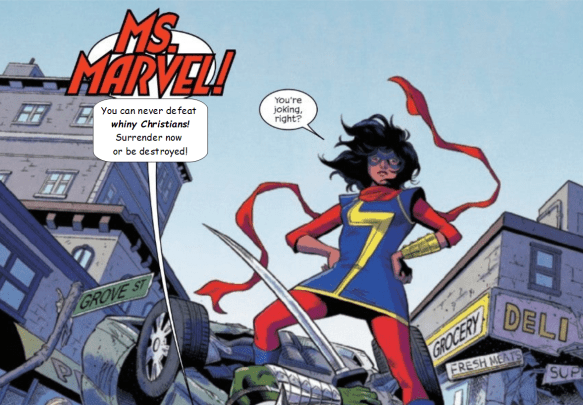
Christians Against Ms Marvel

Image: Marvel Comics

In the new Disney+ weekly series, Ms Marvel has been cast as an Asian Muslim who is possibly gay. My god! What is the world coming to? A comic book character (yes, comic book character. Not the president or the head of the church. A comic book character) is Asian, Muslim and perhaps gay. So what?

According to a group of infantile Christians, it’s a very, very big deal. They’ve created a private Facebook page (or rather changed an existing one) so they can tantrum about Disney’s ‘woke’ agenda. I don’t know if they’ve watched the show, though it seems unlikely. Ms Marvel is pitched at a younger audience than, say, WandaVision or Moonknight. It is light and breezy, touching on the very racism these Christians typify.

But let me address some of their objections:

The show, they say, represents ‘the biggest slap in the face for conservative Christians to date.’ An unfortunate metaphor when their Lord and Savior™ tells them exactly what to do when ‘slapped in the face’. According to Matthew 5.39 they should start a whiny Facebook page to protest against the perceived sleight. Oh wait, no, that’s not it. They should, he said, ‘turn the other cheek’ for a second slapping. Wouldn’t it be a marvel (pun intended) if once in a while Christians did what Jesus commanded them to do?

There’s more: Disney is ‘pushing’ to make ‘Kamala Khan the face of the franchise over Carol Danvers.’ (the original comic book Ms Marvel.) Captain Marvel and Ms Marvel have a complicated history. In the comic books, Carol Danvers became a non superpowered Captain Marvel back in 1968. Monica Rameau, a black American, took over in 1978, and in 2013, long before the onset of wokeism, Kamala Khan, the Ms Marvel of the Disney+ series, made her debut. Carol Danvers, now with powers, appeared in her own movie in 2019. She’ll return, with Kamala Khan, next year. I feel sure God, America and Christian ‘culture’ will cope with this onslaught of merry Marvel mayhem. These Christians’ objections to Kamala Khan betray only their own bigotry.

They whinge that there’ll be ‘no more straight Christian characters from Marvel,’ failing to realise there never have been any ‘Christian’ characters. Marvel comics has never been about peddling Christianity, thank Christ. As for ‘no more’ straight characters, they must mean apart from all the major figures in the MCU and most of the minor ones too. 98% of Marvel (and DC) characters are straight. Or as straight as cartoon characters can be.

What really irritates me about this though, is Christian priorities. This is what the Holy Spirit is prompting God’s holy ones to campaign about? This is what’s important? Again, according to their supposed Savior. He seemed to think that what was important was boring stuff like feeding the hungry, helping the homeless and loving enemies. Not wasting time moaning about a film company choosing characters and casting actors that privileged Christians don’t like because they’re different from them.

Jesus wouldn’t recognise this sort of embarrassing expression of faith. Lucky for today’s low-calibre Christians then that he doesn’t exist.


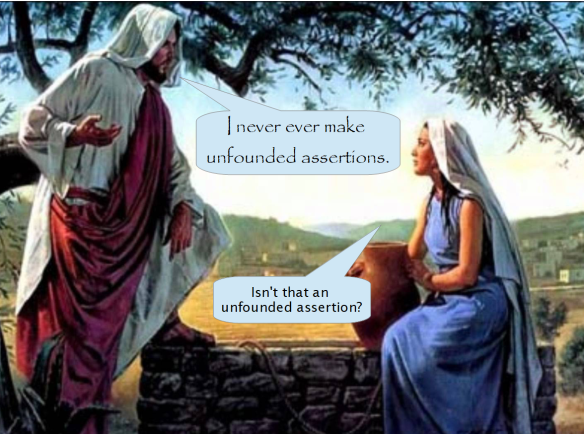
Assertions

Don likes to take me to task for what he says are assertions in my arguments. I do make assertions, as do we all, because not all points in an argument need to be demonstrated every time they’re used. Indeed, not all assertions can be.

There are assertions that we all accept are likely to be true: the sun will ‘rise’ tomorrow; the Earth is a sphere; evidence is better than no evidence and so on. There are those who dispute these assertions but the onus is then on them to provide the evidence or argument that their counter-assertion is true. Yes, there may come a day when the sun doesn’t rise but it is statistically improbable; the Earth is demonstrably not flat; faith is not an reliable substitute for evidence. There is abundant evidence and sound argument why these things are not the case. But – and this is my point – this evidence does not have to be trotted out every time an argument relies on such probabilities; they can be asserted.

I write, and indeed live my life, on the basis of the fact (‘assertion’) that the supernatural does not exist. Over the last ten years, I’ve posted several arguments why this is the case. I frequently provide a link to these arguments when asserting that, outside of the human imagination, gods, spirits, angels, devils, demons, powers, principalities, ghosts, avatars, heaven and hell do not exist. These arguments form the backbone of any subsequent assertion that the supernatural is not real.

Nonetheless, the onus to ‘prove’ that this is the case does not rest with me. First, because it is impossible to prove a negative. Consider, for example, the Christians challenge to prove their God doesn’t exist. While there is plenty of circumstantial evidence that this is the case, there is no absolute ‘proof’ of God’s non-existence (as I’ve argued before, it all comes down to probability, or, in God’s case, improbability.) Absence of evidence is invariably evidence of absence.

The onus instead lies with the one making the incredible claim. Those who take it as fact that the supernatural and God are real need to demonstrate to the rest of us that this is the case. They have, in my long experience, failed to do this. The best they can do are the various arguments (the ontological, Kalam cosmological, teleological, fine-tuning and the argument from design) that suggest the possibility of the supernatural but fall far short of convincing evidence that the supernatural is real, and further still that the Christian God exists. They depend in the end on the feelings they have in their heads and the Bible (or some other holy book.) This is wholly inadequate

Consequently, I’ll continue to operate from and make my assertion that the supernatural does not exist until such time as Don or any other of his co-religionists demonstrate the probability that it does.

From my assertion, backed up, remember, by earlier arguments, a number of other facts follow:

With no supernatural, there are no gods; YHWH in all his incarnations is a God, therefore YHWH does not exist.

Much follows from this:

If YHWH does not exist, Jesus cannot have been either his avatar, Son or incarnation;

Jesus cannot have been raised from the dead by a being who doesn’t exist;

Stories that he did so must therefore be merely that: stories;

The celestial, eternal Jesus who sits at the right hand of God in heaven is not real;

Any experience people have of this being is entirely within their own imaginations;

The Bible is based on such imagined encounters with these imagined characters;

There is no after-life or judgment;

The Christian faith, including my own, cannot be explained in terms of the supernatural;

Only explanations that are rooted in naturalism, as in science, have any validity.

There are more implications that can be drawn from the premise that there is no supernatural, including the fact that the world makes much more sense (if it makes any sense at all) without drawing gods and demons into it.

Consequently, I shall continue to make my assertions, like those above, supported as always by previous argument. Any religious believer who wants to challenge them is welcome to do so, but must do more than point out the obvious, that they are assertions. They must provide the evidence for the supernatural, and all that follows from it, independent of the goings on in their heads and without reference to holy books written by those with similar subjective feelings.

Warning: May Contain Nuts

You ever meet a guy who says –

The world is under the power of evil supernatural beings.1

These supernatural beings once caused the death of a Godman. 2

This Godman had the last laugh because he came back to life.3

He, this guy, has actually seen the risen Godman! In his head.4

He’s visited part of Heaven, though maybe this was all in his head too.5

Those who align themselves with the risen Godman will also be resurrected (he’s not clear how this works. It just does).6

The Godman will be coming down from Heaven soon (‘soon’ as in the first century).7

Everyone who believes in the Godman will then levitate into the sky to meet him (yes, really!)8

People who die before this happens won’t miss out. Like everyone else, they’ll get a brand new body – a spiritual one!9

This guy has no idea what this spiritual body will be like (so don’t ask)10

The Godman will set up a magic Kingdom on Earth and those who’ve aligned themselves with him will live in it forever.11

People this guy doesn’t like won’t.12

If you were to encounter someone who said these things today, you’d quite rightly decide they weren’t right in the head and you’d give them a wide berth. Of course there’d be those who wouldn’t; gullible individuals who are unable to tell the difference between fantasy and profundity (like those duped by cult founders such as Joseph Smith, Charles Taze Russell, Jim Jones, David Koresh, L. Ron Hubbard and hundreds of others.) This is precisely what happened when this particular collection of absurdist claims first circulated, for these form the core of Christian belief, as devised by arch-fantasist Paul. Whether they’re aware of it or not, today’s Christians subscribe to this nonsense.

This is what Paul teaches.

This is what the Bible says.

This is what faith entails.

________________________________

1 1 Corinthians 2. 6-10

2 1 Corinthians 2.8

3 Colossians 2.15

4 Galatians 1.11-12

5 2 Corinthians 12.1-4

6 1 Corinthians 20-23

7 1 Thessalonians 4.15-16

8 1 Thessalonians 4.17

9 1 Corinthians 15. 42-44

10 1 Corinthians 15.35-37

11 Colossians 1.13

12 1 Corinthians 6.9-10