Metaphor, Hyperbole and Context

Blog387a

A moderate and self-styled ‘intellectual’ Christian told me in a online discussion recently that ‘most of the bible is metaphor’. When I asked what it was a metaphor for, he decided it was time to end the discussion. A metaphor signals a deeper or alternate meaning; the bible cannot be ‘mostly metaphor’ without there being something else – what Christians might regard as a ‘greater truth’ – the metaphor is intended to convey. So, yes, I can see that the Genesis creation stories might be interpreted metaphorically (though symbolically might be a better term) as the inclination of all humans to rebel against God… but then that’s only one of many interpretations, and not actually what the text says. If the bible is mostly metaphor then understanding what God is supposedly communicating through it becomes a matter of personal, subjective interpretation, which is why there are so many factions and sects within the Christian brand.

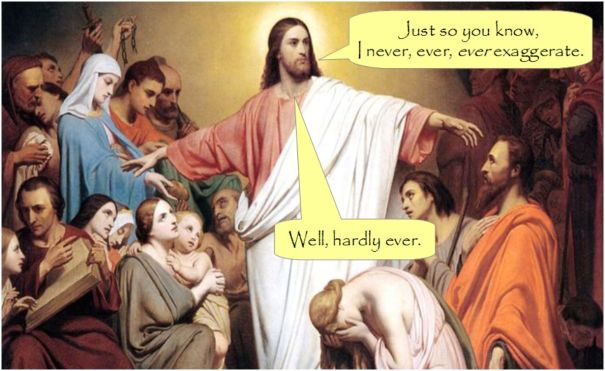
Similarly, when I challenged Dave Armstrong on Biblical Evidence for Catholicism, about why Christians don’t take everything Jesus said literally, he told me it’s because Jesus was fond of hyperbole and it’s the point underlining his hyperbole that matters. I knew, of course, that Jesus liked to exaggerate so I asked Dave how we know which of Jesus’ remarks are hyperbole and which are not. He declared that this was ‘obvious’. Perhaps it is, in sayings like ‘when your eye offends you pluck it out’, but it’s less apparent with pronouncements like ‘sell all you have and give to the poor’ or ‘abandon everything and follow me’. Again, it becomes a matter of subjective opinion, however learned that opinion might consider itself to be, about which of Jesus’ words are hyperbole and which are meant to be followed to the letter.

When I made this point, Dave decided that, rather than it being ‘obvious’, it actually takes years of study to know which is which: ‘It’s by studying Bible commentaries and linguistic aids, and the rules of hermeneutics and exegesis (Bible interpretation).’ Jesus as the incarnation of the God of the Cosmos, and the gospels in reporting him, could surely have made it clear. Instead, it seems, it takes armies of theologians and commentators, and years of study to work it out.

The third way Christians (of all stripes) manoeuvre around the bible’s shortcomings is to say that anything they’re keen to disregard is ‘context-bound’. There are some matters, they say, that are of their time and ancient place and are therefore no longer applicable today.

There are things in God’s timeless Word that pertain only to the time in when they were written? Who knew?

So, instructions like ‘greet each other with a holy kiss’ (which Paul advocates four times in his letters: Romans 16:16, 1 Corinthians 16:20, 2 Corinthians 13:12, and 1 Thessalonians 5:26); ‘women should always have their heads covered in church’ (1 Corinthians 11:2-16) and ‘heal the sick by anointing with oil’ (James 5:14) are now generally considered to be context-bound. This, however, creates the same problem that arose over Jesus’ hyperbole. How do we know which of the bible’s pronouncements are context-bound and which are still of significance today? Answer: we don’t.

It could be argued that, just as ‘greet each other with a holy kiss’ is a custom anchored in the first century, beliefs like

the world is populated by demons,

humans are capable of living forever,

and

incantations (that Jesus is the Saviour) work

are equally context-bound. We know categorically in the 21st century, that demons don’t exist, humans cannot live forever and magic spells don’t work. Only those in a pre-scientific age, dominated by superstition, thought so (together with those today who buy into these same ancient beliefs.)

Once believers start claiming – and it’s Christians themselves who do this – that significant parts of the bible are metaphor, hyperbole or are context-bound, then they’re acknowledging that the bible frequently makes little sense, and that significant portions  lend themselves to whatever interpretation suits the individual reader. Some parts can even be dismissed altogether, which is precisely what Christians do with them (how many Christians do you know who believe they can move mountains or heal the sick by laying on of hands?) What this shows is that they don’t really believe the bible is God’s Word, either in the literal, evangelical sense, nor in a moderate, quasi-intellectual way.

In practice, even to most Christians, the bible is a book of no particular merit.

Bible Truths

Blog387

If ever there was evidence that Christianity is an entirely human affair it’s the way believers constantly disagree with each another. If the bible really was, in some way, ‘the Word of God’ (they don’t all agree even with what this might mean) then surely it would offer greater clarity on what being a Christian entails. Given what’s at stake – heaven or hell, a life of fullness or one spent mired in sin, helping the poor and hungry or self-indulgence – you’d think God would be just a little more precise about what his expectations are.

Instead, what do we get? A rag bag collection of myths, pseudo-history, folklore, poetry, fantasy, yet more pseudo-history, letters, forgeries and invective. Muddled and inconsistent about what the Supreme Being requires of his creation, it ranges from a forever agreement that says following a set of arbitrary laws is what he wants, along with a spot of male genital-mutilation (Genesis 17.1-16), to a new scheme that involves magical incantation (Romans 10.19), to yet another that says helping those in need is what he requires (Matthew 25.31-40).

I’ve been involved at different times in my life with writing policy documents for a range of organisations. Despite creating what I’d estimate to be around 50 of these documents, it never occurred to me to cobble together myth, stories, letters and fake news in even one of them. They needed to be precise, detailing how the organisation worked, what its take was on various areas of operation and, most importantly spelling out for people as clearly as possible what was expected of them. This precision was important; the documents had to be water-tight and open to as little interpretation as possible. They couldn’t allow for the possibility of one part of the organisation acting in one way in a given area while another acted completely differently in that same area.

If I, a fallible human, could manage this more often than not, why couldn’t God?

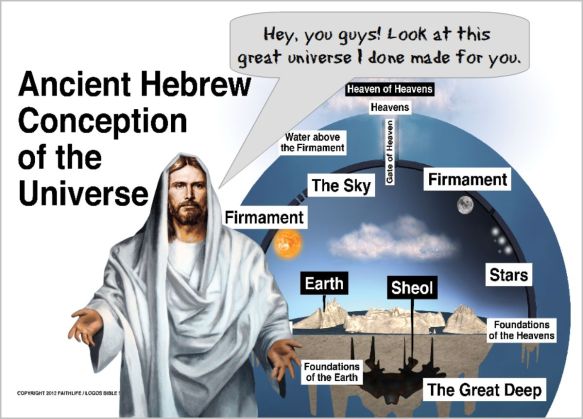
Why could he not declare definitively how old the Earth is so as to leave no room for dispute?

Why could he not set out his requirements for pleasing him as one single, unequivocal list? (he’s not averse to bullet points – see his ten commandments, of which he manages to present two largely incompatible versions, both of them fairly useless.)

Why could he not ‘inspire’ scribes contemporaneous with the figures in the Old Testament to record what happened as they happened and not centuries later?

Why could he not ‘inspire’ eye-witnesses of Jesus ‘ministry’ to write about it at the time, instead of waiting decades before giving the job to strangers who’d never met him?

Why could he not say decisively what happens to people when they die?

Why could he not present one definitive way of how to get in his good books instead of offering a range of confused alternatives, about which he is prone to change his mind?

And so on and so forth…

If the managing director of an organisation produced policy documents as shoddy and shambolic as God’s they wouldn’t last five minutes. Nor would the organisation.

But of course God didn’t write, inspire or otherwise cause the bible to be written. It’s human through and through, culturally-bound (to a range of ancient cultures) and not intended by its myriad authors to be a single volume. This fact doesn’t trouble most Christians; they read it selectively, if they read it at all, and believe what they are told about it. Others, who are aware of the bible’s shortcomings, have a variety of ways of negotiating around them. All of these entail great dollops of cognitive dissonance. We’ll look at some of them next time.

The Chosen One

Blog377

Donald Trump is chosen by God. His powerful friends in The Family have decided. Other influential Christians, like the odious Franklin Graham, have endorsed it. Trump himself made reference to it in a speech recently. He claims this was a joke, but we know what’s said about words spoken in jest; the Donald believes what his Christian chums have told him.

Evidently Trump cannot have been chosen by God when there is no God to do the choosing. Nor does Trump’s behaviour indicate that he’s God’s man. He is ignorant, self-obsessed, spiteful, vindictive, boorish, narcissistic and cruel. Not only is he ignorant generally, he is ignorant about the bible, has no idea about what being a Christian entails and is unable to answer any questions about his supposed faith.

Why then do Christians of all stripes claim he is specifically chosen by God to be president? How do they know? Allowing for a moment that there is a God, the notion that he chooses his agents here on Earth is fraught with insurmountable problems. That he predetermines who will serve him or even who is saved is an insoluble paradox that I’ve written about before, here and here.

No, Christians who say Trump is God’s Chosen are convinced of this only because he supports and implements their agenda; he is anti-abortion, anti-gay and anti-immigrant. He favours guns, white people, Israel, the wealthy and evangelicals. This is why Christians like him, why The Family says he is chosen by God, because these are their priorities and therefore, they conclude, they must be God’s priorities too.

Blog377a

For any Christians reading, particularly in the U.S., the process goes something like this:

1. You decide what is important to you.

2. You find support for your priorities in the bible (because support for just about anything can be found somewhere in the bible. Alternatively, you can just say what you believe is in the bible. Nobody’s checking.);

3. You disregard any apparent contradiction in the words attributed to Jesus;

4. You tell yourself that because God supports your agenda somewhere in the bible, this must therefore be his agenda also;

5. You exercise cognitive dissonance, a.k.a. dishonesty, to enable you to conclude that any influential agent who is prepared to support your priorities must therefore be chosen by God.

Naturally your agent need not demonstrate any other traits that might reasonably be expected of a God-follower (humility, love, hospitality, treating others like they themselves like to be treated and so on.) These things are unimportant so long as the agent is carrying out your agenda.

6. You tell others only of point 5, thus furnishing the entire process with a high-sheen spiritual gloss;

7. You accuse anyone who doesn’t support your agenda and your Chosen One of betraying God.

A good deal of self-deception and deceiving of others is required to pull this off, but Christians are more than up to the job. That’s why Trump is in the White House and why his Christian fixers are never far from his side.

Whatever happened to the Golden Rule?

Blog375a

So in everything, do to others what you would have them do to you, for this sums up the Law and the Prophets. (Matthew 7.12: New International Version)

In everything, treat others as you would want them to treat you, for this fulfils the law and the prophets. (Matthew 7.12: NET Bible)

I went to see a performance at the Edinburgh Fringe on Saturday. Actor David Benson presented a one-man show about the Cato Street Plot, which was an 1820 plan to assassinate the British Prime Minister and government (or possibly not. It was probably a set-up.)

During the show, Benson riffed on some of Jesus’ sayings, including the one above, about how we should treat one another in a country that claims to be Christian (as Britain did in 1820). ‘Do unto others’ has become known as The Golden Rule and like most rules it is largely ignored, even (or especially) by many who profess to be disciples of the man said to have formulated it. The principle is of course much older than the gospels.

When I returned home I caught up with some of my favourite blogs and read about:

A military organisation that promotes the separation of church and state in the U.S. on the receiving end of Christian hate mail.

A preacher who thinks the comedian Sarah Silverman should have her teeth smashed before dying prematurely and being sent to Hell.

The same preacher promising that the Jews, who he says are not God’s Chosen People, will be made to bow down before male Christians, who are.

A different pastor who recited Bible verses while allegedly assaulting an under-aged girl.

The cover-up of the sexual abuse of minors by the Jehovah’s Witness cult.

A Baptist Preacher charged with sexual assault.

Thousands of hateful messages, many from Christians, sent to Montreal Pride organisers.

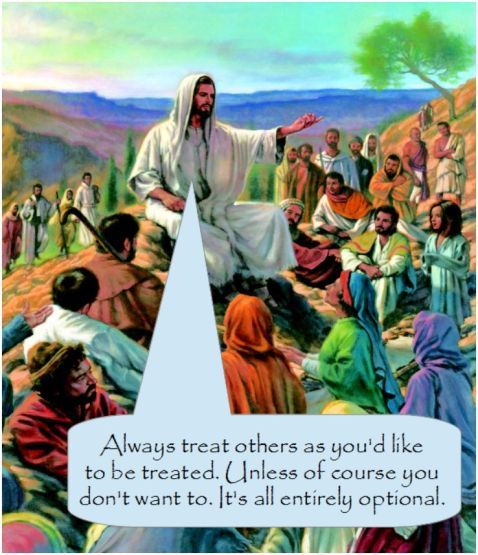
They just don’t get it, do they? Being a Christian means doing what Jesus says (doesn’t it?) and he says that in everything we should to treat others as we ourselves like to be treated. Note how all encompassing that is: in everything, meaning ‘in every circumstance, with no exception’.

My guess is that the majority of Christians like to be treated fairly, with kindness and respect. I know they do because they whine endlessly when they think they’re not being. Yet so many of them won’t extend the same fairness, kindness and respect – in every circumstance – to other people.

I recently saw a slogan that said ‘Why be racist, sexist, homophobic or transphobic when you could just be quiet’; too many Christians can’t even manage that. They feel compelled to hurl vitriolic insults and threats in defence of the most powerful being ever imagined (and he is imagined). Others think that people more vulnerable than themselves, children included, exist only for their own sexual gratification. These Christians have no interest in ‘In everything, treat others as you like to be treated’. It just doesn’t apply to them.

Strike up another failure for their Lord and Saviour, Jesus Christ.

All in the Mind

Blog 368 (2)

Christians dispute that those who saw the Risen Jesus after his death were merely experiencing hallucinations or ‘visions’ in their own heads. Despite the fact that the only first-hand eye-witness report we have of a resurrection sighting is of precisely this nature – Paul’s, in Galatians 1.16 where he says that the Risen Christ was revealed ‘in’ him – Evangelicals in particular insist that Jesus rose physically from the dead and was seen by numerous ‘witnesses’.

And yet, in the two thousand years since he supposedly ascended into Heaven, no-one has seen Jesus in his resurrected, physical body. This doesn’t stop believers today claiming that they experience him in ‘real’ ways. As the old song goes, they walk with him and talk with along life’s narrow way. Or they think they do.

Back when I was a Christian I used to hear Jesus speaking to me. He’d create a thought in my head, telling me to act in a certain way, to speak to some lost soul about him, for example. At the time I was convinced these promptings were really ‘the Lord’. How could they not be? I had his Spirit living inside me, a sure-fire way of experiencing the living Jesus. His presence felt very real, as it does still for millions of Christians. What greater proof of the resurrection could there be?

In fact, Jesus’ ‘voice’ was no more than the vague recollections of Bible verses I half remembered. The sense of his presence I felt was a trick of my own mind, conditioned by hours of sermons, Bible reading and the mutual reinforcement provided by fellow-believers.

I never actually visualised Jesus, though many claim to. They see him in burnt toast or cloud formations; they dream about him or think he has visited them in the night, standing at the foot of the bed. Some have near-death experiences when (they imagine) they travel to Heaven and are welcomed by his outstretched arms. Others ‘know’ he has rescued them from calamity, or purposely sent them a sign (by leaving a Bible unscathed after a storm destroyed a house, as happened this week in Indiana.) Still others, a mite more credibly perhaps, have a sense of Jesus being present in a wishy-washy mystical way. He seems especially real when they’re caught up in the ecstasy of worship or a mighty and wondrous healing is being staged taking place. What a blessing! After all, didn’t Jesus promise in Matthew 18.20 that ‘when two or three are gathered in my name there I am in the midst of them’? (Probably not, but Christians believe he did and that’s what matters.)

My point is this: if this is how Jesus ‘manifests’ himself today – in whispered messages, inner-visions, emotions, dreams, blessings and ‘signs’ – and if these are enough to keep today’s believers convinced he lives again, then isn’t it likely that this was exactly how his earliest followers experienced him after his death? Not as a real, physical body but in these same ‘spiritual’ ways, conjured up by minds deep in the thrall of religion? If illusions of their own imaginations are enough to persuade the susceptible of the Risen Lord’s presence today, then surely they were more than enough to convince a handful of superstitious zealots in the first century.

I mean, just look at Paul.

Jesus, Simon and me

Blog357a

It took me long time to accept who I was. Most of my life, in fact. When I was in my late teens, I had a relationship with a young man the same age as myself. This was illegal at the time as the age of homosexual consent in the UK was 21, remaining so until the late 1990s when it became 18. (In 2004 it was finally made the same as heterosexual consent: 16.) We didn’t care. We had a lovely time and I for one was very happy. I think Sam was too. We lost touch eventually as life took us down different paths.

Not long after, I fell in among Christians. A friend – let’s call him Simon – thought it would be a good idea if we started going to the YMCA. This was long before the organisation became synonymous with the Village People and hangin’ out with all the boys. The YMCA I encountered was markedly evangelical. Once we’d visited a few times we were ‘invited’ to one of their young people’s meetings. I can’t remember what snappy title these meetings went by, but essentially they were a mixture of worship, bible reading and ‘teaching’. Sometimes there’d be a guest speaker who would tell us all about their relationship with Jesus, which, in case we had any doubts, was just marvellous. Before long I was giving my life to Jesus too, though in the long run it turned out to be only a temporary loan.

Occasionally, one of these guest speakers would talk about relationships, those with other human beings, and sex. From them I learnt that sex was almost always wrong: sex before marriage, sex outside marriage, sex with yourself – all of them were sinful. Even imagining sex and fancying someone (which qualified as lust) were wrong too. Who knew? But the most sinful, wicked and sordid sex of all was sex with someone of the same sex.

It didn’t seem it to me. The encounters I’d had with Sam were far from sordid and not at all evil. On the contrary, they were a lot of fun! But these people, these Christians, seemed to know what they were talking about. And hadn’t I given my life to Jesus? He detested homosexuality, or God did anyway, so Jesus must’ve felt the same way (actually this was all in the present tense, Jesus being alive and monitoring us from Heaven and all; Jesus detests homosexuality, they’d tell us.) Sometimes they’d read verses from the bible that proved it.

And so I started to suppress my feelings. They’d kinda got me in trouble anyway, when my body betrayed me in the showers after gym at school. Other boys would torment me about it. I wasn’t actually ‘out’, as we’d say today, and terms like ‘queer’ and ‘poof’ (the British equivalent of ‘fag’) were bandied around as general insults – they didn’t necessarily mean anyone actually thought you were gay. Nonetheless, they came a little too close to comfort. All things considered, a retreat to the back of the closet (not that I knew this terminology then either) seemed the best option. It was what Jesus wanted, or so I thought. I started to deny myself for him, as he insists his followers do, and began a life of self-deception.

Which would’ve been fine, except it’s impossible to live a lie in isolation. Others invariably become involved.

Enter Jane…

God’s deficient policy documents

Universe

If you have read even a small percentage of my posts then you know I focus a great deal on defining and presenting the Gospel of our Lord Jesus Christ. I also focus on the Word of God as our source of God’s Truth, which is absolute. We also have defined faith and what God has done to save His people from their sins, which is the purpose of Jesus’ incarnation, perfect life, crucifixion, and resurrection.                 

Mike Ratcliff on Possessing the Treasure


Is your job description at work expressed as a story or myth?

       Are the aims and objectives of your company based on the hallucinations of the owners?

                   Is the health and safety policy made up of spells and incantations devised by someone with no real connection to the company?

Can you imagine if the kind of documentation that determines your work conditions was composed of myths, stories of dreams and visions, historically unreliable accounts and largely incomprehensible, magical terms and conditions? Not only this, but you’re required to root around within this documentation to discover what it is you’re meant to be doing and when you have, you need to find someone who can explain it properly to you.

This, according to Christians, is how God chose to tell his creation what he expected of it. The omniscient, all powerful creator of the universe, whose thoughts are so much greater than ours, was unable to put together a clear, systematic and concise set of directions about how he wants us to live and what we should believe if we’re to avoid an eternity of torture.

These messages are so important, apparently, that he thought they’d be best conveyed in folklore and myth – much of it plagiarised from other cultures – fantastic stories written decades after the events they relate, and muddled, contradictory theology.

Why on Earth would he do this? Why would he not speak directly and clearly to fallible, sinful humans? Provide us, perhaps, with a list that sets out straightforwardly and unequivocally what we need to do if we’re to be ‘saved’. (It’s not as if he’s averse to supplying lists; the Ten Commandments are a list, as are the rules in Leviticus about beating slaves and what should and shouldn’t be eaten.) Why not communicate with us so that we know it’s him and not, say, some pre-scientific tribesmen or a bunch of superstitious zealots? Why not speak to us in ways that are not identical with the way we ourselves invent stories about imaginary beings and far-fetched events?

Why provide us with a ragbag of myths, legends and fables crammed with confused and inconsistent ideas, all of them created by those same fallible, sinful human beings, and stitched together, eventually, by a committee with a vested interest in the success of such a book?

It’s a mystery. Unless of course there’s no God behind the bible. Maybe that’s why we have much better policy documents at work.

Give me some of that ol’… New Testament scholarship?

Blog336JC&Kids

Roger E. Olson has deigned to reply to me! He says that every fule know there are multiple Jesuses in the New Testament. All the same, Rog is sure he has a pretty clear picture of the real one, even if this is only in his own head. Then I hit the jackpot! Rog treats me to one of the Christian apologist’s top retorts: those with dissenting views know nothing about New Testament scholarship.

Here’s his response in all its glory:

I hear your suggestion, but I’m not sure what it has to do with atheism. All serious New Testament scholars–including the most conservative Christian ones–already know and admit that the gospel portraits of Jesus differ somewhat from each other. But very early in Christian history all attempts to reduce them to one portrait (one united gospel stitched together from the four in our New Testament) were rejected as heretical. We Christians already know what you say and it doesn’t bother us. I have read numerous biographies of Abraham Lincoln, for example, and the “man himself” stands out in spite of differences of description from different points of view. Your point is simplistic and displays that you know little or nothing about New Testament scholarship.

My reply to this, which Roger hasn’t seen fit to post:

So you think one has to be fully cognizant with New Testament scholarship to be a Christian? Funny, I don’t find any of the Jesuses in the bible saying that. Doesn’t one of them suggest we ‘become as little children’? Still, I expect you’re right: if you need a level of understanding that’s the equivalent of a doctorate to follow Jesus, then I guess I don’t qualify.

As for what my comment has to do with atheism, you were the one who said we see God most clearly in Jesus. I responded by saying I don’t see God in any of the interpretations. If Jesus is the best reflection we have of God, as you suggest, then his failed prophecies, false promises and general ignorance make it probable that the God he, and you, promote doesn’t exist.

If you can cherry-pick which bits of the bible are relevant to your understanding of the divine, Roger (you dismiss, for example, the barbarity of the Old Testament), then it is not unreasonable for others to do the same, even if we aren’t as well versed in Christian mumbo-jumbo theology as you.

Atheists and Agnostics

Child

This is how a god-botherer managed to make a fool of himself recently in the i, a national UK newspaper.

Agnostics and Atheists

It is misleading for Gwilyn Hughes to put atheism and agnosticism together as if they are the same two varieties of the same genre: they are worlds apart.

‘The fool has said in his heart, there is no God’ – the old psalm is right, for the atheist is a fool.

He ignores the thousands of centuries of human thought and experience to put all his trust in the tiny fragment of the present, embracing the myth of inevitable human progress.

The agnostic, on the other contrary, is wise: he considers everything including the present and concludes that, with the believer, its existence is unproven as its non-existence.

John Toy,

Scarborough

I sent the following reply:

As an atheist, I was interested to read that, according to Mr Toy, I ignore ‘all the thousands of centuries of human thought’ and embrace ‘the myth of inevitable human progress.’ Clearly, I’m failing as an atheist as I do neither and nor do most other atheists. Nonetheless, I’m grateful to be set on the right track by Mr Toy, who, I’m guessing from his quoting one of the bible’s most ignorant verses (oh, what choice there is!) is a Christian.

In fact, I regard myself as both an atheist, which means I see no evidence of a personal loving god and therefore ‘believe’ accordingly, and an agnostic. I do not know if there is some sort of deity ‘out there’ that gets on with his/her/its life with neither interest in, nor involvement with, the inhabitants of this planet. I doubt it, but as the possibility exists, I can only be agnostic on the subject.

I have to say I’m surprised that a national newspaper in a largely secular country allows those promoting belief in a god, however tenuously, to do so in its pages. I do hope it won’t happen again.

It all comes down to feelings and subjective experience

Faith4

Argue with Christians (Hi there, Jim! Hi there, Don!) about the veracity of their faith and they will tell you it’s true for two reasons: the Bible and their own personal experience. ‘Christianity is true and Jesus is real because the Bible says so – and, whatsmore, I feel it.’

Or, as William Craig Lane likes to put it, the inner witness of the Holy Spirit testifies to the truth of Christianity. It’s a beautifully circular argument: ‘Christianity and its holy book are true; I know this because the Holy Spirit who lives in me tells me so; I know the Holy Spirit lives in me because the Bible says he does; therefore, I know Christianity and the Bible are true because the Holy Spirit tells me so’.

But equally, Mormons claim that they ‘know’ a completely different set of improbable beliefs are true because they experience a ‘burning in the bosom’ that tells them so. Roman Catholics say their faith is true because they experience Christ through the Eucharist, while Muslims know theirs is true because they have a real sense of Allah’s presence.

All of these spiritual convictions are not, as a liberal theologian like Karen Armstrong might claim, evidence that there is Something-Out-There that loves and communicates with us, but more obviously that human beings’ brains are adept at creating whatever ‘inner witness’ is required to support the beliefs and convictions they have arrived at. William Lane Craig concedes this when he acknowledges that

Anyone (or, at least any sort of theist) can claim to have a self-authenticating witness of God to the truth of his religion. But the reason you argue with them is because they really don’t: either they’ve just had some emotional experience or else they’ve misinterpreted their religious experience.

In other words, any experience of ‘self-authenticating witness’ enjoyed by believers in faiths outside Craig’s own brand of Christianity is at best mistaken, at worst fake. But then, how can anyone know, Craig included, that his own conviction isn’t just as much an emotional flush or mere subjective experience? Why is his conviction any more real than that of other kinds of believers? Ultimately, Craig can only say, “because it is”:

a person (possessed by the Holy Spirit) does not need supplementary arguments or evidence in order to know and to know with confidence that he is in fact experiencing the Spirit of God.

In other words, the true believer knows his experience of the Holy Spirit is real because his experience of the Holy Spirit tells him it is. And round the argument goes, though no amount of assertion makes a subjective experience an event in objective reality.

It is impossible for Craig, or any other Christian, to demonstrate that an entity he imagines inhabits his brain, no matter how convincing its presence may seem, has any existence anywhere other than in his brain. What the person who says ‘I believe’ is really saying is that they have no evidence at all for what they are claiming. If they had, they wouldn’t need to believe it; they would know it. They would, whatsmore, be able to point to independent, external evidence for it.

The Bible makes a virtue out of not knowing, of believing when there is no evidence.  It calls the resulting cognitive dissonance, ‘faith’.

Adapted from my book, Why Chrisitans Don’t Do What Jesus Tells Them To …And What They Believe Instead.