The Case of Plagiarised Essays and the Missing Source

This is a true story. I was involved. It took place when I was a university tutor and had dozens of student essays to mark at any time. The work of about 120 students were distributed randomly between myself and two colleagues.

On this particular occasion, I had about 40 to assess and about half way through them I came upon an essay from a student whom I’ll call Matty. It wasn’t a particular good essay; it was poorly argued, and was littered with errors, the most glaring of which was the referring to the well known psychologist E. (for Elizabeth) Loftus as a man. I gave it a grade only a little over the pass mark and moved on.

Three or four essays later I reached one by ‘Lucas’. As I started on this submission, I realised I’d read it before. I searched back in the marked pile and pulled out Matty’s work. Sure enough, both essays were pretty much identical. The occasional word had been changed, paragraph breaks altered here and there and some sentences rearranged, but the two pieces of work were essentially the same. Crucially, the second essay used the very same quotations from E. Loftus and again used male pronouns for her when discussing her work.

The university, quite rightly, took plagiarism seriously. I summoned Lucas and Matty to my office and confronted them with their third-rate essays. Both insisted they had not copied. They had, they insisted, worked independently. They hadn’t even seen the other’s work.

So,’ I asked, ‘how is it your essays are so similar, identical in many places, and most tellingly, how have you both ‘independently’ managed to attribute the wrong sex to Elizabeth Loftus?’

We must have used the same books,’ Lucas offered.

Right,’ I said, ‘and which book was it that thought Loftus was a man?’

Not sure, ‘ Matty offered, ‘but we could maybe find it for you. Because it definitely did.’

Just point it out to me from one of your identical and very thin bibliographies,’ I suggested.

The two scanned down the list of three or four books. ‘Erm, not sure,’ Lucas said.

No, it’s not there,’ Matty concluded. ‘I’m not sure which it was.’

Okay,’ I said, ‘when you find it, maybe you can bring the book in to show me.’

They nodded eagerly, believing they’d averted the problem.

In the meantime,’ I said, ‘I’m going to fail both of your essays. I’m afraid too I have no choice but to report you to the Academic Standards Board for your plagiarism.’

The boys looked stunned. ‘But we didn’t copy and that book definitely said Mr Loftus was a man.’

There’s no book that says she’s a man,’ I said, ‘and you know it. You’re not going to be able to produce the book because it doesn’t exist. One of you made the mistake of thinking she was male and the other simply copied the error. I don’t know which way round it was, but that’s the only reasonable explanation.’

They left dejected. I did report them to the Academic Standards Board. Unbeknown to me, a tutor from a different department had also reported them for plagiarism in the essays they had submitted to him. Both students were eventually expelled for repeated offences.

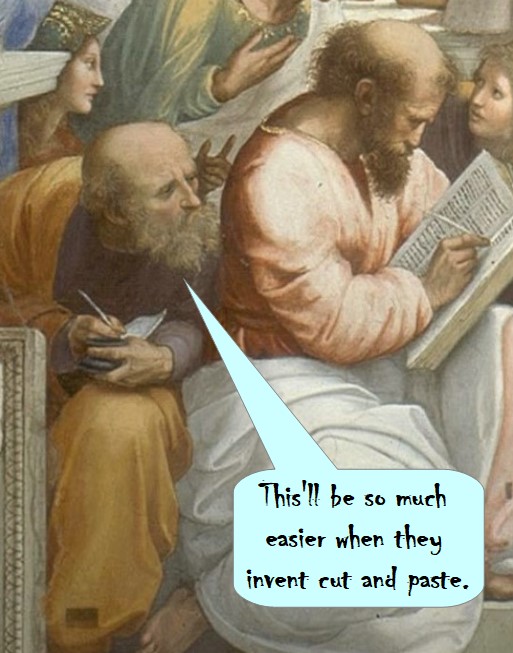
I recalled the episode while reading Gary Marston’s Escaping Christian Fundamentalism blog about the hypothetical ‘Q’ that some scholars argue existed before Matthew and Luke’s gospels were written. These scholars postulate that both gospel authors lifted the material they have in common, other than that copied from Mark, from ‘Q’. Like my two likely lads, none of them has ever been able to provide evidence for the existence of this mythical document.

The most obvious explanation for the similarities between Matthew and Luke’s non-Markian material is that one of them, probably Luke, cribbed from the other. Like my two plagiarists, Matthew and Luke are without credibility. Whoever came first – probably Matthew – plagiarised from Mark and made up stories that Luke then copied, mistakes and all, and altered to suit his own purposes. If they’d been dishonest students they’d have been expelled long ago.

Pest Control

I used to pride myself on how patient I could be. I’m finding recently however that I’m becoming far less so. Not with everyone, I hasten to add, but with religionists, Evangelical Christians in particular.

As I mentioned last time, they have infested my Facebook feed with their inane Jesus-Loves-You Amen BS and now I find they’ve practically taken over a science page I occasionally read called From Quarks and Quasars, a sometimes sensationalist site that collects together science posts from other legitimate sources. It recently published an item called ‘Earth Was Once Entirely A Water World, New Research Shows’, prompting 5.2k comments. Many of these were from cranks trying to show how the finding verifies the biblical flood story, despite the fact the article makes it clear it is talking about something that occurred 3-4 billion years ago. Certified genius Dennis Mears offers this comment (all grammatical, spelling and punctuation errors in the original):

Of coarse it was !! but we don’t need “ new research “ to know what every culture on earth has talked about in their history for thousands of years . We can simply read genesis and learn about it in detail

while Scotty Johnson wades in (pun intended) with:

It’s called the flood, it’s recorded in Genesis in the Bible, Noah and the Ark, kids have been learning about it in Sunday School for years. Scientists should study the Bible first, maybe they wouldn’t be surprised when they discover something.

It’s down to astute reader Gene Steiner, catching the original article’s reference to 3-4 billion years, to correct it:

(In) Genesis 7:24 the great flood covered the whole earth, even the highest mountains; and the waters remained on the earth for 150 days…. Not billions of years ago, but 4500 or so years ago during the NOAHIC GLOBAL FLOOD! We knew that all the time!

This is the line subsequent commenters take up until we get to Tobie Schalkwyk, who offers the insight that the water-covered Earth is the same as mentioned in Genesis 1:

1 In the beginning God created the heavens and the earth. 2 Now the earth was formless and empty, darkness was over the surface of the deep, and the Spirit of God was hovering over the waters.

And on it goes for thousands more comments. The photo at the top of this post was also shoved on somewhere along the line.

It is the purveyors of this sort of crap that I no longer have any patience for. I want to call them out for their tomfoolery. It’s the same with commenters (Arnold and Don on this blog, Marley1312/Aussiestockman on Gary’s, Revival Fires on Bruce’s) who think atheist sites exist only to provide a forum for their brainless theobabble and Bible-bashing. They can’t be argued with, such is the depth of their ignorance and need to inject Jesus into everything. They bring out the worst in me: snark, bad language and name calling (as you can tell from this very post). I don’t want to stoop to this level, nor is it good for my blood pressure, and so feel compelled to leave them to it. I avoid reading comments and sometimes actually abandon sites I like to read because of the infestations of religious gobbledegook.

I know it infuriates some of you too, but what to do? Let the epidemic spread or resist it? What do you advise?

This Must Be Heaven

In the last week or so my Facebook feed has been bombarded with posts and memes of a religious nature. Every other one is of this sort. Most are Evangelical though some are evidently Roman Catholic, what with Jesus and his mom with their hearts pinned to their blouses. All of them inform me in the schmaltziest of terms how wonderful Jesus/God/Heaven is. Just about every one is followed by comments consisting single word: Amen! Some have a ‘Praise Jesus’ and occasionally there’s profound philosophical insight (kidding).

Last time my FB was invaded, about six months ago, I had to go into each post separately to blocked them. For a while FB complied. Now that my period of grace (pun intended) is over, they’re back with a righteous vengeance. Before I block them all over again, I’d like to share one with you. Its picture is at the top of this post. Some bright-spark has given it the title First Moments in Heaven, which is patently not what it’s called; not even the nuttiest fantasist would include gravestones in heaven. None of the undiscerning commenters seemed to have spotted their inclusion. Having had this pile of old cobblers dumped on my FB page, I felt obliged to point out the problem. As if a single drooling commenter cared. Here’s a sample of what they went on to say:

I despair that this saccharine banality is the best many Christians have to offer. It really can’t be argued with; people who enthuse over such slush are immune to reflection, reason and critical thinking. A staggering 13,000 of them reposted the damn thing.

The picture evidently depicts the general resurrection here on Earth and, as I thought when I first saw it, is a Jehovah’s Witness creation, originating in a Watchtower magazine. Not a single one of the thousands of born-again geniuses who orgasmed over the picture noticed it was the product of a sect they detest. Again, I felt compelled to alert them to the fact.

Now to block the lot of them. Amen! Praise Jesus!


A New Kind Of Christian


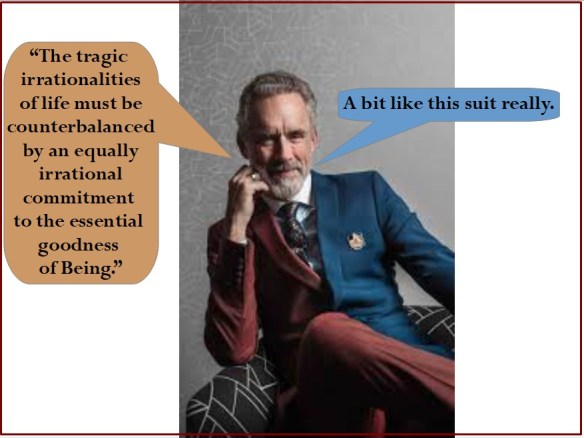
You’ll be overjoyed to hear that Jordan B. Peterson has a new book out. He’s been busy promoting the not at all pretentiously titled We Who Wrestle With God. He was interviewed about it recently in British magazine The Spectator. The interview has to be read to be believed. The introduction can be read here but the rest, alas, is behind a paywall. Don’t worry though, I’ll supply you with the highlights. The article is a goldmine of stupefying statements about God and how Jordan is the only one who really understands the Bible’s stories. They need ‘arranging’, you see, and their underlying ‘hypotheses’ understood:

The Bible presents a series of hypotheses. One is that there’s an underlying unity that brings together all structures of value. The second claim is that there’s a relationship between the human psyche and that unity and each of the main biblical stories casts that unity in a different light, accompanied by the insistence that, despite those differences, what is being pointed to is one animating principle. As far as I can tell, that’s correct.

You got that? As ol’ Jordan humbly admits, this ‘revolutionary realisation’ is his and his alone. Of course, none of this sort of thing is original; the idea that characters, events and stories in the Old Testament prefigure realities in the New is as old as the hills. Typology can be imposed on any set of myths. The gospel writers and Paul did it, seeing Jesus prefigured in Jewish scripture and inventing stories about him so that he complied with these earlier types. There’s nothing ‘revolutionary’ about spotting this, but like so many before him, Peterson gets it back to front and falls, quite literally, for the oldest trick in the Book. Continue reading

The Origins of Evil

Where does evil come from? The Billy Graham Organisation knows:

…the Bible does reveal two important truths about where evil comes from. First… evil comes from the Evil One — that is, from Satan… Satan is a powerful spiritual being who is absolutely opposed to God, and is far stronger than most of us realize. He isn’t equal with God, but is totally evil, and repeatedly works against God. Jesus called him “a murderer from the beginning…. a liar and the father of lies”.

No, not really. Evil is not a supernatural being cavorting around an unseen, undetectable spiritual realm while inflicting havoc on our reality (see here). Satan is not the embodiment of all evil for the simple expedient he and his minions do not exist.

What else does the Bible have to say about the origin of evil? Fake Paul in 1 Timothy 6: 9-10 claims that ‘…the love of money is the root of all evil’. He goes on to say, ’while some coveted after (money), they have erred from the faith, and pierced themselves through with many sorrows,’ which sounds suspiciously like a snipe at early Christians who refused to hand over their worldly goods to the cult.

Now, while greed and avarice can undoubtedly lead to wickedness, the love of money is not the root of all evil. Vindictiveness, spite, fear, ignorance, stupidity, hatred, lust for power, sexual lust, jealousy, coveting another’s property or territory, religious beliefs and deceit (take note, fake Paul): all can, and do, lead to evil.

Let’s give the Bible one last chance.

The author of Mark’s gospel has Jesus say:

What comes out of a man, that defiles a man. For from within, out of the heart of men, proceed evil thoughts, adulteries, fornications, murders, thefts, covetousness, wickedness, deceit, lewdness, an evil eye, blasphemy, pride, foolishness. All these evil things come from within and defile a man (Mark 7:20-23 NKJV).

While ‘Mark’ is talking about ritual purity in this bizarre mix of low-level immorality, religious offences and actual wickedness, he nails it as far as the source of evil is concerned. It emanates from human beings, most often, from men. While women are also capable of committing evil acts, and children too sometimes, most are perpetrated by men. 

It’s not easy finding evidence for this online, where misogynistic, religionist have taken over, claiming women are more evil than men on account of Eve eating the forbidden fruit. They also argue that women are more evil because they ‘hold a grudge longer’. However, a little digging dispels this ridiculous notion. Consider:

Are most dictators men or women? (Men, almost exclusively);

Are most genocidal acts initiated and carried out by men or women? (Men, almost exclusively)

Are most murderers men or women? (Men: 98% of murder convictions are of men);

Are most rapists men or women? (Men; 99% of convictions are of men);

Are rape gang members men or women? (Men, almost exclusively);

Are most child abusers men or women? (Men make up 88% of perpetrators);

Are most school shootings carried out by males or females? (Males, on a ratio of 145:4);

Are most terrorists men or women? (Men, on a ratio of 5:1);

Are most crime lords, drug barons and death-cult leaders men or women? (You already know the answer…)

Are most victims of sexual abuse male or female? (Female: 1 in 5 compared with 1 in 7 males)

Almost all malicious and unnecessary infliction of harm on others, nearly every evil act ever committed has been and is committed primarily by men. Only a small number are carried out by women. However, just because most evil is committed by men, not all men are evil. More than this, most human beings don’t commit ‘evil’. Neither do most Christians, though there does seem to be an inordinate number who are prepared to sexually abuse others. Nonetheless, many are happy to blame Satan for what evil there is, including their own. Attributing human evil to a malevolent fantasy figure is a duplicitous attempt to evade both responsibility and culpability.

In any case, according to true believers Satan’s main occupation is sowing the seeds of doubt in the minds of Christians, in an attempt to lead them away from Jesus (2 Corinthians 11:30). Satan is, when all is said and done, a pretty hopeless prop, not ‘a powerful spiritual being’ but an enfeebled metaphor for the evil that some humans engender.

Afterthought:

Where does goodness come from? That too is human. All compassion, kindness, consideration, empathy, helpfulness, love, joy and peace come from us.

Or not, as the case may be.

Live Backwards

I wanted in this post to think about the source(s) of evil, given it cannot be supernatural. However, defining evil isn’t as straightforward as I anticipated. The Oxford English Dictionary offers ‘Profoundly immoral and wicked’ while Merriam Webster goes for ‘morally reprehensible: sinful, wicked.’ Other dictionaries also mention both immorality and wickedness, replacing one concept in need of explanation with two. ‘Wicked’, it seems to me, is synonymous with evil, which doesn’t get us any closer to defining it. There are problems with ‘immorality’ too, as what constitutes immorality is frequently culturally determined.

Evangelicals, for example, regard same-sex relationships as immoral (so that’s me told) as is sex outside marriage. When I was involved in the church, dancing, drinking and listening to rock music (with all its backward messages!) were anathema. In some countries today many of these behaviours attract the attention of so-called morality police and are punishable by death (how moral is that!) Then there are those who fail to keep their word. Within months of being elected, the UK government under Keir Starmer has reneged on almost every promise they made prior to the election. Everyone expects politicians to lie so perhaps allowing ourselves to be duped by them means they’re not entirely responsible. Let’s not forget too that for some, eating meat is immoral, as is using fossil fuels. Our eating meat and our burning fossil fuels, that is.

So, are the practitioners of such relatively low-level, and disputed immoral acts – being gay, having non-marital sex, drinking and dancing, lying, using oil, eating meat – actually evil? Are women who have abortions, and the people who carry them out, evil? Of course not. It’s debatable whether some of these behaviours are immoral to begin with, but even if they are, immorality does not always equate with evil. I would argue that while all truly evil acts must, by definition, be immoral, not all (supposed) immorality is evil. Somehow personal immorality lacks the scale and awful consequences of true evil.

The Sanford Encyclopaedia of Philosophy is much nearer the mark when it comes to defining evil:

Evil must involve harm, and it must be serious enough to damage its victims’ capacity to function normally… Furthermore, the harm must be unjustified…

I’ll adapt and paraphrase this as ‘the malicious and unnecessary inflicting of harm on others’ to give us a working definition of evil.

So, who qualifies? Hitler obviously. Putin certainly. Other oppressive regimes. Murderers. Hamas. Child abusers. The gangs who have raped very young girls in numerous UK cities. How about the God of the Old Testament? He orders the cruel deaths of Israel’s enemies (Deuteronomy 7), promotes the smashing of babies’ heads against rocks (Psalm 137:9) and orders the taking of prison-of-war virgins as sex slaves (Numbers 31: 17-18). Later, Jesus – like father, like son – relishes the opportunity to put his enemies to the sword (Luke 19:27) and orders those who don’t believe in him be consigned to hell where they’ll be tortured forever (Matthew 25: 41-46). This is evil by any definition.

So, given there isn’t a God nor a heavenly Jesus, from where does evil originate? I’ll get to that, at last, in the next post.

What to make of the Supernatural

When I was young, about 8 or 9, I was frightened of creatures that invaded my bedroom in the dark: monsters under the bed, devils in human form lurking in the shadows, that kind of thing. One night when I couldn’t sleep through fear, it came to me that if these creatures were real then so too were the super-heroes I loved: Superman, Batman and the Legion of Super-Heroes! Now, I knew these DC characters didn’t really exist and so I reasoned (I think pretty well for a 9 year old!) that that neither did their evil counterparts, the monsters and devils I was scared of. With this realisation, the horrors were vanquished. Shadows were just shadows. There was nothing scary under the bed.

Somewhere in a recent comment, either here or elsewhere (I can’t remember which nor can I find it), someone informed me that I make the a priori assumption that the supernatural isn’t real.

The term a priori is used with abandon by people who don’t necessarily know what it means so here’s how The Oxford English dictionary defines it:

relating to or denoting reasoning or knowledge which proceeds from theoretical deduction rather than from observation or experience.

I’ll take that. The only way one can assess the supernatural is through reasoning and deduction. There’s no independent evidence for it that can be considered; no external phenomenon to observe and analyse; no science, history or philosophy books that take it seriously or even consider it. I have no personal experience of the beings that supposedly inhabit the supernatural realm; no gods, angels, spirits, demons, ghosts or goblins have manifested themselves in front of me. I’ve never experienced magic, spells or exorcisms, at least not ones that can’t be explained far more convincingly in other ways. So what does that leave in terms of evidence?

Fantasy stories and religious texts. These are the only sources of information about the supernatural, and at least one of them is entirely fictional. Fantasy stories are by definition fiction. They are made up. Similarly, religious works are the products of minds from before the advent of science; explanations of the world and human experience that their creators could construct only in terms of their localised, pre-scientific superstitions. No-one outside of those who’ve chosen to believe in them takes them seriously, which is why their claims are never considered in serious science or history books (Ken Ham’s ‘scientific’ publications are nothing of the sort; they’re religious texts masquerading as science.)

That the supernatural has to be argued for, from an assumption that it does exist, is clear indication it does not; such powerful beings would surely be apparent in the real world, just as they are in Stranger Things (a fiction in case you’re not sure.) No-one has so far demonstrated that the supernatural is real. It is possible to argue it is but only through reliance on the same religious texts, the authority and reliability of which is in dispute on such matters

So, do I make an a priori assumption the supernatural doesn’t exist? Yes, in the sense I take it a priori that it doesn’t. Is this an assumption? No, it is a conclusion arrived at through an assessment of the evidence – there isn’t any: consideration of accounts of the supernatural reveals they’re fictional or prescientific, while personal experience of the apparently supernatural is better explained by rational means. I don’t therefore assume the supernatural doesn’t exist, I deduce it does not.

Actually, I did this when I was 8 or 9.

It’s the End!

AI shows how it’s done. Arrange your elements carefully, and – hey, presto! – Jesus appears!

I’ve reached the end! The end of Jonathan Cahn’s The Dragon Prophecy that is. He has me convinced: the end of the age and the world itself, is just around the corner. He looks around the world, particularly the Middle East, sees the state it’s in and dives into the scriptures to uncover the prophecies that presage present day events. He then reveals how, collectively, these scriptures accurately describe the state of the world today following Hamas’s invasion of Israel on 7th October 2023.

Had he collected these passages prior to 7th October, would they have accurately foretold the events of that day? They should’ve done if that’s what they are really about. So where was this expose before 7th October? Where were the books, by Cahn or anyone else, revealing how the Bible predicted in detail, events that still lay in the future? Predicatbly (pun intended), they don’t exist. Cahn’s The Serpent’s Prophecy could only be written with hindsight, after the events, 7th October 2023 in particular, that he’s decided fulfil biblical prophecy. The prescience of these ancient scriptures is only apparent, to Cahn if no-one else, in retrospect.

He gathers disparate verses together to demonstrate how they do indeed predict current events. He omits many that don’t, even though they too appear to prophesy the future. He does this because they don’t fit the picture he’s trying to create: his interpretation of events in Israel and the significance he wants ascribed to them.

Cahn disingenuously forces unrelated verses to work together, like pieces from different jigsaw puzzles, to create a picture that loosely and disjointedly conforms with and thereby confirms his own conclusions. 

The culmination of The Dragon’s Prophecy is that the time is right and the stage set for Christ’s ‘return’. Cahn advises his readers to surrender to him before he comes though the clouds to do unspeakable things to them. While none of the ‘prophecies’ he’s pressed into service have ever been fulfilled and are certainly not being now, this one must surely be the greatest of the Bible’s failed prophecies.

Does all of this sound familiar? It should. Starting with Paul and the gospel writers, numerous hacks have pulled together biblical prophecies to show how events of their times fulfil the conditions for Christ’s return.

More than this, the gospels were created in exactly the same way that Cahn creates his end-of-the-world scenario. Mark, Matthew and Luke, ruthlessly plundered ancient Jewish scripture to show how their suffering Messiah (whether real or not) was predicted there. Significantly, no-one prior to the early days of the Christian cult believed that these particular scriptures foresaw a suffering Messiah who would die for the sins of his people before coming back to life. The scriptures could only be made to do so in retrospect. After some claimed to have seen the risen Jesus, early cultists began to scour the scriptures for passages – how many they had to ignore or misinterpret! – that could be made to create a loose, disjointed picture of their super-hero. It’s how Paul attempted to persuade others that Jesus was the Messiah (1 Corinthians 15:3,4 etc).

So Cahn is doing nothing new, finding a ready audience for his particular sleight of hand.

Back by unpopular demand – it’s the New Year Pop Quiz!

All set? Here we go!

1. Which one of these fantasy figures actually exists?

2. For which one of these ideas is there refutable/verifiable, corroborative scientific evidence?

3. Which one of these events is demonstrably historical?

4. Which one of these phenomena is verified and corroborated by psychology?

5. Applying logic and reasoning, which of the following scenarios is most likely to be true:

6. Which of these statements is verifiably true?

Answers:

Question 1. The answer is none of them, though C, Donald Trump, comes closest. 10 points if you put C, none if you plumped for any of the others: despite the volumes written about them there isn’t an iota of  evidence that they exist.

Question 2. Award yourself 10 points for B, though if you’re a True Believer this is the only one you think isn’t true. There is an abundance of refutable/verifiable, corroborative scientific evidence that it is. You can only wish there were for the other three.

Question 3. A is correct – 10 points. There is a considerable amount of evidence that the moon landing occurred on 20th July 1969. There is absolutely none at all that the other three are historical. For the sake of argument, let’s say they’re mythical. Nul points if you think otherwise.

Question 4. The answer is all of them. Oh no, wait… that’s my cognitive dissonance speaking. D is the only one of those listed recognised by psychologists. My bad and 10 points to you.

Question 5. The answer is of course E. Award yourself another 10 points if you thought outside the box on this one. (You can also have 10 points if you said they’re all equally likely, as in ‘not at all’.)

Question 6. 10 points for D

Scores: 

If you scored 50 or more, congratulations! If you scored nothing at all, you are confirmation that question 6’s answer – D. Human beings are capable of believing just about anything – is true. Well done.

A happy new year to you all.


When A Child Is Born… Supernaturally

To what extent are the conflicting nativity stories in Matthew and Luke historical? That depends on whether or not you believe in the supernatural.

There is no evidence of a supernatural realm nor the beings who are said to inhabit it: God, heavenly Jesus, the Holy Spirit, angels and those they are constantly at war with: Satan and his demonic hordes. It is not as Jonathan Cahn describes it in The Serpent’s Prophecy:

Behind the perceivable realm lies another, beyond our ability to measure or quantify. Behind the history of this world lies another, unrecorded, unrecited, unknown. And behind that which moves and transforms the world lie unseen forces, causes, agents, undying and primeval (p3).

Cahn cannot possibly know any of this, any more than fake-Paul could when he wrote Ephesians 2,000 years ago (6:12). A reality that exists above and beyond nature – the meaning of supernatural – that is ‘unseen’, undetectable and ‘unknown’ is one that doesn’t exist, except in the imagination of a few fantasists.

Yet the supernatural is the basis of Christianity. Without it, its agents, as Cahn calls them, could not have interacted with the only reality there is. The Holy Spirit could not have impregnated Mary; angels could not have materialised to announce Jesus’s birth to a group of credulous shepherds; a divine being could not have communicated through dreams with Joseph and the Magi; a magic star could not have been manoeuvred into place over Jesus’ house. Most significantly, a non-existent God could not have sent his ‘son’ into this world.

It is futile to argue whether Matthew or Luke’s nativity narrative is the more historically accurate. Nor is there any point in trying to harmonise the two accounts. Neither is historical: the involvement of the supernatural rules out their being factual.

The inclusion of the supernatural in everything that follows is also fatal to claims made for the gospels’ historicity. The clues are there in the text: God’s pronouncements from the sky; the inexplicable miracles and healings; the presence of angels, demons and Satan; the dead rising; visions, prayers and prophecies. These tell us that what we’re dealing with is fantasy material. The creators of the gospels and other books of the New Testament had no more evidence than Cahn does that secretive super-beings existed, even if they did take them for granted. God and his interventions no more exist than Santa Claus and his magical Christmas deliveries.

Paul tells us that God raised Jesus from the dead (Romans 8:11). But there is no God, so he didn’t. There was no supernatural resurrection and without a resurrection there were no encounters, like those in the gospels, with a reanimated body.

Remove the supernatural from the Jesus story and there’s nothing left. Some wise advice lifted from Jewish scripture perhaps, plus a few cult rules, but that’s all. Paul’s experience of the risen Christ, like that of Cephas before him (described nowhere in the New Testament but allegorised in the gospels) and John of Patmos after him, were as Paul himself says, a ‘revealing’ in their own heads.

I hope none of this spoils Christmas for you. The Nativity isn’t a bad story, indeed it’s quite beautiful in places. But it is not historical. Like much in gospel Jesus’ life, and the resurrection itself, it is a fantasy generated by irrational and superstitious minds.

A very happy Christmas to both my readers.