The ‘F’ Word

Don Camp is defending Christians in the comments. They’re in the process of becoming ‘more like Jesus’, he says.

What does this even mean, Don? How can you know what Jesus was like when there are so many disparate versions of him in the Bible (as has been pointed out to you)? Does becoming more tempestuous, impatient, impossibly demanding and Jewish count? These are some of the traits his propagandists show him as having.

You then tell Jim not to measure Christians ‘by his (own) experience’. What other measure is there? Christians aggressively promote their beliefs on the internet, have infected politics and, at a lower level, are encountered as judgmental evangelicals and sanctimonious street preachers; these are the Christians of our experience and like it or not, the fragrance ain’ that sweet. As Jesus is supposed to have said, ‘by their fruits shall you know them’. We sure do.

Bottom line, Don: you Christians have had two thousand years now to make the world a better place by being ‘more like Jesus’. On balance, you’ve failed. Not surprising when Jesus himself failed even more. Where is he, Don? Following his ‘return’, the Righteous should have been living in peace and harmony for the past two millennia, tediously worshipping him and his Father in God’s Kingdom on Earth. They haven’t been, even though Jesus, Paul and several other NT writers said they would be ‘soon’, relative to their own lifetimes. 

Argue it how like, Don (and you will), Christianity merits one big ‘F‘.

Dear Evangelical: Why Aren’t You A Mormon?

Dear Don,

Why are you not a Mormon? I mean, you appeal to the evidence of consistency across the 66 books of the bible, claim that the gospel writers remained true to an oral tradition (despite John’s gospel being markedly different from the other three) and insist there is no difference between the original apostles’ gospel and Paul’s (when Paul is adamant there is.) In fact, there is even better evidence that Mormonism is true.

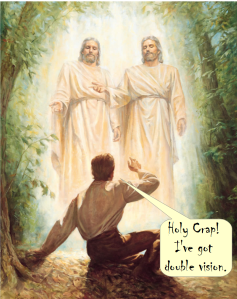
First off, Joseph Smith saw the resurrected Jesus in person! Not only Jesus but God the Father too. And they spoke to him! He relates the story himself, so unlike the gospels, this is no second hand reportage:

I saw two Personages, whose brightness and glory defy all description, standing above me in the air. One of them spake unto me, calling me by name and said, pointing to the other—This is My Beloved Son. Hear Him!

Following this, young Joseph was instructed to translate the Book of Mormon from some golden plates. We don’t have to take his word for it that these plates existed because Joseph had witnesses:

Eleven official witnesses and several unofficial witnesses testified to the existence of the golden plates and, in some cases, to dramatic supernatural confirmation of their truth. Meticulous research on these witnesses has confirmed their good character and the veracity of their accounts.

Impressive, don’t you think? We have no such affidavits for the gospel writers – we don’t even know who they were!

Also like the Bible, the Book of Mormon had multiple authors (Joseph Smith was only translating, remember):

Furthermore, in recent years, rigorous statistical analysis strongly indicates that neither Joseph Smith nor any of his known associates composed the English text of the Book of Mormon. In fact, research suggests that the book was written by numerous distinct authors.

And yet, the Book of Mormon tells a story even more consistent than the Bible’s!

Better still,

the Holy Ghost affirms the authenticity of the Book of Mormon, just as he does the Bible: the conclusion of the matter is that much modern evidence supports the more powerful witness of the Holy Ghost that the Book of Mormon is true. Joseph Smith, who translated it, had to be what he said he was, a prophet of God.

Finally, the growth of the Church of The Latter Day Saints demonstrates its truth and saving power. Its early expansion was greater than that of the first-century church.

Amazing, don’t you think, Don?

* * * * *

I expect like me, you reject all this so-called evidence and regard Mormonism as so much bunk. But on what basis? What causes you to dismiss the teaching of the Latter Day Saints while embracing the equally incredible, magic-infused stories of the Bible? As the Mormon church says (sounding not unlike yourself when talking about the Bible):

Persons who choose to dismiss the Book of Mormon must find their own ideas for explaining it and the mounting evidence for its authenticity.

When you arrive at the criteria you apply in rejecting Mormonism, you’ll have arrived at the reasons I and many others reject your beliefs.

The Jesus Story v. Reality

Recycled picture, new post

Whenever the Jesus story comes face to face with reality, it fails. The nativity stories, which only Matthew and Luke think to invent include, are a case in point.

  • Luke tells us the Emperor Augustus decreed there should be a census in what we now know as 4BC. He didn’t. The closest Roman census was in AD6, ten years later and it didn’t entail hordes of people trailing back to their ancestral village.
  • Matthew claims that Herod was so enraged about the birth of the ‘royal’ baby that he killed all little boys under two years old. Except he didn’t. This never happened.
  • According to the same story, a host of supernatural beings appeared announcing that a young woman who’d never had sex with a man had given birth, while a wandering star shone directly over her house.

Where in reality do these kinds of things happen? That’s right: in myths and stories. They are typical literary tropes found in fantasy fiction. The ‘miraculous’ events of the nativity are of this genre.

  • Christians who delude themselves into thinking theirs is an intellectual faith concede the nativity is mythical, its events symbolic. They’re not usually so hot on what they’re symbolic of but say the story conveys truth. Still, they insist, the rest of the Jesus story is true. Evangelicals go even further and say it’s literally true. So, Jesus walking on water really happened (or if your faith is, oxymoronically, intellectual faith, it didn’t.) After all, the illusionist Dynamo walked across the Thames a few years ago (see it here), and if he could walk on water then how much more capable of doing that was the Son of God. Except the modern illusionist‘s feat was – yes, you guessed it – an illusion. So even if Jesus did the same thing, his trick was also an illusion. Those who say the story is included in Mark and Matthew because it’s actually only a parable about faith (or something) are conceding, again, that it didn’t actually happen.
  • Likewise when Jesus turns water into wine, calms the storm, raises the dead, chats with apparitions of long dead Jewish folk-heroes and does every other ‘miracle’ he’s credited with. If they’re only symbolic then, by definition, they didn’t happen. Nor did they happen, if, as Evangelicals believe, they’re being passed off as real events. ‘Miracles’ do not happen in reality. Never have, never will. They happen only in stories.

Well, okay, more enlightened Christians might say, but nonetheless Jesus conveyed to the world what God wanted us to know. He was wise and compassionate and told us how our sins could be forgiven. Except his wisdom comes directly from Jewish scriptures; he had nothing new to say. He was no more compassionate than anyone else and could in fact be an absolute s**t. He was inconsistent across the gospels about how sins were forgiven and much of his teaching in the original Gospel (Mark’s) is lifted from Paul or reflects the beliefs of the early Christ cult. Jesus the holy man is a construct – or rather a series of constructs, a literary device, not a real man.

So, okay; the nativity didn’t happen as depicted. The astounding feats attributed to Jesus didn’t happen and Jesus is whoever the various gospel writers and Paul want to make him. Nothing we’ve seen so far is factually, historically or really (as in reality) true.

But, the crucifixion and resurrection are! Oh yes. The rest is made up, but these two events most certainly are not.

  • Even though Jesus’ trial is historically inaccurate and is, as a consequence, highly implausible.
  • Even though there was no-one to record Jesus’s snappy repartee (or silence depending on which gospel you read) with Pilate or Herod.
  • Even though there was no such Roman custom as releasing a prisoner on the Passover.
  • Even though the synoptics have Jesus crucified on Friday while John says it was a Thursday.
  • Even though characters like Barabbas, Joseph of Arimathea, Mary Magdelene and the ‘disciple whom Jesus loved’ are evidently and entirely fictional.
  • Even though there was no eclipse of the sun that lasted for hours.
  • Even though there was no earthquake that shook zombies loose from their graves before Jesus had a chance to rise and shine himself.

Such things are not historical. They’re not even feasible. They did not happen in reality. Well, if not the crucifixion per se, Christians say, then definitely the resurrection: that most unlikely of all unlikely events. That really happened.

  • Even though the reports of it are completely at odds with one another.
  • Even though angels are involved once again.
  • Even though Jesus behaves entirely like a ghost, walking through closed doors, altering his appearance and vanishing at will.
  • Even though he levitates into the clouds.
  • Even though some of the disciples find it impossible to believe he’s back.
  • Even though dead people rise only in stories, myths, legends and fantasies.
  • Even though, in reality, dead people do not come back to life after three days, which is why Jesus didn’t either.

Still, I’m sure I’ll be told when I go to a carol service with my friends in a few days, that the story of Jesus’ birth, emotionally powerful as it is, is true from start to finish. Why? Because people’s capacity for believing fantasy stories knows no bounds.

Are You Born Again?

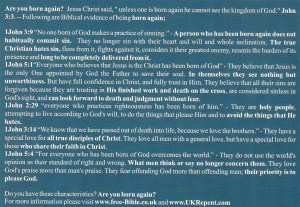
Someone handed me the above card in town yesterday. ‘Are you born again?’ No, mate, and neither are you. As Bart Ehrman shows in Jesus Interrupted, and as I’ve written about before, the story of Jesus and Nicodemus in John 3 is a literary construct (as are the gospels in general.) The pun between ‘born a second time’ and ‘born from above’ only works in the Greek, where ἄνωθεν (anothen) can mean either ‘again’ or ‘from above’ (though it’s usually the latter.) Unfortunately, it is highly unlikely Jesus spoke Greek. Here’s Ehrman:

  In the Gospel of John, chapter 3, Jesus has a famous conversation with Nicodemus in which he says, ‘You must be born again.’ The Greek word translated ‘again’ actual has two meanings: it can mean not only ‘a second time’ but also ‘from above.’ Whenever it is used elsewhere in John, it means ‘from above’ (John 19:11, 23). That is what Jesus appears to mean in John 3 when he speaks with Nicodemus: a person must be born from above in order to have eternal life in heaven above. Nicodemus misunderstands, though, and thinks Jesus intends the other meaning of the word, that he has to be born a second time. ‘How can I crawl back into my mother’s womb?’ he asks, out of some frustration. Jesus corrects him: he is not talking about a second physical birth, but a heavenly birth, from above. (Jesus Interrupted, p155)

So Nicodemus is made to misunderstand Jesus, confusing ‘born again’ with ‘born from above’, and Jesus has to tell him what a twit he is. Translators of this chapter haven’t understood the point of the story either, making Jesus say, in John 3.3, ‘you must be born again’, when the rest of the narrative makes clear he means, ‘you must be born from above’ (i.e: be renewed by God who sits in Heaven on high.) 2000 years later, Christians, thanks to these translators, still make the same mistake.

There’s even more poppycock on the back of the card. The born again, it seems, avoid sin like the plague. Sure they do. Just ask all those kids molested by priests, preachers and Christian youth workers.

Jesus v. Covid (and the winner is…)

Two years ago, a few months before Covid hit, I wrote a post entitled ‘God’s Very Good Creation’ that included the picture above. The post concluded that ‘Jesus can’t save you from the common cold, let alone death’. How the past 23 months have borne that out! We hear almost daily of anti-vax pastors, preachers and assorted evangelicals, who have trusted the Lord to save them from Covid, dying of the virus. The Lord failed to come through for them despite their faith in him and his promises.

I recognise there are Christians who like to tell us God doesn’t work like this. He’s not, they say, a dispenser of health and healing, a fairy godmother who fixes those who love him just because they pray in earnest that he will. They’re right of course; God doesn’t work like this. (God doesn’t work, period.) So why does the Bible tell us he does?

Is anyone among you sick? Let him call for the elders of the church, and let them pray over him, anointing him with oil in the name of the Lord. And the prayer of faith will save the one who is sick, and the Lord will raise him up. And if he has committed sins, he will be forgiven (James 5.14-15).

And these signs will accompany those who believe: in my name they will… their hands on the sick, and they will recover (Mark 16.17-18).

Whatever you ask in my name, this I will do, that the Father may be glorified in the Son (John 14.13).

Again I say to you, if two of you agree on earth about anything they ask, it will be done for them by my Father in heaven. For where two or three are gathered in my name, there am I among them (Matthew 18.19-20).

At best this is delusional wishful thinking, at worst, out and out lies. Surely the men who made these fantastic claims knew that God wasn’t like this at all, that magical thinking and ritual didn’t really cure illness? (Perhaps we should expect nothing better from people who believed that God had granted them eternal life.) Despite their dishonesty, some believers today are still prepared stake their lives, quite literally, on the same false promises, discovering when it’s too late, that they are empty and meaningless. The Lord will not and has not saved anyone from Covid nor anything else.

Worse than that, however, is how Christian anti-vaxxers affect others; dissuading the gullible from having the vaccine, spreading infection and providing the means, the culture, for the virus to mutate. They also take up space in ICUs that people with unavoidable medical conditions need but can’t access because of them – like the child in this story. It’s also likely that, should health services become overwhelmed this winter because of the unvaccinated contracting Covid – the overwhelming majority of hospitalisations are of the unvaccinated – the rest of the population will need to go into lockdown again. The UK government, while saying it wants to avoid further lockdowns, has not ruled them out should the NHS need ‘saving’ once more.

Sarah Palin has said she will not get the vaccine because she ‘trusts in the science’. No, it doesn’t makes sense (when has she ever?) Palin believes her own immune system will protect her, failing to understand how vaccines work – by priming the immune system to produce anti-bodies against disease before coming into contact with it.

Palin and those similarly motivated by the fatal combination of ignorance and religion, who refuse to protect themselves and others, are selfish and socially irresponsible . Their actions are as far from loving one’s neighbour as it’s possible to imagine.


Jesus writes…

Image: Caleb Havertape (https://www.pinterest.co.uk/calebhavertapei/_saved/)

Ubi Dubium has posed the question, ‘why didn’t Jesus write his own gospel?’ It’s a good question. What better way to ensure his ideas were conveyed precisely without any margin for error or misinterpretation, than to do it himself? If he hadn’t the time or the ability to do so, why didn’t he dictate his message to one of his literate disciples (surely one of them could write) who could then, as an eye-witness, finish off the story accurately once Jesus himself had returned to Heaven. Why, instead, did he leave it to people he’d never met, most of whom wouldn’t be about for another few decades?

It seems to me there are three possible answers.

  1. Jesus believed the world as he knew it was soon to end. He was convinced God was about to intervene and sweep away the old order and inaugurate the Kingdom of God on Earth. If the gospels that have come down to us are to believed, this was the core of his teaching. Jesus mentions its imminence repeatedly across the synoptic gospels and the morality he proposes, wholly impractical in the long term, is designed for the ‘shortness of the hour’. In this scenario, Jesus and his followers had no interest in writing anything down for posterity. There was no posterity; the end was very truly nigh.

  2. God didn’t want his Son to write his own story. He wanted the job left to people whom Jesus never met, who were little more than children during his lifetime and who lived hundreds of miles from where events occurred. God was sure this was the best way to create a record of his Son’s visit to Earth, without inaccuracies, inconsistencies and contradictions. 

  3. The creator of Mark’s gospel bought into Paul’s celestial Saviour, his illusory ‘Lord Jesus Christ’. Mark set about creating a ‘what if’ back story for him, set in Palestine in the recent past and constructed from Paul’s ’revelations’ and Old Testament ‘prophecy’. Mark highlighted Paul’s teaching that the Christ, whom he calls the Son of Man in his gospel, would soon be coming to the Earth (not a second coming or a return) to rescue his Chosen and reset reality.

Are there any other possibilities? I can’t think of any, nor have I read of any. So which of the three is the most plausible?

Scenario 1 leaves us with a Son of God not knowing what he was talking about. This Jesus was wrong about when the Son of Man would appear, wrong about the End of the Age, wrong about the traumatic nature of God’s intervention, wrong about the Final Judgement, wrong about the fate of the unrighteous and wrong about the Kingdom of God being established on the Earth. This scenario gives us a Jesus who is a failure as both a prophet and Messiah. It’s a wonder anything at all was written about such a loser, let alone narratives that preserved his hopeless predictions about the Kingdom’s arrival.

Scenario 2 is of course ridiculous, though it is the one most Christians buy into, more or less. As well as its inherent implausibility, it relies on the hypothetical document Q, for which no evidence exists let alone any extant copy (or even fragment). It, and a supposedly reliable oral tradition, are speculative, needed only to counter the improbability of this scenario.

Scenario 3, while contentious, makes most sense of why neither Jesus nor any of his contemporaries wrote down or otherwise recorded a single thing he said or did. Mark’s gospel, created shortly after 70CE, was the first anyone had heard of a Jesus on Earth. The three subsequent gospels were all based, to varying degrees, on Mark’s fable. In this scenario there was no real Jesus, and no dozy disciples, to have recorded his exploits and teaching.

What you think, Ubi?

Prophets At A Loss (again)

What a joy it is to witness the prophets of the Lord who a few weeks ago assured the world that Jesus had told them Donald Trump was going to win the US presidential election. Look at them floundering now to explain away their foolishness:

Pat Robertson on 20th October: ‘Without question, Trump is going to win the election.’

After the election: ‘Here is my take on the election. In my opinion I think Trump won it. That may shock you… There are cases being filed in many courts but I don’t give them much chance of winning.’

Paula White on 5th November: I hear a sound of victory. I hear a sound of abundance of rain. I hear a sound of victory. The Lord says it is done. The Lord says it is done. The Lord says it is done.

After the election: ‘God’s decision has been made… the church must enforce some things in the realm of the Earth. We must take authority over every demonic spirit, every high thing.’

Kat Kerr on 24th October: ‘Trump will win. He will be president of the United States. He will sit in that office for four more years and God will have his way in this country.’

After the election: ‘One of the things [God] had me say was that Trump would win by a landslide… But many times, as we know in the Word or even just from experience ourselves — especially as a prophet — that doesn’t ever mean what man thinks that means.’

Jeremiah Johnson on 30th September: ‘I had a dream… God showed me… President Trump will be re-elected.’

After the election: ‘There has been a chorus of mature and tested prophets in America with a proven track record that have predicted Donald J. Trump would be re-elected President of the United States. I am one of them… Either a lying spirit has filled the mouths of numerous trusted prophetic voices in America or Donald J. Trump really has won the Presidency and we are witnessing a diabolical and evil plan unfold to steal the Election. I believe with all my heart that the latter is true.’

Denise Goulet on 19th October, speaking to Trump in person: ‘The Lord showed me today that you are going to get a second wind…another in-filling of the Holy Spirit…because the Holy Spirit makes you able to finish, to take this to the end, Mr President.’

After the election: f*** all.

It’s demons! An evil plan! I meant something else! I still think I’m right! I hope everyone forgets what I said.

Friendly Atheist Hermant Mehta has a whole lot more. These people are either frauds or self-deluded idiots. It’s stating the obvious to say that God and Jesus do not communicate directly with them. They haven’t been singled out to receive divine messages. Yet that is what they believe, or claim to anyway. They know no more about the future or God’s intentions than a typical house fly does. Yet the gullible, those caught in the same pretence that is Christianity, believe them. Yes, there are smart arse discerning Christians out there who say they never fall for these charlatans. Yet they do.

In Jesus Eclipsed, David Chumney cites Eugene Boring who, he says, ‘catalogs dozens of sayings ascribed to Jesus in the Gospels that very likely originated with later Christian prophets’ (my emphasis). Yet the writers of the gospels pass off these ‘spiritual insights’ as though they were Jesus’ own. Those who first read the gospels believed they were. Christian’s today assume the same. They’re not. They’re the words of religious zealots making things up as they went along. Some, most perhaps, no doubt believed what they were channelling the words of the Lord. Others wouldn’t have been quite so sincere.

There is no such thing as a prophet. God doesn’t make his intentions known through cranks and fraudsters. There’s no God and no Eternal Jesus to do such a thing, as today’s holy con-artists so ably demonstrated with their predictions of a Trump victory.


Stories


  • Many Christians believe that God himself impregnated Mary and that her son, Jesus, was God Incarnate. Yet they don’t accept that numerous others, including Perseus, Buddha and Vishnu, who were all fathered by gods, are in any way divine. Why not?
  • Evangelicals and other Christians believe that Jesus performed many miracles. However, they dismiss other miracle workers as frauds or mythical beings. As John Oakes puts it on the Evidence for Christianity website, ‘religious figures (such) as Osiris, Empedocles or Krishna almost certainly were not real people, making stories of supposed miracles they worked irrelevant’. Why?
  • Christians believe Jesus fed 5,000 people with 5 fish and 2 loaves. They don’t believe the Qur’an’s story that Muhammed did much the same thing. Why not?
  • Christians believe Jesus was visited by the long dead Moses and Elijah. They believe Paul saw Jesus after he died. Yet they dismiss the Mormon claim that Joseph Smith saw Jesus and God himself. Why?
  • Christians believe Jesus came back to life a day and a half after he was killed. However, they regard the resurrection stories of Dionysus, Osiris and Attis as counterfeit. Why?
  • Christians believe Jesus rose into the sky to take up his place in heaven. Yet they think it preposterous that Muhammed went there on a flying horse. Why?

When it comes to their own stories Christians are adamant that they are reliable accounts of events that really happened. Jesus really was God’s son. He really did do magic; really did feed 5,000 people with a few scraps; really did rise from the dead and really did beam up to heaven. Paul really met him on the road to Damascus.

Even liberal Christians like Joel Anderson, while acknowledging there is much that is suspect in the Jesus story, argue with all the cognitive dissonance they can muster, that the gospels are nevertheless ‘historically reliable’. This really won’t do. Evidentially, the gospels are as ‘historically reliable’ as the tall tales involving Osiris, Buddha, Vishnu, Muhammed and Joseph Smith. Gods only make visits to the Earth in stories, individuals only rise from the dead in stories, magic and miracles only occur in stories. The Christian examples of these tropes are as imaginary as all the others. The heroes of such stories – be it Empedocles, Perseus, Mithras, Buddha, Krishna or Jesus – are fabrications too.

If it’s constructed like a story, has all the components of a story and reads like a story then that’s exactly what it is. 

Making it all up

While the Old Testament is made up of myth and legend and the New created from the visions and dreams of a few disturbed individuals, we are expected to believe that the gospel accounts nevertheless shine out as beacons of truth.

We know, however, that much of what is contained in the four canonical gospels is fiction. I’m not referring here merely to how contradictory they are (though there is that), I’m talking about the parts that are clearly made up, invented for theological and literary purposes. These include:

The nativity stories: These are myth, created so that the Godman has an origin similar to those of other Godmen: There is no historical evidence for a wand’rin’ star, a census that involved the mass movement of populations or the Massacre of the Innocents.

The virgin birth: relies on a misreading of ‘young woman’ in Isaiah 7.14

The flight to Egypt: a misapplication of Hosea 11.1.

Genealogies: invented. Matthew’s and Luke’s are completely different and don’t, in any case, include sufficient generations to reach back to ‘the first man’.

The Magnificat: Written as a Greek poem. It is not an outpouring of a young peasant woman.

The temptation in the wilderness: Jesus did not have a conversation with the devil. He was not attended to by squadrons of angels; we know such beings do not exist. In any case, which eye-witness was present to record these fanciful encounters?

Angels: 12 appearances across the gospels. Demons and other evil spirits: at least 20 mentions. Myth, pure and simple.

The miracles: all of them make a theological point. This is their purpose. They are literary.

Jesus’s teaching: designed to encourage members of the cult, a cult that could only exist after the events the gospels purport to relay. Everything he’s made to say comes from different sects, Paul’s teaching, Old Testament wisdom literature and even pagan sources.

The sermon on the mount: created and written in sophisticated Greek, not delivered by a semi-literate itinerant preacher.

John’s self-obsessed Jesus: nothing like the character in the synoptic gospels. Either he’s made up or they are. Or both.

The Transfiguration: Elijah and Moses do not return from the dead to have a chat with Jesus. This is completely made up.

The Eucharist: first appears in Paul’s teaching in I Corinthians 11.23-27. It is distinctly pagan but is accommodated in the gospels because Paul insisted he got it directly from his (imagined) Christ.

Judas’ betrayal: suggested by Zechariah 11.12-13 (which in context is not a prophecy).

The custom of freeing a prisoner (Barabbas): no such custom existed. The event is symbolic.

Resurrected corpses emerge from their graves: Matthew made this up. No-one else seems to know of it and Luke makes a point of cutting the episode out of his version of events.

The Crucifixion: based on Isaiah 53 and various Psalms.

The Resurrection: based on the visions of Cephas, Paul and others with added, invented detail, incompatible across the four accounts.

The Ascension: Jesus levitates into the stratosphere, in front of witnesses no less. Or perhaps not; Luke invented this impossibility.

There is much more in the gospels that is evidently and demonstrably made up. We can, as Christians do, believe it all really happened. We can insist that the stories are not based on other sources but that these sources are prophecies of real events that took place in history. From this perspective, Paul’s and others’ visions are then the result of these same events.

But which is more likely? –
The Old Testament is packed with prophecies about Jesus’ life and death, and that what Paul and others saw in their heads was because Jesus really existed and spoke to them once he’d returned to Heaven…

Or: The Jesus story is fictional, a patchwork of Old Testament snippets, mystical visions, invented symbolic events and pagan ideas of resurrecting Godmen.

And If the gospels are fiction – and they evidently are – then why not Jesus himself? If there was no real history to be written about him, just this mish-mash of other sources, that can only be because there was no Jesus who walked the Earth 2000 years ago.

Jesus is the same as his near contemporaries Osiris, Dionysus and Mithras. Like them, he is entirely mythological.

What are the Odds?

To look at it another way…

The stories of the Old Testament are largely fictional. They’re myth, legend and otherwise fabricated. There was no Eden, no world-wide flood, no slavery in Egypt, no Exodus. There’s no evidence that the characters around which events supposedly took place actually existed: no Noah, Abraham, Moses, Job, Jonah or Daniel. Their stories were created long after the time they purportedly lived; centuries later. The stories written about kings – which, if they existed, were no more than half-remembered tribal chiefs – and the so-called great prophets are constructed from folktales. In short, nothing we read in the Old Testament actually happened.

When we get to the New Testament, we find convoluted exposition of Paul’s ‘revelations’ about Jesus; visions and imagined sightings of a celestial being he had in his own head. It’s the same for the fruitcake writer of Revelation who envisaged an unreal comic book Jesus; invention every bit of it. The Acts of the Apostles offers a fanciful and wholly inaccurate ‘history’ of the early church, including angels, teleportation and fatal miracles. Of the 21 letters in the New Testament, at least 11 are forgeries, known to have been written by anonymous authors who were not who they claimed to be. The other 10, including Paul’s genuine letters and the likes of Hebrews, make up all sorts of mystical stuff about an angelic Godman-cum-high priest.

 And yet, in the midst of these myths and legends, made-up characters and stories, forgeries and fantasies and mystical musings stands the indisputable truth of the gospels. Or so Christians and theologians would have us believe. These particular stories, surrounded as they are by fiction on all sides are historical, factual and true.

What are the odds?