The Stuff Christians Say… (part three)

DoorToDoorAtheists are aggressive/militant/unreasonable: The Christians might’ve got us on this one. After all, it is incredibly irritating when we atheists start preaching in the town centre or invade others’ events to tell them what to believe or dish out loony pamphlets or turn up at people’s doors when they’re just about to have their tea. And what about all those meeting places we have, on just about every corner of the city, with smart-arse posters about Adam and Steve on the board outside? And let’s not forget our readiness to blow up ourselves and others in the name of our great cause. Now that’s ‘militant’! Yes, we atheists really do have too much freedom to push our views on others. No wonder we’re so insufferable. (Note to self: check you’ve got this right.)

It takes more faith to be an atheist than a Christian: It takes no faith to recognise there are no supernatural beings. It takes no more faith not to believe in God – or to acknowledge that there is no God to believe in – than it does not to believe in Santa Claus, Poseidon or Ra. Christians themselves require no great abundance of faith to dismiss these characters. Is it so difficult to understand that atheists disregard the Christian pantheon of fantasy figures in exactly the same way? Or are believers practising their dishonesty-for-Jesus again? There is no faith involved in being an atheist. On the other hand, believing in an omnipotent but suspiciously inactive God, a super-hero Saviour, a magic Spirit, angels, cherubim, seraphim, demons, Satan, resurrected saints, Heaven, Hell and all manner of powers and principalities – this requires faith in delusional quantities. No atheist could possibly compete. Nor would they want to.

Faith: An Exercise In Futility

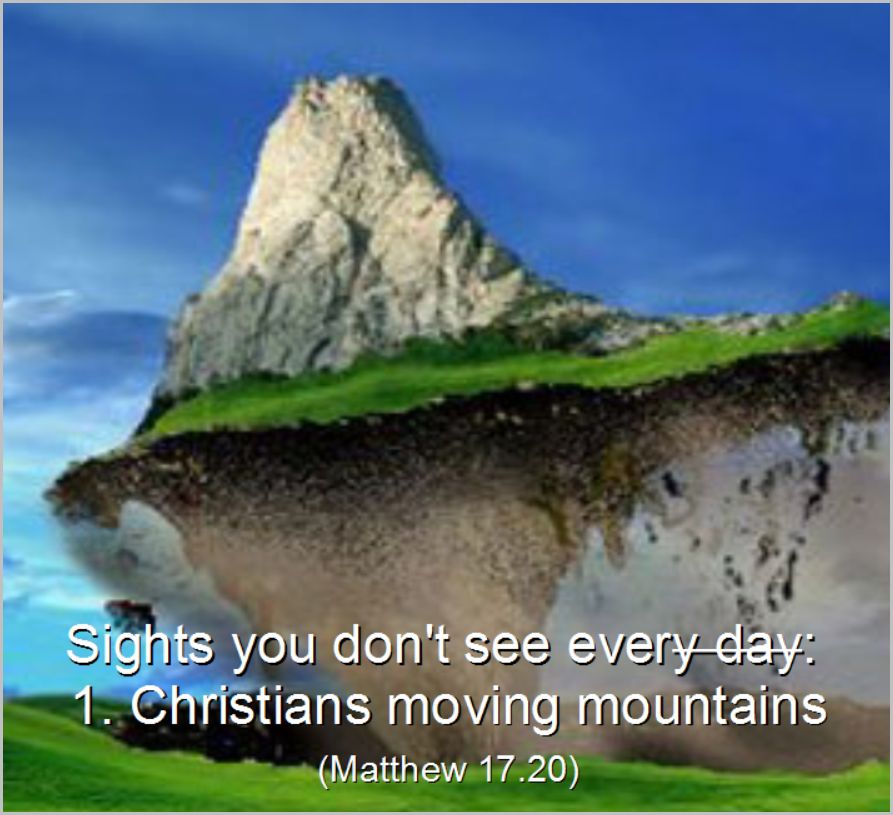
MountainsWhat is faith?

The anonymous author of the book of Hebrews says it’s ‘the substance of things hoped for, the evidence of things not seen.’ (11.1)

Hoping for ‘things’ like perfection, resurrection, eternal life, heaven (not to mention the ability to move mountains), the likes of which no-one has ever achieved, is nothing but wishful thinking. Despite what the Hebrews author says, wishful thinking isn’t evidence of anything – except a capacity for wishful thinking.

By it’s very nature, then, faith is not evidence, but the very opposite. It is the effort to believe in things for which there is no evidence and the delusional insistence that the imagined is more real than that which is.

The Stuff Christians Say… (part two)

Balaam

Atheists don’t behave as evolution says they should: This ridiculous accusation is often slung at atheists by Christians who seem to see it as some sort of stinging rebuke. Answers In Genesis is very fond of it; the Hamster’s drones and other Christians seem to believe – without ever thinking it through (plus ca change) that because those who acknowledge the veracity of evolution don’t behave according to its principles they are somehow inconsistent in their ‘beliefs’ – hypocritical even. They seriously propose that because natural selection and the survival of the fittest (not one of Darwin’s phrases) are cruel, uncaring processes, then that is how, for the sake of consistency, atheists ought to behave too. We shouldn’t care, they say, when a child develops cancer or someone dies. We shouldn’t attempt to cure illness or work to prevent suffering because these are nature’s way and part of the mechanism of evolution.

While it’s true they are, it’s been a long time since our behaviour, our existence and continued success as a species has been solely determined by what nature does. Humans regularly override its mechanisms, natural selection included; every time we use birth control, show compassion for the weak, heal the sick, develop medicines, engineer genes and preserve life. And so we should.

Christians seem unable to comprehend that evolution is not a pattern to be followed. It is not a set of instructions for living, a prescription or a set of (a)moral guidelines. It is the best explanation, supported by considerable amounts of evidence, of how life developed on the Earth. As such it makes no ethical claims nor does it demand that its principles be blindly followed (that’d be religion). Are Christians truly unable to detect this difference?

Atheists have no reason to be moral: I’ve looked at this ignorant claim before. Of course we have reason to behave morally. We’re human, we live in human society. Morals help us do so while doing the least damage to ourselves and others. They may also enable us to bring some happiness or comfort to those around us. Atheists don’t look to an imaginary God to tell us how to be good; our morals come from our culture, upbringing and education. Christians’ morals do too, whatever else they may claim. They certainly don’t get them from that most immoral of books, the Bible.


to be continued…

The stuff Christians say… (part one)

Jesus-Facepalm

On the day Christians remember the time Jesus allegedly spent being dead and buried (that’s one day, if you’re counting; what happened to the three he promised?) by going shopping or watching sport, let’s take a look at some of the nonsense they spout about atheists:

Atheism/humanism is of Satan: Given there’s no evidence for any supernatural beings, there can be no devil, Satan, Lucifer – or whatever other name Christians come up with for this fantasy figure. (Bizarrely, it’s Jesus who’s called Lucifer in Revelation 5.5) The devil is a creation of the human mind, intended to explain the nasty stuff in life and to let a supposedly good God off the hook. It follows that an imaginary being can’t make human beings be anything. The devil therefore does not make people atheists nor direct them in their ways.

Humanists/atheists set themselves up as God: Every manifestation of the god(s), including those that happen to be popular at present, is of human origin. Like all the others, the Christian God is a product of the human imagination that is made manifest only through human behaviour. So who is it who sets themselves up as God? Those who recognise that this creation of the human mind has no external reality, or those who claim an intimacy with the ‘Supreme Being’, believe his Holy Spirit lives within them and delude themselves into thinking they speak for him? No prizes.

Humanists/atheists worship man as God: Atheists don’t do this either. We are well aware of humans’ fallibility, inconsistency and capacity to bugger things up. However, we’re all we’ve got. There’s no God going to come and save us or solve our problems. We have to do it ourselves (or, as the case may be, not). Nor do atheists regard other people as wicked sinners who have no good in them – a particularly unhealthy viewpoint favoured by the religious – but this hardly constitutes ‘worship’.

Atheists hate God: Only to the same extent we ‘hate’ Santa Claus, Poseidon and Ra. You can’t hate (or rebel) against something that doesn’t exist. We do get very tired though of Christians foisting their views on us, insisting we should believe what they believe. And we get angry when they disparage others and attempt to curtail their freedom because they alone know what Jesus would want. But being angry about Christians’ unreasonableness is not the same as hating something that doesn’t exist.

To be continued

Is It Wise To Be An Atheist?

Tract

Christians say the funniest things… like ‘atheists can’t possibly know that there’s no God.’

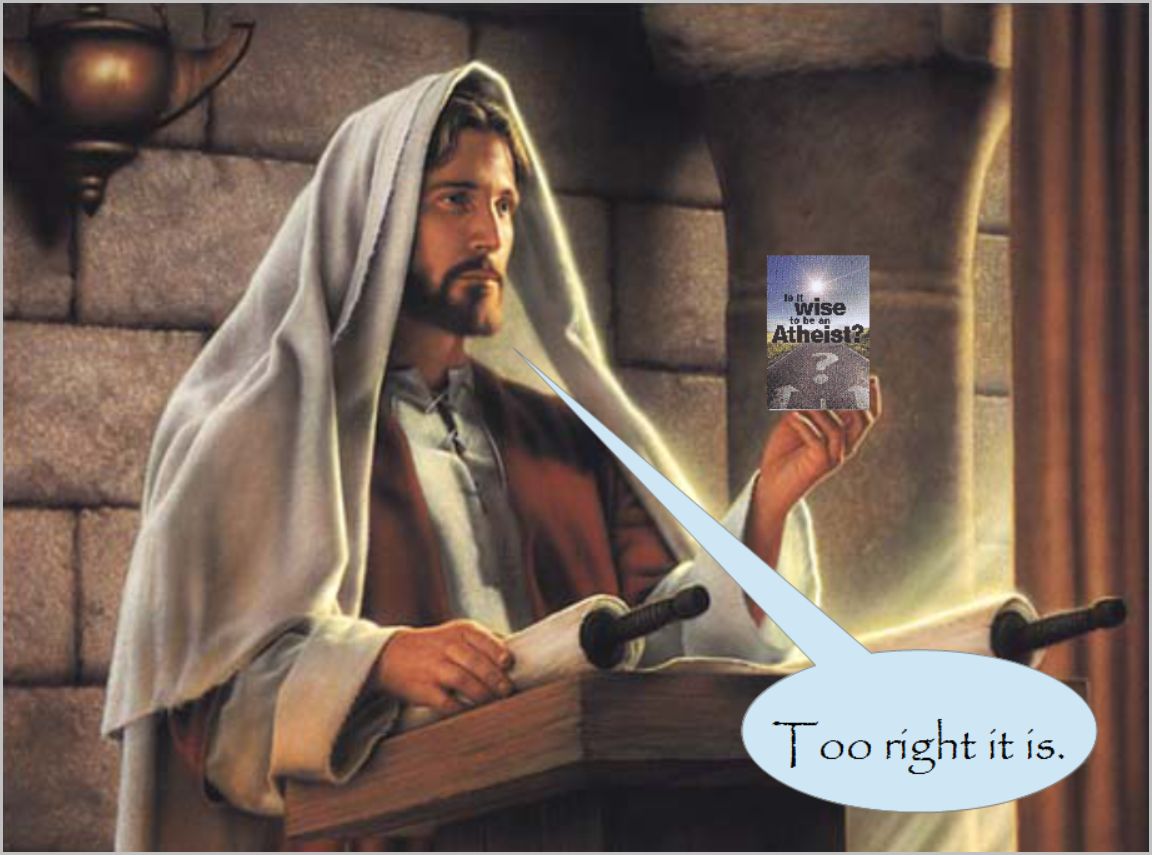
This is the argument expressed in a tract,  Is It Wise To Be An Atheist?, that I was given on the street the other day:

A person cannot really be sure there is no God (unless) they have existed for all time and have identified that God isn’t there; they have been everywhere and have seen that God isn’t anywhere and they know everything and therefore know for certain that God is non-existent.

Safe to say, these are not the same impossible criteria Christians apply when determining whether deities other than their own exist. Even Christians know that Allah, Zeus, unicorns and the tooth fairy don’t really exist. But without being immortal, omnipresent and omniscient, they cannot know for sure. By their own criteria, all mythical/supernatural beings have as much chance of existing as their God. Yet Christians do claim, with reasonable certainty, that other Gods and imaginary entities are not real. This is because determining the authenticity of entities is not about absolute certainty but probability and, yes, reasonable certainty.

For reasons I explore on this blog – here, here and here, for example – the likelihood that a god of some sort exists is low. That that god should then turn out to be the one worshipped by Christians today reduces the possibility still further, on the basis that the more conditions one adds to a proposition, the more improbable it becomes.

To put it another way, the probability that there is no god is already high; that there is no God as conceived by Christians is higher still. Therefore it is reasonable to conclude he does not. This is reasonable certainty; the same reasonable certainty Christians apply when dismissing all other gods.

Better luck next time, Christians.

Arguing for God

God3It’s a funny thing, but there aren’t hundreds of sites on the internet arguing for Barrack Obama’s existence. Nor the Eiffel Tower’s. Nor Australia’s. Nor the moon’s, nor the universe’s.

Why not? Because we have an abundance of empirical evidence that all of these things are real. People have experienced them first hand, can observe them and interact directly with them. There is no need to ‘prove’ or argue for their existence.

There are, however, hundreds of sites – plus books and broadcasts – that argue for the existence of God. This is telling. It is, whether those offering such arguments realise it or not, a blatant admission that there is no empirical evidence for him. If there were, there would be no need for argument and ‘proofs’; no need for apologists to resort to persuasion that is ultimately self-refuting to ‘demonstrate’ his existence. No need for apologists. Their problem is, of course, no-one has ever met God nor observed or interacted directly with him. Not in the same way people have met President Obama, seen him on the television, heard him speak or interacted with him in person. No-one has done anything of the kind with God, not even those who claim they have and feel compelled to tell us all about it. Every encounter with the Almighty has taken place in the mind of the individual experiencing it, just as St Paul admitted. God himself has never made an appearance.

So, yes, it’s very telling, this having to argue for God. If there was clear evidence of him there wouldn’t be any need to devise arguments for his existence; he’s not, or shouldn’t be, a philosophical proposition. An omnipotent, omniscient, omnipresent, creative being would, by dint of his immanence (presence in this world), be somewhat obvious and there would be incontrovertible evidence of his existence. Christians and other god-botherers say there is such proof, citing Nature, Goldilocks universes, Holy Books and personal experience. But these are far from incontrovertible, being much better explained by other means, none of which involve God. His very superfluousness demands that, through the application of Occam’s razor, he be discarded; not, as apologists would have it, rebranded as ‘transcendent’, a sleight of hand allowing them to proffer unreality as the ultimate reality.

The desperation to convince others there’s a God with an existence outside the human imagination is, then, more than adequate demonstration that there isn’t. Christians and others who want us to believe their God is real, protest much too much and in so doing, demonstrate precisely the opposite.

Our Father

FatherJosh, our social worker, would always tell us that our father didn’t mean it. He didn’t mean to threaten and intimidate us. He didn’t want to have us cringing in fear of him whenever he came near. Josh said our father loved us really, in his own way. I think we knew that ‘in his own way’ really meant ‘not in the way anyone else would recognise as love’. But, Josh said, whatever it might look like, father really did love us. It was just, Josh said, that he was naturally short-tempered and really couldn’t tolerate what he judged to be our terrible behaviour, even though none of us was really what you’d call badly behaved. No more than most children, anyway. Just by being there, it seemed we irritated father to such an extent that he’d punish us severely, the punishments out of all proportion with our supposed misdemeanours. Dolores once spent the night in the coal shed because she forgot to ask father’s permission for something trivial. No-one could remember what the next morning when she was allowed back in, crying, shivering and covered in black dust. But father said she deserved it for being such a wicked child. He said we all did.

We’d appeal to Josh, of course, but he’d just say we should ask father’s forgiveness for our wickedness, but as we explained to Josh, it seemed to us that father was the wicked one. We couldn’t see what we’d done that we needed to ask forgiveness for. Josh said that this sort of attitude wasn’t going to get us anywhere except into more trouble. Didn’t we know father loved us very much? All the same, he said, he’d have a word with father on our behalf. ‘He’ll listen to me,’ he said, but it didn’t seem like he did. Father’s demands would become all the more exacting as he told us he expected more of us only for our own good. Then he’d punish us when we couldn’t do what he asked — when we weren’t what he asked, which seemed terribly unfair when we couldn’t be anything more than he’d made us in the first place. Maybe if he’d been around more and had shown us more love than he did, we might not have turned out to be such a disappointment to him.

As you might expect, we eventually lost all faith in Josh. He really wasn’t much use. He promised to fix things with father, but it always seemed like he was on father’s side rather than ours, and his threats still hung over us. We would never be good enough for him, even with Josh’s ineffectual interventions. So when we grew up we all left home. I don’t think any of us has any contact with father now. I’m fairly sure he’s dead, in fact. He has no more control over us anyway; we don’t live in fear of his threats and punishments. We’re finally free of him, thank God.

Round in Circles

JC2

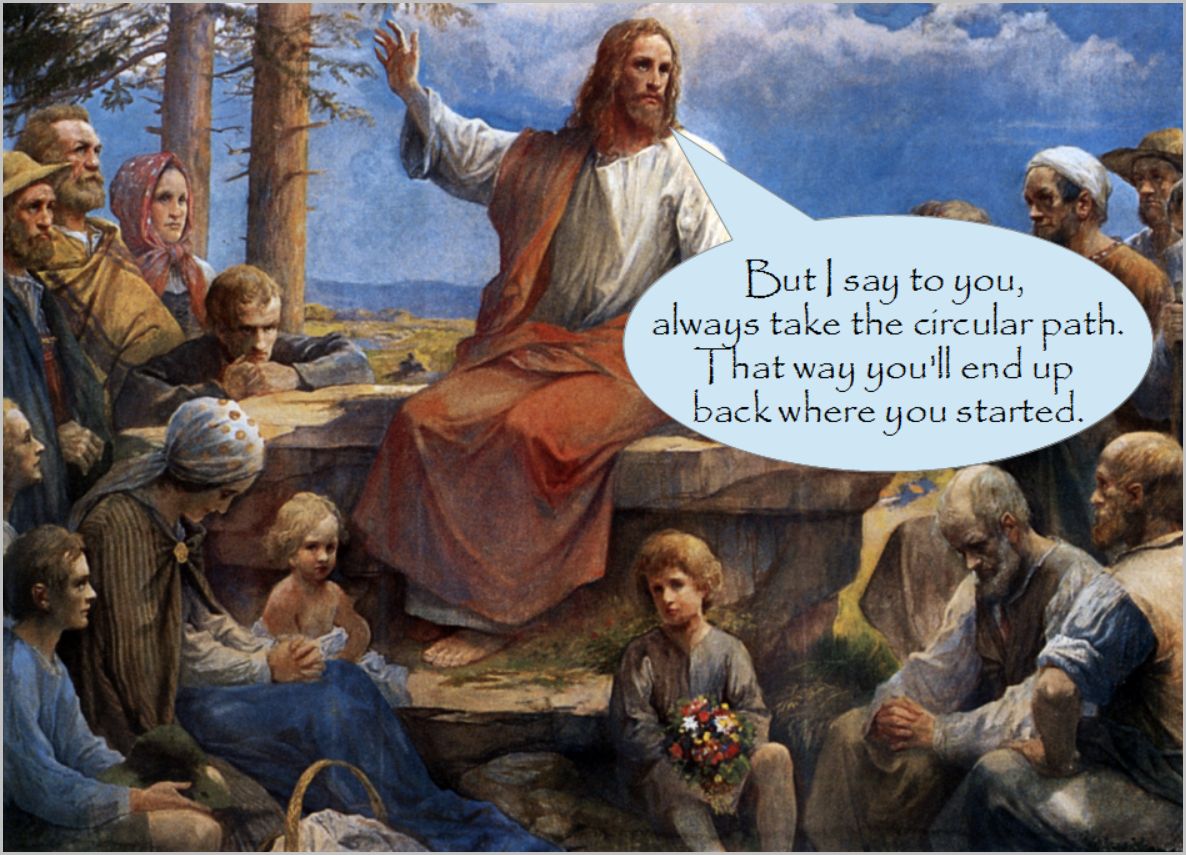
Being a religious believer means you can’t be a free thinker. Your conclusions are already determined for you – in the Bible or Qu’ran or some other holy book – and you are compelled, if you’re fundamentalist in your beliefs, to reach and affirm these conclusions. More than this, you are compelled to begin with them, which is why Ken Ham can say that where you start determines where you end up (though this only applies to those who think magic books have all the answers). So if you believe, because the Bible appears to say so, that the universe and all that is in it was created in six days about 6,000 year ago, then that is the premise from which you begin. You are then highly selective in the evidence you’ll consider, forcing it to support your predetermined conclusion. Christian argument is always this circular and heavily dependent on confirmation bias.

It can’t be anything else:

William Lane Craig ‘knows’ that the Holy Spirit is real because he feels it inwardly; the Bible tells him this kind of feeling is attributable to the Holy Spirit, so consequently the Holy Spirit must be real.

Pastor Mike Ratcliff understands that the Bible says everyone is a sinner; Mike’s confirmation bias means he sees sin and apostasy everywhere; therefore the Bible is right when it says everyone is a sinner.

Pastor Steven Anderson condones slavery. God approves of it in the Bible therefore slavery cannot be morally repugnant, and attempts to eradicate it are misguided. How does he know this? Because the Bible says slavery is okay.

Christians generally argue that God is good (because the Bible says he is) but have to disregard the horrors of his creation and the cruelties of life to reach the conclusion that, yes, God is good.

There really is no arguing with such arrested development, such intellectual dishonesty. Christian are not open to wherever reason and the evidence might take them; the end is always assumed at the beginning. Maybe that’s why comments are rarely allowed on Christian web-sites. You can’t argue with the Truth™ – another premise masquerading as a conclusion.

My preciousss is mine (and mine alone)

bible3Christians have a monopoly on the Bible. No-one else should comment on it, criticise it or even quote from it. Or so Christians tell me. The reason for this, apparently, is that ‘it is absurd to contest the Bible when (you’re) missing the one main ingredient: Jesus’. Not so, of course; the Bible is there for anyone who wants to consider and ‘contest’ it. Granted one’s perspective will be coloured by how one regards it to begin with –

whether you approach it with a reasonable degree of objectivity or look at it through the myopia of faith;

whether you take what it says at face value or apply shifty exegesis to smooth out its many inconsistencies;

whether you acknowledge it was created over time by a succession of fallible men or assume it represents the accurately recorded words of God;

whether you regard it as beliefs of ancient tribesmen and religious fanatics or see it as the means of salvation and the ultimate guide to life.

It is only reasonable that those who take the first of each of these alternatives look to those who take the latter to see how closely they adhere to the demands the Bible makes of them. It’s reasonable because those who believe in its magical properties use it to tell the rest of us how wicked and/or lost we are and how much we need Jesus. If the Bible is the Word of God (as I’ve noted before, it doesn’t claim to be; it’s Christians who say it is), instructing believers on how to live their lives while spreading the gospel, it is not unreasonable for those of us on the receiving end of their ‘witness’ to take a look at how that works out. Not so well as it happens.

Now either this is the fault of the book – heaven forfend that it isn’t clear about what’s expected of God’s Chosen – or Christians themselves are to blame for failing to live as it expects. Unsurprisingly, it’s a combination of the two; a book of mixed messages in the hands of flawed human beings. When Christians refuse to acknowledge that the Bible is far from perfect they are faced with the challenge of making its impossible demands compatible with their own imperfections. They have a number of cop-out excuses that enable them to do this, several of which appear in the comments on this blog. I’ve discussed a number of them before, but here’s a quick summary:

Christians are not perfect and the Bible doesn’t say we should be (actually it does, in Matthew 5.48);

Others have no right to be critical of Christians when we’re doing our best;

You can’t use our own book against us when you don’t know Jesus (see above);

You’re a sinner so what do you know?;

You’re quoting out of context (and only Christians can do that);

You’re not applying the correct exegesis and/or hermeneutics (i.e. mine);

The Christians you’re criticising aren’t real Christians;

It is unfair to lump all Christians together.

Is it? Is it really unfair to lump all Christians together? Aren’t you all meant to be one body, the Body of Christ – you, the Pope, Westboro Baptists, the mega-churches and their celebrity pastors, Joyce Meyer, those who would stone gays, those who affirm gays, Franklin Graham, Alpha converts, abortion-clinic bombers, African witch-finders, Archbishop Sentamu, ‘Emergents’, those who belong to one of the thousands of other denominations and all your friends in your own little church? Who are you to say who’s saved and who isn’t? All Christians represent all other Christians, who represent Christ himself. The Bible says so in 1 Corinthians 12.12-26, Ephesians 4.14 -16 and elsewhere. Or did it get it wrong again?
The Embarrassment that is the Old Testament

bible2

When does the Old Testament count and when doesn’t it? When does what it says matter and when doesn’t it?

The answer to both questions is when Christians say so. It counts when something from it can be used to underline how wicked the rest of us are and when they think it’s pointing to the coming of Jesus, many years in its future. It doesn’t, of course, foretell of Jesus as such, despite its predictions of a coming Messiah and/or Son of Man. Jesus doesn’t fit its descriptions of either of these figures. Rather, Jesus’ story is read back into the older texts, their characters and events forced to serve typological and prophetic purposes for which they were never designed. The entire endeavour, which began very early in the development of Christianity, is entirely back to front, with the gospel writers, Paul and other New Testament authors pillaging older Jewish texts and forcing them to fit Jesus retrospectively (and often laughably.)

Regarding ancient Jewish texts as an Old Testament – that is, as representing a previous agreement/covenant between God and his people that has since been superseded – is a political, interpretive manoeuvre of the later religion. (While it’s true Jesus is made to speak of a new covenant, it is debatable how authentic his words are; rewriting the past is not only confined to the New Testament’s treatment of the Old.) This kind of slippery manoeuvring was also endorsed by those who later compiled the Bible as we now know it,* when they relegated the writings that Jesus and all the New Testament writers would have regarded as sacred Scripture to nothing more than a forerunner of the real thing.

Believers want to hang on, naturally, to Genesis, because that’s where it tells them God created everything using nothing but magic and breath from his holy lungs. It relates too how everything went pear-shaped after some mythical people ate some fruit. Noah’s ark is there too, which is a jolly good fantasy, apart from that weird bit at the end where Ken Ham gets an eyeful of his old man’s old man (Genesis 9.20-27). Christians are less keen on those Old Testament stories where God instructs the Israelites to massacre other tribes (1 Samuel 15.2-3; Deuteronomy 2.34 etc) and rape their women (Isaiah 13.15; Zechariah 14.1-2 etc) but nonetheless they’ll defend these unpleasant, barbaric stories just because they’re in the Bible. The Psalms are nicer, what with their words of comfort and paranoia, but best of all are the Old Testament pronouncements that can be used for clobbering sinners. Leviticus 20.13 – ‘If a man lies with a male as with a woman both of them have committed an abomination; they shall be put to death; their blood is upon them’ – is a particular favourite, as is the story of Sodom and Gomorrah for much the same reason. But when it comes to other diktats, Christians are less interested; rules about not eating shellfish or wearing clothes of mixed fabrics, they are quick to point, are entirely negated by the new covenant; they don’t count any more, even though they’re in the same list of largely petty rules as the homophobic one (Leviticus 11.10 & 20.9.)

So how do Christians decide which Old Testament laws are applicable and which are now inessential? There is no shortage of know-alls Christian scholars who make it up as they go along and can tell them. It’s easy you see; the old ‘ceremonial’ rules of the old covenant are now redundant while the moral precepts still stand. Needless to say, the Bible itself suggests no such thing, with Jesus saying precisely the opposite in Matthew 5.17-18 and Luke 16.17; evidently another of his strange ideas that can safely be ignored.

So how do we know which of the Old Testament’s prescriptions are ceremonial and which moral? The same self-appointed experts can tell us this too, though it’s actually easy to work it out for oneself. As a general rule of thumb, verses that condemn other people are still applicable while those that Christians themselves don’t care for are not. So the shellfish and mixed fabrics directives can be disregarded, because obviously they’re ceremonial, while the anti-gay stuff isn’t – obviously. And there’ll be no public stoning of wayward teenagers (Deuteronomy 21.18-21) because that’s obviously ceremonial too – and don’t even think of having sex with the slaves, not even ceremonially. These days, thank God, it’s considered so uncivilised (even if, in Numbers 31.17-18, Yahweh says it’s okay. )

The Old Testament then; an embarrassment Christians are compelled to defend as part of their magic book but which they nevertheless feel free to use selectively, according to taste. Not unlike the New Testament really.

*There are, we should note, several variations of the Bible within Christendom; God can’t seem to decide which books are or are not part of his Holy Word.