
Can you be good without God?

Good

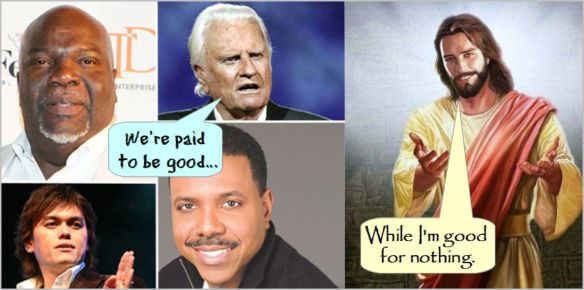
You can’t be good without God, you can only be good with him – or so Christians like to tell us.

What is the evidence for this? What ‘goodness’ do we see in and from Christians (and other believers in God) that demonstrates they are directed in their morality by a supernatural being who, they say, dwells within them? ‘By their fruits ye shall know them,’ declares their leader in Matthew 7.16 – so what ‘fruits’ do we see?

How about Christians abusing the vulnerable? Sexual abuse of minors has long been widespread in the Catholic church and more and more cases are coming to light in Protestant ones too. Bruce Gerencser keeps a log of those accused and convicted of such crimes, adding names and cases from the States on almost a daily basis. Is this the ‘goodness’ Christians like to say comes from knowing God?

Or how about those believers whose ‘goodness’ manifests itself in cruelty, dishonesty or extreme right-wing views? (Never mind goodness, from these examples it would seem God doesn’t even provide his followers with common sense.)

Then there’s the likes of former judge Roy Moore, anti-LGBT politician who, when he’s not trying to erect monuments to the ten commandments, is excusing his history of grooming and abusing 14 year old girls? What part of this behaviour is ‘good’?

How about preachers like Franklin Graham, Stephen Green here in the UK and the self-righteous know-alls of Teens4Truth, all of whom persistently bear false witness? Perhaps demonising others with the intention of stirring up hatred and paranoia is somehow ‘good’ inside the Christian bubble.

‘Ah, but wait!’ say those Christians who insist we can only be good with God. ‘These people are not true Christians; if they were they wouldn’t be doing these things. Their behaviour tells us they’re not really Christians at all.’ And yet, they all profess faith in Jesus and are convinced his spirit lives in them; however they behave, and whether or not other believers accept it, they are Christians by virtue of this profession alone (Romans 10.9). Christian apologists can’t get out of the double-bind they’ve got themselves into by saying those who do wrong can’t be considered Christians and only those who are seen to be ‘good’ are true believers. They can’t reasonably demonstrate the goodness of God’s Chosen by discounting those who don’t manifest the characteristic they’re attempting to demonstrate, while pointing only to those who remain.

‘Well,’ Christians say, ‘non-believers and atheists are capable of behaving immorally too!’ which is true. But wasn’t their original argument that Christians are so much better (more good) than non-believers because of the indwelling Holy Spirit and their resulting spiritual discernment (or whatever)? Pointing out that some non-believers are capable of behaving as deplorably as some Christians is hardly a demonstration of the supernatural goodness that allegedly infuses Christ’s followers.

It has always seemed to me that religion is like alcohol. A little too much of either accentuates an individual’s true nature. If he or she is already a decent, kind person, drink and god-bothering tend to highlight these characteristics. If, on the other hand, a person is self-centred, greedy and unreasonable then that’s what we get more of. God has nothing to do with it; if it’s your nature, you can be good with or without him. As Bertrand Russell put it:

Cruel men believe in a cruel god and use their belief to excuse their cruelty. Only kindly men believe in a kindly god and they would be kindly in any case.

It is a pernicious lie that subscribing to a superstition imbues a person with ‘goodness’. It should be disputed at every turn.
 

The Moral Maze

Stoning

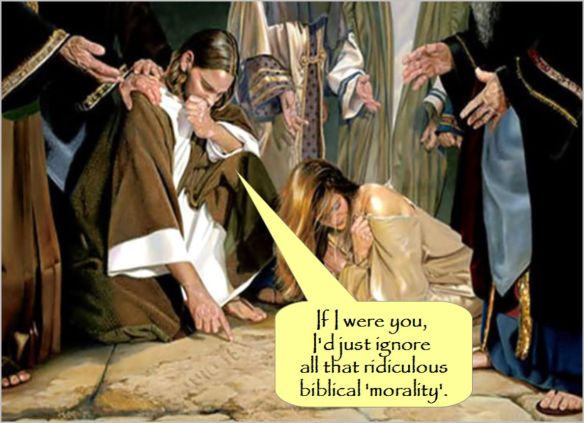
Where does morality come from? Ken Ham and others like to tell us it comes from the bible and the Christian ‘worldview’ they say they find there. Those non-believers who profess or practise morality in any meaningful way ‘steal’ it, they say, from this Christian worldview. They argue that without supernatural beings to dictate, with wild inconsistency, how we should behave, we simply wouldn’t know how to. That we do, by and large, means we can only have ‘stolen’ our morality from Christianity.

Unsurprisingly, the evidence suggests otherwise; versions of morality exist in all cultures – the secular, the pagan, the alternatively religious. Some of these are similar to those traditionally and often mistakenly associated with Christianity, some are not – which tells us they are socially determined. We decide ourselves, collectively, what is and isn’t morally acceptable. We don’t ‘steal’, or even need to, from the Christian ‘worldview’. Some of our morality might coincide with that espoused somewhere in the bible, but that doesn’t mean its taken from it. It means we value some of the same principles that ancient cultures valued – ‘do not steal’, is fairly ubiquitous, for example – because they too lived communally and needed rules like this one, as we do, to facilitate social cohesion. Of course, the collective understanding of a principle does not necessarily mean that everyone adheres to it, just as in those ancient cultures. Nonetheless we can all understand morality insofar as our culture defines and experiences it.

But let’s take a closer look at that ‘biblical worldview’ morality, that evangelicals think is the be-all-and-end-all, shall we?

T.C. Howitt, curator of the Oil for Light blog and commenter here, argues that ‘God’s moral law’, as demonstrated in the bible, is the only true (‘transcendent’ and absolute) morality. I’ve asked T.C. if he’s talking about the ‘morality’ that promotes the keeping and beating of slaves; the stoning of couples who have sex when the woman is menstruating; the execution of men who sleep with men, uppity teenagers and those who worship other gods, and which forbids work on the Sabbath (Friday evening to Saturday afternoon, that is).

It turns out it’s not (and yet it is) because, this, you see, is Old Testament morality and Jesus did away with all that. But nonetheless it’s still transcendent and absolute because it’s God’s Eternal Law. (I hope you’re following this so far.) However, in practical terms, what moralising believers seem to mean by biblical morality, is that which can be found in the New Testament. As I’ve pointed out to T.C., this is not the same thing as biblical morality.

So what does New Testament morality look like? Presumably it’s the morality promoted by Jesus, such as go the extra mile; sell all you have and give to the poor; turn the other cheek; give to everyone who asks; hand over your shirt when your jacket is demanded of you; don’t judge; love your neighbour as yourself; love your enemies; treat others as you like to be treated yourself, etc, etc.

If this isn’t what’s meant by New Testament morality then I don’t know what is. But forgive me – I don’t know many Christians who practise it, not even with an indwelling Holy Spirit and God’s personal support. That’s because it is an impossible morality. Consequently, Christians, like the rest of us, derive their moral standards from the culture around them, at the same time reserving the right to harangue the rest of us over our lack of ‘biblical morality’.

Doesn’t the bible have something to say about this? Oh my, yes it does. It goes something like this: attend to the log in your own eye, because it’s blinding you, and leave others to attend to the speck in theirs.

Now that’s what I call biblical morality.


On being free

chains

Commenter Rebecca responded at length recently to my post ‘Why God Could Not Possibly Have Created The Universe (pts 4 & 5)’. There was so much in her response, that I thought it best to reply to her in a full length post rather than with a brief comment:

Hi Rebecca,

I won’t be able to respond to all of your points as there are so many, but will attempt a few.

I’m glad you find your faith beneficial. You’ve obviously thought about the whole incarnation/sacrifice/reconciliation issue, but I wonder whether you’ve ever asked yourself what it is you need saving from and reconciled with? What is it that means you personally need to avail yourself of the sacrifice Jesus supposedly made (however you interpret that)? I guess evangelicals, of which you seem to say you are not one, would claim it’s because of sin; the alienation from God that our very existence seems to cause.

Is that really the case though? Isn’t it rather that ancient superstitious peoples needed some explanation for why life was so difficult, short and brutish? They reasoned that surely it couldn’t be the fault of the creator God, so his tendency to treat them badly must be entirely their fault. Consequently, they had to do something to appease this god, to make him smile upon them again as they felt he must once have done. They thought the way to do this was, variously, through sacrifice and/or righteous living, by murdering those they felt offended him the most, and through praise and supplication.

There is no getting away from the fact, however, that the primary way they sought to reconcile themselves with their deity was through blood sacrifice. The New Testament’s interpretation of the death of Jesus is expressed in just such terms:

In Him we have redemption through His blood, the forgiveness of our sins, according to the riches of His grace (Ephesians 1.7).

This is not just an evangelical perspective; it is the major theme of much of the New Testament.

I’d like to ask you, Rebecca: are you really so steeped in sin that you need to avail yourself of a bloody human sacrifice in order to be reconciled with God? I have to say it seems extremely unlikely.

I didn’t leave faith behind because of how repugnant this idea is, however. I experienced an epiphany while walking one day, after many years of thinking about such things, and realised with conviction that there was no god: no god to appease, be reconciled with or commune with. He simply didn’t and doesn’t exist (see here for why I think this is the case). Of course, there being no god means there’s no son of god either.

I then started living my life on the basis of the fact there is no god, and I have to tell you it became a whole lot better. I didn’t have the constant feeling I had to come up to some impossible standard; I didn’t feel guilt for the most trivial of ‘sins’; I no longer worried that not getting my beliefs quite right would result in the loss of my eternal life; I stopped worrying about eternal life because it was obvious there was no such thing; I stopped thinking hell and heaven were real; I started living in the here and now; I stopped thinking I had to respond to others’ needs by telling them about Jesus (and started relating to them as people); I no longer had to subjugate whatever intellect I have to force myself to believe things that were clearly nonsense; the self-loathing I felt about my sexuality began to slip away. I could be me, and what a massive relief that was. I think I became a better person as a result. I certainly became a happier one.

You say the bible contains many deep truths – perhaps – but it also includes much that is cruel, spiteful, damaging and just plain wrong. I lost interest in sifting the wheat from the chaff because there was just too much chaff (a free biblical analogy for you there.)

The secrets of life, whatever they may be, Rebecca, are not in the bible, nor in any convoluted explanation of what Jesus stood for (he was just another failed apocalyptic preacher). They do not lie in Christianity or in any religion. Life is more than any of these ultimately dead things.

Thank you for writing. It can only be a good thing that you’re thinking about these issues. You will I’m sure find your way out into the light. I hope what I post here can help you with that.

The evidence for Christ

Christ

The evidence for Christ is not historical — it’s spiritual — and that evidence is indeed abundant for those who believe.

So says T. C Howitt, commenter on the Rational Doubt blog. And what is the ‘abundant evidence’, of which he speaks, for the existence of this spiritual being? It is, he says, ‘spiritual’. That’s quite a tautology: ‘the evidence for my fantasy is my fantasy’.

T.C. goes on to say that only those who truly believe can know that their experiences of the spiritual are real; the rest of us, he decrees, are blind. In other words, evidence that his fantasy is real is that other people have experienced versions of the same fantasy – some of them thousands of years ago. The ‘evidence’ for Christ (as opposed to Jesus) is therefore one’s own feelings plus the strange psychotic experiences Paul relates that he feels sure must be this supernatural being.

Science removes human subjectivity, as far as is possible, from its demonstration of how things are. All that Christians (and other believers in the supernatural) need do is similarly demonstrate that the spiritual realm, with its attendant beings, has an existence independent of human emotions, feelings and imagination. They could show us that, like gravity, electricity and quantum mechanics, Christ and angels, seventh heavens, demons and all manner of spiritual beings, have an existence separate from the internal, subjective experiences of human beings.

They’ve had two thousand years to do just this and still they haven’t. Why not? Because it can’t be done: Christ and his angels, God and his heaven are mythologies and, like all others, are constructs of the human mind.


Say Hul-loa to the Loa loa, another of God’s amazing creatures

AiGlogo

Answers from the Depths of Ignorance

by Hen Skam on October 22nd 2017

What a great God is our Creator God! Like it tells us in his Word™, he made everything in only six literal days, 6,000 years ago. Then, after planting fake fossils in pre-aged rocks, he found he had a little time on his hands so set about making deadly viruses, pathogens and parasites.

Now, these amazing examples of God’s handiwork didn’t evolve! That would be ridiculous. No, they were made by God just as they are now. So let’s take a look at one special ickle-bitty critter called the ‘Loa loa‘.

You see, this little creature, carefully crafted by our wonderful creator, has an intriguing life-cycle which involves it living for some of the time in the human eye. Once it has burrowed its way in, it quietly eats the eye from the inside, and unless treated with medicine (derived from man’s fallible word, so obviously not recommended) it can render its host blind. It may also lead to early death, but as the Loa loa is found only in Africa, we needn’t worry too much about this. Instead, let’s acknowledge what a blessing it must be to serve one of the Lord’s creations in such a way!

How foolish it is of our atheist friends to think that such an amazing creature could have evolved! There are many more animals like the Loa loa, each and every one of them is the handiwork of the one true Creator God. What an amazing, loving God he is!


This item was written with the assistance of AiG’s pseudo-scientists.

Thanks for stopping by and thanks for paying

(for us to continue with this ministry of superstition and stupidity.)

Those resurrection experiences explained

Emmaus

Isn’t it amazing how modern Christians see Jesus in clouds (the picture in the previous post was taken from a site that genuinely believes it was Jesus in the sky – there were lots of others examples there too), on toast, in their own whipped-up emotions, through voices in their heads and as a result of inner-visions but deny that the original resurrection appearances were just the sort of thing? No, Jesus really appeared then, they say, resurrected in his damaged body – he showed Thomas the holes in his side, didn’t he?

Given people’s propensity for seeing things that are not really there – figures in clouds, the sense of a supernatural presence (‘Mother Mary comes to me’) – isn’t it more likely the original ‘manifestations’ of the risen Lord were precisely this; the same sort of ‘sightings’ that people claim to experience today? Maybe not on toast admittedly, but in their heads, in the euphoria of shared worship, in their need for comfort? I’ve done it myself, when I was a Christian. I sensed Jesus’ presence in carefully stage-managed worship, in intense prayer, in what I took to be his response to those prayers. Of course, these were nothing more than my interpreting my own emotions as something from outside myself; an intense and reassuring self-delusion.

Is there evidence of this sort of process in the accounts of the risen Christ? Sure there is – Paul’s encounter is a vision in his head (Galatians 1.16; 1 Corinthians 9.1 & 15:8), while the gospels have Jesus say that whenever two or three of his followers are gathered together, there he will be amongst them (Matthew 18.20). He cannot have meant that, long after he’d left the Earth, he’d be physically present. Rather, this is a later explanation of the intense emotion early believers felt and decided could only be Jesus’ mystical presence – his so-called holy spirit (which isn’t called ‘The Comforter’ for nothing.) They were doing what I did and what millions of Christians still do today – interpreting the feelings they shared in these worshipful contexts as visits from the risen Lord. Later, the gospel writers made Jesus ‘predict’ just such experiences and then firmed them up, so that the accounts of warm feelings and visions became, retroactively, encounters with a physically manifested person.

That’s how it happens today – a vaguely human-like shape in the clouds or on toast and warm feelings become an experience of Jesus. We readily see human form where there is none (we are psychologically primed to seek out human faces) and attribute external agency to phenomena that don’t have any. No reason to suppose it was any different back in the first century.

The oldest trick in the book

Cloud

Hemant Mehta draws our attention to a new book by ‘Christian Prophet’, Mark Robert Pryce called Princess Diana Speaks from Heaven: A Divine Revelation. In it, Pryce claims, the late Princess of Wales communicates with him from beyond the grave. Hemant notes how

(Diana) spends a lot of time convincing readers it’s totally her. Which is exactly what the real Diana would do, of course.

Sound familiar?

Here’s an earlier version:

After his suffering, (Jesus) presented himself to (the disciples) and gave many convincing proofs that he was alive (Acts 1.3).

I’ve always wondered why Jesus would need to do this. Wouldn’t his old friends just, well… recognise him? How exactly do you prove you’re alive? Wouldn’t it be self-evident when you were breathing, moving and talking right there in front of people? Unless, of course, you weren’t really there, but were some sort of apparition or shared delusion. Then, those who felt they were experiencing you would need to convince themselves that you were really there. Just as charlatan Prophet Mark Robert Pryce has ‘Diana’ do in his book.

Plus ça change.


The Same Old Song

Ascension2

How was it for you? The End of the World, I mean. The one last Saturday – 23rd September?

What do you mean it never happened? Christian numerologist David Meade promised it would. He worked it all out from the bible and stuff, and had numbers – numbers I tell you – to prove it.

When it didn’t happen, what did Meade do next? He explained that Saturday was only the beginning of the End. Terrible stuff was going to start happening on 23rd, that would lead up to the actual end End, which is not far off.

Same old, same old. How many times has this happened before? A predicted end-of-everything that doesn’t come to pass, followed by post-hoc ‘explanations’ from those who invented the nonsense? Invariably this entails some version of ‘it was really only the beginning of the end’, even though this is not what the ‘prophecy’ claimed before it failed. It’s easy to scoff, which is what Christians themselves do when one of their number fails spectacularly to predict the End. ‘They should know,’ they say, ‘that the Lord warned that no-one knows the precise time of the End.’ (And indeed he does in Mark 13:32.)

What they fail to see is that Christianity itself is built on a failed prediction that the End was nigh, and the resulting catalogue of excuses when it turned out not to be. Jesus (or those who put words into his mouth) was clear that the End of the World was scheduled while his pals and fans were still alive. When it didn’t happen, those who came after him invented all sorts of reasons why not: ‘he meant it would be a gradual process (Luke 17:20-21),’ ‘God doesn’t see time the way we do’ (2 Peter 3.8), ‘he’s delaying so more people can be saved (2 Peter 3.9). The writer of John’s gospel, written about 70 years after Jesus lived, solves the problem by ignoring the issue entirely.

Christians today leap on these excuses to explain why the world still hasn’t ended; yet there is an unassailable incongruity between this kind of fudging and what Jesus says. He thought and taught that the world was coming to a spectacular end soon, when God would remodel it in favour of the poor, the oppressed and the righteous (Matthew 16. 27-28 & 24.27, 30-34; Luke 21.27-28, 33-34 etc). He was wrong. Paul too thought God was going to rescue his ‘remnant’ while he still lived (1 Corinthians 15.51) and he was wrong too.

When it dawned on early Christians that the world was not going to end when Jesus and Paul had said it would, they started inventing their excuses. 2 Peter 3.3 warns that there would be scoffers in the last days, an undoubted jibe at those in the early second century who pointed out how mistaken Christians and their Christ were about the End. Those scoffers had a point and, two thousand years down the line, have even more of one.

Jesus is the archetypal failed prophet of End Times. Cranks like David Meade are merely modern day equivalents, purveyors of the exact same fatuous nonsense about the end of the world. Meanwhile, nothing changes; we are still here, the world is still here and God, as is the way with a non-existent being, remains characteristically unconcerned.

God delays his judgement so he can torture more people

Judgement2

A Christian pastor, ‘Peter C’, has been assuring everyone on Daniel B. Wallace’s blog-site that God’s judgement has been delayed (2000 years and counting) because, as it says in 2 Peter 3.9, he wants to give as many people as possible time to repent and avoid hell. The pastor puts it like this:

The Lord is longsuffering, and not willing that any should perish, but that all would come to repentance. The context of 2 Peter 3:9 tells us that this is why the Lord appears to delay His coming – it is His longsuffering and love for humanity. It is not His will that anyone would pay the penalty for their own sin…

The claim of 2 Peter 3.9 – written not by Peter but by someone pretending to be Peter almost a century after he lived – has never made sense. God would have to delay his judgement indefinitely if he wanted to avoid punishing most of mankind. That’s because new unsaved humans are appearing all the time – about 353,000 are born every day. The longer God leaves it, therefore, the more unsaved humans there will be, simply because, as time goes on, the more of us there are.

If God had got on with the judgement in the first century, as Jesus said he would (Matthew 16.27-28; 24.27, 30-31, 34; Luke 21:27-28, 33-34 etc) then the unsaved would have been far fewer.

Here’s the maths: the population of the world in the first century was about 300 million; today it is 7.4 billion. Assuming, very generously, that about 30% of the population then, as now, was ‘saved’, the judgement then would have resulted in only 210 million people being sent to hell. The same percentage today would see 5.2 billion people being condemned to burn for all eternity.

2 Peter 3.9 is a weak excuse for why God’s judgement didn’t occur when Jesus, and Paul, said it would. It was written either by a fraud who lacked any understanding of basic maths and had no conception of how the world’s population would increase over the next two thousand years – or by someone who, like his predecessors in the cult, thought the judgement was imminent. If the latter, then he was referring only to those alive in his own time whom he thought were being given more time to repent. Either way, he was wrong. That his mistaken beliefs and false assurances are given credence by pastors and their flocks today testifies only to the stultifying effect of religious faith.

Why God could not possibly have created the universe (pts 4 & 5)

Sacrifice2

The final two reasons why it is altogether unreasonable to credit the God of the bible with the creation of all that there is.

4. YHWH is inadequate

Christians want us to believe that the God of the bible is the ‘First Cause’ who purposefully created the cosmos. He is, they tell us, powerful beyond imagining, capable of bringing into existence a universe of infinite proportions, with its billions of suns, trillions of planets, nebulae, dark matter, black holes and the rest.

But this vast complexity stands is incompatible with YHWH, who demonstrates all the limitations we might expect of a god devised by primitive nomadic herdsmen. He is anthropomorphic, restricted in knowledge and defeated by technology his creators didn’t possess; like other deities of the period, he is obsessed with bizarre ritual, requiring genital mutilation and the sacrificial burning of animals. He lives, alternately, at the top of a mountain or in a box, from where he is capable of smelling roasting meat, and spends his time issuing laws about sex and slavery. He is primarily a god of war, his acts almost entirely destructive, rarely creative, which is what we might expect from a people continually in conflict with their neighbours.

Whatever else such a being might be, he is not one capable of creating the universe. He is nothing more than a small and petty tribal deity – one of many recognised by the Israelites during their history – created and sustained by men who knew no better. This is the god Jesus believed in, though he relocated him in the sky (‘the heavens’) and tried to turn him into something more amenable.

Despite this partial make-over, the New Testament version of God retains the attributes and limitations of his older self. He is, if Paul is to be believed, still pre-occupied with blood sacrifice, in dictating sexual behaviour and wreaking destruction on his supposed creation. He is no more capable of creating the cosmos than his predecessor. The God that modern Christians insist brought everything into being isn’t this limited, feeble, unsavoury figure. That God is another construct altogether, a far cry from the paltry god of the bible, and one they have devised themselves, that they make appear capable of creating the universe as we now know it to be.

5. The supernatural has no independent existence.

This is the bottom line: outside the human imagination, there is no evidence the supernatural exists. Even if we do take the human imagination into account, there is no evidence of an independent supernatural realm. No-one has ever seen a god, demon or angel, in exactly the same way they’ve never seen a fairy, goblin or unicorn. They may think they’ve experienced spiritual beings ‘within’ or felt them emotionally or hallucinated about them, but this does not mean they have independent existence. Despite millennia of religious belief no supernatural beings have ever manifested themselves, been witnessed, demonstrated or measured. Gods, like angels and spirits, do not exist. It follows, therefore, that the cosmos cannot have been created by them.

Thank you for bearing with me on my exploration of why god could not possibly have created the universe. I don’t know, of course – none of us do (yet) – how it came about, but the notion that it must have been god, the Christian god no less, simply isn’t feasible:

He would have had to create something from nothing, when the supernatural and immaterial are incapable of creating the natural and material.

The bible’s YHWH is too feeble to have been responsible and God-as-creator leads, in any case, only to an infinite regress.

The supernatural is a product of the human imagination; it has no independent existence.

However the universe came to be, we can be certain no gods, including the Christian one, were involved.