How to argue like a Christian (part two)

Street-preachers

Five more ‘arguments’ offered by Christians in defence of their insupportable beliefs:

You’re not entitled to speak because you have no objective basis for your morality; morality comes only from God/the Bible.

Except it doesn’t, of course; moral codes existed long before the Bible or even the invention YHWH, who is, in any case, morally bankrupt. This ‘most unpleasant character in all fiction’ ‘wallows’, if I might borrow the term, in genocide (1 Samuel 15.2-3 etc) and slavery (Leviticus 25.44-46; Exodus 21.20-21 ); he relishes the death penalty for the most minor infringements of his petty rules (Leviticus 24.16; Deuteronomy 21.18-21, etc ad nauseam); fails to keep his promises (Genesis 17.7; Mark 11.24); does nothing to relieve human or animal suffering and lets millions of children die needlessly, year in, year out. It just doesn’t suit his mysterious ways, apparently, to behave like any halfway-decent human being would.

And even if he were the morally-upright paragon of virtue Christians delude themselves into thinking he is, they would ignore his moral guidance at every turn, just as they do now. Ministers, priests, evangelists as well as run-of-the-mill believers are convicted every day of the most despicable of crimes (Bruce Gerenscer keeps a tally on his blog-site) and that’s before we get to the more exacting moral demands Jesus makes. Going the extra mile (Matt 5.41), loving neighbour (Mark 12.31) and enemy alike (Luke 6.27), giving to all who ask (Luke 6.30) – these most Christians simply ignore. ‘We’re forgiven, not perfect,’ they whimper, even though ‘perfect’ is precisely what their unreasonable saviour tells them to be (Matt 5.48). But then I’m probably quoting out of context again… or something.

You’ve been hurt in the past.

This weak, ad hominem response is the converse of the charge that you’re immoral; good cop as opposed to bad cop. The Christian who says this is all-seeing and all-knowing and is able to evaluate your entire psychology and personal history from a single comment you’ve made. They can tell that you’re only disputing an aspect of Christianity because obviously at some point in your past a Christian – who wasn’t really a true Christian – hurt you. Or maybe it was a church you once belonged to that let you down. Well, you’ve every right to feel hurt! But that doesn’t mean there’s anything wrong with the True Faith™ or those who subscribe to it! And so your point is neatly invalidated; you’re only responding emotionally and you’ll get over it.

If there’s no God then life is meaningless.

Used extensively by some Christian blog-sites, this non-sequitur translates as, ‘I’m not going to address anything you say. My neediness demands there’s some point to life and I’ve decided that it comes from the fantasy I’ve bought into.’ Questions of whether that fantasy is actually true (which by definition it can’t be) and whether life is meaningless without it, are never considered. Believers’ need for the delusion to be true, their fear of working out meaning for themselves and their subsequent investment in Christianity’s empty promises, compel them to hide behind what is an essentially… er, meaningless solipsism.

Unbelievers have no right to criticise those who belong to Jesus.

Haven’t we? We put up with all the nonsense Christians spout, their attempts to influence everything from elections to what we can see on TV, from their opposition to gay rights, same-sex marriage, women’s rights, abortion and adoption issues to the restrooms people can or can’t use and their judging of the rest of us as hell-bound sinners. In return, we unbelievers are perfectly entitled to hold Christians accountable. At the risk of repeating myself, do they do what Jesus tells them to? Do they turn the other cheek (Matt 5.39)? Sell their possessions to give to the poor (Mark 10.21)? Give more than is demanded of them (Matt 5.40)? Avoid judging others so they’re not judged in return (Matt 7.1-3)?

What do you think?

You’re of the devil/an enemy of the cross/wilfully blind/apostate/a troll.

If all else fails (and it will) the faithful resort to an insult carefully selected from the extensive bank of Christian cliches. That way, there’s no need to engage the brain at all. God love ’em!

 

Suffer the Little Children

Jesus said to them, “Let the little children come to me, and do not hinder them, for the kingdom of God belongs to such as these.” Mark 10.14

…the very hairs of your head are numbered. Fear not: you are of more value than many sparrows. Luke 12.7

Jesus+kid

Recently, I attended the funeral of a little boy who died of the cancer he’d suffered from the time he was nine months old. His young parents are friends of mine. They showed their son such incredible love during his illness, ensuring he received the best medical care possible.

But where was God through it all? The God that Christians say has a special affinity for children, who loves them and cares for them? The God who looks after ‘the little people‘?

That God was nowhere. He showed no interest in this particular ‘little person.’ No concern and no compassion for him or his parents. Of course, that’s because he doesn’t exist, though this didn’t stop Christians telling the family how marvellous and caring and loving he is.

Really? If I had any vestige of faith left, what has happened to this innocent during his short life would have cured me of it entirely. And make no mistake, he was innocent, not a sinner (as if that would let God off the hook.) A deity who allows a baby to have cancer and to die after fourteen months of prolonged, invasive treatment would be a callous, worthless bastard. But we knew that already.

Had there been a God who cared, this little boy would’ve been two today, Easter Sunday.

Faith by any other name (is still a waste of time)

celia3Faith; the brand name for ‘wishful thinking’. In what other area of life, other than the religious, do we have faith in faith? Christians like to say we do – we have faith, they say, in the pilot who’s controlling the aircraft we’re flying in, or we have it in the surgeon who’s operating on us. But this is not faith in the sense religious people usually use the term. ‘Faith’ in pilots, surgeons and even our own abilities is more like trust or confidence; trust that the pilot is qualified to fly the plane, confidence that the surgeon is trained and skilled or that we have the ability to complete the task we’ve set ourselves. This is not faith in the sense of ‘belief in things that can’t be seen and for which there’s no evidence’. It’s not faith in the sense of wishing and hoping there really is a God and that he cares enough about us to grant us eternal life, much in the manner of the magic fountains and wish-granting genies of folk tale.

Religious faith – Christian faith particularly – is of this latter kind. It’s not trust in a real person’s capabilities, be it our own or a specialist’s. It’s a blind belief in a God who evolved from being one tribal deity among many into the everlasting, omniscient creator of all things. A God who, if he did create everything, set us on the Earth together with viruses, microbes, infections, disease, sickness, cancer, AIDs and Alzheimer’s. A God who thought putting us in an environment so frequently hostile to our well-being on an insignificant planet in the corner of a vast and indifferent universe was just the right place for us.

This is a God who doesn’t seem to understand us but who is swift to punish us while he himself stands by as half of his favoured creation endures poverty, starvation and the cruelty of much of the other half. His ways are not our ways, believers say, making what they surely know is a flimsy excuse – the flimsiest – for his failure to interact with us in any meaningful way.

Faith is the wishful thinking that despite the evidence, this neglectful, capricious God really does care for us. He cares so much he has devised an illogical, incomprehensible plan (or two) that, with its blood sacrifice and magical overtones, we must believe if we want his forgiveness for the way he made us in the first place.

We need to have faith that this cosmic madman will bring us back to life us after we’ve died and take us to Heaven to live with him, but we must first have the right sort of belief, even if it’s difficult to work out what that is. Faith is necessary for all of this because there isn’t a scrap of evidence anyone has ever been returned to life after they’ve died, or that Heaven exists, or that anyone has ever gone there. That’s why it takes, not trust, but a great wallop of wishful thinking that this fantasy is not only real but more real than the reality in front of us.

As for me, I can’t believe any of it.

  – I can’t believe the claims of those who even today say they’ve seen or heard from God or Jesus or Mary, who reckon they’ve had visions the same way Paul or Peter, Joseph Smith or Mary Baker Eddy did.

  – I don’t believe those who say they almost died and went to Heaven, because what these visions of fantasy figures and make-believe places have in common is that they take place, so far as they occur at all, entirely within people’s heads.

  – I won’t believe that those who say all of this magic, hallucination and mumbo-jumbo is true because it’s in the Bible, when the creators of that book were men far more ignorant and superstitious than any reasonably educated person today.

  – I am unable to believe muddled nonsense that is designed to appeal to our vanity and fear of obliteration.

  – And I really don’t care that some say they get comfort, joy and morality from their belief; their morality no more derives from God as mine does from Superman and emotions don’t make any of it true.

So, faith – what good is it? If your answer is it enables you to believe the impossible, then isn’t it just another word for delusion?


It’s Only Make Believe

godsatan

All you have to do to become a Christian/be saved from sin/gain eternal life is to accept Jesus as your Lord and Saviour.

Except, it isn’t.

You’ve also to put your faith in the Bible, acknowledging it’s God’s word in some form or other. It would be impossible to be a Christian without it; you’re required  to read it, let the Holy Spirit or one of God’s chosen instruments here on Earth interpret it for you and you’ve to live by it.

And this, in turn, entails believing in the menagerie of supernatural creatures and invisible realms the Bible assumes exist. Angels and demons we considered last time, and then there’s –

The Risen Christ who sits at the hand of the Father. He sits? He’s like a real body, but at the same time not a real body? A spiritual body, then, who metaphorically ‘sits’ next to –

God the Father, whom no human has ever seen (confirmed by John 1.18 but contradicted by Genesis 32.20) who abides in –

Heaven, a place no-one has ever seen. No, really, no-one. Not even those people who have hallucinated about being there. Hallucinations, dreams, visions, even so-called out of body experiences, are not evidence Heaven exists. They’re evidence that people sometimes hallucinate, dream and have visions and out of body experiences. The same is true of ‘sightings’ of God himself and of –

The Holy Spirit. That’s the part of God Christians dupe themselves into thinking has moved in inside them to guide them through their Christian life. That’s the same Holy Spirit who’s guided God’s Chosen to create 34,000 different distinct interpretations of the Truth. Even now, the Spirit is leading church after church down the road of apostasy, according to those he also leads to condemn them. Confused yet? It all makes sense if you recognise that it’s all imaginary, created by human beings who didn’t and don’t know any better. Like –

Satan is. He’s the character who evolves during the course of Bible until he’s a cross between Lex Luthor and the Joker; God’s arch-enemy. He only ‘exists’ to get God off the hook. All the bad in the word can’t be God’s fault now, can it? Somebody’s got to carry the can and it sure isn’t YHWH. So Satan, the devil, gets to be the embodiment of evil. Which isn’t to say evil doesn’t exist because it does, but it’s not caused by this third-rate Dick Dastardly. Nor is –

The Anti-Christ. This is the guy Christians believe will appear at the end of the age, some time around AD 100 according to Revelation 14.9-10. Never mind his creator there calls him something else entirely (‘the Beast’ as it happens); unless he’s finally arrived in the shape of Donald J. Trump, he’s no more real than –

Those who’ve died (‘the saints’ according to Catholics) and have been given new, magic bodies in Heaven or –

Those who’ve died and have gone to Hell to be tortured forever. That’s because –

Hell doesn’t exist either.

Nor do seraphim (Isaiah 6.2), cherubim (Hebrews 9.5), dragons (Psalm 148.7), satyrs (Isaiah 13.21) or unicorns (Numbers 23.22 etc) .

How do we know these beings, places and states don’t exist? Well, they’re all invisible, intangible, undetectable, unverifiable, supernatural (literally, ‘outside nature’), and, ultimately, unconvincing. They’re rejects from far more interesting mythologies that abounded in the ancient world. Today’s mythologies – of Middle Earth, Game of Thrones and the innumerable virtual worlds of computer games – are far more plausible (and even then, not very).

The supernatural doesn’t exist; everything we know is part of a physical universe. There is no evidence anything exists outside, alongside or in addition to that universe. (Though if you think there is evidence for the supernatural – and I mean evidence, not ‘feelings’, personal experiences or ancient texts – then please make it known in the comments).

There is an abundance of evidence, however, that –

Human beings are rather good at inventing stories and mythologies;

Their psychology inclines them to inner imaginings;

They are largely irrational and with a tendency to attribute agency to inanimate objects, phenomena and the chimera of their own imagining;

They have a fear of death and their own personal extinction.

How could religion, with all of its make-believe, not fail to materialise under such conditions? And how can anyone in this day and age take it seriously, knowing what we do now?

I know I can’t.

How It Works: God

Let’s see. If there’s a God – and how could there not be? – he’d have to be perfect. And powerful and really, really good. Not like all those pagan Gods who are just a bit too much like us. No, the most bestest God of all would have to be big and powerful, and good and perfect. I mean, why bother otherwise?

Oh, oh… first problem. If he’s good and perfect, how to explain us and the fact life can be pretty crap and not good or perfect at all? That can’t be his fault, can it? He’s perfect, so he couldn’t possibly make something that isn’t. Soooo… only logical conclusion – the crap must be our fault. Something we do, or maybe something we are. Yes, that’s what it must be (plus we get to bump up our part.)

And shit happens. Tsunamis, earthquakes, the crops fail, the rains don’t come. Life can be tough and seem pointless. It’s all depressing, then we die. It can feel like we’re being punished. Wait! Maybe we are being punished! For things we’ve done, or for what we are. That would fit wouldn’t it? A good and perfect God would surely want to punish us, with death and destruction and stuff. So that’s what these things must be!

Let’s get all this written down, that this is how things are. This good and perfect God finds us offensive and that’s why life is so shit. Except, except… surely God’s a reasonable bloke at heart and can be appeased? We could wheedle our way back into his good books and then life wouldn’t be quite so bad. Not sure how, though. Maybe sending him presents would do the trick, though how to get them to him when we can’t see him or anything…

I know! Let’s eviscerate some animals and then burn them and that way, he’ll be able to smell our efforts up where he lives, in the sky. That’s bound to work. And to be doubly sure, let’s mutilate our genitals and keep our women subjugated – because he can’t fail to like that.

Or maybe not. Maybe life will still be shit and we’ll still be shit. Maybe we need something more… imaginative. So let’s pretend that this God of ours puts together a rescue package. And what this means is he zaps us with some magic that obliterates the bits of us he can’t stand, which is pretty much all of it. And – here’s the good bit – we get to keep some of the eviscerating and sacrifice stuff.

Let’s get that written down too. And, and… maybe we can have it that this God is really going to rescue us and make everything not shit any more. He’s going to shake things up down here… no, no, wait – better than that, we’re going to go and live with him in the sky once we die, which gets rid of how shit death really is, and we’ll all live happily ever after, those of us he’s zapped anyway. Everyone else he can torture and burn forever! Yes that’s it! That’s how it’s got to be. God can still be good and perfect, even though he murders just about everyone, and some of us will get to be good and perfect too, and all the crap will just disappear, as if by magic.

That’s it. That’s how it really is. I can see it all now.

Oops. Gotta go. Time for my medication.

straitjacket

God’s Chosen Ones

chosen The God of the Bible is not the God of Reason that Answers in Genesis, William Lane Craig, Tim Keller, Silence of Mind and others tell us he is. None of the evidence, some of which we’ve reviewed, supports the supposition. That’s because the God of Reason, like all gods, is a construct of the human mind. In much the same way as Yahweh was a reflection of irrationality, this God is a reflection of our rationality. He could not – and did not – exist before the Enlightenment, before Rationalism itself and the new understanding of mathematics, science and philosophy.

As appealing as his apologists try to make him, the God of Reason is demonstrably not the God of the Bible, who is defined by impulsive, destructive passions. No, he’s not the tempestuous Yahweh, nor is he the daddy-god Jesus imagined (who is just Yahweh with a few rough edges knocked off), nor the God of blood-sacrifice and atonement beloved of Paul. He is, like all those inventions, a fabrication of our own making. For Christians who are drawn to him, he is a false god. But then, aren’t they all?

Whichever version of the Christian God Christians choose to worship, however, they’ve got it wrong. They don’t choose to believe in him or to follow Jesus or whatever. Not at all; he chooses them (or not as the case may be.) Now known as Calvinism, the idea that God earmarked a select few to be his best mates right back at the dawn of time – while disregarding others who might want to be but aren’t on the guest list – is right there in the Bible. Paul first:

For those God foreknew he also predestined to be conformed to the image of his Son, that he might be the firstborn among many brothers and sisters. And those he predestined, he also called; those he called, he also justified; those he justified, he also glorified (Romans 8:29-30; see also 1 Thessalonians 1.4)

The idea is picked up by one of Paul’s imitators in the forged letter to the Ephesians:

For he chose us in him before the creation of the world to be holy and blameless in his sight. In love he predestined us to be adopted as his sons through Jesus Christ, in accordance with his pleasure and will—to the praise of his glorious grace, which he has freely given us in the One he loves. (Ephesians 1.4-6)

The same sort of time-loop paradox also finds its way into the gospels. In Matthew 22.1-14, Jesus tells a parable involving a man who has been asked to a Royal Banquet (i.e. the Kingdom of God) only for the King (Jesus) to take offence at the way he’s dressed. For this heinous crime he is bound hand and foot and unceremoniously thrown out. Jesus concludes his cheery tale with the aphorism, ‘Many are called but few are chosen.’

So much for ‘free will’, a notion that’s alien to the Bible in any case. If I were a Christian, which thank God I’m not, I’d really want some answers to the questions this bizarre idea throws up. We’ll take a look at what these are next time.

Picture shows Tim Keller, John Sentamu (Archbishop of York), ‘Pastor’ Rick Warren and ‘Pastor’ Steve Furtick. Chosen by God, every one. And some kids he couldn’t care less about.


Smash! Kill! Destroy!

handsofgod

So how has the great God of Reason done so far?

We’re still not out of Genesis and he’s –

Trashed his entire creation just because a couple who didn’t know how touchy he is managed to upset him;

Destroyed two towns and almost everyone in them because he found the locals offensive;

Drowned everyone in existence (except for an old piss-head and his family) because – you guessed it – they offended him;

Engineered a spot of child-abuse;

Decided the best way for people to show him they’re his bestest buddies is to have them disfigure their genitals.

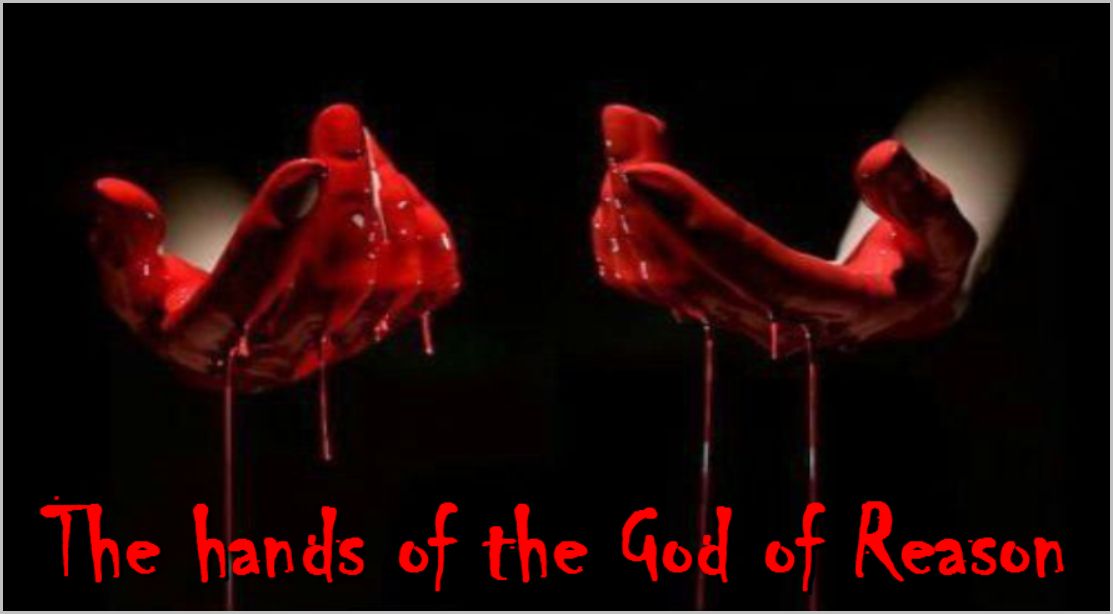
Now, honestly, Christians, how can you say any of this is rational or logical, reasonable or considered? Your God’s response to everything is Smash! Kill! Mutilate! Destroy! – never as a last resort, always as his first reaction. He’s the Hulk, Godzilla and ISIS all rolled into one. Not once does he apply reason or logic. Smash! Kill! Mutilate! Destroy! And not only in Genesis but throughout the Old Testament:

His chums want the land occupied by other tribes? Smash! Kill! Destroy!

They don’t show him enough love? Smash! Kill! Destroy!

They break one or other of his mostly petty rules? Smash! Kill! Destroy!

They offend him in some remarkably trivial way (collecting sticks, teasing a bald bloke, doing sex wrong)? Smash! Kill! Destroy!

Over and over again.

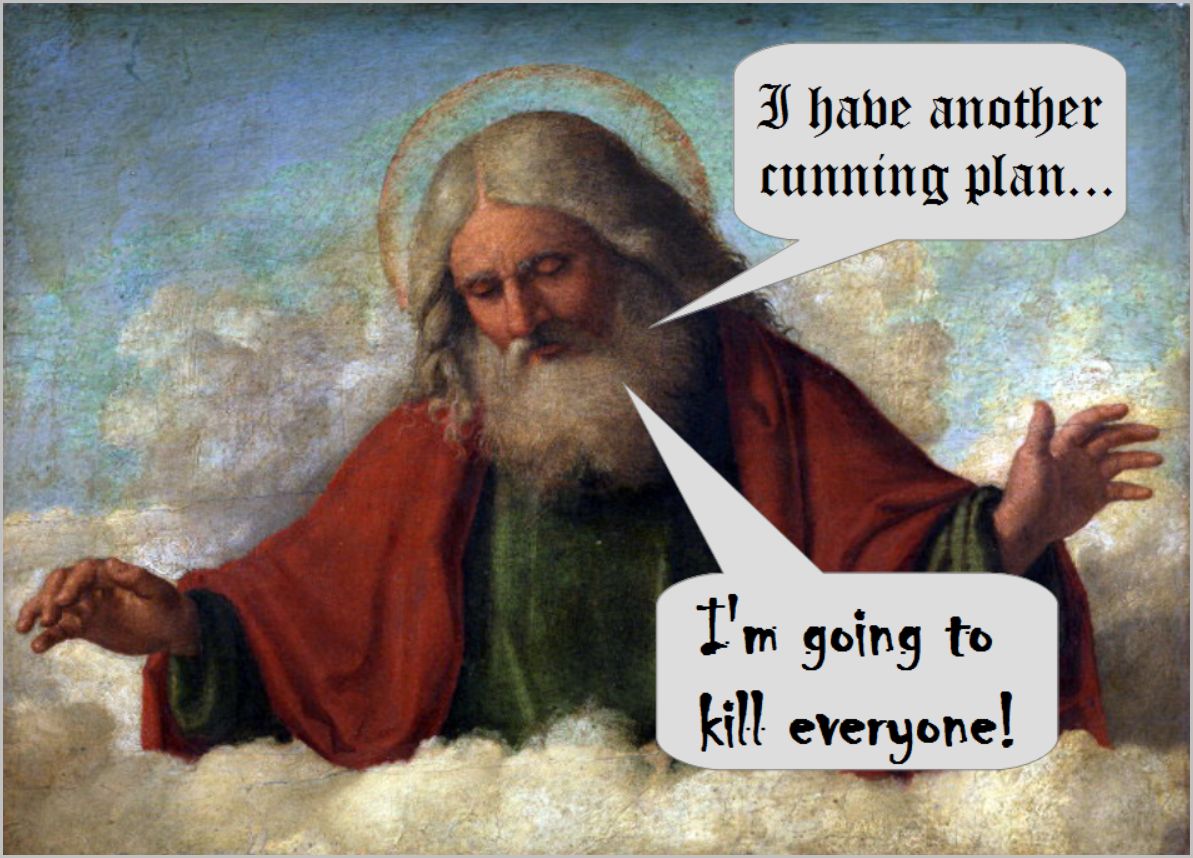
Until, at last, he has another big idea! Another Master Plan! The Master Plan to end all Master Plans! (His fourth at least.) And guess what? It’s all Smash! Kill! Destroy! Especially Kill! This is a dude who really can’t think outside the box.

Here’s how it goes: the Lord gives up on his previous Master Plan, which he’d told some selected desert marauders was forever and ever, and decides its time to have another go at sorting out mankind that he helped screw-up in the first place. His idea this time is to come to Earth himself as a sort of clone, which he creates by raping a young woman, just like all the other gods of old. When he grows up this clone/avatar tells everyone how God wants them to behave so they don’t upset the version still in Heaven quite so much. The clone then gets himself murdered at the hands of the very people he’s come to visit – the same ones the Lord promised to take care of forever and ever in his previous Master Plan – which magically allows anyone who repeats a special incantation to join an exclusive club. Everyone else he plans to torture and murder for all eternity, because that’s what he likes doing best. Of course, the version of himself he sends to Earth won’t actually make any of this clear – that’ll be left to someone else to make up afterwards – but, in the best illusion yet, he’ll come back to life before beaming up to Heaven to cosy up to his other self, the one preoccupied with death, destruction and mutilation.

This time it’s foolproof: a well-thought through, logical, rational and reasonable plan.

Except… not really. It’s bullshit. There’s no reasoning here, just a lot of stuff made up as people went along. None of it makes sense. The copy seems to have no idea what’s going on and certainly no inkling that his death has cosmic significance. On top of that, no-one really knows how the magic works – everyone who mentions it has a different idea – and the record of it all is scrappily cobbled together donkeys’ years after it all was supposed to have happened. Still, the main thing is it all involves a lot of killing – the clone first; then the poor sap manipulated into ‘betraying’ him; a couple who don’t want to give away all their belongings; some of the dudes who believe the magic is for real then, after they’ve really pissed off the Romans, lots more of them and finally, once the nutjobs get the upper hand, loads and loads of other people – which must really have pleased the God of Death Reason.

If this is the best he can do, then we’re in trouble deep. If our ability to reason comes from him, as Christians claim, it’s no wonder we can be irrational, illogical, unreasonable and unreasoning. Which of course is why he is, because he’s a reflection of the beings  that created him – us. Human emotions and cognitive capabilities came first and were projected onto the gods we created, including, eventually, the monotheistic monster, Yahweh. It was he primitive tribesmen decided must be responsible for natural disasters and the brevity and brutality of life. Such things had to be punishments, hadn’t they? And if punishments, then there had to be One doing the punishing. One who must be appeased if he was ever to stop. Hence sacrifices, behaving in ways that might please him, killing those who don’t, worship. All futile, like pleading with one’s own reflection in a mirror.

The God created by this kind of thinking only reflected back at his makers the worst of themselves; jealousy, anger, intolerance, belligerence, petulance, vengefulness and violence. Hardly ever Reason. 

And so does he still.


The God of Reason strikes again!

planWe’ve been looking at how well The God of Reason™ fares in the reasoning stakes. Is he as logical, rational and reasoned as his self-appointed representatives on Earth say he is? Is he logical, rational and reasoned at all? He didn’t do so well in the set-up, those wacky creation stories at the start of Genesis. There’s nothing reasoned or rational about his behaviour there. So how does he do further down the line? Does his intelligence evolve or does he make like Donald Trump for the rest of eternity? (Spoiler alert…)

Having willfully allowed everything to deteriorate into chaos, God is upset again when his abandoned human creation doesn’t behave as he wants them to. Evidently he couldn’t see this coming, so he decides the most rational thing to is to drown everyone and everything, with the exception of a family left over from an earlier myth by the Babylonians and a floating zoo. Everyone else, every baby, every child, every pregnant woman, every living thing – from the smallest insect on four legs to brachiosaurs and the cutest lickle kittens – he murders in cold water.

After he’s annihilated them all, Yahweh is dismayed when Noah gets pissed and romps around naked in front of his son, who is called Ken Ham (can’t blame him for not seeing that coming) and he realises this plan hasn’t worked out either. Now where, in all of these larks, is rationality? More nul points for the great God of Reason and his ability to think things through.

Yahweh’s next cunning plan involves persuading a bloke who’s a few brain cells short of a pastry case himself to murder his own son and burn his body. Yahweh tells him this will be such fun. But then, at the last minute, just when the kid is trussed up on a pyre with his old man ready to plunge the knife into him, God sends a messenger to call the whole thing off. Turns it was no more than a test. Never mind the trauma to the kid and the damage to his relationship with his father, this was the only logical way for Yahweh to see if ol’ Abe was one of the good guys.

He follows it up with another great plan; he promises he’ll look after Abe and his descendants till the end of time, so long as – wait for it – they all slice off the end of their penises. Now, come on – that’s a well thought through scheme if ever there was one.

Isn’t it?  

The God of Reason

god4

The next three posts will look at the claim Christians make for their God being the God of Reason. The fact that he is, they say, demonstrates how inconsistent those who see no evidence for a deity are when we use his very attributes – reason, logic and rationality – to make a case against him. Here’s Dr Jason Lisle on Answers In Genesis:

…there is an absolute standard for reasoning; we are to pattern our thoughts after God’s. The laws of logic are a reflection of the way God thinks… Laws of logic are God’s standard for thinking. Since God is an unchanging, sovereign, immaterial Being, the laws of logic are abstract, universal, invariant entities. In other words, they are not made of matter—they apply everywhere and at all times. Laws of logic are contingent upon God’s unchanging nature. And they are necessary for logical reasoning. Thus, rational reasoning would be impossible without the biblical God.

The materialistic atheist can’t have laws of logic. He believes that everything that exists is material—part of the physical world. But laws of logic are not physical… The atheist’s view cannot be rational because he uses things (laws of logic) that cannot exist according to his (Godless viewpoint).

Similarly, Tim Keller in his book The Reason for God argues that the fact humans can reason is evidence both of God’s existence (because reason has to come from somewhere) and of our being made in his image.

According to Christians then, God is the only reason we can think rationally at all.

But then where did God’s rationality come from? Is he pure reason or is reason an attribute he acquired or evolved over time as we did? As Richard Dawkins has pointed out, the only reasoning intelligence we know of is our own, and it is the product of evolution. If God’s ability to reason also evolved – and we know of no other way it could have developed – then he must intially have been incomplete. He could not have been the supreme intelligence Christians claim he is now. If, on the other hand, God is and always has been pure reason, there should be plenty of evidence for it. Let’s take look:

We first encounter God in the opening chapters of Genesis, where he puts two naked humans in a garden and tells them not to eat the fruit of a tree labelled ‘The Tree of the Knowledge of Good and Evil’.* He sets this tree right where they can see it and then he leaves. The two people, who have no concept of right and wrong (that’s the point of the tree) each take a bite of its fruit. While taking his evening stroll in the garden, God discovers what they’ve done and is not best pleased. (I hope you’re getting just how logical all of this is.**)

This deity, who, according to Dr Lisle and Tim Keller is the epitome of logical reasoning, doesn’t then take the trouble to explain to his creations, ‘Look, I’m sorry I made you without a sense of right and wrong; I’ll put that right. But you’ve got to promise me you’ll do as I say from now on because you won’t like me when I’m angry.’ No, he doesn’t do this; instead he throws a hissy fit. He punishes the couple, who until they’d tried the fruit had no idea disobeying him was wrong, and, just for good measure, he trashes the rest of Creation too – forever. Because of a single act committed by two naive individuals who didn’t know any better, he ruins everything and then, irrationally, blames the humans for the mess he’s made. That’s his reasoned, reasonable and rational response to their upsetting him – which, if he was the omniscient being Christians tell us he is, he’d have known was going to happen anyway.

Of course the whole set up and God’s reactions are not rational, reasonable or logical at all. They’re not considered, proportionate or insightful either. The God of Reason, the God who is Reason according to Answers in Genesis and Tim Keller, scores on this, his first outing, zero points on the scale of reasoned, reasoning reasonableness.

Maybe though God was just having an off day and he improves later on, once his intelligence has evolved a bit more. We’ll find out next time.


* All my examples of God’s great thinking skills and ‘reasonableness’ are drawn from the Bible; there are, however, simply too many to reference throughout this series of posts. I would be happy to supply them to any who feel the need to see them.

** Yes, I’m aware it’s a myth but a) many Christians don’t and b) even as a myth the story seeks to address how humans became alienated from God, ironically by developing the capacity to think for themselves. 


God wants you to beg

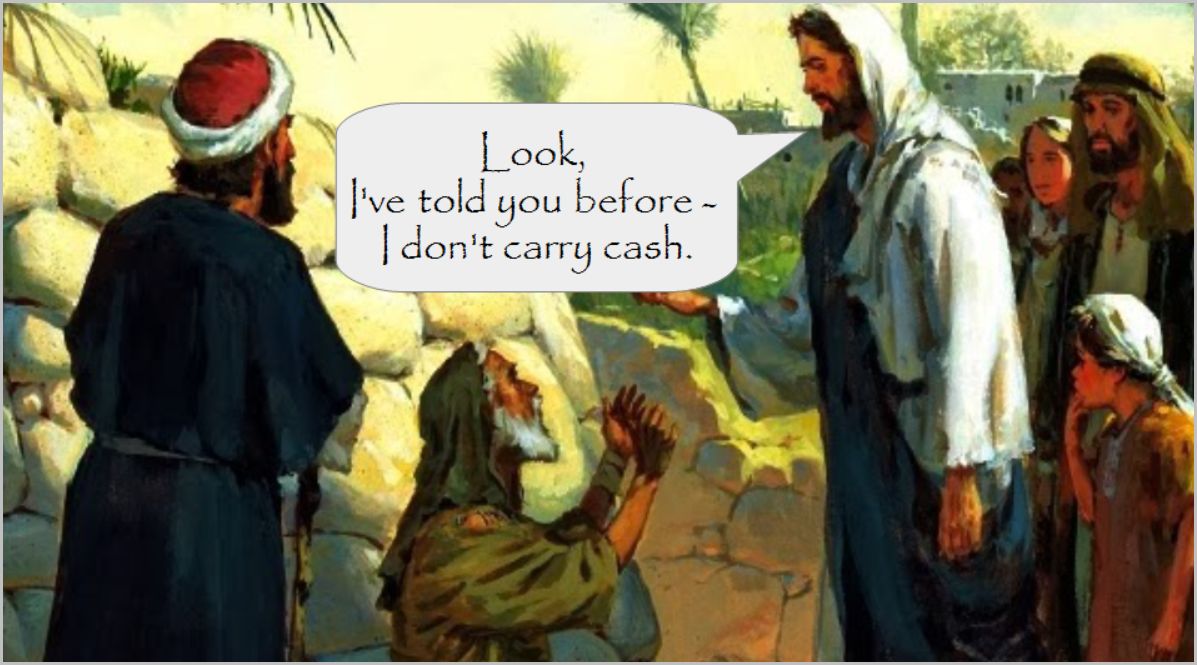
beggar2 What do God and the Queen have in common?

Neither of them do money. Famously, Queen Elizabeth II never carries cash. It’s not like she’s ever going to find herself out of milk so that she has to dash to shop for some. Even if she did, she wouldn’t be expected to pay for it. So she doesn’t need to bother with money.

Same with God. He’s less likely to run out of milk, it’s true, but he does lots of important work in the world and a bit like the Queen, who is funded in large part by the British tax payer, he expects everyone else to cough up what’s needed.

Though he’s a God of abundance who supplies whatever is asked of him, he just can’t bring himself to do money. We know this because those humans who work for him here on earth constantly have to beg other people for it. When they’re busy getting his Word™ out to those who don’t have a Bible of their own, the Lord refuses to pay a penny. Likewise, he declines to assist the brave souls who work tirelessly protecting one-man-one-woman marriage, which, as they tell us, was all his idea in the first place. Nor does he support building Noah’s Arks theme parks ($18 million in tax perks helped with that one), church maintenance (tithes anyone?), helping the persecuted or feeding the hungry. He’ll do all he can to help, naturally, just so long as he doesn’t have to put his hands in his pockets and get them grubby handling cash.

No, what all these noble causes need they have to raise themselves, which is why every single Christian enterprise begs for money, not from God who they know won’t help, but from fellow human beings. ‘Search your heart,’ they tell the gullible, ‘and ask the Lord what he would have you give us.’ Could this the same God of whom Paul says, “He is able to make every blessing of yours overflow for you, so that in every situation you will always have all you need for any good work” (2 Corinthians 9.8)? It surely could. And this being so, why, when he specifically directs his people to create projects that will make his Kingdom a reality, does the money not come pouring in to the point where it ‘overflows’? God being God could make it happen supernaturally or, if that’s a little too ostentatious, by more mundane means. But he doesn’t, hence all the begging.

Like his love, God’s provision is met only through other human beings, be it money, food, love or, most importantly of all, spreading the Word™. You have to wonder, when he finds himself incapable of supporting even his own causes – and they are his own causes because those who operate them on his behalf tell us so – whether he has the remotest interest in any of them.

Which might just be because it’s all a delusion.

The Lord really wants you to support the efforts of this site. Send cash only in a plain brown envelope and he will surely bless you.