“When (a worldview) doesn’t include God, there is no basis for morality.” Roy Moore, 2008

Ravi3

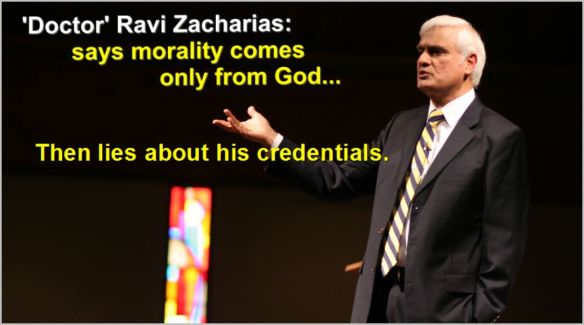
I planned to dissect Ravi Zacharias’ morality argument even before recent revelations that he lied about his credentials. I’m sure that, despite his fraudulent claims, he’s still a good Christian™, perfectly entitled to tell the rest of us what terrible sinners we are. If you’ve ever seen his grandiose sermonising, you’ll know he likes to pretend that Faith is something deeply intellectual, despite Paul’s contention in 1 Corinthians 1. 26-27 that it isn’t. Zacharias’ pseudo-intellectual Christianity is, like many of his qualifications, fake.

In common with other Christians desperate to prove their God, he relies too on circular reasoning. He tells us that our morality derives from God (you listening TC Howitt?) and then uses this to argue that, because of we have morality, God must exist. His unproven conclusion is his premise, with nothing in between to justify either.

Here’s his ‘argument’ in full:
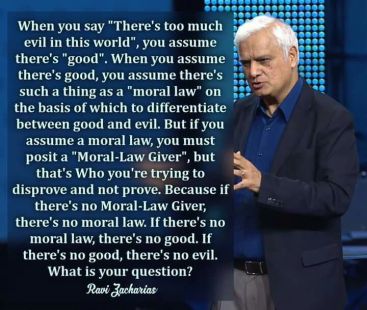
Ravi3

Let’s take a closer look:

‘When you say “There’s too much evil in the world”, you assume there’s “good”. Who says this? How much evil is ‘too much’? Do people other than Christians see the world in terms of good and evil? Does acknowledging evil mean one also assumes there is good? How is this ‘good’ defined? So many unanswered questions in this first muddled statement.

‘When you assume there’s good, you assume there’s such a thing as a “moral law” on the basis of which to differentiate between good and evil.’ The only one making assumptions here is Ravi himself. The considerate treatment of others, which is how we might reasonably define morality, is easily recognisable when it occurs. This presumably, given he fails to define any of his terms, is what Ravi means by ‘good’ (and conversely, inconsiderate or malicious treatment of others is his ‘evil’). There’s no reason to suppose, however, that the demonstration of good is a component of an objective ‘moral law’ that exists somehow independent of human interaction. Morality and any resulting goodness (or ‘evil’), is human interaction.

‘But if you assume a moral law you must posit a “Moral-Law Giver.” Well, of course we’re not assuming a moral law, not in the magical way Ravi is assuming we’re assuming. And how about that imperative: ‘You must posit a “Moral-Law Giver”‘! Must we? Morality is socially determined by human beings themselves; we see this is in the different moralities that have emerged in cultures with shared heritage; we see it in the changing attitudes over the last fifty years to the treatment of women and gay people. Morality is fluid; it evolves. The ‘Moral-Law Giver’ then, if we must have such a term, is we ourselves.

‘But that’s Who you’re trying to disprove and not prove.’ Erm no. Ravi’s being disingenuous here. ‘We’ were not trying to disprove a Moral-Law Giver at all; he was trying to prove it (him? – note the capital sneakily added to ‘Who’). Let’s though, for the sake of argument say Ravi is right; let’s say there is a Moral-Law Giver out there somewhere. Why has he, over the expanse of human existence, issued such varying and often conflicting moral codes? Compare, for example, today’s moral standards with the harsh, brutal morality of the ancient Israelites, which demanded the death penalty for almost any infringement of the law. Compare that with the morality Christians today claim they derive from New Testament. Then compare Jesus’ impossible demands with how Christians actually behave. By and large, they’re happy to ignore him and, with the exception of one or two areas they get hot under the collar about (abortion, same-sex relationships), they go along with the consensus of the culture in which they live.

‘Because if there’s no Moral-Law Giver, there is no moral law.’ There is a ‘moral-law giver’: it is us. That is why moral laws vary according to culture and through time. Zacharias wants us to conclude that this capitalised ‘Moral-Law Giver’ is his God, yet he has neither demonstrated that a deity (any deity) decrees moral codes from on high, nor has he ‘proved’ (his word) that this cosmic law giver is his god, the barbaric and inconsistent YHWH. Rather, he ‘assumes’ this to be the case and hopes that his audience, failing to notice his assumptions, presuppositions and sleight of hand, will too. Given that most of them are Christian sheep  (Jesus’ term, not mine) they will no doubt do just that.

‘If there’s no moral law, then there’s no good. If there’s no good, there’s no evil.’ This is where the argument, such as it is, turns back on itself. Zacharias thinks he’s being very clever (he always thinks he’s being clever) but all he’s doing is declaring his premise over again.

Of course there are moral standards; humans have devised them throughout their existence. The ‘Golden Rule’ promoted by Jesus, for example, is first recorded thousands of years before him. We determine for ourselves what is good and therefore what is ‘evil’; these defintions are not delivered to us ready made from a “Moral-Law Giver” in the sky.

(While Zacharias doesn’t use the argument, there are those who like to say, on the basis of Romans 2.15, that God has written his (ever-changing) rules in our hearts, a fallacy I’ll address in the next post.)

‘What is your question?’ clever Ravi finally asks. We didn’t have a question. Here’s one for him anyway: how has he got away with such fraudulent drivel for so long?


On being free

chains

Commenter Rebecca responded at length recently to my post ‘Why God Could Not Possibly Have Created The Universe (pts 4 & 5)’. There was so much in her response, that I thought it best to reply to her in a full length post rather than with a brief comment:

Hi Rebecca,

I won’t be able to respond to all of your points as there are so many, but will attempt a few.

I’m glad you find your faith beneficial. You’ve obviously thought about the whole incarnation/sacrifice/reconciliation issue, but I wonder whether you’ve ever asked yourself what it is you need saving from and reconciled with? What is it that means you personally need to avail yourself of the sacrifice Jesus supposedly made (however you interpret that)? I guess evangelicals, of which you seem to say you are not one, would claim it’s because of sin; the alienation from God that our very existence seems to cause.

Is that really the case though? Isn’t it rather that ancient superstitious peoples needed some explanation for why life was so difficult, short and brutish? They reasoned that surely it couldn’t be the fault of the creator God, so his tendency to treat them badly must be entirely their fault. Consequently, they had to do something to appease this god, to make him smile upon them again as they felt he must once have done. They thought the way to do this was, variously, through sacrifice and/or righteous living, by murdering those they felt offended him the most, and through praise and supplication.

There is no getting away from the fact, however, that the primary way they sought to reconcile themselves with their deity was through blood sacrifice. The New Testament’s interpretation of the death of Jesus is expressed in just such terms:

In Him we have redemption through His blood, the forgiveness of our sins, according to the riches of His grace (Ephesians 1.7).

This is not just an evangelical perspective; it is the major theme of much of the New Testament.

I’d like to ask you, Rebecca: are you really so steeped in sin that you need to avail yourself of a bloody human sacrifice in order to be reconciled with God? I have to say it seems extremely unlikely.

I didn’t leave faith behind because of how repugnant this idea is, however. I experienced an epiphany while walking one day, after many years of thinking about such things, and realised with conviction that there was no god: no god to appease, be reconciled with or commune with. He simply didn’t and doesn’t exist (see here for why I think this is the case). Of course, there being no god means there’s no son of god either.

I then started living my life on the basis of the fact there is no god, and I have to tell you it became a whole lot better. I didn’t have the constant feeling I had to come up to some impossible standard; I didn’t feel guilt for the most trivial of ‘sins’; I no longer worried that not getting my beliefs quite right would result in the loss of my eternal life; I stopped worrying about eternal life because it was obvious there was no such thing; I stopped thinking hell and heaven were real; I started living in the here and now; I stopped thinking I had to respond to others’ needs by telling them about Jesus (and started relating to them as people); I no longer had to subjugate whatever intellect I have to force myself to believe things that were clearly nonsense; the self-loathing I felt about my sexuality began to slip away. I could be me, and what a massive relief that was. I think I became a better person as a result. I certainly became a happier one.

You say the bible contains many deep truths – perhaps – but it also includes much that is cruel, spiteful, damaging and just plain wrong. I lost interest in sifting the wheat from the chaff because there was just too much chaff (a free biblical analogy for you there.)

The secrets of life, whatever they may be, Rebecca, are not in the bible, nor in any convoluted explanation of what Jesus stood for (he was just another failed apocalyptic preacher). They do not lie in Christianity or in any religion. Life is more than any of these ultimately dead things.

Thank you for writing. It can only be a good thing that you’re thinking about these issues. You will I’m sure find your way out into the light. I hope what I post here can help you with that.

The evidence for Christ

Christ

The evidence for Christ is not historical — it’s spiritual — and that evidence is indeed abundant for those who believe.

So says T. C Howitt, commenter on the Rational Doubt blog. And what is the ‘abundant evidence’, of which he speaks, for the existence of this spiritual being? It is, he says, ‘spiritual’. That’s quite a tautology: ‘the evidence for my fantasy is my fantasy’.

T.C. goes on to say that only those who truly believe can know that their experiences of the spiritual are real; the rest of us, he decrees, are blind. In other words, evidence that his fantasy is real is that other people have experienced versions of the same fantasy – some of them thousands of years ago. The ‘evidence’ for Christ (as opposed to Jesus) is therefore one’s own feelings plus the strange psychotic experiences Paul relates that he feels sure must be this supernatural being.

Science removes human subjectivity, as far as is possible, from its demonstration of how things are. All that Christians (and other believers in the supernatural) need do is similarly demonstrate that the spiritual realm, with its attendant beings, has an existence independent of human emotions, feelings and imagination. They could show us that, like gravity, electricity and quantum mechanics, Christ and angels, seventh heavens, demons and all manner of spiritual beings, have an existence separate from the internal, subjective experiences of human beings.

They’ve had two thousand years to do just this and still they haven’t. Why not? Because it can’t be done: Christ and his angels, God and his heaven are mythologies and, like all others, are constructs of the human mind.


Why God could not possibly have created the universe (pts 4 & 5)

Sacrifice2

The final two reasons why it is altogether unreasonable to credit the God of the bible with the creation of all that there is.

4. YHWH is inadequate

Christians want us to believe that the God of the bible is the ‘First Cause’ who purposefully created the cosmos. He is, they tell us, powerful beyond imagining, capable of bringing into existence a universe of infinite proportions, with its billions of suns, trillions of planets, nebulae, dark matter, black holes and the rest.

But this vast complexity stands is incompatible with YHWH, who demonstrates all the limitations we might expect of a god devised by primitive nomadic herdsmen. He is anthropomorphic, restricted in knowledge and defeated by technology his creators didn’t possess; like other deities of the period, he is obsessed with bizarre ritual, requiring genital mutilation and the sacrificial burning of animals. He lives, alternately, at the top of a mountain or in a box, from where he is capable of smelling roasting meat, and spends his time issuing laws about sex and slavery. He is primarily a god of war, his acts almost entirely destructive, rarely creative, which is what we might expect from a people continually in conflict with their neighbours.

Whatever else such a being might be, he is not one capable of creating the universe. He is nothing more than a small and petty tribal deity – one of many recognised by the Israelites during their history – created and sustained by men who knew no better. This is the god Jesus believed in, though he relocated him in the sky (‘the heavens’) and tried to turn him into something more amenable.

Despite this partial make-over, the New Testament version of God retains the attributes and limitations of his older self. He is, if Paul is to be believed, still pre-occupied with blood sacrifice, in dictating sexual behaviour and wreaking destruction on his supposed creation. He is no more capable of creating the cosmos than his predecessor. The God that modern Christians insist brought everything into being isn’t this limited, feeble, unsavoury figure. That God is another construct altogether, a far cry from the paltry god of the bible, and one they have devised themselves, that they make appear capable of creating the universe as we now know it to be.

5. The supernatural has no independent existence.

This is the bottom line: outside the human imagination, there is no evidence the supernatural exists. Even if we do take the human imagination into account, there is no evidence of an independent supernatural realm. No-one has ever seen a god, demon or angel, in exactly the same way they’ve never seen a fairy, goblin or unicorn. They may think they’ve experienced spiritual beings ‘within’ or felt them emotionally or hallucinated about them, but this does not mean they have independent existence. Despite millennia of religious belief no supernatural beings have ever manifested themselves, been witnessed, demonstrated or measured. Gods, like angels and spirits, do not exist. It follows, therefore, that the cosmos cannot have been created by them.

Thank you for bearing with me on my exploration of why god could not possibly have created the universe. I don’t know, of course – none of us do (yet) – how it came about, but the notion that it must have been god, the Christian god no less, simply isn’t feasible:

He would have had to create something from nothing, when the supernatural and immaterial are incapable of creating the natural and material.

The bible’s YHWH is too feeble to have been responsible and God-as-creator leads, in any case, only to an infinite regress.

The supernatural is a product of the human imagination; it has no independent existence.

However the universe came to be, we can be certain no gods, including the Christian one, were involved.


Why God could not possibly have created the universe (pt 3)

Sun

Posts here and here considered two reasons why Christians’ claim that their God created the cosmos is preposterous. A third reason is that –

God as creator leads to an infinite regress.

Christians like to assert that everything that has a beginning has a cause; the universe had a beginning therefore it had to have a cause. That cause – watch the unwarranted leap of faith here – can only have been have been their god. My previous arguments notwithstanding – that God needed to create everything from nothing (which according to Christians is impossible) and the immaterial cannot produce the material – the notion that god caused everything begs the question, as Richard Dawkins points out, of who caused his being. If, as Christians like to argue, everything has a cause then their god must have one too. Their assertion that he is the exception because, by definition, he has no beginning and consequently has no need of a cause is merely special pleading; why should he be different from everything else?

Christian apologists – William Lane Craig, for example – always assume that the first cause is their god, without a beginning and need of a cause. Their thinking goes as follows: everything that exists has a cause; the universe must have had a first cause; this first cause was somehow sentient; we are going to call this sentience ‘god’; this god must be our god, YHWH.

Yet they provide no evidence that there is, or was, a first cause; there could have been several contributory causes, including chemical, physical (gravity, for example) and activity on a quantum level. They then make the unwarranted assumption that this cause must have been sentient, again without evidence, and load this presumption with further insupportable connotations when they label it ‘god’. Finally, they make another leap of faith by claiming this ‘god’ is their god, YHWH.

This is all so much special pleading, insisting everything has a cause except the thing Christians don’t want to have had a cause. But God cannot be excluded; he too must have a cause (and indeed he does). So who or what caused him and gave him his start? And who or what created whatever it was that created god? Who or what created that? And on into infinite regress.

Those who offer such arguments put the proverbial cart 613.772 billion years before the horse. As Richard Dawkins says in The God Delusion, intelligence and creativity have only ever arisen as a result of evolution, specifically the evolution of the (human) brain. We know of no other means – there is no other means – by which intelligence and high-level creativity are produced. For a creative, super-intelligent mind to exist prior to the beginning of everything is, therefore, an impossibility. As I suggested in the second part of this series, the physical always precedes the immaterial; the natural world produced the advanced human brain about 200,000 years ago, and that brain has, ever since, projected its gods backward to the beginnings of the universe. This does not mean that a being without a beginning was actually there, much less that he produced the whole show. It means we know the cause of god. It is us.


Why God couldn’t possibly have created the universe (pt 2)

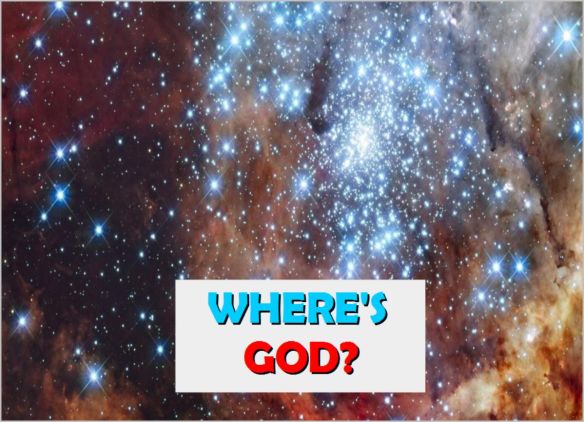
Where'sGod

More thoughts on why it is impossible that a God, much less the God of the bible, could have made everything.

2. The supernatural and immaterial cannot create the natural and material.

Let’s explore a little more of the nature of the God of the Christians. He is, they say, transcendent; ephemeral, intangible, invisible, ineffable, wholly spiritual. He is super-natural, existing on a plane outside the universe of matter, separate and removed from it and unlike any aspect of it. The bible implies as much and Christians have elaborated on these qualities throughout the millennia. The Christian God is everything, in fact, apart from physical matter (yes, those who claim to know all about this unknowable being assert he took on physical form as Jesus, but he’d yet to do that at the beginning of everything; 6000 years ago if you believe nutjobs like Ken Ham, 613.772 billion years if you accept the science.)

There is no incidence anywhere, no evidence that has ever existed ever, that demonstrates that something ephemeral, immaterial and super-natural is capable of creating the concrete, tangible and natural. To draw an analogy or two: music, which as heard is ephemeral and intangible, does not create the physical objects of the orchestra that play it. It does not look back as it vibrates through the air and conjure up the instruments from which it emanates.

Similarly, human thought, itself largely ephemeral and capable of imagining possibilities that don’t yet exist, does not of itself produce physical objects. However much you picture your ideal house in your mind, it will not produce the bricks and mortar without you taking action to realise them. This is always the case (and why prayer, spells and other wishful thinking are always ineffective); further action is required if what the human mind can imagine is to become a reality – some manipulation of the physical world. In all of our experience, in everything we know of reality, the transcendent cannot and does not produce anything material, ever. Music does not produce the orchestra. Thoughts do not construct the house; they must be translated into action, in the form of engagement with the physical world, for anything to materialise.

Two things follow: while the transcendent or spiritual cannot create anything in the real world without the corresponding physical activity, the reverse is not the case. Physical activity can and does produce the ephemeral. The instruments of the orchestra can produce music. The synapses of the brain can produce thought, love, empathy, desire. These do not exist, like other abstract concepts such as peace, hope and beauty, outside the physical human brain. In this reality, as opposed to that of the bible and the Creation Museum, the physical is always primary; it always comes first, the transcendent second. Never the other way round.

This, in fact, would appear to be a ‘law’ of the universe. As such, it is impossible a transcendent, supernatural being could have created the natural, material world. Applying this law, it can only be the case that the physical reality – or some aspect of it (guess what) – imagined the transcendent, without it having any real existence. No amount of physical activity has ever been able to produce it. If Christians therefore want to postulate a spiritual being as the first cause they need explain how the universal law that the physical always precedes the non-physical came to be overturned.

More to follow. Part one of this series is here.


Why God couldn’t possibly have created the universe (pt 1)

Preacher

I’m doing some thinking aloud here in an attempt to address the Christian claim that atheists are somehow compelled to believe the universe arose from nothing. Nothing can’t create something they say, so a creator is required – and what do you know? This creator turns out to be their very own pet god, YHWH, in one of his many incarnations. Definitely not Allah, Ra or any of the other hundreds of creator gods dreamed up by mankind through the millennia.

I’m not convinced atheists do claim that the universe can only have come from nothing. It’s an argument put into the mouths of atheists by some Christians who say, in effect, ‘if you don’t accept that our God made the universe then you have to believe it came from nothing.’ But it is the result of a false dichotomy (or false witness) because the position is not the only alternative to claim that a supernatural entity made everything. Lawrence Krauss, for example, demonstrates how something can arise from nothing and he and other scientists tell us that in any case there is no such thing as nothing – there’s always something, if ‘only’ at the quantum level.

The notion then, that in God’s absence the universe can only have come from nothing is a straw man, created by Christians desperate to diminish, dilute and dismiss scientifically viable alternative explanations.

It’s patently dishonest. (Christians being intellectually dishonest? Whoever heard of such a thing?) It’s dishonest because, in fact, it is Christians who believe the physical universe was created from nothing. I’m going to attempt to show you that they do and in the process dismantle their claims that their God was the one who magicked up everything from this nothing.

1. God too would have had to have create something from nothing.

Here’s the problem. God had nothing to go on. No raw materials with which to create the universe, and no raw materials from which to make the raw materials. There was only him and nothing. It is not unreasonable to ask, therefore, where the material from which he made the universe came from. The necessary ingredients for a universe – gravity, black holes, dark matter, dark energy, vast quantities of chemicals and what-have-you – are all physical phenomena, none of which existed before god allegedly made them. So, from what did he make them?

Perhaps he used parts of himself, in which case, he’s been depleted ever since, missing those bits of himself he used to make matter. Or maybe he turned part of himself into the physical universe so that he retained his integrity while integrating the universe into his very being – like a divine dream, say, or a tattoo.

The bible, however, doesn’t support either of these propositions. It makes clear that God created the earth and that which surrounds it (it has little concept of the universe as we now know it) as entities entirely separate from himself. His creation did not deplete him, nor was it a part of him (though he wasn’t, in the early days, averse to making guest appearances in it). Which bring us back to my original question; with what did he make it when there was only himself and nothing? Everything, Christians tells us, is made from something, so if God did not make the universe out of himself then he can only have made it from nothing. Everything there is, everything there has ever been – from gas clouds to planets, bugs to brains – God apparently produced from nothing.

Those who argue for this – and everyone who says God made everything is doing just that whether they realise it or not – does not advance our understanding of how the universe came into being one iota. All it does is introduce a sentient being into the equation, long before sentient beings existed. Moreover, the presence of such a being is superfluous, adding only unnecessary complication while explaining… absolutely nothing. Applying Occam’s razor we can just as easily take God out of the equation and be no worse off. There is a far greater probability that phenomena that do actually exist created the universe, not one that is mere conjecture.


Next time we will look at an empirical and logical impossibility that also means (a) God can’t have had anything to do with it.


More fairly random, half-formed thoughts on Evolution

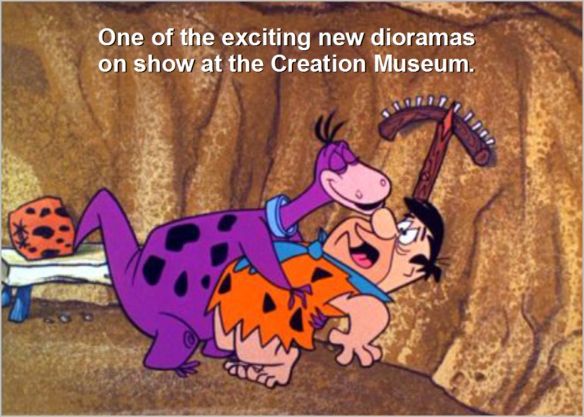
Flintstones42

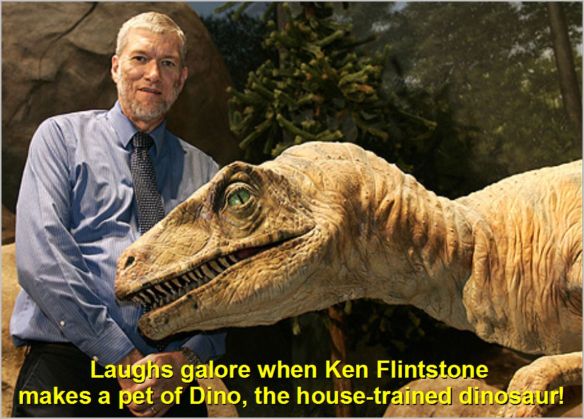
(Note to self: check the captions to this and last time’s pictures are the right way round.)


3. On God in Nature

God is revealed in nature! The bible says so (Romans 1.20) and you don’t even have to be a Creationist to see it – the evidence is there in plain sight.

But to suggest that, because aspects of nature are beautiful (or stunning or endearing) from a human perspective, the natural world can only have come from the hand of a loving Creator is merely to argue from a position of incredulity: “I can’t conceive how such beauty came to be; it must have been God.”

I live close to the countryside and although there is much that is impressively beautiful, the mercilessly cruel working of nature is also apparent: ruthless competition, even between plants and certainly among animal wildlife; waste on a vast scale; predation – young blue-tit (chickadee) chicks in my garden eaten a few weeks ago by magpies – death and sex.

The incredulous believer who refuses to see these aspects of nature and sees only beauty – and much of it is undeniably beautiful – is being disingenuous in their selection of evidence (confirmation bias in action). If God reveals himself in nature, then just as it is, he has to be callous, cruel and indifferent to suffering too.

“Ah, yes,” says the Christian, “but that’s because we live in a fallen world,” which is having it both ways: God is apparent in nature, except when he isn’t… because then it’s a fallen world.

Speaking of which –


4. On This Being a Fallen World

Creationists, such as those at Answers In Genesis, like to argue that genetic mutations in humans and animals fail to ‘increase the information’ and, further, that such errors would only lead to malfunction and the death of the organism. They’re right about the latter; significant mutation is almost always detrimental. However, according to Nature, ‘others have little or no detrimental effect. And sometimes, although very rarely, the change in DNA sequence may even turn out to be beneficial to the organism.’ A mutation that increases the chances an animal will survive and reproduce ensures that the particular mutation is passed on to its offspring.

The constant shuffling and recombining of genes in sexual reproduction also changes and ‘increases the information’ within the genome with the consequent effect on the phenotype (the genome’s physical expression). This is analogous with the twenty-six letters of the English alphabet producing new, unique sentences, paragraphs and texts every time they are recombined.

Creationists are wrong therefore to insist that mechanisms do not exist to change or add to genetic ‘information’. They are wrong too that variations caused by mutation cannot contribute to the evolution of an organism; while most born with such variance are likely to die before they can reproduce (natural selection in action) a minority are able to pass on the changes. Mutation and sexual recombination of genes are integral to evolution and the development of the organism.

I mention this because the bible presents quite a different scenario. In Genesis, the world and everything in it is created in a state of perfection. Then, because of human disobedience and sin, God feels compelled to curse his entire creation and the sudden or gradual – Christians are none to clear about which it is – transition to degradation, entropy and death begins.

It’s here that creationists’ objection to the role of mutation in evolution proves a stumbling block for their own scenario: a system designed to function in a particular way cannot continue to operate effectively after undergoing such a radical, brutal overhaul. We know of no other system that, having undergone such demolition, can continue to work in the way it was intended to, and certainly not as effectively as the ecosystem has for millennia. Look, for example, at how human activity has contributed recently to radical changes in climate.

Nature relies on those things that Christians say arose because of God’s curse on it: death, disease, waste, competition, cruelty. A system with such inherent ‘faults’, so far removed from how it was ‘designed’ to operate, would have failed long ago.

From this we can conclude that:

Nature/ecosystems/life were not ‘designed’ at all.

     They were never part of a ‘perfect’ creation.

         They were not cursed and are not now faulty components of a fallen,     malfunctioning world – nor could they be.

                       They could not operate any differently from the way they do.

                             They will not, despite what the bible says (Romans 8.20-21), be restored one day to a state of perfection they didn’t have in the first place.


Some fairly random, half-formed thoughts on Evolution

ew

Ken2

1. On Sex

‘Evolution is a Lie’ read the placard in the town centre the other day as Christian preachers took to ranting, again, about how everyone’s a sinner in need of Jesus.

I thought, if evolution is a lie then why is there sex? What would be the point of it in a world created by God?

While sex makes abundant sense in the context of evolution, it is difficult to explain in terms of Creationism. Why? Because sexual reproduction (as opposed of any other sort) exists specifically to ensure the shuffling and recombining of genes to produce variation in offspring. Why would a Creator (say the God of the bible, so beloved of Ken Ham and every other Christian) create the very mechanism that makes natural selection, and therefore evolution, possible? Why would he introduce a process that has no purpose but to serve as the engine of evolution? There wouldn’t be any need to, unless this deity specifically planned to develop life through evolution, or a process very like it.

But Christians like those street preachers and Answers in Genesis and its sycophants, reject the Darwinian model of evolution. So how do they explain sexual reproduction when it’s not only incongruous in a creationist scenario, but completely unnecessary? If not to drive evolution, why does sexual reproduction exist at all? It’s not, if I might pre-empt one possible response, because God thought we’d enjoy it; most living creatures reproduce sexually and ‘enjoyment’ is not part of their perfunctory copulation. Not to mention the fact that the Creator God of the bible spends most of his time objecting to and condemning sex.


2. On Life from Non-life

I’ve been told many times by Christians that, without God, life could not have got underway and subsequently evolved. Their argument goes like this: ‘inanimate chemicals are incapable of organising themselves into complex, self-replicating organisms,’ which makes me think, not of sex, but of viruses; non-living groups of chemicals that are highly organised self-replicators.

I’m not saying life necessarily developed from viruses, but they are evidence that inanimate chemicals are capable of acting as if alive, organising themselves to serve a collective purpose, namely self-perpetuation. The earliest viruses would not of course have been as complex as those today (viruses evolve too), but next time you have a viral infection, consider whether the difference between non-life and life is as great as it might seem. From what we do know, it wouldn’t need much, and certainly not a god, to turn one into the other.


More random thoughts on Evolution next time.


How the bible gets almost everything wrong: volume 3

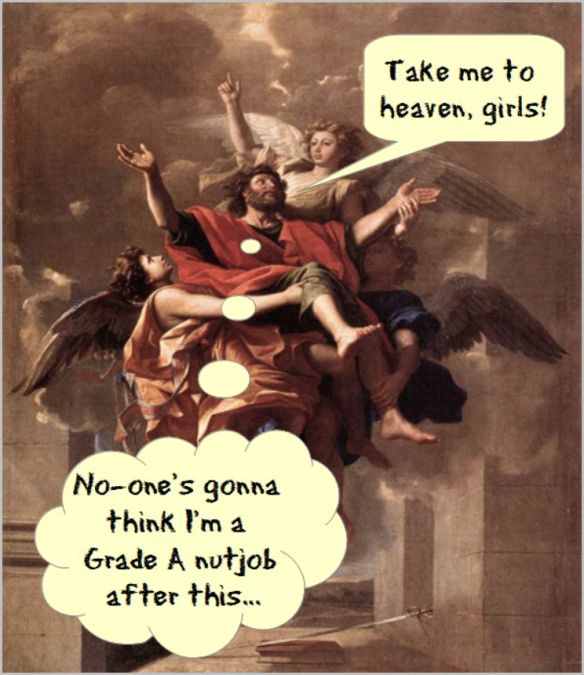
Paul4

So there we have it. The bible is historically, scientifically, medically, morally, and psychologically inaccurate. It is a muddle of contradiction and confusion, written by pre-scientific, bronze-age tribesmen and religious zealots who made guesses about how the world worked. In almost every respect they got it wrong.

So what does this mean for the central premise of the book, its claim that the Creator of the universe, the Father of mankind speaks through it? Why should we suppose that when it gets everything else wrong, it manages to get this right?

We shouldn’t. The bible’s knowledge of God comes from the same source as the rest of its information: the wild imaginings of men who knew no better. The bible itself tell us so, many times. By its own admission, it is a catalogue of dreams, visions and inner ‘revelations’. In the New Testament alone there are at least twenty ‘meaningful’ fantasies of this sort, including the entirety of its final book, the aptly named ‘Revelation of St John’. The bible comes from an era when dreams and other subjective internal experiences were widely regarded to have significance as messages – revelations – from the gods, not the routine and not-so-routine workings of the human mind we now know them to be. Every era, before the scientific, regarded them in this way.

So Paul interpreted his psychotic episodes, depicted as a disembodied voice and bright light in Acts but far more dreamlike and hallucinatory in Paul’s own descriptions, as experiences of the risen Jesus himself (1 Corinthians 9.1 & Galatians 1.11-12) and of heaven (2 Corinthians 12.1-4). From these he built up all of his fanciful ideas of ‘the Christ’, not one of them based on anything demonstrable or real. All of them mere notions in his head, notions that others were all to willing to accept as the words of a god. After all, wasn’t that how the Almighty always communicated with mere mortals?

Still today people surrender to these ‘revelations’; Paul’s theology built on out-of-body experiences, the disciples’ grief-induced visions, John’s hallucinogenic ‘bad trip’. These are the foundation of Christianity as we have it, providing all we know of God, Christ and salvation, and all of them without any basis in reality. Some believers even claim to have the same sort of ‘revelations’ themselves; God speaking to them, Christ bathing them in light, visions of Heaven. All of these, again, entirely within their heads and no more real than the occasional appearances of my long dead grandfather in my own dreams. However much Christians might insist on a rational basis for their beliefs, it is an inescapable fact that the faith has its origins in ancient people’s dreams and hallucinations. Rationalising after the fact doesn’t alter this.

I don’t know about you, but I’m not interested in basing my life on others’ emotionally-induced inner visions, whether those of a Paul, or a Joseph Smith or a contemporary whack-job. I don’t want to learn about the world and life from people whose understanding and knowledge derive from their sub-conscious and hallucinatory fantasy life. Give me science any day, with its attempts to minimise subjective, human biases from its exploration of how things are. Give me its discoveries that have enhanced life, however imperfectly, in the here and now. Above all, give me honest rationality over sub-conscious imaginings and psychoses.

I have no interest in a god, or a saviour, constructed from other people’s dreams, visions or hallucinations, even, or especially, when they’re recorded in that most unreliable of sources, the bible.