Are You A Good Person?

Bleach

My old mate Dale McAlpine has been missing from the streets of my home town recently. Perhaps he’s saving himself for Pride when he can ‘coincidentally’ turn up with his fellow street-preachers and try to ruin the celebration. He hasn’t updated his blog for two years either. I’m really quite worried about him. Perhaps he’s realised the error of his ways and has abandoned all that Salvation clap-trap has taken up a more rational approach to life. I do hope so. Or perhaps he’s just given up trying to reach people for Jesus; maybe the folk where I live are so reprobate even the mighty Dale Jesus can’t reach them. I’d like to think so.

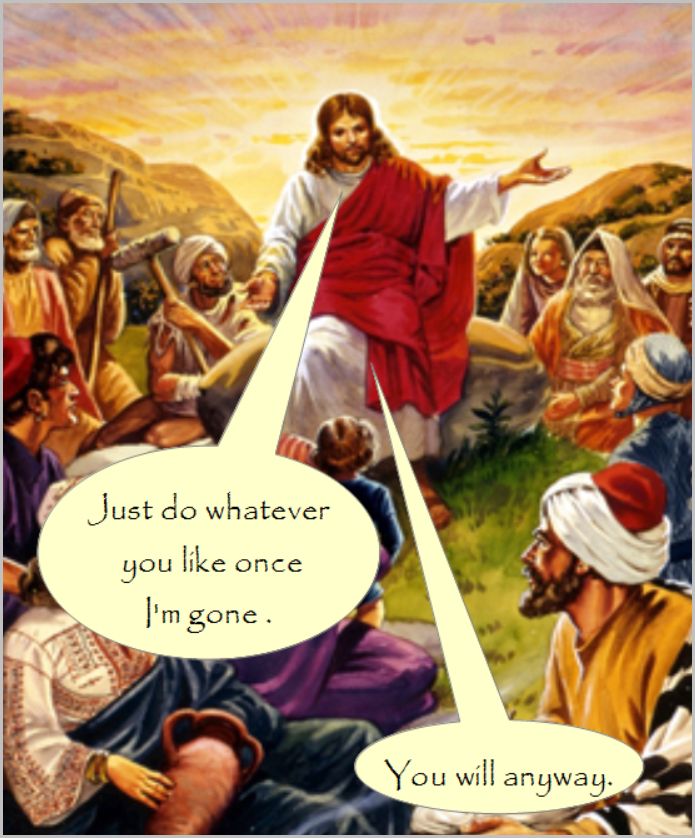
Dale, like other joyless evangelists, is fond of asking those he’s haranguing, ‘are you a good person?‘ It’s a loaded question, of course, because no matter how you answer it, the street preacher is able to use it to direct the ‘conversation’ (in which he has a megaphone and you don’t) around to Jesus. If you say ‘yes, I am a pretty good person’, the evangelist will then ask you if you’ve ever told lie or stolen something; if the answer is ‘yes’, he will then pronounce you ‘Not A Good Person’ and point out how, as a result, you are in need of Jesus. Easier to answer ‘No,’ in the first place, ‘I’m not a good person’ and get it over with quickly, leading, as this does, more directly to the saving power of Jesus. He alone, apparently can save you from not being good, stop you stealing the paper clips and save you from sin. Because, as everyone knows, accepting Jesus into your life automatically makes you a good person. (It doesn’t? Okay, but we’ll leave that for another time.)

Of course it might be the case that you really are a mass-murderer, child-molester or fraudster, and this may indeed disqualify you from being ‘a good person.’ But most of us are not; we’re just ordinary folk living ordinary lives with the characteristics, flaws and foibles that result from being raised by other ordinary folks with flaws and foibles of their own. If, on the other hand, you really are a bad person, it’s hardly likely you’re going to tell Dale and his pals about it in the middle of a public street.

However you regard yourself, it’s far better not to answer the likes of Dale at all; what right have they to know whether you regard yourself as a good person or not? What right have they to expect you to declare it publicly? Why should you respond to an agenda set entirely by them? None at all. Just shake the dirt from your Nikes and walk away.

If, however, you do feel inclined to engage with the religiously disturbed, you could try telling them you are neither a good person nor a bad one, because that is what most of us are; complex individuals who really can’t be delineated in such a nonsensically simplistic way. Only the religious seek to define human psychology with the false dichotomies of good and evil, right and wrong, righteous and unrighteous. Responding that you are neither good nor bad, while quite possibly both at the same time, is much too complicated for them. They will judge you a smart arse unworthy of God’s Grace and pretty quickly move on to a fresh victim.

Sweet and sour, nasty and nice

or, whatever happened to Luke 18.11-14?

prayer2Why is it when people are emotionally blackmailed into becoming followers of Jesus, does their conversion make them sweet and sour, nasty and nice at the same time? The sweet and nice parts are what their new experience does for them. They get a new start of sorts, are introduced to like-minded friends in the church and become compelled to share their new joy with everyone else, whether they want to hear it or not, about how much they’ve changed because of Jesus. It’s nice for them. Deluded too, but if it makes them happy then why not?

This is why not. What they don’t tell you, not at first anyway, is how sour and nasty they have also become; how they must now defend God’s standards, because, as everyone knows, the omnipotent God of all creation is incapable of defending them himself. Being born again and morphing into ‘a new creation’ involves, without exception, becoming judgemental of others, condemnatory, inflammatory, bigoted and spiteful.

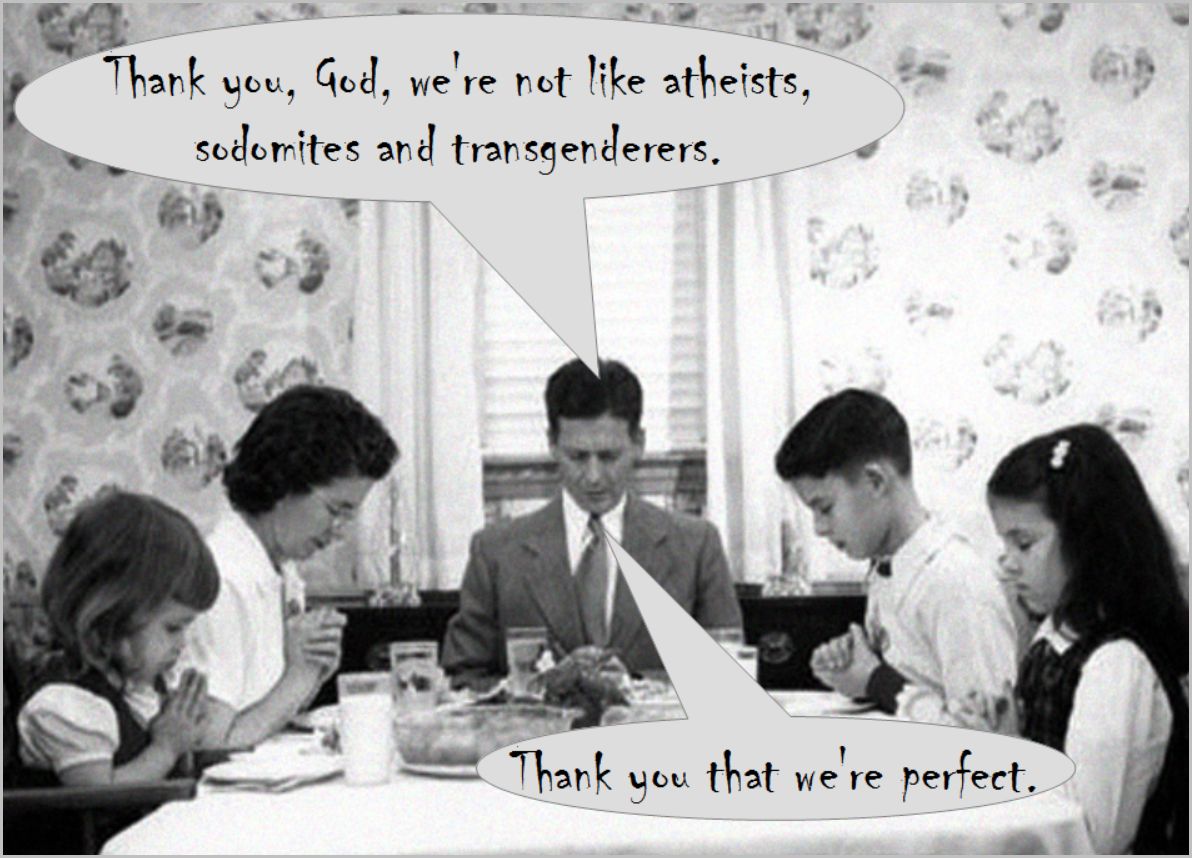
You think not? Then you haven’t heard what these same Christians think about abortion and women who have them. Homosexuality and those who are gay. Transgenderism and those born in the wrong body. Science and those who value evidence. Atheism and those of us who see through believers’ sad delusion.

Christians don’t, as some of them profess, hate the sin but love the sinner. They despise those who have philosophies different from them, those who live differently from them, those who are different from them.

A recent BBC poll asked if the world wouldn’t be more peaceful without religion. Here’s the results as of 14th July 2016:

Poll

I don’t know how many people this represents nor where they’re from – the site doesn’t say – but it would seem that most of us would think we would be better off without religion. It’s long past time we were able to be; religion has nothing to offer. It’s time we stopped giving it special treatment because some of it is sweet and nice. Its sour, nasty aspects are just as much a part of it, inseparable from whatever positives its adherents say it has. I’ll be looking soon at how we might push back against religion’s pervasive and poisonous influence in society.

What does God think about the Orlando massacre?

Orlando

Let’s see what he’s saying through his spokesmen here on Earth:

According to a minister from the cathedral in my home town, who conveyed this message from the Lord at a vigil on Monday night,

God is just as confused as we are. All the same, he’s full of compassion for those who died and for their loved ones.

Makes you wonder though, if he’s so compassionate, why he didn’t do anything to prevent the murders in the first place. Still, he is sympathetic, which is something.

Oh wait! That isn’t how God feels at all, not according to Pastor Steven Anderson, who knows exactly what the Lord thinks:

…in Leviticus 20:13, God’s perfect law, he put the death penalty on murder, and he also put the death penalty on homosexuality. That’s what the Bible says, plain and simple. So, you know, the good news is that at least 50 of these pedophiles are not gonna be harming children anymore. The bad news is that a lot of the homos in the bar are still alive, so they’re gonna continue to molest children and recruit people into their filthy homosexual lifestyle.

Right. So now we know.

Hang on, though. Christian Today tells us something different again. According to this guy, what God really wants his followers to know is that,

true believers should pray for everyone involved in the terrible events of the weekend and ‘not miss a huge opportunity to build bridges and demonstrate our saviour’s love.’

Phew, glad that’s finally sorted.

Or maybe not, because God has changed his mind again: Pastor Roger Jimenez has this straight from the Lord himself:

The tragedy is that more of them didn’t die… the Bible paints the picture that these are wicked people. These are evil people. God gave them up to their vile affections… they’re not natural… they received a reward for their error… God almighty says, ‘there’s nothing I can do for (homosexuals).’

All these mixed messages, and all supposedly from the same Person! Compassion, punishment, love, abandonment; that truly is one confused, mixed-up deity you worship, Christians. You’d be confused too, I guess, if one nutjob after another put words into your mouth. Just who’s the ventriloquist here and who the dummy?

When, Christians, are you going to stop deluding yourselves that arses like Anderson and Jimenez know anything about what God thinks? When are you going to stop pretending that anyone knows what he thinks? When are you going to recognise that a God who ‘speaks’ so inconsistently through simple-minded ‘intermediaries’ is not God at all?  When are you going to stop deluding yourselves that there even is a God?

Religion poisons the well. Again.

dye

The shooting in Orlando of people in a gay night club (50 dead, 53 wounded) is yet another example of religion as the antithesis of human flourishing. Not Christianity this time, of course, but that other ‘great’ religion, Islam, the religion of peace. But Christians cannot distance themselves from atrocities like this, carried out in the name of God, when the influence of even moderate religion is a pervasive, unhealthy presence in our society.

It’s true that Christians don’t, as rule, rampage in the streets or fly planes into buildings but they do contribute to the medium in which more extreme forms of religion grow:

Westboro Baptist Church, for example, with its own peculiar brand of Bible-based homophobia – ‘God hates fags’ and all the rest – is, like it or not, an expression of Christianity;

Right-wing evangelicals who interfere in the churches and governments of Africa and South America, actively encouraging them to take a homophobic stance and to pass anti-LGBT laws, are equally culpable; Scott Lively, Pat Robertson, Sharon Slater, you too are people filled with hate;

Likewise, those Catholic bishops who use their influence to denounce gay and transgendered folk as ‘mentally disordered’;

Christian bloggers who trot out the old, ‘Woe to those who call evil good and good evil’ (Isaiah 5.20) and misapply it to homosexuality, together with those who quote Leviticus 18.22 (‘abominations!’) and Romans 1.26-27 (‘unnatural and indecent!’)…

All of these contribute to the animus directed towards fellow human beings whose ‘sin’ is merely to be different. Religions, or more specifically their adherents, contribute significantly to the levels of misery in the world today, though Christians will cry ‘foul’ here (or ‘persecution’ even, because how they love claiming they’re being persecuted when asked to demonstrate some empathy and a little love.) After all, it wasn’t a Christian who gunned down the people in the Pulse nightclub this weekend. No it wasn’t. But every time religious bigots –

tell others what despicable sinners they are,

misrepresent and denigrate minorities,

promote ‘gay cures’,

attack same-sex marriage,

add quotation marks around the words gay and gay marriage, as if they’re somehow not real,

assert homosexuality and transgenderism are synonymous with ‘moral decay’,

claim natural disasters are God’s response to gay people’s very existence,

boycott businesses that support equality,

‘take a stand’ against transgendered people using the appropriate restroom and

refuse to serve gay couples –

every time, in short, they say LGBT people are evil, sick or worthless, the self-righteous prepare the ground for individuals like Omar Mateen to do what he did in Florida on Sunday. Religious leaders condemning such atrocities after the event is too little, too late, when they’ve failed to take charge of their acolytes and  do nothing to stem the tide of hatred flowing from their churches, mosques and temples. 

To those of us on the outside, religions are all of a kind; harmful superstitions. If a ‘faith’ entails belief in supernatural beings and puts allegiance to such imaginary figures above fellow human beings, it is without merit. It is the evil among us.

Dear Christian

Christians

Dear Christian,

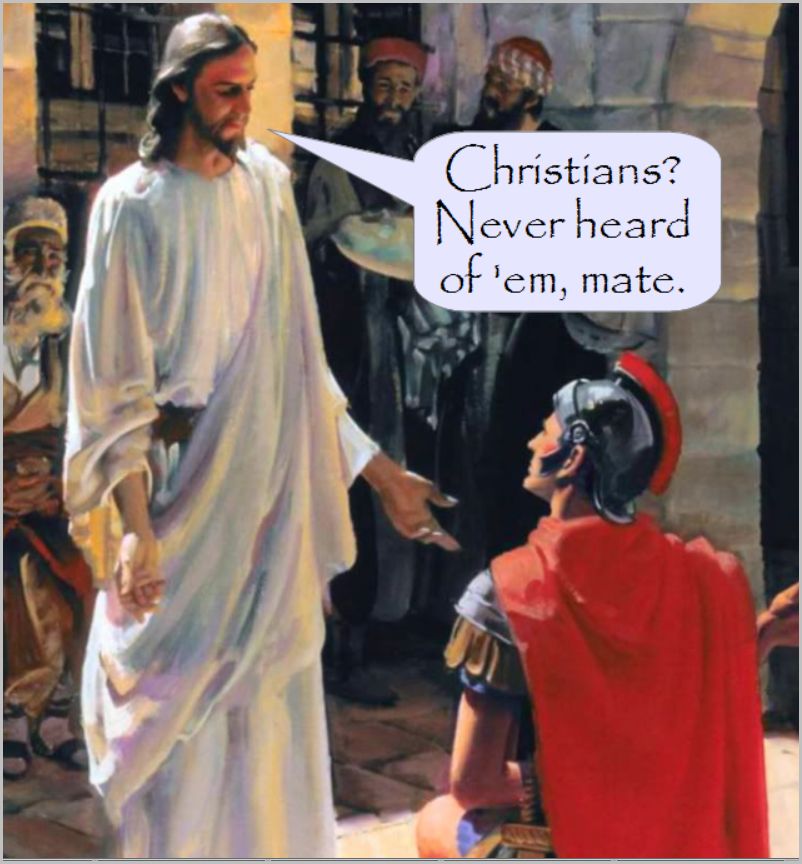
Jesus said treat others as you like to be treated (Matthew 7:12) so why do you treat them with abuse and unpleasantness?

Blog191(2)

Jesus said turn the other cheek (Luke 6:29) so why do you respond with insults?

Blog191(1)Jesus said don’t judge unless you want to be judged (Matthew 7:1) so why do you constantly judge and condemn?

Blog191(5)

Jesus said love your enemies (Luke 6:27) so why doesn’t it happen?

Blog191(11)

Jesus said don’t call anyone a fool (Matthew 5.22) so why do you call them far worse than that?

Blog191(4)

Jesus said don’t pray in public (Matthew 6.5) so why do you pray in public?

Blog191(7)

Jesus said sell all you have and give the money to the poor (Luke 18.22) so why don’t you?

Jesus said you cannot serve God and money (Luke 16.13) so why are some of you so obscenely rich?

CrouchHinn'sJet

Jesus said deny yourself (Matthew 16.24) so why do you indulge and promote yourself above all things?

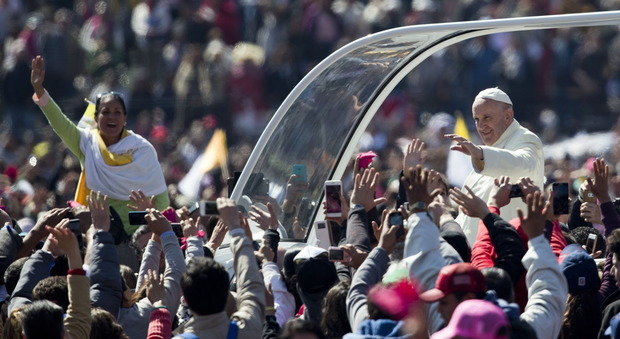
Blog191(8)OsteenPope Francis waves to the crowd, aboard the popemobile in Mexico City's main square, the Zocalo, Saturday, Feb. 13, 2016. Pope Francis kicks off his first trip to Mexico on Saturday with speeches to the country's political and ecclesial elites. The pontiff's five-day visit will include a very personal prayer at the Virgin of Guadalupe shrine. (AP Photo/Moises Castillo)

Jesus said ‘be perfect’ (Matthew 5.48) so why don’t we see you trying?

Sick

Jesus asked why you call him ‘Lord, Lord’ and yet don’t do what he tells you (Luke 6.46). Evidently he didn’t understand, as you do, just how many of his commands are optional. Thank goodness you know better than he did.

In the Wrong Body

prayer3What to do about those people who feel they don’t belong in the body they were born with? Those who disparage the vehicle that carries them through life? Should we ban them, shun them? Prevent them from using the same bathrooms – to use that ridiculous euphemism for places never known to include baths – as those of us who accept the body we’ve got? Should they be side-lined, castigated and ridiculed?

Well, no. Let’s go easy on Christians who believe they are somehow separate from the bodies that house them; who regard their bodies are inferior to the spiritual being God intends them to be. Christians who look forward to the day when they’ll be relieved of their physical bodies, which will then be transformed into spiritual ones, and who, in preparation for this miraculous change, claim to resist the demands of the body – the lusts of the flesh as the Bible puts it (1 John 2.16). Yes, those Christians, the same ones who disparage people who find themselves in the wrong bodies and want them to conform to the sex they know themselves to be; transgender people.

The Christians are wrong on every level of course:

  • They are not designed to be spiritual beings;
  • None of us is separate from our bodies;
  • The illusion of the self is a product of the brain and wider society, and we demonstrably do not have souls or spirits;
  • Bodies, while frail and susceptible to illness, injury and ageing, are all we’ve got; they don’t survive death and are not refurbished or replaced after it.
  • The demands of the body can be managed but not entirely ignored, not even by Christians who eat, drink, have sex, sleep, defecate and generally indulge their carnality in the same way the rest of us do.

Still, none of this prevents Christians from thinking they’re prisoners of a temporary yet  strangely inhospitable body while here on Earth. You’d think that would make them empathetic to people who are also in the wrong bodies, but you’d be wrong. They ridicule them and tell them that they’re sinful aberrations; they object to their use of the ‘bathroom’ that corresponds to the gender they know themselves to be.

What was it someone once said? ‘Let he who is without sin cast the first stone’. There sure seem to be a lot of sinless Christians about these days.

The Stuff Christians Say… (part two)

Balaam

Atheists don’t behave as evolution says they should: This ridiculous accusation is often slung at atheists by Christians who seem to see it as some sort of stinging rebuke. Answers In Genesis is very fond of it; the Hamster’s drones and other Christians seem to believe – without ever thinking it through (plus ca change) that because those who acknowledge the veracity of evolution don’t behave according to its principles they are somehow inconsistent in their ‘beliefs’ – hypocritical even. They seriously propose that because natural selection and the survival of the fittest (not one of Darwin’s phrases) are cruel, uncaring processes, then that is how, for the sake of consistency, atheists ought to behave too. We shouldn’t care, they say, when a child develops cancer or someone dies. We shouldn’t attempt to cure illness or work to prevent suffering because these are nature’s way and part of the mechanism of evolution.

While it’s true they are, it’s been a long time since our behaviour, our existence and continued success as a species has been solely determined by what nature does. Humans regularly override its mechanisms, natural selection included; every time we use birth control, show compassion for the weak, heal the sick, develop medicines, engineer genes and preserve life. And so we should.

Christians seem unable to comprehend that evolution is not a pattern to be followed. It is not a set of instructions for living, a prescription or a set of (a)moral guidelines. It is the best explanation, supported by considerable amounts of evidence, of how life developed on the Earth. As such it makes no ethical claims nor does it demand that its principles be blindly followed (that’d be religion). Are Christians truly unable to detect this difference?

Atheists have no reason to be moral: I’ve looked at this ignorant claim before. Of course we have reason to behave morally. We’re human, we live in human society. Morals help us do so while doing the least damage to ourselves and others. They may also enable us to bring some happiness or comfort to those around us. Atheists don’t look to an imaginary God to tell us how to be good; our morals come from our culture, upbringing and education. Christians’ morals do too, whatever else they may claim. They certainly don’t get them from that most immoral of books, the Bible.


to be continued…

Do No Harm

sermon2

If religions took ‘do no harm’ to heart (as the Hippocratic Oath does) and their adherents were made to comply with it, what a better place this world would be. There’d be –

No more religiously-motivated suicide bombers and terrorist atrocities;

No more murder in the name of the Lord (whichever);

No more children molested by priests and pastors;

No churches attempting to cover up their crimes;

No more child deaths as a result of ‘faith-healing’;

No religiously-sanctioned denigration and abuse of women;

No more ritualistic mutilation of children’s and young women’s genitals;

No more religious scams and shams;

No more religiously-inspired vitriol directed at gay and transgender people;

No more barbaric executions of ‘minorities’, like gay men, women and those of other faiths.

Of course, even without these, the world would still not be perfect. Awful things would still happen. But the principle of doing no harm would eliminate much of the trauma inflicted on people by the proponents of irrational superstition.

On paper at least, the Abrahamic religions have expectations that are more demanding than simply doing no harm:

Love your neighbour as yourself (Leviticus 19:18; Judaism);

Love your enemies; treat others as you would like to be treated’ (Matthew 7.12 and 5.44; Christianity);

…compete with each other in doing good (Surat al-Ma’ida, 48; Islam).

However, these are just too damned hard for so many religionists. They disregard them and opt instead for the spiteful paranoia of the same holy books. Perhaps the simpler injunction of ‘do no harm’ would be easier for them. But until the preachers of judgement and hatred find it in themselves to promote such a principle, we will all continue to suffer the destructive effects of the ‘great’ faiths.

So, how long until the next terrorist attack? The next church child-abuse cover-up? The next rape scandal? The next persecution of gay people?

      Not long at all.

           Praise the Lord (whichever)!


Consensual text

BiblePastor Chris Linzey has taken me to task for quoting the Magic Book out of context. Interestingy, the latest post on Chris’s blog, written by his father, does just that, so it must be okay for Christians to do it even if no-one else can.

Let’s take a close look at a couple of verses, Matthew 19.4-6, that God’s Chosen like to quote out of context, entirely altering their meaning in the process (but that’s okay, because you know, Christians are doing it):

Have you not read that the one who made them at the beginning “made them male and female”, and said, “For this reason a man shall leave his father and mother and be joined to his wife, and the two shall become one flesh”? So they are no longer two, but one flesh. Therefore what God has joined together, let no one separate.’ (Matthew 19.4-6; Jesus quoting Genesis 2.24 out of context).

As it stands, this passage seems to suggest that Jesus is endorsing marriage between one-man and one-woman (only) but pan out from the isolated section and this not what he’s talking about at all. He’s discussing divorce. Here’s the verse in context:

Some Pharisees came to (Jesus), and to test him they asked, ‘Is it lawful for a man to divorce his wife for any cause?’ He answered, ‘Have you not read that the one who made them at the beginning “made them male and female”, and said, “For this reason a man shall leave his father and mother and be joined to his wife, and the two shall become one flesh”? So they are no longer two, but one flesh. Therefore what God has joined together, let no one separate.’ They said to him, ‘Why then did Moses command us to give a certificate of dismissal and to divorce her?’ He said to them, ‘It was because you were so hard-hearted that Moses allowed you to divorce your wives, but at the beginning it was not so. And I say to you, whoever divorces his wife, except for unchastity, and marries another commits adultery.’ (Matthew 19. 3-9)

What the one-man, one-woman verse can now be seen to be saying is that once a couple are married, they should stay together and not divorce; Jesus isn’t prescribing marriage at all. Add even more context and what we find following the lines about divorce is this:

His disciples said to him, ‘If such is the case of a man with his wife, it is better not to marry.’ But he said to them, ‘Not everyone can accept this teaching, but only those to whom it is given. For there are eunuchs who have been so from birth, and there are eunuchs who have been made eunuchs by others, and there are eunuchs who have made themselves eunuchs for the sake of the kingdom of heaven. Let anyone accept this who can.’ (Matthew 19.10-12)

In other words, Jesus doesn’t recommend marriage in any shape or form, not even between one man and one woman; his view is that it is better not marry at all. He goes further still: it is better to be completely sexless, as if without testicles, for the sake of the Kingdom of God. He acknowledges, bless him, that not everyone will be able to comply with this ‘teaching’ – who’d have thought it?

Zoom out further still and set this part of Matthew’s gospel against Luke 20.34-35 where Jesus really is talking about marriage:

He said to them, ‘Those who belong to this age marry and are given in marriage; but those who are considered worthy of a place in that [Kingdom] age and in the resurrection from the dead neither marry nor are given in marriage.’

This time the message is that only those mired in the ways of the world marry, costing themselves a place in the coming Kingdom. Those in the know, however, avoid it and so guarantee their resurrection and transition to the new age. Whatever else it is (wackadoodle nonsense?) this is not a ringing endorsement of marriage. The verses from Matthew and Luke when taken together show clearly that not only did Jesus fail to endorse one-man, one-woman marriage, but that he disparaged the entire institution. He believed that when the Kingdom came to the Earth, marriage would be done away with altogether and advocated abandoning it in the interim as well. You wouldn’t know this though from the decontextualised use of Matthew 19.4-6.

We might ask here why it is that today’s Christians don’t comply with his directive. Why don’t they shun marriage as their Lord and Saviour says they should? Why do they regard his commands as optional? Why don’t they want to guarantee themselves a place in the coming Kingdom by vetoing marriage? Have they abandoned all hope of God’s Kingdom ever coming to the Earth? Shifty hermeneutics won’t help them here either, because Paul is of a similar opinion (1 Corinthians 7.8-9; 28-29). Evidently this is the kind of teaching Christians are free to discard, perhaps because they see it – unjustifiably – as specific to the first century, like the coming Kingdom itself.    

So, yes, context can be important, given the haphazard and disjointed fashion in which the Almighty chose to express himself. But it doesn’t always produce the result Christians might like. That’s where the sleight of hand known as ‘hermeneutic consistency’ comes in. We’ll try that out next time.


Some material in this post has appeared before; specifically here. I hope I didn’t take it out of context.


What Does Atheism Have To Offer? (Part Two)

Think4. Atheism offers genuine morality
Having no magic book to tell them how to behave (not that Christians derive their morals from theirs) atheists work out their own morality. They don’t do this in a vacuum, however, recognising that morality is culturally derived, evolving as the means by which primates with complex social arrangements relate to one another. It’s likely they adhere to their moral codes imperfectly, as do believers of various stripes. Not having an ideology they feel compelled to impose on others, they don’t regard their fellow human beings as mere conversion fodder. The atheists’ world is big enough to embrace all, though they lament the damage wreaked on it by religion. Atheist terrorists are a much rarer breed than their religious counterparts, while secular societies are among the most peaceful and prosperous in the world today (with the more religious generally at the opposite end of the spectrum.) Nor do atheists attribute their behaviour to supernatural forces; neither god nor the devil inspires them to act. Rather they recognise and take personal responsibility for what they do.

5. Atheism offers authenticity
An atheist is free to be him or herself. There is no striving to maintain the imagined standards of an imaginary god, no need to represent the perspective of a ‘sacred’ book or to defend the indefensible. The atheist does not see themselves or other people as lost, worthless, sinners, suppressors of truth, goy, infidels or any of the other disparaging terms used of non-believers in so-called holy books. The atheist can be a free-spirit, possessed of self-respect, and true to themselves and their nature, whatever that may be. Here’s how pastor-turned-atheist Ryan Bell put it in a recent blog post:

I don’t have secrets anymore, which is a huge mental and moral relief. I also wrestle with less cognitive dissonance than ever. All of this means I’m more at peace and more comfortable in my own skin. I give far fewer fucks about what people think of me and my decisions. My ire is raised, from time to time, by unfair attacks, and I will probably always struggle with my tendency to be a people pleaser, but I am in recovery. I’m learning to tell the truth on a more regular basis and trust that people can handle the truth (whether they actually can or not). I’m learning to trust myself and what I know while remaining open to critique and able to say I was wrong.

6. Atheism offers free thought
Having no dogma to represent or promulgate, no myths to restrict them and no cult leaders, shaman or gurus dictating to them, atheists are free to think for themselves. Religion demands that its adherents begin with myth or dogma, which the facts are then forced to fit. When they don’t, which is invariably the case, the believer is compelled to dismiss the facts to preserve the fantasy (if you think not, you’ve never visited Answers In Genesis). The atheist, on the other hand, can begin with the evidence and reason from it to make up their own mind about ethics, the issues of the day and the human condition.

to be continued…