We owe it all to Jesus

MarySo the UK is a Christian country. Prime minister Dave Cameron has decreed it. In his hallowed Christmas message he proclaims that Britain derives all of its values from Christianity:

As a Christian country, we must remember what (Jesus’) birth represents: peace, mercy, goodwill and, above all, hope. I believe that we should also reflect on the fact that it is because of these important religious roots and Christian values that Britain has been such a successful home to people of all faiths and none.

‘Peace, mercy, goodwill, hope and tolerance’. Doesn’t it warm your heart? This country of ours has these wonderful sentiments at its core and all of them derive from the baby Jesus. I’m not sure about where our other values – capitalism, colonialism, democracy, free-thought and expression – originate but no doubt Dave will tell us they too spring from our ‘religious roots’.

What about the values he mentions though? Do they originate with Jesus as Dave claims?

Peace we covered last time: Christianity have not brought peace into the world, ever. Dave seems to have forgotten that Britain is currently at war; the so-called ‘war on terror’ Is he now suggesting that as a ‘Christian country’ we should turn the other cheek and propose peace, because that’s what Jesus would want? I doubt it, somehow.

Mercy? Here’s the kind of mercy Jesus proposed: ‘But those enemies of mine who did not want me to be king over them – bring them here and kill them in front of me’ (Luke 19:27). Nice.

Goodwill? Jesus always extended goodwill to others. Like here: ‘It is not right to take the children’s bread and toss it to the dogs (non-Jews)’. And here: ‘Do not give dogs what is holy, and do not throw your pearls before pigs (non-Jews again), lest they trample them underfoot and turn to attack you’ (Matthew 15.26 & Matthew 7.6).

Hope? The Bible does speak about hope – hope that this will all soon be over and God will consign non-believers to hell, set up his kingdom on earth and put Jesus in charge (Matthew 19:28 & 24.51). Is this what Cameron means by hope?

Tolerance? Paul on tolerance: ‘do you not know that wrongdoers will not inherit the kingdom of God? Do not be deceived: Neither the sexually immoral nor idolaters nor adulterers nor men who have sex with men’ (1 Corinthians 6:9). It’s difficult to see how modern notions of equality and acceptance can derive from bigotry like this.

No, Britain does not get its values from Christianity or the Bible or baby Jesus. It has worked them out for itself, principally through social progress and the reforms of modern times.

The UK is not a Christian country in any other sense either. Christians are required to turn the other cheek (Matt. 5.38–42), give all they have to the poor (Luke 14.33) and buy into a convoluted salvation scam plan (2 Timothy 1.9 etc). Can a country do these things? It would be unthinkable for it to give away its wealth, accede to other countries’ demands and respond non-aggressively to attack. Individual Christians don’t or won’t do these things and it would be nothing short of suicidal for a country to attempt to; yet this is what Jesus insists is involved in following him. It’s impossible for individuals to live this way, let alone entire nations.

Cameron can’t even claim that the majority of the population subscribes to the great salvation plan either. A recent government poll showed that only 49% of the population admits to being Christian and in any case, the plan is designed for individuals, not countries. So let’s hope (hah!) the Prime Minister will stop fawning over Christians, fatuously pretending that the UK is a Christian country when it isn’t. Let’s hope too he understands that our values, whatever they are, do not derive from an ancient, expired superstition. The UK is not a Christian country in any sense. Let us rejoice in that fact.

Loose Threads

FamilyPick a thread. Any thread. And start pulling. Gently does it, no need for force. A gentle pull on any of the loose ends of faith and the whole fabric will come apart quickly.

Here, pull on this one marked ‘the infallibility of the Bible‘. See how easily it comes loose as soon as you realise that most of it, Old and New Testament alike, was written long after the events it purports to describe, some of it by imposters and forgers.

Or this one – the salvation thread, much of it stitched into place by an excitable chap prone to hallucinations. Pull it and see how its pattern is nothing like the one proposed by the man it claims to be about.

Pull the magic threads, the ones about Gods, supernatural beings, heaven and hell, eternal life. Watch them disintegrate in your fingers once they’re teased out into the real world.

Take hold of the threads about Resurrections, Second Comings, Raptures and Judgements; so fragile, these break away as soon as they’re touched. The only miracle is that they’ve lasted this long.

Then there’s the promises threads, about how believers are going to do fantastic miracles and heal the sick and raise the dead. Imaginative and colourful, these have never really fitted in.

Then there’s the prayer threads, whose embroidery tells us how prayer works, how God will give us whatever we ask for. Downright embarrassing, these – yank ’em out.

And how about the strands that those who say they love the cloth pick out themselves and throw away? You know the ones; the threads which tell them how to live their lives that they just don’t like the look of and think spoil the overall effect. These have definitely got to go.

What about the threads that weren’t originally there – the ones about ‘defending God’s standards‘ and having a ‘relationship‘ with a dead person? These grubby, greasy threads have been added in to replace the ones those who love the cloth have pulled out for themselves.

Choose any number of other threads – the ones that clash with other bits of the pattern, the ugly brutal ones, the fantastic, the ignorant – and give them a tug. Oh, look. They come away too.

And before you know it, the entire fabric has come apart in your hands. All that’s left is a pile of worthless, brittle threads, good for nothing but throwing in the bin.

Idiotic Stuff Jesus Said 13: We Don’t Need No Educashun

MegaBut you are not to be called rabbi (teacher), for you have one teacher, and you are all brothers. And call no man your father on earth, for you have one Father, who is in heaven. Neither be called instructors, for you have one instructor, the Christ. The greatest among you shall be your servant. Whoever exalts himself will be humbled, and whoever humbles himself will be exalted. Matthew 23:8-12

Evidently these words were put into Jesus’ mouth by the community that produced Matthew’s gospel and reflect the egalitarianism and communism that characterised it. The phrase that gives away their origins is ‘you have one instructor; the Christ’. ‘The Christ’, as we know, was a creation of the early church and it is highly unlikely Jesus would have referred to himself in such a way. In the synoptic gospels he is reticent even about claiming the Jewish title of Messiah for himself. In any case, the reference is patently to a third party, and is by an author or interpolator who subscribes to the later, supernatural Christ.

In the unlikely event, then, that these words emanated from Jesus himself, all they achieve is to demonstrate his lack of understanding of human psychology. Even as ‘Matthew’ set about recording them, the newly founded church was already ignoring them, which is perhaps why he felt the need to have Jesus say them. Here’s Ephesians 4.11, written by someone pretending to be Paul round about 80-100CE, contradicting them:

Christ gave (us) the apostles, the prophets, the evangelists, the shepherds and teachers…

The imposter who wrote 1 Timothy (5:17) up to a hundred years after Jesus’ death goes further, endorsing the exaltation of those who teach and rule others:

Let the elders who rule well be considered worthy of double honour, especially those who labour in preaching and teaching.

Why? Because human beings like hierarchies. Almost all human societies are hierarchical in nature and groups invariably arrange themselves hierarchically. There will always be people who see themselves as leaders and teachers and still others who look to those who’ve set themselves up as authorities to tell them what to do.

Despite what Jesus or ‘Matthew’ might have preferred – everyone being equal while those who ‘exalt’ themselves are humbled – it just doesn’t happen in human culture. It certainly wasn’t happening in the movement that emerged following Jesus’ death, in the church that existed by the time Matthew was making Jesus say that the only authority Christians should recognise was God’s and his own. The institution that was appearing in place of the end of the age – an institution that Jesus neither anticipated nor instigated – could not function effectively as the simple band of ‘brothers’ he is made to suggest. It was in need of structure, and a hierarchy was it.

And so it was that, before long, the first popes emerged – ‘pope’ deriving from the Latin for ‘papa’. Each of these exalted figures would come to be referred to as ‘Holy Father’, a title still in use today. With complete disregard for Jesus’ instructions, other priests (meaning ‘elders’) in the Catholic church also assumed the title ‘father’. Evangelical churches, lest they think the Catholic church is the only guilty party, have their ‘pastors’, meaning ‘shepherds’, who, by definition, lead others. A common or garden ‘clergyman’ is a ‘learned man’, while a bishop is one who ‘looks down from above’. An archbishop is chief look-downer and exalted indeed. Elsewhere, showmen preachers in mega-churches ‘teach’ with a mixture of anecdote, wild conjecture and stuff they make up as they go along; tune into TV’s God channels for a taste of this particular brand of humility. The church in all its manifestations has, from the beginning, been hierarchical from top to bottom.

Jesus, however, didn’t want there to be a top or bottom; if Matthew 23.8-12 is to be believed, he commanded there shouldn’t be. He envisaged his followers living in harmony with everyone equal under his and God’s authority. No-one was to set themselves up as teacher or leader; no-one was to exalt themselves above others. If any did, they would need to be humbled. But this isn’t how human beings organise themselves, and never how the church has conducted itself. Shouldn’t he have known that?

The Jesus Cult

Cult2A programme on the UK’s Channel 5 this week, Trapped In A Cult?, featured stories of people who had had encounters with or had escaped from cults. It didn’t spend too much time defining what a cult might be, but suggested that it’s a movement revolving around a charismatic individual who insists that only he or she has a direct line to God or some sort of Higher Truth. Such individuals insist that others must follow their teaching exclusively and that followers sever all ties with family and non-believing friends. They frequently demand too that followers give up their material possessions in order to demonstrate their commitment to the movement.

The programme also noted that once the original founder of a cult dies, or has been discredited in some way, belief in him or her can persist, with followers persuading themselves that their leader has miraculously transferred to a higher plane of existence. (Further information about cults and their leaders can be found on The Cult Education Institute web-site.)

Many modern religious movements conform to this pattern: The Church of Latter Day Saints (Mormons), Jehovah’s Witnesses, Christian Science, the Unification Church (Moonies), Scientology and Branch Davidians to name but a few. Orthodox Christians are always eager to point out the apostate, cultish nature of these heterodox ‘churches’, blind to the fact that their own belief system began in exactly the same way. The original Jesus movement had all the hallmarks of a cult and its leader the characteristics of a cult leader:

Jesus insisted that only he had a direct line to God and Higher Truth:
For example in Matthew 10.32–33: Whoever acknowledges me before others, I will also acknowledge before my Father in heaven.  But whoever disowns me before others, I will disown before my Father in heaven

and John 14.23: Anyone who loves me will obey my teaching. My Father will love them, and we will come to them and make our home with them.

He demanded his teaching be followed exclusively:
For example in Luke 10.16: He who listens to you, is listening to me; and he who rejects you is rejecting me; and he who rejects me is rejecting him who sent me

and Matthew 12.30: Whoever is not with me is against me, and whoever does not gather with me scatters.

He expected his followers to sever ties with family and non-believing friends:
For example in Luke 14.26: If anyone comes to me and does not hate his own father and mother and wife and children and brothers and sisters, yes, and even his own life, he cannot be my disciple.

He told those interested in joining his movement to give up material possessions:                                                                                                             Matthew 19.21: If you want to be perfect, go, sell your possessions and give to the poor, and you will have treasure in heaven. Then come, follow me.

and when he died, his followers persuaded themselves he’d gone on to a higher plane:                                                                                                                  Luke 24.51: While he blessed them, he parted from them and was carried up into heaven.

What do we learn from this? That if it looks like a cult, sounds like a cult and behaves like a cult then the chances are, it’s a cult. Christianity is just a first century cult that hit the big time. We are now so used to having it around – how legit it became! – we overlook its origins and essential characteristics. These are exactly the same as any other cult, both before and since.

Christians’ Favourite Delusions 35: Jesus Christ is the same yesterday, today and forever.

LaughAccording to God’s Magic Book (in Hebrews 13.8), Jesus is ‘the same yesterday, today and forever’. Let’s see how that works out in reality:

Yesterday he said the way to ‘inherit eternal life’ was to follow the law and sell everything you had (Mark 17.17-22).
Today, according to his spin doctors, he says you’ve got to believe a magic formula – the one about him dying – if you want to live forever.

Yesterday he despised wealth and possessions (Luke 6.24-25).
Today he thinks they’re just fine.

Yesterday he said this world would end while his disciples were still alive (Matthew 16:27-28).
Today he says these are the end times:

… we’re now living in Romans 1. How do you know when the wrath of God is released? How do you know when the wrath of God is unleashed against a society? First, Romans 1:24, there is a sexual revolution. We’ve had that—in the 60s, the last century. Then there will be a homosexual revolution led by lesbians. The women are mentioned first in Romans 1:26. And then there will be the reprobate mind. And that’s when the thinking is really the product of the sexual, homosexual revolutions, and the thinking is so corrupt we can’t find our way back. That’s where we are. (John MacArthur, We Will Not Bow; all subsequent references to MacArthur are from this same poisoned well)

Yesterday Jesus’ Good News was about the coming Kingdom (Luke 4.43).
Today it’s about eternal damnation:

And the most compassionate thing you can do for those (LGBT) people is, in love, to warn them of eternal damnation—to warn them of eternal judgement. That’s compassionate. That’s compassionate. Preach the gospel; proclaim the gospel; proclaim grace and forgiveness such as we read in Isaiah and 1 Corinthians. But preach judgement. (MacArthur again)

Yesterday Jesus invited people to join God’s Kingdom on Earth (Matthew 6.10; 13.43 etc).
Today he’s made to invite everyone to Heaven.

Yesterday his Good News was only for his own people: ‘I was sent only to the lost sheep of the house of Israel’ (Matthew 15:24).
Today he says anybody can go to Heaven so long as they believe the magic formula. Oh, and aren’t gay.

Yesterday his own people were the Jews (Luke 2.22-32; Matthew 4.23 etc).
Today he’s really only interested in America (to listen to MacArthur and others).

Yesterday he was recruiting slaves for his Kingdom (Matthew 20.27).
Today he wants to be your buddy.

Yesterday he’d nothing good to say about marriage (Luke 20.34-35).
Today he’s all for it (unless it’s same-sex marriage).

Yesterday he had nothing good to say about the family (Luke 14.26).
Today he’s all for it (unless the parents are gay).

Yesterday he had nothing to say about abortion, homosexuality or people changing sex.
Today it’s all he’s interested in (MacArthur and just about every other Christian preacher).

Yesterday he was an itinerant Jewish preacher and failed messiah.
Today he’s a Starman waiting in the sky to zap unbelievers to hell (yup, MacArthur again, quoting 2 Thessalonians 1.7-8).

Like a ventriloquist’s dummy, Jesus just says whatever his self-appointed spokespersons want him to say. Pliable and malleable, he can be made to match the needs of anyone who recruits him to their spiritual, moral or social crusade. He is all things to all people and what he’s like today is nothing like what he was yesterday. Which doesn’t say much about ‘forever’.

Idiotic Stuff Jesus Said 12: My words will never pass away

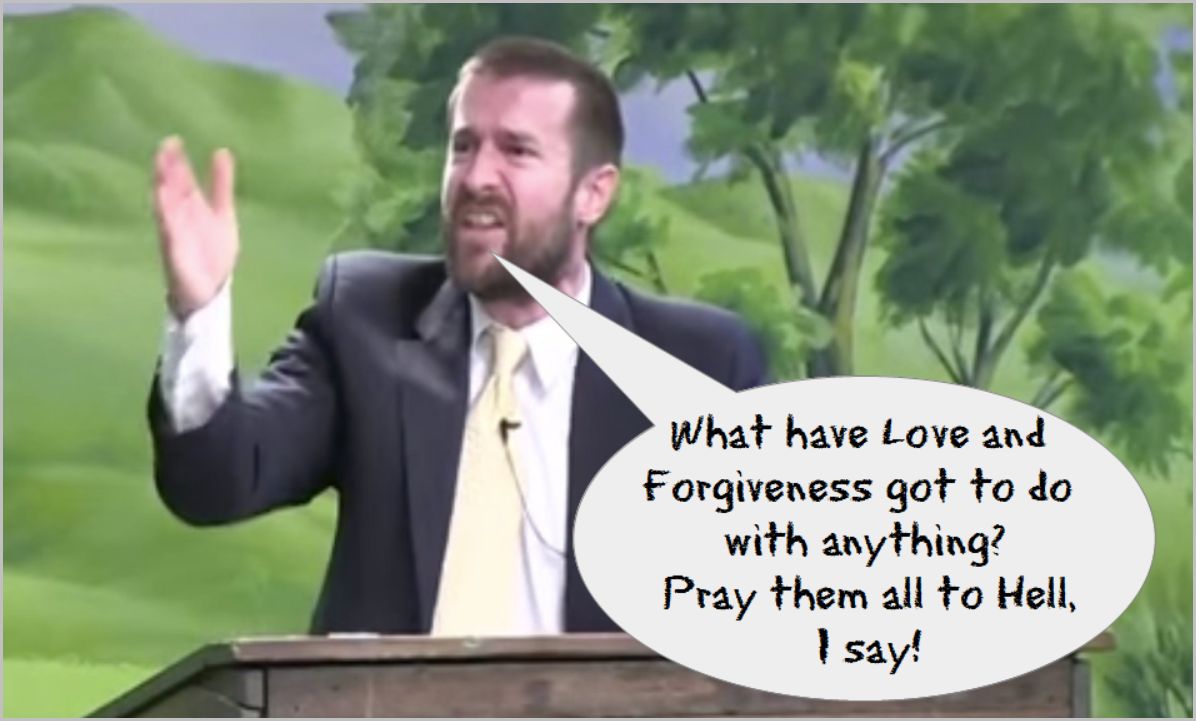
AndersonThe premise of my first ‘Jesus’ book* is that while Christians profess to believe in Jesus, they choose to ignore most of what he taught while he was alive. While they claim a vapid super-hero Christ as personal saviour, they replace what the human Jesus had to say with words of their own choosing. In reality, they have about as much time for Jesus’ ‘eternal words’ as the average non-believer or atheist. You don’t have to look very far to see how much his words have already ‘passed away’:

Jesus said, ‘Don’t judge so that you won’t be judged’ (Matthew 7.1). Our representative Christian says, ‘LGBT people are filthy and wrong.’

Jesus said ‘Love your enemies, pray for those who persecute you’ (Matthew 5.44). Our representative Christian says, ‘I’m gonna pray a transgender person dies and goes to Hell.’

Jesus said, ‘Love your neighbour as yourself’ (Mark 12.31). The Christian says, ‘The way to show love is to tell other people they’re going to Hell.’

Jesus said, ‘sell all you have and give to the poor’ (Mark 10.21). The Christian is concerned about where to buy jewellery: ‘…somewhere other than Tiffany’s, because Tiffany’s is gay friendly.’

Jesus said, ‘Forgive those who sin against you so you can be forgiven yourself’ (Matthew 6.14). Our believer rants, ‘LGBT people should be executed.’

Jesus said, ‘Don’t commit adultery and don’t get divorced’ (Matthew 5.27-28 and 19.9). Significant numbers of Christians , including our own Stephen Green, say, ‘that doesn’t apply to me.’

See what I mean? Christians regard the words of their saviour, not as having everlasting value, but as if they’re nothing more than worthless bits of fluff. Even if God were real, every word of the Bible true, every aspect of the Great Salvation Plan genuine, it wouldn’t change the fact that believers treat as optional almost everything Jesus commanded and live as if he never had.


* Why Christians Don’t Do What Jesus Tells Them To …And What They Believe Instead is available from Amazon worldwide (UK here, US here) but not, alas, from Tiffany’s.

The picture shows the deplorable Pastor Steven Anderson (linked above). He knows better than Jesus ever did.


Idiotic Stuff Jesus Said 11: Build Your Lives on the Things I Say

WhoDoJesus demanded you base your life on his teaching. It’s the only way, he said, that you’re going to find meaning, as well as the principles you’ll need when the going gets tough:

Everyone then who hears these words of mine and acts on them will be like a wise man who built his house on rock. The rain fell, the floods came, and the winds blew and beat on that house, but it did not fall, because it had been founded on rock (Matthew 7.24-25).

And what exactly were those words of his? Here’s what he taught:

  • The Son of Man was coming to the Earth to establish God’s Kingdom within the lifetime of his original followers (Matthew 16:27-28; Matthew 24:27, 30-31, 34; Luke 21:27-28, 33-34);
  • His own people needed to be more ‘righteous’ in order to be part of this Kingdom (Matthew 5.20; Matthew 6.33; Matthew 13.49 etc);
  • Being righteous entailed some extreme behaviour; loving your enemies, giving away all you had, turning the other cheek, forgiving repeatedly, being perfect (Matthew 5.44; Matthew 5.42; Luke 6.29; Luke 6.37; Matthew 5.48; Matthew 19.21);
  • It was crucial to obey Jewish law, even if some of it could be reinterpreted (Matthew 5.17-18; Matthew 12.1-7);
  • Once the Kingdom arrived Jesus himself would be King of the world, aided and abetted by his pals (Matthew 19.28; Luke 22.30);
  • His followers would do even greater miracles than he did himself. Given he controlled the weather, healed the sick and raised the dead, that’s going some (John 14:12).

Anybody know anyone who believes all of this or lives this way? Anyone who operates on these exacting principles? I don’t know of anyone and never have. I didn’t even when I was Christian myself. Jesus demands are impossible. No-one can live according to them. ‘Of course not,’ say Christians. ‘You need supernatural help to live like this.’ So why don’t they, when they have God’s spirit living within them (John 14.16-17)? Why don’t we see Christians who perform spectacular miracles, who constantly go the extra mile, who give away everything they have, who are, as Jesus tells them they should be, perfect?

We don’t because no-one can live as Jesus insisted they should. Nor do we see Christians who believe his prophecies either, particularly the one about the Son of Man bringing God’s Kingdom to Earth two thousand years ago. Christians pretend he didn’t really say it, or if he did, that he meant something else entirely. They’ve changed his very words – the ones they should be building their lives on – to claim Jesus himself will be returning any time now (the synoptic gospels are confused about whether Jesus is this Son of Man, or someone else). When he does, they say, true believers will be going with him to Heaven. Never mind that Jesus teaches nothing of the kind and there’s absolutely no foundation for these beliefs in his words. As such, they’re the faith built on sand he tells them is worthless:

And everyone who hears these words of mine and does not act on them will be like a foolish man who built his house on sand. The rain fell, and the floods came, and the winds blew and beat against that house, and it fell—and great was its fall! (Matthew 7.26-27).

So, if Christians don’t do what Jesus tells them and don’t believe his promises or prophecies, then in what way can it be said they take his words as the foundation of their lives? Don’t they, rather, base them on Paul’s teaching, about a supernatural Christ who bears little resemblance to the zealous Jewish preacher they pretend is their ‘Lord’? Teaching that has nothing to do with that of the man who demands his pronouncements be the very basis of life? Paul doesn’t quote any of Jesus’ teaching.  The foundation Jesus speaks of is of no interest to him; so, naturally, this is whom Christians follow – not Jesus, but Paul and his mythical Christ.

Christians have no time for Jesus’ words – and who can blame them? All he offers is impossible morality, false promises and failed prophecies. Far better to go with what Paul offers, because that’s about what’s in it for them. But even Paul didn’t believe anyone was going to Heaven, so they ignore that bit in his teaching too.

Jesus: The Dark Side

SacrificeDo not think that I have come to bring peace to the earth; I have not come to bring peace, but a sword (Matthew 10.34).

Well, isn’t that a comfort. Jesus, who said ‘blessed are the peacemakers’ and for whom Christians like to claim the title ‘Prince of Peace’, declares himself to be anything but.

Of course, it’s possible these words were put into Jesus’ mouth once belief in him had indeed started splitting families and communities; between those who subscribed to his cult and those who saw it for what it was. Maybe though he really did advocate armed rebellion – against the Roman and Jewish authorities – rather more than later believers care to admit. Even as they’ve come down to us, the gospels retain references to taking up arms in the cause of God’s Kingdom. For example:

  • Jesus didn’t see the transition from the existing system to the Kingdom as a peaceful one:

Matthew 11.12: From the days of John the Baptist until now the kingdom of heaven has been coming violently and the violent take it by force.

Matthew 3.10: Even now the axe is lying at the root of the trees; every tree therefore that does not bear good fruit is cut down and thrown into the fire.

  • He instructed the disciples to arm themselves:

Luke 22. 36-38: He said to them… ‘the one who has no sword must sell his cloak and buy one. For I tell you, this scripture must be fulfilled in me, “And he was counted among the lawless”; and indeed what is written about me is being fulfilled.’ They said, ‘Lord, look, here are two swords.’ He replied, ‘It is enough.’

  • And evidently they did:

Luke 22.48-49: Jesus said to him, ‘Judas, is it with a kiss that you are betraying the Son of Man?’ When those who were around him saw what was coming, they asked, ‘Lord, should we strike with the sword?’ Then one of them struck the slave of the high priest and cut off his right ear. (Jesus promptly heals the slave and then says, sanctimoniously, that ‘those who live by the sword will die by it’, as if swords weren’t his idea in the first place!)

  • More than this, when, as he clearly believed he would be, Jesus is appointed King in God’s new Kingdom, he hints he will be happy to see all of his opponents put to death:

Luke 19.27: “But as for these enemies of mine who did not want me to be king over them—bring them here and slaughter them in my presence.”

  • Jesus was executed by the Romans as a revolutionary. Crucifixion made an example of those who actively opposed Roman rule. The charge against Jesus was that he was an intended usurper of power; two fellow ‘rebels’ are executed with him:*

Mark 15.26-27: The inscription of the charge against him read, ‘The King of the Jews.’ And with him they crucified two rebels, one on his right and one on his left.

So much for ‘love your enemies’ and ‘turn the other cheek’. So much for the Jesus who does nothing but preach love and forgiveness. So much too for Paul’s mystical Christ. There is a very dark side to Jesus that expresses itself in vengefulness and megalomania. That anyone so disturbed could be considered an emissary from God, let alone God the Son, beggars belief.


* Since writing this post I’ve read Marcus J. Borg’s Jesus: Uncovering the Life, Teachings, and Relevance of a Religious Revolutionary. Borg makes precisely the same point about the charges against Jesus (though he sees him as a non-violent revolutionary). He explains that the Greek word used to describe the two killed with him – rendered as ‘rebels’ above – ‘is the term more commonly used for those engaged in armed resistance against Rome – “terrorists” or “freedom fighters”, depending on one’s point of view (p265).

Jesus v. Paul Round 2: And the winner is…

Make-overI’m re-reading Barrie Wilson’s excellent How Jesus Became Christian. Wilson makes the case that Paul’s Christianity was, and is, an entirely different religion from that of the historical Jesus. He shows how Paul’s ‘Christification’ changed the original mission of Jesus – to alert his fellow Jews to the imminence of God’s kingdom on Earth – ‘from one focused on the teachings of Jesus to one about the Christ’ (p242).

How right he is. This very the dichotomy troubled me in my own church-going days when evangelical Christianity, as it still does, consistently excluded the demanding, extreme and human Jesus of the synoptic gospels to focus instead on this illusory supernatural being. They preach sermons about him, sing hymns to him and intone creeds that skip glibly over everything Jesus said and did when he was alive. The Christ was, I came to see over time, an invention of Paul’s, the product of his strange hallucination sketchily recounted in Galatians 1.11-12 and 1 Corinthians 9.1 & 15.45. The Jesus he talks about is a sort of cosmic super-hero, a god-man of the type found in pagan religions in the first century. He has little or nothing to do with Jesus the Jew preacher and would-be Messiah, preserved – just about – in the three synoptic gospels.

So, the differences between Jesus and the Christ are profound. Here are a few of them, that I’ve drawn up, demonstrating that Christianity as we know it – essentially Paul’s ‘Christified’ version with inconvenient bits removed – bears little relation to the ‘good news’ of Jesus:

Jesus’ good news: God’s Kingdom on Earth imminent (Mark 9.1 etc)
Paul’s good news: Salvation through a dying/rising god-man (Romans 3.19-26; 4.24; 5.1-2; 5.10 etc)

Jesus presents as: Jewish Messiah claimant: ‘Son of Man’; Self-appointed judge and king in near future (Matthew 16.28; 13.41; Luke 22.30 etc)
Paul presents: Mystical saviour: The Christ, who saves those who ‘share’ in his death and resurrection; Christ as judge and ruler of mankind in near future (Romans 3.25; 6.1-11; 13.11-12; 1 Corinthians 15.20-28; Philippians 3.20)

Jesus’ qualifications: Teacher, preacher and healer; ideas rooted in Jewish prophecy; full of his own importance (Matthew 5.17; 7.12; 9.35; 25.40)
Paul’s qualifications: Builds entire religion on single hallucination; borrows heavily from pagan cults; full of his own importance (1 Corinthians 15.8; Galatians 1.15-16)

Jesus’ position: Adherent of Jewish Law; emphasises its importance (Mark 6.2; Matthew 5.19)
Paul’s position: Disregards Jewish Law; implies it is ‘dung’ (Romans 3.28; Galatians 5.6; Philippians 3.7-9)

Jesus insists on: Obedience to Jewish Law (Matthew 5.17-20)
Paul insists on: Faith in Christ and his resurrection (Romans 1.16-17; 3.22)

Jesus’ salvation requirement: Be righteous/perfect (Matthew 5.48; 13.43)
Paul’s salvation requirement: Faith (Romans 5.1; Galatians 2:15-16)

Jesus expects: Right behaviours and attitudes (Matthew 5.38-48)
Paul expects: Right belief (Romans 10.10-13)

Jesus’ teaching: Measure for measure morality (Matthew 6.38; 7.2; Luke 6.37); Forgive in order to be forgiven (Matthew 6.14); Show mercy in order to be shown it (Matthew 5.7); Give in order to receive (Matthew 6.38); Treat others as you wish to be treated (Matthew 7.12)
Paul’s teaching: Profess right belief (Romans 10.9)

Jesus’ commands: Love God (Matthew 22.37); Love your neighbour (Matthew 22.39); Love your enemy (Matthew 5.44)
Paul’s commands: Embrace Christ (Romans 8.35-38; Galatians 3.27); Be filled with the Holy Spirit (Romans 5.5; Galatians 5.16-18); Avoid those with different teaching (Romans 16.17; Galatians 6.6-9)

Jesus’ extremism: Give up everything you have (Mark 10.21; Luke 14.33); Give to all who ask (Matthew 5.42); Turn the other cheek (Matthew 5.39); cut off own hands, remove eyes (Mark 9.43-47); Consider castration (Matthew 19.12)
Paul’s extremism: No interest in anything Jesus taught when was alive; intolerance of Jesus’ original followers (Galatians 2.11-21)

Jesus’ guarantees: Resurrection/eternal life through demonstration of one’s personal righteousness once the Kingdom comes (Matthew 25.31-36)
Paul’s guarantees: Resurrection/eternal life for those with right belief and faith when Christ returns soon to judge mankind (1 Corinthians 15.20-28; 51-52)

Jesus’ outcomes: No Kingdom on Earth; no appearance of the Son of Man or a returned Jesus; disappearance of the movement that subscribed to Jesus’ ‘good news’
Paul’s outcomes: No appearance of the Christ; no rapture; no resurrection; no cosmic judgement

Jesus’ result: Failure
Paul’s result: Becomes mainstream Christianity; Paul wins!

As Wilson makes clear, the two are, despite some small overlap, very different belief systems. The Christ Christians worship is not the same as the Jesus they ignore. Nonetheless, they continue to pretend they are one and the same, unable to see that the join is, and always has been, a gaping hole.

 
Notes:
i) Biblical references are by no means exhaustive; there are many others that support each point and difference.

ii) Details of Wilson’s book are:
Wilson, B. (2008) How Jesus Became Christian: The Early Christians and the Transformation of a Jewish Teacher into the Son of God. Weidenfeld & Nicolson, London.

The Revolution Has Been Postponed

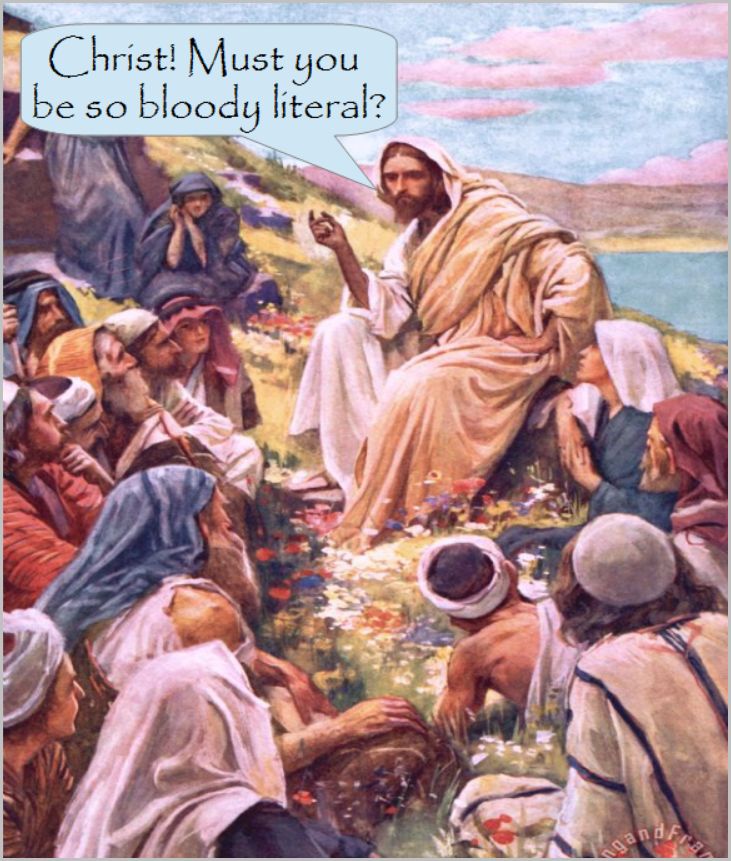
LiteralSo we all sat down on the grass and waited for the great man to speak.

“You’re a winner,” he said eventually, “if you’re ordinary and oppressed, because one day you’re going to rule the Earth!” Everyone gasped. We were all of us just ordinary, plain-speaking folk and things like this didn’t happen to us.

“Yes, really,” he said, “because God is going to establish his kingdom on Earth. And when he does he’ll sweep away the rich and the powerful, and you’ll be in charge. This I promise.”

We couldn’t believe it – proper gobsmacked we were.

“You’re in luck too,” the teacher went on, “if you’re poor, because once God’s kingdom comes, you’ll be rich beyond measure. And as for those of you who are hungry, you’re going to be filled like you’ve never been filled before. God, you see, is going to turn everything upside. Those of you at the bottom of the heap now – and let’s face it, that’s all of you sorry schmucks – are suddenly going to find yourselves at the top. And those who are on top now will be right down at the bottom. This, I promise you, is how it’s going to be.”

I can tell you everyone was beaming. We could already feel the change in the air.
Then Eli, sitting next to me sticks up his hand. “Hey, boss,” he shouts.

“Eli,” I says to him, “don’t be disrespectful. This bloke obviously knows what he’s talking about. He’s a messenger from God.”

“Yo, boss!” shouts Eli again.

“Yes,” the man up front says to him. “What?”

“When’s all this going to happen, then?” asks Eli. “When can we expect this big change?”

“Oh,” the teacher says, “I was thinking… maybe in a couple of thousand years?”

“What?” Eli says. “What good is that to us? From the way you were talking we thought all these wunnerful things were going to happen soon. What’s the point of telling all of us, sitting here in front of you, that we’re gonna be top dog and everything if it’s not us you’re talking about.”

“Good point,” the great man says. “All right then. How about if it’s sooner?”

There’s a lot of murmuring and everybody thinks this a good idea.

“Great,” he says. “Then that’s settled. We’ll make it sooner, so that you guys are still around. How does that sound?”

Everybody says it sounds marvellous.

“Great,” the big man says again. “It’s agreed, then – it’ll be soon. On that, you have my word.”

That was good enough for us and so we all set off home to get ready for the big changes we’d been promised.

“Thousands of years in the future,” Eli scoffs. “What a bloody con. Who does he think he is? God Almighty?”