Jesus: The Dark Side

SacrificeDo not think that I have come to bring peace to the earth; I have not come to bring peace, but a sword (Matthew 10.34).

Well, isn’t that a comfort. Jesus, who said ‘blessed are the peacemakers’ and for whom Christians like to claim the title ‘Prince of Peace’, declares himself to be anything but.

Of course, it’s possible these words were put into Jesus’ mouth once belief in him had indeed started splitting families and communities; between those who subscribed to his cult and those who saw it for what it was. Maybe though he really did advocate armed rebellion – against the Roman and Jewish authorities – rather more than later believers care to admit. Even as they’ve come down to us, the gospels retain references to taking up arms in the cause of God’s Kingdom. For example:

  • Jesus didn’t see the transition from the existing system to the Kingdom as a peaceful one:

Matthew 11.12: From the days of John the Baptist until now the kingdom of heaven has been coming violently and the violent take it by force.

Matthew 3.10: Even now the axe is lying at the root of the trees; every tree therefore that does not bear good fruit is cut down and thrown into the fire.

  • He instructed the disciples to arm themselves:

Luke 22. 36-38: He said to them… ‘the one who has no sword must sell his cloak and buy one. For I tell you, this scripture must be fulfilled in me, “And he was counted among the lawless”; and indeed what is written about me is being fulfilled.’ They said, ‘Lord, look, here are two swords.’ He replied, ‘It is enough.’

  • And evidently they did:

Luke 22.48-49: Jesus said to him, ‘Judas, is it with a kiss that you are betraying the Son of Man?’ When those who were around him saw what was coming, they asked, ‘Lord, should we strike with the sword?’ Then one of them struck the slave of the high priest and cut off his right ear. (Jesus promptly heals the slave and then says, sanctimoniously, that ‘those who live by the sword will die by it’, as if swords weren’t his idea in the first place!)

  • More than this, when, as he clearly believed he would be, Jesus is appointed King in God’s new Kingdom, he hints he will be happy to see all of his opponents put to death:

Luke 19.27: “But as for these enemies of mine who did not want me to be king over them—bring them here and slaughter them in my presence.”

  • Jesus was executed by the Romans as a revolutionary. Crucifixion made an example of those who actively opposed Roman rule. The charge against Jesus was that he was an intended usurper of power; two fellow ‘rebels’ are executed with him:*

Mark 15.26-27: The inscription of the charge against him read, ‘The King of the Jews.’ And with him they crucified two rebels, one on his right and one on his left.

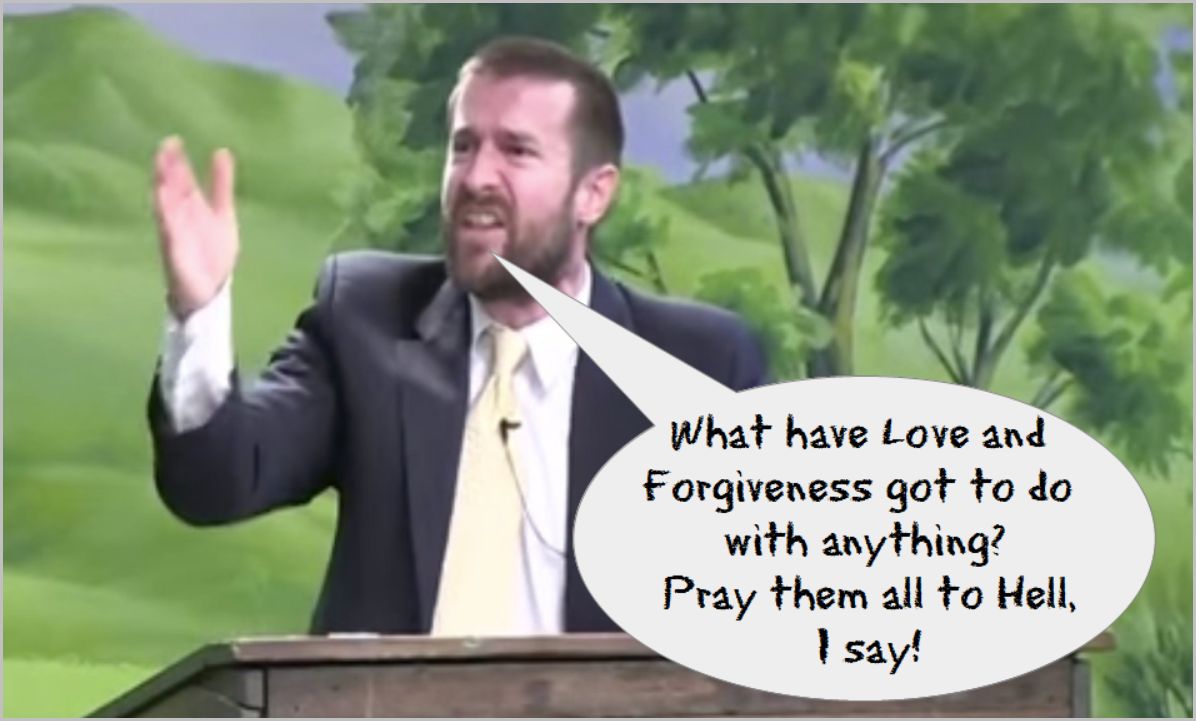
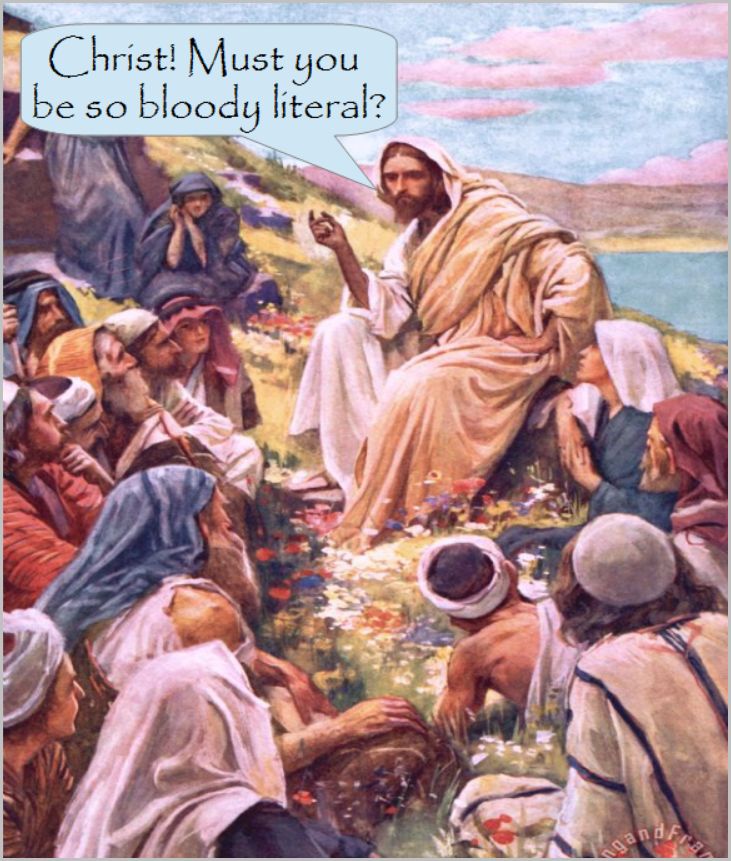
So much for ‘love your enemies’ and ‘turn the other cheek’. So much for the Jesus who does nothing but preach love and forgiveness. So much too for Paul’s mystical Christ. There is a very dark side to Jesus that expresses itself in vengefulness and megalomania. That anyone so disturbed could be considered an emissary from God, let alone God the Son, beggars belief.


* Since writing this post I’ve read Marcus J. Borg’s Jesus: Uncovering the Life, Teachings, and Relevance of a Religious Revolutionary. Borg makes precisely the same point about the charges against Jesus (though he sees him as a non-violent revolutionary). He explains that the Greek word used to describe the two killed with him – rendered as ‘rebels’ above – ‘is the term more commonly used for those engaged in armed resistance against Rome – “terrorists” or “freedom fighters”, depending on one’s point of view (p265).

Jesus v. Paul Round 2: And the winner is…

Make-overI’m re-reading Barrie Wilson’s excellent How Jesus Became Christian. Wilson makes the case that Paul’s Christianity was, and is, an entirely different religion from that of the historical Jesus. He shows how Paul’s ‘Christification’ changed the original mission of Jesus – to alert his fellow Jews to the imminence of God’s kingdom on Earth – ‘from one focused on the teachings of Jesus to one about the Christ’ (p242).

How right he is. This very the dichotomy troubled me in my own church-going days when evangelical Christianity, as it still does, consistently excluded the demanding, extreme and human Jesus of the synoptic gospels to focus instead on this illusory supernatural being. They preach sermons about him, sing hymns to him and intone creeds that skip glibly over everything Jesus said and did when he was alive. The Christ was, I came to see over time, an invention of Paul’s, the product of his strange hallucination sketchily recounted in Galatians 1.11-12 and 1 Corinthians 9.1 & 15.45. The Jesus he talks about is a sort of cosmic super-hero, a god-man of the type found in pagan religions in the first century. He has little or nothing to do with Jesus the Jew preacher and would-be Messiah, preserved – just about – in the three synoptic gospels.

So, the differences between Jesus and the Christ are profound. Here are a few of them, that I’ve drawn up, demonstrating that Christianity as we know it – essentially Paul’s ‘Christified’ version with inconvenient bits removed – bears little relation to the ‘good news’ of Jesus:

Jesus’ good news: God’s Kingdom on Earth imminent (Mark 9.1 etc)
Paul’s good news: Salvation through a dying/rising god-man (Romans 3.19-26; 4.24; 5.1-2; 5.10 etc)

Jesus presents as: Jewish Messiah claimant: ‘Son of Man’; Self-appointed judge and king in near future (Matthew 16.28; 13.41; Luke 22.30 etc)
Paul presents: Mystical saviour: The Christ, who saves those who ‘share’ in his death and resurrection; Christ as judge and ruler of mankind in near future (Romans 3.25; 6.1-11; 13.11-12; 1 Corinthians 15.20-28; Philippians 3.20)

Jesus’ qualifications: Teacher, preacher and healer; ideas rooted in Jewish prophecy; full of his own importance (Matthew 5.17; 7.12; 9.35; 25.40)
Paul’s qualifications: Builds entire religion on single hallucination; borrows heavily from pagan cults; full of his own importance (1 Corinthians 15.8; Galatians 1.15-16)

Jesus’ position: Adherent of Jewish Law; emphasises its importance (Mark 6.2; Matthew 5.19)
Paul’s position: Disregards Jewish Law; implies it is ‘dung’ (Romans 3.28; Galatians 5.6; Philippians 3.7-9)

Jesus insists on: Obedience to Jewish Law (Matthew 5.17-20)
Paul insists on: Faith in Christ and his resurrection (Romans 1.16-17; 3.22)

Jesus’ salvation requirement: Be righteous/perfect (Matthew 5.48; 13.43)
Paul’s salvation requirement: Faith (Romans 5.1; Galatians 2:15-16)

Jesus expects: Right behaviours and attitudes (Matthew 5.38-48)
Paul expects: Right belief (Romans 10.10-13)

Jesus’ teaching: Measure for measure morality (Matthew 6.38; 7.2; Luke 6.37); Forgive in order to be forgiven (Matthew 6.14); Show mercy in order to be shown it (Matthew 5.7); Give in order to receive (Matthew 6.38); Treat others as you wish to be treated (Matthew 7.12)
Paul’s teaching: Profess right belief (Romans 10.9)

Jesus’ commands: Love God (Matthew 22.37); Love your neighbour (Matthew 22.39); Love your enemy (Matthew 5.44)
Paul’s commands: Embrace Christ (Romans 8.35-38; Galatians 3.27); Be filled with the Holy Spirit (Romans 5.5; Galatians 5.16-18); Avoid those with different teaching (Romans 16.17; Galatians 6.6-9)

Jesus’ extremism: Give up everything you have (Mark 10.21; Luke 14.33); Give to all who ask (Matthew 5.42); Turn the other cheek (Matthew 5.39); cut off own hands, remove eyes (Mark 9.43-47); Consider castration (Matthew 19.12)
Paul’s extremism: No interest in anything Jesus taught when was alive; intolerance of Jesus’ original followers (Galatians 2.11-21)

Jesus’ guarantees: Resurrection/eternal life through demonstration of one’s personal righteousness once the Kingdom comes (Matthew 25.31-36)
Paul’s guarantees: Resurrection/eternal life for those with right belief and faith when Christ returns soon to judge mankind (1 Corinthians 15.20-28; 51-52)

Jesus’ outcomes: No Kingdom on Earth; no appearance of the Son of Man or a returned Jesus; disappearance of the movement that subscribed to Jesus’ ‘good news’
Paul’s outcomes: No appearance of the Christ; no rapture; no resurrection; no cosmic judgement

Jesus’ result: Failure
Paul’s result: Becomes mainstream Christianity; Paul wins!

As Wilson makes clear, the two are, despite some small overlap, very different belief systems. The Christ Christians worship is not the same as the Jesus they ignore. Nonetheless, they continue to pretend they are one and the same, unable to see that the join is, and always has been, a gaping hole.

 
Notes:
i) Biblical references are by no means exhaustive; there are many others that support each point and difference.

ii) Details of Wilson’s book are:
Wilson, B. (2008) How Jesus Became Christian: The Early Christians and the Transformation of a Jewish Teacher into the Son of God. Weidenfeld & Nicolson, London.

The Revolution Has Been Postponed

LiteralSo we all sat down on the grass and waited for the great man to speak.

“You’re a winner,” he said eventually, “if you’re ordinary and oppressed, because one day you’re going to rule the Earth!” Everyone gasped. We were all of us just ordinary, plain-speaking folk and things like this didn’t happen to us.

“Yes, really,” he said, “because God is going to establish his kingdom on Earth. And when he does he’ll sweep away the rich and the powerful, and you’ll be in charge. This I promise.”

We couldn’t believe it – proper gobsmacked we were.

“You’re in luck too,” the teacher went on, “if you’re poor, because once God’s kingdom comes, you’ll be rich beyond measure. And as for those of you who are hungry, you’re going to be filled like you’ve never been filled before. God, you see, is going to turn everything upside. Those of you at the bottom of the heap now – and let’s face it, that’s all of you sorry schmucks – are suddenly going to find yourselves at the top. And those who are on top now will be right down at the bottom. This, I promise you, is how it’s going to be.”

I can tell you everyone was beaming. We could already feel the change in the air.
Then Eli, sitting next to me sticks up his hand. “Hey, boss,” he shouts.

“Eli,” I says to him, “don’t be disrespectful. This bloke obviously knows what he’s talking about. He’s a messenger from God.”

“Yo, boss!” shouts Eli again.

“Yes,” the man up front says to him. “What?”

“When’s all this going to happen, then?” asks Eli. “When can we expect this big change?”

“Oh,” the teacher says, “I was thinking… maybe in a couple of thousand years?”

“What?” Eli says. “What good is that to us? From the way you were talking we thought all these wunnerful things were going to happen soon. What’s the point of telling all of us, sitting here in front of you, that we’re gonna be top dog and everything if it’s not us you’re talking about.”

“Good point,” the great man says. “All right then. How about if it’s sooner?”

There’s a lot of murmuring and everybody thinks this a good idea.

“Great,” he says. “Then that’s settled. We’ll make it sooner, so that you guys are still around. How does that sound?”

Everybody says it sounds marvellous.

“Great,” the big man says again. “It’s agreed, then – it’ll be soon. On that, you have my word.”

That was good enough for us and so we all set off home to get ready for the big changes we’d been promised.

“Thousands of years in the future,” Eli scoffs. “What a bloody con. Who does he think he is? God Almighty?”

Christians’ Favourite Delusions 29: The Resurrection Can’t Be Disproved

Or can it?Burial

The resurrection can’t be disproved, or so says a Christian on Bob Seidensticker’s Cross Examined blog. If it could be, the commenter tells us, he would abandon his Christian faith. Of course it isn’t up to sceptics to disprove the resurrection, or any other of religion’s fantastic claims. It’s up to those making them to demonstrate their veracity, just as it would be for me to prove I keep an invisible pink unicorn in my garage. There would be no obligation on anyone else to disprove it.

That being said, the resurrection is rather easy to refute. First, let’s qualify what we mean by the term, or rather what Christians usually mean by it: that Jesus rose from the dead in or as the same body that had, a couple of days earlier, died on the cross. There are, it’s true, some liberal Christians who find this such a preposterous idea that they concede the resurrection happened only in some sort of metaphorical fashion. They’re probably right, so our truck is not with these particular believers, even if their evangelical brethren take them to task for their apostasy. No, we are refuting the idea that Jesus rose physically from the grave, fully alive again, after spending slightly under two days completely and entirely dead.

Here’s how we can know this didn’t happen:
1. There’s only one eye-witness account of the resurrected Jesus, and that’s Paul’s (in Galatians 1.11-12 and 1 Corinthians 9.1 & 15.45; I’ve covered this more fully here.) And what does he ‘see’? Not a resurrected body, just a beam of light and a voice, both in his own head as the text makes clear (the Greek states baldly his experience was ‘within’ him). His resurrected Jesus is therefore a vision or an hallucination or an epileptic event. It is most emphatically not an encounter with an actual man returned from the dead.

So much for our only eye-witness. What about the others?

There are no others:

2. All the other resurrection accounts were written, third, fourth, fifth hand, some 40-70 years after the supposed event, so they’re not exactly reliable. They are, in fact, positively unreliable. In these accounts, Jesus is unrecognisable to those who knew him; he walks through walls; disappears at will and beams up into the sky.

I’m sure it won’t escape your attention that these are not something a flesh-and-blood body can do. They are not, as a result, descriptions of real experiences and belong, like Paul’s inner experience, to the realm of fantasy/visions/hallucination. Paul himself was of the view that others’ experiences of the ‘risen Christ’ were exactly the same as his own (1 Corinthians 15.6-8).

Not only this, the gospel accounts of these visions were embellished between the time they occurred (if they did) and their being recorded many years later by different groups of interested parties. They were also significantly tampered with. For example, Mark’s gospel originally had no resurrection appearances; these were added later – possibly 40 years later – 80 after the events they supposedly describe.

And so we come to the most conclusive of the arguments against the resurrection:

3. The dead stay dead. Always, with no exceptions. Once the brain is dead it cannot be revived – certainly not 40 hours after it is extinguished. “Ah, but wait!” say Christians, “Jesus was (the Son of) God so the normal laws of nature don’t apply. He is the one true exception.” But this is special pleading based on circular reasoning: Jesus rose from the dead because he was (the Son of) God. How do we know he was (the Son of) God? Because he rose from the dead. As such, it’s no proof at all – even if, in Romans 1.14, Paul seems to think it is. The man Jesus died and then… he stayed dead.

There are other reasons that lend support to the fact that the resurrection did not happen (for example, all the noise about an empty tomb, which is nothing more than a distracting sleight of hand. So what? What does an empty tomb prove? Certainly not a resurrection.) These three, however, are sufficient evidence that Jesus didn’t physically rise from the dead – and without the resurrection, as Paul says in 1 Corinthians 15:13-19, Christianity falls apart:

If there is no resurrection of the dead, then not even Christ has been raised. And if Christ has not been raised, our preaching is useless and so is your faith. More than that, we are then found to be false witnesses about God, for we have testified about God that he raised Christ from the dead. But he did not raise him if in fact the dead are not raised. For if the dead are not raised, then Christ has not been raised either. And if Christ has not been raised, your faith is futile…

How right he was.

Now if you’ll excuse me, I have to take my invisible pink unicorn for a walk.

Idiotic Stuff Jesus Said 10: How to Entertain

Last supper 2Here’s something you don’t see every day.

When you give a luncheon or a dinner, do not invite your friends or your brothers or your relatives or rich neighbours, in case they may invite you in return, and you would be repaid. But when you give a banquet, invite the poor, the crippled, the lame, and the blind. And you will be blessed, because they cannot repay you, for you will be repaid at the resurrection of the righteous.
Luke 14.12-14

In fact, you don’t see it at all, because Christians feel free to flout this command of their Lord’s. I mean, he couldn’t speak any more plainly than he does here, could he? And yet, Christians, you don’t invite the poor, the dispossessed and the disabled to your luncheons and dinner parties. Like the rest of us – that’s the unsaved and sinners in Christian-speak – you only invite your friends, family and fellow-believers. If you’re well-placed, maybe as an official of the established church or as an obscenely wealthy evangelist, you invite those who are similarly rich and famous. As far as you’re concerned Jesus and his ridiculous ideas can just f**k off.

What? You object? You don’t say this, Christians? It would be blasphemous? But of course you say it, when you spiritualise his point, explain it away (‘what he really means is…’), claim the context excuses you or just plain ignore him.

Please don’t misunderstand me; I don’t blame you. Jesus’ expectations are totally unreasonable – idiotic even. But I’m not a Christian; I don’t pretend to follow him and don’t have to do as he says. You, on the other hand claim him as your saviour, your God, and profess to live your life in obedience to him. Except you don’t, do you; you wilfully disregard the clear, direct instructions, like this one, that he gives you.

You much prefer setting your own agenda, whether that’s ‘defending God’s standards’ (your God is incapable of defending his own standards?), bashing the gay or making sure you yourself are ‘blessed’. But these are not part of Jesus’ agenda; his good news (mad as it is), is much more concerned with elevating the lowest of the low, including inviting them into your homes and feeding and entertaining them.

So how about it Christians? How about it all you outspoken men of God – Stephen Green, Steven Anderson, Scott Lively, Matt Barber, Franklin Graham – and all you other Christians; isn’t it time you got down off your soap-box of whatever it is you’re opposing this week and made a start doing what your saviour commands you to do?

Well, isn’t it?

What Christians Believe: Part Two

AscensionHi, Thea Lojan here talking about the creed. Here’s what else it says, following on from last time:

I believe Jesus ascended into heaven and is seated on the right hand of God and will come to judge the living and the dead. As I was saying, Jesus could do amazing things. He could, like, beam up into the sky and out into space – that’s what ‘ascended’ means. Amazing. And he is coming back to judge the Earth, just like he promised. I know he said he’d be back real soon, like while his disciples were still alive, but to God a minute is like a thousand years so a few years can be anything like a million, or something like that. We shouldn’t take it literally when he said he’d be back while his friends were still around, though the Bible is, without a doubt, the literal Word of God.

Anyway, when he returns Jesus is going to send those who don’t believe in him to Hell, where they’ll suffer eternal torment for, like, forever and ever, amen. And he’ll take people who are saved, like me, back to Heaven with him. I can’t actually find the bit in the Bible where he says he’ll be taking me to Heaven, but I have faith so I’m sure he will.

Just a thought, but why doesn’t this creed mention the Bible, and how it’s the ineffable and literal Word of God? You’d think it would, wouldn’t you.

I believe in the Holy Spirit, the holy Catholic Church and the communion of saints. Definitely. The Holy Spirit is like the feeling of God that you get when you’re being blessed. You can’t see it – though it’s actually a ‘him’ because God is a ‘him’ – but it’s there, helping you make decisions, like whether you should buy a new car or install a heated pool in the yard. You definitely get a sense of him then. In my experience, he’s never let me down. He always guides me right.

I’m less sure of the holy Catholic Church because of course we’re not all Catholics and nor should we be when Catholics have got everything so wrong. But the pastor at church says it just means ‘the Body of Christ’ here, the same as ‘the communion of saints’ does, though that makes you wonder why we’ve got it in there twice. The communion of saints means all worshippers everywhere being united and working together. So, yes, I totally believe that because, that’s what we do as Christians; we all love each other. I don’t accept any of those lies that some people put about that there’s, like, 41,000 different kinds of churches. I don’t think God would let that happen, do you?

I believe in the forgiveness of sins. Yes I surely do, for God has forgiven my sins through the redeeming blood of the Lord Jesus Christ, his son. And if they’re really, really sorry I can forgive the sins of others, except of course if they’re, like, homosexuals. It really grosses me out to think about what so-called “gay” people do with each other. It’s unforgivable and even the Lord doesn’t forgive it. But my sins, yes, he forgives those.

The resurrection of the body and the life everlasting. Well, I already covered this. This is another repeat. What this really means is that everyone whose sins are forgiven and have been saved will go to live with God in Heaven after they die. Isn’t that amazing? Just think, whatever happens to your body all the time you’re dead, even if it’s been burnt or has rotted away to nothing, God will repair it and make it good as new. And then you’ll live forever in Heaven, because that’s what it means when it says ‘the life everlasting’. Even if I still can’t find that bit in my Bible.

Well, that’s it. That’s my creed, and what Christians everywhere believe. It was written, in fact, by the apostles, that’s Jesus’ friends, way back when he was still alive or just after. If you were to give your life to the Lord – and you really should if you want live forever in Heaven – then it’s what you’d believe too. Isn’t that, like, really, literally incredible?

Predictions for 2015

BrideMy predictions prophecies for the year ahead:

1. There’ll be no Second Coming in 2015.
Jesus won’t be back this year. Just like he wasn’t back in 2014, 2013, 2012… 1985… 1914… 1868… 1497… 1000… 446… 35. Just think of all those years – count ’em, nearly two thousand – when he’s failed to return so far. Actually, he promised he’d be back while his disciples and those daft enough to listen to him were still alive – around AD30 or thereabouts (Matthew 16:27-28; Matthew 24:27, 30-31, 34; Luke 21:27-28, 33-34). Safe to say he’s not coming back at all now, just like dead people don’t. Not in 2015, not ever.

2. Christians will go on insisting Jesus is going to return any time soon.

3. There’ll be no natural disasters or human calamities as a result of same-sex marriage.

4. Christians will claim natural disasters and human calamities are the result of same-sex marriage. Shaking our fists at God… the wrath of the Almighty… sign of the End Times… blah, blah, blah.

5. More than one prominent Christian will call for the execution of gay people.

6. Christians in the west will claim they’re being persecuted when they’re being expected to treat others fairly and equally, and not to discriminate against them.

7. Christians will respond to criticism with clichés like ‘they wouldn’t dare say that about Muslims’… ‘Christians are the last group who are fair game’… ‘It’s time for Christians to speak out’… ‘Stand up for God’s standards…’ etc.

8. Christians will continue to dismiss and disparage anyone who doesn’t share their views, especially atheists. Look out for ‘atheists have no morality’, ‘the fool hath said in his heart there’s no God’ and ‘atheists want to oppress Christians’ occurring with tedious regularity.

9. There will be more revelations about the abuse of children by church ministers.

10. Church hierarchies will attempt to cover up the abuse of children by their ministers.

11. There will be the usual manufactured ‘war on Christmas’.

12. These predictions have far more chance of coming to pass than any of the so-called prophecies of Bible. I’ll return to them at the end of the year so we can see.

A happy new year to you all!


Original picture: Ursula Klawitter / zefa / Corbis

Idiotic Stuff Jesus Said 9: God knows what you need before you ask him

PrayJesus said: ‘Do not be like non-Jews, for your Father knows what you need before you ask him.’ Matthew 6.8

Prayer has been in the news quite a bit lately. Not, of course because it’s suddenly started working, but because prominent Christians have been pretending, yet again, that it does:

Archbishop of Canterbury, Justin Welby, has been telling us just how important prayer is. He prays for others while he does the ironing.

The pope has been praying for victims of Islamic State.

Churches in Glasgow have been praying for the victims and families involved in last Monday’s terrible accident there.

Bishops in Australia prayed for victims of the Sydney seige.

Christians inherit this futile behaviour and empty posturing from Jesus himself. He believed that talking ‘in secret’ to his god-in-the-sky could actually change things down here on Earth. This God, according to Jesus, knew what his children wanted even before they asked.

His children were not, however, Christians; they were Jews. The phrase I’ve interpreted above as ‘non-Jews’ is ‘Gentiles’, which means exactly that – outsiders who weren’t Jews. These outsiders, Jesus implies, just don’t get prayer. Only the chosen people, the Jews, do. Only they know how to talk to the big Sky Daddy properly and it’s only their needs that he knows about beforehand. He isn’t interested in others, their needs or their prayers.

But if he knows the needs of his chosen before they even ask him, why doesn’t he simply meet those needs? Why does he have to be asked? What sort of perverse and twisted version of a loving father is this, who insists on being asked before he will consider acting? I’m only a fallible and flawed human being but when I know my children’s needs, I don’t wait to be asked to meet them.

Maybe God isn’t really as magic as Jesus seems to think. Maybe he needs time to let things happen by chance so that he can then take the credit. Because there’s absolutely no evidence prayer works. The opposite is the case; there’s plenty of evidence to suggest that the supposed results of prayer are no more likely than if they happened by chance.

As if this weren’t ludicrous enough, many of the examples of prayer we’ve heard about recently are prayers after the event; appeals for the victims and survivors of disasters once the disaster has struck. So did God not know those involved ‘needed’ not to be killed or tortured or bereaved? If he didn’t already know this, then Jesus’ claim is, like so many others he made, utterly worthless. And if God did know, why did he not do anything to prevent the loss of life, the hardship, the devastation? Because he wasn’t asked

It’s likely though that he was asked, by those believers who were caught up in appalling circumstances. So then, why didn’t he act? Why didn’t he meet those needs he knew so much about beforehand?

Perhaps he just doesn’t care or he’s not able. Or, more likely, maybe he doesn’t exist.

And if he doesn’t exist, then Jesus was wrong in everything he said about him. He was wrong to think God was there in Heaven, taking an interest; wrong to think he cared. It also means Jesus certainly wasn’t the son of any such god. Nor was he the human manifestation of a make-believe Sky Daddy on Earth.

Who Ya Gonna Call?

DemonAnd when they came to the crowd, a man came up to him and, kneeling before him, said, “Lord, have mercy on my son, for he is an epileptic and he suffers terribly. For often he falls into the fire, and often into the water. And I brought him to your disciples, and they could not heal him.” And Jesus answered, “O faithless and twisted generation, how long am I to be with you? How long am I to bear with you? Bring him here to me.” And Jesus rebuked the demon, and it came out of him, and the boy was healed instantly. (Matthew 17.14-20)

Do you believe in spirits and demons? When you’re ill, do you visit the nearest exorcist or do you take yourself off to the doctor or hospital? Of course, most Christians (but by no means all) have more faith in the medical profession than they do in the wingnuts who’d tell them their ailment was the result of demonic activity and command the demon to leave in the name of Jesus.

Why? Because, even Christians know, in spite of what they might tell you, what causes disease and illness. They know what cures them too; and it has nothing to do with Jesus. ‘The Son of God’ is among the wingnuts when it comes to believing unclean spirits are at the root of human ailments and behaviour (Mark 5.1-8; Matthew 8.28-34; Matthew 12.43-45; Luke 4.33-36; Luke 8.29 etc.)

In spite of the fact there’s absolutely no evidence that demons exist, Jesus thought that invisible supernatural creatures were responsible for conditions like epilepsy. Like everyone at the time he thought that if these unclean spirits could be driven out, then the condition would be ‘cured’. Some follow in his misguided footsteps today; the Catholic church has an entire coven of exorcists, and charlatans like the Reverend Bob Larson make a living driving out the demons of pride, lust, homosexuality and greed from stooges and the gullible (except of course they don’t.)

If you’re a Christian, you should believe in demons and unholy spirits; you believe everything Jesus uttered was true, don’t you?

Of course, Jesus was a product of the pre-scientific era in which he lived; his ignorance might be excusable if it wasn’t offered up as God’s Truth. All that Jesus’ belief in devils and unclean spirits demonstrates is that he was very much a man of his time – evidence, if more were needed, that he wasn’t remotely divine. Unless, of course, the God he also believed in was as ignorant of the causes of illness and human behaviour as he was.

But next time you’re unwell, Christian, or you’re feeling a mite greedy or lustful, don’t go to the doctor’s. Don’t even ask the Lord for forgiveness. Have a little faith and, in the name of Jesus, command that hell-spawned demon within you to leave. See how that works out for you.


Update: New this week in ‘It Can All Be Blamed On Demons’:

Right-wing American broadcaster, Bryan Fischer, claims unarmed black teenager killed by cop was in fact possessed by a ‘homicidal demon’.

Tele-evangelist Pat Robertson asserts playing Dungeons and Dragons leads to demon possession.

Thank you, Lord, for your endorsement of fantasist rubbish like this.


Banned from the Kingdom of God

PaulHere’s ‘Saint’ Paul’s list of those who won’t be allowed in God’s Kingdom:

Do you not know that the unrighteous will not inherit the kingdom of God? Do not be deceived; neither the immoral, nor idolaters, nor adulterers, nor sexual perverts, nor thieves, nor the greedy, nor drunkards, nor revilers, nor robbers will inherit the kingdom of God. (1 Corinthians 6. 9-10)

We can do better than that though. Who else could we add? How about the self-righteous? The converted? The born-again? The saved? Fundamentalists? Evangelicals? Evangelists? Ministers, bishops and popes? Christians of all stripes and persuasion? Will they all make it into the Kingdom?

No, they won’t. Not one of them will enter the magic Kingdom.

Why not?

Jesus, Paul and other New Testament writers were sure that the Kingdom of God would be arriving on the Earth soon. That’s ‘soon’ as in their own time, 2000 years ago*, and, as you’ll have noticed, the Kingdom, promised in the past for the past, never arrived. It’s not going to now either; neither Jesus nor Paul thought their fantasy was going to materialise some time in the distant future.

More than this, both were wrong that God was preparing to establish a heavenly kingdom on Earth at all. They were religious fanatics caught up in the religious zeitgeist of their day, religion being all they had to explain life, the universe and everything. Their interpretation was wrong on so many levels – but they were stuck with it. And so, when so much seemed unjust, unfair and unreasonable to them, Jesus in particular felt sure the only solution was for God to intervene to set things right; the meek would inherit the Earth, those last would be first and the first last. It was a dream, a vain hope, a complete invention. Not only did the Kingdom not arrive when Jesus and Paul said it would, it was never going to. There was no God waiting in the wings to make everything better.

So don’t worry if you’re gay or you like sex with more than one partner or you drink a bit too much or you’ve not been as honest as you might have been. You won’t be part of the Kingdom of God, to be sure, but that won’t be because of your sexuality or your morals or your ‘lifestyle’. You won’t be part of the Kingdom because it isn’t real. You’ll be in good company though – those who love the Lord won’t be getting in either. They’re just as far from Jesus and Paul’s land of make-believe, their special magic club, as you are.


* See Matthew 24:27, 30-31, 34; Luke 21:27-28, 33-34; Matthew 16:27-28; Matthew 19.28; 1 Corinthians 15.51-52; 1 Thessalonians 4.15-17; 1 John 2:17-181 and Peter 4.7 for predictions by Jesus, Paul and other NT writers that the Kingdom was coming real soon.