Less religion, not more

Welby

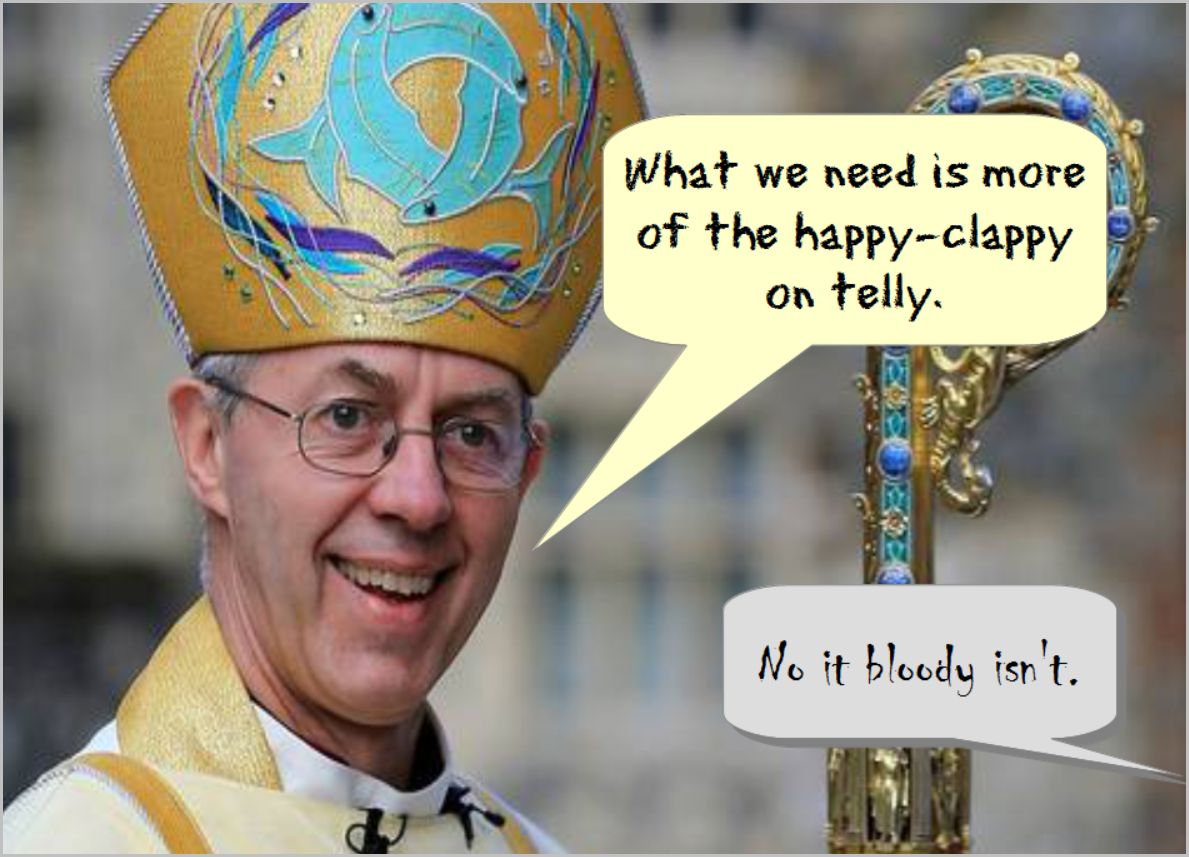
A bloke in a pointy hat and posh frock thinks there should be more religion on television and radio. Justin Welby, Archbishop of Canterbury, says that religion merits as much air time as politics, sport and drama.

The Archbish makes it sound like there’s nothing at all on TV and radio already about religion. In fact, in the last few months in the UK we’ve had a full schedule of Easter programmes; Simon Reeves’ The Ganges on BBC2 (looking at India’s religious heritage); Channel 4’s Unreported World and Dispatches, which regularly consider religious issues; Clare Balding’s trite Good Morning Sunday on Radio 2; the weekly broadcast of church services and daily Thought For the Day on Radio 4; the weekly dollop of worship on Songs of Praise on BBC1 and the 24-hour Christian ‘ministry’ of Trinity Broadcast Network and other God channels for those who just can’t get enough mumbo-jumbo.

Maybe that’s not as much as sport, but then there’s hardly anything on TV that has as much coverage as sport. (Bad news too for those of us with little interest in watching others running, jumping and hitting things; there’s even more to come in the shape of Wimbledon, Euro 2106 and the Olympics.)

Do we really want religion to have the same level of coverage? Are people really as interested in belief systems as they are in sport? Or music? Or art? Or comic book franchises? Even if there are, why is it up to television – the Archbish singles out the BBC as the broadcaster he thinks should indulge his fantasies – to provide it? Isn’t it, rather, up to churches, mosques, temples and other centres of superstition to promote their own particular brand of nonsense?

Make no mistake about it, this is what Justers is proposing; the promotion of religion – ‘religious literacy’ he calls it. He is not, we can be fairly sure, looking for programmes that are critical of religion (unless it’s other people’s). He wants, he says, to see more programmes that give us a better understanding of religious belief. What he means by this are proselytising programmes that create greater empathy for those who subscribe to delusion.

He isn’t advocating, for example, documentaries that explore the irrationality of faith, or ones that show the slap-dash, deceptive ways in which holy books came to be compiled or ones that demonstrate how most adherents to faith fail to live out its exacting demands. Nor is he suggesting programmes that focus on the appalling misery religion brings to some, or shows that give a sympathetic hearing to cults, sects and extremists. I would have no objection to programmes like these (except those that are sympathetic to extremists) because the ugly underbelly of religion deserves to be exposed, like Channel 4’s The Untold History of Islam of a few years ago, taken off air after its presenter was threatened with violence by those who didn’t like its critical perspective.

But these are not the kind of programmes the Archbishop is proposing. The religious literacy he wants us to have is of the cuddly side of faith, the supposed deep spirituality of the obsessive and what he regards as the positive contribution religion makes to the world; a one-sided picture already more than adequately covered by the nation’s broadcasters.

Thankfully, despite the recent political interference in the BBC, the Corporation is still required to present balanced and impartial views of its subject matter. If the Archbishop, who sits in the House of Lords and so is not without influence, is successful in forcing the BBC and other broadcasters to increase their coverage of his obsession, then we should also be able to look forward to programmes that are critical of religion too.

No broadcaster is obliged to promote religion nor to proselytise on its adherents’ behalf. Shame on the Archbishop, with his smiles and pointy hats, for suggesting they are.

Get your free Porsche here*

*Or maybe notRaising

A True Story**

“So,” he says, “you might have an old banger now but when it finally packs in for good, we’ll upgrade it for you, free of charge.”

“You’ll upgrade it?”

“Sure. No problem. You see your old car is… well, I’ll be honest with you, it’s a really rubbish make. It’s a pile of crap to tell you the truth.”

“A pile of crap?” I splutter. “I can’t believe what I’m hearing. If it’s such a pile of crap why’d you sell me it in the first place? Why d’you sell them at all?”

“No need to get upset, mate,” he says. “As I said, when it’s completely clapped out we’ll replace it with a brand new one, free of charge.”

“Free of charge?”

“Yeah, that’s the deal. You wear out a lemon we give you a brand new Porsche.”

“A new Porsche? C’mon man, you’re winding me up. Why would you give me a new Porsche for nothing?”

“Because as I said, that’s the deal. Have a little faith man. It all works out.”

“Okay, I say. Well how about I get the Porsche now. Before this old rust bucket let’s me down completely.”

“Doesn’t work like that mate,” he says. “You get the banger first, the Porsche at the end.”

I tell him this makes no sense at all. “Look… Paul,” I say, reading his name off the dirty old name tag he’s wearing, “if you want people to have a completely free brand-new, top-of-the-range luxury car then you should just give it to them the first time they come in here. Forget the clapped out old banger bit. Just give them the Porsche.”

“Nah, mate. I’ve told you, that’s not the offer.”

“Okay,” I say, making one last effort. “Show me one person who’s benefited from this mad scheme of yours. Show me one person who’s driven away in a Porsche after their old vehicle’s reached the end of the road.”

“Listen, mate,” he says, “it’s like I said. You need to have a little faith.”

One person,” I say.

“Okay,” he mumbles, ”there are stories that the boss’s son did once…”

“The boss’s son? ‘Stories’? Christ, what sort of con are you operating here?”

“You’ve upset me now, you fool” he says, “and I’m not sure you qualify for the deal any more.”

I can only shake my head. “I’m not sure I ever did… mate,” I say.

*   *   *   *   *   *   *   *   *   *   *   *

**Yes, this really is a true story. You can find it in Paul’s first letter to the Corinthians (15.35-50). Here’s how it goes there:

But some one will ask, “How are the dead raised? With what kind of body do they come?” You foolish man! What you sow does not come to life unless it dies.  And what you sow is not the body which is to be, but a bare kernel, perhaps of wheat or of some other grain…

So will it be with the resurrection of the dead. The body that is sown (buried) is perishable, it is raised imperishable; it is sown in dishonour, it is raised in glory; it is sown in weakness, it is raised in power; it is sown a natural body, it is raised a spiritual body…

Flesh and blood cannot inherit the kingdom of God, nor does the perishable inherit the imperishable.

Right…


Christianity: always winter but never Christmas

Spot the difference:Shore

Christians are hot on evidence.

There isn’t enough for evolution, they say, even though there’s an abundance.     

None, they claim, that the Earth is billions of years old, but only 6 thousand.

Not enough that climate change is man-made, when there’s considerable evidence it is.

None that there’s a genetic component to homosexuality when science reveals that there is.

But, as far as the resurrection of the body, judgement and eternal life in either Heaven or Hell are concerned, these they believe in, no evidence required.

I recently challenged Christians on Charisma magazine’s blog-site to provide or point me to evidence that any one of the 107 billion people who has ever lived who after they had died had gone on to enjoy either eternal life in Heaven or eternal punishment in Hell. Unfulfilled promises from magic books weren’t admissible, because a promise of something happening is not the same as it actually doing so. Jesus didn’t count either, as there are no eye-witness accounts of his bodily resurrection, only stories written decades after the supposed event. In any case he was half Vulcan or something, not an ordinary mortal.

Alas, my challenge went unanswered. You won’t find it on the Charisma site now because it has been removed by the moderator there. Expecting evidence from Christians for what they believe is patently unreasonable. After all, who needs evidence when you can exercise your licence to believe whatever you’re told?

Of course, there is no evidence of any resurrection nor of anyone who has gone on, post-mortem, to enjoy everlasting life. Have you noticed how everything about Christianity is either invisible – God, the Holy Spirit, Heaven, angels, demons – or lies permanently in the future; the Second Coming, the resurrection of the body, the Kingdom of God, judgement and eternal life? All of them always just that little bit further on. This year, next year, sometime, never. Just not now.

Yet Jesus, Paul, Revelation’s John and most other New Testament luminaries believed God’s Kingdom, the resurrection and judgement were coming within their own lifetimes.* Not one of them entertained the thought that 2000 years down the line none of these miraculous events would have materialised.

Small wonder then, that at the start of the second century, believers began to lose hope in the Second Coming, the Kingdom’s arrival and an earthly resurrection of the dead. Maybe, some of them began to think, eternal life would be not be here on Earth, as Jesus and Paul had promised, but in Heaven with God, which they most definitely hadn’t. This way, everything that hadn’t happened here on Earth would happen instead after death (we can see this transition taking place in the very late gospel of John). All of which was fortunate, because it dispensed with the need for confirmation and evidence; no-one could prove – apart from the fact nobody has ever survived their own extinction – that believers didn’t go to Heaven when they died. Equally, no-one could provide evidence they did.** How neat and convenient.

So if any Christians reading this would like to like to show us some evidence for the resurrection of the dead, post-mortem judgement, Heaven, Hell, God’s Kingdom on Earth – any of it – I’m sure we would all like to see it. Until then, I will go on regarding all of these assurances as empty promises – pie in the sky – that believers cling to desperately, while calling their desperation ‘faith’.

* See Matthew 16.27-28 & 24.27, 30-31, 34; Luke 21.27-28, 33-34; 1 Corinthians 15.51-52; 1 Thessalonians 4.15-17; 1 John 2:17-181; Peter 4.7; Revelation 1.1 & 21.2-4

** Psychics claim to commune with the dead of course, or at least with their spirits; more hokum from the minds of the deluded. Even if it weren’t, this isn’t the kind of resurrection Christians envisage for themselves. They dismiss psychics’ ‘evidence’ of life-after-death as so much demonic deception.

Some gospel truths

Jesus&Roman

Imagine a new book is discovered that claims to answer all of our questions about life, promises hope for the future and provides remarkable insights into the nature of reality. You’d be interested, right? It wouldn’t even bother you that the book was the result of a series of hallucinations its writers claim to have had.

You don’t need to imagine this book because it already exists. It answers essential questions that we all have at some point like whether is life after death, and what’s waiting for us on the other side; what is the purpose of life, and how can we find happiness and peace now? Does God know us personally and hear our prayers? How can we avoid sin and learn to truly split infinitives repent. It’s called (wait for it) The Book Of Mormon and it purports to answer all the deep questions I’ve just mentioned – I know it does because I’ve just lifted them from mormon.org – and it is the result of the visions a ‘prophet’ called Joseph Smith had of one of the Lord’s angels back in the 1820s.

What? You don’t believe it? Why not? It’s the result of divine revelation and it answers all the questions you have – we are all supposed to have – about the meaning of life.

I’m guessing you don’t believe it because Joseph Smith has the reputation of being a bit of a fraud. His visions are implausible and inconsistently reported, while the book itself is fanciful and feels, well, fabricated; Jesus’ adventures in America after his resurrection just seem so made up.

No, I’m with you on this one, as is 99.93% of the Earth’s population. They don’t believe the Book Of Mormon either.

So how about a different book, a much older one? It too is said to answer all the serious questions about life and is also the result of visions and revelations. Okay, maybe it’s inconsistent, contradictory and fanciful. Maybe its more than a little improbable in places, but this book is different. Truly, it is. Everything in it, though  written, misremembered and altered by human beings is the very word of God; it says so itself so it must be true, and 2.2 billion people in the world can’t be wrong.

Or can they? Why is it that a book that relies even more than the Book of Mormon does  on innervisions and ‘revelations’ – the Bible – is held in such high esteem by so many? The New Testament alone records over twenty such hallucinations*, including the entirity of its final book. Some of these visions – those of the Risen Christ – serve as the foundation for the entire belief system.

Why are these ‘revelations’ regarded, by Christians at least, as real and trustworthy when those of the Book Of Mormon, the Qu’ran, the Vedas, and all those other ‘holy’ texts that owe their existence to hallucinations, are not? There is no substantive difference between them; no difference between one group of religious fanatics’ visions and those of all the other groups. None are demonstrably divine and all are essentially the same. That the Bible is older than the Book Of Mormon does not lend it more credence or affirm its ‘holy’ status. On the contrary, its production in a more credulous, pre-scientific era gives it less credibility, not more, and supplies greater reason not to sanctify or revere it.

So, Christians, what distinguishes the revelations of the Bible from those found in other ‘holy’ books? What makes its visions viable and real when the others, apparently, are not? What makes the Bible right and those wrong? It cannot be because the Bible says it’s inspired by God (in a letter known to be a forgery) because the others claim the same thing. Why are you prepared to base your lives on one set of ancient hallucinatory experiences but dismiss all the others? Why don’t you subscribe to all the books that claim divine providence? Doesn’t Pascal’s wager demand that you at least hedge your bets and embrace them all, just in case?

News just in: Neither Jesus nor Paul nor the disciples nor the gospel writers nor the Bible’s forgers nor the churches mentioned in it nor the early ‘Church Fathers’ ever read the Bible. They didn’t know of its existence, living 300 years before it was finally put together. They didn’t even envisage its creation, believing the world was going to end in their own lifetimes.

*The visions recorded in the New Testament include 10 separate ‘sightings’ of the risen Christ in the gospels and Acts; the Transfiguration (Mark 9.2-8 etc); Paul’s conversion alluded to in Galatians 1.11-12 and 1 Corinthians 9.1 & 15.45 and recounted, with contradictory details, three times in Acts; Paul’s vision – in or out of his body, he’s not sure – of ‘the Third Heaven’ (2 Corinthians 12.1-6); Stephen’s vision of Christ at the right hand of God (Acts 7.56); Peter’s ‘trance’ in which he sees a giant table cover (Acts 10.9-16); Paul and Barnabas’ visit from an angel (Acts 5.19-20); 5 other reports of visions in Acts (9.12; 16.9; 18.9-10; 22.17-20; 27.23-24) and the entire book of Revelation that relates the many hallucinations of a very disturbed mind. And then there are all the other sightings of angels and the dreams through which God is said to communicate with various nut-jobs people. I ask you – dreams!

Now make up a story about it

Bible4

So there we have it. The accounts of Jesus’ resurrection all derive from imagined sightings of him post-mortem. Call them hallucinations, visions or revelations, none of them were encounters with a real, revived physical being.

Except that’s not quite it, because it’s worse than that, Jim.

Most of our accounts of the resurrection appearances are fifty years or more too late. Paul’s is the only first hand account we have and even that is sketchy and recounted several years after it happened. For at least three of those years, Paul meditated on his seizure and interpreted it as a revelation from the Lord. Undoubtedly, others had similar experiences; the stories of the resurrected Christ came from somewhere and the resurrection seems to have been central to Christian faith from its earliest days. Paul cites in 1 Corinthians 15:4-8 those he says have encountered the risen Christ:

He appeared to Cephas, then to the twelve. After that He appeared to more than five hundred brethren at one time, most of whom remain until now, but some have fallen asleep; then He appeared to James, then to all the apostles; and last of all, as to one untimely born, He appeared to me also.

Paul implies here that his own experience is the same as that of the others on his list; they too, then, had visions of the risen Christ within their imaginations. Significantly, Paul omits Mary Magdalene, the first to ‘see’ the post-mortem Jesus according to the later gospels, while some of the other encounters Paul claims to know about do not find their way into those accounts. Of those that do, we can be confident the details are wrong. They were most certainly not as they are described in the stories that eventually came to be written.

The earliest copies of Mark’s gospel famously have no resurrection appearances. The women discover the empty tomb, which Matthew and Luke later lift into their gospels, and, bizarrely, decide not to tell the disciples about it. By the time we get to last canonical gospel, written some thirty years down the line, its author embellishes Luke’s attempts to suggest that the risen Jesus has some physicality; he allows his old friends, especially Thomas, to poke around in his wounds and he eats fish. Nonetheless, as in the earlier gospels, the disciples all have trouble recognising him, even on a third occasion, and are afraid to ask him who he is (John 21.12). Did his followers simply experience, as John 14.15-20 and Matthew 18.20 seem to suggest, an intense sense of Jesus’ presence? This would make the reports of actual sightings evidence of later believers’ need for something more substantial than flashing lights and fuzzy feelings. Which is how, over time, surrounding detail came to be added.

In their specifics, the resurrection appearances in the gospels and Acts are stories that accrued around the visions and inner traumas experienced by Jesus’ friends and other zealots. As such they are fiction; the angels at the tomb – probably the empty tomb itself – the encounter on the road to Emmaus, the fish breakfast and the rest. Bart D. Ehrman demonstrates convincingly in Jesus Before The Gospels, that the oral tradition was not capable of transmitting the details of Jesus’ life and ministry accurately over a 40 year period (when Mark’s gospel was written). The same is true, perhaps moreso, of individuals’ idiosyncratic inner experiences. Over 50+ years, after which Matthew and Luke’s gospels were composed, reports of these visions would have been altered innumerable times by those relating them, ever onwards and outwards; details would inevitably have been changed, added, removed and invented in a protracted game of Chinese whispers. In all probability the gospel writers themselves introduced their own embellishments.

So then, from a small number of visions/hallucinations/feelings, via significantly altered accounts of these same subjective experiences, together with others that are pure invention, to the eventual recording of such stories 50 to 80 years later, this is the evolution of the fantasy that is the risen Christ.

Are You Doing What Jesus Christ Says?

Billboard

Dale McAlpine, sometime commenter here and fanatical street-preacher in these parts, has posted a tasteful little video on his web-site – that’s the smugly named Repent.com if you’re interested – called Are You Doing What Jesus Christ Says? Take a look at it over on Repent.com or on YouTube; it’s ludicrously melodramatic and wonderfully over the top. You’re sure to enjoy its typos and spelling mistakes too.

What’s remarkable about it apart from these things is that, despite its title, it makes little reference to what Jesus is supposed to have said. Instead, it’s all about how you’ll go to hell if you don’t repent and accept him as your saviour; but Jesus never said this. It says you’re a ‘vile, wretched, hell-deserving son or daughter of Adam’ – Jesus didn’t say this either. It also insists you should let his cross ‘disrupt the very centre and citadel of your life of self’ (whatever that means) and guess what? This wasn’t part of Jesus’ teaching either. In fact, none of these claims were part of his ‘good news’.

Of the things Jesus did say – go the extra mile, sell all you have to give to the poor, turn the other cheek, avoid judging so you won’t be judged, give to all who ask, give away your shirt as well as your coat, feed the hungry, visit the sick, clothe the naked and love your enemies – the video makes no mention. Funny that. Maybe that’s why we don’t see Christians doing them very often.

So, Christians – and Dale too – are you doing what Jesus said or are you, like the video, only interested in pointing out others’ supposed sins and shouting about how they need to join you in your delusional mumbo-jumbo?

Yes. Thought so.

In the Wrong Body

prayer3What to do about those people who feel they don’t belong in the body they were born with? Those who disparage the vehicle that carries them through life? Should we ban them, shun them? Prevent them from using the same bathrooms – to use that ridiculous euphemism for places never known to include baths – as those of us who accept the body we’ve got? Should they be side-lined, castigated and ridiculed?

Well, no. Let’s go easy on Christians who believe they are somehow separate from the bodies that house them; who regard their bodies are inferior to the spiritual being God intends them to be. Christians who look forward to the day when they’ll be relieved of their physical bodies, which will then be transformed into spiritual ones, and who, in preparation for this miraculous change, claim to resist the demands of the body – the lusts of the flesh as the Bible puts it (1 John 2.16). Yes, those Christians, the same ones who disparage people who find themselves in the wrong bodies and want them to conform to the sex they know themselves to be; transgender people.

The Christians are wrong on every level of course:

  • They are not designed to be spiritual beings;
  • None of us is separate from our bodies;
  • The illusion of the self is a product of the brain and wider society, and we demonstrably do not have souls or spirits;
  • Bodies, while frail and susceptible to illness, injury and ageing, are all we’ve got; they don’t survive death and are not refurbished or replaced after it.
  • The demands of the body can be managed but not entirely ignored, not even by Christians who eat, drink, have sex, sleep, defecate and generally indulge their carnality in the same way the rest of us do.

Still, none of this prevents Christians from thinking they’re prisoners of a temporary yet  strangely inhospitable body while here on Earth. You’d think that would make them empathetic to people who are also in the wrong bodies, but you’d be wrong. They ridicule them and tell them that they’re sinful aberrations; they object to their use of the ‘bathroom’ that corresponds to the gender they know themselves to be.

What was it someone once said? ‘Let he who is without sin cast the first stone’. There sure seem to be a lot of sinless Christians about these days.

Faith: An Exercise In Futility

MountainsWhat is faith?

The anonymous author of the book of Hebrews says it’s ‘the substance of things hoped for, the evidence of things not seen.’ (11.1)

Hoping for ‘things’ like perfection, resurrection, eternal life, heaven (not to mention the ability to move mountains), the likes of which no-one has ever achieved, is nothing but wishful thinking. Despite what the Hebrews author says, wishful thinking isn’t evidence of anything – except a capacity for wishful thinking.

By it’s very nature, then, faith is not evidence, but the very opposite. It is the effort to believe in things for which there is no evidence and the delusional insistence that the imagined is more real than that which is.

Do No Harm

sermon2

If religions took ‘do no harm’ to heart (as the Hippocratic Oath does) and their adherents were made to comply with it, what a better place this world would be. There’d be –

No more religiously-motivated suicide bombers and terrorist atrocities;

No more murder in the name of the Lord (whichever);

No more children molested by priests and pastors;

No churches attempting to cover up their crimes;

No more child deaths as a result of ‘faith-healing’;

No religiously-sanctioned denigration and abuse of women;

No more ritualistic mutilation of children’s and young women’s genitals;

No more religious scams and shams;

No more religiously-inspired vitriol directed at gay and transgender people;

No more barbaric executions of ‘minorities’, like gay men, women and those of other faiths.

Of course, even without these, the world would still not be perfect. Awful things would still happen. But the principle of doing no harm would eliminate much of the trauma inflicted on people by the proponents of irrational superstition.

On paper at least, the Abrahamic religions have expectations that are more demanding than simply doing no harm:

Love your neighbour as yourself (Leviticus 19:18; Judaism);

Love your enemies; treat others as you would like to be treated’ (Matthew 7.12 and 5.44; Christianity);

…compete with each other in doing good (Surat al-Ma’ida, 48; Islam).

However, these are just too damned hard for so many religionists. They disregard them and opt instead for the spiteful paranoia of the same holy books. Perhaps the simpler injunction of ‘do no harm’ would be easier for them. But until the preachers of judgement and hatred find it in themselves to promote such a principle, we will all continue to suffer the destructive effects of the ‘great’ faiths.

So, how long until the next terrorist attack? The next church child-abuse cover-up? The next rape scandal? The next persecution of gay people?

      Not long at all.

           Praise the Lord (whichever)!


The stuff Christians say… (part one)

Jesus-Facepalm

On the day Christians remember the time Jesus allegedly spent being dead and buried (that’s one day, if you’re counting; what happened to the three he promised?) by going shopping or watching sport, let’s take a look at some of the nonsense they spout about atheists:

Atheism/humanism is of Satan: Given there’s no evidence for any supernatural beings, there can be no devil, Satan, Lucifer – or whatever other name Christians come up with for this fantasy figure. (Bizarrely, it’s Jesus who’s called Lucifer in Revelation 5.5) The devil is a creation of the human mind, intended to explain the nasty stuff in life and to let a supposedly good God off the hook. It follows that an imaginary being can’t make human beings be anything. The devil therefore does not make people atheists nor direct them in their ways.

Humanists/atheists set themselves up as God: Every manifestation of the god(s), including those that happen to be popular at present, is of human origin. Like all the others, the Christian God is a product of the human imagination that is made manifest only through human behaviour. So who is it who sets themselves up as God? Those who recognise that this creation of the human mind has no external reality, or those who claim an intimacy with the ‘Supreme Being’, believe his Holy Spirit lives within them and delude themselves into thinking they speak for him? No prizes.

Humanists/atheists worship man as God: Atheists don’t do this either. We are well aware of humans’ fallibility, inconsistency and capacity to bugger things up. However, we’re all we’ve got. There’s no God going to come and save us or solve our problems. We have to do it ourselves (or, as the case may be, not). Nor do atheists regard other people as wicked sinners who have no good in them – a particularly unhealthy viewpoint favoured by the religious – but this hardly constitutes ‘worship’.

Atheists hate God: Only to the same extent we ‘hate’ Santa Claus, Poseidon and Ra. You can’t hate (or rebel) against something that doesn’t exist. We do get very tired though of Christians foisting their views on us, insisting we should believe what they believe. And we get angry when they disparage others and attempt to curtail their freedom because they alone know what Jesus would want. But being angry about Christians’ unreasonableness is not the same as hating something that doesn’t exist.

To be continued