In Which Don Gets It All Back To Front

Let’s take a look at one of Don Camp’s latest contributions regarding the authenticity of the Jesus story and how it was all prophesied beforehand and explained after the fact:

Don: You mean all the Old Testament prophecies that spoke of the eternal continuance of the Messiah king were mistaken?

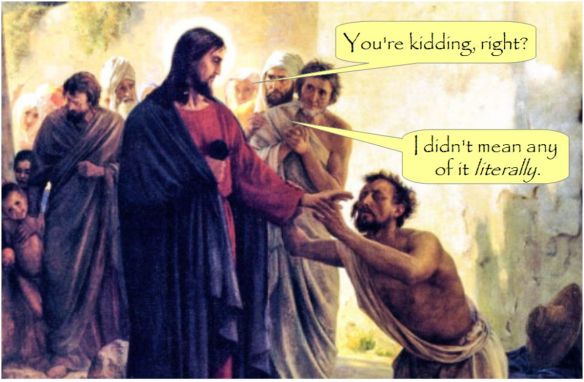
What prophecies, Don? You mean all those tenuously connected Old Testament stories that the gospel writers, especially Matthew, pressed into service to construct their Jesus stories? That this is how it happened is the scholarly consensus and once we exclude the possibility of magic, the only way ‘prophecy’ can later be ‘fulfilled’.

Don: “After he has suffered he will see the light of life and be satisfied; (Isaiah 53:11).

Which proves my point. You think this is a prophecy? It could mean anything about anyone!

Don: The prophecy about him not seeing corruption as a dead body was mistaken?

And again. Not mistaken: lifted from the OT around which to build the resurrection story.

Don: The words of Jesus as he repeatedly told his disciples of his resurrection were mistaken?

He didn’t. The stories were written long after Jesus supposedly lived. Those who created his story gave him this ‘foreknowledge’ long after the event.

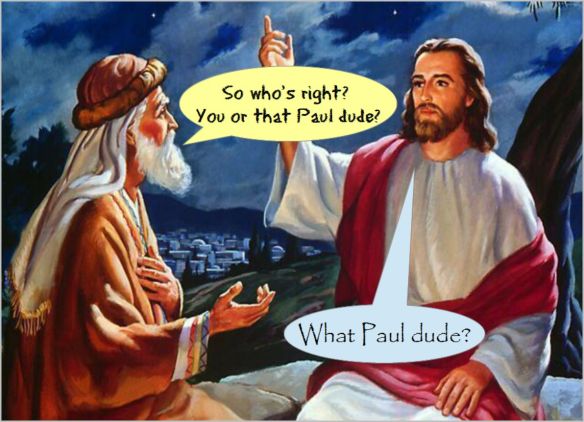
Don: Paul made nothing up; his simply explained what it all meant.

Oh come on, Don. Why would God leave it to someone who’d never met Jesus, and appears to know nothing about him, to explain ‘simply’ what he was all about? Of course Paul made it all up, after he had some sort of vision, in his head, from which he developed a fanciful theology, one that was very much at odds with that put in Jesus’ mouth years later. Hence Paul’s disputes with the ‘pillars of the church’ whom he held in such disdain.

I know you’ll have some convoluted explanation about how everyone else has got it wrong, Don, but it’s you who’s got it all back to front!

The ‘F’ Word

Don Camp is defending Christians in the comments. They’re in the process of becoming ‘more like Jesus’, he says.

What does this even mean, Don? How can you know what Jesus was like when there are so many disparate versions of him in the Bible (as has been pointed out to you)? Does becoming more tempestuous, impatient, impossibly demanding and Jewish count? These are some of the traits his propagandists show him as having.

You then tell Jim not to measure Christians ‘by his (own) experience’. What other measure is there? Christians aggressively promote their beliefs on the internet, have infected politics and, at a lower level, are encountered as judgmental evangelicals and sanctimonious street preachers; these are the Christians of our experience and like it or not, the fragrance ain’ that sweet. As Jesus is supposed to have said, ‘by their fruits shall you know them’. We sure do.

Bottom line, Don: you Christians have had two thousand years now to make the world a better place by being ‘more like Jesus’. On balance, you’ve failed. Not surprising when Jesus himself failed even more. Where is he, Don? Following his ‘return’, the Righteous should have been living in peace and harmony for the past two millennia, tediously worshipping him and his Father in God’s Kingdom on Earth. They haven’t been, even though Jesus, Paul and several other NT writers said they would be ‘soon’, relative to their own lifetimes. 

Argue it how like, Don (and you will), Christianity merits one big ‘F‘.

How Do Christians Explain Those Who Renounce Their Faith?

Aka The Death of Ananias by Raphael (Acts 5)

What was original Christianity like, long before it acquired that name? Before Paul’s ideas took hold? Clearly the cult existed prior to Paul. He tells us so himself: worship groups were around – the one he writes to in Rome, for example – before he  established his own. 

The early faith seems to have emanated from the visions of early believers such as Cephas and James. Quite what they ‘saw’ is open to debate but it led to them setting up a sect within Judaism that focused on the saving power of a risen celestial being.

And everything was absolutely hunky dory within these early communities. Members shared all their possessions (except when they didn’t, in which case they were annihilated on the spot) and lived in perfect harmony together, worshipping Jesus and experiencing miracles on a daily basis.

According to Acts, that is. According to Paul, by the time he came to be involved, it was all very different. Many of the early ‘churches’ were characterised by squabbling, greed, legal disputes, confusion about doctrine, sleeping around, visiting prostitutes and power struggles (Galatians 5.20; 2 Thessalonians 3.14-15; 1 Corinthians 1.10, 4.21; 1 Corinthians 6.1-10; 1 Corinthians 6.12-20; Galatians 1.6-9; 1 Corinthians 5.9-13 etc.) Worse still, there were defections by converts who came to their senses and left the cult.

How can this be when, according to Paul these people were inhabited by God’s holy spirit and saved once and for all by the redeeming blood of Jesus? Just as today, early believers, including Paul, had a hard time explaining how a person could be once saved and then lose their faith. They came up with various excuses how this could happen:

Excuse #1. Apostates were never really been saved: they were faking it in some way, their faith hadn’t been deep enough or Satan had snatched it away from them. One enterprising and influential cult member even came up with the sneaky idea of putting these explanations into the mouth of Jesus (because of course he would have foreseen the problem.) So arose the parable of the sower. According to Mark 4.1-20, the ‘word’ doesn’t always ‘take’. It might seem as if it has but sometimes it is uprooted by the cares of this world. Alternatively, it falls on stony ground and really doesn’t stand a chance of growing. Or Dick Dastardly Satan intervenes and destroys the faith of those who once believed. As a cultist called John later put it,

They went out from us, but they did not really belong to us. For if they had belonged to us, they would have remained with us; but their going showed that none of them belonged to us… (1 John 2.19)

Which really says nothing: ‘they left, so really they weren’t part of our gang to begin with.’ A brilliant bit of exposition.

Excuse #2. Apostates are still saved. In direct contradiction of the parable of the sower, some Christians invented a different way of accounting for those who had ‘fallen away’: the ‘once saved always saved’ argument, based on a few cherry-picked bible verses. Despite appearances, those who’ve left the faith are nonetheless still savedThe ‘reasoning’ is that because salvation is a work of God, it cannot be undone, no matter how much one refutes the faith, or provides reasons for leaving it or demonstrates the untruthfulness at the heart of it. Salvation is like a tattoo you regret getting but with which you’re stuck for the rest of your existence. (Except not really, for a whole host of reasons but principally because there’s no God to work the magic in the first place.) This line of reasoning runs entirely contrary to the acknowledgement in the parable of the sower that there are always those who will leave the faith.

Excuse #3. Apostates have been hurt by the church and as result have abandoned the faith (but Jesus is waiting for them to return!) While I don’t know anyone who has renounced Christianity for this reason alone, it does play a small part in some defections. Why? Because self-serving and vindictive Christians are evidence that Christianity simply doesn’t work. It doesn’t make ‘new creations’, infusing people with a holy spirit that makes them better people. Believers, despite their claims, are no more moral than those who are unsaved. You’ll know this if you’ve been on the receiving end of Christian judgment or condemnation. When Christians themselves undermine the claims of their religion it creates a justifiable scepticism in one-time brothers and sisters.

Excuse #4. Apostates just want to wallow in sin. Back to the parable of the sower for this one: ‘Satan has ensnared you into life of sin and debauchery and you have abandoned the one true way’. I have to say this is not true of any ex-Christians I know.  They’ve dispensed with the wholly religious idea of ‘sin’, and now live their lives as authentically as they can, looking after their loved ones and helping others where possible. Then again, so what if people want to wallow a little bit?   

The one reason that causes others to leave the fold that is never recognised by Christians is the gospel itself. No sir. That some people are able to see how irrational, contrived and downright untrue it is, is not a possibility Christians are willing to entertain. Jesus himself, however, seems to recognise that some people are just too intelligent to go along with it:

I praise you, Father, Lord of heaven and earth, because you have hidden these things from the wise and learned, and revealed them to little children (Matthew 11.25).

Even he knew – or, far more likely, the sect that put these words into his mouth – that for anyone capable of a modicum of critical thinking (‘the learned and the wise’), the cult’s claims simply don’t stand up to inspection.

Where’s The Harm?

So what does it matter if people believe in make-believe? It does no harm and might even do some good, right? I mean, if they want to believe in ghosts or horoscopes and that helps them make sense of life, then why not?

But with Christianity and other theistic religions it’s a different story. While they might provide their adherents with some coherence to their lives, they also equip them with a distorted and unhealthy view of other people. This is what compels local street preacher, Dale McAlpine, to pick up his megaphone and stand yelling at passers-bye in my local town centre. I took the picture above of him yesterday, when he invited me, like an evangelical Hannibal Lecter, to come closer. I declined.

Dale’s theme this time was, predictably, that evolution is a Satanic hoax, everyone is a wicked sinner and God requires a blood sacrifice for them to be saved. He no doubt had a swipe at LGBT folk too; he usually does. Dennis and I didn’t stop to listen to him but, along with everyone else, were lambasted with his ignorant BS as we passed. Such nasty stuff needs to be opposed and in the absence of my own megaphone, this is my way of doing it.

Those who believe planets millions of miles away control their lives don’t, as a rule, set themselves up on a soap box in the centre of town and threaten people with hell. Ultimately, though, there is no substantial difference between the baseless wishful thinking of astrology and Christianity. Today’s version of the faith owes its existence to Paul’s ‘revelation’ of an imaginary celestial being that sacrificed itself to restore our standing with an imaginary God. This makes as much sense as believing that the planets ‘in conjunction’ shape our destinies.

Would I, if it were in my power, ban the likes of Dale from spouting his ignorant, ugly version of Christianity? Probably not, as I’m a liberal at heart and cancel culture concerns me. I would, however, be pleased if he came to senses and of his own volition stopped spouting publicly his brand of theo-babble. I’d rather he spent his time tending to the sick, homeless, naked and imprisoned as his Saviour tells him to. I fear though that that kind of Christianity is too hard for the likes of Dale.

The Trouble With Atheists: A Christian Sets Us Straight

My friend Bruce Gerencser was good enough to repost my previous post on his blog. It prompted a comment from someone calling himself James Thompson, who Bruce says used a fake email address and quite possibly a false name. (These Christians; so fearless and honest in all their doings!) Here’s what ‘James’ had to say:

It’s because that’s what you live to do argue the truth. You’re not “atheists”. Antitheists yes. Agnosticism yes. A true atheist would not give a rip about the discussion on this blasphemous blog.

And atheists don’t go out seeking to remove Mickey Mouse from everything.

Or Buddha or Mohammed.

But they do Jesus Christ because Satan knows he is the only one who can bring salvation

I did respond to James on Bruce’s blog but wanted to address his garbled points, such as they are, more fully here. They’re typical of the low level thinking Christians and others use to defend their beliefs.

It’s because that’s what you live to do argue the truth.

Amazingly James has an uncanny insight into the minds of atheists; we live only to argue the truth, by which he means, presumably, critiquing his pet deity and magical saviour. Most of the time, most atheists barely give these two mythical beings a second thought; neither do I when I’m not blogging. I live for entirely different things.

You’re not “atheists”. Antitheists yes. Agnosticism yes.

But wait! People who don’t believe in his God aren’t, according to the omniscient James, atheists; they’re anti-theists. Okay, I concede; I am opposed to the notion that there’s a loving God somewhere out there who is interested in us and has made it possible for us to know him by, according to James and other deluded souls, making his only son a blood sacrifice. I dispute this silly idea, which has no evidence to support it, and is, as Jesus is made to say in Matthew 11.25, irrational and illogical. So yes, I’m an anti-theist. I’m also anti-theist because of what believers in the one true God (in his various guises) do terrible things to each other and to non-believers. And when they’re not doing that, they’re parading their ignorance, propagating their book of myths and spells, denying evolution, dumbing down children’s education, suppressing LGBT+ people and threatening everyone who doesn’t subscribe to their superstition with eternal damnation. I mean, what’s not to like?

 A true atheist would not give a rip about the discussion on this blasphemous blog.

And then James returns to his mind reading act. How does he know what a ‘true atheist’ might think of Bruce’s blog? There are plenty of atheists who comment there; whether they are ‘true’ atheists apparently only James knows.

And atheists don’t go out seeking to remove Mickey Mouse from everything.

It is true atheists (which we’re not, according to James) don’t seek to remove Mickey Mouse from everything, whatever this means. But then Mickey Mouse doesn’t start wars, condemn everyone as wicked sinners or try to control their sex lives. Disneyworld would quickly go out of business if he did. (That Donald Duck is a different kettle of fish however.)

Or Buddha or Mohammed.

James then scrapes the bottom of the cliché barrel: ‘You wouldn’t dare criticise the revered characters of other religions’. Yes, we would. As I said in my post, which evidently James didn’t read, there is no supernatural. All gods, ghosts, spirits, angels, demons, heaven and hells, from whichever religion or superstition they emanate, are figments of the imagination.

But they do Jesus Christ because Satan knows he is the only one who can bring salvation

These two as well. The Christ and his evil doppelganger, Satan, are human inventions. As fantasy figures they are open to as much ridicule and ‘removal’ as any other imaginary being. Perhaps more, given the damage they’ve caused and continue to cause.

James has been sold salvation snake-oil and thinks that because he’s been duped, everyone else should be too. Or at the very least should respect his delusion. Ain’t gonna happen, Jimmy boy. You need to grow up a little. And maybe also learn some grammar.

Are You Born Again?

Someone handed me the above card in town yesterday. ‘Are you born again?’ No, mate, and neither are you. As Bart Ehrman shows in Jesus Interrupted, and as I’ve written about before, the story of Jesus and Nicodemus in John 3 is a literary construct (as are the gospels in general.) The pun between ‘born a second time’ and ‘born from above’ only works in the Greek, where ἄνωθεν (anothen) can mean either ‘again’ or ‘from above’ (though it’s usually the latter.) Unfortunately, it is highly unlikely Jesus spoke Greek. Here’s Ehrman:

  In the Gospel of John, chapter 3, Jesus has a famous conversation with Nicodemus in which he says, ‘You must be born again.’ The Greek word translated ‘again’ actual has two meanings: it can mean not only ‘a second time’ but also ‘from above.’ Whenever it is used elsewhere in John, it means ‘from above’ (John 19:11, 23). That is what Jesus appears to mean in John 3 when he speaks with Nicodemus: a person must be born from above in order to have eternal life in heaven above. Nicodemus misunderstands, though, and thinks Jesus intends the other meaning of the word, that he has to be born a second time. ‘How can I crawl back into my mother’s womb?’ he asks, out of some frustration. Jesus corrects him: he is not talking about a second physical birth, but a heavenly birth, from above. (Jesus Interrupted, p155)

So Nicodemus is made to misunderstand Jesus, confusing ‘born again’ with ‘born from above’, and Jesus has to tell him what a twit he is. Translators of this chapter haven’t understood the point of the story either, making Jesus say, in John 3.3, ‘you must be born again’, when the rest of the narrative makes clear he means, ‘you must be born from above’ (i.e: be renewed by God who sits in Heaven on high.) 2000 years later, Christians, thanks to these translators, still make the same mistake.

There’s even more poppycock on the back of the card. The born again, it seems, avoid sin like the plague. Sure they do. Just ask all those kids molested by priests, preachers and Christian youth workers.

Jesus v. Covid (and the winner is…)

Two years ago, a few months before Covid hit, I wrote a post entitled ‘God’s Very Good Creation’ that included the picture above. The post concluded that ‘Jesus can’t save you from the common cold, let alone death’. How the past 23 months have borne that out! We hear almost daily of anti-vax pastors, preachers and assorted evangelicals, who have trusted the Lord to save them from Covid, dying of the virus. The Lord failed to come through for them despite their faith in him and his promises.

I recognise there are Christians who like to tell us God doesn’t work like this. He’s not, they say, a dispenser of health and healing, a fairy godmother who fixes those who love him just because they pray in earnest that he will. They’re right of course; God doesn’t work like this. (God doesn’t work, period.) So why does the Bible tell us he does?

Is anyone among you sick? Let him call for the elders of the church, and let them pray over him, anointing him with oil in the name of the Lord. And the prayer of faith will save the one who is sick, and the Lord will raise him up. And if he has committed sins, he will be forgiven (James 5.14-15).

And these signs will accompany those who believe: in my name they will… their hands on the sick, and they will recover (Mark 16.17-18).

Whatever you ask in my name, this I will do, that the Father may be glorified in the Son (John 14.13).

Again I say to you, if two of you agree on earth about anything they ask, it will be done for them by my Father in heaven. For where two or three are gathered in my name, there am I among them (Matthew 18.19-20).

At best this is delusional wishful thinking, at worst, out and out lies. Surely the men who made these fantastic claims knew that God wasn’t like this at all, that magical thinking and ritual didn’t really cure illness? (Perhaps we should expect nothing better from people who believed that God had granted them eternal life.) Despite their dishonesty, some believers today are still prepared stake their lives, quite literally, on the same false promises, discovering when it’s too late, that they are empty and meaningless. The Lord will not and has not saved anyone from Covid nor anything else.

Worse than that, however, is how Christian anti-vaxxers affect others; dissuading the gullible from having the vaccine, spreading infection and providing the means, the culture, for the virus to mutate. They also take up space in ICUs that people with unavoidable medical conditions need but can’t access because of them – like the child in this story. It’s also likely that, should health services become overwhelmed this winter because of the unvaccinated contracting Covid – the overwhelming majority of hospitalisations are of the unvaccinated – the rest of the population will need to go into lockdown again. The UK government, while saying it wants to avoid further lockdowns, has not ruled them out should the NHS need ‘saving’ once more.

Sarah Palin has said she will not get the vaccine because she ‘trusts in the science’. No, it doesn’t makes sense (when has she ever?) Palin believes her own immune system will protect her, failing to understand how vaccines work – by priming the immune system to produce anti-bodies against disease before coming into contact with it.

Palin and those similarly motivated by the fatal combination of ignorance and religion, who refuse to protect themselves and others, are selfish and socially irresponsible . Their actions are as far from loving one’s neighbour as it’s possible to imagine.


What Christian Music Tells Us About God

ThankYouBasedGod.tumblr.com

Have your ever noticed how the unchanging God’s musical tastes… well, change?

In the time of David, or so we’re told in Psalm 150, he liked nothing better than the sound of lutes and harps. When monasteries were all the rage, he was pacified by the monotonous chanting (‘plainsong’) of those very same psalms. He went all highbrow a few centuries later with the likes of Bach and Handel, but found out later still that he preferred bad poetry set to rousing tunes, such as How Great Thou Art and Amazing Grace (the latter by slave trader John Newton.) Not to show partiality, he’s also been known to be turned on by some good ol’ gospel music. Last night on TBN, a TV network of spectacular mindlessness, he was brought to orgasm by a third-rate hip-hop track that, like a primitive enchantment spell, repeated Jesus’s name ad infinitum. Which reminded me of a Christian rock group of that name that performed back in my youth, when God was into sub-standard glam rock. It is amazing, isn’t it, that God’s musical tastes keep pace with our own.

On the other hand, maybe it’s that we delude ourselves into thinking our changing musical preferences, be it for lutes and harps, glam rock or hip-hop (ten years past its sell-by-date), are what please the Lord. He is not a God of changing tastes but one who is a reflection of whichever culture projects its idiosyncrasies, musical or otherwise, onto their conception of him. He truly is made in our image.

Same Old Same Old

I’ve been watching a Storyville documentary on the BBC iPlayer on the phenomenon that is Hillsong Church. In case you’ve not encountered it, Hillsong is a megachurch that began in Australia in the 1980s under the auspices of a remarkably uncharismatic individual, Brian Houston. It is hip, trendy and oh so cool. Its superstar preachers minister to thousands of gullible souls in vast stadia all over the world.

The programme represented the church fairly (needless to say Hillsong disagreed), interviewing people who felt it had rescued and helped them, as well as those who believed it had taken advantage of their goodwill. In the latter category were volunteers who had given their all to an aspect of the church’s ministry – attendees are told not to be ‘stingy with God’s money’ – while its higher echelons used members’ donations to finance lavish lifestyles and thousand dollar sneakers. It covered the child sex abuse of Frank Houston, Brian’s father and minister of the Lord, and Brian’s failure to disclose it, as well as superstar preacher, Carl ‘marriage is for life’ Lentz’s extra-marital affair.

The overall impression was one of a church that doesn’t practise what it preaches, or at least what the supposed object of its worship preached; money and sex loom large. What the documentary didn’t show was Hillsong’s compromised doctrinal position, at least according to other arms of Jesus’s one true church; its failure to preach repentance, focusing instead on individual happiness and purpose.

How like some of the early churches Paul wrote to. Churches that strayed from his personal brand of Christianity, not yet called that of course, but which he felt weren’t adhering to the ‘gospel’ he’d preached to them. They were attracted instead, he said, to the alternate versions proffered by his many rivals: Apollos (1 Corinthians 1:12), the ‘Pillars of the Church’ (Galatians 2:9), Judaisers (Galatians 2:14); ‘those who preached another Jesus’ (2 Corinthians 11:4) and the unnamed smooth-talkers of Romans 16:17-19, all of whom Paul hates with a vengeance. Who is to say their gospels were any more ‘wrong’ than the aberrant nonsense that emanated from Paul’s psychotic ‘visions’? He rails too at the excesses of those early cult communities; their stinginess (2 Corinthians 8:8-9), greediness (1 Corinthians 6:8-10), muddle-headedness (Galatians 1:6-9) and sexual immorality (1 Corinthians 5:9-13). I have long wondered at Paul’s stubborn insistence that these were groups of people inhabited and guided by the holy spirit, when they had, according to him, no idea how to live lives of holiness, committed to (his) sound doctrine. Any lesser man would have given up; lesser that is in obstinate arrogance. How jealous he would have been of the numbers Hillsong attracts.

All of which goes to show that, as it was in the beginning, so it would be forever more; two thousand years later, the Christian church, as typified by Hillsong, exhibits all the faults and shortcomings of its progenitors. It is exploitative, self-serving, hypocritical, while other factions object, jealously, to its doctrine and success, just like Paul with his rivals. The more things change, the more they stay the same; how very disappointingly human.


All Along The Watchtower III

Jim has shaken the dust from his sandals. As he says, and as I knew, he wasn’t really looking for a discussion. He was looking to draw me, and the others who received his letter, into his cult. When it was obvious I wasn’t going to be, he lost interest. Plus, I mentioned Jesus’s non-return. I don’t think he liked that.

Hi Neil, 

Thanks again for your response. I think we’ll have to agree to disagree. We aren’t here to debate over things but we do respect your beliefs and thank you for taking the time to talk to us. 

We find what we read in the Bible answers many of life’s big questions and there is much archaeological evidence today to back up Bible accounts which adds to the accuracy of the Bible. So we want to share the truths and hope we have found with others, but we do respect everyone’s beliefs. 

Take care, 

Jim and Sandra