Get your false Messiahs here…

blog351b

There was this guy who said he was the Son of God and the Messiah of his people. God appeared to him in a vision that enveloped him and changed him completely. Afterwards he discovered he had a knowledge of scripture that he previously hadn’t possessed and a invigorated sense of mission: God had appointed him to redeem his people. He changed his name and began to teach his people with power and a knowledge that all of them testified they had never experienced before. He brought them close to God and showed them how the world was coming to an end and how God would soon establish his Kingdom on Earth. He prophesied too, however, that he himself would die at the hands of the authorities, but that his followers should have no fear, because God would not forsake them: they would be part of the coming Kingdom.

And so it came to pass. At the age of 33, the Messiah died at the hands of the state.

And the name of this guy? Jesus, maybe? Well, it could be, but it wasn’t. Saul/Paul perhaps? Again, possibly… but no.

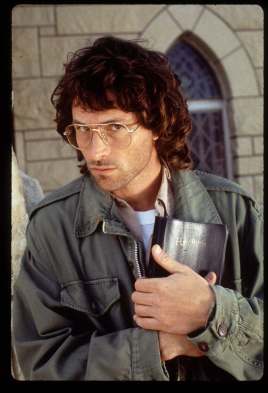
This guy’s name was David Koresh (real name Vernon Howell), leader of a Christian sect called the Branch Davidians. You may remember him from such massacres as the 1993 siege at Waco, where his church was based. He made all the claims above, just like Jesus and, to a lesser extent, Paul before him. None of his followers, it’s true, claimed to see him after his death, but some of those who survived the siege believe still that he will be resurrected and will return to lead them personally into the Kingdom of God.

I was watching a programme about him recently, a Storyville documentary originally broadcast in the States last year, which showed how easily we create our Messiahs and Saviours. The recipe, it turns out, is easy:

Take one charismatic individual who thinks he’s speaking for God;

Mix in an obsession with scripture;

Add some absurd self-promotion, and

Bake for a few years in the over-heated adulation of some desperate sycophants.

So – Jesus, Paul, Koresh. What’s the difference?
blog 351

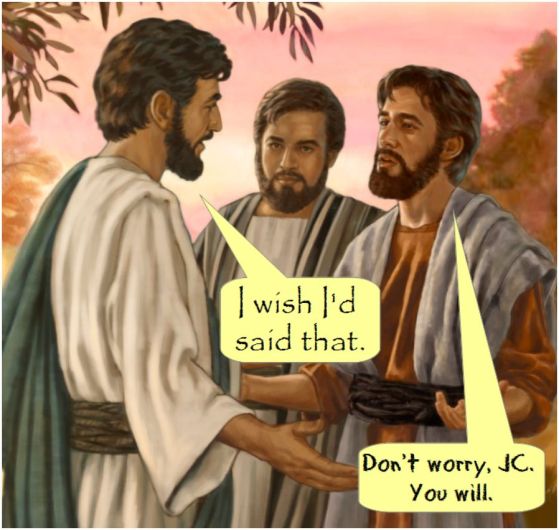
*Actually, the quote in the picture up top is not Jesus at all; its Koresh, from an interview with the FBI (see first link above.) John 14.6 says ‘No-one comes to the Father except by me,’ which is much the same.

Woe to you hypocrites!

blog350

Independent Fundamentalist Baptist pastor, Donnie Romero, an associate of Steven Anderson’s, resigned from his church this week after he was discovered paying prostitutes for sex, smoking weed and gambling.

Well, who cares really what such a pathetic little man gets up to in his spare time – apart, maybe, from his wife – except that Romero, like Anderson, is virulently anti-gay. He preaches that LGBTQ people are filthy animals who prey on children and calls for the state-sanctioned execution of all ‘homos’. He rejoiced when LGBT people were killed in the Pulse shooting a few years ago.

Christians can argue all they like that the bible is the Word of God™, that Jesus really did rise from the dead and that he was the Son of God come to save us, but even if all this were true, which it isn’t, it makes not the slightest bit of difference. Romero and his predilection for ‘sin’ demonstrate, once again, that Christianity does not work.

According to the bible, those who are born again are washed in the blood of the lamb (Revelation 1.5) and are cleansed and purified (1 John 1.7). They cannot sin (1 John 3.6), being possessed by the Holy Spirit (1 Corinthians 6.19- 20) who changes their nature (John 3.3–7; Titus 3.5) and gives them victory over sin (Romans 6.1–10). So how do Christians explain believers like Romero, and the multitude of others who fornicate, abuse, steal, bear false witness and even, sometimes, resort to murder? Were such people ever really Christians in the first place?

IFB doctrine says they were; once a Christian always a Christian. Despite what Romero has done, he will be going to heaven.

Others say not; a Christian who visits prostitutes is not and never has been a real follower of Jesus, because visiting prostitutes is not something a real follower, one who has the indwelling Holy Spirit would do. Yet Paul admonishes some of the early church (1 Corinthians 6.15-18) for doing just this, without, strangely enough, tell them they were never true believers. Looks like Christians with prostitutes has been a problem from the very start.

Perhaps believers who cheat and fornicate are redeemed a second time, once they’ve sought forgiveness for their trespasses. The comments on the YouTube version of Romero’s resignation speech speak of how noble he is for confessing his sins, making him ‘a true man’ according to one. They seem to miss the fact that he does nothing of the sort. He leaves fellow zealot Anderson to explain what has happened. Is it scriptural that a believer can fuck up (literally) as many times as he likes, and so long as he admits it he’ll still be one of the Chosen? Hardly. Still, there’s got to be a free get-out of jail card for today’s fornicating minister, and this is as good as any. How long until Romero is back in front of a gullible and duped forgiving congregation? In the meantime his place has been taken at the ironically named ‘Stedfast church’ by an ignorant jerk who is every bit as hate-filled.

By their fruits shall ye know them, Jesus is made to say. I can’t help but think that prostitute sex, cannabis, gambling, homophobic rants and bare-faced hypocrisy weren’t quite what he had in mind.


The Incarnate Deity?

Blog347Nativity

Veiled in flesh the Godhead see; Hail th’incarnate Deity,

Pleased with us in flesh to dwell, Jesus our Emmanuel.

This, according to Charles Wesley’ hymn, ‘Hark! The Herald Angels Sing’, is what Christmas is all about: God manifesting himself on Earth as a child and subsequently a man.

What a disaster this whole idea is. The stories of Jesus’ birth do serious damage to two key elements of the Christian message:

First, they detract significantly from the good news the adult Jesus proclaimed and which survives to some extent in the synoptic gospels: the Kingdom of God was coming to the Earth very soon and people – Jewish people – should mend their ways accordingly. Instead, the nativity stories, which occur only in Matthew and Luke, are a reflection of what had happened to the faith by the time these gospels were written. The message had changed. It was less about what Jesus had to say and more about how he himself should be worshipped. He had, after all, as early Christians had started to believe, come from Heaven to save everyone from their sins.

Second, the nativity stories negate the resurrection. If a mortal Jesus rose from the dead, then we might conceivably have a miracle on our hands. But for an ‘incarnate deity’ to have accomplished the same thing – well, that’s no big deal. It’s what gods do all the time. The resurrection experiences, whatever they were, are invalidated by the gospel writers when, at the start of his story, they suggest Jesus is somehow divine. (John is even more emphatic; Jesus is the eternal Word made flesh.) So there’s nothing special about the resurrection, it’s just a god doing what gods do.

The nativity stories represent the confusion within early Christianity. Its adherents wanted it both ways, to have their cake and eat it. Maybe today’s believers can help us out of the dilemma: is it Jesus’ birth – his incarnation – that matters, or is it his death? Because it cannot be both. If Jesus was God in human form from the very beginning, then there’s nothing particularly special about his death and resurrection. Gods can’t really die, especially when none of them, including Yahweh, are alive in the first place.

According to the Scriptures (not)

Blog344Jonah

Christ died for our sins according to the Scriptures. He was buried (and) was raised on the third day according to the Scriptures…

This is Paul’s claim in 1 Corinthians 15.3-4, where he is probably quoting an early Christian creed. He uses the phrase ‘according to the scriptures’ twice, meaning that what he’s claiming fulfils prophecy from the Jewish scriptures. He is not referring to the gospel accounts of Jesus’ death and resurrection as these ‘scriptures’ had yet to be written at the time of 1 Corinthians (circa 54/55AD.) Mark’s gospel was still fifteen or so years away.

So where in the Jewish scriptures – the Christian Old Testament – is there any prophecy that the Messiah would die for the sins of the people? Where the prediction that he would rise from the dead on the third day?

As Michael J. Alter notes, there is no prophecy either that the Messiah would die for the sins of the people nor that he would then rise from the dead. Not one. Passages that are pressed into service by Christians ancient and modern to demonstrate that Jesus’ death and resurrection were presaged in the Old Testament are either not prophecy or they don’t have any bearing on either Jesus’ death or supposed resurrection.

Let’s look at a couple:

In Matthew 12.40, Jesus is made to equate his time in the grave – three days and three nights – with the time Jonah spent in the belly of a great fish. But the Jonah story has nothing to do with events hundreds of years later. It is an ancient fable, not a prophecy delivered by one of the Old Testament’s recognised prophets. In any case, in the story Jonah is being disobedient and is running away from his God-given mission. Jesus, according the gospels, doesn’t do either of these things. Moreover, Jonah does not have to die to spend three days in a fish. He does not resurrect when the fish spews him out. The only aspect the two stories have in common is the period of three days and nights, which as we have seen, bear little relation to how long Jesus was actually in the tomb. Matthew has press-ganged an irrelevant story into service, in an attempt to show that Jesus really was the Messiah. Why does he do this? Because he can’t find any ‘scripture’ that points incontrovertibly to the Messiah dying and resurrecting. Jonah is literally the best he can do.

Modern Christians like to tell us that Isaiah 53 is a prophecy that Jesus would die as a sacrifice for sin. Significantly, none of the New Testament writers attempt to make Isaiah’s ‘suffering servant’ narrative fit Jesus. This is because the suffering servant it describes is the beleaguered Jewish nation; earlier chapters say so several times. To insist that Isaiah 53 describes Jesus’ death and resurrection is to render it incompatible with all the Old Testament prophecies that are actually about the Messiah. For those who created these scriptures, this figure was a warrior, a human who would route the enemies of Israel and usher in the Messianic age. Isaiah 53 is about how the rulers of the kingdoms of this world will stand in awe of this feat. Jesus does not fulfil this role; he was not a warrior, he did not redeem the Jewish nation, he did not route its enemies, he did not bring about the Messianic age. Jesus died an ignoble death and was ‘seen’ afterwards in visions; he was as far from the anticipated Messiah as could be envisaged.

Jesus’ death and resurrection did not happen ‘according to the scriptures’. There are no prophecies in the Old Testament that pertain to Jesus, no foreshadowing of what happened to him. Christian can try to retrofit selected scriptures as much as they like to make it seem as if there are, but none hold up under scrutiny.

Death’s Sting

supermancry-e1457347480705

Image copyright DC Comics

A long time friend of mine died suddenly a couple of days ago. Tom was in his comic shop, putting together orders, and, it appears, suffered a heart attack. He died there alone.

Death still has its sting – for both those who die (which is all of us) and those who are left behind. Paul’s rhetorical question, ‘Oh death, where is thy sting?’ (1 Corinthians 15:55) has always seemed to me to be particularly fatuous, not to mention deceitful. He said it, of course, in the belief that faith in his Christ meant life would resume on the other side of the grave. Even if this were so, dying would not be without its pain, and grieving not without deep sorrow.

And what about that word ‘sting’? The Greek Paul uses, ‘κέντρον’, means ‘a sharp point’ as if death is nothing more than a pin prick, a short sharp shock no more troublesome than an injection. In my experience, spending time with people who are dying, it is far from that. The body’s shutdown is often slow, relentless and unbearable. Morphine helps, not Jesus.

Mourning too is persistent; an emptiness and a profound sense of loss, as we often acknowledge when offering condolences. It takes time to subside, but never truly disappears. Every death, especially of loved ones, depletes us. As John Donne puts it:

Any man’s death diminishes me, because I am involved in mankind; and therefore never send to know for whom the bell tolls; it tolls for thee.

God Nature, whose product we are, is insensible and indifferent to our suffering. It neither knows nor cares that we are self-aware, emotional beings who grieve and suffer. Death, which troubles us so much, is one of the engines of evolution. Once we have passed the stage at which we might viably reproduce we are programmed to decline and  die. We must make way for new creations, which is not, despite what Christians claim, in a brand new body on a new earth or in heaven. The new creations are those who follow us. Paul, as he was in so many respects, is wrong to say that because of the futile hope of resurrection, death has lost its sting and the grave its victory. Death will never lose its sting, its pain and finality.

Tom will be remembered by those to whom he mattered in life. This is the best we can do; this and living our lives to the full while we’re still here, loving others and being kind.

Farewell Tom, my friend.

Why Jesus can’t possibly have known he’d ‘rise from the dead’.

Blog340JC&Peter

I said at the start of this series of posts about the date of Jesus’ crucifixion that the gospel writers perhaps felt unable to exclude Jesus’ predictions about rising from the grave after three days because these were too well-known. On reflection, it seems more likely that Jesus didn’t make any such prophecies. It is more probable that the gospel writers introduced them into their stories about him decades later.

I’ve written before about how the Resurrection appearances were nothing more than visions and dreams. Paul’s experience of the risen Jesus most certainly was – he says so himself – and Mary’s encounter with angels, telling her Jesus was no longer in his tomb, is described as ‘a vision’ in Luke 24.23. The subsequent accounts of Jesus’ post-mortem appearances also bear all the hallmarks of hallucinations; he disappears at will; passes through closed doors; isn’t always recognisable, drifts up into the sky and so on.

These mystical experiences, those that really happened anyway (it’s safe to say some – the Emmaus story, for example – are complete inventions: see Alter, pp536-8) quickly became a conviction among Jesus’ early followers that he had somehow risen from the grave. By the time of Luke’s and John’s gospel, 50 to 70 years later, this idea had evolved into a full-blown bodily resurrection.

The question is, did Jesus know that this was what was going to happen? Could he have had foreknowledge that he would be seen again after his death? Could he, during his life, have predicted he would rise bodily from the grave?

Christians will tell you that as God or God’s Son, Jesus was omniscient and therefore of course he knew these things in advance. There are, however, several good reasons why we can be sure he didn’t:

  • According to Paul, it was the resurrection that elevated Jesus to his god-like status, not his divinity that enabled the resurrection. Christians who argue that Jesus rose from the dead because he was divine have it back to front. Paul says clearly that Jesus ‘was appointed the Son of God in power by his resurrection from the dead‘ (Romans 1.4; my italics). Without the resurrection, Jesus was, Paul argues, of no great significance (1 Corinthians 12.15-19). However, the only ‘evidence’ for the resurrection is the contradictory, incompatible accounts offered by only three of the gospel writers and by Paul himself. So implausible is this evidence that we can safely conclude, with Michael J. Alter, that there was no such event. How, then, could Jesus possibly ‘know’ he’d rise from the dead when in fact he didn’t?
  • While he suffered from the delusion that he was going to rule God’s imminent Kingdom, it is unlikely Jesus thought he would have to die and be resurrected in order to do so. There was nothing in the Jewish scriptures to suggest either the Son of Man (a figure from Daniel with whom Jesus appears to have claimed some affinity) or the Messiah would be put to death only to rise again. This wasn’t what these characters were about and it wouldn’t have been how Jesus thought.
  • The Kingdom of God did not come about in the way Jesus believed. His death therefore did not bring about the apocalypse, judgement and rule of God he predicted and anticipated. In fact, his death took his cult off in a completely different direction, thanks mainly to Paul’s intervention. Jesus, and to a significant degree, the synoptic writers appear to have little awareness of this seismic shift. The Jesus they portray has little cognisance of events following his demise. Any suggestion he foresaw the creation of the Church is anachronistic, written back retrospectively into the accounts of his life. This was not what his ‘good news’ was about.

  • From their reactions preserved in the gospels, Jesus’ execution evidently came as a shock to both himself and his followers. None of them appear to have been expecting anything like a resurrection. Immediately following his death and burial, not a single one of his followers recalled his supposed predictions of his resurrection, nor did they express the sure and certain hope he would be returning. Even the discovery of the empty tomb (if it happened at all) failed to elicit such an expectation, nor any recollection of his words. The gospels say all those who witnessed the empty tomb were ‘frightened’, ‘astonished’ or ‘amazed’ that the body was missing, but not that they believed he must have risen from the dead. All those who witnessed the empty tomb behaved as if they’d never heard Jesus’ predictions that he’d be returning – probably because they hadn’t

  • It wasn’t until the ‘visions’ started that some of them began to consider the possibility that Jesus had ‘risen’. Not all were convinced, however. Matthew 28.16 notes how a number ‘doubted’ that the apparition they were seeing was Jesus. Significantly, at no point do any of those who think they’re seeing the risen Jesus say, ‘I remember him predicting this would happen.’ On every occasion, either angels or the risen Jesus himself has to explain it to them. (Of course, it’s the gospel writers doing the explaining for those hearing these stories decades later.)

All of this points to the fact that, while he was alive, Jesus didn’t make any predictions about rising from the grave on the third day, after three days, or after three days and nights; these prophecies, incompatible with each other and with the synoptic timeline, were created later, probably much later, after belief in the resurrection had become a central plank – the central plank – of the new cult. They were subsequently written back into the gospels, and placed on Jesus’ lips on the basis to show that of course he knew he’d rise again and knowing would have spoken about it.

The circle was thus complete; his early followers created the myth of Jesus’ return while later ones invented the ‘prophecies’ to bolster the belief that Jesus must have known he would. He said so, didn’t he?

How to work out when Jesus died

Blog338Darkness

When did Jesus die? The year, I mean.

The honest answer is we don’t know. In Michael J. Alter’s The Resurrection: A Critical Enquiry, recommended by John Loftus’s Debunking Christianity blog-site, the author considers twelve different dates that have been proposed, together with the reasons why. Ultimately though, we don’t know.

Which is strange, not only because, as Alter points out, Jesus’ death and resurrection are supposedly the most significant events ever to have happened in the entire history of the world, but because it should be really easy to pinpoint the date. It was the year there was –

  • a total eclipse of the sun that, for over three hours, plunged the whole land (some translations have ‘earth’) into darkness,
  • an earthquake that caused appreciable damage, 
  • the tearing from top to bottom of the four inch thick, 82 feet high curtain in the temple,
  • the dead rising from their graves to make themselves known to the inhabitants of Jerusalem (including, presumably, the extensive Roman presence.)

We know this because the gospels tell us so; these events all took place either just before (Luke) or just after (Matthew) Jesus’ death. Let’s overlook the fact that solar eclipses don’t ever occur at the point of a full moon, while Passover, when Jesus died, happens only when there is one, and take a look at Matthew’s version of events:

From noon on, darkness came over the whole land until three in the afternoon. And about three o’clock Jesus cried with a loud voice… and breathed his last. At that moment the curtain of the temple was torn in two, from top to bottom. The earth shook, and the rocks were split. The tombs also were opened, and many bodies of the saints who had fallen asleep were raised. After his resurrection they came out of the tombs and entered the holy city and appeared to many. (Matthew 27.45, 46, 51-53)

All we need to do, therefore, is look for corroboration of these four cataclysmic events occurring together in the records of the time. (The Romans were particularly good at recording such things; we know, for example, there was an eclipse in AD29, though that lasted a measly 2 minutes.) Once we’ve found this corroborative evidence, we’ll know for certain the year in which Jesus died.

But you’re ahead of me: there is no record anywhere, apart from the gospels, of these events ever taking place, certainly not in combination. No record of a widespread darkness, nor of an accompanying earthquake nor of the temple veil tearing from top to bottom, nor of the dead emerging from their tombs. Which isn’t to say they didn’t happen, but you’d think someone, somewhere would have noticed and would have written about them. Josephus maybe, or Plutarch, Greek or Roman authorities, or even Paul; anyone writing at the time or soon after; any of those whose history of the period has survived.

But no.

It’s enough to make you think these earth-shattering events didn’t really happen; that they’re all made up for theological reasons.

And you’d be right.

God is revealed in Jesus… or not


Blog335CompositeOn his blog-site, humbly named after himself, Roger E. Olson trots out the tired old cliche that there’s no such thing as atheism. Atheists, Rog tells us, know in their hearts that God exists, they just choose to ignore him. As a result, Rog has little time for atheism. (I discovered Roger’s wonderfully smug site through Bruce Gerenscer’s excellent one.)

Rog says that if we want to see what this heart-implanted God looks like, then we shouldn’t look to the Old Testament and the tribal warlord we find there – goodness me, no; we can safely discard him! That God just doesn’t match up to our twenty-first century sensibilities. No, if we want to see God then what we must do is look at Jesus, for in Jesus we see what God is really like.

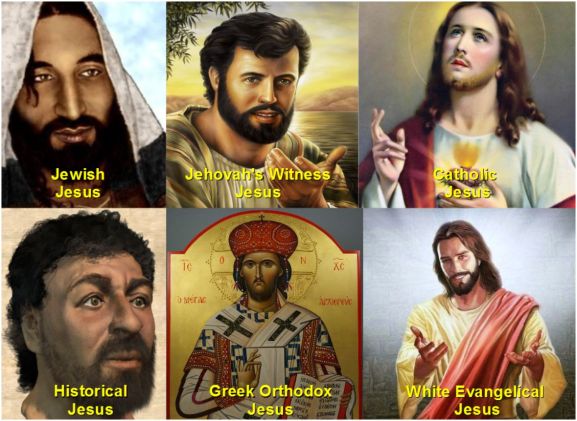
Oops! We’re right back at the problem I’ve been discussing these last few posts: just which Jesus are we talking about? There are so many. There’s the Jesus of the synoptic gospels (though he’s neither consistent nor pleasant), who is nothing like the self-obsessed Jesus of John’s gospel. Paul’s Christ is different again; he’s a complete invention, much like the Jesus of Hebrews who has morphed into a Jewish High Priest. The Jesus of Revelation meanwhile is an Evil Mutant straight out of the Marvel Universe, what with swords coming out of his mouth and all. So which Jesus has Rog got in mind? I think we should be told.

There are so many discrepancies in the various interpretations of Jesus in the New Testament, that it’s hard to see a clear, consistent picture of anything, let alone God, in such a shifting kaleidoscope of images. I’ve recommend that Rog should take atheism a little more seriously; the often incompatible Jesuses of the bible don’t reveal ‘the true nature of God’ anywhere as clearly as he claims. I’d go further: none of them show – can possibly show – what the non-existent is ‘really’ like. What they reveal instead are ideas about a God and a saviour made entirely in the image of the men who tasked themselves with creating them.

The Christian blog that knows better than Jesus

Triablogue-Header-240x1080 (1)

The superior intellects at Triablogue responded to my comment (see previous post below) by telling me they’d already dealt with the claim that Jesus believed the arrival of the Son of Man/the End of the Age/the Final Judgement and God’s Kingdom on Earth were imminent.

They directed me to one of their articles, Misdating the Second Coming, which argues that neither Jesus nor Paul really believed the end was nigh and that the texts which suggest they were need to be interpreted carefully (i.e. to get round what they clearly say to make them say something else.)

I can’t find any other instance of Triablogue contributors proposing that Jesus didn’t really say what the gospels have him say. They don’t dispute, for example, the so-called great commission in Matthew 28.19 (‘Therefore go and make disciples of all nations, baptizing them in the name of the Father and of the Son and of the Holy Spirit‘) even though, with its Trinitarian formulation, Jesus almost certainly didn’t say it. Instead, the know-alls at Triablogue  reserve their hedging for the prophecies that patently failed to materialise, on the basis that Jesus couldn’t possibly have been wrong so he must have meant something else.

I’ve written several posts under the banner Making Excuses for Jesus, on the varied and feeble attempts Christians make to get round the fact the synoptic gospels consistently have Jesus say the Kingdom of God, and all that accompanies it, are just around the corner. His early followers all believed this and his eschatological pronouncements are recorded in all of the earliest texts. Mark’s gospel includes his prophecies about the Son of Man while Matthew and Luke include material not found in Mark from their ‘M’ and ‘L’ (oral?) sources that warn it is the ‘eleventh hour’. The entire thrust of the synoptic gospels is that the Kingdom is about to arrive and therefore people need to be prepared for it: ‘The time is fulfilled, the kingdom of God is at hand; repent and believe the good news’ (Mark 1.15).

The sayings gospel ‘Q’, which predates Mark and was probably in circulation only a few years after Jesus died, preserves several Son of Man sayings; he would be appearing soon to kick-start the Kingdom. Paul, writing decades before the gospels, tells his readers to expect the Second Coming – the Son of Man having become Jesus himself – while he and they are still alive (Thessalonians 4.14-15). Likewise, the anonymous writer of Hebrews believed he lived in the ‘last days’ (1.1-2) while the nutjob who concocted Revelation claimed he was quoting the Risen Jesus promising he would ‘surely come quickly’ (22.20). The imminence of God’s Kingdom on Earth is the consistent message of the New Testament.

And what do the cerebral Christians at Triablogue do when confronted with a summary of these facts? They don’t approve my comment, that’s what. I guess that’s all you can do when you really don’t have an answer for why your Savior™ got everything so drastically wrong; dishonestly pretend he didn’t and silence those who show that he did

Young men’s visions, old men’s dreams

Stephen4

In Acts 2.17, Luke (mis)quotes a prophecy from Joel 2.28:

In the last days, God says, I will pour out my Spirit on all people. Your sons and daughters will prophesy, your young men will see visions, your old men will dream dreams.

I was always taught that the Acts version was a prophecy in its own right, predicting what would happen in the very last days before Jesus returned, some time in the future (his future, though maybe not ours.) But it isn’t. Luke, or whoever wrote Acts, is claiming the fulfilment of the prophecy in his own time. He’s not saying,’ this is what will happen at some point in the next few millennia.’ He’s declaring – or he’s making Peter declare – ‘this is what’s happening right now.’ Luke, like all members of the cult in its early days, believed the last days had arrived; God was about to impose his Kingdom on the Earth, in a display of power and glory (Luke 21.27).

The dreams and visions of which Luke speaks were, he believed, happening then, as he was writing. To prove it, he relates numerous dreams and visions in Acts; Stephen’s vision of God and Jesus; Paul’s ‘sighting’ of the risen Christ on the road to Damascus and Peter’s encounter with, erm… a table-cloth to name only a few. Elsewhere, Paul himself refers obliquely the innervision that led to his conversion (Galatians 1.16) and recounts his ‘visit’ to ‘the third heaven’ (2 Corinthians 12.2); he’s kind of embarrassed about this one though – as well he might be – and relates it in the third person.

Luke knows that the new cult is built on dreams and visions. He believes such hallucinations are genuine revelations from God himself. Moreover, Luke tells his readers explicitly and directly in Acts 2.17 that such visions and dreams were how the cult’s founders experienced the risen Jesus. How do we know this is what he means? Because he puts the quotation about young men having visions and old men dreaming dreams into the mouth of Peter. That’s the disciple Peter whom the gospels tell us was one of the first to experience the risen lord. Luke has Peter reveal the nature of that experience. ‘This is how it was for me,’ he confesses. ‘I had a god-given vision, just as the scriptures promise.’

Luke is proud of the fact that the new faith is based on young men’s visions and old men’s dreams. Proud enough to include it in Acts 2.17 and proud enough to make Peter of all people declare it. Christianity owes its existence to these hallucinations and delusions, nothing more.