The Case of Plagiarised Essays and the Missing Source

This is a true story. I was involved. It took place when I was a university tutor and had dozens of student essays to mark at any time. The work of about 120 students were distributed randomly between myself and two colleagues.

On this particular occasion, I had about 40 to assess and about half way through them I came upon an essay from a student whom I’ll call Matty. It wasn’t a particular good essay; it was poorly argued, and was littered with errors, the most glaring of which was the referring to the well known psychologist E. (for Elizabeth) Loftus as a man. I gave it a grade only a little over the pass mark and moved on.

Three or four essays later I reached one by ‘Lucas’. As I started on this submission, I realised I’d read it before. I searched back in the marked pile and pulled out Matty’s work. Sure enough, both essays were pretty much identical. The occasional word had been changed, paragraph breaks altered here and there and some sentences rearranged, but the two pieces of work were essentially the same. Crucially, the second essay used the very same quotations from E. Loftus and again used male pronouns for her when discussing her work.

The university, quite rightly, took plagiarism seriously. I summoned Lucas and Matty to my office and confronted them with their third-rate essays. Both insisted they had not copied. They had, they insisted, worked independently. They hadn’t even seen the other’s work.

So,’ I asked, ‘how is it your essays are so similar, identical in many places, and most tellingly, how have you both ‘independently’ managed to attribute the wrong sex to Elizabeth Loftus?’

We must have used the same books,’ Lucas offered.

Right,’ I said, ‘and which book was it that thought Loftus was a man?’

Not sure, ‘ Matty offered, ‘but we could maybe find it for you. Because it definitely did.’

Just point it out to me from one of your identical and very thin bibliographies,’ I suggested.

The two scanned down the list of three or four books. ‘Erm, not sure,’ Lucas said.

No, it’s not there,’ Matty concluded. ‘I’m not sure which it was.’

Okay,’ I said, ‘when you find it, maybe you can bring the book in to show me.’

They nodded eagerly, believing they’d averted the problem.

In the meantime,’ I said, ‘I’m going to fail both of your essays. I’m afraid too I have no choice but to report you to the Academic Standards Board for your plagiarism.’

The boys looked stunned. ‘But we didn’t copy and that book definitely said Mr Loftus was a man.’

There’s no book that says she’s a man,’ I said, ‘and you know it. You’re not going to be able to produce the book because it doesn’t exist. One of you made the mistake of thinking she was male and the other simply copied the error. I don’t know which way round it was, but that’s the only reasonable explanation.’

They left dejected. I did report them to the Academic Standards Board. Unbeknown to me, a tutor from a different department had also reported them for plagiarism in the essays they had submitted to him. Both students were eventually expelled for repeated offences.

I recalled the episode while reading Gary Marston’s Escaping Christian Fundamentalism blog about the hypothetical ‘Q’ that some scholars argue existed before Matthew and Luke’s gospels were written. These scholars postulate that both gospel authors lifted the material they have in common, other than that copied from Mark, from ‘Q’. Like my two likely lads, none of them has ever been able to provide evidence for the existence of this mythical document.

The most obvious explanation for the similarities between Matthew and Luke’s non-Markian material is that one of them, probably Luke, cribbed from the other. Like my two plagiarists, Matthew and Luke are without credibility. Whoever came first – probably Matthew – plagiarised from Mark and made up stories that Luke then copied, mistakes and all, and altered to suit his own purposes. If they’d been dishonest students they’d have been expelled long ago.

It’s the End!

AI shows how it’s done. Arrange your elements carefully, and – hey, presto! – Jesus appears!

I’ve reached the end! The end of Jonathan Cahn’s The Dragon Prophecy that is. He has me convinced: the end of the age and the world itself, is just around the corner. He looks around the world, particularly the Middle East, sees the state it’s in and dives into the scriptures to uncover the prophecies that presage present day events. He then reveals how, collectively, these scriptures accurately describe the state of the world today following Hamas’s invasion of Israel on 7th October 2023.

Had he collected these passages prior to 7th October, would they have accurately foretold the events of that day? They should’ve done if that’s what they are really about. So where was this expose before 7th October? Where were the books, by Cahn or anyone else, revealing how the Bible predicted in detail, events that still lay in the future? Predicatbly (pun intended), they don’t exist. Cahn’s The Serpent’s Prophecy could only be written with hindsight, after the events, 7th October 2023 in particular, that he’s decided fulfil biblical prophecy. The prescience of these ancient scriptures is only apparent, to Cahn if no-one else, in retrospect.

He gathers disparate verses together to demonstrate how they do indeed predict current events. He omits many that don’t, even though they too appear to prophesy the future. He does this because they don’t fit the picture he’s trying to create: his interpretation of events in Israel and the significance he wants ascribed to them.

Cahn disingenuously forces unrelated verses to work together, like pieces from different jigsaw puzzles, to create a picture that loosely and disjointedly conforms with and thereby confirms his own conclusions. 

The culmination of The Dragon’s Prophecy is that the time is right and the stage set for Christ’s ‘return’. Cahn advises his readers to surrender to him before he comes though the clouds to do unspeakable things to them. While none of the ‘prophecies’ he’s pressed into service have ever been fulfilled and are certainly not being now, this one must surely be the greatest of the Bible’s failed prophecies.

Does all of this sound familiar? It should. Starting with Paul and the gospel writers, numerous hacks have pulled together biblical prophecies to show how events of their times fulfil the conditions for Christ’s return.

More than this, the gospels were created in exactly the same way that Cahn creates his end-of-the-world scenario. Mark, Matthew and Luke, ruthlessly plundered ancient Jewish scripture to show how their suffering Messiah (whether real or not) was predicted there. Significantly, no-one prior to the early days of the Christian cult believed that these particular scriptures foresaw a suffering Messiah who would die for the sins of his people before coming back to life. The scriptures could only be made to do so in retrospect. After some claimed to have seen the risen Jesus, early cultists began to scour the scriptures for passages – how many they had to ignore or misinterpret! – that could be made to create a loose, disjointed picture of their super-hero. It’s how Paul attempted to persuade others that Jesus was the Messiah (1 Corinthians 15:3,4 etc).

So Cahn is doing nothing new, finding a ready audience for his particular sleight of hand.

When A Child Is Born… Supernaturally

To what extent are the conflicting nativity stories in Matthew and Luke historical? That depends on whether or not you believe in the supernatural.

There is no evidence of a supernatural realm nor the beings who are said to inhabit it: God, heavenly Jesus, the Holy Spirit, angels and those they are constantly at war with: Satan and his demonic hordes. It is not as Jonathan Cahn describes it in The Serpent’s Prophecy:

Behind the perceivable realm lies another, beyond our ability to measure or quantify. Behind the history of this world lies another, unrecorded, unrecited, unknown. And behind that which moves and transforms the world lie unseen forces, causes, agents, undying and primeval (p3).

Cahn cannot possibly know any of this, any more than fake-Paul could when he wrote Ephesians 2,000 years ago (6:12). A reality that exists above and beyond nature – the meaning of supernatural – that is ‘unseen’, undetectable and ‘unknown’ is one that doesn’t exist, except in the imagination of a few fantasists.

Yet the supernatural is the basis of Christianity. Without it, its agents, as Cahn calls them, could not have interacted with the only reality there is. The Holy Spirit could not have impregnated Mary; angels could not have materialised to announce Jesus’s birth to a group of credulous shepherds; a divine being could not have communicated through dreams with Joseph and the Magi; a magic star could not have been manoeuvred into place over Jesus’ house. Most significantly, a non-existent God could not have sent his ‘son’ into this world.

It is futile to argue whether Matthew or Luke’s nativity narrative is the more historically accurate. Nor is there any point in trying to harmonise the two accounts. Neither is historical: the involvement of the supernatural rules out their being factual.

The inclusion of the supernatural in everything that follows is also fatal to claims made for the gospels’ historicity. The clues are there in the text: God’s pronouncements from the sky; the inexplicable miracles and healings; the presence of angels, demons and Satan; the dead rising; visions, prayers and prophecies. These tell us that what we’re dealing with is fantasy material. The creators of the gospels and other books of the New Testament had no more evidence than Cahn does that secretive super-beings existed, even if they did take them for granted. God and his interventions no more exist than Santa Claus and his magical Christmas deliveries.

Paul tells us that God raised Jesus from the dead (Romans 8:11). But there is no God, so he didn’t. There was no supernatural resurrection and without a resurrection there were no encounters, like those in the gospels, with a reanimated body.

Remove the supernatural from the Jesus story and there’s nothing left. Some wise advice lifted from Jewish scripture perhaps, plus a few cult rules, but that’s all. Paul’s experience of the risen Christ, like that of Cephas before him (described nowhere in the New Testament but allegorised in the gospels) and John of Patmos after him, were as Paul himself says, a ‘revealing’ in their own heads.

I hope none of this spoils Christmas for you. The Nativity isn’t a bad story, indeed it’s quite beautiful in places. But it is not historical. Like much in gospel Jesus’ life, and the resurrection itself, it is a fantasy generated by irrational and superstitious minds.

A very happy Christmas to both my readers.

Presenting a well-thought through Christian Response*

If there’s one thing I love about writing this blog it’s the considered, articulate comments I get from loving Christians.

A brave anonymous commenter left one the other day on the 2015 post ‘Gentle Jesus – meek and mild?‘. Short on time and rhetorical skills, Brave Anon opted instead for a different range of tactics. Here’s what he(?) had to say:

I’m a little short on time, and i wish I wasn’t, because I could pick apart your post piece by piece for hours. I WILL say though, that I’d expect someone who has dedicated a whole site to this matter to have actually read the book he’s so dedicated to disproving. It’s pretty clear that you haven’t and only used quick Google searches to try to prove your point. The big thing that i’d really like to point out is that most of the scripture you quoted to try to prove your point is from the Old Testament. That means it was law BEFORE Jesus was born. Yes, some of them are pretty harsh. That is why Jesus whittled the 613 commandments in the OT down to 10 in the NT. The most important being, ”Love the Lord your God with all your heart, and with all your soul, and with all your mind.” The most important one, right behind that, is to, “Love your neighbor as yourself.” That is why I just prayed for you. I wish that people like you would get away from trying to disprove the Word and find something else (literally ANYTHING else) to spend your time doing. What do you have to gain by making this site? Do you have such little self worth that, as a grown adult (I assume, but maybe I’m wrong), you really need someone to pat you on the back and say, “WOW! You did a really good job! You get a gold star. That means, you get to pick out what toy you want to play with at recess first today!” Will, if that’s what you need, I ain’t the one to say it. Your arguments are weak, and you are clearly uninformed on the subject you’ve chosen to focus on. Why don’t you, at least, read the Bible (I mean cover to cover) before you speak on it. If you need a little motivation, why don’t you remember that Satan knows the Bible better than ANYONE here on Earth. I mean, even better than the POPE!!! Familiarize yourself so you can, at least, make an educated, organized, well informed, argument. You do that, and I’ll consider giving you a shred of respect. Otherwise, good luck on your day of reckoning. I hear it’s hot down there, so make sure you pack shorts!!

Let’s ‘pick apart’ the tactics in use here:

  1. Mind reading: Brave Anon knows that I have never read the Bible. Impressive. Wrong, but impressive. He uses his telepathy too to work out my motivation for writing: so I’ll be rewarded with praise. Thanks, Brave Anon; in the 12 years I’ve been blogging I’ve never realised this.

  2. Jumping to conclusions: Brave Anon decides all my information comes from Google. While it’s true I do use Google to verify sources and provide links to articles, when it comes to the Bible, I quote it directly. All those references in brackets are the clue that this is what’s going on. They look like this: (Matthew 7:1-3), (1 Corinthians 5:12). Brave Anon might want to look these two up on Google.

  3. Confused irrelevancy: Brave Anon is unhappy I ‘quoted… from the Old Testament’ in the post in question. Wait – didn’t he just say I’ve never read the Bible? Isn’t the Old Testament part of the Bible any more? The point made by the post is that Matthew’s very Jewish Jesus says that the Law – that’s the one in the Old Testament – will never pass away, not one jot or tittle of it. Wasn’t the Old Testament, under a different name of course, the only scripture Jesus knew? Maybe that’s why I quote it alongside the later stuff Matthew makes up for him to say.

  4. Intuition: Brave Anon intuits I’m a full grown adult. Brilliant. He could of course have read ‘The Author…’ above, which would have told him that, and would also have informed him of why I post what I do. Guessing is so much more effective though, don’t you think?

  5. Condescension: Brave Anon prayed for me. Nice. Nevertheless, he felt moved to send a derisory comment.

  6. Withholding his respect: Jeez, if I’d known this was going to happen I’d never have written the post. I’m positively bereft.

  7. More confused irrelevancy: Satan, the capitalised POPE… what the…?

  8. Desperation: ‘Just wait until the day of reckoning then you’ll regret criticising my buddy Jesus ‘cause you’ll be burning in hell!’ This threat is always a part of Christians’ comments. I’m thrilled Brave Anon remembered to include it.

Thanks for dropping by, Brave Anon, and for reminding me to pack my shorts.

*Not really.

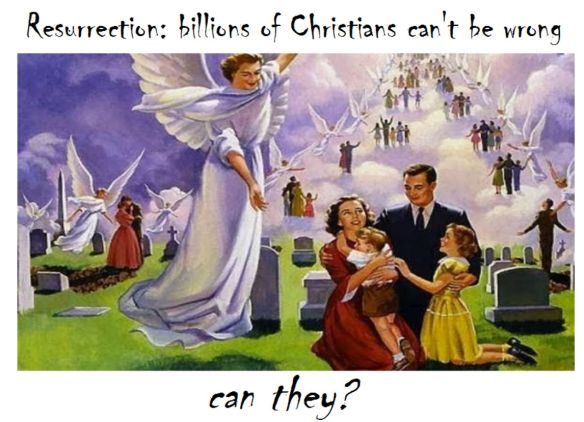
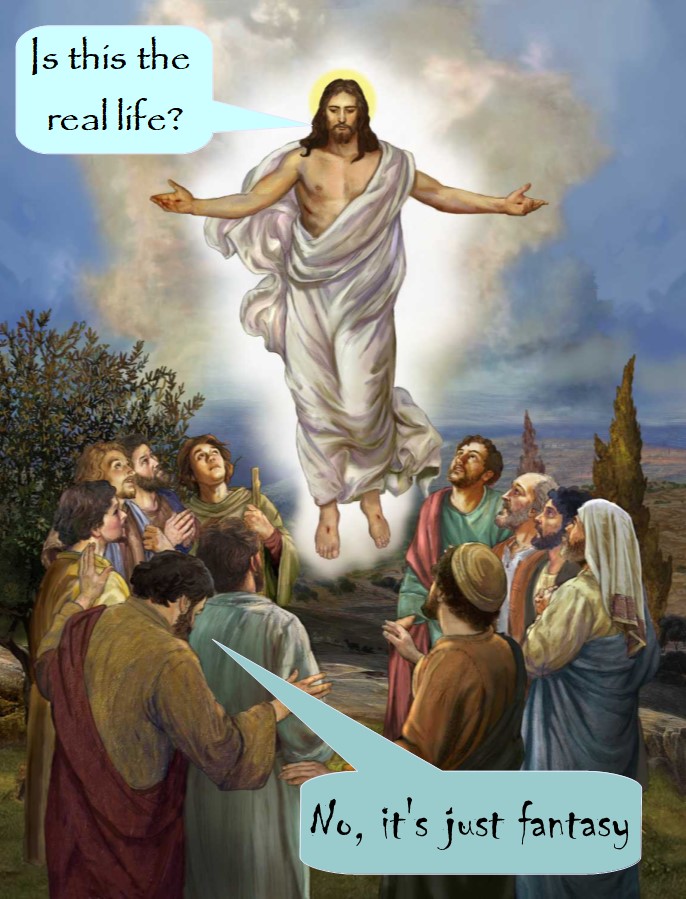
How the Bible tells us the Resurrection was nothing more than Visions

I’ve written about this before, but want to pull together some strands that demonstrate the risen Jesus was a vision or hallucination. He appeared only in the mind of others: the New Testament tells us as much.

Exhibit 1. Paul writes of the appearance of the risen Jesus, whom he sees as a ‘life-giving Spirit’, being ‘in’ him (Galatians 1.16). Paul has more than one such vision, including his trip to heaven recounted in 2 Corinthians 12.2, which he refers to as his ‘revelations’.

Exhibit 2. Paul implies in Corinthians 15.5-8 that others who have experienced the post-mortem Jesus ‘saw’ him in exactly the same way he did. For Paul, there was no difference between his inner-visions and those experienced by the so-called apostles.

Exhibit 3. The author of Acts creates a story out of Paul’s first vision, the famous account of his conversion on the road to Damascus. It’s a fabrication of course, told differently each time it’s referred to Even so, Luke retains the visionary nature of the experience: Jesus is a bright light and a disembodied voice.

Exhibit 4. The other sightings of the risen Jesus in Acts are visions. When, for example, Stephen is about to be stoned (Acts 7:54-56) he sees in his mind’s eye the heavens open and Jesus sitting at the right hand of god. Other New Testament encounters of the resurrected Jesus, such as John’s Revelation, are explicitly said to be visions.

Exhibit 5. Many of the sightings of the risen Jesus in Matthew and Luke are not of a real, physical human being. Those who experience him see him materialising in locked rooms, vanishing at will and floating up into the clouds. None of these events actually happened; they are the gospel writers’ literary realisations of visions experienced decades earlier, and they retain the hallucinatory qualities of those experiences.

Exhibit 6. Remaining with the gospels’ accounts of the risen Jesus, there is the strange phenomenon of those experiencing him failing to recognise him. Mary in the garden thinks he’s the gardener; the disciples on the road to Emmaus don’t know its him until he breaks bread; the disciples mistake him for someone else on the shore until he tells them how to fish properly. Most damning of all, some of the inner circle of disciples doubt it’s Jesus they’re seeing in their collective visions (Matt 28:17-18). Again, these stories preserve the tradition that the earlier visions weren’t always recognised as Jesus. And why wasn’t he? Because he was an hallucination

Exhibit 7. The risen Jesus has to prove who he is. According to Acts 1:1-3, he ‘presents himself’ his followers, some of whom have wandered around aimlessly with him for three years, and has to convince them he is who he appears to be. And, the text suggests, it takes him forty days to do it. This makes no sense. A far better explanation of this story (and it is a story) is that having experienced their visions of something-they-took-to-be-the-resurrected-Jesus (bright lights? Disembodied voices?), his followers set about convincing themselves that what they experienced really was their former Master. This they did by scouring the scriptures to find ‘proof’ that the Messiah would die and rise again. We know this is how their thinking worked. The same process was used to create the gospels and is evident throughout the New Testament.

Exhibit 8. Dead people stay dead. They do not resurrect.. This is not an a priori assumption. No corpse has ever revived after 36 hours or indeed any other period of time. We know this experientially, statistically and scientifically. Only in stories and religious myth do the dead return. This is what we are dealing with here: stories and myth that flesh out the visions and hallucinations of a few religious zealots.

If not Metaphor, then what?

I’ve been arguing that everything in Mark’s gospel is metaphor (because he says so) but there are some pronouncements credited to Jesus in the synoptic that do seem to read as if they’re not. These look as if they are meant to be taken at face value: 

Mark 9:1 And he said to them, “Truly, I say to you, there are some standing here who will not taste death until they see the kingdom of God after it has come with power.”

Mark 10:21. Go, sell everything you have and give to the poor, and you will have treasure in heaven. Then come, follow me.

Matthew 5:39. But I tell you, do not resist an evil person. If anyone slaps you on the right cheek, turn to them the other cheek also.

Matthew 5:40. And if anyone wants to sue you and take your shirt, hand over your coat as well.

Matthew 5: 43-44. You have heard that it was said, ‘Love your neighbour and hate your enemy.’ But I tell you, love your enemies and pray for those who persecute you,

Matthew 6:24. No one can serve two masters. Either you will hate the one and love the other, or you will be devoted to the one and despise the other. You cannot serve both God and money.

Matthew 6.25. Therefore I tell you, do not worry about your life, what you will eat or drink; or about your body, what you will wear. Is not life more than food, and the body more than clothes?

Matthew 7:6. Do not judge, or you too will be judged. For in the same way you judge others, you will be judged, and with the measure you use, it will be measured to you.

Luke 6:30. Give to everyone who asks you, and if anyone takes what belongs to you, do not demand it back.

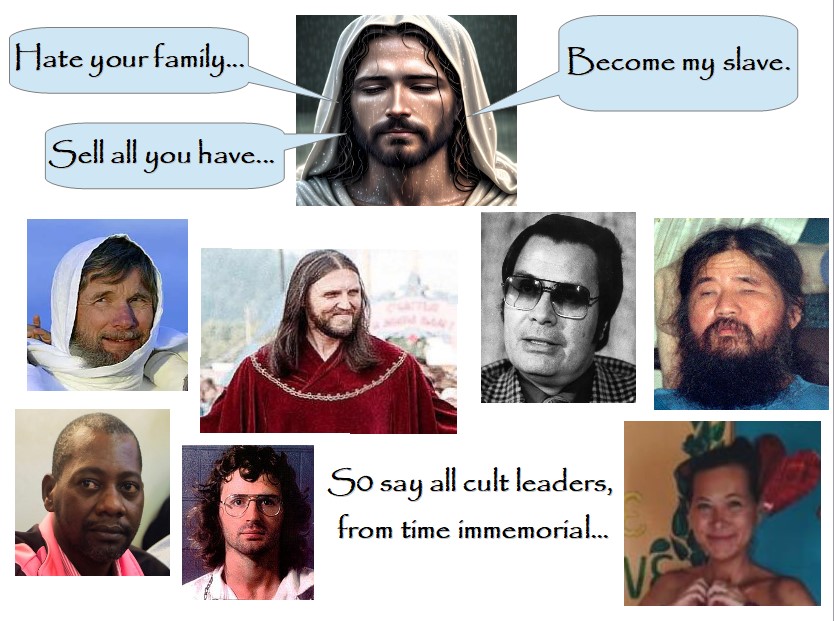
Luke 14:26 If anyone comes to me and does not hate father and mother, wife and children, brothers and sisters – yes, even their own life – such a person cannot be my disciple.

Perversely, these are the very commands that most Christians insist are intended metaphorically. This includes those who oppose the idea that, Jesus’ parables excepted, the gospels are in any way symbolic. I know from experience that they have any number of unconvincing arguments of why Jesus doesn’t really mean what he is made to say. For example: ‘these pronouncements are too severe and impractical to be taken literally’; ‘the verses are being taken out of context’, and ‘they have a deeper spiritual meaning’ (oops – that’d be metaphor, wouldn’t it?). Ask these same folk if the statements are therefore metaphorical and you can expect to be met with barrage of abuse.

If they’re not metaphorical, why do we not find Christians striving to live according to them: renouncing wealth, giving to all who ask, selling all they have, resisting no-one, judging no-one, hating family, becoming a slave and having no care for their own welfare for the sake of the kingdom that Jesus promised was imminent.

Because they don’t believe him. Easier to disregard his words about the kingdom arriving within his disciples’ lifetime and the instructions for living in the short time until then. The hard stuff is treated as metaphorical when it makes demands on Christians themselves.

Possibly they’re right. I’d suggest that the pronouncements like those above were not Jesus’s at all. They’re cult-speak; the extreme demands of cult leaders seeking to control their acolytes. In case this sounds like an about face on my part, let me assure you it isn’t; I’ve long argued that among the metaphor and the reworking of Jewish scripture, the gospels include copious amounts of early cult rules.

Whether they’re metaphor or extreme demands once imposed on cult members, no-one today takes much notice of Jesus’ commands. What does this tell us about their worth? What does it tell us about Christians from the earliest days until now? What does it say about their willingness to crucify themselves (definitely a metaphor) in order to follow him?

Parables

Jesus’ parables are analogies: similes or metaphors. ‘The Kingdom of heaven is like’; ‘there once was a man…’ Every one of the parables tells a story that didn’t actually happen. There was no literal Good Samaritan, no Prodigal Son or Sower. Jesus, or more probably the gospel authors, made up these stories to illustrate ‘mysteries’ (μυστήριον; gnosticism anyone?) What do they say about the parables? The majority appear in Matthew’s gospel, though Mark and Luke also include them. There are none in John. Did he, a supposed eye and ear- witness, not know of them?

Mark has Jesus say to his disciples:

To you has been given the secret of the kingdom of God, but for those outside everything is in parables, so that “‘they may indeed see but not perceive, and may indeed hear but not understand, lest they should turn and be forgiven’” Mark 4:11-12

Mark lets his readers in on the ‘secret’ (μυστήριον again) because there are mysteries within the cult, secrets available only to the initiated. Remember, the parables were written – they are almost certainly literary creations – 40 years after the cult was established. Only cultists would understand the secrets/mysteries embodied in the parables. Parables, Mark tells us, are intended to disbar those who are not spiritually attuned from salvation/the kingdom of God/eternity.

The word translated as parable also means ‘riddle’, designed to puzzle or obfuscate. But Mark doesn’t just say the parables are intended to do this. He says ‘everything is in parables’. What did he mean by ‘everything’? All of the teaching he attributes to Jesus? All of the episodes he relates? Could it be that the entire Jesus story, crucifixion and resurrection included, is one long, extended parable? A metaphor, if you like.

You bet it is.

Related:

Stories about Jesus

The Jesus Story v. Reality

Cruci-fiction

Inventing Jesus

Myths and Endless Genealogies

I’ve been reading Richard Carrier’s recent post about Docetism. Docetism, as you’ll know, is the idea that the Christ’s human body was illusory. Carrier questions whether this idea existed as a belief system in ancient times; the term, he says, was invented by modern theologians to describe a few vague notions that appeared only towards the end of the 2nd century.

He finds no evidence for Docetism as a movement at any time and certainly not when the books of the New Testament were being composed. Along the way, however, he discusses 1 Timothy 1:3-4, written either in the late first or early second century (and therefore not by Paul who died in AD 64):

…Command certain people not to teach false doctrines any longer or to devote themselves to myths and endless genealogies. Such things promote controversial speculations rather than advancing God’s work – which is by faith. (My emphasis)

‘Myths and endless genealogies’: interesting. What could these myths and genealogies be? Where were they to be found? In what way did they promote controversial speculations? How did they deplete faith?

The ‘myths’ are mentioned again in 2 Timothy, also not written by Paul but by someone using his name, again in the late first or early second century:

For the time will come when people will not put up with sound doctrine. Instead, to suit their own desires, they will gather around them a great number of teachers to say what their itching ears want to hear. They will turn their ears away from the truth and turn aside to myths. (2 Timothy 4:3-4)

Not, you’ll note, ‘(they will) turn aside to false doctrines or heretical teaching’, which is how this verse is usually interpreted and applied by nit-picking evangelicals today, but ‘they will turn aside to myths‘. Some in the early second century church were being distracted by such myths – spurious stories about Jesus – and the writer(s?) of 1 and 2 Timothy feel compelled to warn against them.

The author of 2 Peter, who certainly wasn’t Peter/Cephas, issues a similar warning in his letter of 80-90:

For we did not follow cleverly devised stories when we told you about the coming of our Lord Jesus Christ in power, but we were eyewitnesses of his majesty. (2 Peter 1:16)

What can these myths have been? What ‘cleverly devised stories’ about Jesus were circulating in the late 1st century and early 2nd? There were no ‘Docetic’ texts at this time, no ‘Gnostic’ ones, none of the more far-fetched, downright weird gospels, which all appeared later.

The use of ‘genealogies’ in 1 Timothy is a clue. Which documents with ridiculously contrived genealogies were circulating in the churches of the late first and early 2nd centuries? We know of none – apart from Matthew and Luke’s gospels. Could the forgers of 1 & 2 Timothy and 2 Peter be referring to these? Did they object to the fictional backstory Matthew, Luke and Mark had created for their heavenly saviour? Were these the myths to which believers were turning to instead of gazing heavenward at the ‘majesty’ of the celestial saviour who was soon to come in power to the Earth, as 2 Peter 1:16 suggests?

It certainly could.

The Gospels and Other Fiction, part 1

Christian apologists vigorously deny the idea that the Jesus story is fiction even though all of the evidence, both internal and external, points to the fact that it is. I’m not going to rehearse that evidence in this post (I address it in several earlier posts, including here and here, and there are always primary sources that, God forbid, defenders of the faith could read for themselves.) I’m interested here in looking at Christians’ defence of scripture as truth. What arguments do they have and better still, what evidence, that the gospels are historically accurate depiction of events in 1st century Palestine? Most of these arguments have been offered by our resident apologist, Don Camp, and although I’m fairly sure Don makes things up as he goes along, I’ll not reference other sources except where I’m introducing an argument he hasn’t offered.

Church Fathers believed the gospels were accurate, therefore, because they lived closer to the time of the gospels’ composition, they’re more likely to be right.’

Church Fathers, such as the unreliable Eusebius,, Papias, Clement, Ignatius and Polycarp were predisposed to believe the gospels were accurate; they had already converted to the faith and had a vested interest in seeing it promulgated and preserved. They were also steeped in the thinking of the age, typified by Paul and other NT writers, that the Earth was at the centre of a cosmic war between God and the forces of Satan. Above all, the Jesus story was theirs, a new revelation from God that didn’t, as far as they were concerned, belong to Jewish tradition or any other. It was new and it belonged to them: they wanted and needed it to be true. Later scholars, from the 19th, 20th and 21st centuries, did not come with these particular encumbrances and while of course not entirely free of prejudices of their own, considered the texts more dispassionately as history and found them to be wanting.

‘‘Mark’ is an accurate record of the disciple Peter’s time with Jesus.’

There is no evidence at all for this claim. Analysis of Mark (and also Matthew and Luke) demonstrates how the story is constructed around supposed prophecies from Jewish scriptures. Mark also incorporates much of Paul’s gospel to the Gentiles, a feature Matthew is at pains to ‘correct’. His Jesus is distinctly Jewish.

There was an oral tradition that accurately preserved the stories about Jesus until such time as they could be written down.’

There is no evidence that this tradition, if it existed, was accurate. It is, as Bart Ehrman shows in Jesus Before The Gospels, highly unlikely that it was. We know that stories conveyed orally are altered, embellished and modified with successive retellings.

There was an earlier document that preserved sayings of Jesus’ until such times they could be incorporated into the gospels.’

Then it simply vanished so that no fragment of it survived. The Church Fathers don’t appear to know anything about it. Wouldn’t such a priceless document have been preserved somehow, somewhere by someone? Q, as it’s called, is entirely hypothetical. It’s unlikely it existed. Even if it did, it is considered to have been a sayings gospel. It did not preserve details of Jesus’ life, death or resurrection. We’ll get to the so called ‘logia’ in part 3.

The gospels were written by eye-witnesses or associates of eye-witnesses.’

We know with certainty that this is not the case. All of them were written in Koine Greek and are carefully constructed literary creations. None was written in Palestine but much further afield and all reflect the concerns of the later cult. Over a hundred years after they were written, Irenaeus ascribed the names by which they are now known without any evidence that the authors were called Matthew, Mark, Luke or John. Later compilers of the New Testament didn’t even know of ‘Mark’s’ primacy, which is why ‘Matthew’s’ gospel appears first in the New Testament. ‘Matthew’ and ‘Luke’ are heavily dependent on ‘Mark’ (as is ‘John’ for its overall structure), an incongruous and inexplicable approach for Matthew to take, and John too, if they were eye-witnesses themselves. Eye-witnesses do not need to rely on the testimony of people who weren’t.

More next time…

Sowing seeds

The early church had multiple problems, many of which Paul and other New Testament writers refer to. Any reasonable person would have taken these problems as a sign that the faith they were pushing really didn’t work; didn’t produce new creations powered by a holy spirit. Some, including a number of the very earliest followers (Matthew 28.17), were leaving the church, disappointed and disillusioned. How were leading figures in the cult to explain this? Having supposedly encountered the supernatural Jesus these people were now having doubts that he was real and were turning their backs on him. This shouldn’t have been happening!

The writer of 1 John accounts for the departure of those who had come to their senses by suggesting they were never really true believers:

They went out from us, but they were not of us; for if they had been of us, they would have continued with us. But they went out, that it might become plain that they all are not of us. (1 John 2:19)

It’s significant that the writer of this letter doesn’t allude to Jesus’ parable about the sower of the seeds from Matthew 13. Not one of the letter writers in the New Testament who address the problem of defections does so. This can only be because none of them knew of it when they were writing decades after it was supposedly told. The reason they don’t mention it is because it had yet to be written.

The parable of the sower is Matthew’s attempt to have Jesus address the problem of those who fell away from the cult. Matthew’s explanation is it’s because the good news – the imminent arrival of God’s kingdom on Earth – only takes root in the spiritually astute. Others, who might initially accept the gospel, are like stony ground on which birds gobble up the seed. They are those who allow the cares of this world – metaphorical weeds – to choke the message before it can flourish.

It’s a very colourful explanation designed to reassure those persisting in the faith that they are the favoured, while those who have defected have fallen prey to the shallow soil, birds and weeds. It’s neat and it gives reassurance and encouragement to remaining cultists.

Jesus could not possibly have known what was to become of his ‘church’ and the (non)arrival of God’s Kingdom – his good news – following his death. The parable was created for him, or more specifically, as Matthew makes abundantly clear in 13:11-12, for devotees of the early cult decades later. What it emphatically is not, is a story originally delivered by Jesus.