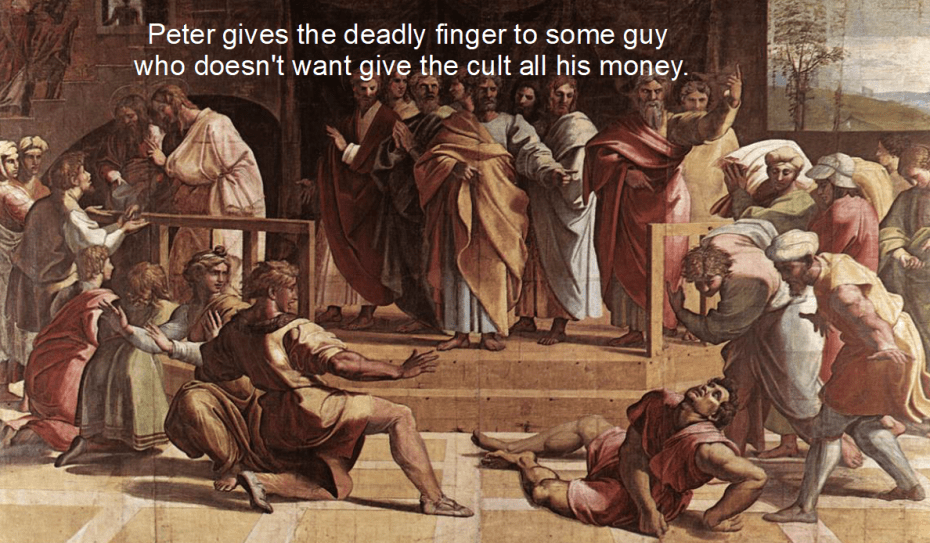
Dear Christian…

I’m seriously considering converting but need some help figuring what I should believe. Can any Christians out there help me out?

1. As a Christian, what will happen when I die? Will I –

a) Go immediately to heaven like my pastor says;

b) Go into suspended animation until Christ’s coming and the final judgement, as it says in 1 Thessalonians 4:13-16;

c) Just cease to exist like my atheist friends tell me?

2. Can you clear up for me how long was Jesus in the grave?

a) Was it about 36 hours (Friday evening till early Sunday morning);

b) Three whole days like he predicts in Matthew 12:40;

c) Was he not really in the grave but down in hell like it says in the Apostles’ Creed?

3. Where can I find information in Paul’s letters about

a) Jesus’ miraculous birth;

b) Jesus’ parables, teaching and miracles;

c) The Empty Tomb?

4. How often did Paul refer to Jesus’ second coming?

a) In all of his letters

b) 2 or 3 times

c) Never

5. Can you tell me how often Jesus referred to his second coming? Was it –

a) Once or twice;

b) Frequently;

c) Never because it was someone called the Son of Man who was going to come?

6. Can you clear up my confusion about when Paul says the Messiah will be coming to the Earth? Is it –

a) While Paul was still alive;

b) Thousands of years later;

c) Any day now?

7. When did Jesus say this Son of Man would be coming to the Earth?

a) He didn’t

b) Thousands of years in the future

c) While those he was talking to were still alive

8. What is the Word of God? I’ve heard the term used for –

a) The Bible

b) The Church

c) Jesus

9. Help me out: which was written first?

a) Mark’s gospel

b) Acts of the Apostles

c) Paul’s letters

10. Can you clarify what it’s referring to when the Bible talks about ‘the Scriptures’?

a) Ancient Jewish writings;

b) The whole of the Bible as we now know it;

c) The New Testament.

11. How does the New Testament writers prove Jesus was the Messiah?

a) By claiming the scriptures predicted he would be;

b) By pointing to his miracles;

c) By quoting things he said

12. How would Jesus want me to spend my time?

a) By witnessing to atheists on the internet;

b) By worshipping him;

c) By feeding the hungry, healing the sick and helping the weak

(I know which I’d prefer.)

The Feeding of the 4000

Mark 8:1-15 has the credibility-defying story of Jesus feeding 4000 people. The story is in fact one of numbers, all of which have symbolic significance. Numbers, bread and fish.

At first reading the account seems to be little more than a retelling of the earlier feeding of the 5000 in Mark 6:30-44. However its numerology is different and Mark has Jesus explicitly compare the two stories in verses 8-21. Both are intentional inclusions in his gospel, not an editorial oversight.

The events almost certainly didn’t happen in reality; significant numbers of people, 5000 and 4000 respectively, following an itinerant preacher around for – magic number alert! – three days would not have escaped the attention of the Romans. Nor would the men (Matthew 13:58 insists 4000 was the number of men) have been able leave their livelihoods for this length of time to follow Jesus around the distant countryside.

Then there’s the repetition of the bread and fish motif. In both stories the entire crowd fails to bring a single thing to eat. On both occasions, the disciples somehow, from nowhere at all, come up with a few loaves and some fish. Symbolic food for symbolic crowds.

Bread, while a staple food of the first century always has spiritual significance in the bible. From manna from heaven in Exodus 16:17 to the Body of Christ in Paul’s teaching. Fish likewise: Mark has it that several of the disciples were fishermen and makes Jesus declare they’re ‘fishers of men’ (Mark 1:17). John will later take bread and fish symbolism to extremes.

The bread in the feeding of 4000 is spiritual manna. Jesus is not feeding a real crowd with real bread. He is ‘feeding’ those who follow him, the early cult, with himself: ‘Jesus took bread… and said this is my body which is for you’ as Paul has him say in 1 Corinthians 11:23-24. So satisfying is this heavenly Bread that there is a great abundance left even after his followers have taken their fill.

There’s more: the numerology signifies that the crowd following Jesus in the story aren’t any old rag tag collection. They are specifically Gentile. Mark alludes to this when he mentions they have come ‘a long distance’ (8:3) and again when he has Jesus explain, in typically obtuse fashion, the meaning of the miracle (8-21):

Jesus asked (the disciples): “Why are you talking about having no bread? Do you still not see or understand? Are your hearts hardened? Do you have eyes but fail to see, and ears but fail to hear? And don’t you remember? When I broke the five loaves for the five thousand, how many basketfuls of pieces did you pick up?”

Twelve,” they replied.

And when I broke the seven loaves for the four thousand, how many basketfuls of pieces did you pick up?”

They answered, “Seven.”

He said to them, “Do you still not understand?”

Seven loaves with seven baskets left over, seven being the number of the Gentile nations. In the earlier feeding of the 5000 the twelve leftover baskets represent the twelve tribes of Israel.

And still the dumb old Jewish disciples don’t understand. The story is about how the early Jesus cult was open to anyone, Gentiles as well as Jews, who recognised and accepted Jesus as the Bread of Heaven, the Saviour. As Mark was aware, Paul had already expressed this universality:

when we break the bread, aren’t we sharing in the body of Christ? And though we are many, we all eat from one loaf of bread, showing that we are one body. (1 Corinthians 10:18).

For his next miracle, the healing of a blind man in Mark 8:22-26, Jesus/the cult/Mark go on to hammer home the point still further.

Whatever Happened to Mary Magdalene?

(The risen Jesus) appeared to Cephas, and then to the Twelve (1 Corinthians 15:12)

When Jesus rose early on the first day of the week, he appeared first to Mary Magdalene, out of whom he had driven seven demons. (Mark 16:9)

Mary Magdalene and the other Mary went to look at the tomb… Suddenly Jesus met them. “Greetings,” he said. They came to him, clasped his feet and worshipped him. (Matthew 28: 1 & 9)

Mary Magdalene went to the tomb and saw that the stone had been removed from the entrance… she turned around and saw Jesus standing there. (John 20: 1 & 14)

Whatever happened to Mary Magdalene? I mean, where did she go? She’s everywhere in the gospels: following Jesus and his entourage around the place, funding his layabout lifestyle (Luke 8:1-3) and being first to see him after he returned from the dead. After that, nothing. Luke doesn’t even bring her back for his sequel and no one else in the New Testament so much as mentions her. When, in 1 Corinthians 15, Paul lists those who, like him, have had a vision of the risen Christ, she’s conspicuously absent. Mary is the first person to see Jesus resurrected according to three of the four gospels, yet in the far earlier tradition mentioned by Paul, she doesn’t get a look in. Her place is taken by Cephas.

The neglect of Mary Magdalene in early tradition could of course be because she was a woman, and a woman’s testimony, back in those less than enlightened times, was worth far less than a man’s. However, it’s far more likely that whoever created the creed had never heard of her. Why not? Because the gospels didn’t exist when they came up with it. They had no idea that a woman was supposedly the first to see Jesus alive again. As far as they were aware, it was ‘Cephas’ who’d had the first vision of the risen Lord. Yet Peter – assuming he and Cephas are the same person – isn’t the first to see the risen Jesus in any of the gospels.

Mary Magdalene is side-lined like this because when the creed was created, and later still when Paul quotes it in 1 Corinthians 15, the stories about her hadn’t yet been invented. It’s safe to say, she hadn’t been invented.

In fact, Mary Magdalene and most of the rest of the support cast from the (future) gospels aren’t referred to anywhere else in the New Testament. This includes at least eight of the disciples from the slightly differing lists in the gospels, the Virgin Mary, Joseph, the angel Gabriel, the Magi, Nicodemus, Lazarus, Martha & Mary, Judas (apart from Luke’s side-splitting story about him in Acts), Barabbas, Joseph of Arimathea and Doubting Thomas. Likewise, fictionalised versions of historical figures with key roles in the gospel stories aren’t referred to either: Herod, Pilate, Caiaphas and John the Baptist(?) are all absent, even from epistles written and forged after the appearance of the gospels’ ‘cunningly devised fables’ (2 Peter 1:16).

Decades after the early creed of 1 Corinthians 15 and Paul’s letters, Mark invented Mary Magdalene, as well as many other characters who appear in his gospel. His allegory then became the basis for the other three canonical gospels, whose authors added their own imaginary characters.

And just as they invented the earthly Jesus’ companions and adversaries, they created too his miracles, teaching, cryptic parables, bodily resurrection and ascension. Mary Magdalene was but one small aspect of their ingenuity.


The Meaning Of Matthew’s Mistakes

So Matthew likes quite a lot of what he finds in Mark. Likes it so much he decides to lift over 90% of it into his own Jesus story. Of course he’ll tweak it a bit because, disappointingly, Mark hasn’t emphasised Jesus’ Jewishness enough. That definitely needs bumping up; it’s what his readers will expect. And Mark has missed a trick or two: he starts his story with Jesus’ baptism, when, as everyone knows, every godman needs a magical origin. Just look at Tammuz, Horus, Romulus and, according to some, the Jewish high priest Melchizedek. So Matthew sets about scouring the scriptures for a prophecy or fable, anything really, that hints that the Messiah would have a miraculous birth. And he comes across this in Isaiah (7.14):

Therefore, the Lord, of His own, shall give you a sign; behold, a virgin is with child, and she shall bear a son, and she shall call his name Immanuel.

It’s not really a prophecy about the Messiah as the context makes clear, but that’s okay. There’s enough of a hint that it could be about a future Messiah that it’ll do. So Matthew sets about creating a birth narrative for his godman based on this verse, yanked from its context. His godman is going to have a virgin birth too.

What Matthew doesn’t realise, however, is that he’s made a mistake. He’s picked up the verse in the Septuagint, a Greek translation of the scriptures. If he’d checked, or even been able to read the original Hebrew, he would have soon seen that the verse actually reads:

Therefore, the Lord, of His own, shall give you a sign; behold, the young woman is with child, and she shall bear a son, and she shall call his name Immanuel.

The Hebrew word for ‘young woman’ is alma and that is the word used in Isaiah 7.14. The word for virgin is betulah. It does not appear. The use of it in the Septuagint is a mistake, a mistake that Matthew is not aware of. So he misappropriates the mistranslated verse to create a miraculous birth for Jesus and the myth of his virgin birth is born.

But Matthew hasn’t finished scouring the scriptures for prophecies that appear to be about Jesus. This time he alights on Zechariah 9:9:

Rejoice greatly, Daughter Zion! Shout Daughter Jerusalem! See your king comes to you, righteous and victorious, lowly and riding on a donkey, on a colt, the foal of a donkey.

Incredibly, this time Matthew has stumbled upon a prophecy about the Jewish Messiah! According to Zechariah, the Messiah-King’s victorious entry into Jerusalem will follow the defeat of his enemies and the establishment of universal peace. Matthew likes the sound of this. If he can shoehorn an episode into his story where Jesus rides into Jerusalem on a donkey, this will show his readers that Jesus really is the long-awaited Messiah-King. Never mind that the Jesus version bears little resemblance to the scenario predicted by Zechariah: Jesus is not an anointed king, he has not recently defeated his enemies nor has he just established universal peace. The only thing the original prophecy and Matthew’s version have in common is that the two principle figures, Zechariah’s Messiah-King and Jesus, ride into Jerusalem on a donkey.

Oh, no, wait. That’s wrong. According to Matthew Jesus approaches on two donkeys; a mother and her colt. He’s made another mistake. He doesn’t know that the use of ‘donkey’ and ‘colt’ in the prophecy refers to the same animal. He thinks there has to be two: a larger one and a smaller one. He is not familiar with the practice of parallelism, common in Jewish writing to emphasise a point by repeating it  but using alternative terminology. There aren’t two animals on which Jesus sits lop-sidedly, there’s one: a donkey, otherwise known as a colt which, to state the bleedin’ obvious, is also the foal of a donkey. Matthew misses all of this and places Jesus precariously on two mismatched animals.

What does this tell us? That Matthew is not describing an actual event. He has, rather, created a story based on a prophecy, designed to illustrate to his readers that Jesus is the Messiah-King prophesied by Zechariah. There is nothing historical about this story; it is an actualisation-in-fiction of a prophecy. A prophecy,  which, incidentally, still has not been fulfilled.

So Matthew is caught out at least twice. There are more examples in his gospel of his forcing an episode from the scriptures into his Jesus fable: other aspects of his birth narrative are clearly based on elements of Moses’ story; Judas’ thirty pieces of silver are based on a story from Zechariah 11, which has no relevance at all to the use he makes of it. There is also evidence that Matthew invented prophecy that he could then show Jesus ‘fulfilling’ (Matthew 2.23, for example.)

What all of this demonstrates is not that Jesus was foreshadowed in the Jewish scriptures, (foreshadowing being a technique beloved of some authors who use it to hint at future events in their fiction) but rather that many aspects of the Jesus story are literary re-imaginings of ‘prophecies’ and often unrelated episodes from the scriptures.

And if some, why not all?

How Prophecy Works

Like many evangelicals and others afflicted by Christianity, Don Camp believes that the Old Testament is jam-packed with prophecies about Jesus; his origin, background, mission, teaching, sacrifice and resurrection. He quotes a couple in one of his recent comments, which we’ll get to soon, and thinks that the general direction of travel is from ancient prophecy to later fulfilment in Jesus. Don and those like him will not entertain the possibility that this is an illusion created by those who constructed the Jesus’ stories.

Here’s how the illusion was created: the gospel writers, and Paul too, looked back at the Old Testament (‘the scriptures’) and found there what Don describes as ‘indistinct’ references to events they believed had happened in their own time. From these and other sources, they built their stories about Jesus. More often than not, these scriptural references were not in themselves prophecies or predictions of Jesus’ life, death or resurrection. We know this by a) reading them in their original context, b) recognising that the Jewish scriptures as a whole never speak of a Messiah who must die an ignoble death for his people, and c) noting the number of times these ‘indistinct’ statements have to be altered by the gospel writers and others, to make them ‘fit’ their conception of their God-man.

Let’s start with one of Don’s picks, from Isaiah 53:11:

After he has suffered, he will see the light of life.

It has to be conceded that all of Isaiah 53 does indeed look like it’s a prophecy of Jesus’ suffering, death and resurrection. In context, however, the suffering servant it describes is Israel itself, as surrounding chapters make clear. Furthermore, on closer inspection, some of it doesn’t seem to apply to Jesus at all. Verses 2&3 really don’t describe a man followed around by multitudes and later worshipped by millions:

He grew up before him like a tender shoot, and like a root out of dry ground. He had no beauty or majesty to attract us to him, nothing in his appearance that we should desire him. He was despised and rejected by mankind, a man of suffering, and familiar with pain. Like one from whom people hide their faces he was despised, and we held him in low esteem.

Unsurprisingly, Don doesn’t quote these verses. Sure, it’s possible to make them fit; to say that these verses 2-3 describe Jesus on trial with the crowd baying for his blood; but it’s a stretch. We’ll come back to Isaiah 53 shortly.

Don then refers to ‘the prophecy about (Jesus) not seeing corruption as a dead body’. This is actually Psalm 16:10:

You (YHWH) will not abandon me to the realm of the dead, nor will you let your faithful one see decay.

And, my, yes it does seem to fit Jesus once again, if we believe he died and rose again before his body could deteriorate. But it isn’t about him. It’s about the writer of the psalm, traditionally David, expressing his belief that his God will preserve him. Plucked out of context, it can sound like it’s Jesus being described, just as any number of other verses can be said to be about future events when they’re not. For example, some Christians, including Pat Robertson, are currently claiming that Ezekiel 38:1-2 is a prophecy of Russia’s invasion of Ukraine:

Son of man, set your face against Gog, of the land of Magog, the prince of Rosh, Meshech, and Tubal, and prophesy against him.

That works, don’t you think?

No. Me, neither. Such nebulous statements can easily be applied to much later events on which they have no actual bearing.

Which brings us neatly to the gospels. These claim that the events they describe were foretold by the prophets of old (Luke 24:44). It would be truly remarkable if, as Don believes, all of the prophecies about Jesus in the scriptures were actually fulfilled by him. Some Christian sources claim there are as many as 300. But, as we’ve seen, some of these are so vague they can be made to apply when in fact they don’t.

And this is how the Jesus story came about; it is structured around many of these indistinct prophecies. The authors of the gospels, and Paul too, knew their scriptures and built up a story about the Messiah using them. Like Paul, Mark had little knowledge of the circumstances of his Messiah’s earthly life, so he set about creating a biography for him using ‘prophecies’, scenarios and statements from the scriptures. We might ask here why he should do this if Jesus was as remarkable as early cultists claimed. There is no need to invent stories about a remarkable figure if that figure has already lived an amazing life that is widely known about. Be that as it may, Mark and the other gospel writers set about creating an elaborate life for their hero, largely based on ancient scriptures.

Mark quotes Isaiah 53 directly in 15:38 and makes extensive use of the chapter in his account of Jesus’ passion. Let me stress: Isaiah 53 is not a prophecy of the passion, it is the blueprint for it. Mark’s account is Isaiah 53, down to Jesus’ silence at his trial and his being buried ‘with the rich’.

Matthew and Luke later embellished Mark’s efforts by doing more of the same thing, adding fresh episodes to Mark’s core gospel. Most of these embellishments  are based on ‘prophecies’ that Mark somehow missed. None of them necessarily happened – I’m persuaded they didn’t – but are ‘actualisations’ of parts of ancient scripture. We know this because of mistakes Matthew made in expanding the story, using the additional ‘prophecies’ he ‘discovered’ in scripture. We’ll get to these mistakes next time.

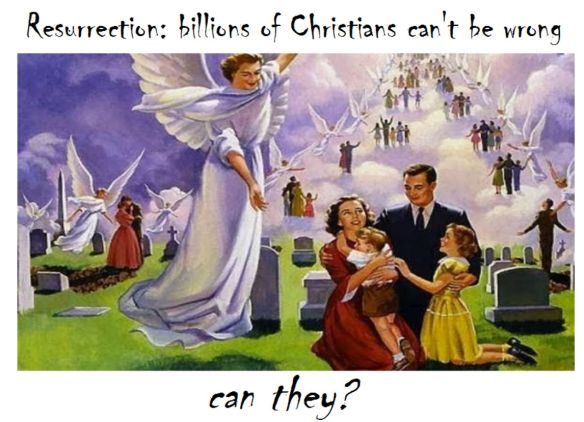
 

How Do Christians Explain Those Who Renounce Their Faith?

Aka The Death of Ananias by Raphael (Acts 5)

What was original Christianity like, long before it acquired that name? Before Paul’s ideas took hold? Clearly the cult existed prior to Paul. He tells us so himself: worship groups were around – the one he writes to in Rome, for example – before he  established his own. 

The early faith seems to have emanated from the visions of early believers such as Cephas and James. Quite what they ‘saw’ is open to debate but it led to them setting up a sect within Judaism that focused on the saving power of a risen celestial being.

And everything was absolutely hunky dory within these early communities. Members shared all their possessions (except when they didn’t, in which case they were annihilated on the spot) and lived in perfect harmony together, worshipping Jesus and experiencing miracles on a daily basis.

According to Acts, that is. According to Paul, by the time he came to be involved, it was all very different. Many of the early ‘churches’ were characterised by squabbling, greed, legal disputes, confusion about doctrine, sleeping around, visiting prostitutes and power struggles (Galatians 5.20; 2 Thessalonians 3.14-15; 1 Corinthians 1.10, 4.21; 1 Corinthians 6.1-10; 1 Corinthians 6.12-20; Galatians 1.6-9; 1 Corinthians 5.9-13 etc.) Worse still, there were defections by converts who came to their senses and left the cult.

How can this be when, according to Paul these people were inhabited by God’s holy spirit and saved once and for all by the redeeming blood of Jesus? Just as today, early believers, including Paul, had a hard time explaining how a person could be once saved and then lose their faith. They came up with various excuses how this could happen:

Excuse #1. Apostates were never really been saved: they were faking it in some way, their faith hadn’t been deep enough or Satan had snatched it away from them. One enterprising and influential cult member even came up with the sneaky idea of putting these explanations into the mouth of Jesus (because of course he would have foreseen the problem.) So arose the parable of the sower. According to Mark 4.1-20, the ‘word’ doesn’t always ‘take’. It might seem as if it has but sometimes it is uprooted by the cares of this world. Alternatively, it falls on stony ground and really doesn’t stand a chance of growing. Or Dick Dastardly Satan intervenes and destroys the faith of those who once believed. As a cultist called John later put it,

They went out from us, but they did not really belong to us. For if they had belonged to us, they would have remained with us; but their going showed that none of them belonged to us… (1 John 2.19)

Which really says nothing: ‘they left, so really they weren’t part of our gang to begin with.’ A brilliant bit of exposition.

Excuse #2. Apostates are still saved. In direct contradiction of the parable of the sower, some Christians invented a different way of accounting for those who had ‘fallen away’: the ‘once saved always saved’ argument, based on a few cherry-picked bible verses. Despite appearances, those who’ve left the faith are nonetheless still savedThe ‘reasoning’ is that because salvation is a work of God, it cannot be undone, no matter how much one refutes the faith, or provides reasons for leaving it or demonstrates the untruthfulness at the heart of it. Salvation is like a tattoo you regret getting but with which you’re stuck for the rest of your existence. (Except not really, for a whole host of reasons but principally because there’s no God to work the magic in the first place.) This line of reasoning runs entirely contrary to the acknowledgement in the parable of the sower that there are always those who will leave the faith.

Excuse #3. Apostates have been hurt by the church and as result have abandoned the faith (but Jesus is waiting for them to return!) While I don’t know anyone who has renounced Christianity for this reason alone, it does play a small part in some defections. Why? Because self-serving and vindictive Christians are evidence that Christianity simply doesn’t work. It doesn’t make ‘new creations’, infusing people with a holy spirit that makes them better people. Believers, despite their claims, are no more moral than those who are unsaved. You’ll know this if you’ve been on the receiving end of Christian judgment or condemnation. When Christians themselves undermine the claims of their religion it creates a justifiable scepticism in one-time brothers and sisters.

Excuse #4. Apostates just want to wallow in sin. Back to the parable of the sower for this one: ‘Satan has ensnared you into life of sin and debauchery and you have abandoned the one true way’. I have to say this is not true of any ex-Christians I know.  They’ve dispensed with the wholly religious idea of ‘sin’, and now live their lives as authentically as they can, looking after their loved ones and helping others where possible. Then again, so what if people want to wallow a little bit?   

The one reason that causes others to leave the fold that is never recognised by Christians is the gospel itself. No sir. That some people are able to see how irrational, contrived and downright untrue it is, is not a possibility Christians are willing to entertain. Jesus himself, however, seems to recognise that some people are just too intelligent to go along with it:

I praise you, Father, Lord of heaven and earth, because you have hidden these things from the wise and learned, and revealed them to little children (Matthew 11.25).

Even he knew – or, far more likely, the sect that put these words into his mouth – that for anyone capable of a modicum of critical thinking (‘the learned and the wise’), the cult’s claims simply don’t stand up to inspection.

Jesus writes…

Image: Caleb Havertape (https://www.pinterest.co.uk/calebhavertapei/_saved/)

Ubi Dubium has posed the question, ‘why didn’t Jesus write his own gospel?’ It’s a good question. What better way to ensure his ideas were conveyed precisely without any margin for error or misinterpretation, than to do it himself? If he hadn’t the time or the ability to do so, why didn’t he dictate his message to one of his literate disciples (surely one of them could write) who could then, as an eye-witness, finish off the story accurately once Jesus himself had returned to Heaven. Why, instead, did he leave it to people he’d never met, most of whom wouldn’t be about for another few decades?

It seems to me there are three possible answers.

  1. Jesus believed the world as he knew it was soon to end. He was convinced God was about to intervene and sweep away the old order and inaugurate the Kingdom of God on Earth. If the gospels that have come down to us are to believed, this was the core of his teaching. Jesus mentions its imminence repeatedly across the synoptic gospels and the morality he proposes, wholly impractical in the long term, is designed for the ‘shortness of the hour’. In this scenario, Jesus and his followers had no interest in writing anything down for posterity. There was no posterity; the end was very truly nigh.

  2. God didn’t want his Son to write his own story. He wanted the job left to people whom Jesus never met, who were little more than children during his lifetime and who lived hundreds of miles from where events occurred. God was sure this was the best way to create a record of his Son’s visit to Earth, without inaccuracies, inconsistencies and contradictions. 

  3. The creator of Mark’s gospel bought into Paul’s celestial Saviour, his illusory ‘Lord Jesus Christ’. Mark set about creating a ‘what if’ back story for him, set in Palestine in the recent past and constructed from Paul’s ’revelations’ and Old Testament ‘prophecy’. Mark highlighted Paul’s teaching that the Christ, whom he calls the Son of Man in his gospel, would soon be coming to the Earth (not a second coming or a return) to rescue his Chosen and reset reality.

Are there any other possibilities? I can’t think of any, nor have I read of any. So which of the three is the most plausible?

Scenario 1 leaves us with a Son of God not knowing what he was talking about. This Jesus was wrong about when the Son of Man would appear, wrong about the End of the Age, wrong about the traumatic nature of God’s intervention, wrong about the Final Judgement, wrong about the fate of the unrighteous and wrong about the Kingdom of God being established on the Earth. This scenario gives us a Jesus who is a failure as both a prophet and Messiah. It’s a wonder anything at all was written about such a loser, let alone narratives that preserved his hopeless predictions about the Kingdom’s arrival.

Scenario 2 is of course ridiculous, though it is the one most Christians buy into, more or less. As well as its inherent implausibility, it relies on the hypothetical document Q, for which no evidence exists let alone any extant copy (or even fragment). It, and a supposedly reliable oral tradition, are speculative, needed only to counter the improbability of this scenario.

Scenario 3, while contentious, makes most sense of why neither Jesus nor any of his contemporaries wrote down or otherwise recorded a single thing he said or did. Mark’s gospel, created shortly after 70CE, was the first anyone had heard of a Jesus on Earth. The three subsequent gospels were all based, to varying degrees, on Mark’s fable. In this scenario there was no real Jesus, and no dozy disciples, to have recorded his exploits and teaching.

What you think, Ubi?

Goodbye, Jesus

The Jesus narrative is a made-up story, originally created by a member of one of the many branches of a first century cult centred on a supernatural being experienced in visions. We call this cult member ‘Mark’. His ‘gospel’ was not written to convert anyone – I doubt any of them were – it was written as a ‘what if?’ story for fellow cult members: ‘what if our celestial saviour had lived on Earth?’ It is made up of St Paul’s teaching, Old Testament mythology, and ideas taken from pagan dying-god myths (probably in that order). It amalgamates the cult’s rules with what cultists believed about the end of the age: that their celestial saviour would very soon be coming down to Earth to save them and annihilate their enemies.

Ten or fifteen years later, another writer took Mark’s fiction and rewrote much of it for his branch of the cult. This was a group who saw themselves as still firmly within Judaism, so ‘Matthew’ toned down Paul’s teaching, eliminating a good deal of it. He heightened Jewish teaching for his co-religionists, and created a Jesus who was a manifestation of prophecy, as he saw it, from the Jewish scriptures. This construct had no time for any magic salvation-formula; like the cult who created him, he taught obedience to Jewish Law and believed that serving others was the way to eternal life.

A few years on and a third sect found Mark and Matthew’s stories weren’t entirely to their liking. They didn’t quite get Jesus right. So they took them and altered them again. Their scribe, known now as Luke, created a third Jesus. It’s possible this sect didn’t realise the original story was fiction. There’s some evidence Luke thought Jesus had really existed, 50 years or so before he remodelled him.

Later still, the creators (plural) of a fourth gospel created a Christ totally unlike the other three. This branch of the cult had ceased to believe, perhaps because it hadn’t happened when earlier believers said it would, that the saviour would be coming through the clouds at any minute to set up God’s kingdom on Earth. That part of the original idea was dropped; this Jesus is made to preach an internalised salvation, and everlasting life in heaven is beginning to be hinted at.

And that’s it. The adventures of Jesus on Earth began as a ‘what if?’ story created for existing cult members. Other branches of the cult took it and reshaped its central character so that he suited their needs and beliefs. A real Jesus was not necessary for any of this to happen. Just as it was for Paul, whether one existed or not is immaterial,. Even if he did, we can know nothing about him. The Jesuses created by each sect is a product of what they imagined their saviour to be, just like the various Christs that are worshipped today.

So, I’m saying a final goodbye to Jesus – or rather to all the Jesuses, Christs and made-up Messiahs spawned by the visions, fantasies and fan-fiction of the first century. I don’t need them, and neither do you.

This blog will be taking a new direction in the new year. Next time, though, I hope you’ll read one of my Christmas stories, as featured on the BBC.

Stay safe. 

Did Jesus exist? A rethink.

Blog418

Who determined the rules for the early Jesus cult? Jesus himself or the members of the cult? What does the evidence suggest? They all appear in documents written between 40 and 90 years after Jesus died. Either they survived from the moment the words left his lips, remembered accurately by generations of believers or they were included in the gospels by the cult communities that created them.

I’ve written before about how much of the Bible was written backwards (so to speak) and the gospel’s cult rules look likely to have been developed in just this way. The cult members had, by the time the gospels came to written, established these rules for their communities. They had shaped a Jesus that suited their purposes; it has long been recognised that the creators of Matthew’s, Luke’s and even John’s gospel took Mark’s account and amended it significantly. Their depiction of Jesus, his teaching and the resurrection are amended to reflect their particular beliefs and community rules. How do we know this?

Richard Carrier, the so-called mythicist (he actually says there’s a 1 in 3 possibility of the historicity of Jesus; figures as mythologised as Jesus rarely existed in fact) demonstrates how Mark’s gospel is an allegorical story based on Paul’s teaching. Mark created a well constructed narrative designed, literally, to flesh out the spiritual being that Paul imagined he’d seen in his visions. Using Jewish and pagan myths to structure it, he incorporates Paul’s visions and ‘revelations’ to create his Jesus story. To take one example, Paul relates in 1 Corinthians 11.23-25 how his celestial Christ told him in person (i.e. in his head) how his sacrifice of himself should be celebrated: with bread and wine. Mark turns this into an actual meal supposedly shared between Jesus and his early followers: the Last Supper.

Subsequent gospel writers took Mark’s allegory and amended it both to suit their needs and to correct what they perceived as Mark’s shortcomings. In the process they ‘fleshed out’ still further the figure at the centre of Paul’s (and others’) visions and Mark’s story based on them. Most significantly, they added increasingly elaborate resurrection appearances; it is significant Mark’s gospel has none, as if he knew Jesus’ resurrection wasn’t a physical event but a visionary one exactly as Paul describes.

It seems indisputable that the gospels were written this way (though there are, naturally, those who do dispute it.) None of the gospels rely on a hypothetical oral tradition, which, if it existed, would be extremely unreliable over 50 or so years (the time between Jesus’ supposed ministry and the writing of Matthew’s gospel), nor do they depend on the equally hypothetical Q. In any case, Q, if it existed, was a book of sayings, not a narrative account. Significantly, no copies of what must surely would have been a precious document have survived.

No, Mark made up the story of Jesus based on Paul’s visions (we know others had similar visions before Paul; he tells us so in 1 Corinthians 15.1-8). We know too that subsequent gospel writers built on Mark, adding what suited them, including their particular sect’s rules. What better endorsement of these rules than to have the object of their worship seeming to issue them himself? It’s highly unlikely he did anything of the sort. In 1991 the Jesus Seminar determined, controversially, that only about 20% of the words in the gospels could be attributed to an historical Jesus. All of the rest is made up and put retrospectively into his mouth. (The Seminar nevertheless concluded that Jesus existed.)

From the small amount of Jesus’ teaching that might be attributed to an historical Jesus, to the way the gospels were created, what can be known about a ‘real’ Jesus – what he said and did – grows increasingly small. All we are left with is a ghost of a figure. And isn’t this precisely what Paul claimed he and others had seen?

I’m rethinking my position and I’m coming to the conclusion, based on how the gospels were written, especially the way Mark allegorised Paul’s visions and teachings, that the likelihood of an historical Jesus is slim. Carrier has an abundance of evidence to support his proposal of a 1 in 3 chance that Jesus existed. Certainly the Jesus(es) of the gospels did not exist; they’re all made up. It now seems to me there’s no real, historical Jesus behind any of them. 
 

The Ten Rules of Cult Club

Blog417

Which cult?        

        Any.

            All of them.

Let’s call this one The Brotherhood of the Lord.

Rule 1. Give your heart and soul to the Brotherhood.

Rule 2. Separate yourself from you family. They’ll just be a drag on you. They won’t understand you’ve found the Truth.

Rule 3. Treat other Brothers and Sisters as your family instead. Put them first.

Rule 4. Be prepared to die for your Brotherhood family. It’s not too much to ask.

Rule 5. Renounce your ego! You can’t enter fully into Truth until you let go of self.

Rule 6. Don’t criticise your brothers and sisters, specially not the leadership. The leaders know better than you; you are mere sheep and little children.

Rule 7. Sell everything you own; you won’t need it now. Give what you make to the poorest members of the group.

Rule 8. Listen to your leaders. They will tell you secrets about life that no-one outside the Brotherhood can possibly understand.

Rule 9. Don’t stop believing: if you’re obedient to the cult, your sins will be forgiven and you will live forever.

Rule 10. Be prepared: God is coming real soon to rescue you from this wicked world and elevate you to a place of glory

Or, as Jesus put it:

Rule 1. Any one of you who does not renounce all that he has cannot be my disciple (Luke 14.33). No one who puts his hand to the plough and looks back is fit for the kingdom of God. (Luke 9.62).

Rule 2. If anyone comes to me and does not hate his own father and mother and wife and children and brothers and sisters, yes, and even his own life, he cannot be my disciple (Luke 14.26).

Rule 3. Who is my mother and who are my brothers?” And stretching out his hand toward his disciples, he said, “Behold my mother and my brothers! For whoever does the will of my Father who is in heaven, he is my brother and sister and mother.” (Matthew 12.48-50).

Rule 4. Greater love hath no man than this, that a man lay down his life for his friends (John 15.13).

Rule 5. If anyone wants to come after me, let him deny himself, and take up his cross, and follow me. For whoever wants to save his life will lose it. But whoever loses his life for my sake will find it. (Luke 9.23).

Rule 6. Judge not, and you shall not be judged. Condemn not, and you shall not be condemned. Forgive, and you will be forgiven (Luke 6.37). Anyone who is angry with his brother without a cause will be subject to punishment. And whoever says to his brother ‘Raka!’ will be subject to the Council. And whoever says, ‘You fool!’ will be subject to hell fire (Matthew 5.22). Unless you change and become like children, you will never enter the kingdom of heaven (Matthew 18.3).

Rule 7. Go, sell everything you have and give to the poor, and you will have treasure in heaven. Then come, follow me (Mark 10.21).

Rule 8. This is why I speak to the crowds in parables: although they see, they don’t really see; and although they hear, they don’t really hear or understand (Matthew 13.13)

Rule 9. My sheep hear my voice, and I know them, and they follow me: and I give them eternal life; and they shall never perish (John 10.27-28)

Rule 10. Whoever exalts himself will be humbled, and whoever humbles himself will be exalted (Matthew 23.12). I am the resurrection and the life. He who believes in Me, though he may die, he shall live. And whoever lives and believes in Me shall never die. (John 11.25-26).

Two questions:

1. How many Christians today do all the things demanded by Jesus?

2. Who decided he said these things? Did Jesus say them – or was it the cult that arose in his name who put them retrospectively in his mouth?

Next time…