New Bodies For Old

Paul taught that believers in the Lord Jesus would, once the Christ returned, be resurrected in a ‘spiritual body’. Those who remained alive at this time, as Paul anticipated he himself would be, were also to be ‘re-clothed’ in a new body (2 Corinthians 5.3) in preparation for life in the Kingdom.

He also seems to have believed that Jesus himself was resurrected in a ‘spiritual body’. This is presumably what Paul thinks he saw when Christ revealed himself to him in his head. Christians since have argued that when Jesus rose from the dead, it was in the same body in which he was crucified. Indeed, John’s gospel goes so far as to show his resurrected body still carried the wounds he suffered during his execution (John 20.26-29).

So what does this spiritual body, the one Paul promises all believers will receive, which is somehow physical yet not – the risen Jesus can pass ghost-like through locked doors (John 20.19) and levitate into the sky (Acts 1.8-11) – look like? What is its nature? Is it ephemeral so that it can vanish at will (Luke 24.31) and change its appearance (Luke 24.16), or is it like the bodies we have now, only better? Is it made of meat and gristle? Does it breath, eat, sweat, need to sleep, poop and pee? If not, then in what way is it a body? Will the new body retain its lungs, sweat glands, digestive system and genitals? Can it be considered a proper body if it doesn’t? If it’s to be an upgraded version of our existing bodies, minus all those pesky instincts, demands and messy bits, then how does it work? Does it only vaguely resemble the body we have now, like an Avatar in the famous film? Is it intangible, like the risen Christ’s (as implied in John 20.17)? Can it morph into unrecognisable forms (John 20.14)? Will it be able to pass through physical objects like Jesus’ ghostly form could ?

Alas, we shall never know. When Paul was making pronouncements about ‘spiritual bodies’ he hadn’t a clue what he was talking about. Writing to the cultists in Corinth, he anticipates that someone might want to know what ‘spiritual bodies’ are like. Here’s his profound answer:

But someone will ask, “How are the dead raised? With what kind of body do they come?” You foolish person! (1 Corinthians 15.35)

Yup, he had no idea what he was talking about so he resorts to ad hominem abuse instead. He then twitters on about how the physical body has to die, like a seed, before the new super-duper spiritual body can manifest itself. Except a seed doesn’t die in order to produce a plant. It may be buried but it doesn’t die. His analogy, which, you’ll note, doesn’t actually answer the question, fails miserably:

What you sow does not come to life unless it dies. And what you sow is not the body that is to be, but a bare kernel, perhaps of wheat or of some other grain…. So is it with the resurrection of the dead. What is sown is perishable; what is raised is imperishable. It is sown in dishonour; it is raised in glory. It is sown in weakness; it is raised in power. It is sown a natural body; it is raised a spiritual body. If there is a natural body, there is also a spiritual body. (1 Corinthians 15.36-37, 42-44)

His final flourish – if there is physical body then there has to be spiritual one – is, to use a technical term, absolute crap. He is making this stuff up and passing it off as a message from the Lord. Then as now, there were those who were taken in by him.

No-one has ever received a new body after their death; when this, our only body dies, we die. Our consciousness does not survive; it is a manifestation of our bodies, specifically of the brain, part of the meat and gristle that make up our bodies. It doesn’t hang around waiting for Jesus or God or some other non-existent being to transplant it in an imaginary super body.

No-one has ever received a new ‘spiritual body’, and no-one ever will. Of the 100.8 billion people who have died in the history of mankind, not one has gone on to live again in a new ‘spiritual body’. Not one has gone on to live again, period. If you think they have, you are free to present your evidence here. (Jesus, I should point out, doesn’t count: he wasn’t, according to Christian myth-making, entirely mortal. Plus his resurrection appearances are fiction.)

Paul is lying. There is no such thing as a ‘spiritual body’, no such thing as resurrection. You won’t be experiencing either. You are allowing yourself to be duped if you think you will.

Did Jesus exist? A rethink.

Blog418

Who determined the rules for the early Jesus cult? Jesus himself or the members of the cult? What does the evidence suggest? They all appear in documents written between 40 and 90 years after Jesus died. Either they survived from the moment the words left his lips, remembered accurately by generations of believers or they were included in the gospels by the cult communities that created them.

I’ve written before about how much of the Bible was written backwards (so to speak) and the gospel’s cult rules look likely to have been developed in just this way. The cult members had, by the time the gospels came to written, established these rules for their communities. They had shaped a Jesus that suited their purposes; it has long been recognised that the creators of Matthew’s, Luke’s and even John’s gospel took Mark’s account and amended it significantly. Their depiction of Jesus, his teaching and the resurrection are amended to reflect their particular beliefs and community rules. How do we know this?

Richard Carrier, the so-called mythicist (he actually says there’s a 1 in 3 possibility of the historicity of Jesus; figures as mythologised as Jesus rarely existed in fact) demonstrates how Mark’s gospel is an allegorical story based on Paul’s teaching. Mark created a well constructed narrative designed, literally, to flesh out the spiritual being that Paul imagined he’d seen in his visions. Using Jewish and pagan myths to structure it, he incorporates Paul’s visions and ‘revelations’ to create his Jesus story. To take one example, Paul relates in 1 Corinthians 11.23-25 how his celestial Christ told him in person (i.e. in his head) how his sacrifice of himself should be celebrated: with bread and wine. Mark turns this into an actual meal supposedly shared between Jesus and his early followers: the Last Supper.

Subsequent gospel writers took Mark’s allegory and amended it both to suit their needs and to correct what they perceived as Mark’s shortcomings. In the process they ‘fleshed out’ still further the figure at the centre of Paul’s (and others’) visions and Mark’s story based on them. Most significantly, they added increasingly elaborate resurrection appearances; it is significant Mark’s gospel has none, as if he knew Jesus’ resurrection wasn’t a physical event but a visionary one exactly as Paul describes.

It seems indisputable that the gospels were written this way (though there are, naturally, those who do dispute it.) None of the gospels rely on a hypothetical oral tradition, which, if it existed, would be extremely unreliable over 50 or so years (the time between Jesus’ supposed ministry and the writing of Matthew’s gospel), nor do they depend on the equally hypothetical Q. In any case, Q, if it existed, was a book of sayings, not a narrative account. Significantly, no copies of what must surely would have been a precious document have survived.

No, Mark made up the story of Jesus based on Paul’s visions (we know others had similar visions before Paul; he tells us so in 1 Corinthians 15.1-8). We know too that subsequent gospel writers built on Mark, adding what suited them, including their particular sect’s rules. What better endorsement of these rules than to have the object of their worship seeming to issue them himself? It’s highly unlikely he did anything of the sort. In 1991 the Jesus Seminar determined, controversially, that only about 20% of the words in the gospels could be attributed to an historical Jesus. All of the rest is made up and put retrospectively into his mouth. (The Seminar nevertheless concluded that Jesus existed.)

From the small amount of Jesus’ teaching that might be attributed to an historical Jesus, to the way the gospels were created, what can be known about a ‘real’ Jesus – what he said and did – grows increasingly small. All we are left with is a ghost of a figure. And isn’t this precisely what Paul claimed he and others had seen?

I’m rethinking my position and I’m coming to the conclusion, based on how the gospels were written, especially the way Mark allegorised Paul’s visions and teachings, that the likelihood of an historical Jesus is slim. Carrier has an abundance of evidence to support his proposal of a 1 in 3 chance that Jesus existed. Certainly the Jesus(es) of the gospels did not exist; they’re all made up. It now seems to me there’s no real, historical Jesus behind any of them. 
 

The Ten Rules of Cult Club

Blog417

Which cult?        

        Any.

            All of them.

Let’s call this one The Brotherhood of the Lord.

Rule 1. Give your heart and soul to the Brotherhood.

Rule 2. Separate yourself from you family. They’ll just be a drag on you. They won’t understand you’ve found the Truth.

Rule 3. Treat other Brothers and Sisters as your family instead. Put them first.

Rule 4. Be prepared to die for your Brotherhood family. It’s not too much to ask.

Rule 5. Renounce your ego! You can’t enter fully into Truth until you let go of self.

Rule 6. Don’t criticise your brothers and sisters, specially not the leadership. The leaders know better than you; you are mere sheep and little children.

Rule 7. Sell everything you own; you won’t need it now. Give what you make to the poorest members of the group.

Rule 8. Listen to your leaders. They will tell you secrets about life that no-one outside the Brotherhood can possibly understand.

Rule 9. Don’t stop believing: if you’re obedient to the cult, your sins will be forgiven and you will live forever.

Rule 10. Be prepared: God is coming real soon to rescue you from this wicked world and elevate you to a place of glory

Or, as Jesus put it:

Rule 1. Any one of you who does not renounce all that he has cannot be my disciple (Luke 14.33). No one who puts his hand to the plough and looks back is fit for the kingdom of God. (Luke 9.62).

Rule 2. If anyone comes to me and does not hate his own father and mother and wife and children and brothers and sisters, yes, and even his own life, he cannot be my disciple (Luke 14.26).

Rule 3. Who is my mother and who are my brothers?” And stretching out his hand toward his disciples, he said, “Behold my mother and my brothers! For whoever does the will of my Father who is in heaven, he is my brother and sister and mother.” (Matthew 12.48-50).

Rule 4. Greater love hath no man than this, that a man lay down his life for his friends (John 15.13).

Rule 5. If anyone wants to come after me, let him deny himself, and take up his cross, and follow me. For whoever wants to save his life will lose it. But whoever loses his life for my sake will find it. (Luke 9.23).

Rule 6. Judge not, and you shall not be judged. Condemn not, and you shall not be condemned. Forgive, and you will be forgiven (Luke 6.37). Anyone who is angry with his brother without a cause will be subject to punishment. And whoever says to his brother ‘Raka!’ will be subject to the Council. And whoever says, ‘You fool!’ will be subject to hell fire (Matthew 5.22). Unless you change and become like children, you will never enter the kingdom of heaven (Matthew 18.3).

Rule 7. Go, sell everything you have and give to the poor, and you will have treasure in heaven. Then come, follow me (Mark 10.21).

Rule 8. This is why I speak to the crowds in parables: although they see, they don’t really see; and although they hear, they don’t really hear or understand (Matthew 13.13)

Rule 9. My sheep hear my voice, and I know them, and they follow me: and I give them eternal life; and they shall never perish (John 10.27-28)

Rule 10. Whoever exalts himself will be humbled, and whoever humbles himself will be exalted (Matthew 23.12). I am the resurrection and the life. He who believes in Me, though he may die, he shall live. And whoever lives and believes in Me shall never die. (John 11.25-26).

Two questions:

1. How many Christians today do all the things demanded by Jesus?

2. Who decided he said these things? Did Jesus say them – or was it the cult that arose in his name who put them retrospectively in his mouth?

Next time…

What Jesus didn’t know

Blog416

Creating the picture for the previous post reminded me of how little Jesus, assuming he actually existed, knew of the consequences of his ‘ministry’. Here’s a few of the things he either didn’t do or had no knowledge of while he lived.

  • Jesus never read a single word of the New Testament. The earliest of its books, I Thessalonians, was written about twenty years after he died. The New Testament did not appear in its entirety until the end of the 4th century.
  • He never read any of the accounts of his life, the first of which didn’t appear until about forty years after his death.
  • He had no control at all over what went in any of the gospels.
  • He did not endorse them in any way, nor verify their accuracy.
  • He never met Paul nor was he aware of the fantastical claims Paul would make about him.
  • He had no idea he would come to be regarded as God.
  • He did not know that soon after his death, people would worship him as God.
  • He would not have anticipated that his teaching would be adapted for a Gentile audience. It is unlikely he would have approved if he had.
  • He had no idea a new religion would be created in his name.
  • He did not know anything about, nor did he anticipate, the Church. His apparent acknowledgement of it is a fabrication.
  • He did not know the damage those who followed him would do in his name.
  • He did not know that the Kingdom of God would never arrive on Earth, nor that the Romans would continue to dominate it for a further 400 years.
  • He did not know the world would continue pretty much as it was for another 2000 years.
  • He did not know of the scientific discoveries that would be made in those years that would invalidate his beliefs and worldview.
  • He did not know that, forty years after his ‘ministry’, the Jerusalem temple would be destroyed by the Romans. His ‘prophecy’ of it is a fabrication written after the event.
  • He did not know of the world beyond the Roman Empire, if he was aware even of that. He certainly did not know of the American continent.
  • He had no knowledge of the United States, founded more than 1,700 years after he died.
  • He had no concept of most, if not all, of the concerns of today’s evangelicals: religious liberty, right-wing politics, guns, abortion, ‘the homosexual agenda’.
  • He had no idea what his legacy would be: the arrested development of millions and of western society itself; pogroms, persecutions and inquisitions; a corrupt and abusive church; the psychological damage caused to innumerable people; his name hi-jacked for political causes he had never heard of and almost certainly would not have approved of.

None of this is what he saw for himself. He thought he would be ruling the world with his besties on behalf of Yahweh. Like every other mortal, he had no idea of anything that would happen after his lifetime. What does this tell us about him?

Believe what you want to believe

Blog415

I’ve been responding to some comments of Don Camp’s over on Cross Examined.  First off, Don objected to the claim someone made that the Bible is ‘full of errors’. He went on to make a number of assertions that I felt compelled to challenge. I’ve also added here a number of other points in italics, where, it seems to me, Don is trying to bluff with guff.

Don: “Full of errors” is an overstatement. There are errors, which is obvious when one looks at the critical apparatus of the USB Greek text. (What is this ‘apparatus’ of which Don speaks? Critical scholarship? Can’t see Don bothering much with that. Magic seer stones, then?) But if you know how to read the apparatus (ah, we must have insider knowledge to know how to read the manuscripts [which ‘manuscripts?] the way Don does) you will notice that the differences between manuscripts is minor and do not impact the message (we will? How?) The doctrine of “inerrancy” speaks to the original manuscripts (autographs). (We don’t have the original manuscripts so we can’t verify their accuracy or otherwise. Even if we did have access to them, how would we know they said what God wanted them to say? How would we know if what they said was true? We wouldn’t. They’re both hypothetical and irrelevant, and this is all meaningless theobabble.)

Don: I don’t subscribe to a strong inerrancy… (The examples you cite are) nitpicking and, I suspect, avoidance. (What is ‘strong inerrancy’? I’d have thought something was either inerrant or it wasn’t. The presence of one error in a document means it isn’t inerrant. If Don doesn’t subscribe to ‘strong inerrancy’ there’s nothing else – only the presence of error.) 

And then we’re off on a tangent – call it ‘sleight of hand’ – about how marvellous the Bible is:

The Bible is a remarkable book. There is none like it in all of literary history. It is the story of man and God and explains not only why things are the way they are but how God acted to reconcile man to himself. That message throughout the Bible is the same. In that sense, the Bible is unified.

And then another unfounded assertion, to which I sent the reply that follows:

Don: The Bible is also coherent. The message is logical and consistent. The third chapter of Genesis contains the message in brief as a narrative. It is sometimes called the proto-evangel. The rest of the Bible unfolds that message and explains how God accomplished his purpose and how we can respond to his mercy and grace […]

Me: Okay, let’s disregard the numerous ‘minor’ inconsistencies and contradictions. There’s insurmountable disunity between the old and new covenants: God in the Old Testament (OT) promises Abraham his contract with him and his seed is ‘always and forever’ (Genesis 12). He negates this completely in the New Testament (NT) when he declares, or so Paul would have us believe, that the only way to find favour with him is through faith in his saviour. Yes, the Bible’s unchanging God changes his mind and presents two irreconcilable ways to be reconciled with him.

Or how about the differences between Paul’s theology – salvation through faith alone – and Matthew’s Jesus who says salvation is through personal righteousness achieved by doing good works (Matthew 25)? For God’s sake, Don, there’s only about forty years distance between these two schemes and yet they don’t agree on what God’s plan is for mankind.

You want more? How about the differences between the OT and NT perspectives of the afterlife? Jesus’ (and Paul’s) conviction about the imminence of the End of the Age and that of later NT writers? The views of Heaven in earlier and later writing?

You’re deluding yourself, Don, if you think there’s a unity to these central doctrines in the Bible. There evidentially isn’t. Please don’t take us for fools with your attempts to delude us too.

To which I’d add that Christians’ dishonest attempts to prop up that book of  suspicion and make-believe, the Bible, as something it isn’t are tiresome in the extreme. Words like ‘apparatus’ and ‘original manuscripts/autographs’, are meaningless, while ‘inerrancy’, ‘coherence’ and ‘consistent’ are used in ways that strip them of any of their meaning. There is no ‘apparatus’ that magically removes the serious discrepancies in the Bible, no pristine, error-free original manuscripts to which we can refer. As in many of its minor details, the Bible’s central messages lack unity, coherence, consistency – and anything approaching sense. The American Bible Society reported recently that through lockdown, Christians haven’t – shock! horror! – been reading their Bibles with any regularity. Given they don’t read them much anyway, this can only be a good thing.

The Mask of the Beast

Blog413

Know which fights to pick. Making an issue out of wearing a face mask isn’t one of them.

I don’t want to wear a mask. They’re an incovenience; stuffy and uncomfortable. They hide the face, making communication difficult. An internet meme I saw recently said requiring a face mask four months into a pandemic is like requiring a condom at a baby shower.

Nevertheless, I will be wearing one when they become mandatory in UK shops next week. Wearing a mask isn’t about the wearer. It’s about protecting others from your respiratory effusions that may harbour the virus. That seems a good enough reason to put one on in shops. That and the threatened £100 fine for not doing so (unenforceable in practice, I’d have thought.)

So why are so many Christians opposed to protecting the neighbours they’re supposed to love? Wonder no longer. Here is DeAnna Lorraine to explain:

Biblically, God does not want us wearing masks. Masks are a symbol of hiding yourself, of doing bad deeds, inappropriate deeds, or malicious things that you need to hide from. And it is also a symbol of stripping us of our unique identity because [when] we’re wearing a mask, we’re not unique anymore, we’re all the same. And God doesn’t see us that way.

He also sees us as being good, and anyone who is doing good deeds should not be living and hiding in the shadows behind a mask. A mask is a symbol of fear. You’re living in fear. If you have a mask on, it means you actually don’t trust God. You don’t have faith. You’re living in fear instead of faith. And of course, the Marxist globalist Satanists that are pushing all this, they are trying to invert reality and pervert God and Christians, and they want to isolate us from God, isolate us from other humans, and deprive us of that faith so that we rely on the government, the media, telling us what to do and telling us whether to be fearful or not instead of God.

It’s simple, you see: ‘Biblically’, God doesn’t want us to wear masks. It’s right there in Revelation: God just doesn’t recognise his Chosen Ones if they’ve got a mask on. Just as you or I wouldn’t recognise Hal Jordan or a ninja turtle once they donned their masks, so God is totally flummoxed when we ‘strip ourselves of our identities’ by the simple expedient of covering our mouths and noses.

Instead, according to the insecure, self-obsessed Lorraine, we should trust this enfeebled deity to keep us, and our neighbours – towards whom we evidently have no obligation – safe.

Like this has worked in churches that have flouted lockdown and social distancing rules! The God who doesn’t recognise us in a mask has proven himself incapable of protecting a single one of his followers from Covid-19; not entirely unexpectedly, admittedly, when he’s no more than a figment of their imagination. (This is the same God, incapable even of protecting them from the common cold, whom they think is going to rescue them from death.)

So no, resisting the wearing of masks and other covid precautions is not the fight Christians should be taking on. Nor is raving about the erosion of ‘religious liberty’ (read, ‘Christian privilege’) and the supposed decline in morality. I mentioned last time a number of causes with which they might consider engaging. We might add campaigning to end poverty and the deaths of 15,000 children a day through hunger. ‘Biblically’, God would want them to do that (Matthew 25.31-40).

Failing this, they might put their neighbour above themselves, wear a face mask and shut the f**k up.

In which Paul takes a trip to the third heaven

Blog408

In the New Testament, there are:

8 or more supernatural ‘visions’;

18 or so ‘appearances’ of angels;

about 6 significant dreams, through which God talks to people;

a dozen apparitions of dead people and

at least 3 significant ‘revelations’, in which individuals sense God in their heads (Paul, Jesus and John of Patmos).

The man who is largely responsible for Christianity as we know it, Paul, alludes only briefly to his magical conversion to the faith, describing it as ‘in’ his head in Galatians 1.16. It’s up to the writer of Acts to elaborate and embroider this non-event. Paul does, however, give rather more detail about another hallucination he has, in 2 Corinthians 12.1-4. To avoid boasting, he says boastfully, he refers to himself in the third person:

I must go on boasting. Although there is nothing to gain, I will go on to visions and revelations from the Lord. I know a man in Christ who fourteen years ago was caught up to the third heaven. Whether it was in the body or out of it I do not know, but God knows. And I know that this man—whether in the body or out of it I do not know, but God knows— was caught up to Paradise. The things he heard were too sacred for words, things that man is not permitted to tell.

This is evidently a psychotic episode; seeing things that are not there, experiencing events that are not happening. Paul himself admits he doesn’t know whether it was a real experience, nor does he know if he was in his body or not (definitely in it, just out of his mind.) He heard, he says, things he can’t possibly repeat, which makes you wonder why he bothers mentioning the whole bizarre episode in the first place: ‘I had this fantastic experience, unlike anything I’ve experienced before – but I can’t tell you a thing about it.’ It sounds like a dream he’s having trouble remembering or, like, man, a really freaky hallucinogenic trip.

From psychotic episodes like this – his conversion is another one – Paul spins his entire theology. Yes, the faith of Christians everywhere is founded on the hallucinations of a first century nutcase visionary.

I don’t know about you, but I’ve better things to do with my life than base it on the dreams and visions of a psychotic who lived 2000 years ago.


Demons, demons everywhere…

Blog407

I wonder if any Christians out there can help me understand something. I know that not all of you believe in demons; some of you are far too rational to believe in non-existent supernatural beings! I know too that when the bible mentions demons, as it does often, you know it’s as a metaphor, for sin perhaps, or as the personification of evil. Presumably, you reach this conclusion with the help of the Holy Spirit (you do believe in him, don’t you?)

And yet other, lesser brethren are led by that same Spirit to see demons as 100% real.

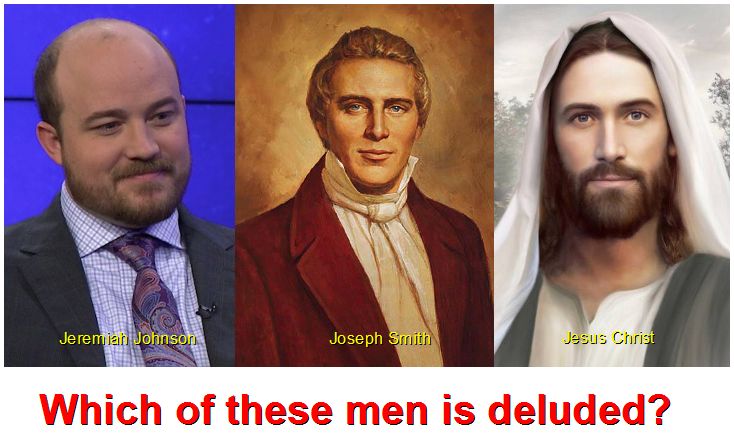
Take this guy, Jeremiah Johnson, a preacher/prophet/author from Florida who recently had a real live conversation with a demon:

On the night of May 30th, while praying and pacing over the United States in my home around 2 am, a demonic entity appeared right before me in an open vision. This type of encounter has only ever happened one other time while I was ministering in a foreign country in 2015. I have always engaged in this type of spiritual warfare while asleep and dreaming prophetically, but rarely if ever to this degree while awake.

This demonic entity had a visible and deep scar underneath its right eye, but it also had the ability to mutate or rather change forms. I watched this “being” morph several times right in front of me, yet the gash below its right eye remained.

As I see it, there are three options here. Either –

a) This really happened, or

b) Jeremiah made it up, or

c) It happened but entirely within Jeremiah’s disturbed mind

Can you advise me which it is? I’m leaning towards b) or c). I say ‘leaning’ when what I mean is I rule out a) entirely, though I’d be interested to know which conclusion the Holy Spirit is leading you to. (Actually, reading the comments following Jeremiah’s posting of his ‘Urgent Prophetic Alert and Warning’ on Facebook, I already know what 4 thousand of you think: you fall for this crapola hook, line and sinker.)

Of course, not all supernatural encounters are with demons. Sometimes your fellow believers have encounters with angels, or dead people from the bible. Here’s an example of that:

I kneeled down, and prayed, saying, ‘O Lord, what Church shall I join?’ Directly I saw a light, and then a glorious Personage in the light, and then another personage, and the first personage said [of] the second, ‘Behold this is my beloved Son, hear him’” 

Wow, that sounds amazing, doesn’t it? Joseph Smith recounting his first ‘vision’.

Again, you’ve got three options:

Either:

a) This really happened, or

b) Joseph made it up, or

c) It happened but entirely within Joseph’s disturbed mind.

If you’re a Mormon, the Holy Ghost will have led you to embrace option a). I lean myself towards b), possibly c). If you’re an evangelical Christian, however, you probably think Smith’s vision was demonically inspired. Can I ask you why you think this? Is it because that’s what your version of the Holy Ghost tells you? Ain’t it amazing how ‘he’ always confirms what you already believe?

With that in mind, let’s look at one final example:

When Jesus stepped out of the boat, a man out of the tombs with an unclean spirit met him. He lived among the tombs; and no one could restrain him any more, even with a chain; for he had often been restrained with shackles and chains, but the chains he wrenched apart, and the shackles he broke in pieces; and no one had the strength to subdue him. Night and day among the tombs and on the mountains he was always howling and bruising himself with stones. 

When he saw Jesus from a distance, he ran and bowed down before him; and he shouted at the top of his voice, “What have you to do with me, Jesus, Son of the Most High God? I adjure you by God, do not torment me.” For he had said to him, “Come out of the man, you unclean spirit!”  Then Jesus asked him, “What is your name?” He replied, “My name is Legion; for we are many.”  He begged him earnestly not to send them out of the country. Now there on the hillside a great herd of swine was feeding; and the unclean spirits begged him, “Send us into the swine; let us enter them.” So he gave them permission. And the unclean spirits came out and entered the swine; and the herd, numbering about two thousand, rushed down the steep bank into the sea, and were drowned in the sea. (Mark 5.1-20)

Either:

a) This really happened, or

b) Mark made it up, or

c) Mark made it up but it’s a metaphor for something or other.

I’m guessing most of you, including those who regard yourselves as rational Christians, opted for a): you think this really happened in some form. Why? Because this time it’s your hero, Jesus, who’s involved.

However, and this is my point, Jesus’ encounter with a demon – and it’s not the only one in the gospels – is no different in kind from Jeremiah Johnson’s or Joseph Smith’s. If you believe one really happened – the Jesus one – you really haven’t any reason not to believe the other two. And yet, my Christian friends, you reject at least one of the other two, don’t you. You dismiss Smith’s encounter with God and Jesus as, at best, a delusion and at worst, a fiction intended to dupe others. You may, as I’ve suggested, see it as demonically inspired (even though no actual demons appear, unlike in the Jesus and Johnson accounts.)

You may also, if you’ve half a brain, dismiss Johnson’s ridiculous story too. I hope so. So why persist in believing that Jesus met with demons? It’s not the Holy Spirit who convinces you that this story is the only plausible one of the three. The Holy Spirit is only as real as Johnson’s morphing demon. No, the only reason you give Jesus a free pass, but not Smith or Johnson (possibly), is that the Jesus story is in the bible.

So, what’s the answer to the question at the top of this post: which of those men, Jeremiah Johnson, Joseph Smith and Mark’s Jesus, is deluded? The answer is… all of them. And at least two of them are frauds.

Myself, I’m leaning towards all three.


The many and varied, Spirit-inspired interpretations of the Kingdom of God

Blog406Heaven

For the Son of Man is going to come with his angels in the glory of his Father, and then he will repay each person according to what he has done. Truly, I say to you, there are some standing here who will not taste death until they see the Son of Man coming in his kingdom” (Matthew 16.27–28).

Truly I say to you, this generation will not pass away until all these things take place. (Matthew 24.34)

See also Matthew 24.27, 30-31; Luke 21:27-28, 33-34; 1 Corinthians 15.51-52; 1 Thessalonians 4.15-17; 1 John 2:17-181; Peter 4.7

The Kingdom of God. What does it look like? When will it happen? Has it happened? You’d think that with the Kingdom of God being a central part of Jesus’ teaching, the central part, in fact – his ‘good news’ is about nothing else – that these would be questions Christians would find easy to answer.

They don’t. The Holy Spirit inspires a variety of incompatible responses from the faithful to the what, when and where questions. The most popular is, of course, that the Kingdom of God equates with Heaven: the saved are all going to heaven when they die. Post-mortem bliss, most Christians would tell you, is what Jesus meant by the Kingdom of God. After all, doesn’t Matthew refer to the Kingdom as the Kingdom of Heaven? Yes… but no: an after-life in Heaven is not what Jesus and his scriptwriters meant by the Kingdom. If it was, they would have said so, rather than promising, as they do, that God’s Kingdom was coming to the Earth real soon.*

So, when Jesus says the kingdom is just around the corner, which he does repeatedly in the synoptic gospels, he can’t have meant Heaven. Let’s try another favourite: Jesus meant that God’s Kingdom on Earth would manifest itself thousands of years in the future – in our time, no less. It’s all to do, you see, with Jesus’ return and the final judgement. As these have yet to happen then the final part of God’s plan – his reclaiming of his creation – will be in the (far) future too. A neat solution to be sure, but one that runs counter to everything in the gospels and in Paul. Admittedly it’s an idea that was taking shape in 2 Peter (3.8), a forgery written about 150CE, long after it had become apparent the Kingdom was running way behind schedule. However, you won’t find it in the synoptic gospels or the Pauline epistles because it isn’t what Jesus, Paul, the gospel writers or the earliest Chrsitians believed.

Where does this leave Jesus’ devotees today? With a Jesus who didn’t really mean the Kingdom would be manifesting itself in the physical world. This Jesus proclaims the Kingdom as something that exists inside his followers as an internal state of being. It’s true some of his pronouncements appear to fit this interpretation; the Kingdom is within you and all that, but what these statements are about in context is the Kingdom’s immanence at the time; what Jesus was saying was, ‘the Kingdom is arriving now; look at the signs – it’s all around you.’ A gnostic flavoured restructuring of what he actually claimed is yet another Spirit-led interpretation we can dispense with.

Consequently, some Christians accept that, yes, Jesus preached a Kingdom that would dramatically materialise in the real world close to the time he was speaking. That it didn’t in any observable way creates a dilemma: as God Incarnate, perfect and infallible, Jesus can’t have been wrong. This must mean the Kingdom did arrive when he said it would and we are living in it now. The Kingdom, these Covenantists say, is another term for the Christian era; the reign of the church, the Age of the Holy Spirit. We’re living in the Kingdom and have been for two thousand years!

How’s that working out?

Blog406Riot

Blog406Pollution

Blog406Bury

Blog406Starve

Yes, this looks exactly like the Kingdom of God Jesus promised: An eternity of peace with death and illness banished and the meek having inherited the earth; the social order reversed, God in charge and Jesus and his pals running the show. Or not.

So, however the faithful (re)interpret his words, however much they twist, cherry-pick or just plain ignore them, Jesus was wrong. The Kingdom of God did not arrive on the earth in the first century as he predicted. It’s definitely not here now. It won’t be coming in the future and it doesn’t await in an after-life; these were never the deal. (See my earlier series, Making Excuses for Jesus, for more detail.)

Whatever Christians do, wherever their imaginary Holy Spirit leads them, they end up with implausible and incompatible ways of explaining (away) the non-arrival of the Kingdom of God that Jesus promised. It’s a fallacy, a fantasy, another delusion sustained by the wilfully ignorant.

*John 18.36 does have Jesus say that ‘his’ Kingdom, as it’s become by the time of the fourth gospel, is not of this world. John, however, bears little relation to the other gospels and was written at least 70 years after Jesus lived. In any case, it doesn’t say or mean that common-or-garden believers are going to Heaven when they die.

God: more reasons why not

Blog403

The third reason it’s unlikely God exists (see the previous post for the first two) is that he is a mass of contradictions; omnipotent and yet vulnerable to his creation’s ‘sin’. Loving yet unable to stop himself from meting out savage justice. Interventionist yet conspicuously absent when actually needed. Distant and mysterious and yet intimately involved with a select number of humans. Oblivious to the thousands who starve to death each day yet overly concerned with how others dress, spend their money or have sex.

The God of the Bible is everything a badly conceived character in a third-rate novel might be. Not surprising really, when that’s what he is. The all-too-human authors of that most mixed, muddled and deplorable book creating and recreating him in their own image, modifying and evolving him until he is a transparently human creation. He is a product of their misinterpretation of reality, wishful thinking and vindictiveness, human traits he reflects throughout the so-called ‘holy book’ and in his church throughout history.

Four, God is ineffectual in the real world. He demands the love and devotion of his creation and gives next to nothing in return. Warm fuzzy feelings possibly, and a ludicrously nonsensical ‘salvation’ plan that undercuts his supposed omnipotence. That’s it. That’s all he offers. Oh, and eternal life spent as an automaton, forever worshipping him. Nothing in the here and now. Nothing to alleviate poverty, feed the starving, eliminate disease or rescue us from viral pandemics. He doesn’t even do this for those whom have pledged allegiance to him, however much they claim he has or will do. This leaves us with two options: he is either an absolute failure or he doesn’t exist. I conclude the latter.

Five: Jesus. Jesus is the prime evidence there is no God. Not one of the claims Jesus made for God was realised. God doesn’t answer prayer; he doesn’t give whatever is asked of him (Mark 11.24; Matthew 21.22); he didn’t bring his kingdom to the earth in the first century (Luke 9.27; Matthew 24.29-31 & 34); he didn’t set Jesus and his disciples up as rulers of the world (Matthew 19:28). In short, he didn’t do a damn thing his supposed son said he would. Jesus was sadly mistaken, deluded, about his Father. In terms of delivery, Jesus’ God did nothing for him, nor for those, like Paul, who came after him. The New Testament is nothing but testimony to its own failure, its God mere make-believe.

To be continued, again. I mean how many more reasons can there be that demonstrate God is unlikely to exist?