Demons, demons everywhere…

Blog407

I wonder if any Christians out there can help me understand something. I know that not all of you believe in demons; some of you are far too rational to believe in non-existent supernatural beings! I know too that when the bible mentions demons, as it does often, you know it’s as a metaphor, for sin perhaps, or as the personification of evil. Presumably, you reach this conclusion with the help of the Holy Spirit (you do believe in him, don’t you?)

And yet other, lesser brethren are led by that same Spirit to see demons as 100% real.

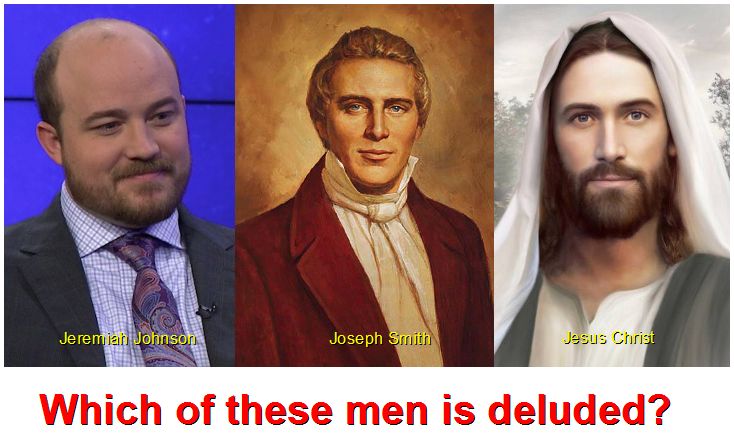
Take this guy, Jeremiah Johnson, a preacher/prophet/author from Florida who recently had a real live conversation with a demon:

On the night of May 30th, while praying and pacing over the United States in my home around 2 am, a demonic entity appeared right before me in an open vision. This type of encounter has only ever happened one other time while I was ministering in a foreign country in 2015. I have always engaged in this type of spiritual warfare while asleep and dreaming prophetically, but rarely if ever to this degree while awake.

This demonic entity had a visible and deep scar underneath its right eye, but it also had the ability to mutate or rather change forms. I watched this “being” morph several times right in front of me, yet the gash below its right eye remained.

As I see it, there are three options here. Either –

a) This really happened, or

b) Jeremiah made it up, or

c) It happened but entirely within Jeremiah’s disturbed mind

Can you advise me which it is? I’m leaning towards b) or c). I say ‘leaning’ when what I mean is I rule out a) entirely, though I’d be interested to know which conclusion the Holy Spirit is leading you to. (Actually, reading the comments following Jeremiah’s posting of his ‘Urgent Prophetic Alert and Warning’ on Facebook, I already know what 4 thousand of you think: you fall for this crapola hook, line and sinker.)

Of course, not all supernatural encounters are with demons. Sometimes your fellow believers have encounters with angels, or dead people from the bible. Here’s an example of that:

I kneeled down, and prayed, saying, ‘O Lord, what Church shall I join?’ Directly I saw a light, and then a glorious Personage in the light, and then another personage, and the first personage said [of] the second, ‘Behold this is my beloved Son, hear him’” 

Wow, that sounds amazing, doesn’t it? Joseph Smith recounting his first ‘vision’.

Again, you’ve got three options:

Either:

a) This really happened, or

b) Joseph made it up, or

c) It happened but entirely within Joseph’s disturbed mind.

If you’re a Mormon, the Holy Ghost will have led you to embrace option a). I lean myself towards b), possibly c). If you’re an evangelical Christian, however, you probably think Smith’s vision was demonically inspired. Can I ask you why you think this? Is it because that’s what your version of the Holy Ghost tells you? Ain’t it amazing how ‘he’ always confirms what you already believe?

With that in mind, let’s look at one final example:

When Jesus stepped out of the boat, a man out of the tombs with an unclean spirit met him. He lived among the tombs; and no one could restrain him any more, even with a chain; for he had often been restrained with shackles and chains, but the chains he wrenched apart, and the shackles he broke in pieces; and no one had the strength to subdue him. Night and day among the tombs and on the mountains he was always howling and bruising himself with stones. 

When he saw Jesus from a distance, he ran and bowed down before him; and he shouted at the top of his voice, “What have you to do with me, Jesus, Son of the Most High God? I adjure you by God, do not torment me.” For he had said to him, “Come out of the man, you unclean spirit!”  Then Jesus asked him, “What is your name?” He replied, “My name is Legion; for we are many.”  He begged him earnestly not to send them out of the country. Now there on the hillside a great herd of swine was feeding; and the unclean spirits begged him, “Send us into the swine; let us enter them.” So he gave them permission. And the unclean spirits came out and entered the swine; and the herd, numbering about two thousand, rushed down the steep bank into the sea, and were drowned in the sea. (Mark 5.1-20)

Either:

a) This really happened, or

b) Mark made it up, or

c) Mark made it up but it’s a metaphor for something or other.

I’m guessing most of you, including those who regard yourselves as rational Christians, opted for a): you think this really happened in some form. Why? Because this time it’s your hero, Jesus, who’s involved.

However, and this is my point, Jesus’ encounter with a demon – and it’s not the only one in the gospels – is no different in kind from Jeremiah Johnson’s or Joseph Smith’s. If you believe one really happened – the Jesus one – you really haven’t any reason not to believe the other two. And yet, my Christian friends, you reject at least one of the other two, don’t you. You dismiss Smith’s encounter with God and Jesus as, at best, a delusion and at worst, a fiction intended to dupe others. You may, as I’ve suggested, see it as demonically inspired (even though no actual demons appear, unlike in the Jesus and Johnson accounts.)

You may also, if you’ve half a brain, dismiss Johnson’s ridiculous story too. I hope so. So why persist in believing that Jesus met with demons? It’s not the Holy Spirit who convinces you that this story is the only plausible one of the three. The Holy Spirit is only as real as Johnson’s morphing demon. No, the only reason you give Jesus a free pass, but not Smith or Johnson (possibly), is that the Jesus story is in the bible.

So, what’s the answer to the question at the top of this post: which of those men, Jeremiah Johnson, Joseph Smith and Mark’s Jesus, is deluded? The answer is… all of them. And at least two of them are frauds.

Myself, I’m leaning towards all three.


The many and varied, Spirit-inspired interpretations of the Kingdom of God

Blog406Heaven

For the Son of Man is going to come with his angels in the glory of his Father, and then he will repay each person according to what he has done. Truly, I say to you, there are some standing here who will not taste death until they see the Son of Man coming in his kingdom” (Matthew 16.27–28).

Truly I say to you, this generation will not pass away until all these things take place. (Matthew 24.34)

See also Matthew 24.27, 30-31; Luke 21:27-28, 33-34; 1 Corinthians 15.51-52; 1 Thessalonians 4.15-17; 1 John 2:17-181; Peter 4.7

The Kingdom of God. What does it look like? When will it happen? Has it happened? You’d think that with the Kingdom of God being a central part of Jesus’ teaching, the central part, in fact – his ‘good news’ is about nothing else – that these would be questions Christians would find easy to answer.

They don’t. The Holy Spirit inspires a variety of incompatible responses from the faithful to the what, when and where questions. The most popular is, of course, that the Kingdom of God equates with Heaven: the saved are all going to heaven when they die. Post-mortem bliss, most Christians would tell you, is what Jesus meant by the Kingdom of God. After all, doesn’t Matthew refer to the Kingdom as the Kingdom of Heaven? Yes… but no: an after-life in Heaven is not what Jesus and his scriptwriters meant by the Kingdom. If it was, they would have said so, rather than promising, as they do, that God’s Kingdom was coming to the Earth real soon.*

So, when Jesus says the kingdom is just around the corner, which he does repeatedly in the synoptic gospels, he can’t have meant Heaven. Let’s try another favourite: Jesus meant that God’s Kingdom on Earth would manifest itself thousands of years in the future – in our time, no less. It’s all to do, you see, with Jesus’ return and the final judgement. As these have yet to happen then the final part of God’s plan – his reclaiming of his creation – will be in the (far) future too. A neat solution to be sure, but one that runs counter to everything in the gospels and in Paul. Admittedly it’s an idea that was taking shape in 2 Peter (3.8), a forgery written about 150CE, long after it had become apparent the Kingdom was running way behind schedule. However, you won’t find it in the synoptic gospels or the Pauline epistles because it isn’t what Jesus, Paul, the gospel writers or the earliest Chrsitians believed.

Where does this leave Jesus’ devotees today? With a Jesus who didn’t really mean the Kingdom would be manifesting itself in the physical world. This Jesus proclaims the Kingdom as something that exists inside his followers as an internal state of being. It’s true some of his pronouncements appear to fit this interpretation; the Kingdom is within you and all that, but what these statements are about in context is the Kingdom’s immanence at the time; what Jesus was saying was, ‘the Kingdom is arriving now; look at the signs – it’s all around you.’ A gnostic flavoured restructuring of what he actually claimed is yet another Spirit-led interpretation we can dispense with.

Consequently, some Christians accept that, yes, Jesus preached a Kingdom that would dramatically materialise in the real world close to the time he was speaking. That it didn’t in any observable way creates a dilemma: as God Incarnate, perfect and infallible, Jesus can’t have been wrong. This must mean the Kingdom did arrive when he said it would and we are living in it now. The Kingdom, these Covenantists say, is another term for the Christian era; the reign of the church, the Age of the Holy Spirit. We’re living in the Kingdom and have been for two thousand years!

How’s that working out?

Blog406Riot

Blog406Pollution

Blog406Bury

Blog406Starve

Yes, this looks exactly like the Kingdom of God Jesus promised: An eternity of peace with death and illness banished and the meek having inherited the earth; the social order reversed, God in charge and Jesus and his pals running the show. Or not.

So, however the faithful (re)interpret his words, however much they twist, cherry-pick or just plain ignore them, Jesus was wrong. The Kingdom of God did not arrive on the earth in the first century as he predicted. It’s definitely not here now. It won’t be coming in the future and it doesn’t await in an after-life; these were never the deal. (See my earlier series, Making Excuses for Jesus, for more detail.)

Whatever Christians do, wherever their imaginary Holy Spirit leads them, they end up with implausible and incompatible ways of explaining (away) the non-arrival of the Kingdom of God that Jesus promised. It’s a fallacy, a fantasy, another delusion sustained by the wilfully ignorant.

*John 18.36 does have Jesus say that ‘his’ Kingdom, as it’s become by the time of the fourth gospel, is not of this world. John, however, bears little relation to the other gospels and was written at least 70 years after Jesus lived. In any case, it doesn’t say or mean that common-or-garden believers are going to Heaven when they die.

God: more reasons why not

Blog403

The third reason it’s unlikely God exists (see the previous post for the first two) is that he is a mass of contradictions; omnipotent and yet vulnerable to his creation’s ‘sin’. Loving yet unable to stop himself from meting out savage justice. Interventionist yet conspicuously absent when actually needed. Distant and mysterious and yet intimately involved with a select number of humans. Oblivious to the thousands who starve to death each day yet overly concerned with how others dress, spend their money or have sex.

The God of the Bible is everything a badly conceived character in a third-rate novel might be. Not surprising really, when that’s what he is. The all-too-human authors of that most mixed, muddled and deplorable book creating and recreating him in their own image, modifying and evolving him until he is a transparently human creation. He is a product of their misinterpretation of reality, wishful thinking and vindictiveness, human traits he reflects throughout the so-called ‘holy book’ and in his church throughout history.

Four, God is ineffectual in the real world. He demands the love and devotion of his creation and gives next to nothing in return. Warm fuzzy feelings possibly, and a ludicrously nonsensical ‘salvation’ plan that undercuts his supposed omnipotence. That’s it. That’s all he offers. Oh, and eternal life spent as an automaton, forever worshipping him. Nothing in the here and now. Nothing to alleviate poverty, feed the starving, eliminate disease or rescue us from viral pandemics. He doesn’t even do this for those whom have pledged allegiance to him, however much they claim he has or will do. This leaves us with two options: he is either an absolute failure or he doesn’t exist. I conclude the latter.

Five: Jesus. Jesus is the prime evidence there is no God. Not one of the claims Jesus made for God was realised. God doesn’t answer prayer; he doesn’t give whatever is asked of him (Mark 11.24; Matthew 21.22); he didn’t bring his kingdom to the earth in the first century (Luke 9.27; Matthew 24.29-31 & 34); he didn’t set Jesus and his disciples up as rulers of the world (Matthew 19:28). In short, he didn’t do a damn thing his supposed son said he would. Jesus was sadly mistaken, deluded, about his Father. In terms of delivery, Jesus’ God did nothing for him, nor for those, like Paul, who came after him. The New Testament is nothing but testimony to its own failure, its God mere make-believe.

To be continued, again. I mean how many more reasons can there be that demonstrate God is unlikely to exist?

Jesus: best social distancer ever

Jesus is coming back. He’s coming back soon! The Covid-19 pandemic is a sign of the end times and it won’t be long now till Jesus returns to rapture all his buddies!

I know this because a whole load of cranks pastors are telling the world that, once again, the end is nigh. 56% of U.S. pastors polled believe it’ll be real soon with 97% convinced that if not now, then in the near future.

In reality, Jesus is never coming back. He might appear to predict his return in the gospels but he said it would be soon relative to those who were listening to him. True, he didn’t appear to know exactly when it would be because his Father hadn’t deigned to tell him (weren’t he and the Father one?) but he did know it was soon:

Truly I tell you, some who are standing here will not taste death before they see the Son of Man coming in his kingdom (Matthew 16:28).

Truly, I say to you, this generation will not pass away until all these things take place (Matthew 24:34).

I don’t believe Jesus said this at all. His mission while he was alive was to kick-start God’s kingdom on Earth and to right the wrongs done to his own people, the Jews. He didn’t expect to die when he did (he didn’t predict his death either) but right up the last minute thought God would intervene, rescue him and set him up as King of the world (Matthew 19.28). All of this is preserved in the synoptic gospels.

Once everything had gone disastrously wrong, his followers had to make sense of his premature death. So followed the stories of a resurrection, based on grief-induced visions and fuzzy feelings. Once these faded, his early followers became convinced this wasn’t – couldn’t be – the end of the story. Jesus had to come back to complete his mission. The newly converted Paul thought so too: Jesus’ death wasn’t the end; his resurrection wasn’t the end – it was the beginning; when Jesus came back down from Heaven he would resurrect his followers and the Kingdom of God would arrive. Paul believed this would happen in his own lifetime (1 Thess 4:15-17)

When the gospels came to be written decades later, Jesus himself was made to say much the same thing. Like a 1st century Arnold Schwarzenegger, he promised he’d be back. But Jesus wouldn’t have said this. He had no intention of going away until his mission – to bring about the Kingdom of God on Earth – had been completed. Subsequent believers, including the gospel writers, knew with the benefit of hindsight that this mission hadn’t gone to plan. Consequently, they rewrote the plan. Jesus, having risen from the dead (or so they believed) would be returning to complete his mission. They then retrospectively supplied him with foreknowledge not only of his supposed return but of his execution and resurrection too. The predictions of a second coming were put into Jesus’ mouth by later believers; the gospel writers specifically.

They were wrong. Jesus did not return when they hoped, which is hardly surprising for any number of reasons: the dead don’t come back to life; Jesus himself didn’t promise he’d return (neither the first time nor the second); beliefs, however resolutely held, do not create reality.

The Jesus story would now be over and done with if it were not for Paul re-interpreting into something it wasn’t; substitutionary atonement designed for Gentiles as well as Jews. Jesus failed to inaugurate the Kingdom of God on Earth (no surprise there); he didn’t rise from the grave; he’s not coming back. Believing won’t make it so.

Happy Easter y’all.


The disciples who doubted the Resurrection

Now the eleven disciples went to Galilee, to the mountain to which Jesus had directed them. When they saw him, they worshiped him; but some doubted.

Matthew 28.17

On his Escaping Christian Fundamentalism blog recently, Gary Matson looked at this verse in which the remaining disciples supposedly encounter the risen Jesus. Gary discussed why they should have doubted what they are reported as witnessing, concluding that what they were actually ‘seeing’ was a ghost. A commenter called Rachel, who has also commented here, objected, arguing that the verse didn’t mean what it actually says. I responded with the following:

Well, let’s not, Rachel, accept what the text actually says. Let’s impose our own meaning that fits with what we want to believe. Then we can insist that none of the 11 doubted, even though the text clearly states they did. Let’s supplement that particular sleight of hand with the unproven myth that all the disciples except one subsequently died for their faith (even though there’s no evidence they did and even though we know nothing about the actual beliefs of the few who may have been martyred and even though zealots today are prepared to die for their beliefs despite never having seen the risen Jesus) and, hey presto, Gary’s hypothesis is disproved.

Except, of course, it isn’t. The resurrection accounts were written 40 years or more after the supposed event by people who weren’t there; and yet still they preserve the inconvenient fact that some of the disciples remained unconvinced by the visions and apparitions others of their number thought they’d experienced.

Rachel came back with this (my responses are in red with additional comments in blue).

Neil, you write the following as if you know for a fact (100%) that “there’s no evidence” — “(even though there’s no evidence they did and even though we know nothing about the actual beliefs of the few who may have been martyred and even though zealots today are prepared to die for their beliefs despite never having seen the risen Jesus)”

If I understand Rachel here, she isn’t happy I can’t prove a negative. However, if there’s no evidence, there’s no evidence. This in itself is a fact.

Neil, none of the 11 apostles/disciples of Jesus lied and died and convinced their families and loved ones to die for a fictional character. Unlike you and Gary, they literally saw the resurrected Jesus (that was enough evidence for them) and they spread the gospel (the good news of the Promised Messiah and that in Him the Old Testament pointed)

You’re right, Rachel, we have no evidence that any of them did any of this. This was the point I was making: there is no historical evidence whatsoever that indicates 10 of the 11 died for their belief in the resurrection. With the exception of James we simply don’t know how, when or why they died. I’m sorry you were unable to grasp this point.

Neither is there evidence ‘they literally saw the resurrected Jesus’. In fact, the only evidence there is, in the gospels, is sketchy, inconsistent and strongly suggestive of visions and apparitions, as Gary suggests. The only eye-witness report we have of the resurrected Jesus, that of Paul, is precisely of this nature, with Paul claiming the other sightings of Jesus were the same as his.

You say that “zealots today are prepared to die for their beliefs despite never having seen the risen Jesus.” Care to give me examples of Christian Zealots today “prepared to die for the risen Jesus” sight unseen?

Are you really questioning whether zealots today are prepared to die for a character they’ve never actually seen? A simple Google search brings up numerous Christian sites, either celebrating or lamenting this very fact. Here’s one to start you off: https://www.opendoorsusa.org/christian-persecution/stories/11-christians-killed-every-day-for-their-decision-to-follow-jesus/

And like Gary, there you go saying: “we know nothing!” Okay, I will agree with you and Gary, both of you have convinced me totally -— you guys know nothing! You will no longer get any argument from me! You guys know nothing! I am now fully convinced by your: “We (Gary and Neil) don’t know” true statement.

While I didn’t point it out to her, Rachel here assumes that acknowledging ‘there is no evidence for..’ means the same as ‘we know nothing’. A very basic and disingenuous error.

Ironic isn’t it, Neil, you do not believe the New Testament accounts as historical events, and yet you like Gary proceed to prove your case by using “fictional” accounts! Go figure!

Gary and I look at the texts as they are and draw our conclusions accordingly. We, like many others outside the evangelical bubble, acknowledge that the gospels are literary creations and as such are historically unreliable. The evidence they present for an actual, physical resurrection is weak, inconclusive and distorted beyond recognition by an agenda intended to promote belief – as they themselves admit.

You, on the other hand, argue entirely from a position of faith, which prevents you from seeing what is actually there, making you dismissive of external evidence and compelling you to supplement your arguments with assumptions (for example, that most of the disciples died for their belief in the resurrection.) It also prompts you to add unnecessary ad hominem insults. I’m sure Gary is as glad as I am that you’re slinking away in defeat.

Some of the disciples doubted that what they were seeing – apparition? bright light? hallucination? – was really Jesus returned from the dead. It may be the case that this detail was included by the creator of Matthew’s gospel, 50 years after the event it describes, to disparage the favoured disciples of other early Christian communities. The disciples they looked to weren’t as good as those of Matthew’s cultists because they doubted. Who knows. Whatever the reason for including it, the verse is awkward and embarrassing for believers today. How to explain it (away)? Even some of those who ‘saw’ the risen Jesus weren’t convinced it was him. They were right. It wasn’t.


God or Superman?

Blog397

An early problem faced by the creators of Superman, only a few years after his first appearance in Action Comics #1 in 1938, was his impotence in the real world. Here was a character with incredible super-human powers – not quite as phenomenal as they would later become – who could defeat gangsters, wife-beaters, bullies and evil dictators with a flick of his little finger, but who, when a real life bully emerged on the world stage, couldn’t do anything. Stories could have been written about how he single-handedly defeated the Nazis and restored world peace but none of this would have been reflected in the real world. It’s true that today with its alternate realities and constant rebooting that Superman could be made to defeat modern-day fascism; but that would be on some other fictional Earth, not the real one. In the real world, Superman would remain impotent, having little effect beyond raising awareness and morale, which is what he did – or, more accurately, what his creators had him do – during World War II. There wasn’t anything else he or they could do.

By now, coronavirus should really have disappeared from the face of the Earth. Last Sunday was National Day of Prayer in the US. Independent of Donald Trump’s ‘initiative’ in calling for a day of grovelling in front of the Almighty, many other Christians have also been begging God to protect their church community from covid-19 (the godless can fend for themselves). Still others have commanded the virus, in the name of Jesus, to leave them and the USA alone (the rest of the world be damned.)

The effect of all this pleading and commanding has been that the coronavirus has continued to spread, heedless of borders and indifferent to the religious beliefs of its victims. Either God doesn’t give, as we say in this neck of the woods, a rat’s arse about who contracts covid-19, nor who dies from it, not even his born-again Chosen Ones. Everybody’s gotta die sometime, right? The important thing is that they’re right with the Lord before they do.

Or – God’s just like Superman. We can imagine him doing all sorts of incredible things, like healing disease, curing illness and saving the world, but in reality, none of them ever happen. He’s not going to protect people from coronavirus in precisely the same way he failed to protect them from 9/11, AIDs, the Holocaust, Spanish Flu, The Great Plague, Black Death and Leprosy. It’s not that he doesn’t care, it’s that he’s not there. He’s no more real than Superman and is every bit as impotent as the Man of Steel.

I’m a big fan of Superman – I’ve been reading the comics he appears in for 57 years now – and I’m fully aware he’s not real; he was created by Jerry Siegel and Joe Shuster 82 years ago and has been embellished by every writer and artist who’s worked on him ever since – much like God. If only those who plead with the Almighty, and worse, tell the rest of us what he thinks of us, would recognise that he is fictional too. He exists only in a fantasy realm, outside of which he has no super-powers, no influence, no ability to save us from coronavirus or anything else.

Remember the sequence in the Simpsons episode where Homer is, as usual, in lots of trouble; he looks to the sky and pleads, ‘I’m not normally a praying man, but if you’re up there, please save me… Superman.’ That’s exactly what Christians are doing right now, and the result will be the same as it was for Homer and for everyone else who’s ever called on Superman God to save them.

The Darkening Age

Blog393

I’ve been reading Catherine Nixey’s The Darkening Age: The Christian Destruction of the Classical World. I highly recommend it.

Its sub-title says it all. The early church’s determination to destroy any way of life, any belief system or enterprise that it didn’t agree with was deliberate, systematic and brutal. It set out to eliminate the forms of worship, culture, learning and social norms in which it found itself. It did this initially by demonising, literally as far as it was concerned, the opposition. If it wasn’t Christian then it was demonic; ancient religious beliefs especially, but also schools of philosophy, science, education, the theatre, dancing and sexual mores.

As it grew in power, the church went from holding its ‘heathen’ neighbours’ views as suspect to actively and violently opposing them, destroying temples, toppling and mutilating statues of the old gods, razing to the ground historic buildings they considered ‘demonic’. Those they regarded as ‘pagans’ were compelled to convert to the new religion. According to the Christian propaganda of the time, these pagans turned to Jesus with joy in their hearts, once shown the error of their demonic ways. What choice did people have? It was either that or lose everything they held dear.

Once Christianity became the state religion under Constantine, religious authorities legislated against other philosophies and beliefs. As the Justinian code put it, ‘we forbid the teaching of any doctrine by those who labour under the insanity of paganism.’ Free thinkers could be arrested and have their possessions, including their homes, Blog393aconfiscated. They could be imprisoned for believing and saying things that ran contrary to Christian orthodoxy. Their works were burnt, often on public pyres, and that which survived was frequently written over with pages of scripture. Soon, however, even this wasn’t enough. It became a capital offence to subscribe to alternate beliefs, to write or teach about them. Similarly, same sex activity became outlawed and punishable by death. No wonder the philosophers of the day called Christianity ‘the tyrant’.

In 392, Christian mobs destroyed the magnificent temple of Serapis in Alexandria. The Great Library in the same city had disappeared by then too, quite possibly at the hands of Christian mobs. Hypatia, one of the Library’s greatest mathematicians, was degraded in the street and then murdered. (You may have seen the 2009 film Agora where Hypatia is played by Rachel Weisz; if not you definitely should.)

By AD500, the church had successfully and completely eradicated the opposition. The culture that had preceded it had gone; its knowledge, mythologies, philosophy together with the ability to think freely and to criticise – all consigned, if not to hell, then to oblivion. Nixey reports that 90% of classical literature is lost forever (p246), including almost all Greek writing from the ancient world. As John Chrysostom boasted, the writings of the Greeks ‘have all perished and are obliterated’ (p245). From the little that survives we know that Greek philosophers had postulated that the world was made from atoms and didn’t have a beginning as such. They had also developed a form of evolutionary theory (pp35-36). It would take the world 1500 dark years to catch up with these suppressed ideas.

The elimination of Christianity’s opponents was carried out in the name of the man who supposedly said, ‘love your enemies and pray for those who persecute you’ (Nixey points out that the persecution of Christians was greatly exaggerated; many early believers aspired to martyrdom and the church undoubtedly meted out more persecution than it received.) It was done to bring the world into line with the way they thought God had decreed it should be:

That all superstition of pagans and heathens should be annihilated is what God wants, God commands, God proclaims! (‘Saint’ Augustine)

Thank Enlightenment we can’t, in the west at least, be executed these days for our beliefs and philosophies. And whatever became of Christians? Those who oppose anything in their culture they consider contrary to their tyrannical views, who would punish, perhaps execute, sexual non-conformists and who regard other belief systems, atheism especially, as demonic. The same believers who would eagerly take us back to the demon infested dark ages.

They’re still with us of course and have, in the UK where I am and certainly in the United States, a disproportionate amount of influence and power. We must be grateful they are moderate, reasonable people who wouldn’t hurt a fly.

Aren’t they?

Bathwater

Blog392

While putting together the ‘Can You Be a Christian and…’ series, I encountered on more than one occasion the line of reasoning (I use the term lightly) used by moderate Christians that, essentially, certain parts of the Bible are no longer relevant. So you can, they said, be both a free thinker and a Christian; you can be gay, so long as you disregard what the bible says about homosexuality; you can be a Christian woman if you dismiss Paul’s denigration of women; you can acknowledge evolution provided you reinterpret what the bible says about creation; you can be a realist if you ignore the bible’s supernaturalism.

But if you’re going to disregard anything the bible teaches that appears incompatible with what we know about psychology, sexuality, biology and reality, then how does the Bible’s central objective truth, as one commenter on here calls it, survive? What makes its core message (that, in some way, Jesus’ death and resurrection is capable of saving humankind) an immutable, eternal truth, while almost everything else can be compromised, deemed to be ‘culture-bound’ and metaphorical, to the point of irrelevance?

I recognise, of course, that fundamentalist Christians don’t do this. For them the bible is inspired, infallible and immutable. They’re prepared to compromise themselves, science and reality in order to honour and preserve what the book says. For them evolution, feminism, homosexuality and independent thinking will always be wrong. The alternative is to acknowledge that the bible doesn’t get everything right and to take the approach of the liberal progressive Christian who is prepared to adjust and adapt what it says; to emasculate it.

Which brings us back to asking where this process stops. If progressive Christians are prepared to dilute to the point of meaninglessness what the bible has to say about creation, women, sexuality and reality itself then why not what it teaches about Jesus and salvation?

It’s a fact that almost all varieties of the Faith, including fundamentalism, are happy to ignore completely Paul and Jesus’ teaching that the Kingdom of God was due to arrive, in all its glory, in their own time. It’s the same with Jesus’ moral extremism (giving to all who ask, loving enemies, turning the other cheek.) So why not the rest of it?

Why are Paul’s muddled theology and selected bits of the Jesus stories considered to be the baby while the rest of the bible is the disposable bathwater? On what basis do progressive Christians decide what is inessential and what is crucial, critical, indispensable? Ideas about angry deities, blood sacrifice, the sins of the people and the resurrection of god-men are every bit as culture-bound as the bible’s perspective on all those other issues.  

Because really, in the end, it’s all bathwater.


Can you be a Christian and … a Realist?

Blog391c

If you’ve been reading this series of posts, you’ll pretty much know how this one’s going to go. You can’t really be Christian if you have, as the old song goes, half a brain. Still, it won’t hurt to see how compatible faith is with reality as we know it. You never know, we might be surprised.

Speaking of songs, I always liked Billy Joel’s ‘An Innocent Man’ from the album of the same name. Of course, by Christian reckoning there’s no such thing as an innocent man, nor woman or child – no, not one – because all have fallen short and are worthy only of death (Romans 3:23 & 6:23). All the same, we’ll give Billy the benefit of the doubt. In a song of insightful lyrics, the lines I particularly like are

Some people hope for a miracle cure
Some people just accept the world as it is
But I’m not willing to lay down and die
Because I am an innocent man

Christians seem to have such difficulty accepting the world as it is. They’re constantly upset that the world, which I’m taking to be synonymous with reality, does not and will not conform to what they expect of it. And when it doesn’t, it’s the world that’s at fault, that has it all wrong.

When the evidence is presented for climate change and our contribution to it, some believers announce, with no hint of irony, that God will never let it happen. He’ll step in, just like he always does, to prevent it. So take that Australia with your bush fires, Java with your floods and all you polar bears with your melting icebergs: God’s got it all in hand.

When a Hollywood movie depicts a same sex couple in the background of a scene for a nano-second, the born-again are apoplectic about the world’s immorality. When two female performers wiggle their bits, Franklin Graham – arch-supporter of the Pussy-Grabber-in-Chief – has the hypocrisy to claim, ‘I don’t expect the world to act like the church, but our country has had a sense of moral decency on prime time television in order to protect children.’ Clearly he does expect the world to act like the church (which as we know is both spotless and sinless.) All these modern-day Jeremiah’s do.

Reality doesn’t, and won’t, conform to what Christians want it to be. So what to do? Either join with Graham and those other evangelicals railing pointlessly against reality, like Don Quixote and his damn windmills, or (and this a much more comfortable position to adopt) be like those climate change deniers and tell yourself that whatever sort of state the world is in, God will be step in any time soon to sort it all out. After all, this is what Jesus believed. He didn’t rant and rave about the state of things, brutal Romans and all, he just had a simple, smug faith that his Father was going to set everything right real soon and put him in charge.

Christianity demands that Jesus’ disciples deny the world; reject it, despise it. The faith has denial at its core, even of oneself. It demands reality be replaced with a fantasy version of the world.

As I’ve written before:

Christians, even moderate ones

Those older links could easily be replaced with up-to-date, reality-denying ones. This is what it’s like in the Christian bubble; with all this denial taking up space, there’s no room for accepting the world as it is, and trying to change what needs changing and improve what needs improving.

Again as I’ve said before, truth, reality and other people are the casualties of religion’s life-denying efforts at self-preservation. Fantasy and reality are just not compatible.

Can you be a Christian and… gay?

Blog391

No. You can’t. The church regards your gayness, your same-sex attraction, as sinful. If you act on your feelings you are, according to the bible, an abomination. You cannot enter the Kingdom of God if you have sex with someone who’s the same sex as yourself, not even if that’s within a committed, loving relationship:

…do you not know that wrongdoers will not inherit the kingdom of God? Do not be deceived: Neither the sexually immoral nor idolaters nor adulterers nor men who have sex with men (1 Corinthians 6:9)

Paul doesn’t mince his words in Romans 1:25-28 either:

…God gave them over to degrading passions; for their women exchanged the natural function for that which is unnatural, and in the same way also the men abandoned the natural function of the woman and burned in their desire toward one another, men with men committing indecent acts and receiving in their own persons the due penalty of their error… God gave them over to a depraved mind, to do those things which are not proper…

There’s no getting away from this: the bible is emphatic and unequivocal about how it views homosexuality and those who ‘practise’ it. There’s no ‘hate the sin, love the sinner’ here. Gay people are unnatural, degraded, indecent, dishonourable, wicked, unrighteous, sinful and more: this, Paul is clear, is how God sees it too.

Some people, however, want to be both; they’re gay and they also consider themselves to be Christians. They’ve answered the altar call/been born again/baptised into the family of God and have made a commitment to Jesus/God/the church in whatever way their particular ‘fellowship’ teaches they should. Now they’re faced with what to do about their sexuality, when the bible, and in all probability their church too, finds it abhorrent. What to do?

Not all Christians are alike, of course, and not all churches the same. Some, a scattered few, are gay affirming. They say it’s okay for you and your partner to be gay, they still welcome you and see your homosexuality as a cause for celebration: you can, they say, be gay and Christian. To do this, however, they have to find ways around what the bible says about homosexuality. So they argue that the condemnation of the Old Testament is no longer applicable and doesn’t, in any case, refer to committed same-sex relationships. They make the case that Paul is really only referring to temple prostitution and promiscuity, not to loving couples.

If they’re honest, they acknowledge that these are pretty weak arguments and resort instead to ignoring everything the bible says about homosexuality (which is actually very little) and find comfort in the fact Jesus himself doesn’t appear to have mentioned it.

There are several problems with this way of thinking:

  • If you’re going to ignore these parts of the bible, what else can safely be ignored? It’s a slippery slope, brethren, a slippery slope;
  • Dismissing the bible’s grave warnings about same-sex sex, doesn’t mean that they’re not still there;
  • you’re engaging in a form of collective cognitive dissonance in pretending they’ve somehow disappeared or are no longer applicable;
  • You’re out of step with most other branches of Christianity, nearly all of which noisily disapprove of homosexual sex, relationships and even “marriage” (note obligatory scare quotes.)

In any case, gay-affirming churches are few and far between. The chances of living close to one are remote. Chances are, you’re stuck with a common-or-garden church. Chances are it disapproves of you. Chances are it will want you to renounce your sexuality. But there’s good news! If you’ve been saved/washed in the blood of the lamb/baptised, it’s easy. Your sins are forgiven and you are a new creature: God/Christ/the Holy Spirit will free you from the shackles of same-sex attraction. Here’s how Paul puts it in 1 Corinthians 6:10-11:

And such were some of you (idolaters, adulterers, homosexuals, that is). But you were washed, you were sanctified, you were justified in the name of the Lord Jesus Christ and by the Spirit of our God.

So that’s it then. You can’t be a Christian and gay. The gay has to go.

That’s the Christian perspective anyway. I hope I’ve represented it fairly enough. I can’t help but feel there’s more to it than that, however. We’ll consider whether there is next time.