
Human Sacrifice

Swanson

Mesoamerican cultures would ritually kill other human beings to appease their gods. Thousands were sacrificed either willingly or under compulsion.

Thank goodness we have progressed beyond this. We no longer allow superstition to dictate that others should be deprived of their lives to curb gods’ anger and bless us instead.

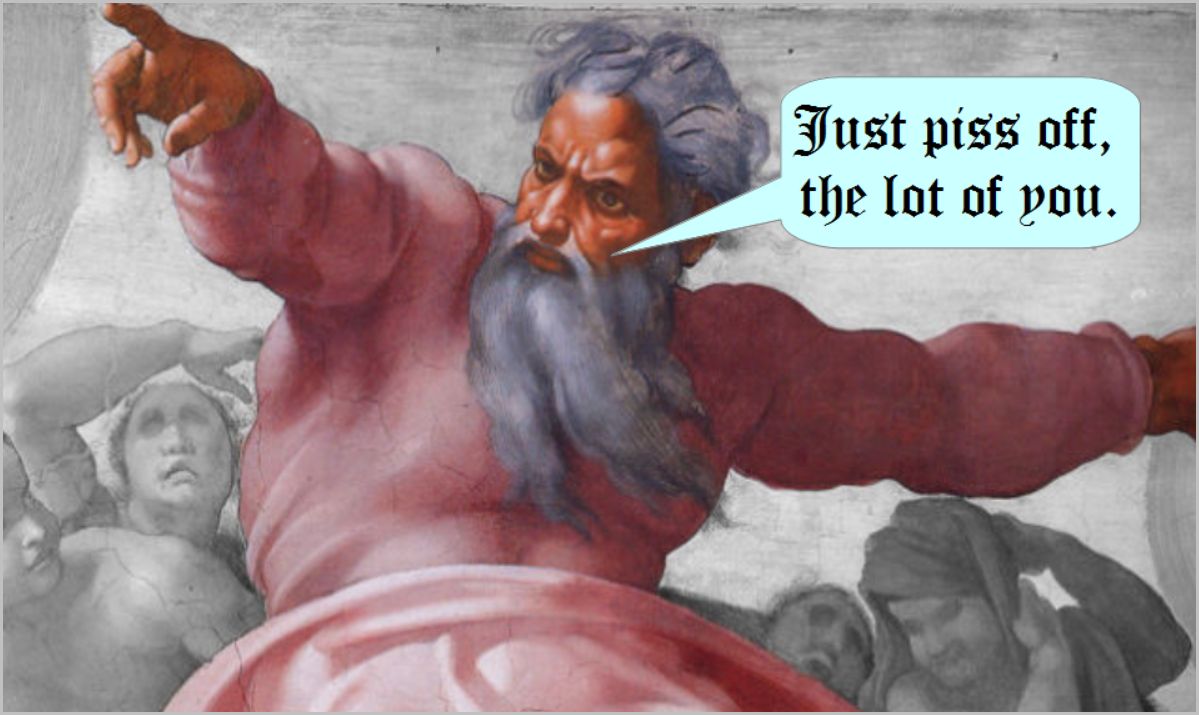
Unless we’re Christians like pastor Kevin Swanson, pastor Phillip Kayser, Ted Shoebat (loony name, loony guy!) and pastor Rob Gallaty, who call for the execution of LGBT people. It’s gay people, they say, who are bringing down’s God’s wrath on the world because of their wicked ways. Judgement, destruction and death shall surely befall us – or America, anyway, as that’s the only place God has any interest in – because of the gay peril. Unless homosexuals repent, they must be put to death. Only then is God likely to back off.

And just in case you think I might be misrepresenting them, here are those loving, gentle Christian folk to tell you all about it in their own words:

Swanson:

Homosexuals are worthy of death… It’s not so much an issue of the death penalty. It’s an issue of God’s judgement that’s hanging upon this nation today.

This, Swanson says, is ‘the gospel of Jesus Christ’ of which he is not ashamed.

Kayser:

And if we love our country and we don’t want to see God’s intense wrath falling upon it, we cannot ignore the abominations found in the radical LGBTQ movement. It is not just the sinfulness of homosexuality that is known, but also the justice of the death penalty for homosexuality.

In fairness, Kayser also wants the death penalty for breaking the Sabbath, blasphemy and cursing God publicly, publicly sacrificing to other gods and apostasy. He’s nothing if not fair-minded.

Shoebat:

The sodomite, the atheist, the fanatic feminist, the Muslim — all such must be deemed as criminals and enemies to civilization, for they war against the Faith, promote death and hate life…
They should be told to leave their wicked ways under coercion, and if that does not work, then death and strong suppression is the only solution.

Gallaty:

God said that the sins of the people had infected the very land in which they live. So what happens to people who engage in this activity, this sexual immoral activity? Go to Leviticus 20, God gives us the punishment for engaging in these sins… ‘If a man sleeps with a man as with a woman, they have both committed a detestable thing. They must be put to death. And their blood is on their own hands.’

These enlightened men, and others, advocate a return to primitive, barbaric practices like that of the Aztec and Mayan cultures that sacrificed humans to imaginary gods. They have much in common with ISIS and the Taliban too, who are also motivated by religion to murder others. Perhaps we haven’t made as much progress as we like to think.

With or without religion, you would have good people doing good things and evil people doing evil things. But for good people to do evil things, that takes religion.

Steven Weinberg

Talking Jesus

Harvest

The Church of England published its report, Talking Jesus, last week. It finds that, rather than interesting others in Jesus, Christians only put them off when they talk about him. What a dilemma! To evangelise or not when all it achieves is the opposite of what’s intended. Christians must feel their hands are tied.

Not that this will stop them doing it, more’s the pity. But why? What drives some Christians to talk about their beliefs at every opportunity? What makes them think others haven’t heard of Jesus already? Do they honestly think that in England and other places where the Anglican church holds sway, people have never heard of him? Let’s have that show of hands: if this is the first time you’ve heard about Jesus, raise you hand. Or admit to being a Jesus-virgin in the comments.

That’ll be no-one then.

Please – we know about Jesus! And, what’s more, most of us would be happy if we didn’t. While some feel duty-bound to treat him with respect (God knows why when they don’t do the same for Father Christmas or Julius Caesar) most recognise him for the myth he is and trust their instinct not to get involved.

Here in the West it’s almost impossible to escape him, especially as Christmas approaches. Church leaders, with free access to the media, burble on about him, Christian web-sites number in the hundreds of thousands, and songs about his miraculous, fabricated birth will soon be everywhere. At any time of year, armies of street preachers invade our town centres, shouting about how we all need him, while Jehovah’s Witnesses hawk their version at a front door near you. And if we’re really unlucky, a friend or colleague will feel it their duty to tell us all about him at work or school or in the pub.

But, Christians, this isn’t how you’re meant to ‘make disciples of all the world’. The Jesus of the gospels (though that should be ‘Jesuses‘, plural) tells his followers how it should be done. Not by ambushing others to tell them how much they need him but by letting your lights shine (Matthew 5.16). Your ‘good deeds’ and sacrificial love are what should mark you out and impress others; Jesus says so himself. Actions, not words, are how to demonstrate your faith in him, if that’s what you feel you must do.

But they don’t, and that’s why we’re not interested when you’re subjecting us to your fantasy and dogma. If you lived the life – the really radical life Jesus advocated – forsaking wealth, spending yourself on others, going the extra mile, turning the other cheek, giving and forgiving, loving everyone sacrificially – then we might just be persuaded there’s something to this Jesus cult after all (then again we might not). As it is, talking the talk without walking the walk, is – how does the Bible put it? – just the empty noise of clanging cymbals.


You’re not as saved as you think

God2So now you’re a Christian. You’ve listened to the street preacher or that Christian at work and you’ve accepted Christ. You’re saved and going to Heaven when you die.

Or are you? You’re not going to Heaven that’s for sure, because Heaven isn’t on offer – as we saw here, the Bible doesn’t promise an eternal life in Heaven. But are you even saved? Has ‘the most important decision of your life’ really made you one of God’s own?

If you think you’ve chosen God, you’re wrong. You don’t choose God, he chooses you (or not, as the case may be). And if he hasn’t chosen you, then any decision of yours is of no consequence. You can shout all you like about how you’re now saved, born again and a follower of Jesus but if God says you’re not, then you’re not.

How do we know this? Because the Word of God™ says so:

Blessed be the God and Father of our Lord Jesus Christ, who has blessed us in Christ with every spiritual blessing in the heavenly places, just as he chose us in Christ before the foundation of the world to be holy and blameless before him in love. He destined us for adoption as his children through Jesus Christ, according to the good pleasure of his will… (Ephesians 1. 3-5)

In other words, you’re only saved if God decided you were going to be right back at the beginning of time. And if he didn’t, well, you can talk the talk and even walk the walk, but it will all be for nothing.

Jesus too is quite clear that it isn’t up to you whether or not you’re one of God’s chosen few. Here he is the middle of one of his tiresome parables about the Kingdom of God, where the King has told his slaves:

“Go… into the main streets, and invite everyone you find to the wedding banquet.” His slaves went out into the streets and gathered all whom they found, both good and bad; so the wedding hall was filled with guests. But when the king came in to see the guests, he noticed a man there who was not wearing a wedding robe, and he said to him, “Friend, how did you get in here without a wedding robe?” And he was speechless. Then the king said to the attendants, “Bind him hand and foot, and throw him into the outer darkness, where there will be weeping and gnashing of teeth.” For many are called, but few are chosen. (Matthew 22.9-14)

So, how do you know if you’re one of the special few hand-picked by God himself and not just one of those poor suckers who’s been invited along only to be thrown out? You don’t. Your capricious God won’t tell you till after you’ve died and you meet him face to face. There’s every possibility you’ll find out then that you’re not saved, because only a few of those called actually are. And then where will you be? Hell, that’s where. You’ll be no better off, according to the Bible anyway, than those who’ve not been duped by all of this nonsense.

So, you can believe all you like that God loves you. You can make all the right noises, study your Bible, pray, imagine you hear God’s voice in your head, go to church, sing the right songs and defend God’s standards, but there’s still a very good chance you’re not saved.

Jesus again:

Not everyone who says to me, “Lord, Lord”, will enter the kingdom of heaven, but only one who does the will of my Father in heaven. On that day many will say to me, “Lord, Lord, did we not prophesy in your name, and cast out demons in your name, and do many deeds of power in your name?” Then I will declare to them, “I never knew you; go away from me, you evildoers.” (Matthew 7.21-23)

But don’t worry, you were never ‘saved’ in the first place, nor lost, nor in need of Jesus; none of this mad fairy tale is real. Your only mistake – and it was a big one – was to think it was.

You’re all sinners!

BabyYou are a sinner. You deserve the wrath of God. After you die, you will meet God face to face and because of your sin he will throw you into the pit of hell for all eternity. But repent of your sin and believe the gospel and instead he will cast your sin away from you, as far as east is from west.

Or so said the street preacher in the centre of town at the weekend (yes, our old friend Dale McAlpine; he who suffers excessively from religion-virus).

I’m not a sinner. And neither, dear reader, are you. Sometimes in my life I’ve behaved badly, it’s true. I’ve hurt other people, though usually unintentionally, and I’ve been thoughtless. I’ve been unappreciative of loved ones and haven’t done enough for others. I’ve said things I shouldn’t and have occasionally lost my temper. I’ve even had sex when it wasn’t for making babies.

Maybe you’ve done similar things and, like me, have transgressed the moral law (which is entirely of human making) in all of these minor ways. Others have transgressed it, and the societal laws it gives rise to, in far worse ways, by deliberately hurting or abusing others, raping and murdering.

But still neither they nor us are sinners. Whether we have behaved reprehensibly or only a little thoughtlessly, we are still not sinners. We are human and we behave as humans behave; as evolved apes our developed brains jostle with animal natures, and we act as our distinct environments have taught us. ‘Sin’, on the other hand, is a distinctly religious concept, a component of a fantasy perspective of life with no purchase outside of its religious context. The problem with it is, however, that it has intruded for the best part of a two thousand years into reality, into life as it is lived by most people most of the time, and we’ve grown used to it. We give it credence when it’s talked about or preached from pulpit or soap box. But it is a meaningless concept.

The word for sin that is used most frequently in the New Testament (221 times) is ‘hamartia’, an archery term meaning ‘to miss the mark’. It means not being as good as we could be; not coming up to God’s standard: ‘for all have sinned and fall short of the glory of God,’ as old wingnut Paul puts it in Romans 3.23. And this is the secondary – some would say primary – application of the idea of sin; it denotes our separation from God. The thinking behind this idea goes as follows: there must be a reason God always seems so distant, remote, far away, elusive and absent from us. And because he’s God and so wouldn’t behave in such a cold-hearted way if we didn’t deserve it, it can only be our fault. His distance, therefore, can only be because of sin, our failure to behave and be, from the moment of our birth, as he would want us to. Yes, sin really is God’s kryptonite and, according to Christian doctrine, Jesus came to be the lead lining that blocks its rays.

But this is an unnecessarily convoluted way to account for the perceived divine distance. It is much better explained by God’s existential and literal absence. It’s not our fault he’s so far away – or rather it is, but not because we sin. In our childish need to have someone out there who both explained everything and cared for us, we made him up. We anthropomorphised an insentient, indifferent universe, which could only ever lead to a God who felt distant and remote.

So, as Dale was recommending on Saturday, free yourself from ‘sin’. Recognise that you don’t fall short of the glory of God, because no such thing exists, and that you behave as you do because you’re human. And then you will be free indeed.

Loose Threads

FamilyPick a thread. Any thread. And start pulling. Gently does it, no need for force. A gentle pull on any of the loose ends of faith and the whole fabric will come apart quickly.

Here, pull on this one marked ‘the infallibility of the Bible‘. See how easily it comes loose as soon as you realise that most of it, Old and New Testament alike, was written long after the events it purports to describe, some of it by imposters and forgers.

Or this one – the salvation thread, much of it stitched into place by an excitable chap prone to hallucinations. Pull it and see how its pattern is nothing like the one proposed by the man it claims to be about.

Pull the magic threads, the ones about Gods, supernatural beings, heaven and hell, eternal life. Watch them disintegrate in your fingers once they’re teased out into the real world.

Take hold of the threads about Resurrections, Second Comings, Raptures and Judgements; so fragile, these break away as soon as they’re touched. The only miracle is that they’ve lasted this long.

Then there’s the promises threads, about how believers are going to do fantastic miracles and heal the sick and raise the dead. Imaginative and colourful, these have never really fitted in.

Then there’s the prayer threads, whose embroidery tells us how prayer works, how God will give us whatever we ask for. Downright embarrassing, these – yank ’em out.

And how about the strands that those who say they love the cloth pick out themselves and throw away? You know the ones; the threads which tell them how to live their lives that they just don’t like the look of and think spoil the overall effect. These have definitely got to go.

What about the threads that weren’t originally there – the ones about ‘defending God’s standards‘ and having a ‘relationship‘ with a dead person? These grubby, greasy threads have been added in to replace the ones those who love the cloth have pulled out for themselves.

Choose any number of other threads – the ones that clash with other bits of the pattern, the ugly brutal ones, the fantastic, the ignorant – and give them a tug. Oh, look. They come away too.

And before you know it, the entire fabric has come apart in your hands. All that’s left is a pile of worthless, brittle threads, good for nothing but throwing in the bin.

Is there anybody out there?

KenAnyone searching for extra-terrestrial life – NASA, SETI and so on – can stop now. We know definitively that there isn’t any out there. How do we know? Because Ken Ham says so. The Bible – Genesis specifically – doesn’t mention life on other planets so that means there isn’t:

(T)he notion of alien life does not square well with Scripture. The earth is unique. God designed the earth for life. The other planets have an entirely different purpose than does the earth, and thus, they are designed differently… where does the Bible discuss the creation of life on the “lights in the expanse of the heavens”? There is no such description because the lights in the expanse were not designed to accommodate life [this is utter gibberish; life within stars? Who has ever suggested that?] God gave care of the earth to man, but the heavens are the Lord’s. From a biblical perspective, extraterrestrial life does not seem reasonable.

But hang on a minute! The Bible doesn’t mention other planets, never mind whether there’s life on them. It doesn’t tell us anything about cultures outside of a small area in the Middle East, doesn’t mention the Americas or Australasia, doesn’t have anything to say about microbes, anti-biotics, computers or technology in general. It must follow, therefore – to use Ken’s logic – that none of these things exist either.

The reason the Bible doesn’t mention any of them, and a myriad of other things, is not because they don’t exist but because the primitive priests and ignorant scribes who wrote Genesis and the rest of Ken’s magic book didn’t know that they did. They had no concept that the Earth is a planet, let alone that there are others; they had no idea that the sun is a star, nor that other stars, which they thought were attached to the inner surface of a canopy surrounding the Earth, are suns. With such a limited cosmology, the possibility that there might be life on other planets was as alien to them as, well, aliens themselves.

Whether there is extra-terrestrial life, and whether any of it is intelligent, we may never know. But either way, Ham’s deity will have no bearing on it, nor it on the Christian God. The existence of aliens, like their absence, won’t breathe life into an already discredited idea.

The Late Great Planet Earth

burning_earth1The scene yesterday as the Earth finally came to an end.


Today is an illusion. You are not really here. Yesterday, the world ended, destroyed with the fire predicted in 2 Peter 3. The Lord finally had enough and set fire to the Earth and obliterated it.

So how was it for you?

And here we are today, the day after it all ended. Doesn’t it seem remarkably like it was before the terrible events of yesterday?

As ever, God mispoke to his trusted servants who took the time to tell us of our impending doom.

Never mind. Let’s set another date. Oh wait – we already have. Plenty to choose from here. You can’t have too many ends-of-the-world, can you?


Our Operators are Waiting to Hear from You!

ApostlesHi! You’ve reached the Salvation Hotline. Calls may be recorded for training purposes. All offers are validated by our six day guarantee.* Please listen carefully to your options:

Press 1 for Matthew. With one of our less popular offers (but don’t let that put you off!) Matthew is waiting to explain our buy-one-get-one-free offer! Keep the Jewish law and be saved, plus, forgive others and be forgiven yourself!

Press 2 for John who will tell you how you can get your very own get-out-of-Hell just by believing! Eternal life awaits!

Press 3 for Luke. Luke wants to let you know you how you can be saved simply by asking for forgiveness. Note: this offer cannot be used in conjunction with any other.

Press 4 for Luke’s bargain Family Ticket! Only one family member need sign up and the rest go free!

Press 5 for Paul and to hear about a unique special offer! ‘God’s grace’ can save you without you making any real effort on your part! Not to be missed.

Press 6 for Paul’s great alternative offer: get saved for free! No need to do anything! (Offer good for Jews only. Terms and conditions apply.)

Press 7 for a special operator who passes himself off as Paul but isn’t. And he has a great offer for our female callers! He’ll tell you about how, just by having babies, you can be saved! It really doesn’t get any better than this, ladies! Get saved just by doing what comes naturally!

Press 8 for a very special guy of ours who wants to stay anonymous! But he will show you how you can escape death by buying into Jesus’ cosmic defeat of evil!

Press 9 for James who will tell you how you need to do good if you want to be saved. So, okay, Paul doesn’t think so, but we want to make sure you hear all our offers!

Please note: these offers are mutually incompatible so you might just want to hang up now and forget all about them.

*Our guarantee isn’t worth the paper it’s written on but for legal reasons, here it is anyway:
Press 1: Matthew 5.17-19 & 6.14.
Press 2: John 5.24.
Press 3: Acts 2.36-38.
Press 4: Acts 16.30-31.
Press 5: Romans 10.5; Ephesians 2.8.
Press 6: Romans 11.26-27.
Press 7: 1 Timothy 2.15.
Press 8: Hebrews 2.14-15.
Press 9: James 2.14-17, 24

Once in a Blood Moon

HageeSomething’s going to happen today. Or maybe tomorrow. Maybe something happens every day. But evangelical pastor John Hagee says that because of last night’s Blood Moon and lunar eclipse, something special’s going to happen real soon. He can’t say whether it’s something good or something bad, but it’s something, okay? Because predictable lunar events are really secret messages from God, telling us he’s pissed  off again and warning us something big is going to happen, whether that’s something good or something bad. Who knows. But you will know when you see it and you’ll be able to say, ‘So this is what John Hagee warned/promised us would happen!’ He really can’t lose; ‘prophecy’ with the details filled in after the event – any event – is prophecy that can’t fail.

Christians, you are being short-changed. Your teachers and leaders, including, in all probability, those you sat listening to in church yesterday (maybe even writing down what they said) are feeding you inanities. The rest of us see it whenever we look at the God channels or stumble upon the pronouncements of the likes of Hagee or Robertson or Meyer. These people have nothing to say of any substance, sense or meaning. This isn’t just someone in an ‘unregenerate’ state saying so – analyse what they tell you for yourself and let your eyes be opened. See through the thin veneer of derisible pop-psychology and lunatic make-believe (pun intended) to the vacuousness at the heart of Christian ‘teaching’. Admittedly, this will entail doing some thinking for yourself rather then just absorbing uncritically the drivel these people send your way – but it will be worth it. Then you’ll finally see: the emperor’s self-appointed spokespersons really don’t have any clothes on.

Meanwhile look out for something happening today. Or tomorrow. Or some other damn time.

The Seventeen Commandments

mosesQuick – can you name the sixth of the ten commandments? That was the question in a quiz I went to last night. We got it wrong, but I have to to tell you, so did the quiz-master. If you Google ‘the Ten Commandments’ – which I can assure you we didn’t during the quiz – what you get is the list of injunctions from Exodus 20. You know the ones: thou shalt not kill, steal, commit adultery or covet thy neighbour’s ass. Read them all here if you feel inclined.

When, in a fit of pique, Moses destroyed the stone slabs on which these ‘commandments’ were written, God generously offered to provide him with a replacement set. The Almighty even made a point of saying, in Exodus 34.1, that the two sets would be identical. But they’re not. Here’s the lot from Exodus 34:

1. You shall worship no other god, because the Lord, whose name is Jealous, is a jealous God.
2. Do not make any molten gods (idols).
3. Keep the Feast of Unleavened Bread.
4. The first born of every creature shall belong to me.
5. Work for six days and rest on the seventh.
6. Observe the Feast of Weeks.
7. Present all your male children to the Lord God three times a year.
8. Do not offer the blood of sacrifices to God with leaven and don’t leave the sacrifice of the Feast of the Passover until the morning.
9. Give the first of the first-fruits of the land to the house of the Lord thy God.
10. Do not boil a kid in his mother’s milk.

Far from being identical, only three commandments are the same in the two sets; missing from the Exodus 34 group are those about adultery, theft and killing, replaced with stipulations about ancient Jewish festivals and boiling baby goats (of great eternal significance, that one.) Just to complicate matters, this second lot is the only one referred to in the Bible as ‘The Ten Commandments’ (Exodus 34.28). The more familiar injunctions from Exodus 20 – the ones Google brings up – are not.

What is going on here? It’s as if ‘The Ten Commandments’ are not as immutable as Christians claim. What are they to do? Should they pick and mix between the two sets? Should they reject one and use only the other? Obey both lots – The Seventeen Commandments? It’s far from clear and yet, according to Jesus, their eternal existence depends on getting it right (Matthew 19:17).

All of which makes me think how a single seamless garment has been created out of a ragbag of scraps and patches. The church and believers in general have told us that the shambolic writings stitched together as the Bible tell a consistent story. This deceit is a major accomplishment of the Christian faith because the seamless garment is an illusion, created by pretending there are no discrepancies or inconsistencies and by glossing over all the significant differences within God’s Word™.

This is why we never hear of the second set of commandments – they’re put away like a mad woman in the attic. The church doesn’t want people seeing them or hearing about them. Best to shut them away and make out they don’t exist. Same with the second account of creation in Genesis 2. It’s different from that in Genesis 1, though both are embarrassingly wrong about the means and order of creation. When Christians do acknowledge that there are two accounts (as Ken Ham does) they insist, that, of course, there are no real differences and they can all be explained (away). If there are no differences, why then do they need explaining?

Then there are the disparate accounts of Jesus’ life. Even where they share the same material each gospel presents it differently or gives it a spin that frequently contradicts the other gospels’ versions of the same events. Every one of the stories about the resurrection, for example, is radically different in both detail and significance from all the others.

There are even greater problems for Christians in explaining how Jesus’ supposed sacrifice on the cross brings about salvation. The writers of the New Testament aren’t clear themselves, suggesting at least a dozen largely incompatible ways between them. The four gospels alone have conflicting ideas about how it works (more on this next time), all of which differ from Paul’s salvation formula.

I suppose if Christians want to deceive themselves about their faith and their magic book, it’s up to them. But, please, righteous ones, don’t try and tell the rest of us it has a clear consistent message when it doesn’t. Don’t tell us it’s a seamless garment when it has tangles of loose threads and you’ve had to throw away all the material that doesn’t fit the pattern you pretend you can see.


Oh, and that sixth commandment? ‘Observe the Feast of Weeks’. But of course you knew that.