The Son of Man

I started wondering why, if his creators believed him to be the Messiah, they have gospel Jesus habitually refer to saviour-figures in the third person? He does it Matthew 23 which we looked at couple of weeks ago, when he talks about there being ‘one instructor: the Messiah’, and he does it repeatedly in all four gospels when he refers to ‘the Son of Man’. The term comes from Daniel 7:13 where it is rendered as ‘one like a son of Man’.

In my vision at night I looked, and there before me was one like a son of Man, coming with the clouds of heaven. He approached the Ancient of Days and was led into his presence.

The interpretation of which, supplied in Daniel 7:27, is that:

The sovereignty, power and greatness of all the kingdoms under heaven will be handed over to the holy people of the Most High. His kingdom will be an everlasting kingdom, and all rulers will worship and obey him (my emphasis).

The phrase used for ‘son of Man’, bar enash, means simply ‘human being’ and is used to contrast with the ‘beasts’ of nations that the ‘prophecy’ says will rule prior to this. However, as Daniel explains, the human being in question is the nation of Israel – the holy people of the Most High – who will finally triumph over the four beastly nations that will dominate the Earth first. The nation of Israel will metaphorically emerge from the clouds and join the Ancient of Days to rule from Heaven. There is no mention anywhere in the Daniel dream-prophecy of a Messiah or individual human being who will accomplish any of this.

As Neil Godfrey puts it:

The coming of this “Son of Man” is within the realm where one expects deities to travel. The coming is, moreover, to another station within the clouds, namely the throne of the Ancient of Days. The context again explains that this “coming” is effecting a change of rule on earth. A kingdom is falling, and freedom is given to “the saints of the Most High”.

Nevertheless, it is this title – the now fully capitalised ‘Son of Man’ – that Mark has Jesus assume. The other three gospel writers copy it from him. Paul, writing decades before them, seems not to know that Jesus used it. Evidently the celestial Christ he encountered in visions and revelations didn’t feel the need to mention it. (Hardly surprising when Mark is freely inventing years later.)

So what does this tell us about Jesus, or, more specifically, about how the Jewish Christians of Mark’s community viewed him?

A number of scholars (e.g. Ehrman, Carrier, Goodacre, Westar Institute) have argued (as have I in my own amateurish way) that gospel Jesus is constructed from ‘prophecies’ lifted from Hebrew scriptures. Other commentators have demonstrated how he is, in the first two gospels at least, the personification of the nation of Israel*. This isn’t just because he identifies with the son of Man figure in Daniel. He also equates himself with the Suffering Servant of Isaiah 53 and elsewhere. Strictly speaking, he is made to identify with the Suffering Servant by Mark and the other gospel authors, particularly Matthew, who all copy Mark’s original idea. As Isaiah 53 makes clear, God’s Suffering Servant is not a person: it is Israel.

Not only is Jesus identified with Daniel’s son of Man and Isaiah’s Suffering Servant – the personification of the Jewish nation – but Isaiah 53 is used as a template for his trial, mockery, crucifixion and resurrection. It is the nation that is God’s servant which, as Mark was writing, was going through trials, tribulation, suffering and apparent death: the destruction of Jerusalem and its temple, with thousands of Jewish people being crucified by the Romans.

So it will be Israel, Mark hints in his extended parable, that will emerge resurrected and who will ascend metaphorically through the clouds to sit at the right hand of God to rule the nations. He leaves out the details of this resurrection and ascension from the end of his gospel because at the time of his writing they had yet to happen. But, he tells his readers and listeners, they will. They have to because Daniel and Isaiah say so: after suffering comes God-assured victory. Mark’s Jesus story, then, is an allegory of the history of the Jewish nation and its projected future. The allusions to Abraham, Moses, the Exodus, Elijah, Isaiah’s Suffering Servant, Daniel’s son of Man and the accompanying ‘prophecies’ make this more than apparent.

Gospel Jesus is a metaphor (or indeed a simile, one who is like a son of Man/the Jewish nation), his life made to conform in every respect with the history of that same nation. He is an allegory as Mark makes clear throughout his gospel. 

The clues are there for all to discern and as Mark advises, ‘he who has ears, let him hear’.

*See Watts: Isaiah’s New Exodus and Mark and numerous Christian apologists who make the same point: Google ‘Jesus and Israel’.

The Gospels and Other Fiction, part 1

Christian apologists vigorously deny the idea that the Jesus story is fiction even though all of the evidence, both internal and external, points to the fact that it is. I’m not going to rehearse that evidence in this post (I address it in several earlier posts, including here and here, and there are always primary sources that, God forbid, defenders of the faith could read for themselves.) I’m interested here in looking at Christians’ defence of scripture as truth. What arguments do they have and better still, what evidence, that the gospels are historically accurate depiction of events in 1st century Palestine? Most of these arguments have been offered by our resident apologist, Don Camp, and although I’m fairly sure Don makes things up as he goes along, I’ll not reference other sources except where I’m introducing an argument he hasn’t offered.

Church Fathers believed the gospels were accurate, therefore, because they lived closer to the time of the gospels’ composition, they’re more likely to be right.’

Church Fathers, such as the unreliable Eusebius,, Papias, Clement, Ignatius and Polycarp were predisposed to believe the gospels were accurate; they had already converted to the faith and had a vested interest in seeing it promulgated and preserved. They were also steeped in the thinking of the age, typified by Paul and other NT writers, that the Earth was at the centre of a cosmic war between God and the forces of Satan. Above all, the Jesus story was theirs, a new revelation from God that didn’t, as far as they were concerned, belong to Jewish tradition or any other. It was new and it belonged to them: they wanted and needed it to be true. Later scholars, from the 19th, 20th and 21st centuries, did not come with these particular encumbrances and while of course not entirely free of prejudices of their own, considered the texts more dispassionately as history and found them to be wanting.

‘‘Mark’ is an accurate record of the disciple Peter’s time with Jesus.’

There is no evidence at all for this claim. Analysis of Mark (and also Matthew and Luke) demonstrates how the story is constructed around supposed prophecies from Jewish scriptures. Mark also incorporates much of Paul’s gospel to the Gentiles, a feature Matthew is at pains to ‘correct’. His Jesus is distinctly Jewish.

There was an oral tradition that accurately preserved the stories about Jesus until such time as they could be written down.’

There is no evidence that this tradition, if it existed, was accurate. It is, as Bart Ehrman shows in Jesus Before The Gospels, highly unlikely that it was. We know that stories conveyed orally are altered, embellished and modified with successive retellings.

There was an earlier document that preserved sayings of Jesus’ until such times they could be incorporated into the gospels.’

Then it simply vanished so that no fragment of it survived. The Church Fathers don’t appear to know anything about it. Wouldn’t such a priceless document have been preserved somehow, somewhere by someone? Q, as it’s called, is entirely hypothetical. It’s unlikely it existed. Even if it did, it is considered to have been a sayings gospel. It did not preserve details of Jesus’ life, death or resurrection. We’ll get to the so called ‘logia’ in part 3.

The gospels were written by eye-witnesses or associates of eye-witnesses.’

We know with certainty that this is not the case. All of them were written in Koine Greek and are carefully constructed literary creations. None was written in Palestine but much further afield and all reflect the concerns of the later cult. Over a hundred years after they were written, Irenaeus ascribed the names by which they are now known without any evidence that the authors were called Matthew, Mark, Luke or John. Later compilers of the New Testament didn’t even know of ‘Mark’s’ primacy, which is why ‘Matthew’s’ gospel appears first in the New Testament. ‘Matthew’ and ‘Luke’ are heavily dependent on ‘Mark’ (as is ‘John’ for its overall structure), an incongruous and inexplicable approach for Matthew to take, and John too, if they were eye-witnesses themselves. Eye-witnesses do not need to rely on the testimony of people who weren’t.

More next time…

Eggs, Bunnies and Dead Bodies

88

Easter rolls round again. The spring festival, which in English is named after a pagan fertility Goddess (hence the eggs and bunnies), was usurped by the church in the second century as a celebration of a dead man rising.

Sometime in the first century, a few desperate men had visions of a Yeshua – his name meaning ‘to deliver’ – shortly after his death (if indeed he existed). The visions, which were entirely in their heads, were so vivid, it seemed to these men that Yeshua was alive again. They began looking for his (re)appearance in the sky when they thought he would establish God’s Kingdom on Earth. It was a preposterous idea, but in preparation for his appearance, the men encouraged others to adhere to Jewish law so that they would find a place in the New Age.

A short while after, a different fanatic had his own vision. Saoul, who transitioned into Paûlos, thought he heard Yeshua speaking to him. Yeshua told him the conditions that needed to be met in order to secure a place in the new order: all anyone had to do was believe and they would live forever. This was all entirely within Paûlos’ head of course but nevertheless enough people took notice of his preposterous idea and decided to worship Yeshua.

Later still, the Romans destroyed Jerusalem, which was the centre for those who’d come up with the original version of the preposterous idea. Almost all of them were eliminated. Not because of their preposterous idea but because the Romans were indiscriminate in slaughtering those they regarded as rebellious Jews. Their elimination cleared the way for Paûlos’ preposterous idea to flourish unopposed.

Around this time, a literate acolyte of Paûlos’ idea, who later became known as Mark, set about creating a back story for Yeshua. He based it on Paûlos’ teaching and on stories from Jewish scripture that he thought predicated Yeshua, though in fact they didn’t.

Two other cultists liked this idea but didn’t think Mark had done a very good job of it. They set about rewriting his story, adding even more preposterous elements. Finally, about 60 or 70 years after the whole thing had begun, a fourth chap, later called John, reimagined the Yeshua story. His version bore little relationship to Mark’s tale but this didn’t really matter as all the versions of Yeshua’s life story were made up. In any case, no-one would notice the discrepancies provided the four stories were never collected together.

And so Christianity was born, created from visions and false hopes, reinventions and fanciful fictions. The preposterous idea in its different forms appealed to people, now as then, because of its false promise of eternal life and as the means of avoiding an imagined God’s wrath.

This is the idea the church is celebrating, preposterously, this weekend.

As for me, my days of fertility are long gone, but I might, nevertheless, indulge in a little bit of chocolate egg.

But Is It True?

We can argue till Kingdom come (i.e. forever) about whether or not this or that Bible verse is meant to be taken literally or metaphorically (God couldn’t make himself clearer?) and whether a particular author was an eyewitness or not, but the bottom line is, ‘Is what the Bible says True?’ Nothing else matters. If it is true, then it’s claims must be accepted. It would be extremely foolish to disregard them. If not, if the Bible is one big lie, then we must consign it to the dustbin of history.

Is it true that whatever a believer prays for, God will provide? Jesus says so several times:

If you believe, you will receive whatever you ask for in prayer (Matthew 21:22).

And I will do whatever you ask in my name, so that the Father may be glorified in the Son (John 14:13).

Very truly, I tell you, if you ask anything of the Father in my name, he will give it to you (John 16.23).

No, its not true. We don’t see ‘whatever’ and ‘everything’ being granted even when Christians pray ‘in accordance with God’s will’ as they like to qualify these promises.

Is it true that whatever a believer gives will be returned to him until it overflows (Luke 6:38)? While this is the foundation for the prosperity gospel movement it is patently untrue. Untrue symbolically too; if you give of yourself in God’s service you will be rewarded excessively? Just ask all those burnt-out ministers.

Is it true that with sufficient faith believers can uplift mountains and throw them in the sea (Matthew 21:21)? Obviously not, not even when this hyperbolic promise is interpreted figuratively. Christians can’t resolve their problems, work miracles or bring about radical change more than anyone else, and certainly not by ‘faith’.

Is it true that God looks after those he has chosen, to the extent he knows the number of hairs on their heads (Matt 10:29-30)? Evidently not. It didn’t work this way for Jewish people in the holocaust, it doesn’t work for the 10,000 children who die everyday of hunger and it doesn’t work for Christians, who fair no better than anyone else in life’s calamities.

Is it true that Jesus was born in Bethlehem under a wandering star? No. This is a myth constructed from older stories.

Is it true Jesus walked on water, turned water into wine and raised the dead? Or is it more likely these ‘miracles’ were created for him, ‘signs’ from Jewish scripture designed to present him as the anticipated Messiah? This is the more likely explanation. A man called Iesous did not really perform supernatural feats.

Is it true Jesus rose from the dead after three days and nights? No. While Mark (10.33-34) and Matthew (12:40) claim this was going to happen, they don’t even pretend that it did. Friday evening till Sunday morning is 36 hours, not three days and nights.

Is it true his disciples and lady friends saw Jesus risen from the dead? We don’t know; the accounts of them doing so were written forty and more years after the supposed event by people who weren’t there. The only eye-witness account of a risen-Jesus sighting is Paul’s and he admits it was in his head. So probably the answer is no: it’s not true people saw a resurrected physical body.

Is it true gospel Jesus existed? With his story made up from existing myths and mystical visions, it’s highly unlikely. So no.

Is it true Jesus sends those he’s saved to heaven when they die? The Bible doesn’t say he does; it claims he would be coming from heaven himself, in the time of those who were writing about him, to initiate God’s kingdom on Earth. So, no and no again; its not true he came down from heaven, in the time of those who were writing about him, to initiate God’s kingdom on Earth.

Is it true, that by believing in something akin to magic, people can rise from the dead? No. Believing a secret formula does not enable anyone to escape death. There is no evidence anyone has resurrected after being fully, properly dead because they believed something. There is no evidence anyone has resurrected from the dead ever.

Is it true that believing in Jesus makes people into new creations? No more than many other experiences in life. Does it make for better people – more righteous, more moral, more loving? Evidence from the Bible itself suggests not, as does the appalling behaviour of some Christians today.

Is it true that the spirit of this long-dead first-century itinerant Jewish preacher lives inside people today (John 14:17)? No, it’s not. There is no evidence that dead people, or celestial super-beings from some other plane, inhabit the living. Many believers are embarrassed to acknowledge even the possibility.

Is any of it true? We could play this game all day: taking any of the New Testament’s claims and stories and asking ourselves whether they are true. The answer will be, invariably and demonstrably, no. It takes the closing down of any critical faculties to believe they are, and mental gymnastics to maintain that, even if they’re not literally true, they contain hidden, profound truth. They don’t.

No Sign of Life

For what I received I passed on to you as of first importance, that Christ died for our sins according to the Scriptures, that he was buried, that he was raised on the third day according to the Scriptures. (1 Corinthians 1:4)

This, apparently, is what early Christians believed; Paul is thought to be quoting an early creed here. What an incredible statement it is. Incredible because of its demonstrable falsity.

Christ died for our sins according to the Scriptures’: just where, in which scriptures, does it say this? Presumably Paul, or those he’s quoting, thinks it’s Isaiah 53, where it says:

…the Lord was willing to crush (his servant), and he made him suffer. Although you make his soul an offering for sin, he will see his offspring, and he will prolong his days, and the will of the Lord will triumph in his hand. ‘the Lord makes his life an offering for sin’ (Isaiah 53:10)

Unfortunately for Paul, most scholars agree that Isaiah 53 is not about the Messiah at all, but about the Jewish nation. It looks as if it neatly fits the much later ‘Christ’ because the Christ is a construct built on a handful of believers’ visions and this very chapter, which seemed, but only superficially, to validate their inner experiences.

Paul goes on to say, ‘he (Christ) was buried (and) was raised on the third day according to the Scriptures. Here he is on even shakier ground. The Messiah was not going to die for his people – he would be a triumphant warrior king – and he certainly wasn’t predicted to rise from the dead. There are no references at all, anywhere in the Scriptures, to the Messiah being raised from the dead and certainly not ‘on the third day’. Paul is wrong. At best, he’s mistaken, at worst he’s deliberately perpetuating a falsehood.

When Paul wrote this, the gospels were still many years away from being written. All that new believers, in as faraway a place as Corinth, could rely on was the testimony of preachers who came to tell them about the Christ. Some of these preachers may have known Jesus personally (though I doubt it) but most, like Paul, had limited means of persuading those they aimed to convert that Jesus had died for their sins and had risen again. Not unlike today’s evangelists, all they offered was their own and others’ inner spiritual experiences and visions, together with ‘evidence’ from scripture. Paul admits this is all he’s offering here: ‘what I received’ and ‘according to scripture’. But there is no evidence from the scripture available at that time.

What’s a gospel writer to do? When Mark created his gospel, he undoubtedly knew of Paul’s teaching about the resurrection and he may have known of this early creed. Yet he knew also that there was no prophecy about Jesus rising ‘on the third day’, on which to build his story. Consequently, he has Jesus declare in Mark 8:12 that ‘no sign will be given’ (= ‘there’s nothing in the scriptures about this’) and he omits the resurrection from his story.

Not so Matthew. As is his way, Matthew scoured Jewish scripture till he alighted, in the absence of anything resembling a prophecy, on the story of Jonah. Jonah 1.17 claims preposterously that this ancient prophet spent ‘three days and three nights’ in the belly of a great fish – and Matthew decided, ‘that’ll do!’. He has his Jesus refer to the tall tale as a ‘sign’ that he too will spend three days and nights in the belly of the earth:

Then some of the scribes and Pharisees told Jesus, “Teacher, we want to see a sign from you.” But he replied to them, “An evil and adulterous generation craves a sign. Yet no sign will be given to it except the sign of the prophet Jonah, because just as Jonah was in the stomach of the sea creature for three days and three nights, so the Son of Man will be in the heart of the earth for three days and three nights…” (Matthew 12:38-40)

Contradicting Mark’s Jesus (‘no sign will be given’), Matthew also modifies the original belief that Jesus rose on the third day. Now it’s after ‘three days and three nights’, which does not mean the same as ‘on the third day’. According to Matthew’s own gospel, Jesus was in the tomb – the belly of the earth? Really? – from Friday ‘as the evening approached’ (Matthew 27:57) till before dawn on Sunday morning (Matthew 28:1). This only just qualifies as being ‘on the third day’, given that days are counted from evening to evening in the Jewish calendar; it certainly isn’t ‘three days and nights’. Jesus lay dead in the tomb for no more than 36 hours. The damn ‘sign’ Matthew is so eager to use doesn’t even fit his own story.

What a mess. It’s what you get when you lift any old tall tale from ancient scripture and use it as a symbol for your own made-up story.

This time it’s personal

Desperately searching for another reason to dismiss recent critiques of Christianity, Don has suggested that my views and those of commenters here are somehow invalid because they’re ‘personal’. (I declined to publish Don’s latest comment in which he elaborated on this theme; not only was he already on enforced rest but he also decided to have a rant about ‘sexual depravity’. This would appear to have been directed  at my own happy same-sex relationship, as well as all other forms of consensual sex that God Don disapproves of.)

So what’s wrong with ‘personal’? My faith, when I had it was personal. I’d prayed the sinner’s prayer in which I confessed I was a sinner and I received Jesus into my heart (or so I thought) and began to live my life in accordance with what he required of me. This personal relationship with Jesus, as it was usually described in evangelical circles, was reinforced by the preaching I heard in church, by prayer meetings and Bible studies, by the devotional books I read, C. S. Lewis’s writing and the notes I used alongside my personal Bible reading.

I’ve written before how I abandoned all of this when, in a time of crisis, God wasn’t there, and I eventually came to realise, in what I can only describe as a moment of personal revelation, that this was because he didn’t exist.

I then set about discovering what it was I had believed for the previous 30 years; what were these beliefs that had shaped my life, determining what I did, who I married, my morality, my sense of guilt and failure… essentially all that I was. That quest, which began with my broadening my reading well beyond the bounds of devotional Christian books (how treacherous I felt when I first picked them up!) was personal. It was fuelled by the reaction of some Christian friends who attacked me personally when, still later, I came out not only as an atheist but as gay too. My dealings with one particular zealous and homophobic friend led to my first book and ultimately, over 12 years ago, to this blog.

RejectingJesus is a personal working out of my love-hate relationship with Christianity. It is, I hope, informed by my reading but it is first and foremost personal. The posts are my analysis of Christianity as it is practised and my own dissection of the Bible. I’m not a historian nor a theologian (thank god); my Masters is in English Literary Research and it is these skills, together with my knowledge of the Bible from my Christian days, that I apply in my sometimes irreverent analyses. Nothing is sacred, though I’m aware of the importance of providing evidence for my claims and, where relevant, in citing appropriate sources, which is why I provide links and reference relevant verses from the Bible. Perversely, Don also accuses me of being in thrall to the scholars I cite; the opposite of his complaint that posts are ‘personal’.

Do I then, as Don implies, try to discredit the Bible because I’m gay? Am I, as Don suggests, motivated by the ‘constraints’ the Bible places on my sexuality? I don’t believe so. Once I recognised that God didn’t exist, it followed that he could not have any opinion about homosexuality or indeed anything else. Like any other fictional character, his views were created by those who presumed to speak for him: ‘I am so mysterious and my ways unknowable. Oh, but by the way, I really don’t like those depraved gays. Feel at liberty to stone them.’ God’s self-appointed homophobes have to be challenged because of the damage they do.

Am I as an atheist predisposed to being critical of both faith and the Bible, as Christian readers sometimes say? Undoubtedly, but I’m no more predisposed than as a Christian I was predisposed to see God everywhere. As Nan put it in a recent comment:

Any individual who allows him/herself to put aside the centuries-long teachings of Christianity … and read the scriptures without bias and/or preconception … cannot fail to see the multitude of inconsistencies.

Nor can they fail to see the Bible’s flights of fancy, its reliance on dreams and visions, its make-believe and pretend fulfilment of prophecy, its forgeries and false promises, its disconnect from reality and magical thinking, its supernaturalism and sheer cultishness. Critically evaluating scriptures at face value, without making excuses for them or trying to guessing what the original writers might have ‘intended’ or deciding that unpalatable parts are ‘really’ symbolic/metaphorical is, however ‘personal’, by far the more honest approach.

To insinuate with a personal slur that having ‘personal’ reasons for criticising Christianity is a weak ad hominem. It does not address the arguments in question nor the issues at hand. Anyone who wants to demonstrate that what I say about the Bible, Christian belief and practice is wrong needs to provide evidence of their own. Insult, screeds of Bible quotation and ‘a legion of “work arounds”’ (Nan again) is not how to go about it.


Cruci-fiction

Given the birth, baptism and wilderness narratives are fiction, why not then the other parts of Mark and Matthew? We’ve already seen how the trial and crucifixion in Mark are literary creations, which Matthew lifts and embellishes. The resurrection stories are also invented, which is why the different accounts are confused and contradictory. The likelihood that everything between the beginning and the end – Jesus’ ‘ministry’, miracles and preaching – is invented too, either by the authors of the gospels themselves or by those who preceded them. My money would be on the former; the stories are so carefully arranged, forming an integral part of a clever literary construct.

I have a growing, sneaking admiration for what Mark and Matthew, and later Luke and John, achieved. They consciously set about creating myth. When Paul and others preached that their Christ had died and risen again ‘according to the scriptures’ that’s literally what they meant; the Christ was discernible in Jewish scripture, his story laid out there for those with eyes to see it. Mark tells us as much in Mark 4:9: ‘He who has ears to hear, let him hear.’

What he and, to an even greater extent, Matthew did, was construct a Saviour story from these elements. They saw him, or thought they did, all over the place. Whether or not there was an actual Jesus is beside the point. as is the extent to which the gospel writers may have used existing stories about him. Gospel Jesus is their imaginative creation from start to finish. His life, deeds and many of his sayings are put together by cutting and pasting scripture.

Cite any episode in Mark and Matthew’s gospels and it will have a precedent in scripture, either a prophecy (that invariably isn’t a prophecy) or episode (that was never about a future suffering Messiah) or character (usually legendary in their own right.) You can believe, as many True Believers do, that these ‘Old Testament’ episodes foreshadow the events of Jesus’ life. That he miraculously fulfilled prophecy through everything he did and said while here on Earth. Or you can take the view that doesn’t rely on faith in the miraculous, and recognise that he’s merely written that way. He’s the literary embodiment of scattered scraps of scripture.

On this much more realistic view, everything Jesus is made to do, particularly his miracles and crucifixion, is symbolic; a fictional enactment of scripture. Other aspects are drawn from Paul (the Last Supper/Eucharist, for example), claims of inner-visions (the resurrection) and early cult rules (behavioural expectations.) The events of Jesus’ earthly existence, as created by the gospel writers, have no historical basis; they didn’t really happen. I maintain that all of the gospel writers were fully cognisant of this as they created their respective symbolic lives for him.

Making Prophecy Work

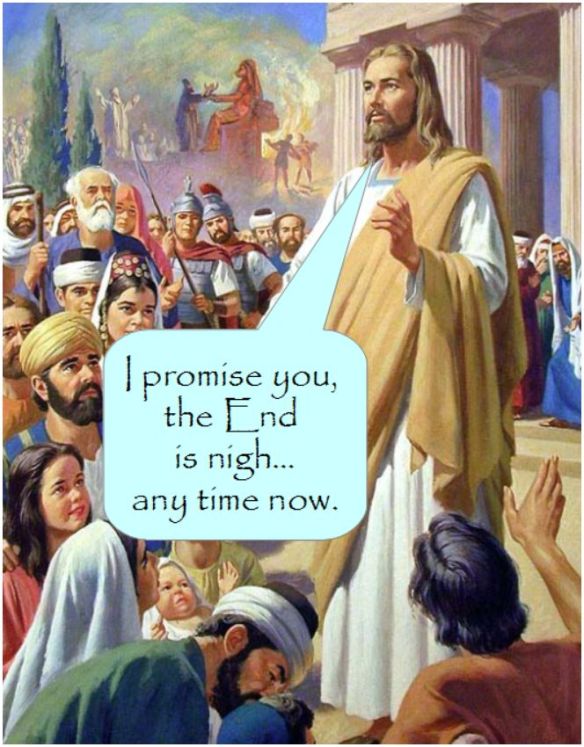
Recycled image and still no second coming

Never one to belabour a point, Don Camp has responded to my posts and comments about prophecy over on his own blog, Biblical Musing. This is a modified version of my response to that post.

What you seem to be saying, Don, is ‘leave a selected prophecy long enough and eventually it’ll appear to come true’. Perhaps, but then, if you take any selection of predictions from any source and you’ll find this to be the case. Why? Because:

1) You’ll have cherry-picked from the start so only those ‘prophecies’ that are vague enough or appear to have been fulfilled already will make up the bulk of your selection.

2) The vagueness of many that are chosen will make it relatively easy to scout around and alight on circumstances that seem to demonstrate some sort of fulfilment. You may even invent some that do, like the synoptic gospel writers do.

3) Some prophecies will indeed come true, but at no greater rate than chance allows. A prophecy you cite may say a particular city state will fall and return to the wilderness from which it was built. To claim that when, centuries later, it does so is not a fulfilment of this prophecy; it is a happy coincidence (for you and your so-called prophet, not so much for the denizens of the city state.) Just look at the number of ancient cities to which this has happened, without there being a preceding ‘prophecy’. It just happens.

4) You’ll ignore your own failure rate, or explain it away: i) discounting those prophecies that have never come to pass, even after millennia; ii) insisting ‘they could still occur! With God a day is like a thousand years!’; iii) reinterpreting them: ‘they’re metaphorical’ etc.

5) You invoke the get-out clause; the god says ‘if you don’t do ‘x’ then I’ll make ‘y’ happen.’ “Well, praise the god, everyone did ‘x’ and the calamity was averted! It’s a miracle!” This then counts, somehow or other, as a win for the ‘prophecy’.

These are your strategies, Don. You use them in combination to demonstrate the ‘fulfilment’ of biblical prophecy. You work really hard at nullifying your own cognitive dissonance, desperately attempting to demonstrate the truth of ancient fantasies. You conclude your post by saying Jesus will return as King soon. No, he won’t. You need to apply every one of your strategies to believe this is ever going to happen.

Prophecy: The Bible’s Track Record

In earlier posts we saw how the authors of Mark and Matthew’s gospels rooted around in the scriptures for anything that might be passed off as a prophecy. They then turned what they found into stories about Jesus.

What though about passages in scripture that actually declare themselves to be prophecy? How do these fair in the fulfilment stakes? As you might guess, not well. There are many failed prophecies in both Testaments; here I’ll take a select few, just to give you a flavour of how hopeless they are:

In Exodus 23:27, YHWH declares that all of Israel’s enemies will run from them:

I will send my terror ahead of you and throw into confusion every nation you encounter. I will make all your enemies turn their backs and run.

Oops! The scriptures themselves are replete with examples of the Israelites’ defeat at the hands of their enemies.

In Ezekiel 29:8-12, the Lord proclaims his intentions towards the hated Egyptians:

The Nile is mine; I made it, therefore I am against you and against your streams, and I will make the land of Egypt a ruin and a desolate waste from Migdol to Aswan, as far as the border of Cush. The foot of neither man nor beast will pass through it; no one will live there for forty years. I will make the land of Egypt desolate among devastated lands, and her cities will lie desolate forty years among ruined cities. And I will disperse the Egyptians among the nations and scatter them through the countries.

None of this ever happened.

Isaiah has it in for Egypt too. In 19:1-8 the Lord promises:

The waters of the river will dry up, and the riverbed will be parched and dry. The canals will stink; the streams of Egypt will dwindle and dry up. The reeds and rushes will wither, also the plants along the Nile, at the mouth of the river. Every sown field along the Nile will become parched, will blow away and be no more. The fishermen will groan and lament, all who cast hooks into the Nile; those who throw nets on the water will pine away.

The Nile has never dried up.

In 2 Samuel 7:13-16, the Lord promises that the descendants of David will rule forever:

(David) is the one who will build a house for my Name, and I will establish the throne of his kingdom forever… Your house and your kingdom will endure forever before me; your throne will be established forever.

The Davidic line ended with King Zedekiah in about 586BC. Much is made in the New Testament of Jesus’ descent from David on his father’s side (while also insisting he didn’t have a human father!) and this prophecy is altered in Acts 2:29-31 to make it fit Jesus’ supposed kingship. This is neither what it says nor means in its original context.

The deranged Zephaniah, writing in the 7th century BC, prophesies that the end of the world is imminent:

The great day of the Lord is near – near and coming quickly. The cry on the day of the Lord is bitter; the Mighty Warrior shouts his battle cry. That day will be a day of wrath – a day of distress and anguish, a day of trouble and ruin, a day of darkness and gloom, a day of clouds and blackness – a day of trumpet and battle cry against the fortified cities and against the corner towers.

Another failure, unless you’re prepared to consider 2600+ years and counting as being ‘near and coming quickly’.

The earliest prediction we have of the Christ’s appearance on Earth is from Paul, in 1 Thessalonians 1-8. You’ll note how he says how everything he describes will happen soon to the people he is writing to:

Now, brothers and sisters, about times and dates we do not need to write to you, for you know very well that the day of the Lord will come like a thief in the night. While people are saying, “Peace and safety,” destruction will come on them suddenly, as labour pains on a pregnant woman, and they will not escape. But you, brothers and sisters, are not in darkness so that this day should surprise you like a thief. You are all children of the light and children of the day. We do not belong to the night or to the darkness. So then, let us not be like others, who are asleep, but let us be awake and sober… For God did not appoint us to suffer wrath but to receive salvation through our Lord Jesus Christ. He died for us so that, whether we are awake or asleep, we may live together with him.

Notch that up as another non-event.

How about the prediction in 2 Thessalonians 2:1-4, thought to have been written circa AD50, that the Christ will not appear from heaven until ‘the man of lawlessness’ takes up residence in the Temple?

Concerning the coming of our Lord Jesus Christ and our being gathered to him, we ask you, brothers and sisters, not to become easily unsettled or alarmed by the teaching allegedly from us – whether by a prophecy or by word of mouth or by letter – asserting that the day of the Lord has already come. Don’t let anyone deceive you in any way, for that day will not come until the rebellion occurs and the man of lawlessness is revealed, the man doomed to destruction. He will oppose and will exalt himself over everything that is called God or is worshiped, so that he sets himself up in God’s temple, proclaiming himself to be God.

The Temple was destroyed by the Romans in AD70 before the man of lawlessness could make his appearance. Unsurprisingly, not a single prophet foresaw the catastrophe. (No, not even Jesus. It is generally agreed that Mark’s gospel was written around AD70 and that Jesus’ ‘prophecy’ about the temple’s destruction was composed after it had happened.)

And then, finally, prophecies about the end times, whether from the scriptures or from Paul, are inserted into the synoptic gospels so, miraculously, they become the words of Jesus:

‘the sun will be darkened, and the moon will not give its light; the stars will fall from the sky, and the heavenly bodies will be shaken.’ (a quote from Isaiah 13:10; 34:4.) At that time people will see the Son of Man coming in clouds with great power and glory. And he will send his angels and gather his elect from the four winds, from the ends of the earth to the ends of the heavens. Now learn this lesson from the fig tree: As soon as its twigs get tender and its leaves come out, you know that summer is near. Even so, when you see these things happening, you know that it is near, right at the door. Truly I tell you, this generation will certainly not pass away until all these things have happened. Heaven and earth will pass away, but my words will never pass away (Mark 13.34).

And thus, Jesus is likewise made into a false prophet.

Then again, what other sort is there? Prophets are zealots who believe they’ve been granted special access to the Lord’s plans. There are still fantasists today who believe the Lord speaks to them with portents of future disaster. It would be generous to say that all of them – those in the Bible and their modern descendants – are wrong far more often than they are right. In fact, they are always wrong; it is impossible to know the future. Meanwhile, so-called interpreters of prophecy, like Matthew, Mark, Luke and their equivalents today, alter ‘prophecy’ and unrelated statements to suit their needs, shaping their stories to create the illusion they have been miraculously ‘fulfilled’.  

Where did Luke get his Bethlehem story from?

Previously on RejectingJesus:

Matthew creates his nativity story, specifically Jesus’ birth in Bethlehem, from Micah 5.2, which prophesies that a ‘ruler over Israel’ will be born there. This prophecy is imposed on Jesus who was not a ruler of Israel – though he may have aspired to be – and certainly was not the Messiah envisaged by the creators of such prophecies. I suggest that subsequently, Luke embroidered Matthew’s fairly basic story and contrived to get Jesus born in Bethlehem by inventing a Roman census that required his parents to travel there.

A Christian commenter (let’s call him Don) then challenged this scenario by claiming, without offering any evidence, that Luke did not have access to Matthew’s gospel, so must have known that Jesus was born in Bethlehem from an independent source. (Christians are fond of attributing suspect gospel material to oral traditions and the hypothetical Q. Don is no exception.)

In fact, a number of scholars, including Michael Goulder, Mark Goodacre, Richard Carrier and others, think that Luke did know Matthew’s gospel. This is the so-called Farrer hypothesis, named after Austin Farrer who first proposed the idea in 1955. As well as his plagiarising 55% of Mark, these scholars show that Luke also used material from Matthew, including the Bethlehem story. The structure of Luke’s version and some of his phrasing is identical to Matthew’s. It is unlikely this would be the case if Luke wasn’t lifting directly from Matthew’s account.

Luke goes further and replaces some of the details in Matthew’s story that don’t suit his purpose (e.g. the magi) with his own (the shepherds), which is why the two accounts diverge. Nonetheless, both versions of the story stem from the ‘prophecy’ in Micah 2.5. Luke doesn’t cite it explicitly but then he is non-specific elsewhere in his gospel about events that supposedly fulfil prophecy. Unlike Matthew, Luke was writing for a gentile audience who would not be as familiar with Jewish scripture; he didn’t need to be as explicit about the source for his stories that were based on these scriptures. Nonetheless, the two nativity accounts, Matthew’s and Luke’s, likely had the same basis (the Micah prophecy) with Luke adapting the narrative that Matthew had already created from it. Moreover, the differences in detail between Matthew and Luke’s accounts demonstrate clearly that both authors were inventing their respective stories. As Neil Godfrey puts it,

Luke, attempting to adapt Matthew’s Bethlehem as the place of birth of Jesus to his more universalist theme, feels obliged to concoct a silly story of everyone being required by imperial edict to return to their places of birth for a special tax registration. Not to mention the necessary anachronism of his Quirinius timing, too. It is not hard to see that Luke is struggling to incorporate Matthew’s Bethlehem setting into his own tendentious narrative.

It’s possible, of course, that all of the scholars who think Luke knew Mathew’s gospel are wrong, but even so, this doesn’t rescue Luke’s nativity from its fictional moorings.

First, it could be argued that both Matthew and Luke knew about Jesus’ birth from their respective sources. Our Christian commenter would say, and does say, that the details of Jesus’s birth were well known in the early, pre-gospel cult (he disputes that Jesus was in any way famous beyond this select few) and that these details were preserved in a reliable oral tradition or in Q. If the former was the case, however, the two nativity accounts would not differ to the extent they do, unless the oral traditions weren’t as reliable as our commenter likes to say they were. On the other hand, Q, if it existed at all, was comprised primarily of sayings and certainly did not include any Bethlehem narrative.

Second, Don will no doubt say that all of this is mere atheist grumbling and is therefore entirely fallacious. He believes that God inspired his anonymous agents to use prophecy, foreshadowing and typology to point the way to Jesus and his birth in Bethlehem. Don believes that both Matthew and Luke had independent knowledge of Jesus’ birth there, which means it must’ve been his birthplace. Of course it indicates nothing of the sort. If Matthew and Luke settled on Bethlehem independently, it would demonstrate only that they had independent knowledge of Micah 2.5.

Third, if the circumstances of Jesus birth in Bethlehem were so remarkable – miraculous, even – then why does Mark not mention them? According to Don (though no serious scholar shares his view) Mark’s gospel is comprised of the recollections of Peter, Jesus’ closest, dim-witted pal in the synoptic gospels. Did Jesus never mention his birth to Peter? Did Peter then fail to pass the details on to Mark? Did Jesus’ mother Mary, who treasured memories of the miraculous birth, never allude to them when she and Peter reminisced together over a glass of water wine? (Yes, Don, I know this is in John’s gospel, but they are meant to be the same characters.) Why does the Bethlehem birth only emerge in Matthew, who built much of his gospel around ‘prophecies’ from scripture, and in Luke, who, in all likelihood, copied from him?

We can be fairly certain that Jesus was not born in Bethlehem. Someone somewhere, other than these two, would have mentioned it outside of symbolic stories that owe far more to myth and legend than they do to fact.