The Evolution of Jesus II: from Life Giving Spirit to God the Son and beyond.

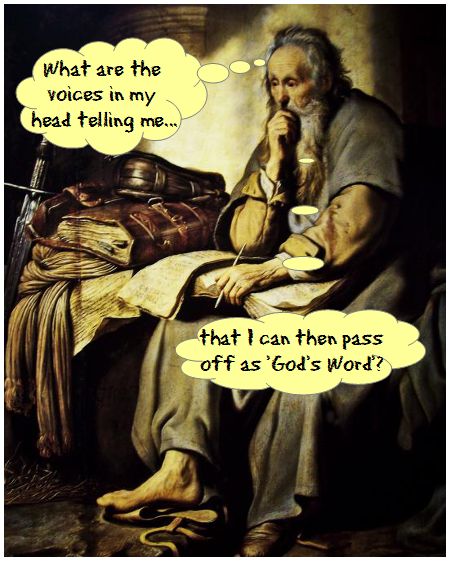
A couple of decades after the first visions of a risen Jesus, a Jewish zealot called Saul decided he’d seen him too. He came to imagine a vision he’d had in his head was this same Jesus, who then revealed to Saul – all entirely within his head as he admits – what his death and return from the dead really meant. Paul, as he renamed himself, announced that God had decided Jesus was a good man and returned him to life after his execution. In doing so, God made Jesus his Son (you can read all this poppycock in Romans 1:3-4). Jesus was now a life-giving spirit, the Saviour Christ: 1 Corinthians 15:45. (Maybe though Jesus always had been this; it’s kind of confusing, but in Philippians 2:6-8 Paul seems to think Jesus was some sort of quasi-divine being from the get-go. Take your pick. Whatever.)

Memetic selection ensured the survival and perpetuation of Paul’s bizarre idea, one that was, after all, not unfamiliar to the Hellenised people of the first century. The superstitious embraced and transmitted it without knowing a thing about any itinerant Jewish preacher. 

The next stage of Jesus’ evolution came twenty or so years later, when a believer we now know as Mark decided to write a back story for this Christ. He created his story using Jewish scripture, Paul’s ideas and the rules of the sect to which he belonged. Who knows if Mark believed Jesus had ever been a real person who trudged around Palestine preaching the good news about the end of everything, but in Mark’s story he had him do just that. He decided, crucially, that he wouldn’t have Jesus become God’s adopted son at the time of his spiritual resurrection. Instead, Mark had him become God’s son at his baptism (Mark 1.10-11).

This wasn’t quite good enough for the next two cultists who attempted a Jesus narrative. While they plagiarised much of Mark’s story, they changed details and made up more for Jesus to say and do. Importantly, where Mark had avoided suggesting Jesus’ resurrection appearances had occurred in the real world, Matthew and Luke showed no such reticence. Their Jesus(es) showed himself not in visions but in the flesh. It’s likely Matthew at least knew he was creating a symbolic, literary representation of others’ visions.

At the other end of the story, Matthew and Luke invented largely incompatible birth stories for their hero. For Matthew, Jesus was the Messiah from the time he was born, fulfilling all the prophecies Matthew borrowed to create his nativity story (he doesn’t: the Messiah, according to the very ‘prophecies’ Matthew manipulates is not divine but a human warrior).

Luke, on the other hand, is determined to push Jesus’ divinity even back further. For Luke, Jesus became divine when God magically made Mary pregnant; Luke’s Jesus is quite literally God’s son (Luke 1.35). Unfortunately, Mary forgot all about being impregnated by the Holy Semen Spirit later on in Luke’s ridiculous story. Nevertheless, Jesus’ status had evolved again; he’d become God’s son from the very moment of conception.

Even this was not good enough for the next version of the Jesus’ story. The writers of the fourth gospel decide to make him eternal and part of God himself. Plundering Greek philosophy and Paul’s ruminations from Philippians, they declare Jesus the ‘Logos’; the Word or aspect of God responsible for the creation of everything (John 1:1-5). And despite this being as far from an itinerant peasant preacher as it’s possible to be, even more gullible folk came to believe it.

Jesus’ evolution was still not complete, however. The council of Nicaea in 325 decided that Jesus was ‘begotten not made’ (whatever that means) – but couldn’t quite decide whether being the Logos and the Son of God actually made Jesus God Incarnate. It wasn’t until the Council of Constantinople in 381 that a collection of bishops decided Jesus was, after all, officially part of the Godhead. The apocalyptic preacher from the backwoods finally became God the Son, a mere 350 years after he lived (if indeed he did).

Jesus has continued to evolve ever since, becoming all things to all people; a God pliable enough to be whatever his followers want him to be: Roman Catholic, Greek Orthodox, Russian Orthodox, Evangelical, Mormon, fringe cult. He’s evolved into a schizophrenic deity capable of being both meek and mild and bellicose; best buddy and chief executioner; Christian Nationalist, socialist and capitalist, gay and anti-gay, pro-family and anti-family; anti-abortion and pro-gun; environmentalist and iconoclast; the one who promotes a prosperity gospel and the ‘One True God’ known (only) to a select few. Every contradictory manifestation is supported by the Bible, the Church or tradition. Every one is non-existent and ultimately pointless.

That’s some evolution.

Only The One Book

Some years ago I visited friends where another of their guests told me he had been reading a remarkable book. It was he said, about Atlantis and demonstrated beyond any doubt that the ancient city had really existed and had sunk beneath the ocean where it still waited to be found. I asked him how he knew this (a polite way of asking what his evidence was.) He looked at me incredulously. ‘Because the book says so,’ he explained.

It’s the same with all the claims made about Jesus: that he was the Saviour, the Messiah and the Son of God. All such claims are found only in one book written by people who already believed such things about him.

Outside of this book there’s nothing: no Roman records of his death and subsequent resurrection; no reports of post-resurrection visits by witnesses who weren’t already invested; no contemporary, independent accounts of his remarkable miracles; nothing from historians of the day about his return from the dead and subsequent ascent into the sky; no mention of him at all in any documentation for the first 80+ years of Christianity outside of this one book. The Son of God appears on Earth and nobody but a handful of superstitious zealots notice.

Not very convincing, is it? 

Is Jesus the Saviour, the Messiah and the Son of God?

Is Jesus the Saviour, the Messiah, and the Son of God?

No, no and no.

We know he’s not the Saviour because he hasn’t saved anyone. Every single person who has believed in him over the last 2,000 years has died and stayed dead. He hasn’t resurrected a single one of them and hasn’t ushered anyone into the heavenly mansion he (supposedly) said he was preparing for his Elect. Neither has he saved them from the trials of this life: illness, pain or suffering. His followers are no more saved from these than the rest of us.

Of course, Christians claim that what he saves people from is ‘sin’. But sin is an empty and peculiarly religious concept signifying the separation of ‘man’ from God. If there’s no God to be separated from there can be no sin. If, however, we’re talking about morals – ‘sinning’ – then it’s evident that believers are no more or less moral than anyone else. Jesus, it turns out, doesn’t save anyone from their own bad behaviour.

He’s not the Messiah (I’m resisting the temptation to add the Monty Python completion of that sentence) which is why most Jews do not believe in him. He doesn’t demonstrate any of the characteristics of the Messiah prophesied in Jewish scripture. He didn’t overturn the oppression his people endured under Roman rule and he hasn’t been there for the Jewish people in all their subsequent suffering. He certainly didn’t rescue them from the Holocaust. Only by redefining what is meant by ‘Messiah’, as early Christians did when they made the term synonymous with ‘saviour’, could Jesus even be considered a contender. In reality, he is an utter failure as a Messiah.

He’s not the Son of God. Even in the synoptic gospels he doesn’t claim to be; he’s cagey whenever the subject arises. It’s as if his early followers couldn’t make up their minds about how divine he actually was. Later Christians were more emphatic, claiming that the resurrection demonstrated Jesus’ divinity. Paul, however, doesn’t think so, saying only that Jesus’ return from the dead elevated him to a favoured position in God’s hierarchy (Philippians 2:9). Even this is going too far when the evidence of Jesus’ physical resurrection is so poor; the gospel stories do not  qualify him for Sonship. Nor do his failed promises and prophecies; if he were the Son of God, he’d have known the appearance of Son of Man (he himself?), the last judgement, the Kingdom of God on Earth, the inversion of the social order and the meek inheriting the Earth would not happen when he said they would. Or indeed at all. He was ignorant about so much! What sort of Son of God was he, to get so much so wrong?

In fact, we can be certain Jesus was no more the Son of God than Alexander the Great was Son of Ammon-Zeus or Augustus the ‘Son of the Most Divine’. How? Because like Ammon-Zeus and ‘the Most Divine’, the likelihood YHWH exists is ridiculously low; so low it’s reasonable to conclude he doesn’t. And no God = no Son of God.

To be continued.

A Christian’s Circular Reasoning

Don asks:

Why is it not possible for people to see immaterial things? We see with the mind as much or more than with then eyes. If the mind can conceive of immaterial things we can see them. Often skeptics declare that what Paul saw was a hallucination. If so, he saw something that was not material. We all dream. When we do we see things that are not material. If there are immaterial beings such as spirits, why would it not be possible to see them?

Why is it not possible for people to see immaterial things? Because ‘immaterial things’ by their very nature cannot be seen. Moreover, in the sense you’re talking about – supernatural beings and places – there is no evidence they have independent existence outside the human imagination.

We see with the mind as much or more than with then eyes. The mind processes what the eyes see. Sometimes it produces, imagines, ‘sights’ for itself, as in hallucinations or dreams, but this doesn’t mean these sights are real. Indeed, they are not.

If the mind can conceive of immaterial things we can see them. You mean like ghosts, spirits from the Greek underworld and Norse gods? Of course you don’t,  though your argument applies equally to these. You mean only Christian immaterial things: heaven and hell, angels and demons and the risen Christ. This is merely special pleading.

Your assertion is patently untrue. It begs the question, ‘if the mind can conceive of ’immaterial things’ does this mean these things are real?’ To which the answer must always be ‘no’.

what Paul saw was a hallucination. If so, he saw something that was not material. Yes and yes. Paul hallucinated on more than one occasion, seeing figures and places that were not real. His seeing them did not make them real.

We all dream. When we do, we see things that are not material. A statement of the bleedin’ obvious, but yes, we all dream. Does this make what we see in those dreams real? Again, no.

If there are immaterial beings such as spirits…There aren’t. As you keep stating while failing to recognise it, they are merely figments of the imagination.

why would it not be possible to see them? Because as figments of the imagination, they don’t exist. Here’s where your ‘reasoning’ is entirely circular: the human mind can conceive of immaterial beings and places and these things can be ‘seen’ ((in dreams and hallucinations); because they can be seen they must be real. Therefore, we know they’re real because they can be seen. Can you not ‘see’ the absurdity of your position, Don?  

My 3+ year old granddaughter can distinguish between reality and figments of the imagination, fantasy and dreams. It is really is time you could too.

Don’s Dynamic Lie-Detector

But you have an anointing from the Holy One, and all of you know the truth. I do not write to you because you do not know the truth, but because you do know it and because no lie comes from the truth.

1 John 2:20-21 as quoted by Don Camp.

Our resident, regularly banned God-botherer, Don Camp, claims that he has a special way of reading and interpreting spiritual writing. No, he hasn’t got a pair of magic rocks, but an inner ‘anointing’ with what Don calls his ‘lie-detector’. (You might have a similar device yourself, known more commonly as a bull-shit detector. Its alarm may well have been a-ring-a-ding-dinging when you read Don’s comment.)

Anointing, if you’re interested, is the ancient Jewish custom of initiating a king or priest by daubing oil on their head. Don has no evidence that he has been inwardly ‘anointed’ by an unseen spirit that helps him understand scripture better than anyone else. There is no evidence, outside of subjective feelings and one tautological bible verse, that any religious believer has had this done to them. (Read 1 John 2.20-21 again, Don, and you’ll see that a tautology is what it is: ‘the truth is the truth is the truth,’ is really all it says.)

On the contrary, we find that different Christians interpret given scriptures in a variety of different ways (I’ll get to examples in a minute). They differ too on which bits of the Bible are relevant to them and their church or sect. They disregard or explain away verses that don’t suit their purposes.

Don does this himself. His anointing Spirit doesn’t lead him to interpret verses like Matthew 16:27-28; 24:27, 30-31 & 34, Romans 13, 11 & 12, 1 Peter 4:7, 1 John 2:18, Revelation 22.20 etc at face value. He cannot countenance the fact that Jesus, Paul, John and all those other early fanatics were wrong about when the end of the age would happen – they are all very clear they thought it was imminent – so he reinterprets what they say to mean something they clearly and unequivocally do not. Don’s interpretation has them meaning, despite what they say, that the end of the age and all that goes with it would be thousands of years in their future. Should you challenge him on this, Don tells you that how you see it is wrong because you don’t have the special anointing he has. As he puts it in his comment, you’re lacking the right ‘dynamic’ (ring-a-ding-ding!) and as a result, you are incapable of interpreting scripture in the right way (i.e. his way).

In fact, Don does not have a way of understanding scripture that he can call his own. Rather, he interprets it with preconceptions he’s acquired elsewhere; that it is God’s Word, that it is Truth, that the spiritual world it describes is real, that it relates an historical resurrection, and so on. He comes to it with these presuppositions that he has learnt from preachers, teachers, commentaries, devotional books and other Christian propaganda he’s been exposed to. He is completely unable to take a step back to look at what he’s reading objectively. He knows what it says before he reads it – ‘truth’ as far as the Bible is concerned, ‘lies’ when it’s the Book of Mormon – and imposes that meaning onto it. This ‘dynamic’ enables him too to smooth over all of the Bible inconsistencies and allows him to see it as one seamless garment when it evidentially is not. He’s not alone in doing this, of course. Most evangelical (‘anointed’) Christians do it. I know I did.

Now for those examples, and a challenge for Don:

1. A few days ago, Holy Spirit anointed, preacher Dillon Awes used his dynamic lie-detector to interpret the Bible’s declarations about homosexuality like this:

What does God say is the answer, is the solution, for the homosexual in 2022, here in the New Testament, here in the Book of Romans (1:26-27)

That they are worthy of death! These people should be put to death!

Every single homosexual in our country should be charged with the crime, the abomination of homosexuality, that they have. They should be convicted in a lawful trial. They should be sentenced with death. They should be lined up against the wall and shot in the back of the head! That’s what God teaches. That’s what the Bible says.

2. Similarly, over the weekend, Ken Ham interpreted Genesis 1 to mean that dinosaurs and humans lived at the same time. After all, he ‘reasoned’, Genesis says God created ‘everything’ in those first six days, so that must include dinosaurs as well as Adam and Eve.

3. Pastor Douglas Wilson who featured recently on Bruce Gerencser’s blog, interpreted the assertion in Ephesians 5:22-24 that wives should be submit to their husbands, even if it entails rape:

…We have forgotten the biblical concepts of true authority and submission, or more accurately, have rebelled against them… However we try, the sexual act cannot be made into an egalitarian pleasuring party. A man penetrates, conquers, colonizes, plants. A woman receives, surrenders, accepts. This is of course offensive to all egalitarians, and so our culture has rebelled against the concept of authority and submission in marriage.

My question to you, Don, is: do you interpret Romans 1:26-27, Genesis 1 and Ephesians 5:22-24 the same way as these other Holy Spirit directed interpreters of scripture? If not, why not, when it’s the same Holy Spirit that equips you with your dynamic lie-detector, that also leads them into all truth?

These is not a rhetorical question; we all want to know. But be warned, Don, our bullshit detectors are primed and ready.


Christians’ Favourite Delusions 36: The Universe Is Fine-Tuned For Life.

  1. The return of an old favourite(?)! Christians’ Favourite Delusions. The other 35 posts in this series start here

The vast universe, almost infinite in size, was created, according to Christians, with the sole purpose of bringing us humans and the other creatures who share this planet with us into existence. This fine-tuning argument is used to ‘prove’ that the God of the Bible really exists.

According to Ken Ham, we’re the only life forms in the universe, while other Christians speculate that there may be other intelligent creatures out there somewhere. If there are, then, so says the late Larry Norman, ‘(Jesus) has been there once already and has died to save their souls.’*

The fine-tuning argument proposes that the universe exists so that this minute, insignificant blue dot we live on, and possibly a few other tiny specks, could produce life of some sort. But what of the rest of the universe: the other 99.9999% that doesn’t have life, because it is entirely hostile to it; the vast bulk of the universe that is made up of nebulae, gas clouds, lethal radiation, black holes, anti-matter and lifeless planets?

Taken as a whole, the universe is cold and dead; not finely-tuned for anything, let alone life. But don’t take my word for it. Here’s Richard Carrier debunking the whole fine-tuning argument:

‘[T]he only way we could exist without a God is by an extremely improbable chemical accident, and the only way an extremely improbable chemical accident is likely to occur is in a universe that’s vastly old and vastly large; so atheism predicts a vastly old and large universe; theism does not …

Likewise, if chance produced this universe, we should expect it to be only barely conducive to life, indeed almost entirely lethal to it (as in fact it is), since there are vastly more ways to get those universes by chance selection, than to get a universe perfectly suited to life throughout. … Design predicts exactly the opposite.’

And here, several more scientists, philosophers and other interested parties do the same thing:

https://www.skeptic.com/reading_room/non-fine-tuned-universe/

https://www.google.com/amp/s/www.technologyreview.com/2011/01/18/260556/evidence-emerges-that-laws-of-physics-are-not-fine-tuned-for-life/amp/

https://whyevolutionistrue.com/2015/12/31/sean-carroll-debunks-the-fine-tuning-argument-for-god/

https://m.youtube.com/watch?v=Z9O5wXsgqrc

https://www.goodreads.com/quotes/tag/fine-tuning-argument-debunked

https://www.answers-in-reason.com/religion/christianity/fine-tuning-debunked-holy-koolaid/

Life is remarkable, it is true (but then we would think that, wouldn’t we, when we are it) but it is no more remarkable than any other of the phenomena the universe has produced in its 13.7 billion years of its current existence. No God has been required for any of it. No fine-tuning = no fine-tuner

*In his 1972 song ‘UFO’.

Assertions

Don likes to take me to task for what he says are assertions in my arguments. I do make assertions, as do we all, because not all points in an argument need to be demonstrated every time they’re used. Indeed, not all assertions can be.

There are assertions that we all accept are likely to be true: the sun will ‘rise’ tomorrow; the Earth is a sphere; evidence is better than no evidence and so on. There are those who dispute these assertions but the onus is then on them to provide the evidence or argument that their counter-assertion is true. Yes, there may come a day when the sun doesn’t rise but it is statistically improbable; the Earth is demonstrably not flat; faith is not an reliable substitute for evidence. There is abundant evidence and sound argument why these things are not the case. But – and this is my point – this evidence does not have to be trotted out every time an argument relies on such probabilities; they can be asserted.

I write, and indeed live my life, on the basis of the fact (‘assertion’) that the supernatural does not exist. Over the last ten years, I’ve posted several arguments why this is the case. I frequently provide a link to these arguments when asserting that, outside of the human imagination, gods, spirits, angels, devils, demons, powers, principalities, ghosts, avatars, heaven and hell do not exist. These arguments form the backbone of any subsequent assertion that the supernatural is not real.

Nonetheless, the onus to ‘prove’ that this is the case does not rest with me. First, because it is impossible to prove a negative. Consider, for example, the Christians challenge to prove their God doesn’t exist. While there is plenty of circumstantial evidence that this is the case, there is no absolute ‘proof’ of God’s non-existence (as I’ve argued before, it all comes down to probability, or, in God’s case, improbability.) Absence of evidence is invariably evidence of absence.

The onus instead lies with the one making the incredible claim. Those who take it as fact that the supernatural and God are real need to demonstrate to the rest of us that this is the case. They have, in my long experience, failed to do this. The best they can do are the various arguments (the ontological, Kalam cosmological, teleological, fine-tuning and the argument from design) that suggest the possibility of the supernatural but fall far short of convincing evidence that the supernatural is real, and further still that the Christian God exists. They depend in the end on the feelings they have in their heads and the Bible (or some other holy book.) This is wholly inadequate

Consequently, I’ll continue to operate from and make my assertion that the supernatural does not exist until such time as Don or any other of his co-religionists demonstrate the probability that it does.

From my assertion, backed up, remember, by earlier arguments, a number of other facts follow:

With no supernatural, there are no gods; YHWH in all his incarnations is a God, therefore YHWH does not exist.

Much follows from this:

If YHWH does not exist, Jesus cannot have been either his avatar, Son or incarnation;

Jesus cannot have been raised from the dead by a being who doesn’t exist;

Stories that he did so must therefore be merely that: stories;

The celestial, eternal Jesus who sits at the right hand of God in heaven is not real;

Any experience people have of this being is entirely within their own imaginations;

The Bible is based on such imagined encounters with these imagined characters;

There is no after-life or judgment;

The Christian faith, including my own, cannot be explained in terms of the supernatural;

Only explanations that are rooted in naturalism, as in science, have any validity.

There are more implications that can be drawn from the premise that there is no supernatural, including the fact that the world makes much more sense (if it makes any sense at all) without drawing gods and demons into it.

Consequently, I shall continue to make my assertions, like those above, supported as always by previous argument. Any religious believer who wants to challenge them is welcome to do so, but must do more than point out the obvious, that they are assertions. They must provide the evidence for the supernatural, and all that follows from it, independent of the goings on in their heads and without reference to holy books written by those with similar subjective feelings.

Making Prophecy Work

Recycled image and still no second coming

Never one to belabour a point, Don Camp has responded to my posts and comments about prophecy over on his own blog, Biblical Musing. This is a modified version of my response to that post.

What you seem to be saying, Don, is ‘leave a selected prophecy long enough and eventually it’ll appear to come true’. Perhaps, but then, if you take any selection of predictions from any source and you’ll find this to be the case. Why? Because:

1) You’ll have cherry-picked from the start so only those ‘prophecies’ that are vague enough or appear to have been fulfilled already will make up the bulk of your selection.

2) The vagueness of many that are chosen will make it relatively easy to scout around and alight on circumstances that seem to demonstrate some sort of fulfilment. You may even invent some that do, like the synoptic gospel writers do.

3) Some prophecies will indeed come true, but at no greater rate than chance allows. A prophecy you cite may say a particular city state will fall and return to the wilderness from which it was built. To claim that when, centuries later, it does so is not a fulfilment of this prophecy; it is a happy coincidence (for you and your so-called prophet, not so much for the denizens of the city state.) Just look at the number of ancient cities to which this has happened, without there being a preceding ‘prophecy’. It just happens.

4) You’ll ignore your own failure rate, or explain it away: i) discounting those prophecies that have never come to pass, even after millennia; ii) insisting ‘they could still occur! With God a day is like a thousand years!’; iii) reinterpreting them: ‘they’re metaphorical’ etc.

5) You invoke the get-out clause; the god says ‘if you don’t do ‘x’ then I’ll make ‘y’ happen.’ “Well, praise the god, everyone did ‘x’ and the calamity was averted! It’s a miracle!” This then counts, somehow or other, as a win for the ‘prophecy’.

These are your strategies, Don. You use them in combination to demonstrate the ‘fulfilment’ of biblical prophecy. You work really hard at nullifying your own cognitive dissonance, desperately attempting to demonstrate the truth of ancient fantasies. You conclude your post by saying Jesus will return as King soon. No, he won’t. You need to apply every one of your strategies to believe this is ever going to happen.

Prophecy: The Bible’s Track Record

In earlier posts we saw how the authors of Mark and Matthew’s gospels rooted around in the scriptures for anything that might be passed off as a prophecy. They then turned what they found into stories about Jesus.

What though about passages in scripture that actually declare themselves to be prophecy? How do these fair in the fulfilment stakes? As you might guess, not well. There are many failed prophecies in both Testaments; here I’ll take a select few, just to give you a flavour of how hopeless they are:

In Exodus 23:27, YHWH declares that all of Israel’s enemies will run from them:

I will send my terror ahead of you and throw into confusion every nation you encounter. I will make all your enemies turn their backs and run.

Oops! The scriptures themselves are replete with examples of the Israelites’ defeat at the hands of their enemies.

In Ezekiel 29:8-12, the Lord proclaims his intentions towards the hated Egyptians:

The Nile is mine; I made it, therefore I am against you and against your streams, and I will make the land of Egypt a ruin and a desolate waste from Migdol to Aswan, as far as the border of Cush. The foot of neither man nor beast will pass through it; no one will live there for forty years. I will make the land of Egypt desolate among devastated lands, and her cities will lie desolate forty years among ruined cities. And I will disperse the Egyptians among the nations and scatter them through the countries.

None of this ever happened.

Isaiah has it in for Egypt too. In 19:1-8 the Lord promises:

The waters of the river will dry up, and the riverbed will be parched and dry. The canals will stink; the streams of Egypt will dwindle and dry up. The reeds and rushes will wither, also the plants along the Nile, at the mouth of the river. Every sown field along the Nile will become parched, will blow away and be no more. The fishermen will groan and lament, all who cast hooks into the Nile; those who throw nets on the water will pine away.

The Nile has never dried up.

In 2 Samuel 7:13-16, the Lord promises that the descendants of David will rule forever:

(David) is the one who will build a house for my Name, and I will establish the throne of his kingdom forever… Your house and your kingdom will endure forever before me; your throne will be established forever.

The Davidic line ended with King Zedekiah in about 586BC. Much is made in the New Testament of Jesus’ descent from David on his father’s side (while also insisting he didn’t have a human father!) and this prophecy is altered in Acts 2:29-31 to make it fit Jesus’ supposed kingship. This is neither what it says nor means in its original context.

The deranged Zephaniah, writing in the 7th century BC, prophesies that the end of the world is imminent:

The great day of the Lord is near – near and coming quickly. The cry on the day of the Lord is bitter; the Mighty Warrior shouts his battle cry. That day will be a day of wrath – a day of distress and anguish, a day of trouble and ruin, a day of darkness and gloom, a day of clouds and blackness – a day of trumpet and battle cry against the fortified cities and against the corner towers.

Another failure, unless you’re prepared to consider 2600+ years and counting as being ‘near and coming quickly’.

The earliest prediction we have of the Christ’s appearance on Earth is from Paul, in 1 Thessalonians 1-8. You’ll note how he says how everything he describes will happen soon to the people he is writing to:

Now, brothers and sisters, about times and dates we do not need to write to you, for you know very well that the day of the Lord will come like a thief in the night. While people are saying, “Peace and safety,” destruction will come on them suddenly, as labour pains on a pregnant woman, and they will not escape. But you, brothers and sisters, are not in darkness so that this day should surprise you like a thief. You are all children of the light and children of the day. We do not belong to the night or to the darkness. So then, let us not be like others, who are asleep, but let us be awake and sober… For God did not appoint us to suffer wrath but to receive salvation through our Lord Jesus Christ. He died for us so that, whether we are awake or asleep, we may live together with him.

Notch that up as another non-event.

How about the prediction in 2 Thessalonians 2:1-4, thought to have been written circa AD50, that the Christ will not appear from heaven until ‘the man of lawlessness’ takes up residence in the Temple?

Concerning the coming of our Lord Jesus Christ and our being gathered to him, we ask you, brothers and sisters, not to become easily unsettled or alarmed by the teaching allegedly from us – whether by a prophecy or by word of mouth or by letter – asserting that the day of the Lord has already come. Don’t let anyone deceive you in any way, for that day will not come until the rebellion occurs and the man of lawlessness is revealed, the man doomed to destruction. He will oppose and will exalt himself over everything that is called God or is worshiped, so that he sets himself up in God’s temple, proclaiming himself to be God.

The Temple was destroyed by the Romans in AD70 before the man of lawlessness could make his appearance. Unsurprisingly, not a single prophet foresaw the catastrophe. (No, not even Jesus. It is generally agreed that Mark’s gospel was written around AD70 and that Jesus’ ‘prophecy’ about the temple’s destruction was composed after it had happened.)

And then, finally, prophecies about the end times, whether from the scriptures or from Paul, are inserted into the synoptic gospels so, miraculously, they become the words of Jesus:

‘the sun will be darkened, and the moon will not give its light; the stars will fall from the sky, and the heavenly bodies will be shaken.’ (a quote from Isaiah 13:10; 34:4.) At that time people will see the Son of Man coming in clouds with great power and glory. And he will send his angels and gather his elect from the four winds, from the ends of the earth to the ends of the heavens. Now learn this lesson from the fig tree: As soon as its twigs get tender and its leaves come out, you know that summer is near. Even so, when you see these things happening, you know that it is near, right at the door. Truly I tell you, this generation will certainly not pass away until all these things have happened. Heaven and earth will pass away, but my words will never pass away (Mark 13.34).

And thus, Jesus is likewise made into a false prophet.

Then again, what other sort is there? Prophets are zealots who believe they’ve been granted special access to the Lord’s plans. There are still fantasists today who believe the Lord speaks to them with portents of future disaster. It would be generous to say that all of them – those in the Bible and their modern descendants – are wrong far more often than they are right. In fact, they are always wrong; it is impossible to know the future. Meanwhile, so-called interpreters of prophecy, like Matthew, Mark, Luke and their equivalents today, alter ‘prophecy’ and unrelated statements to suit their needs, shaping their stories to create the illusion they have been miraculously ‘fulfilled’.  

Fakin’ It

Here’s my dilemma. I got this letter from a group of students at the university of Selcuck in Turkey. Well, when I say I received the letter, it was addressed to Professor Paulson who was head of the Philosophy department here in the 90s. He’s been dead now over 20 years of course, so when I picked up the letter, I thought I’d just write back and tell them that and that they’d have to work out their problems for themselves. Then I thought, ‘well, hang on a minute, the Professor was your tutor back in the day. You know how he thought and how he’d address these particular problems. Hell, you’ve even got some of his old papers locked away in your filing cabinet. You could take one or other of those and with a bit of tweaking, concoct a reply yourself. That’d be perfectly legitimate wouldn’t it?’ I mean I occupy the chair he once did so I am in effect his replacement.

So that’s what I do. I take one of Professor Paulson’s papers and I use it as the basis of a letter. Of course, matters in philosophy have moved on a bit since the Professor’s time so I add quite a bit of my own stuff, which is all pretty good and in line with what he might have thought, had he lived this long. After all, I studied under him in the ’80s so I have a pretty good idea of what he might think today, if he were still with us. If I do say so myself, it’s pretty good stuff. Nobody could tell Paulson didn’t write it.

Now, I do consider admitting at the start of the letter, or maybe the end of it, that I wrote the letter and not the Prof. But then I think, well, these folk don’t know he’s no longer with us so what’s the harm? I’ll just send it and they can reach their own conclusions. I mean, it wouldn’t be my fault, would it, if they jumped to the wrong conclusion. And then I think, well, if they’re going to do that I might as well sign it as if it is from the Professor. I mean, who’s to know? And maybe I could add that bit at the beginning suggesting it was from him. Suggesting? Saying it is from him. That’s what I do, and off it goes.

I hear later, on the grapevine, it’s gone down pretty well. They like what it says and are convinced it’s from Paulson. Everybody’s happy.

And then I find out, a couple of months down the line, that it’s been published. The Selcuck students have had it published, in an influential journal no less, and the academic world is celebrating the final lost paper of Professor Paulson’s. And here’s my dilemma: it’s not, is it. It’s me. I’ve taken his old paper, embellished it and sent it out into the world as if it’s his. What do I do? What would you do? Confess it’s not what it seems? Or bask in the knowledge that what I’ve written is as good as anything he wrote in life? A fake, yes, for sure, but a damn good one that, with a bit of luck, no-one’s ever going to spot. Do you know, I think I’ll leave it, say nothing. The joke’s on them.

Of course such a thing could never happen. Or could it? The letter to the Ephesians in the New Testament claims to have been written by Paul. It starts with this greeting:

Paul, an apostle of Christ Jesus by the will of God, To God’s holy people in Ephesus, the faithful in Christ Jesus: Grace and peace to you from God our Father and the Lord Jesus Christ.

and ends with some vaguely autobiographical details.

But it wasn’t written by Paul. Scholars think it was created in the 80s, about twenty years after Paul died. Much of the letter is a reworking of Colossians, the authorship of which is similarly disputed. Here’s the opening of Colossians:

Paul, an apostle of Christ Jesus by the will of God, and Timothy our brother, To God’s holy people in Colossae, the faithful brothers and sisters in Christ: Grace and peace to you from God our Father.

The Ephesians opening is a direct lift. None of Paul’s genuine letters follow this format. The letter itself has a style and vocabulary unlike that in the genuine Pauline letters and there are significant differences in theology too. Here’s how Bart Ehrman summarises the problem (though note he is not the only scholar who disputes Paul’s authorship of Ephesians; it is the consensus view): 

Ephesians does not resemble Paul’s writing style and the letter contains an inordinate number of words that Paul does not use in any of his undisputed letters. As in Colossians, Ephesians suggests that the believer has already been raised with Christ-a view that contradicts Paul’s undisputed writings. The author of Ephesians, moreover, uses the term “works” differently than Paul. For Paul, “works” refers to adherence to the Jewish law, actions that cannot save. The author of Ephesians, however, understands “works” to mean those actions that demonstrate one’s faith.

Some generously describe Ephesians and other letters attributed to Paul that aren’t by him, as Deutero-Pauline: ‘in the tradition of Paul’. Some speculate that they were written by one of Paul’s disciples but there’s no way of knowing this for sure. Others prefer the term Pseudepigrapha, literally ‘false inscription or writing’, which is nearer the mark.

The author of Ephesians, like those of other pseudepigraphical letters, such as the pastorals (1 and 2 Timothy and Titus) claims explicitly to be Paul knowing full well he is not. This is not some disciple trying to express the views of the master, this is someone passing themselves off as someone else, pretending they are the more well-known, revered and authoritative figure. Even if they were someone familiar with Paul’s teaching (the differences in theology suggest otherwise) would it be legitimate for him to claim he is Paul?

Like my fictional individual above, the author of Ephesians is a deceitful impostor, his work a forgery, designed possibly to ‘correct’ Paul’s position on certain issues. And yet here is his letter in the New Testament; God’s Holy Word no less. While there is a very human history of how works were selected for inclusion in the New Testament, how on Earth did God, in the guise of the Holy Spirit, allow this and other forgeries to become part of the canon?

Of course, God had nothing to do with it. The author of Ephesians duped not only the letter’s original audience, but also the later believers who included it in the Bible. He continues to deceive the faithful down to this day.  I know: I was one.