A Special Christmas Bible Study

An angel of the Lord appeared to (the shepherds), and the glory of the Lord shone around them, and they were terrified.

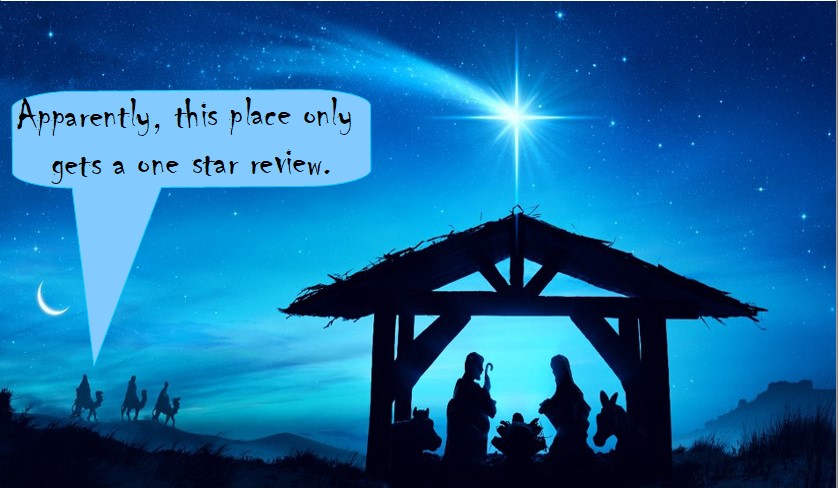
But the angel said to them, “Do not be afraid. I bring you good news that will cause great joy for all the people. Today in the town of David a Saviour has been born to you; he is the Messiah, the Lord. This will be a sign to you: You will find a baby wrapped in cloths and lying in a manger.”

Suddenly a great company of the heavenly host appeared with the angel, praising God and saying, Glory to God in the highest heaven, and on earth peace to those on whom his favour rests.” (Luke 2:9-16)

Another chunk of scripture that will be proclaimed from pulpits and in nativity plays again this year. Let’s take a closer look at the scenario Luke creates. Does it bear any relation to something that might occur in reality?

First, an angel. Doesn’t this tell us from the outset that we’re in the realms of fantasy fiction? You can’t fault Luke for trying though, he does his best to impress by adding a whole host of them. You can hear him thinking that ‘a great company of angels’ should convince all but the most hardened of hearts. He’s inventing freely, throwing in the tropes of the genre with abandon. Doesn’t he know angels are fierce, two-faced, six-winged creatures (Ezekiel 14:18; Isaiah 6), not handsome youths in glowing white robes? There’s a reason they prefaced their every appearance, including this one, with ‘Do not be afraid’.

Good news that will cause great joy for all the people: All? Even as Luke wrote this paean to wishful thinking he knew that the Jesus myth had not brought joy to ‘all people’. Most had rejected the claims of the new cult and joy was hardly the prevalent emotion in some of the churches Paul wrote to.

This will be a sign to you: You will find a baby wrapped in cloths and lying in a manger. A baby wrapped in cloths, as was the custom, and lying in an animal feeding trough is a ‘sign’? A sign that the Messiah had arrived? Really? Granted a manger is not a conventional place for a new-born but it’s hardly miraculous. And what if by the time the shepherds had abandoned their flocks to the night and its marauding wolves, Mary had, say, picked up the child or found a better place for it? Imagine the confusion! Sorry, Luke but this is a very poorly constructed story. You just didn’t think it through.

As for the angels’ last proclamation, what does it really mean?

Glory to God: this of course is fawning to a God whose ego is more inflated and fragile than Donald Trump’s. He demands continual praise not only from his heavenly messengers but from those here below, or else he’ll go off on one. You really want to spend eternity with such a tyrant, Christians?

…in the highest heavens: a reference to the fact that early Christians believed in different layers of heaven; Paul writes about them too. God resides, as acknowledged here, in the highest, the top floor executive suite. No-one ever gets to go up there. Emails are sent down from on high.

And on earth peace to those on whom his favour rests: what sort of peace? Certainly not the absence of conflict or war. We’ve now had two more millennia of these, some in the past initiated by Christians themselves. Do people who are at peace with themselves start wars? Peace within then. Do Christians know greater peace than anyone else? Hard to say when it’s not something that can be measured but I’m sure Christians will claim it’s so.

On whom his favour rests: who exactly is this? Who enjoys the favour of a capricious deity? How do they know when he visits all manner of trials and tribulations, testing and tempering on those who count themselves as his. I’m sure the early Christians who helped write the angels’ speech thought it was they who enjoyed the Lord’s favour. Today’s Christians probably think the same. YHWH has always played favourites. Everyone else can go to hell.

So, the heralds of Jesus’ birth didn’t exactly bring good news, did they. Not even in Luke’s imaginary, completely invented, never-happened-in-reality and isn’t-even-a-decent-metaphor scenario.

Like a Virgin. Or Not


To arrive at the nativity story most of us grew up with and which your kids and grandkids might well be performing this Christmas (mine are), the one with a stable, shepherds and wise-men, involves some cunning sleight of hand, not to mention a liberal dollop of invention.

The biblical ‘account’ of the story is spread across two gospels, Matthew and Luke. Mark hadn’t heard of it when he wrote his gospel so you won’t find it there. In fact, Mark’s Jesus doesn’t become God’s son until his baptism. Paul, writing earlier still, thinks God adopts Jesus only at his resurrection. Paul has no knowledge either of the nativity myth. John has no time for it: his Jesus is an eternal being who has existed with God from the beginning.

For Matthew, however, Jesus comes into existence when the Holy Spirit impregnates a virgin. Luke likes the idea and so copies it into his gospel. And now we have a problem: the idea that a virgin will bear the Messiah is lifted from the Septuagint, the Greek translation of the Jewish scripture, which renders Isaiah 7:14 as –

Therefore YHWH himself will give you a sign: the virgin (almah) will conceive and give birth to a son, and will call him Immanuel.

In the Septuagint, the Hebrew word almah, meaning ‘young woman’, is translated as virgin. However, the word for virgin in Hebrew is betulah, an entirely different word. Isaiah 7:14 is not a prophecy that a virgin will bear a son: only that a young woman will do so; in other words, a commonplace event. Matthew allowed himself to be misled: in his eagerness to find prophecies of Jesus in Jewish scriptures, he alighted on a mistranslation. He wrote his story accordingly, riffing freely on the error. Luke picked up on it a decade later, adding his own embellishments.

Neither does Isaiah 7:14 suggest the child being talked about will be the Messiah, nor that he will appear hundreds of years in the future. As subsequent verses make transparently clear, a short period of time is all that is suggested; no more than a few years:

He (the child) will be eating curds and honey when he knows enough to reject the wrong and choose the right, for before the boy knows enough to reject the wrong and choose the right, the land of the two kings you dread will be laid waste. YHWH will bring on you and on your people and on the house of your father a time unlike any since Ephraim broke away from Judah – he will bring the king of Assyria (Isaiah 7:15-17).

These are all events contemporaneous with the writing of this part of Isaiah. All that is being said is that a young woman will become pregnant and produce a child in the near future. Even before this child properly knows right from wrong, YHWH will bring Israel’s enemies down upon it. (Because he’s such a caring God.)

None of this has anything to do with a virgin becoming pregnant, nothing to do with a Messiah, nothing to do with Jesus. It is not a prophecy about him, even if Matthew persuaded himself it was. Shamefully, almost all modern ‘translations’ of Isaiah retain ‘virgin’, when they know perfectly well it is not the word used, and that the context neither supports it’s use nor makes it necessary. They do so to maintain the lie that Isaiah 7:14 is about Jesus and to give credibility to Matthew and Luke’s ridiculous fiction that he fulfilled ‘prophecy’ by being born of a virgin. It’s a deception that will be repeated in church services around the world over the next couple of weeks.

The Anunciation: A Ghost Story for Advent

The Nativity in Matthew and Luke begins long before Jesus’ birth. Matthew introduces Mary and Joseph once the former has been impregnated with The Holy Sperm. He doesn’t go into any detail about how this happened, he just drops in, in Matt 1:18, that the deed is done. Mary has had sex with a ghost.

This isn’t good enough for Luke though, who after reading Matthew’s tall tale, decides it needs some expansion. A lot of expansion, in fact. He takes the story back to before Mary’s non-consensual encounter with the Holy Spirit and picks on Elizabeth and Zechariah, an elderly couple well past the age of having kids. All the same, they do enjoy a tumble in the sack every now and then, and the Lord – ever the voyeur – decides he’ll bless one such union with fruitfulness. (There is much wrong with the details of this unbelievable yarn, some of which I consider here; I won’t reiterate them now for fear of awakening any amateur theologians who might be lurking here in the wings.)

Suffice to say, Luke – for it is he, lest we forget, who is making this stuff up – decides that Elizabeth is a long lost cousin of Mary’s, like in one of those soaps where long lost relatives pop up all the time, usually to no good end. In this particular episode, however, all goes well and Mary visits Elizabeth, whose baby is, in a strange twist of fate, destined to be John the Baptist from the earlier two gospels. In this story his embryonic self jumps for joy inside his mother once he realises his uterine Saviour has come to visit.

But were getting ahead of ourselves. First Mary has to go through the rigmarole of getting pregnant. Obviously as a good Catholic girl she can’t have sex with her betrothed prior to their wedding and just when she’s considering when that might be, an angel appears unto her. It’s Gabriel who has quite a bit to do in the Nativity story as a whole. As angels do, he annunciates to Mary all about the pregnancy part of the plot and she acquiesces to the Lord getting her with child by magically transferring his seed into her womb. I’m guessing it was by magic. It’s possible some sort of actual rumpy-pumpy occurred but Luke delicately passes over the intimate parts. As apparently the Holy Spirit does too.

Mary is so overjoyed to be pregnant before her 13th birthday that she bursts into song on the spot and spontaneously produces a hymn based on the Psalms and the future teaching of the baby she has only just conceived. It’s hard to believe that no actual time travel was involved. It is instead, a miracle, as her impromptu ditty flourishes into the literary masterpiece now known as The Magnificat, which is not, it turns out, a feline super-hero. Fortunately, she can remember it all, word for word, decades later when Luke decides he needs to invent record it. Honestly, the whole thing puts Cole Porter to shame.

You’d think then Mary would dash off to tell her betrothed, Joseph, the wonderful news that she is pregnant without his or any other man’s assistance, but Luke makes no mention of it. Luckily, it’s covered by Matthew, where an angel drops in on Joseph, a person of great gullibility faith. On hearing what the angel has to say, he swallows the story hook, line and stinker.

Then it’s back to where we came in. Mary’s sets off down the road to see the cousin, the wonderful bearer of John. She pitches up there for three whole months, perhaps to avoid Joseph, who, it turns out, was not as gullible as she thought.

**********************************************

Honestly, this is really what happened. Would I lie to you? No, but someone would, and did. We’ll see what else he has in store in his over-worked imagination, next time.

**********************************************

PS. Don, I know you like indulging in a bit of biblical exegesis. If you’d like to borrow this totally respectful effort for your blog, get in touch and we’ll work something out.

When A Child Is Born… Supernaturally

To what extent are the conflicting nativity stories in Matthew and Luke historical? That depends on whether or not you believe in the supernatural.

There is no evidence of a supernatural realm nor the beings who are said to inhabit it: God, heavenly Jesus, the Holy Spirit, angels and those they are constantly at war with: Satan and his demonic hordes. It is not as Jonathan Cahn describes it in The Serpent’s Prophecy:

Behind the perceivable realm lies another, beyond our ability to measure or quantify. Behind the history of this world lies another, unrecorded, unrecited, unknown. And behind that which moves and transforms the world lie unseen forces, causes, agents, undying and primeval (p3).

Cahn cannot possibly know any of this, any more than fake-Paul could when he wrote Ephesians 2,000 years ago (6:12). A reality that exists above and beyond nature – the meaning of supernatural – that is ‘unseen’, undetectable and ‘unknown’ is one that doesn’t exist, except in the imagination of a few fantasists.

Yet the supernatural is the basis of Christianity. Without it, its agents, as Cahn calls them, could not have interacted with the only reality there is. The Holy Spirit could not have impregnated Mary; angels could not have materialised to announce Jesus’s birth to a group of credulous shepherds; a divine being could not have communicated through dreams with Joseph and the Magi; a magic star could not have been manoeuvred into place over Jesus’ house. Most significantly, a non-existent God could not have sent his ‘son’ into this world.

It is futile to argue whether Matthew or Luke’s nativity narrative is the more historically accurate. Nor is there any point in trying to harmonise the two accounts. Neither is historical: the involvement of the supernatural rules out their being factual.

The inclusion of the supernatural in everything that follows is also fatal to claims made for the gospels’ historicity. The clues are there in the text: God’s pronouncements from the sky; the inexplicable miracles and healings; the presence of angels, demons and Satan; the dead rising; visions, prayers and prophecies. These tell us that what we’re dealing with is fantasy material. The creators of the gospels and other books of the New Testament had no more evidence than Cahn does that secretive super-beings existed, even if they did take them for granted. God and his interventions no more exist than Santa Claus and his magical Christmas deliveries.

Paul tells us that God raised Jesus from the dead (Romans 8:11). But there is no God, so he didn’t. There was no supernatural resurrection and without a resurrection there were no encounters, like those in the gospels, with a reanimated body.

Remove the supernatural from the Jesus story and there’s nothing left. Some wise advice lifted from Jewish scripture perhaps, plus a few cult rules, but that’s all. Paul’s experience of the risen Christ, like that of Cephas before him (described nowhere in the New Testament but allegorised in the gospels) and John of Patmos after him, were as Paul himself says, a ‘revealing’ in their own heads.

I hope none of this spoils Christmas for you. The Nativity isn’t a bad story, indeed it’s quite beautiful in places. But it is not historical. Like much in gospel Jesus’ life, and the resurrection itself, it is a fantasy generated by irrational and superstitious minds.

A very happy Christmas to both my readers.

Christmas Quiz!

See how you do in this year’s Christmas Quiz. Most of the questions are related to subjects we’ve discussed during the year.

  1. Which of the events listed are literary realisations of so-called prophecies from Jewish scripture?

a) The virgin conception and birth

b) Bethlehem as Jesus’ birth place

c) Herod’s massacre of the Innocents

d) The ‘Holy Family’s’ flight into Egypt 

  1. Which of the events listed are metaphorical?

a) God’s insemination of Mary with Holy Semen

b) Pregnant Mary visiting Elizabeth, herself pregnant with the child she’d christen ‘John The Baptist’ (sarcasm, for those who can’t tell)

c) The visit of the shepherds with their symbolic gifts

d) The visit of the magi with their symbolic gifts

  1. Which of the events listed are sentimental and/or dramatic invention on the part of the gospel writers?

a) The archangel Gabriel visiting Mary

b) Joseph’s dream convincing him Mary hadn’t been sleeping around behind his back

c) The no room at the inn scenario

d) Jesus being laid in a manger

  1. Which of the events listed are historical fact?

a) The Roman census that entailed pregnant women trailing off to their husband’s ancestral home

b) The angelic host appearing unto shepherds

c) The Star of Bethlehem hovering over Jesus’ place of birth / home

d) Jesus’ birth occur during the reign of Herod the Great (died 4 BCE) and while Quirinius was governor of Syria (appointed 6 CE)

         5. What do the answers to questions 1-4 tell us about the rest of the      gospel stories?

a) They’re equally fanciful

b) They’re all metaphorical

c) They’re invented, largely based on ancient Jewish scripture

d) There’s nothing historical about them either

        6. What do the answers to questions 1-5 tell us about those who believe these stories to be factual and true?

a) They’re gullible

b) They’ve switched off their critical faculties

c) They believe whatever they’re told

d) They feel compelled to argue that all of the fanciful stories about Jesus are true


Answers:

  1. Which of the events listed are literary realisations of so-called prophecies from Jewish scripture?

All of them are based on what Matthew found in Jewish scripture and shoe-horned into his Jesus fantasy.

  1. Which of the events listed are metaphorical?

All of them. You don’t think such blatantly symbolic events really happened, do you?

  1. Which of the events listed are sentimental and/or dramatic invention on the part of the gospel writers?

Oh come on, what else could they be?

  1. Which of the events listed are historical fact?

None of them.

  1. What do the answers to questions 1-4 tell us about the rest of the gospel stories?

They tell us the gospel writers – Matthew and Luke as far as the Christmas stories are concerned – were more than happy to invent stuff for metaphorical purposes and to make it look like prophecy was being fulfilled when it wasn’t. If they were prepared to do this for the Nativity them why not for all of their other stories, the resurrection included?

  1. What do the answers to questions 1-5 tell us about those who believe these stories to be factual and true?

Yup, they’re all of those things. And they won’t be happy till they’ve inflicted their damn fool views on you too.

So how’d you do? Well done to everyone who got full marks. Try to do better next time the rest of you. It really wasn’t hard.

A very merry Christmas to both my readers. See you on the other side.

The Return of the Annual Christmas Quiz!

Back, due to popular demand! The annual Christmas quiz, last seen in 2014. Ten questions on Biblical trivia. Answers at the bottom of the page.

Good luck. You’ll need it.

1. Where did Mary and Joseph live prior to Jesus’ birth?

a) Bethlehem

b) Nazareth

c) Galilee

2. How did Mary conceive?

a) By the power of the Holy Spirit

b) She didn’t. It’s a story.

c) How’d you think?

3. What was the relationship between John the Baptist and Jesus?

a) They were second cousins

b) They didn’t know each other and didn’t meet until they were adults

c) Jesus originally belonged to John’s baptism cult

4, When was Jesus born?

a) When Herod I was alive

b) After Herod had died and Quirinius was governor of Syria

c) Perhaps he wasn’t

5. How did Mary end up giving birth in Bethlehem?

a) There’s no evidence she gave birth in Bethlehem

b) She and Joseph had to go there because of the Roman census

c) She lived there anyway

6. The Lord tells Mary to call her child

a) Jesus

b) Immanuel

c) Yeshua

7. Where did the family go following the birth?

a) They went home to their house in Bethlehem

b) Egypt

c) Nazareth

8. Who preserved the songs of Zechariah, Mary and Simeon (Luke 1 & 2)?

a) They were preserved orally word-for-word for 50 years

b) They were recorded in Q

c) They were created in their entirety by Luke, based loosely on Jewish scriptures

9. Where is the prophecy, quoted by Matthew (2:23), that Jesus would be called a Nazarene?

a) Micah

b) Isaiah

c) Nowhere: there is no such prophecy in Jewish scriptures or anywhere else

10. Which is the most unbelievable part of the nativity stories of Matthew and Luke?

a) a host of singing angels hovering in the sky

b) the wand’rin’ star

c) a virgin giving birth

d) Herod’s re-enactment of a story from Exodus

e) All the angelic visitations, dreams and visions that are needed to make the stories function

Answers:

1. Where did Mary and Joseph live prior to Jesus’ birth? All of the answers here are correct, so the Holy Bible say. According to Matthew, Mary & Joseph lived in Bethlehem. According to Luke they lived in Nazareth. According to Mark, it was known that Jesus hailed from Nazareth though he doesn’t say Jesus was born there. John refers to Jesus being from Galilee and acknowledges he comes from Nazareth (1:46).

Matthew and Luke insist Jesus was from Bethlehem to make him ‘fulfil’ the prophecy that the Messiah would come from there. Mark and John apparently don’t care.

2. How did Mary conceive? Matthew and Luke have the Holy Spirit do the deed. Matthew says merely that Mary ‘conceived by the Holy Spirit’, while Luke really goes to town with a ridiculous story involving an angel and Mary being orgasmic about the coming of the Lord. Mark hasn’t heard of either account, because neither had been invented, and fails to invent his own. John is only interested in Jesus as The Logos prior to his time on Earth. Actually, Jesus could only have been conceived by the only method we know that works: boy and girl hoochie-coochie.

3. What was the relationship between John the Baptist and Jesus? All are correct. Luke says Jesus and John were second cousins (1:36) and their mothers were close (1:56). The Gospel of John (1:31) says that John the Baptist didn’t know Jesus personally. Some scholars think Jesus was originally a member of John’s baptism cult.

4, When was Jesus born? a) and b) are both correct according to the gospels. Matthew places Jesus’ birth in Herod I’s reign, which ended when he died in 4BCE. Luke meanwhile dates it to Quirinius’ governorship of Syria, which was in 6 and 7CE. No wonder there are those who think Jesus may never have existed, so encrusted with myth and make-believe is he.

5. How did Mary end up giving birth in Bethlehem? The census is a contrivance to shift the birth to Bethlehem. There wasn’t a census of the kind described when Quirinius was governor of Syria, nor in 4BCE. Quirinius’ census was of property and would not have entailed the (mass) movement of people. Matthew seems to think M&J lived in Bethlehem all along. No-one else thinks so.

As the Bethlehem connection derives only from prophecy (Micah 5:2), it is likely Matthew and Luke located the birth there to show the ‘fulfilment’ of that prophecy. In other words, they invented it, as they do other ‘fulfilments’. It looks like a) is the only viable answer.

6. The Lord tells Mary to call her child… According to Matthew. Mary is meant to call the baby Immanuel, which, as the text helpfully informs us, means ‘God with us’. This is to make the story comply with Isaiah 7:14 which claims the Messiah will be called Immanuel. But Mary doesn’t call her baby Immanuel. She calls him Yeshua, meaning ‘God Saves’, which is not the same thing. How Matthew thinks this is a fulfilment of the Immanuel prophecy is anyone’s guess. When the gospels came to be written, Yeshua was rendered in Greek as Iesus and eventually in English as Jesus. Neither he nor his mother would have recognised this rendering.

7. Where did the family go following the birth? Again, all are correct according to the gospels. The family went on living in Bethlehem according to Matthew (2:7-11) but fled to Egypt according to Luke. Mark doesn’t appear to know either the Bethlehem or Egypt stories and refers only to Jesus coming from Nazareth.

8. Who preserved the songs of Zechariah, Mary and Simeon (Luke 1 & 2)? c) is correct. No oral tradition could possibly preserve the three carefully structured poems verbatim for 50 years. The hypothetical Q is conjectured to be a collection of Jesus’ sayings so the songs don’t come from there either. Luke or his community made them up.

9. Where is the prophecy, quoted by Matthew (2:23) that Jesus would be called a Nazarene? There is no such ‘prophecy’ anywhere in Jewish scripture nor in any extant writing: c) is correct once again.

10. Which is the most unbelievable part of the nativity stories of Matthew and Luke? That’s right. All of them are completely unbelievable.

How did you do? If you’re confused, don’t be. It’s the gospel writers who were. They made up stories about Jesus so that he complied with parts of Jewish scripture that seemed to them to be speaking of the Messiah. (John’s stories are a little different; they and Jesus’ tedious monologues were created to make him seem more like a Greek demi-god.)

Perhaps though I’m taking it all too literally, ‘like a fundamentalist’ as my self-appointed chief critic likes to say. I should perhaps accept it’s all just a metaphor, as he advises. Of course, when I do, he objects to that too; ‘A metaphor for what?’ he asks, forgetting he’s the one who believes the stories are ‘intended’ to be deeply meaningfully symbolic.

The muddled accounts arose as each gospel writers attempted to make an origin story for their hero based on scraps from Jewish scripture, Paul’s teaching and the emerging beliefs of their particular brand of the cult. They’d have got away with it too if some clever-dicks hadn’t decided, many decades later, to put their efforts side by side so their differences were laid bare for all to see: all the contradictions, inconsistencies, fallacies, anomalies and incompatible flights of fancy. Thank god the church kept their writings hidden away from most folks by preserving them in a language they couldn’t read.

That same critic will no doubt tell me I’m wrong again. ‘Everything happened as Matthew and Luke relate. There are no contradictions between them and the other two, Mark and John, had different priorities anyway.’ (See comments to this post here). He’ll tie himself in knots rather than admit the nativity stories are myth, as is everything that follows.

Have a happy Christmas, ya’ll. See you on the other side.

 

Jesus the No-Hoper

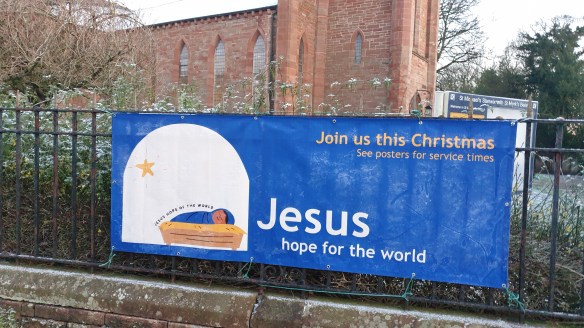
Jesus – Hope for the World declares the banner outside the church near where I live. I can’t help but wonder about the naivety of the people who came up with the slogan and what it means. What are the possibilities?

‘Peace on Earth, goodwill to all men’ (and maybe women)? If so, the world isn’t showing much of either, certainly none that can be attributed to Jesus and his fractured, fractious and frequently intolerant church.

How about inner peace then, even though that’s a long way from ‘hope for the world.‘ How many Christians exemplify this particular fruit of Spirit? Is this, in the end, all that Jesus offers: the hope of a nice fuzzy feeling inside? Of course, peace of mind can be spirit-generate, though personally I prefer wine. 

Hope of reconciliation with God then. Only if you believe in God in the first place, not to mention ‘sin‘, human sacrifice and magic. If this is the kind of hope Jesus represents, then really, what good is it? 

Possibly the hope of which the banner speaks is the hope the earliest Christians had, of Jesus coming back real soon to slaughter his enemies and set up the Kingdom with, naturally, themselves at the top of the pile? Hasn’t Jesus had two thousand years to deliver this hoped for outcome?  An idea well past its sell-by date, the Kingdom of God on Earth isn’t ever going to materialise, however much ‘hope’ people have.

Maybe, then, it’s a hope of eternal life. The gospel writers have Jesus make such a preposterous offer (e.g. John 10:27-28). If this is what Christians are hoping for they are sadly deluded, and, as Paul puts it, the most pitiable of all people (1 Cor 15:19). No human being outside of myth and comic books has ever lived forever. None ever will.

Hope of heaven? See above. Besides, the Bible really doesn’t offer a place in heaven to anyone. That’s a much later development. It’s a waste of this one and only life to live in the vain hope of something better after death. 

Maybe the hope referred to is hope in hope itself. How futile would that be? Hope is no substitute for food for the hungry, shelter for the destitute, treatment for the sick. 

When I go to the carol service at the church next weekend, I’m confident it will be made clear just what sort of hope Jesus offers the world. If not, I’ll be sure to ask. I’ll let you know.

Cruci-fiction

Given the birth, baptism and wilderness narratives are fiction, why not then the other parts of Mark and Matthew? We’ve already seen how the trial and crucifixion in Mark are literary creations, which Matthew lifts and embellishes. The resurrection stories are also invented, which is why the different accounts are confused and contradictory. The likelihood that everything between the beginning and the end – Jesus’ ‘ministry’, miracles and preaching – is invented too, either by the authors of the gospels themselves or by those who preceded them. My money would be on the former; the stories are so carefully arranged, forming an integral part of a clever literary construct.

I have a growing, sneaking admiration for what Mark and Matthew, and later Luke and John, achieved. They consciously set about creating myth. When Paul and others preached that their Christ had died and risen again ‘according to the scriptures’ that’s literally what they meant; the Christ was discernible in Jewish scripture, his story laid out there for those with eyes to see it. Mark tells us as much in Mark 4:9: ‘He who has ears to hear, let him hear.’

What he and, to an even greater extent, Matthew did, was construct a Saviour story from these elements. They saw him, or thought they did, all over the place. Whether or not there was an actual Jesus is beside the point. as is the extent to which the gospel writers may have used existing stories about him. Gospel Jesus is their imaginative creation from start to finish. His life, deeds and many of his sayings are put together by cutting and pasting scripture.

Cite any episode in Mark and Matthew’s gospels and it will have a precedent in scripture, either a prophecy (that invariably isn’t a prophecy) or episode (that was never about a future suffering Messiah) or character (usually legendary in their own right.) You can believe, as many True Believers do, that these ‘Old Testament’ episodes foreshadow the events of Jesus’ life. That he miraculously fulfilled prophecy through everything he did and said while here on Earth. Or you can take the view that doesn’t rely on faith in the miraculous, and recognise that he’s merely written that way. He’s the literary embodiment of scattered scraps of scripture.

On this much more realistic view, everything Jesus is made to do, particularly his miracles and crucifixion, is symbolic; a fictional enactment of scripture. Other aspects are drawn from Paul (the Last Supper/Eucharist, for example), claims of inner-visions (the resurrection) and early cult rules (behavioural expectations.) The events of Jesus’ earthly existence, as created by the gospel writers, have no historical basis; they didn’t really happen. I maintain that all of the gospel writers were fully cognisant of this as they created their respective symbolic lives for him.

Where did Luke get his Bethlehem story from?

Previously on RejectingJesus:

Matthew creates his nativity story, specifically Jesus’ birth in Bethlehem, from Micah 5.2, which prophesies that a ‘ruler over Israel’ will be born there. This prophecy is imposed on Jesus who was not a ruler of Israel – though he may have aspired to be – and certainly was not the Messiah envisaged by the creators of such prophecies. I suggest that subsequently, Luke embroidered Matthew’s fairly basic story and contrived to get Jesus born in Bethlehem by inventing a Roman census that required his parents to travel there.

A Christian commenter (let’s call him Don) then challenged this scenario by claiming, without offering any evidence, that Luke did not have access to Matthew’s gospel, so must have known that Jesus was born in Bethlehem from an independent source. (Christians are fond of attributing suspect gospel material to oral traditions and the hypothetical Q. Don is no exception.)

In fact, a number of scholars, including Michael Goulder, Mark Goodacre, Richard Carrier and others, think that Luke did know Matthew’s gospel. This is the so-called Farrer hypothesis, named after Austin Farrer who first proposed the idea in 1955. As well as his plagiarising 55% of Mark, these scholars show that Luke also used material from Matthew, including the Bethlehem story. The structure of Luke’s version and some of his phrasing is identical to Matthew’s. It is unlikely this would be the case if Luke wasn’t lifting directly from Matthew’s account.

Luke goes further and replaces some of the details in Matthew’s story that don’t suit his purpose (e.g. the magi) with his own (the shepherds), which is why the two accounts diverge. Nonetheless, both versions of the story stem from the ‘prophecy’ in Micah 2.5. Luke doesn’t cite it explicitly but then he is non-specific elsewhere in his gospel about events that supposedly fulfil prophecy. Unlike Matthew, Luke was writing for a gentile audience who would not be as familiar with Jewish scripture; he didn’t need to be as explicit about the source for his stories that were based on these scriptures. Nonetheless, the two nativity accounts, Matthew’s and Luke’s, likely had the same basis (the Micah prophecy) with Luke adapting the narrative that Matthew had already created from it. Moreover, the differences in detail between Matthew and Luke’s accounts demonstrate clearly that both authors were inventing their respective stories. As Neil Godfrey puts it,

Luke, attempting to adapt Matthew’s Bethlehem as the place of birth of Jesus to his more universalist theme, feels obliged to concoct a silly story of everyone being required by imperial edict to return to their places of birth for a special tax registration. Not to mention the necessary anachronism of his Quirinius timing, too. It is not hard to see that Luke is struggling to incorporate Matthew’s Bethlehem setting into his own tendentious narrative.

It’s possible, of course, that all of the scholars who think Luke knew Mathew’s gospel are wrong, but even so, this doesn’t rescue Luke’s nativity from its fictional moorings.

First, it could be argued that both Matthew and Luke knew about Jesus’ birth from their respective sources. Our Christian commenter would say, and does say, that the details of Jesus’s birth were well known in the early, pre-gospel cult (he disputes that Jesus was in any way famous beyond this select few) and that these details were preserved in a reliable oral tradition or in Q. If the former was the case, however, the two nativity accounts would not differ to the extent they do, unless the oral traditions weren’t as reliable as our commenter likes to say they were. On the other hand, Q, if it existed at all, was comprised primarily of sayings and certainly did not include any Bethlehem narrative.

Second, Don will no doubt say that all of this is mere atheist grumbling and is therefore entirely fallacious. He believes that God inspired his anonymous agents to use prophecy, foreshadowing and typology to point the way to Jesus and his birth in Bethlehem. Don believes that both Matthew and Luke had independent knowledge of Jesus’ birth there, which means it must’ve been his birthplace. Of course it indicates nothing of the sort. If Matthew and Luke settled on Bethlehem independently, it would demonstrate only that they had independent knowledge of Micah 2.5.

Third, if the circumstances of Jesus birth in Bethlehem were so remarkable – miraculous, even – then why does Mark not mention them? According to Don (though no serious scholar shares his view) Mark’s gospel is comprised of the recollections of Peter, Jesus’ closest, dim-witted pal in the synoptic gospels. Did Jesus never mention his birth to Peter? Did Peter then fail to pass the details on to Mark? Did Jesus’ mother Mary, who treasured memories of the miraculous birth, never allude to them when she and Peter reminisced together over a glass of water wine? (Yes, Don, I know this is in John’s gospel, but they are meant to be the same characters.) Why does the Bethlehem birth only emerge in Matthew, who built much of his gospel around ‘prophecies’ from scripture, and in Luke, who, in all likelihood, copied from him?

We can be fairly certain that Jesus was not born in Bethlehem. Someone somewhere, other than these two, would have mentioned it outside of symbolic stories that owe far more to myth and legend than they do to fact.

Christmases With Grandad: Christmas Past (1960)

Part three of a three-part Christmas story written for BBC Radio Cumbria.

It was still really dark when I woke up. Really dark. Very, very quiet too. I knew it must still be the middle of the night but I couldn’t see my clock. Even if I could have done I might not have known what time it was because I was only just learning how to do that. I didn’t know if Father Christmas had been. I wriggled my feet down to the end of my bed where it was really, really cold, to see if I could hear any paper rustling down there. I wasn’t very sure I could. I was a bit worried then. If Father Christmas hadn’t been yet, he might not come at all if I stayed awake. I closed my eyes to try and get to sleep again but I couldn’t.

I thought maybe it’d be a good idea to sing one of the songs I’d learnt at school. We’d done a nice concert about a baby being born for our mummies and daddies and we’d learnt some songs for it. I’d had a piece of paper to read too. It said Mary and Joseph had to go to Bethlehem to have a baby, but as I couldn’t really read I just remembered what it said. Then we had sung Little Donkey. So I sang some of that in my head and then O Little Town of Bethlehem because we sang that too, but I could only remember the first bit so I did that two times.

When I finished singing in my head it was still dark, and still quiet and cold. I couldn’t think of anything else to do, so I decided I’d switch my light on. I got out of bed as quietly as I could, tiptoed across the cold lino and reached up to the switch. That’s when I saw that Father Christmas had been after all! There were my presents at the end of the bed. I pulled the red crinkly paper off the first one. It was the train engine I wanted! And the next one was some railway line. I got the rails out of the box and tried to fit them together but it was hard. I must’ve made too much noise because the next thing I knew was my mummy and daddy came in to my room. My mummy sat on the edge of my bed wrapped up in her eiderdown because there was ice on the inside of the window and she was very shivery. She said, ‘Neil, it is still only half past five. It’s far too early,’ but she didn’t mean it because she didn’t make me go back to bed. My dad fitted the railway line together into a big circle and we wound up the little engine and watched it go round and round the track. I knew then it was going to be a lovely Christmas.

A lovely Christmas to both my readers.

Go easy on the wobbly juice.