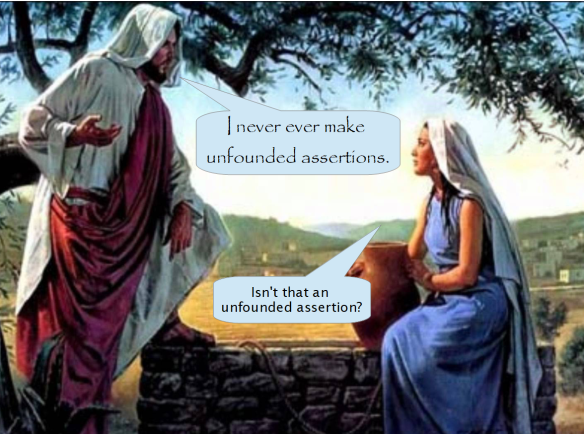
No True Christian


Why is it, I wonder, that every Christian I encounter thinks they are True Christians, while most others are not?

A recent survey in the States revealed that belief in God is in decline. Ken Ham of Answers In Genesis decided this is because:

We live in a day when the religion of secularism (naturalism)—with its belief that there is no God, morality is relative, my happiness is all that matters, and we’re simply the products of evolution—is taught as fact in public schools and through the media.

I suggested on Ken’s Facebook page that the reason more people are rejecting the idea of God might have a lot to do with Christians themselves; that Christians’ own public performance was a complete turn-off for many people. I meant by this the way evangelicals in particular:

  • align themselves with Christian Nationalism;
  • actively campaign to restrict LGBT+ rights (and in some cases to have gay people executed);
  • are obsessed with abortion;
  • disregard almost totally Jesus’ actual commands and instead –
  • waste their time online maligning atheists and other minority groups;
  • are downright unpleasant to those who don’t share their views.

Silly me! I was told by a real Christian called Tim Bodnar that Christians who behave like this are not real Christians (despite believing they are):

If we are to know fellow believers by their fruit (or as you say, “public performance”) – we then know that their fruits show them to not be the Christians they claim to be.  That’s why our relationship with Jesus Christ is a personal one.

When I pointed out to Tim that this was nothing more than the No True Scotsman fallacy, he told me – passively aggressively but oh so lovingly – that ‘it isn’t difficult to grasp’ what’s going on; Christians who aren’t real Christians are the same as people who impersonate police officers. In any case, he said, Jesus had it covered.

Maybe it’s a good thing Christians refuse to look to themselves to learn why others are increasingly rejecting their God and their beliefs. After all, if they were to make their worn-out old fantasies more attractive, more people might fall prey to them. ‘True’ Christians are to be applauded for discouraging, albeit unwittingly, belief in their non-existent God.

If The Resurrection Had Really Happened

Somehow this repost unposted itself after the first few comments. I’m reinstating it and will post something new soon

Don thinks I ‘exaggerate’ when I bring up what the New Testament says are supposed to be the direct consequences of the resurrection. As he seems to have no knowledge of the things Paul and others promised would follow, I offered to provide him with chapter and verse. The easiest way to do that is to republish this post, slightly amended, from 2018. (Alternatively, there’s this rather more flippant take on the subject.)

I’m willing to bet Don now tells me I don’t know how to interpret prophecy like an ancient Jew would, that the promises are really metaphors and despite being written for members of the nascent cult they’re really meant for people thousands of years in the future. 

The Christian faith rests entirely on the resurrection of Jesus. As Paul says in 1 Corinthians 15.17 & 19:

 …If Christ has not been raised, your faith is futile; you are still in your sins. Then those also who have fallen asleep in Christ are lost. If only for this life we have hope in Christ, we are of all people most to be pitied.

Of course neither Jesus nor Paul’s invention, the Christ, were raised from the dead; those encounters with him, described in the gospels are, like Paul’s, visions and sensations of his presence (later ‘the Holy Spirit’) embroidered in the 40 or more years between when they occurred and when they were recorded.

Let’s though, suppose that Jesus really did rise from the dead and work backwards from there. What difference did it make? More specifically, what does the bible say were the results and consequences of Jesus being raised?

The Coming of the Kingdom

According to the New Testament (Matthew 25.34; Romans 15.12; Revelation 20.4-6), the resurrection was a clear sign that the Final Judgement and Yahweh’s Kingdom was finally arriving on Earth. Jesus is made to predict it:

Was God’s wonderful reign established here on Earth back in the first century? Was there a final judgement then? Were all wrongs righted, the social order inverted, and war and suffering abolished (Mark 10.31; Matt 5.2-11; Rev 21.4)? New Testament writers believed that following the resurrection, all of this would be happening –

in reality, none of it happened; not then and not since.

The Resurrection of the Dead

Did Jesus’ resurrection result in even more people rising from the dead? Paul said it would; he said Jesus was the ‘first fruits’, meaning the first of many, with others following him in being raised from the dead (1 Corinthians 15.20-21). Has any ordinary person – anybody at all – ever returned from the dead, long after they passed away? Not one; never mind the hundreds or thousands Paul and other early cultists had in mind. No Pope, no shining example of Christian piety, no activist or worker in the Lord’s vineyard has ever been resurrected during Christianity’s entire history. The dead have always remained stubbornly dead.

So no, this didn’t happen either.

New Creatures

Did the resurrection result in those who believed becoming ‘new creatures’? Paul said it would (2 Corinthians 5.17). He also said members of the new cult would be loving, forgiving and non-judgemental (1 Cor 5.12 & 13.14). There’s no evidence, from his letters, that they were, nor is there evidence from the long and often cruel history of the church. Christians today don’t always radiate loving-kindness either. Those who are caring and gentle before they become Christians remain so; those who are self-gratifying, vindictive or exploitative find a new context in which to be so. As I’ve said before, religion is like excess alcohol; it exaggerates the essential characteristics of a person, for good or for bad.

What it doesn’t do is make shiny ‘new creatures’.

So, what conclusions can we draw from this? Perhaps that nothing went to plan in post-resurrection Christianity. The promised results all failed to materialise. If the effects of the resurrection were and are not what they should have been, what does this say about their supposed cause?

If a storm is forecast and yet, when the time comes, there is no rain, wind or damage, wouldn’t we say that there was no storm?

If a woman said she was pregnant but during the ensuing nine months there was no physical evidence of pregnancy and ultimately no baby, wouldn’t we say she wasn’t pregnant at all?

If God’s Kingdom on Earth, brand new creatures, the resurrection of ordinary believers and the final judgement failed to materialise, wouldn’t we say there can have been no resurrection? The supposed causal event of all these non-effects really can’t have happened. Jesus died and like all dead people stayed dead. The visions, dreams and imaginings of his early followers gave rise to a cult in his name, one that, ultimately failed on all levels to deliver what it promised.

There was no resurrection.

Jesus And The Resurrection Metaphor

While choosing Jesus quotes to use in an earlier post, it struck me how the risen Jesus never declares his resurrected status. He doesn’t say, ‘I am risen’ or indeed anything similar. Instead it’s left to others to claim, ‘He is Risen!’ That’s because the resurrection is a declaration of those others’ visionary experiences and their subsequent faith in those visions. Rather than have him declare himself risen, the Jesus in the (much later) gospels goes about ‘proving’ his reappearance is ‘in accordance’ with scripture (Luke 24:25-27; Acts 1:3 etc).

For those who insist Jesus resurrected physically, this is a bizarre turn of events: Jesus having to ‘prove’ he’s alive again by referencing bits of scripture? In fact, this is the biggest clue we’re dealing with a made-up story. ‘Proving convincingly’ over forty days that he’s risen because it somehow fits with a few unrelated quotes from scripture is an attempt by the gospel writers to ‘prove’ to those in the early Jesus cult that the visions of its founders were completely kosher: ‘visions they might have been, but they really were Jesus, honest: scripture says so!’ If Jesus had really risen in his physical body, he would have had no reason to ‘prove’, convincingly or otherwise, he had resurrected. Eye-witnesses would have seen him in the miraculous flesh. All the ‘proof’ needed, surely.

In fact, the gospel authors knew Jesus’ resurrection was nothing more than inner-visions experienced by a few fanatics. We know this was the case for Paul and John of Patmos. The risen Jesus’ real world appearances were invented by Matthew, Luke and John (Mark of course doesn’t even attempt it) and retain the visionary nature of those original spiritual ‘encounters’. In the stories they created for him, risen Jesus is frequently unrecognisable, even by those who supposedly knew him in life, appears as if by magic in locked rooms, vanishes at will and levitates into the sky.

The gospel authors were well aware they were fleshing out, literarily, the visions of those with overactive imaginations. Nonetheless, despite having him eat fish and inviting others to poke his wounds, they stop short of making Jesus declare explicitly he had returned in the flesh. They knew he had not. The point of the resurrection appearances was to bring to life those visions and to connect them with Old Testament ‘prophecies’. It was not to recount an actual event.

The resurrection is a literary trope, a metaphor intended to illustrate supposed Old Testament prophecies; literature begetting literature. Except in people’s heads, nothing else happened.

Just Like Jesus

Some parts of this post have appeared before.

Early in the first letter of John, we read,

By this we know that we have come to know Him, if we keep His commandments. The one who says, “I have come to know Him,” and does not keep His commandments, is a liar, and the truth is not in him; but whoever keeps His word, in him the love of God has truly been perfected. By this we know that we are in Him: the one who says he abides in Him ought himself to walk in the same manner as He walked. (1 John 2: 3-6)

Isn’t that interesting? John, whoever he was, says that Christians can know they’re saved because they keep Jesus’ commands and ‘walk’ as he walked. Likewise, others should be able to see these traits too because, as Jesus is (later) made to say, cult members can be recognised by their ‘fruits’ (Matthew 7:16).

Just what are Jesus’ commands that converts can’t help but demonstrate? Here’s a few:

  • Cutting themselves off from family – hating their parents, in fact – just to follow him (Luke 14.26);
  • Deny everything about themselves (Matthew 16.24-27);
  • Forsaking home, job, wealth, status, credibility and comfort to help bring about God’s Kingdom on Earth (Mark 10.29-31 etc);
  • Slaving tirelessly in the service of others (Mark 10.43-44; Matthew 23.11 etc);
  • Selling their possessions so that they can give the proceeds to the poor (Matthew 19.21; Luke 14.33);
  • Turning the other cheek, repeatedly going the extra mile and giving away the shirt and coat from off their backs– if they’ve still got them after giving everything away – (Matthew 5.38-40);
  • Welcoming the stranger, feeding the hungry, clothing the naked and visiting those in prison (Matthew 25.35-40);
  • Forgiving again and again and again (Matthew 18.21-22);
  • Avoiding judging others so that they won’t  be judged in turn (Matthew 7.1-3);
  • Loving their enemies (Matthew 5.44);
  • Regarding persecution and injustices as blessings (Matthew 5.11);
  • Doing miracles even more impressive than Jesus’ own (Mark 16.17-18; John 14.12);
  • Healing the sick, raising the dead and casting out demons (Matthew 10.7-8);
  • Asking for anything in prayer, which will be given to them (Mark 11.24; Matthew 21.22);
  • Telling others that the world is about to end (in the first century) and that only Jesus can save them from God’s wrath (Matthew 28.29-34; Matthew 28.16-20).

How many of these things do we see Christians doing? How many of these commandments are Christians compelled to ‘keep’, as letter writer John puts it? Some, it’s true, make attempts with the last (if only they wouldn’t) and a very limited few have a go at a couple of the others. But as far as most Christians are concerned, these commandments may as well not exist. They don’t see Jesus’ instructions as applying to them. I know from experience that they have ready made excuses for not obeying them, let alone feeling an inner compulsion to realise them in their own lives.

Their excuses necessitate them reinterpreting Jesus’ words. They’re metaphorical, they say. ‘He didn’t really mean give everything away because where would that leave us?’ – or they insist his commands have been taken out of context, or have only a spiritual meaning

Which is to say, nothing Jesus said is to be taken literally, even though the most straight forward reading of his pronouncements is that this is how he meant them. It’s how his early followers, the people who preserved or created his words in the gospels, understood them. Why record them otherwise?

But Jesus’ moralising is inconvenient, impractical, exacting, extreme; ridiculous, in fact, and Christians know this. Still his commands must be dealt with somehow. So the Righteous™ work round them or ignore them completely, replacing his priorities with ones of their own: worshipping him; defending his reputation; striving for power; complaining about secular society; whining about the media;  promoting aggression; acquiring wealth (there should be no such thing as a millionaire Christian); claiming persecution; equating faith with guns; trying to control others’ behaviour; interfering in their sex lives; suppressing LGBT people; arguing that religious rights trump those of minorities; opposing abortion.

None of these figured in Jesus’ agenda. Some are even in direct opposition to what he’s made to say in the gospels.

When we see Christians doing the things Jesus tells them they should be doing – what God’s love perfected in them compels them to do – maybe then we’ll listen to what they have to say. When they demonstrate credibility rather than hypocrisy, maybe they’ll have earned the right to be heard. But as there’s not much chance of that happening any time soon, it’s way past time we ignored them, and their superstition, in much the same way they ignore their Lord and Savior™.

A Christian Writes

A Christian commenter writes –

…there is only one issue of primary importantance. That is is Jesus the Son of Man and the Son of God and my/your Savior. If so, every other issue pales.

Neil, you and many other atheists seem to think Christianity is broken up into a multitude of pieces that do not agree and do not get along because of disagreements on doctrine and practice. That is actually untrue. When it gets right down to it, only the one issue is important. And that means there are billions of Christians in fellowship. That is the church.

If you missed that in your time as a Christian, I wonder if you really were or whether you were merely religious. Now, among the religious there are significant differences and divisions. Religious Roman Catholics disagree with religious Baptists, and Pentecostals with Greek Orthodox and so on. But that is religion. Christians in all those denominations agree and can have wonderful fellowship when it is about Jesus.

And I respond –

This is nothing more than the No True Scotsman fallacy: ‘those who don’t practise Christianity in the way I (or my sect/church) approves of are not true Christians; they’re merely ‘religious’.’ Having thus discounted those who ‘disprove’ the rule, the rule now gives every impression of working. Brilliant!

You assert that ‘only one issue is important… is Jesus… my/your Savior?’ No, he’s not. He’s nobody’s. Just because Paul and those who came after him decided he was doesn’t mean he is. He’s long gone. Dead. Even so, he doesn’t claim in the synoptic gospels that he came to be anyone’s personal Savior. For synoptic Jesus the only thing of ‘importantance’ was working towards the Kingdom of God on Earth. ‘Seek ye first the Kingdom of Heaven, and his righteousness, and all these other things shall be added unto you.’ For some in the early church, the ‘only issue of importance’ was obeying Jesus’ commands, including, presumably, seeking first the Kingdom on Earth (1 John 2:3-6).

The evidence shows, however, that Christians have never managed to do this (not even after discounting those they disagree with). Just look at Paul’s first letter to the Corinthians. The church has been an unholy mess since the very beginning. It continues to be to this day: take a look at Christian Research Network, which denounces fellow Jesus-lovers on a daily basis.

You delude yourself if you think the ‘true’ church, then as now, is in complete harmony, enjoying blissful love-ins with Jesus while everything else, differences in doctrine and practice included, conveniently fade away. But then, you’ve already bought into one of the most perfidious delusions ever foisted on human beings so I don’t suppose another one matters all that much.


Christians Against Ms Marvel

Image: Marvel Comics

In the new Disney+ weekly series, Ms Marvel has been cast as an Asian Muslim who is possibly gay. My god! What is the world coming to? A comic book character (yes, comic book character. Not the president or the head of the church. A comic book character) is Asian, Muslim and perhaps gay. So what?

According to a group of infantile Christians, it’s a very, very big deal. They’ve created a private Facebook page (or rather changed an existing one) so they can tantrum about Disney’s ‘woke’ agenda. I don’t know if they’ve watched the show, though it seems unlikely. Ms Marvel is pitched at a younger audience than, say, WandaVision or Moonknight. It is light and breezy, touching on the very racism these Christians typify.

But let me address some of their objections:

The show, they say, represents ‘the biggest slap in the face for conservative Christians to date.’ An unfortunate metaphor when their Lord and Savior™ tells them exactly what to do when ‘slapped in the face’. According to Matthew 5.39 they should start a whiny Facebook page to protest against the perceived sleight. Oh wait, no, that’s not it. They should, he said, ‘turn the other cheek’ for a second slapping. Wouldn’t it be a marvel (pun intended) if once in a while Christians did what Jesus commanded them to do?

There’s more: Disney is ‘pushing’ to make ‘Kamala Khan the face of the franchise over Carol Danvers.’ (the original comic book Ms Marvel.) Captain Marvel and Ms Marvel have a complicated history. In the comic books, Carol Danvers became a non superpowered Captain Marvel back in 1968. Monica Rameau, a black American, took over in 1978, and in 2013, long before the onset of wokeism, Kamala Khan, the Ms Marvel of the Disney+ series, made her debut. Carol Danvers, now with powers, appeared in her own movie in 2019. She’ll return, with Kamala Khan, next year. I feel sure God, America and Christian ‘culture’ will cope with this onslaught of merry Marvel mayhem. These Christians’ objections to Kamala Khan betray only their own bigotry.

They whinge that there’ll be ‘no more straight Christian characters from Marvel,’ failing to realise there never have been any ‘Christian’ characters. Marvel comics has never been about peddling Christianity, thank Christ. As for ‘no more’ straight characters, they must mean apart from all the major figures in the MCU and most of the minor ones too. 98% of Marvel (and DC) characters are straight. Or as straight as cartoon characters can be.

What really irritates me about this though, is Christian priorities. This is what the Holy Spirit is prompting God’s holy ones to campaign about? This is what’s important? Again, according to their supposed Savior. He seemed to think that what was important was boring stuff like feeding the hungry, helping the homeless and loving enemies. Not wasting time moaning about a film company choosing characters and casting actors that privileged Christians don’t like because they’re different from them.

Jesus wouldn’t recognise this sort of embarrassing expression of faith. Lucky for today’s low-calibre Christians then that he doesn’t exist.


Ring-a-ding-ding

Don has responded to my challenge that I set him in the last post. His full response is in the comments section but I’m going to address what he says here:

It is not the fine points of doctrine but the essential points of doctrine that John is talking about…

Really, Don? Where does John say this? Certainly not in the following verse which you cite. Be honest, you just made it up.

This issue rose when you proposed that the Book of Mormon could just as easily by received as scripture as the Bible.

Well, not quite. I asked you why you are not a Mormon, given that the Book of Mormon has, superficially at least, as much credibility as the Bible, perhaps more, given its supposed origin and the eye-witnesses who affirmed its creation. (I’m not a believer in its baloney, just as I’m not in the Bible’s.)   

When I read BoM I do not find a Jesus that is like the Jesus of the Bible. That is sufficient to reject it. I don’t have to worry about baptisms or temples or anything else. If Jesus in the BoM is not the Jesus of the Bible, nothing else matters.

The same is true of the Ken Hams, Douglas Wilsons, and Dillon Awes and Neil Robinsons. If they proclaim a Jesus who is not the Jesus of the Bible, what they have to say about creation, women, homosexuality, or the return of the Lord makes no difference. If they agree with the Bible about Jesus, then we might get down to using out God-given ability to read and interpret. And we might differ. And that won’t matter. Wherever we land on these issues, they are far less important than who Jesus is.

And here we hit some real problems.

You fudge around the issue of whether you agree with the preachers and teachers I quoted, eventually implying that you don’t. (Don’t you get tired of being the only one in step, Don?) You insist that interpretations of Bible verses and the claims Christians make must always be measured against Jesus. But which Jesus is this, Don? The one in your imagination: the meek and mild Mr. Nice Guy that you’ve constructed in your head from a lifetime of conditioning and cherry-picking the Bible? Because if we compare the Jesus in the gospels and the version of him that supposedly inspired Paul and the other NT writers, we find the prattling and general ignorance of Awes, Ham and Wilson matches up perfectly.

For example, Jesus – the man who reputedly said ‘love your enemies’ – tells us what he’d like to do to his own enemies:

But as for these enemies of mine, who did not want me to reign over them, bring them here and slaughter them before me. (Luke 19.27)

And according to Revelation 9, he’ll do just this when he returns with his sword in his mouth. He will unleash plagues of locusts to torment and torture non-believers. However,

(those) not killed by these plagues still did not repent of the work of their hands; they did not stop worshiping demons, and idols of gold, silver, bronze, stone and wood—idols that cannot see or hear or walk. Nor did they repent of their murders, their magic arts, their sexual immorality or their thefts.

Later, while the Son of Man watches on, these poor souls get trampled to death:

The angel swung his sickle on the earth, gathered its grapes and threw them into the great winepress of God’s wrath.  They were trampled in the winepress outside the city, and blood flowed out of the press, rising as high as the horses’ bridles for a distance of 1,600 stadia. (Revelation 14.19-20)

Not hard to see how Ames can justify what he’d like to see done to LGBT+ people, is it. Murderous-Jesus endorses him.

(I know Don, these are among ‘the fine points of doctrine’ your anointed lie-detector doesn’t work on, so you ignore them. Alas, crackpots like Awes do not.)

What about Ham’s contention that dinosaurs and humans co-existed? He’s made a career, not to mention an ark, out of believing such crap. Does your cuddly-Jesus endorse him? Why, yes, he does. He believed in a literal Adam and Eve and a six day creation (Mark 10.6). If he’d have known about dinosaurs, which of course he didn’t, he would have had to fit them into this scenario, just like Ham does.

And how about Jesus’ views of women? While he side-lines them in his pronouncements about divorce (also Mark 10) he consistently ‘reveals’ to Paul and other NT writers that women must submit in all things. The word and its derivatives occur in almost all the passages that discuss women – ‘submit’ and ‘submission’. Easy to see how Wilson believes this applies to sex as well as every other context. Unless of course the Jesus in your head has told you differently. 

So there we have it. Any extremist, despicable view can be justified by appeal to Jesus. To say these differences don’t matter because only Jesus matters is laughably disingenuous. Jesus supports any and all claims made in his name. To paraphrase Paul, he is all things to all men. 

As for me, I’m always careful when discussing Jesus to quote the gospels, as I do above, and where relevant other parts of NT. I realise you don’t like this, because I don’t have your imaginary supernatural radar, but I’m happy to show Jesus in his true light and use his own words to condemn him.


Don’s Dynamic Lie-Detector

But you have an anointing from the Holy One, and all of you know the truth. I do not write to you because you do not know the truth, but because you do know it and because no lie comes from the truth.

1 John 2:20-21 as quoted by Don Camp.

Our resident, regularly banned God-botherer, Don Camp, claims that he has a special way of reading and interpreting spiritual writing. No, he hasn’t got a pair of magic rocks, but an inner ‘anointing’ with what Don calls his ‘lie-detector’. (You might have a similar device yourself, known more commonly as a bull-shit detector. Its alarm may well have been a-ring-a-ding-dinging when you read Don’s comment.)

Anointing, if you’re interested, is the ancient Jewish custom of initiating a king or priest by daubing oil on their head. Don has no evidence that he has been inwardly ‘anointed’ by an unseen spirit that helps him understand scripture better than anyone else. There is no evidence, outside of subjective feelings and one tautological bible verse, that any religious believer has had this done to them. (Read 1 John 2.20-21 again, Don, and you’ll see that a tautology is what it is: ‘the truth is the truth is the truth,’ is really all it says.)

On the contrary, we find that different Christians interpret given scriptures in a variety of different ways (I’ll get to examples in a minute). They differ too on which bits of the Bible are relevant to them and their church or sect. They disregard or explain away verses that don’t suit their purposes.

Don does this himself. His anointing Spirit doesn’t lead him to interpret verses like Matthew 16:27-28; 24:27, 30-31 & 34, Romans 13, 11 & 12, 1 Peter 4:7, 1 John 2:18, Revelation 22.20 etc at face value. He cannot countenance the fact that Jesus, Paul, John and all those other early fanatics were wrong about when the end of the age would happen – they are all very clear they thought it was imminent – so he reinterprets what they say to mean something they clearly and unequivocally do not. Don’s interpretation has them meaning, despite what they say, that the end of the age and all that goes with it would be thousands of years in their future. Should you challenge him on this, Don tells you that how you see it is wrong because you don’t have the special anointing he has. As he puts it in his comment, you’re lacking the right ‘dynamic’ (ring-a-ding-ding!) and as a result, you are incapable of interpreting scripture in the right way (i.e. his way).

In fact, Don does not have a way of understanding scripture that he can call his own. Rather, he interprets it with preconceptions he’s acquired elsewhere; that it is God’s Word, that it is Truth, that the spiritual world it describes is real, that it relates an historical resurrection, and so on. He comes to it with these presuppositions that he has learnt from preachers, teachers, commentaries, devotional books and other Christian propaganda he’s been exposed to. He is completely unable to take a step back to look at what he’s reading objectively. He knows what it says before he reads it – ‘truth’ as far as the Bible is concerned, ‘lies’ when it’s the Book of Mormon – and imposes that meaning onto it. This ‘dynamic’ enables him too to smooth over all of the Bible inconsistencies and allows him to see it as one seamless garment when it evidentially is not. He’s not alone in doing this, of course. Most evangelical (‘anointed’) Christians do it. I know I did.

Now for those examples, and a challenge for Don:

1. A few days ago, Holy Spirit anointed, preacher Dillon Awes used his dynamic lie-detector to interpret the Bible’s declarations about homosexuality like this:

What does God say is the answer, is the solution, for the homosexual in 2022, here in the New Testament, here in the Book of Romans (1:26-27)

That they are worthy of death! These people should be put to death!

Every single homosexual in our country should be charged with the crime, the abomination of homosexuality, that they have. They should be convicted in a lawful trial. They should be sentenced with death. They should be lined up against the wall and shot in the back of the head! That’s what God teaches. That’s what the Bible says.

2. Similarly, over the weekend, Ken Ham interpreted Genesis 1 to mean that dinosaurs and humans lived at the same time. After all, he ‘reasoned’, Genesis says God created ‘everything’ in those first six days, so that must include dinosaurs as well as Adam and Eve.

3. Pastor Douglas Wilson who featured recently on Bruce Gerencser’s blog, interpreted the assertion in Ephesians 5:22-24 that wives should be submit to their husbands, even if it entails rape:

…We have forgotten the biblical concepts of true authority and submission, or more accurately, have rebelled against them… However we try, the sexual act cannot be made into an egalitarian pleasuring party. A man penetrates, conquers, colonizes, plants. A woman receives, surrenders, accepts. This is of course offensive to all egalitarians, and so our culture has rebelled against the concept of authority and submission in marriage.

My question to you, Don, is: do you interpret Romans 1:26-27, Genesis 1 and Ephesians 5:22-24 the same way as these other Holy Spirit directed interpreters of scripture? If not, why not, when it’s the same Holy Spirit that equips you with your dynamic lie-detector, that also leads them into all truth?

These is not a rhetorical question; we all want to know. But be warned, Don, our bullshit detectors are primed and ready.

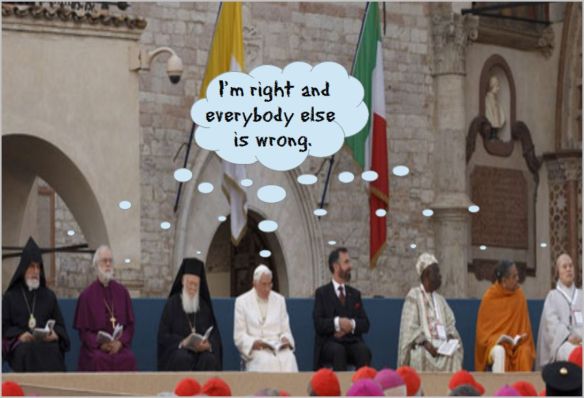
 

God’s Megaphone?

from his book, The Problem Of Pain

Does the Christian God use pain to draw people to himself? Assuming for a moment that such a God exists, does he use human suffering to make followers for himself?

There is no evidence in the Bible to suggest he does. To be sure, the Bible has a fair amount to say about pain. It claims that suffering is a means by which God either chastens Christians (Hebrews 12.7) or strengthens them (Romans 5.3-5), but this is exclusively for people who already believe. The Bible does not say non-believers are afflicted as a means of drawing them closer to God; the idea is unbiblical.

Let’s assume then that while this notion finds no support in the bible, Christians have learnt over the centuries, perhaps though extra-biblical revelation, that God does use pain in this way. What does this tell us about God? That he’s a being whose principal way of making human beings pay attention to him is by causing (or allowing) them to suffer frequently unbearable pain and anguish.

What sort of God is this? Not one who loves the world and cares for humans far more than he does mere sparrows (Matthew 6.26). He’s more an unpleasant, sadistic bully: the jock who backs you up against the wall, grips your balls and squeezes hard.

Maybe that’s how it is. The God who created the universe is just such a being; a moral monster, as commenter koseighty puts it. It’s easy to see how he might be: human beings suffer, yet there’s (supposedly) a God who loves them; therefore pain and suffering must at the very least be sanctioned by God, or, more likely, delivered by him. This, after all, is the story of the Old Testament. The God so arrived at though is a thoroughly human creation, a means of minimising cognitive dissonance by reconciling human suffering and a God who supposedly cares.

One more assumption is needed. Let’s assume this time that despite the odds, this character really exists. Does his strategy work? Does inflicting pain and anguish on people make them, as Lewis suggests, cry out to the One doing (or allowing) the inflicting and compel them to love him? It seems unlikely; I can’t find any evidence online of anyone claiming that pain or anguish brought them to God. From a personal perspective, I can honestly say that in times of distress or suffering I have never, post-deconversion, called out to God or any supernatural entity for help. I’ve never interpreted my suffering as his calling me closer and have never, since escaping Christianity, succumbed to his malicious charms. (What I did do occasionally, following my deconversion, was to convince myself that my suffering was a punishment from God – for leaving him behind, being gay or something I’d done. These feelings disappeared when I embraced fully the fact that the Christian God isn’t real.)

Where does this leave the Christian with, as Lewis puts it, ‘the problem of pain’? How do they reconcile a loving God who allows or even causes human beings to suffer? They can’t. Instead they spout empty platitudes that they think let their indifferent, imaginary God off the hook. Just look at the meaningless theo-babble religious leaders came up with in 2004 after a tsunami hit Indonesia, killing 227,898 people.

Leave God out of the equation, however, and there are far better explanations for why humans suffer. ‘Shit happens’ is far more convincing than anything the religious have to offer. Physical pain is the body’s reaction to damage. It is an imperfect system that frequently overreacts or fires up even after damage is repaired (I know this having fibromyalgia). That’s what it is to have, to be, a physical body. Anguish comes from random acts of nature, the violence and cruelty we inflict on each other and the death of loved ones, much of which is beyond human control. ‘Thoughts and prayers’ are useless in ameliorating this kind of suffering. Measures to restrict people’s access to weapons undoubtedly helps, as it has in countries with politicians with sufficient strength and intelligence to enact gun-control legislation. Without it, as in Ulvalde recently, more children will die, more parents will experience terrible anguish and another massacre is inevitable. God won’t stop it.

Suffering is not symbolic of something else; it is not ‘God’s megaphone’ or an opportunity for others to point those afflicted to Christ’s light (or any other bullshit that involves the supernatural.) Pain simply is. It is our lot as physical bodies to endure or alleviate it as best we can.

Assertions

Don likes to take me to task for what he says are assertions in my arguments. I do make assertions, as do we all, because not all points in an argument need to be demonstrated every time they’re used. Indeed, not all assertions can be.

There are assertions that we all accept are likely to be true: the sun will ‘rise’ tomorrow; the Earth is a sphere; evidence is better than no evidence and so on. There are those who dispute these assertions but the onus is then on them to provide the evidence or argument that their counter-assertion is true. Yes, there may come a day when the sun doesn’t rise but it is statistically improbable; the Earth is demonstrably not flat; faith is not an reliable substitute for evidence. There is abundant evidence and sound argument why these things are not the case. But – and this is my point – this evidence does not have to be trotted out every time an argument relies on such probabilities; they can be asserted.

I write, and indeed live my life, on the basis of the fact (‘assertion’) that the supernatural does not exist. Over the last ten years, I’ve posted several arguments why this is the case. I frequently provide a link to these arguments when asserting that, outside of the human imagination, gods, spirits, angels, devils, demons, powers, principalities, ghosts, avatars, heaven and hell do not exist. These arguments form the backbone of any subsequent assertion that the supernatural is not real.

Nonetheless, the onus to ‘prove’ that this is the case does not rest with me. First, because it is impossible to prove a negative. Consider, for example, the Christians challenge to prove their God doesn’t exist. While there is plenty of circumstantial evidence that this is the case, there is no absolute ‘proof’ of God’s non-existence (as I’ve argued before, it all comes down to probability, or, in God’s case, improbability.) Absence of evidence is invariably evidence of absence.

The onus instead lies with the one making the incredible claim. Those who take it as fact that the supernatural and God are real need to demonstrate to the rest of us that this is the case. They have, in my long experience, failed to do this. The best they can do are the various arguments (the ontological, Kalam cosmological, teleological, fine-tuning and the argument from design) that suggest the possibility of the supernatural but fall far short of convincing evidence that the supernatural is real, and further still that the Christian God exists. They depend in the end on the feelings they have in their heads and the Bible (or some other holy book.) This is wholly inadequate

Consequently, I’ll continue to operate from and make my assertion that the supernatural does not exist until such time as Don or any other of his co-religionists demonstrate the probability that it does.

From my assertion, backed up, remember, by earlier arguments, a number of other facts follow:

With no supernatural, there are no gods; YHWH in all his incarnations is a God, therefore YHWH does not exist.

Much follows from this:

If YHWH does not exist, Jesus cannot have been either his avatar, Son or incarnation;

Jesus cannot have been raised from the dead by a being who doesn’t exist;

Stories that he did so must therefore be merely that: stories;

The celestial, eternal Jesus who sits at the right hand of God in heaven is not real;

Any experience people have of this being is entirely within their own imaginations;

The Bible is based on such imagined encounters with these imagined characters;

There is no after-life or judgment;

The Christian faith, including my own, cannot be explained in terms of the supernatural;

Only explanations that are rooted in naturalism, as in science, have any validity.

There are more implications that can be drawn from the premise that there is no supernatural, including the fact that the world makes much more sense (if it makes any sense at all) without drawing gods and demons into it.

Consequently, I shall continue to make my assertions, like those above, supported as always by previous argument. Any religious believer who wants to challenge them is welcome to do so, but must do more than point out the obvious, that they are assertions. They must provide the evidence for the supernatural, and all that follows from it, independent of the goings on in their heads and without reference to holy books written by those with similar subjective feelings.