How it is

God5

It all depends on the premise from which you begin. I’m tired of the arguments of Christians of all stripes that

   The bible is the inspired word of God

      Jesus died for me

          He really did rise from the dead

                Jesus was, in some sense, the son of God

                     God, or Jesus, loves us and wants to have relationship with us

                          God, or Jesus, will forgive our sins if only we ask him

                            He has supernaturally changed the lives of millions

               We are all, whether we realise it or not, involved in a spiritual battle

       Jesus is coming back soon to judge the world

Most people will go to Hell, a select few to Heaven

We can argue with Christians about these claims – and others you can probably think of yourself – pointing out how the Bible really can’t self-authenticate itself, that just because it appears to say it’s the Word of God doesn’t mean it is; arguing about who wrote the gospels and whether they can be trusted; disputing the resurrection when the bible’s own accounts are so inconsistent; challenging the theology behind Paul’s redemption formula… and so on.

But really, why bother? Take a step back.

All of these ideas are dependent on one thing: that there is a God.

Yet there is no evidence there is. Christians will tell us that that the absence of evidence doesn’t necessarily equate with evidence of absence, but in this case it does. The absence of evidence that I keep a pink unicorn in my garage is fairly conclusive evidence that I don’t – and so it is with God. The evidence for him is circumstantial and so remarkably thin that the probability he exists is virtually zero (I’ve discussed this previously; here, for example). What humans have imagined him to be is not evidence of his external reality; a book written by superstitious sheep-herders and first century fanatics certainly isn’t. And beyond that? Nothing.

It follows that if God doesn’t exist then

       the Bible can’t be his inspired word;

                    Jesus cannot be his son;

                       God cannot have sent Jesus to redeem us;

                            he cannot have raised Jesus from the dead;

                                  he cannot be offended by ‘sin’;

                                        it cannot be God who changes lives;

                                  heaven and hell are not real;

the whole panoply of supernatural beings that populate the bible don’t exist either.

Take away God (and he was never there in the first place) and Christianity with its claims of the supernatural, salvation and eternal life, crumbles to nothing. It is nothing.

So it all depends on your premise. If you’re prepared to believe, against the evidence, that God exists you’ll find substance in the claims of religion. If you recognise that he doesn’t, however, you will also recognise that religion’s claims are illusory, fallacious, deceptive. No need to get involved in fruitless arguments with believers about it; that’s how it is.

On being free

chains

Commenter Rebecca responded at length recently to my post ‘Why God Could Not Possibly Have Created The Universe (pts 4 & 5)’. There was so much in her response, that I thought it best to reply to her in a full length post rather than with a brief comment:

Hi Rebecca,

I won’t be able to respond to all of your points as there are so many, but will attempt a few.

I’m glad you find your faith beneficial. You’ve obviously thought about the whole incarnation/sacrifice/reconciliation issue, but I wonder whether you’ve ever asked yourself what it is you need saving from and reconciled with? What is it that means you personally need to avail yourself of the sacrifice Jesus supposedly made (however you interpret that)? I guess evangelicals, of which you seem to say you are not one, would claim it’s because of sin; the alienation from God that our very existence seems to cause.

Is that really the case though? Isn’t it rather that ancient superstitious peoples needed some explanation for why life was so difficult, short and brutish? They reasoned that surely it couldn’t be the fault of the creator God, so his tendency to treat them badly must be entirely their fault. Consequently, they had to do something to appease this god, to make him smile upon them again as they felt he must once have done. They thought the way to do this was, variously, through sacrifice and/or righteous living, by murdering those they felt offended him the most, and through praise and supplication.

There is no getting away from the fact, however, that the primary way they sought to reconcile themselves with their deity was through blood sacrifice. The New Testament’s interpretation of the death of Jesus is expressed in just such terms:

In Him we have redemption through His blood, the forgiveness of our sins, according to the riches of His grace (Ephesians 1.7).

This is not just an evangelical perspective; it is the major theme of much of the New Testament.

I’d like to ask you, Rebecca: are you really so steeped in sin that you need to avail yourself of a bloody human sacrifice in order to be reconciled with God? I have to say it seems extremely unlikely.

I didn’t leave faith behind because of how repugnant this idea is, however. I experienced an epiphany while walking one day, after many years of thinking about such things, and realised with conviction that there was no god: no god to appease, be reconciled with or commune with. He simply didn’t and doesn’t exist (see here for why I think this is the case). Of course, there being no god means there’s no son of god either.

I then started living my life on the basis of the fact there is no god, and I have to tell you it became a whole lot better. I didn’t have the constant feeling I had to come up to some impossible standard; I didn’t feel guilt for the most trivial of ‘sins’; I no longer worried that not getting my beliefs quite right would result in the loss of my eternal life; I stopped worrying about eternal life because it was obvious there was no such thing; I stopped thinking hell and heaven were real; I started living in the here and now; I stopped thinking I had to respond to others’ needs by telling them about Jesus (and started relating to them as people); I no longer had to subjugate whatever intellect I have to force myself to believe things that were clearly nonsense; the self-loathing I felt about my sexuality began to slip away. I could be me, and what a massive relief that was. I think I became a better person as a result. I certainly became a happier one.

You say the bible contains many deep truths – perhaps – but it also includes much that is cruel, spiteful, damaging and just plain wrong. I lost interest in sifting the wheat from the chaff because there was just too much chaff (a free biblical analogy for you there.)

The secrets of life, whatever they may be, Rebecca, are not in the bible, nor in any convoluted explanation of what Jesus stood for (he was just another failed apocalyptic preacher). They do not lie in Christianity or in any religion. Life is more than any of these ultimately dead things.

Thank you for writing. It can only be a good thing that you’re thinking about these issues. You will I’m sure find your way out into the light. I hope what I post here can help you with that.

The evidence for Christ

Christ

The evidence for Christ is not historical — it’s spiritual — and that evidence is indeed abundant for those who believe.

So says T. C Howitt, commenter on the Rational Doubt blog. And what is the ‘abundant evidence’, of which he speaks, for the existence of this spiritual being? It is, he says, ‘spiritual’. That’s quite a tautology: ‘the evidence for my fantasy is my fantasy’.

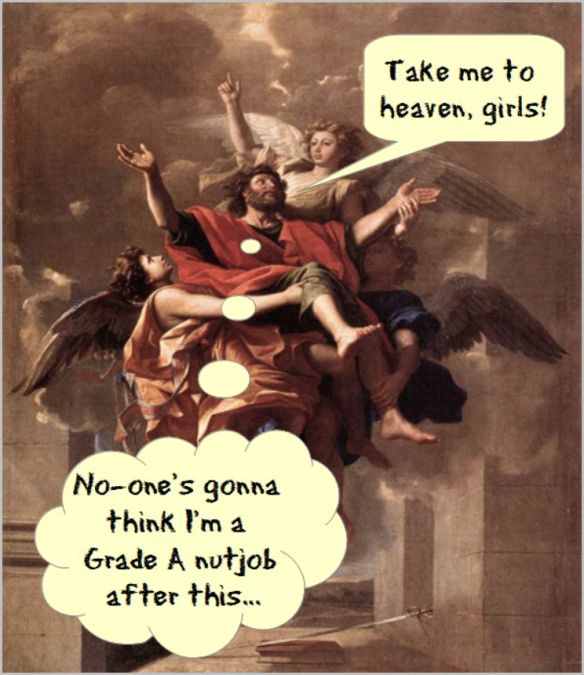
T.C. goes on to say that only those who truly believe can know that their experiences of the spiritual are real; the rest of us, he decrees, are blind. In other words, evidence that his fantasy is real is that other people have experienced versions of the same fantasy – some of them thousands of years ago. The ‘evidence’ for Christ (as opposed to Jesus) is therefore one’s own feelings plus the strange psychotic experiences Paul relates that he feels sure must be this supernatural being.

Science removes human subjectivity, as far as is possible, from its demonstration of how things are. All that Christians (and other believers in the supernatural) need do is similarly demonstrate that the spiritual realm, with its attendant beings, has an existence independent of human emotions, feelings and imagination. They could show us that, like gravity, electricity and quantum mechanics, Christ and angels, seventh heavens, demons and all manner of spiritual beings, have an existence separate from the internal, subjective experiences of human beings.

They’ve had two thousand years to do just this and still they haven’t. Why not? Because it can’t be done: Christ and his angels, God and his heaven are mythologies and, like all others, are constructs of the human mind.


Those resurrection experiences explained

Emmaus

Isn’t it amazing how modern Christians see Jesus in clouds (the picture in the previous post was taken from a site that genuinely believes it was Jesus in the sky – there were lots of others examples there too), on toast, in their own whipped-up emotions, through voices in their heads and as a result of inner-visions but deny that the original resurrection appearances were just the sort of thing? No, Jesus really appeared then, they say, resurrected in his damaged body – he showed Thomas the holes in his side, didn’t he?

Given people’s propensity for seeing things that are not really there – figures in clouds, the sense of a supernatural presence (‘Mother Mary comes to me’) – isn’t it more likely the original ‘manifestations’ of the risen Lord were precisely this; the same sort of ‘sightings’ that people claim to experience today? Maybe not on toast admittedly, but in their heads, in the euphoria of shared worship, in their need for comfort? I’ve done it myself, when I was a Christian. I sensed Jesus’ presence in carefully stage-managed worship, in intense prayer, in what I took to be his response to those prayers. Of course, these were nothing more than my interpreting my own emotions as something from outside myself; an intense and reassuring self-delusion.

Is there evidence of this sort of process in the accounts of the risen Christ? Sure there is – Paul’s encounter is a vision in his head (Galatians 1.16; 1 Corinthians 9.1 & 15:8), while the gospels have Jesus say that whenever two or three of his followers are gathered together, there he will be amongst them (Matthew 18.20). He cannot have meant that, long after he’d left the Earth, he’d be physically present. Rather, this is a later explanation of the intense emotion early believers felt and decided could only be Jesus’ mystical presence – his so-called holy spirit (which isn’t called ‘The Comforter’ for nothing.) They were doing what I did and what millions of Christians still do today – interpreting the feelings they shared in these worshipful contexts as visits from the risen Lord. Later, the gospel writers made Jesus ‘predict’ just such experiences and then firmed them up, so that the accounts of warm feelings and visions became, retroactively, encounters with a physically manifested person.

That’s how it happens today – a vaguely human-like shape in the clouds or on toast and warm feelings become an experience of Jesus. We readily see human form where there is none (we are psychologically primed to seek out human faces) and attribute external agency to phenomena that don’t have any. No reason to suppose it was any different back in the first century.

Why God could not possibly have created the universe (pts 4 & 5)

Sacrifice2

The final two reasons why it is altogether unreasonable to credit the God of the bible with the creation of all that there is.

4. YHWH is inadequate

Christians want us to believe that the God of the bible is the ‘First Cause’ who purposefully created the cosmos. He is, they tell us, powerful beyond imagining, capable of bringing into existence a universe of infinite proportions, with its billions of suns, trillions of planets, nebulae, dark matter, black holes and the rest.

But this vast complexity stands is incompatible with YHWH, who demonstrates all the limitations we might expect of a god devised by primitive nomadic herdsmen. He is anthropomorphic, restricted in knowledge and defeated by technology his creators didn’t possess; like other deities of the period, he is obsessed with bizarre ritual, requiring genital mutilation and the sacrificial burning of animals. He lives, alternately, at the top of a mountain or in a box, from where he is capable of smelling roasting meat, and spends his time issuing laws about sex and slavery. He is primarily a god of war, his acts almost entirely destructive, rarely creative, which is what we might expect from a people continually in conflict with their neighbours.

Whatever else such a being might be, he is not one capable of creating the universe. He is nothing more than a small and petty tribal deity – one of many recognised by the Israelites during their history – created and sustained by men who knew no better. This is the god Jesus believed in, though he relocated him in the sky (‘the heavens’) and tried to turn him into something more amenable.

Despite this partial make-over, the New Testament version of God retains the attributes and limitations of his older self. He is, if Paul is to be believed, still pre-occupied with blood sacrifice, in dictating sexual behaviour and wreaking destruction on his supposed creation. He is no more capable of creating the cosmos than his predecessor. The God that modern Christians insist brought everything into being isn’t this limited, feeble, unsavoury figure. That God is another construct altogether, a far cry from the paltry god of the bible, and one they have devised themselves, that they make appear capable of creating the universe as we now know it to be.

5. The supernatural has no independent existence.

This is the bottom line: outside the human imagination, there is no evidence the supernatural exists. Even if we do take the human imagination into account, there is no evidence of an independent supernatural realm. No-one has ever seen a god, demon or angel, in exactly the same way they’ve never seen a fairy, goblin or unicorn. They may think they’ve experienced spiritual beings ‘within’ or felt them emotionally or hallucinated about them, but this does not mean they have independent existence. Despite millennia of religious belief no supernatural beings have ever manifested themselves, been witnessed, demonstrated or measured. Gods, like angels and spirits, do not exist. It follows, therefore, that the cosmos cannot have been created by them.

Thank you for bearing with me on my exploration of why god could not possibly have created the universe. I don’t know, of course – none of us do (yet) – how it came about, but the notion that it must have been god, the Christian god no less, simply isn’t feasible:

He would have had to create something from nothing, when the supernatural and immaterial are incapable of creating the natural and material.

The bible’s YHWH is too feeble to have been responsible and God-as-creator leads, in any case, only to an infinite regress.

The supernatural is a product of the human imagination; it has no independent existence.

However the universe came to be, we can be certain no gods, including the Christian one, were involved.


Why God could not possibly have created the universe (pt 3)

Sun

Posts here and here considered two reasons why Christians’ claim that their God created the cosmos is preposterous. A third reason is that –

God as creator leads to an infinite regress.

Christians like to assert that everything that has a beginning has a cause; the universe had a beginning therefore it had to have a cause. That cause – watch the unwarranted leap of faith here – can only have been have been their god. My previous arguments notwithstanding – that God needed to create everything from nothing (which according to Christians is impossible) and the immaterial cannot produce the material – the notion that god caused everything begs the question, as Richard Dawkins points out, of who caused his being. If, as Christians like to argue, everything has a cause then their god must have one too. Their assertion that he is the exception because, by definition, he has no beginning and consequently has no need of a cause is merely special pleading; why should he be different from everything else?

Christian apologists – William Lane Craig, for example – always assume that the first cause is their god, without a beginning and need of a cause. Their thinking goes as follows: everything that exists has a cause; the universe must have had a first cause; this first cause was somehow sentient; we are going to call this sentience ‘god’; this god must be our god, YHWH.

Yet they provide no evidence that there is, or was, a first cause; there could have been several contributory causes, including chemical, physical (gravity, for example) and activity on a quantum level. They then make the unwarranted assumption that this cause must have been sentient, again without evidence, and load this presumption with further insupportable connotations when they label it ‘god’. Finally, they make another leap of faith by claiming this ‘god’ is their god, YHWH.

This is all so much special pleading, insisting everything has a cause except the thing Christians don’t want to have had a cause. But God cannot be excluded; he too must have a cause (and indeed he does). So who or what caused him and gave him his start? And who or what created whatever it was that created god? Who or what created that? And on into infinite regress.

Those who offer such arguments put the proverbial cart 613.772 billion years before the horse. As Richard Dawkins says in The God Delusion, intelligence and creativity have only ever arisen as a result of evolution, specifically the evolution of the (human) brain. We know of no other means – there is no other means – by which intelligence and high-level creativity are produced. For a creative, super-intelligent mind to exist prior to the beginning of everything is, therefore, an impossibility. As I suggested in the second part of this series, the physical always precedes the immaterial; the natural world produced the advanced human brain about 200,000 years ago, and that brain has, ever since, projected its gods backward to the beginnings of the universe. This does not mean that a being without a beginning was actually there, much less that he produced the whole show. It means we know the cause of god. It is us.


Jesus just isn’t up to it

A brief diversion from considering why God couldn’t possibly have created the universe…

Falls

Billy Graham’s grandson, Boz Tchividjian, has been addressing the issue of child abuse in the protestant church. He concludes his considered comments with the claim that,“there was no greater defender of children than Jesus.” Presumably he bases this on the few things Jesus is made to say about children in the gospels – all two of them: ‘suffer the little children’ (Luke 18.15-17) and that stuff about ‘whoever leads a little one astray’ (Mark 9.42), which is really more about the precariousness of faith than children. And, according to Boz, this qualifies Jesus as the greatest defender of children ever. No-one has ever done anything ‘greater’ for them. Not Dr Barnardo, not Save the Children, not the NSPCC, not foster carers or ordinary mothers and fathers. Nope, Jesus is the best ever child protector. The same Jesus in whose name both Catholic and Protestant churches have systematically abused young people down the years.

I never cease to be amazed at the willingness of Christians to superimpose every conceivable virtue, and quite a few prejudices, on a long dead itinerant preacher. But this is no modern phenomenon. It began within a few years of Jesus’ death, when religious zealot Saul decided that a peculiar turn he’d had was really Jesus returned from the dead. On the back of this, Saul – newly rebranded as ‘Paul’ – invented all manner of nonsense about a man he’d never met, his entire, tortured theology bearing little relation to any individual who had ever actually lived. We know this is what happened because of the disciples’ objections to Paul’s ideas and the very different ways in which Jesus was later to be portrayed in the synoptic gospels.

Then the crank who wrote Revelation added even more to the Jesus legend; he was now an avenging warrior-king, ready to fight dragons and smite his enemies right, left and centre.

And still it goes on: Christians insist Jesus was perfect, that he did not ‘sin’ or do anything immoral, when the figure in the synoptic gospels is alternately misogynistic, xenophobic, insulting, prone to anger, supportive of slavery and megalomaniacal. Far from perfect, in fact.

Not so, say other Christians who make it up as they go along; Jesus is a great protector and defender, looking after his flock from Heaven. But in reality, his protection is non-existent, as those who implored him to divert hurricane Harvey recently discovered. (We can be sure his uselessness as an insurance policy won’t change the way any of them regard him.)

Even if Jesus isn’t perfect or a great defender, he is, according to extremist nincompoop, Kevin Swanson, a divine punisher, inflicting natural disasters as a result of people’s ’embrace of sexual perversion’. Yet at the same time, he has a special affection for the good ol’ US of A, steering Donald Trump into the presidency and pulling his strings to Make America Great Again.

Or maybe Jesus is really a financial wizard; proponents of the ‘prosperity gospel’ say so, despite Jesus’ repeated repudiation of wealth in the gospels. On the other hand, he’s a sensitive little snowflake, easily offended by anything and everything we do down here on Earth, to the extent he gets upset by what’s on the TV.

Jesus can barely bear the weight of the incredible claims made for him in the gospels (miracle worker, prophet, healer), even though this is a great deal less than the characteristics he’s had projected on him since. Jesus was not eternal, nor the ultimate sacrifice as Paul claimed; he was not God himself as later Christians determined; he was not perfect, nor the greatest defender of children ever; he was not a super-hero warrior-king, nor was he patient, meek or mild. He did not have a preference for a nation that did not exist in his time nor was he explicitly anti-gay. Despite how he’s invariably shown in devotional material produced by western Christians, he certainly wasn’t white. He wasn’t even a Christian.

All of these attributes have been added to him, long after his death, by those who need and want him to be these very things, who need a saviour in their own image. The many Christs that exist, from those invented in the first century to those worshipped today, are, every one, figments of the human imagination.


How the bible gets almost everything wrong: volume 3

Paul4

So there we have it. The bible is historically, scientifically, medically, morally, and psychologically inaccurate. It is a muddle of contradiction and confusion, written by pre-scientific, bronze-age tribesmen and religious zealots who made guesses about how the world worked. In almost every respect they got it wrong.

So what does this mean for the central premise of the book, its claim that the Creator of the universe, the Father of mankind speaks through it? Why should we suppose that when it gets everything else wrong, it manages to get this right?

We shouldn’t. The bible’s knowledge of God comes from the same source as the rest of its information: the wild imaginings of men who knew no better. The bible itself tell us so, many times. By its own admission, it is a catalogue of dreams, visions and inner ‘revelations’. In the New Testament alone there are at least twenty ‘meaningful’ fantasies of this sort, including the entirety of its final book, the aptly named ‘Revelation of St John’. The bible comes from an era when dreams and other subjective internal experiences were widely regarded to have significance as messages – revelations – from the gods, not the routine and not-so-routine workings of the human mind we now know them to be. Every era, before the scientific, regarded them in this way.

So Paul interpreted his psychotic episodes, depicted as a disembodied voice and bright light in Acts but far more dreamlike and hallucinatory in Paul’s own descriptions, as experiences of the risen Jesus himself (1 Corinthians 9.1 & Galatians 1.11-12) and of heaven (2 Corinthians 12.1-4). From these he built up all of his fanciful ideas of ‘the Christ’, not one of them based on anything demonstrable or real. All of them mere notions in his head, notions that others were all to willing to accept as the words of a god. After all, wasn’t that how the Almighty always communicated with mere mortals?

Still today people surrender to these ‘revelations’; Paul’s theology built on out-of-body experiences, the disciples’ grief-induced visions, John’s hallucinogenic ‘bad trip’. These are the foundation of Christianity as we have it, providing all we know of God, Christ and salvation, and all of them without any basis in reality. Some believers even claim to have the same sort of ‘revelations’ themselves; God speaking to them, Christ bathing them in light, visions of Heaven. All of these, again, entirely within their heads and no more real than the occasional appearances of my long dead grandfather in my own dreams. However much Christians might insist on a rational basis for their beliefs, it is an inescapable fact that the faith has its origins in ancient people’s dreams and hallucinations. Rationalising after the fact doesn’t alter this.

I don’t know about you, but I’m not interested in basing my life on others’ emotionally-induced inner visions, whether those of a Paul, or a Joseph Smith or a contemporary whack-job. I don’t want to learn about the world and life from people whose understanding and knowledge derive from their sub-conscious and hallucinatory fantasy life. Give me science any day, with its attempts to minimise subjective, human biases from its exploration of how things are. Give me its discoveries that have enhanced life, however imperfectly, in the here and now. Above all, give me honest rationality over sub-conscious imaginings and psychoses.

I have no interest in a god, or a saviour, constructed from other people’s dreams, visions or hallucinations, even, or especially, when they’re recorded in that most unreliable of sources, the bible.


Whatever happened to the Kingdom of God?

Cross4

Jesus clearly and unequivocally announced that the Kingdom of God would soon be coming to the earth (Matthew 16.27-28; Matthew 24.27, 30-31,34; Luke 21.27-28, 33-34 etc).

This was his Good News. According to the synoptic gospels his entire ministry was about announcing the arrival of this Kingdom and demonstrating it was just around the corner (Mark 1.15; Luke 11.20 etc). All of his teaching was predicated on his belief that God was soon to intervene in human affairs to right all wrongs, repair injustices and punish the wicked (Matt 5.3-12; 25.31-46). He had no message other than this.

Yet many – most? – Christians refuse to acknowledge any of this. For Christians, Jesus was about something else entirely. Many of them argue that even though he might have appeared to say that God’s Kingdom was imminent, this wasn’t what he really meant.

When he promised it would happen ‘within this generation’ (Matt 24.34), they say, what he really meant was the generation alive after certain calamities had taken place (Matt 24.15-31), evidently more than 2000 years into the future. As I’ve suggested before, this makes him one heartless bastard, standing, as he did, in front of the meek, the hungry and the downtrodden and promising them all would soon be well, when he was ‘really’ referring to people who wouldn’t be born for another two millennia.

But then he’s more specific about who he intends the promises for, when says in Matthew 16:28, “Truly I tell you, some who are standing here will not taste death before they see the Son of Man coming in his kingdom.” ‘Some who are standing here’ – the people who were physically present, there in front of him, being addressed by him. It’s difficult to maintain that he meant people in the far future when he specifies those who are ‘standing here.’ Yet Christians maintain just this.

“Aah, yes,” they say, “but he was clear no-one knew the hour of the Kingdom’s return – not even himself.” Yes, he did say this – in Mark 13.32 – but there’s no conflict between this claim and his insistence the Kingdom would arrive soon. We all do this sort of thing when we say, ‘my parcel is due to be delivered some time today but I don’t know when exactly.’ This is what Jesus is claiming: ‘the Kingdom will be here very soon, though I don’t know precisely when.’ Too right he didn’t.

Nonetheless he thought he had a pretty good idea. In Matthew 10.23 he sends the disciples off to announce its arrival to the cities of Israel and tells them the Kingdom will have arrived before they return. When they get back (in the next verse!) the Kingdom is still conspicuously absent, so he and the gospel writers conveniently forget all about his rash promise. Where’s a good editor when you need one?

And then it all goes wrong for him. Jesus is arrested for his seditious idea that the existing system is about to be overturned and replaced (Matt 19.28), and he’s sentenced to death. Did he continue to hold out hope that God would act before the execution could be carried out? Did he expect his Heavenly Father to carry out a last minute rescue by bringing in the Kingdom with a great show of power? It seems likely, but as he hangs on the cross he realises, finally, that God is not going to act. God has let him down, as he always must, and a deserted and despondent Jesus cries out in dereliction: “My God, my God, why have you forsaken me?” (Mark 15.34). How could he have got it so wrong?

‘No, no, It can’t end like this,’ cry the Christians in return (and indeed it didn’t). But how to explain (away) the great failure of Jesus’ mission heralding the arrival of God’s Kingdom on earth?

Don’t worry, our Christian friends are up to the task.

Next time…


The original ‘good news’ had nothing to with any mystical salvation plan (part two)

Disciples2

Last time, I provided evidence that Jesus’ original ‘good news’ had nothing to do with any mystical salvation plan constructed around his supposed resurrection. My six references demonstrated that, even after his death, the disciples adhered to Jesus’ original message: God’s Kingdom was coming soon and they were going to rule over it. Here are six more reasons we can be sure this was the case:

7. Our earliest sources, Q and the gospel of Mark, do not give much credence to the resurrection as an actual event: Q records no sayings of the risen Jesus and Mark has no resurrection appearances; it ends with the women who discover the empty tomb deciding not to tell the disciples about it. In Mark’s gospel, then, the disciples are not even aware the tomb is empty, let alone that Jesus has returned from the dead. We can conclude from this that the community that produced Mark’s gospel, the supposed resurrection was not significant in and of itself.

8. Paul tells us that the disciples’ gospel was not the same as his, despite the fact he too believed the Kingdom wasn’t far off (1 Thessalonians 4:17). The disciples, he says in 2 Corinthians 11.4-5 and Galatians 1.6; 2.11-21, were preaching ‘a different gospel’. Different from his, certainly, but the same as the ‘good news’ Jesus proclaimed: Jewish people should prepare for the imminent arrival of God’s Kingdom on Earth (Mathew 9.35; 15.24), when, as Jesus himself had promised them, the disciples would judge the restored tribes of Israel and rule over them. It is, as we have seen, out of the question that they would jettison this aspect of the ‘good news’, given to them by Jesus himself.

9. Because the disciples – and Jesus’ brother James – saw the new Kingdom as intended for Jews only, as Jesus had before them (Matthew 10.23), they insisted that any Gentile converts must be circumcised; must become Jewish (Galatians 2.7). Paul, of course, objected to this requirement and throws tantrums about it in his letters (Galatians 5.1-12; Philippians 3.3). But like Jesus, the disciples saw no place for Gentiles, the unrighteous, in the new age; those who didn’t convert would, of necessity, be dispatched to eternal punishment (Matthew 25.31-46).

10. As far as the disciples were concerned, therefore, it was entirely for their own good that converted Gentiles be circumcised (Galatians 6.12-13) as this was their only guarantee of a place in the new Kingdom. What this tells us is that a salvation formula, such as that dreamt up by Paul, had no part in the disciples’ ‘good news’.

11. Wherever they appear – in Paul’s writing, the gospels, Acts – the disciples are portrayed as being at odds with an incantational, faith-based Christianity. The Bible attests, even with Paul’s new religion superimposed, that they held to a different gospel, a different sense of what Jesus’ life meant and a different notion of their place in the coming Kingdom. And wouldn’t they be the ones to know? They knew Jesus, spent time with him, listened to his teaching, bought into his misguided mission and had sufficient understanding of it to spread his ‘good news’ to fellow Jews, both while he was still alive and afterwards (Matthew 10.23; Luke 9.1-2).

12. The New Testament is testimony to the failure of everything Jesus and the disciples stood for; their ‘news’ that God was soon to turn the Earth over to the meek and that they would then rule the only people who mattered, the twelve tribes of Israel, with everyone else thrown into outer darkness (Luke 13:28). Jesus himself, of course, would return at some point to be top dog, God’s representative on Earth – his anointed one. None of this happened.

If only it had been allowed to rest there, we might not know today of Jesus and his mad ideas. Instead, Paul stepped in, reinterpreted the whole ridiculous enterprise and bequeathed the world a set of different but equally absurd beliefs. And the rest is history: religious wars, pogroms, inquisitions, suppression, superstition, clerical child abuse, Pat Roberston. Is this the Kingdom that Jesus and his closest associates foresaw? Decidedly not. But it is their legacy.