Now make up a story about it

Bible4

So there we have it. The accounts of Jesus’ resurrection all derive from imagined sightings of him post-mortem. Call them hallucinations, visions or revelations, none of them were encounters with a real, revived physical being.

Except that’s not quite it, because it’s worse than that, Jim.

Most of our accounts of the resurrection appearances are fifty years or more too late. Paul’s is the only first hand account we have and even that is sketchy and recounted several years after it happened. For at least three of those years, Paul meditated on his seizure and interpreted it as a revelation from the Lord. Undoubtedly, others had similar experiences; the stories of the resurrected Christ came from somewhere and the resurrection seems to have been central to Christian faith from its earliest days. Paul cites in 1 Corinthians 15:4-8 those he says have encountered the risen Christ:

He appeared to Cephas, then to the twelve. After that He appeared to more than five hundred brethren at one time, most of whom remain until now, but some have fallen asleep; then He appeared to James, then to all the apostles; and last of all, as to one untimely born, He appeared to me also.

Paul implies here that his own experience is the same as that of the others on his list; they too, then, had visions of the risen Christ within their imaginations. Significantly, Paul omits Mary Magdalene, the first to ‘see’ the post-mortem Jesus according to the later gospels, while some of the other encounters Paul claims to know about do not find their way into those accounts. Of those that do, we can be confident the details are wrong. They were most certainly not as they are described in the stories that eventually came to be written.

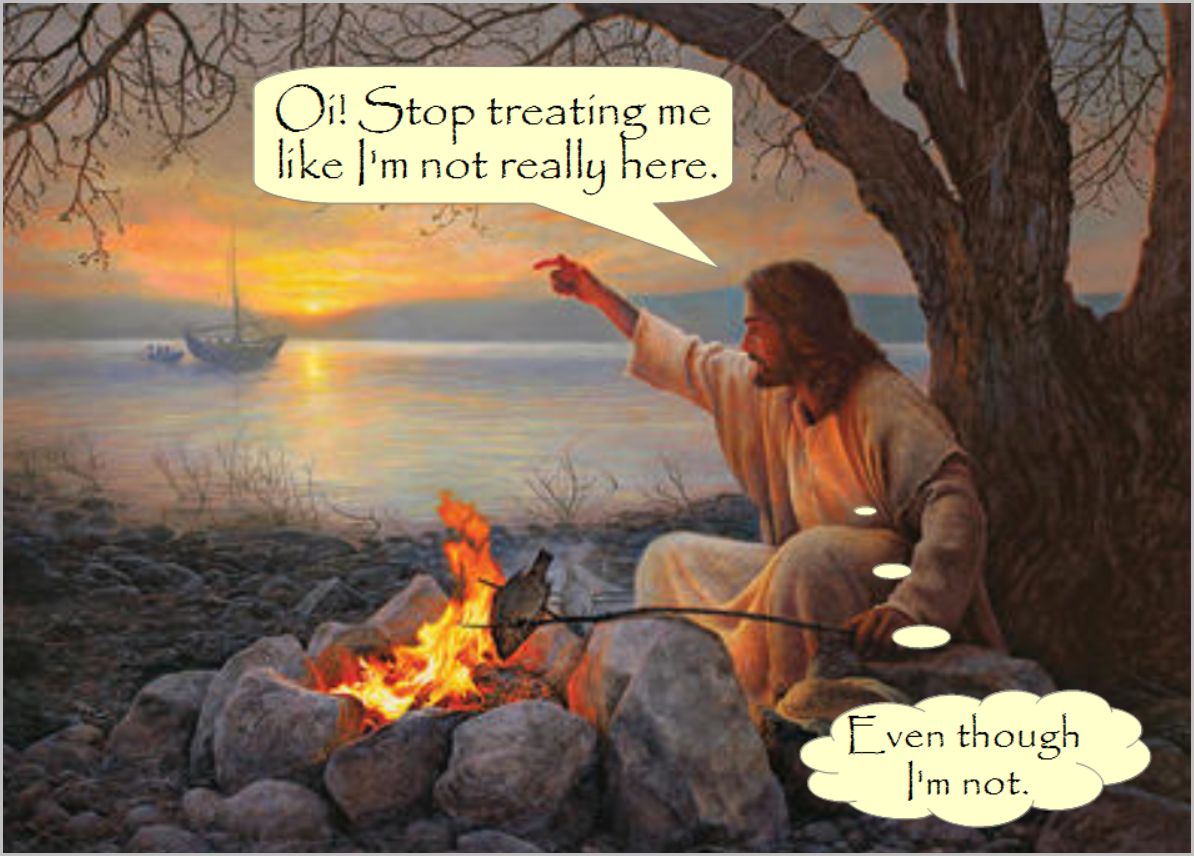
The earliest copies of Mark’s gospel famously have no resurrection appearances. The women discover the empty tomb, which Matthew and Luke later lift into their gospels, and, bizarrely, decide not to tell the disciples about it. By the time we get to last canonical gospel, written some thirty years down the line, its author embellishes Luke’s attempts to suggest that the risen Jesus has some physicality; he allows his old friends, especially Thomas, to poke around in his wounds and he eats fish. Nonetheless, as in the earlier gospels, the disciples all have trouble recognising him, even on a third occasion, and are afraid to ask him who he is (John 21.12). Did his followers simply experience, as John 14.15-20 and Matthew 18.20 seem to suggest, an intense sense of Jesus’ presence? This would make the reports of actual sightings evidence of later believers’ need for something more substantial than flashing lights and fuzzy feelings. Which is how, over time, surrounding detail came to be added.

In their specifics, the resurrection appearances in the gospels and Acts are stories that accrued around the visions and inner traumas experienced by Jesus’ friends and other zealots. As such they are fiction; the angels at the tomb – probably the empty tomb itself – the encounter on the road to Emmaus, the fish breakfast and the rest. Bart D. Ehrman demonstrates convincingly in Jesus Before The Gospels, that the oral tradition was not capable of transmitting the details of Jesus’ life and ministry accurately over a 40 year period (when Mark’s gospel was written). The same is true, perhaps moreso, of individuals’ idiosyncratic inner experiences. Over 50+ years, after which Matthew and Luke’s gospels were composed, reports of these visions would have been altered innumerable times by those relating them, ever onwards and outwards; details would inevitably have been changed, added, removed and invented in a protracted game of Chinese whispers. In all probability the gospel writers themselves introduced their own embellishments.

So then, from a small number of visions/hallucinations/feelings, via significantly altered accounts of these same subjective experiences, together with others that are pure invention, to the eventual recording of such stories 50 to 80 years later, this is the evolution of the fantasy that is the risen Christ.

See what you want to see

dog's bottom2

Paul was a religious fanatic, a zealot is how he describes himself, whose raison d’etre had become the elimination of those who believed that Yeshua was the Messiah. The Jesus movement, which at this time was still very much a part of Judaism (it is Paul who will later uncouple it from its Jewish mooring) is in Paul’s eyes an aberration and he is prepared to brutalise and imprison those who subscribe to it. He is an extremist; religion is his life, his world, his being; he spends all of his time with his band of Pharisaic thugs and members of the new cult (trying to destroy them, admittedly). That’s all he does. He doesn’t have any other interests. No wonder then, that he starts to hallucinate, as fanatics are prone to do, perhaps while suffering an epileptic seizure.

According to Luke in Acts 9.5, Paul can’t make sense of what he thinks he’s ‘seeing’ in his head. He doesn’t immediately connect the light there with Jesus and is forced to interpret it, perhaps some considerable time afterwards (both he and Luke recount the experience only many years later) as being the cult leader whose followers he is persecuting. Once he has decided that this is what his experience was all about, he switches from one kind of fanaticism to another, from one kind of extremist Judaism to another equally fanatical kind.

He does not, I want to emphasise, go from being a Jew to a Christian; he has three years yet to spend brooding on his hallucinatory experience and to work up a convoluted interpretation of it. Only after that does he offer his own bizarre take on the Yeshua phenomenon that conflicts with the original cult and will eventually succeed it.

So, the risen Jesus, like ghosts today, was ‘seen’ only by those already infatuated with him, and even then not always in a form that was recognisably human.

There were no appearances to anyone in the outside world who might have provided objective verification of his return from the dead.

No appearance to any authority, none to the emperor.

There was no appearance in front of Pilate so that the resurrection might be become part of Roman records.

None to Herod to show him he had overcome death.

None to the masses who had earlier called for his death to prove to them he really was their King. 

None to usher in, at last, the Kingdom of God he’d been promising for so long.

None to Caiaphas to demonstrate that he, Jesus, truly was the prophesied Messiah.

None to Judas, to prevent his suicide and forgive him for his betrayal (or ask his forgiveness for using him as a pawn in the Great Divine Plan).

None, in fact, to anyone outside his own coterie, people who were already susceptible to ‘visions’ and psychologically primed to see him again – or to convince themselves they had, like the gullible people today who swear they’ve seen him in the clouds, in various food items or in the hallowed form of a dog’s bottom.

Keen amateur photographer Terry Buckman spotted the 'Face of God' in a cloud formation as he was taking pictures of boats sailing on the English Channel near Sandbanks in Poole, Dorset. Terry said that he was the clouds part and then suddenly the shape of the face appeared. *** Local Caption *** Disclaimer: While Cavendish Press (Manchester) Ltd uses its' best endeavours to establish the copyright and authenticity of all pictures supplied, it accepts no liability for any damage, loss or legal action caused by the use of images supplied. The publication of images is solely at your discretion.kit-katdog's bottom


Believing is Seeing

Fish

Have you noticed how the risen Jesus seems only to have appeared to those who were already primed to see him? Of course, the accounts of the resurrection are inconsistent, unreliable and constructed long after the supposed event, but just for now, let’s take them at face value. Jesus appears first, according to Matthew, Luke and John, to his female followers – maybe one on her own (in John), maybe two (Matthew), maybe several (Luke) – but to women who would be mourning him and would be longing to see him again. And lo and behold, they do! He’s not quite substantial and not quite recognisable – every bit the hallucination, in fact – but he appears.

Next he is said to have shown himself to the disciples – maybe one (Luke), maybe two (Luke again), maybe several (Matthew) – men who have been thrown into complete disarray by Jesus’ death but who believed in him and his mission to inaugurate the Kingdom of God, and were looking forward to ruling it with him. So naturally they see him in their midst. Never mind he walks through walls and disappears at will, just like an apparition – he appears! As Acts 1.3 puts it, ‘he presented himself alive to them after his suffering by many proofs’.

Wait – ‘by many proofs’? What does that mean? That he had to prove he’d come back to life? Could they not see that for themselves? Couldn’t they recognise the man with whom they’d spent the last three years? Or if they could, weren’t they convinced he’d returned from the dead so that he felt he had to prove it? How? How did he prove it? With a death certificate? By letting them poke his holes? And this took forty days? Isn’t it more likely they were subject to group hysteria and some sort of hallucination (they’d had hallucinations before – see Matthew 17:1-9) and they then had to convince each other that what they’d experienced was really Jesus? No wonder it took forty days to concoct a ‘plausible’ story, to arrive at ‘the many proofs’ that Acts speaks of. Whichever it was, Jesus’ gullible old pals convinced themselves they’d seen him.

During these same forty days – though in his gospel Luke implies it’s a much shorter time (24.40-53) – Jesus fits in a guest appearance at a rock concert in front of 500 believers – believers, note. Not people who were converted as a result of this miraculous appearance, but people who were already part of the Jesus cult when they experienced this vision. Or so Paul tells us in 1 Corinthians 15.3-8. He wasn’t actually there, but he heard about it from a friend of a friend of a friend so it must be true.

And finally he appeared also to Paul himself (1 Corinthians 15.5). Not as a physical body but as a beam of light in Paul’s head. I’m not getting into how this was, as Paul himself admits, no more than an inner vision (he too is prone to hallucinations – see also Acts 16:9-10 and 2 Corinthians 12.1-7) because you can read about that here. Rather, I’m going to argue that Paul, arch-enemy to this point of all things to do with the Jesus cult, is just as primed for a sighting of the Lord as all those other people who think they saw him… next time.

to be continued.

The Stuff Christians Say… (part three)

DoorToDoorAtheists are aggressive/militant/unreasonable: The Christians might’ve got us on this one. After all, it is incredibly irritating when we atheists start preaching in the town centre or invade others’ events to tell them what to believe or dish out loony pamphlets or turn up at people’s doors when they’re just about to have their tea. And what about all those meeting places we have, on just about every corner of the city, with smart-arse posters about Adam and Steve on the board outside? And let’s not forget our readiness to blow up ourselves and others in the name of our great cause. Now that’s ‘militant’! Yes, we atheists really do have too much freedom to push our views on others. No wonder we’re so insufferable. (Note to self: check you’ve got this right.)

It takes more faith to be an atheist than a Christian: It takes no faith to recognise there are no supernatural beings. It takes no more faith not to believe in God – or to acknowledge that there is no God to believe in – than it does not to believe in Santa Claus, Poseidon or Ra. Christians themselves require no great abundance of faith to dismiss these characters. Is it so difficult to understand that atheists disregard the Christian pantheon of fantasy figures in exactly the same way? Or are believers practising their dishonesty-for-Jesus again? There is no faith involved in being an atheist. On the other hand, believing in an omnipotent but suspiciously inactive God, a super-hero Saviour, a magic Spirit, angels, cherubim, seraphim, demons, Satan, resurrected saints, Heaven, Hell and all manner of powers and principalities – this requires faith in delusional quantities. No atheist could possibly compete. Nor would they want to.

Faith: An Exercise In Futility

MountainsWhat is faith?

The anonymous author of the book of Hebrews says it’s ‘the substance of things hoped for, the evidence of things not seen.’ (11.1)

Hoping for ‘things’ like perfection, resurrection, eternal life, heaven (not to mention the ability to move mountains), the likes of which no-one has ever achieved, is nothing but wishful thinking. Despite what the Hebrews author says, wishful thinking isn’t evidence of anything – except a capacity for wishful thinking.

By it’s very nature, then, faith is not evidence, but the very opposite. It is the effort to believe in things for which there is no evidence and the delusional insistence that the imagined is more real than that which is.

The stuff Christians say… (part one)

Jesus-Facepalm

On the day Christians remember the time Jesus allegedly spent being dead and buried (that’s one day, if you’re counting; what happened to the three he promised?) by going shopping or watching sport, let’s take a look at some of the nonsense they spout about atheists:

Atheism/humanism is of Satan: Given there’s no evidence for any supernatural beings, there can be no devil, Satan, Lucifer – or whatever other name Christians come up with for this fantasy figure. (Bizarrely, it’s Jesus who’s called Lucifer in Revelation 5.5) The devil is a creation of the human mind, intended to explain the nasty stuff in life and to let a supposedly good God off the hook. It follows that an imaginary being can’t make human beings be anything. The devil therefore does not make people atheists nor direct them in their ways.

Humanists/atheists set themselves up as God: Every manifestation of the god(s), including those that happen to be popular at present, is of human origin. Like all the others, the Christian God is a product of the human imagination that is made manifest only through human behaviour. So who is it who sets themselves up as God? Those who recognise that this creation of the human mind has no external reality, or those who claim an intimacy with the ‘Supreme Being’, believe his Holy Spirit lives within them and delude themselves into thinking they speak for him? No prizes.

Humanists/atheists worship man as God: Atheists don’t do this either. We are well aware of humans’ fallibility, inconsistency and capacity to bugger things up. However, we’re all we’ve got. There’s no God going to come and save us or solve our problems. We have to do it ourselves (or, as the case may be, not). Nor do atheists regard other people as wicked sinners who have no good in them – a particularly unhealthy viewpoint favoured by the religious – but this hardly constitutes ‘worship’.

Atheists hate God: Only to the same extent we ‘hate’ Santa Claus, Poseidon and Ra. You can’t hate (or rebel) against something that doesn’t exist. We do get very tired though of Christians foisting their views on us, insisting we should believe what they believe. And we get angry when they disparage others and attempt to curtail their freedom because they alone know what Jesus would want. But being angry about Christians’ unreasonableness is not the same as hating something that doesn’t exist.

To be continued

A Long Long Time Ago

ShinyJesusHe was a man of great charisma, a provocative individual who challenged the establishment and the norms of his day. Some said, as he implied himself, that he had come to visit the Earth from a higher plane and that perhaps, again as he occasionally hinted (though maybe he was only being contentious) that he was some sort of Messiah. He certainly inspired and gave hope to others who, like himself, found themselves on the fringes of society, who felt unaccepted and down-trodden. Some of what he said and did may have enabled such people to accept who they were or, better still, who they wanted to be.

He refused to accept that he was ‘good’, and certainly he acted as he did because it suited him to do so, not because he felt any need to impress others. Nevertheless, many found him to be humble and kind. His detractors said he was a charlatan and claimed he was demon-possessed; he was all things to all people.

His death came as a shock, what with its suddenness and the manner in which it happened, but nonetheless he seemed to have been prepared for it. In his final messages he suggested he was returning to the higher place from where, perhaps, he’d originally come.

Those who had followed him mourned him and talked of him as an important figure in their lives. They couldn’t, they said, believe he was gone. Some felt that even though he was no longer a physical presence in the world, what he had meant to them would always live on in their hearts, especially when a few of them would gather together to reminisce about him. Others talked of how they hoped and prayed God would raise him from the dead and allow him to live again.

It wouldn’t be long before someone claimed to have seen him back among the living.

So much for David Bowie (there really is a petition asking God to bring him back to life, in spite of his already having been cremated and there being no God.) Within hours of his death being announced, Bowie was elevated to a sort of godhood, his work and sense of alienation imbued with a kind of profound mysticism. The reaction we’ve seen, particularly in the UK, to Bowie’s demise is a common human reaction to the death of a revered one. It happened when John Lennon was killed (a saint he was not) and with Elvis Presley, who, in the years following his death was frequently seen alive in the supermarket or laundromat, and with Diana, Princess of Wales. Elevating larger than life characters to hallowed status when they die is a human trait that helps us mourn them and deal with bereavement.

Is this not what happened when Jesus died? The profound grief, bewilderment, fear and shared memories of those who idolised him, together with their desperate search for meaning in his pointless end, led to his elevation to quasi-godhood and, eventually, to visions of him, if not in the supermarket and laundromat, then back amongst them somehow. If such a thing can happen still, in the technological world of the twenty-first century, how much more could it happen in the superstitious backwaters of first century Palestine.


Peace Off

angels

Glory to God in the highest, and on earth peace, good will toward men. Luke 2.14 as rendered by the King James Bible.

Whatever happened to that peace? There hasn’t been peace on earth ever since the angels were made to herald Christ’s birth with these words. Some of that absence of peace – the conflicts and wars – has been the result of religion, including that of Jesus himself. Then again, he did contradict the angels when he said he hadn’t come to bring peace but a sword and for once, he was right (Matthew 10.34). So what can the angels have meant? More to the point, what can those who created these words to put in the mouths of non-existent beings have been thinking? Is their declaration a promise? A prophecy? Something to look good on Christmas cards?

Other translations of Luke 2.14 avoid the whole peace on earth shtick by watering down the statement: ‘Glory to God in the highest heaven, and on earth peace to those on whom his favour rests’ reads the NIV. Now only those whom God ‘favours’ are granted peace, which presumably means only Christians, and it’s now a vague sense of well-being (complacency? smugness?) that isn’t of much use to the world at large. Certainly other New Testament writers, the creators of John’s gospel and the letter to the Ephesians for example, interpret ‘peace’ in this very limited way.

And yet, in Isaiah, in verses applied to Jesus (especially at this time of year; they were read out in the carol service I attended last night) we find him descibed like this:

For to us a child is born, to us a son is given, and the government will be on his shoulders. And he will be called Wonderful Counselor, Mighty God, Everlasting Father, Prince of Peace. (Isaiah 9.6)

Apart from the fact this is a specifically Jewish prophecy that has nothing to do with Jesus – which is why most of the titles don’t really apply to him (nobody has ever called him ‘Wonderful Counselor’ or ‘Everlasting Father’) – there again is the idea that he’s somehow connected with capital-letter Peace. He’s a Prince of it, no less.

But wait – there’s more:

Of the increase of his government and peace there will be no end. He will reign on David’s throne and over his kingdom, establishing and upholding it with justice and righteousness from that time on and forever. The zeal of the Lord Almighty will accomplish this. (9.7)

Of course; it’s all end time stuff! We should’ve guessed. Long term peace on the Earth, predicted by the angels and, ostensibly, by Isaiah is going to be in the future, after Jesus returns to establish God’s Kingdom on earth.

Have you noticed how it’s always in the future? Everything Christianity offers is going to happen later: heaven, eternal life, the second coming, the rapture, resurrection, God’s Kingdom, the lion lying down with the lamb, the end of war, everlasting peace. Not in Jesus’ own time as he thought; not in Paul’s, not in the gospel writers’, not any time since, but always just around the corner, any time now, soon. Never in the here and now. Peace on Earth, like all those other promises, is always just out of reach, like the pot of gold at the end of the rainbow – the closer you think you might be to it, the further it moves away.

A friend added one of those clever posters to Facebook recently. It said, amongst other things, that it wasn’t okay to ‘shame’ religion. I couldn’t disagree more. Scams must be debunked and the sham of religion’s empty promises held up to the light of reality. None of the things that the Bible says will happen is going to; not now, nor in an ever-elusive future.

A happy and peaceful Christmas to both my readers.

Loose Threads

FamilyPick a thread. Any thread. And start pulling. Gently does it, no need for force. A gentle pull on any of the loose ends of faith and the whole fabric will come apart quickly.

Here, pull on this one marked ‘the infallibility of the Bible‘. See how easily it comes loose as soon as you realise that most of it, Old and New Testament alike, was written long after the events it purports to describe, some of it by imposters and forgers.

Or this one – the salvation thread, much of it stitched into place by an excitable chap prone to hallucinations. Pull it and see how its pattern is nothing like the one proposed by the man it claims to be about.

Pull the magic threads, the ones about Gods, supernatural beings, heaven and hell, eternal life. Watch them disintegrate in your fingers once they’re teased out into the real world.

Take hold of the threads about Resurrections, Second Comings, Raptures and Judgements; so fragile, these break away as soon as they’re touched. The only miracle is that they’ve lasted this long.

Then there’s the promises threads, about how believers are going to do fantastic miracles and heal the sick and raise the dead. Imaginative and colourful, these have never really fitted in.

Then there’s the prayer threads, whose embroidery tells us how prayer works, how God will give us whatever we ask for. Downright embarrassing, these – yank ’em out.

And how about the strands that those who say they love the cloth pick out themselves and throw away? You know the ones; the threads which tell them how to live their lives that they just don’t like the look of and think spoil the overall effect. These have definitely got to go.

What about the threads that weren’t originally there – the ones about ‘defending God’s standards‘ and having a ‘relationship‘ with a dead person? These grubby, greasy threads have been added in to replace the ones those who love the cloth have pulled out for themselves.

Choose any number of other threads – the ones that clash with other bits of the pattern, the ugly brutal ones, the fantastic, the ignorant – and give them a tug. Oh, look. They come away too.

And before you know it, the entire fabric has come apart in your hands. All that’s left is a pile of worthless, brittle threads, good for nothing but throwing in the bin.

The Seventeen Commandments

mosesQuick – can you name the sixth of the ten commandments? That was the question in a quiz I went to last night. We got it wrong, but I have to to tell you, so did the quiz-master. If you Google ‘the Ten Commandments’ – which I can assure you we didn’t during the quiz – what you get is the list of injunctions from Exodus 20. You know the ones: thou shalt not kill, steal, commit adultery or covet thy neighbour’s ass. Read them all here if you feel inclined.

When, in a fit of pique, Moses destroyed the stone slabs on which these ‘commandments’ were written, God generously offered to provide him with a replacement set. The Almighty even made a point of saying, in Exodus 34.1, that the two sets would be identical. But they’re not. Here’s the lot from Exodus 34:

1. You shall worship no other god, because the Lord, whose name is Jealous, is a jealous God.
2. Do not make any molten gods (idols).
3. Keep the Feast of Unleavened Bread.
4. The first born of every creature shall belong to me.
5. Work for six days and rest on the seventh.
6. Observe the Feast of Weeks.
7. Present all your male children to the Lord God three times a year.
8. Do not offer the blood of sacrifices to God with leaven and don’t leave the sacrifice of the Feast of the Passover until the morning.
9. Give the first of the first-fruits of the land to the house of the Lord thy God.
10. Do not boil a kid in his mother’s milk.

Far from being identical, only three commandments are the same in the two sets; missing from the Exodus 34 group are those about adultery, theft and killing, replaced with stipulations about ancient Jewish festivals and boiling baby goats (of great eternal significance, that one.) Just to complicate matters, this second lot is the only one referred to in the Bible as ‘The Ten Commandments’ (Exodus 34.28). The more familiar injunctions from Exodus 20 – the ones Google brings up – are not.

What is going on here? It’s as if ‘The Ten Commandments’ are not as immutable as Christians claim. What are they to do? Should they pick and mix between the two sets? Should they reject one and use only the other? Obey both lots – The Seventeen Commandments? It’s far from clear and yet, according to Jesus, their eternal existence depends on getting it right (Matthew 19:17).

All of which makes me think how a single seamless garment has been created out of a ragbag of scraps and patches. The church and believers in general have told us that the shambolic writings stitched together as the Bible tell a consistent story. This deceit is a major accomplishment of the Christian faith because the seamless garment is an illusion, created by pretending there are no discrepancies or inconsistencies and by glossing over all the significant differences within God’s Word™.

This is why we never hear of the second set of commandments – they’re put away like a mad woman in the attic. The church doesn’t want people seeing them or hearing about them. Best to shut them away and make out they don’t exist. Same with the second account of creation in Genesis 2. It’s different from that in Genesis 1, though both are embarrassingly wrong about the means and order of creation. When Christians do acknowledge that there are two accounts (as Ken Ham does) they insist, that, of course, there are no real differences and they can all be explained (away). If there are no differences, why then do they need explaining?

Then there are the disparate accounts of Jesus’ life. Even where they share the same material each gospel presents it differently or gives it a spin that frequently contradicts the other gospels’ versions of the same events. Every one of the stories about the resurrection, for example, is radically different in both detail and significance from all the others.

There are even greater problems for Christians in explaining how Jesus’ supposed sacrifice on the cross brings about salvation. The writers of the New Testament aren’t clear themselves, suggesting at least a dozen largely incompatible ways between them. The four gospels alone have conflicting ideas about how it works (more on this next time), all of which differ from Paul’s salvation formula.

I suppose if Christians want to deceive themselves about their faith and their magic book, it’s up to them. But, please, righteous ones, don’t try and tell the rest of us it has a clear consistent message when it doesn’t. Don’t tell us it’s a seamless garment when it has tangles of loose threads and you’ve had to throw away all the material that doesn’t fit the pattern you pretend you can see.


Oh, and that sixth commandment? ‘Observe the Feast of Weeks’. But of course you knew that.