Christians ignore Jesus

Optional

Christians are commanded to ‘take up their crosses’ to follow Jesus (Luke 9.23). That means, amongst other things, doing what he commands. Yet Christians don’t just fail to do as he tells them, they replace his agenda with their own and completely ignore him. Being a Christian, according to Jesus – and you’d think he’d know – is not about pointing out the failings of others, nor about defending God’s honour (as an omnipotent being he’s more than capable of doing that himself) and it isn’t about condemning those you don’t agree with. It’s about treating others as you’d like to be treated, loving your enemies… things like these, in fact –

Do not judge, so that you may not be judged. For with the judgement you make you will be judged, and the measure you give will be the measure you get (Matthew 7.1-2).

Yet Christians judge relentlessly and tell us they’re justified in doing so: ‘you’re a sinner’, ‘you’re going to hell’, ‘gay people are of the devil’, ‘you’ve got the wrong set of beliefs’. We can only suppose they’ve don’t have a problem with the judgement they themselves will face as a result (because they don’t really believe there’ll be any such judgement.)

But I say to you, love your enemies and pray for those who persecute you (Matthew 5.44).

What Jesus really meant to say here, surely, was ‘criticise those you don’t like, claim they’re infringing your rights, sue them if need be’. Yes, that’s it.

Give to everyone who begs from you, and do not refuse anyone who wants to borrow from you (Matthew 5.42).

Really? Let’s give it a go. Beg a Christian to pay off your mortgage or ask to borrow the cash for new car. See how far that gets you. The problem here, as with all of these commands, is that Jesus really has no idea. No wonder Christians ignore this one.

How can you say to your neighbour, ‘let me take out the speck in your eye,’ when you yourself do not see the log in your own eye? You hypocrite, first take the log out of your own eye, and then you will see clearly to take the speck out of your neighbour’s eye’ (Luke 6.42).

Another ‘don’t judge’ command, to which Christians respond, ‘What log? Your speck is more of an eyesore than my log. My log doesn’t impede my vision at all. It’s you who can’t see.’

If anyone strikes you on the cheek, offer the other also; and from anyone who takes away your coat do not withhold even your shirt (Luke 6.28).

Yeah, right.

Do to others as you would have them do to you (Luke 6.31).

From which we can only conclude that Christians really must want to be treated as shabbily as they treat others (see links above)  

So how about it Christians? Maybe if you were doing what Jesus commands instead of judging the rest of us, we might take you a little more seriously. And, assuming he’s up in Heaven watching you – though even you know he isn’t or else you’d be doing as he tells you – so would Jesus himself.

As he says in Luke 6.46: ‘Why do you call me “Lord, Lord,” and don’t do what I tell you?’

Why_Christians_Don't_Cover_for_Kindle

For more on this topic – Christians’ failure to take any notice of Jesus’ commands – see my book Why Christian Don’t Do What Jesus Tells Them To …And What They Believe Instead, available from Amazon.

Is your marriage a Bible-based marriage? Find out in this simple quiz.

Marry

1. If you’re male, have you got more than one wife? If female, has your husband got other wives as well as you?

If you answer ‘yes’, score 20 points: all the heroes of the Old Testament had multiple wives: Abraham, Esau, Jacob, Moses, Gideon, David, Solomon… Clearly, polygamy is acceptable in the sight of the Lord (Exodus 21.10). Even Jesus approves of it (Matthew 5.17-18 & 25.1-13). Well done if this is you! No points for a ‘no’ answer – you’ve a lot of catching up to do.

2. Are you married to your brother/sister?

20 for yes, nothing for no. God approves of this kind of marriage in Genesis 16.1-3 and as we know, the answer’s always in Genesis.

3. Ladies, were you a virgin on your wedding night?

Score 20 if you were. Otherwise, get your husband to have you stoned to death on your dad’s doorstep, like Deuteronomy 22.13-21 says he should.

4. Were you under-age when you married?

No problem. In fact, the minimum age for marriage in the Jesus’ time was 12 for girls, 13 for boys so award yourself 25 bonus points if you were still a child when you married. Nothing though if you were ancient… like say, 20.

 5. Have you taken a slave as a partner?

Another 30 points if you have. God’s quite happy with this arrangement. The slave might not be, but who cares? Not God, that’s for sure (Numbers 31.17-18).

6. Men, did you buy your bride off her father? Ladies were you bought?

To really qualify as a bible-based marriage, this how it should be. You gonna argue with Genesis 34.12 and Exodus 22.16-17? Score 50 if money changed hands. Nothing if it you did it all for love: that’s not biblical at all.

7. Have you married your brother’s newly widowed wife?

70 points if you did – it’s what God expects (Genesis 38.9 & Deuteronomy 25.5-10). Just don’t spill your semen on the ground on the wedding night because, as Onan discovered, sex-obsessed Yahweh will smite thee if thou doest.

 8. Do you frolic naked round a garden with your partner without bothering with a formal marriage service?

Score 50 if this Adam-and-Eve arrangement is for you – they didn’t bother with marriage either. You get nothing if you keep your clothes on while gardening.

9. Do you hate your spouse (and children and your father and mother)?

Jesus says you should, in Luke 14.26, so that you can follow him more zealously. If you really can’t stand the person you’ve married to, score 100 points. You get nothing if you’re soppy and still love your wife or husband.

10. Christians, have you shunned marriage altogether?

Your Saviour says you should (Luke 20.34-35) otherwise you’re not worthy of a place in his Kingdom (offer good only in the first century, admittedly). Award yourself 200 points if you’ve been obedient, nothing if you decided this instruction wasn’t for you and you went ahead and got married anyway!

11. Have you castrated yourself for Jesus’ sake?

He thinks you should, you know; see Matthew 19.12. Score 500 (though not much else) for taking this final step. You get nothing for deciding – again! – that this isn’t for you. What are you? A man or a wimp?

12. Have you divorced your partner and married another?

True, Jesus doesn’t approve of divorce, but more ‘bible-believing’ Christians divorce in the USA than non-believers (32% compared with 30%) and they can’t all be wrong. What does Jesus know anyway? Add an extra 100 points to your score for every additional wife or husband you’ve had.

So how did you do?

0. Forget it. You marriage is worthless in the eyes of the Lord.

5-100: What must God think? You’ve really let him down. He offers you all these attractive, biblical options – multiple wives, slaves, siblings  – and you’ve not gone for any of them. For shame.

100-199: Get serious! You think biblical marriage is negotiable?

200 and 499. Pretty good. You’ve avoided marriage, just like JC says you should.

Over 500: You’ve definitely got a bible-based marriage. Or rather, you haven’t, and no balls either.

Would you walk by on the other side?

GoodSamaritan

Earlier this week, Nigeria’s president, Goodluck Jonathan, signed into law draconian measures designed to combat homosexuality in the country. Two days ago, 12 men – 11 Muslims and 1 Christian – were arrested for being gay and could face up to 10 years imprisonment and maybe even the death penalty. The 11 Muslim men will be tried by an Islamic court and could be stoned to death if found guilty – which looks to be a forgone conclusion. Richard Branson and the secretary general of the UN have both protested.

Guess who hasn’t?

The Church of England has a significant presence in Nigeria, its largest ‘province’ outside the UK. It has protested neither the new law nor the arrest of the twelve men. Former Archbishop George Carey, who regularly complains that Christians are ‘marginalised’ and even persecuted in the UK (when they’ve been mildly slighted or offended) hasn’t said a word about the Nigerian situation. The two current Archbishops in the UK, John Sentamu of York and Justin Welby of Canterbury have remained similarly quiet, while the Anglican Church in Nigeria has itself been conspicuously silent.

It all brings to mind Jesus’ story of the Good Samaritan. You know, the one where church leaders see a man in need by the side of the road and pass by swiftly on the other side.

Why God is always a no-show

Peter&Paul

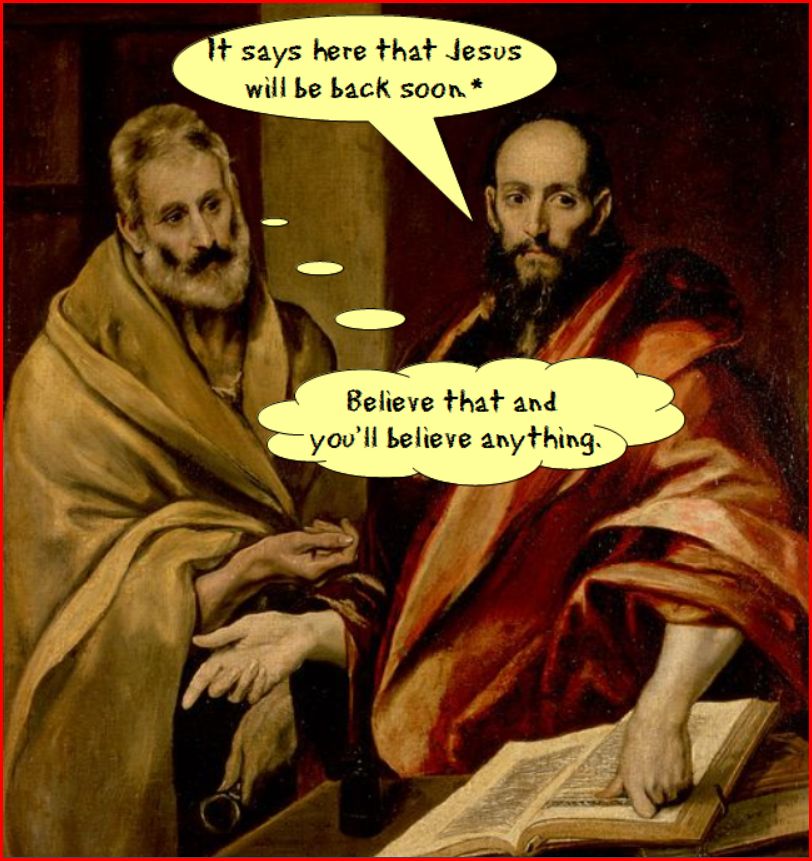
* And he should know; he wrote it in 1 Thessalonians 4:17, 5:23 and elsewhere.

When Jesus thought his world had got into such a bad way, he felt sure God would intervene and turn things around. But God didn’t and Jesus was executed instead.

When St Paul became convinced things couldn’t go on as they were, he told everyone that God was going to send Jesus back to Earth to sort it all out. But God didn’t and Paul was executed instead.

When people were accused of witchcraft in the middle ages, they waited for God to intervene and save them. But God was a no-show, again, and 100,000 were tortured or killed as a result.

When millions of Jews were taken to concentration camps in the second world war, they too prayed for God to save them. Once more, he failed to make an appearance and instead over six million men, women and children were exterminated by the Nazis.

When right-wing Christians today complain that the world has abandoned God (because, you know, gay marriage) they feel sure that God will intervene to judge us all and put things ‘right’. So far, he’s conspicuous by his absence.

God is always a no-show, despite the pleas of his followers, despite the earnest belief of his alleged son, despite the plight of his chosen people, despite those today who claim to know his will. Could this be because he has no existence outside the imaginations of human beings?

It surely could; a being that has failed to show himself throughout the history of mankind is a being that doesn’t exist.

Notes:

1) Jesus says God will intervene: Matthew 24:27, 30-31, 34, Luke 21:27-28 etc.

2) Witchcraft figures from An Atheist’s History of Belief:Understanding Our Most Extraordinary Invention by Matthew Kneale, p198

3) While I’ve linked one site that reflects modern Christian belief, there are thousands more of the same sort. Google ‘God will judge America’ for an unhealthy sample.

Christians’ Favourite Delusions 15: The Bible is the ultimate standard for morality

Plucking

Jesus claimed that his morality came from the only scriptures he knew, those Christians now refer to as the Old Testament. Here’s how he puts it in Matthew 5.18 & 19: 

Do not think that I have come to abolish the law or the prophets; I have come not to abolish but to fulfil. Whoever breaks one of the least of these commandments, and teaches others to do the same, will be called least in the Kingdom of heaven; but whoever does them and teaches them will be called great in the Kingdom of heaven’.

Today’s believers like to pretend that they too derive their morality from the Bible. One Christian web-site tells us that ‘the Bible becomes our source of morality because the Bible is the very Word of God in written form.’ Overlooking the fact, for now, that the Bible is not, for a whole host of reasons, ‘the Word of God’, what sort of moral guidance does it provide us with? Here’s a small sample:

Stone to death anyone who works on the Sabbath. (Exodus 35.2 and Numbers 15.32-36)

A slave is his master’s property; if you beat him so severely that he takes a day or two to die, you won’t be punished. (Exodus 21. 20-21)

Kill publicly children who dishonour their father or mother. (Leviticus 20.9);

Stone to death anyone who blasphemes the name of the Lord. (Leviticus 24.16);

Execute a married couple who have sexual intercourse during the woman’s period. (Leviticus 18.19);

Put to death those involved in adultery. (Leviticus 20.10);

Execute any man who lies with another man, as with a woman. (Leviticus 20.13)

Stone to death at her father’s door any woman who is not a virgin on her wedding night. (Deuteronomy 22.13-14 and 20-21).

Cut off ‘without pity’ a woman’s hand if, during a fight, she seeks to rescue her husband by grabbing his opponent’s testicles. (Deuteronomy 25.11-12)

Isn’t this just the kind of ‘morality’ promoted by the Taliban? Well, the good news is Jesus approves! And he’s got some corkers of his own. How about these for great moral teaching?

Wherefore if thy hand or thy foot offend thee, cut them off, and cast them from thee: it is better for thee to enter into life halt or maimed, rather than having two hands or two feet to be cast into everlasting fire. And if thine eye offend thee, pluck it out, and cast it from thee: it is better for thee to enter into life with one eye, rather than having two eyes to be cast into hell fire. (Matthew 18.8 & 9 AV).

So, no, very few Christians today get their morality from the Bible. Their moral sense has evolved, like that of the rest of us, without the Bible’s assistance and without any reference to god. Thank goodness for that, even if there are some who would like to see a return to the kind of moral barbarism the Bible, and Jesus, promote.

Christmas Quiz Answers

Birth3

1. In what year was Jesus born?   a) 4 BCE (when Herod the Great was king)   b) the year 0     c) 6CE (when Quirinius was governor of Syria)

Matthew’s gospel claims Jesus was born when Herod the Great was king (Matthew 2.1) while Luke says it was when Quirinius was governor of Syria (Luke 2.2). But Herod died in 4BCE and Quirinius didn’t become governor of Syria until ten years later, in 6CE. So JC couldn’t have been born when both men were in their respective positions. Neither was he born in the year 0, because there wasn’t one (the Gregorian calendar goes from 1BCE to 1CE). Most scholars think Jesus was born around 4BCE, just before Herod’s death (as Matthew’s gospel suggests). Award yourself a splash of myrrh if you got this right.

2. When was Jesus born?  a) December 25th?   b) April 1st   c) in the summer

Not December 25th (see my post Jesus Is The Reason For The Season below) which was the date usurped from the pagan festival of Saturnalia; April 1st, maybe, as there’s something about this that takes us all for fools, but if the story is to be believed, it’s most likely he was born in the summer when shepherds would be out on the hillside with their sheep – if the story is to be believed. In short, we don’t actually know. If you said this, reward yourself with three hail Marys.

3. Who was Jesus’ father? a) God himself   b) Joseph, so that Jesus was descended from King David   c) one of Mary’s one night-stands

a) and b) rule each other out: see my post Jesus was born of a virgin… er, no was descended from David, er… below.  There were much later rumours that Mary was raped by a Roman soldier called Pantera, and certainly Jesus’ legitimacy is called into question by early critics of Christianity. This may be reflected in the gospels themselves where Jesus is referred to as his mother’s son, not his father’s as would have been customary (Mark 6.3). Treat yourself to Susan Boyle’s rendering of ‘Silent Night’ if you knew this.

4. How often did the Romans make people return to their ancestral home to be counted?  a) never   b) it was one-off   c) only when the gospel writer needed to get them to Bethlehem

Answer is c). While the Romans did carry out a census in 6CE, i) Jesus was born ten years earlier and ii) there is no record of the Romans forcing people to return to the home of their ancestors.

5. How did Mary get to Bethlehem?  a) on foot   b) on a donkey   c) by being a character in a contrived story

The answer is c). Luke’s nativity story, the only one to have them travel to Bethlehem, doesn’t say how she got there. Leave a carrot out for Santa’s reindeer if you answered correctly.

6. Where was Jesus born?  a) in a stable   b) in a cave   c) at home in Nazareth

Again, Luke’s Bethlehem account doesn’t say. Matthew implies Mary and Joseph lived in Bethlehem all along (Matthew 2.11 & 16) making the whole ‘no-room-at-the-inn’ scenario superfluous. Sprinkle yourself with frankincense for saying so.

7. According to Matthew’s gospel, how many wise-men visited the new-born babe?  a) none   b) three   c) they weren’t wise-men, they were astrologers

The answer is c) and the number isn’t specified.

8. What did the angels say to the wise-men when they told them of Jesus’ birth?  a) you will find him in a manger   b) nothing   c) follow that star

b) is correct. According to the story the angels spoke to the shepherds, not the wise-men. Deck the halls with boughs of holly if you fell for this one.

9. Where did the magic star shine?  a) over the stable where Jesus lay   b) over his house   c) since when do stars shine over specific objects here on Earth?

Looks like c) again, though Matthew, who is the only gospel writer to mention it, claims in Matthew 2.9-11 that it was b), over his house.

10. When did the wise-men visit the infant Jesus?  a) when he was a toddler   b) while he was still in the manger   c) after the Christmas rush

Matthew says Jesus was a child when the so-called wise-men visited him at home (Matthew 2.9-11 again). Given their encounter with Herod (Matthew 2.16), who thinks Jesus could be anything up to two years old, it’s likely JC was a toddler at this point in the fabricated story. Don ye now your gay apparel if you knew this.

11. When did Herod massacre all the little boys, hoping to kill the baby Jesus?  a) later that same week   b) a few years after the birth   c) there is no record of him having done any such thing

Yup, c) again.

12. How many shepherds visited the baby Jesus?  a) all of them  b) two old men and a young boy   c) none

The number isn’t specified, though Luke suggests all of them went (Luke 2.15-16). In fact it was ‘none’ because none of this actually happened.

13. What gifts did the shepherds bring?  a) a lamb   b) a lamb kebab   c) a pair of hand-knitted socks

It doesn’t say. You can have a new pair of hand-knitted socks yourself if you said so. Or a kebab.

14. Which animals were present at the birth?   a) a horse (c’mon, it was supposed to be in a stable)   b) an ox and ass   c) an ox, an ass, the wise-men’s camels and the shepherds’ sheep

No animals are mentioned.

15. After the birth, where did Mary, Joseph and the baby Jesus go?  a) to Egypt   b) home to Nazareth   c) nowhere

According to Matthew (2.13-18) the family went to Egypt following the visit of the wise-men and, after hiding there until Herod died, made their home in Nazareth (Matthew 2.19-23). According to Luke, however, they lived in Nazareth before the birth (Luke 1.26) and simply went back there once they’d had the baby circumcised (Luke 2.38); no mention of the holiday in Egypt nor of Herod, who’d been dead for ten years according to Luke’s chronology. It’s kinda neat the way the Bible tells such a consistent story, don’t you think?

16. Where will you find the Christmas story in the Bible?  a) in Genesis (because the answers are always in Genesis)   b) in all four gospels   c) in only two of the gospels, which have conflicting accounts

The answer is c); only in Matthew and Luke, each having a completely different take on things.

Feel entitled to sacrifice two turtle doves for making it this far.

A short Christmas quiz…

Nativity

How well do you know the Christmas story? See how you fare in this exciting nativity quiz. Answers in the Bible (and posted soon here);

1. In what year was Jesus born?

a) 4 BCE (when Herod the Great was king)   b) the year 0   c) 6CE (when Quirinius was governor of Syria)

2. When was Jesus born?

a) December 25th?   b) April 1st   c) in the summer

 3. Who was Jesus’ father?

a) God himself   b) Joseph, so that Jesus was descended from King David   c) one of Mary’s one night-stands

4. How often did the Romans make people return to their ancestral home to be counted?

a) never   b) it was one-off   c) only when the gospel writer needed to get them to Bethlehem

5. How did Mary get to Bethlehem?

a) on foot   b) on a donkey   c) by being a character in a contrived story

6. Where was Jesus born?

a) in a stable   b) in a cave   c) at home in Nazareth

7. According to Matthew’s gospel, how many wise-men visited the new-born babe?

a) none   b) three   c) they weren’t wise-men, they were astrologers

8. What did the angels say to the wise-men when they told them of Jesus’ birth?

a) you will find him in a manger   b) nothing   c) follow that star

9. Where did the magic star shine?

a) over the stable where Jesus lay   b) over his house   c) since when do stars shine over specific objects here on Earth?

10. When did the wise-men visit the infant Jesus?

a) when he was a toddler   b) while he was still in the manger   c) after the Christmas rush

11. When did Herod massacre all the little boys, hoping to kill the baby Jesus?

a) later that same week   b) a few years after the birth   c) there is no record of him having done any such thing

12. How many shepherds visited the baby Jesus?

a) all of them   b) two old men and a young boy   c) none

13. What gifts did the shepherds bring?

a) a lamb   b) a lamb kebab   c) a pair of hand-knitted socks

14. Which animals were present at the birth?

a) a horse (c’mon, it was supposed to be in a stable)   b) an ox and ass   c) an ox, an ass, the wise-men’s camels and the shepherds’ sheep

15. After the birth, where did Mary, Joseph and the baby Jesus go?

a) to Egypt   b) home to Nazareth   c) nowhere

16. Where will you find the Christmas story in the Bible?

a) in Genesis (because the answers are always in Genesis)   b) in all four gospels   c) in only two of the gospels, which have conflicting accounts

Good luck. Answers here soon.

Christians’ Favourite Delusions 13: Jesus was born of a virgin… er, no, was descended from David, er…

XmasMessage

That most fallible of books, the Bible, often wants it both ways. Never more so than when it’s trying to add spin to its central character. It wants us to believe that Jesus was born of a virgin, with no human male involved, and, at the same time, that he was physically descended from King David on his dad’s side.

He’s got to be born of David’s line, you see, because the prophecies say the Messiah will be just that. The writer of Acts (‘Luke’) knows this and tells his readers that God promised King David that through ‘the fruit of his loins, according to the flesh, he would raise up Christ to sit on his throne’. (Acts 2.30, KJV; my emphasis). The reference is to 2 Samuel 7:12, where Yahweh does indeed appear to tell David that he ‘will raise up your offspring after you, who shall come forth from your body, and I will establish his Kingdom’. This is to be a physical descendancy and is the reason for all those ‘begats’ at the start of some of the gospels; they are there to establish Jesus’ (supposed) royal descent on his father’s side. This is why, in his gospel, Luke contrives to get Mary and Joseph to Bethlehem for the birth: ‘Joseph also went from the town of Nazareth in Galilee to Judea, to the city of David called Bethlehem, because he was descended from the house and family of David‘ (Luke 2.4). That’s Joseph who was descended from David. Not Mary, not Jesus’ uncle Charlie and not the Almighty himself. Joseph.

Perversely, it is also Luke who insists that Jesus is the product of divine impregnation and a virgin birth (Luke 1.32-35). Why doesn’t he realise that if Jesus was virginally conceived, he cannot be the fruit of any human male’s loins? Luke includes the virgin conception and birth in his nativity story while insisting, in both his gospel and in Acts, that Jesus is the Messiah precisely because he is a physical descendant of David (see, for example, Luke 1.27, 1.32, 1.69, 2.4, 2.11, 3.31, 18.38, 20.41). But Jesus can’t be both a physical descendent of David through Joseph and the result of the God helping himself to a nice young girl. Could it be the two conflicting accounts were written by different fantasists?

So, is Jesus the ‘Son of God’ because he was created by the Almighty’s impregnation of Mary or is he the Messiah because he’s King David’s descendant ‘according to the flesh’? Either Jesus is physically descended from David or he is a being conceived through divine rape, like other mythical god-men of the ancient world.

He cannot be both – though he could, of course, be neither.

Christians’ Favourite Delusions 12: Jesus is the reason for the season.

Image

Every year about now, Christians start complaining that Christ has been taken out of Christmas, that we’ve lost the true meaning of the holiday, that the reason we have it at all is because of the arrival on Earth of the Baby Jesus. The tabloid press invariably joins in with this clamour, relating – and often making up – stories of councils that omit the word ‘Christmas’ from town centre displays for fear of offending Muslims. In the States, an influential Christian group has taken to drawing up a ‘Naughty and Nice’ list; stores and organisations that wish customers a ‘happy Christmas’ are to be considered ‘nice’, whether they are or not, while those that opt for ‘happy holidays’ are very, very naughty. Predictably, these Christians advocate boycotting the naughty stores.

The mid-winter celebration now known as Christmas pre-dates Christianity by hundreds of years. It originally had nothing to do with Jesus but instead was a way of celebrating the winter solstice at the time of the shortest day (21st December in the northern hemisphere) and the return, in spring, of the sun. It was entirely pagan and many of the customs today associated with Christmas – giving and receiving presents, decorating the house, singing carols and feasting – originate from it. In Ancient Rome, where it was known as Saturnalia, the festival was held on 25th December and marked the birth, not of Jesus but of the unconquerable sun (Sol Invictus). The early church usurped the festival in the fourth century; too popular to eliminate, they superimposed their saviour and his mythology on to it, in an attempt to make it their own. This had the added bonus of demonstrating – a bit late in the day – that Jesus really was born as a human, when there were those around who claimed otherwise.

So Jesus is not the reason for the season; a pagan celebration of the winter solstice is really what it’s all about.

Christians’ Favourite Delusions 11: God is ours

preacher3

Apparently, you surrender any right to talk about or comment on God when you’re an atheist. Or so Christians would have it. ‘If you don’t believe in God, why don’t you just shut up about him? Why does it bother you that others believe?’ is the sort of line they take. You’ll find it in the comments on this blog and other sites that are critical of faith.

Like so much else, Christians are wrong about who can have an opinion about God. Unbelievers have as much right as believers, of whatever persuasion, to express views on the God-concept. It’s fair game for everyone.

So why do I bother? Six reasons.

1) I gave Jesus the best years of my life. Well, not really ‘Jesus’ because you can’t give anything to someone who’s been dead these past two millennia – but I was a Christian for twenty plus years and I complied with what the church and the Bible told me. It was a mistake; I denied myself, as I was told to do (in Matthew 16.24) and wasn’t able to be who I really am. I’m so much happier without being told what that should be.

2) I find the persistent proselytising by Christians to be thoroughly objectionable. It’s almost impossible to walk through the town centre where I live without being told by some street-preacher or other that without Jesus we’re all bound for Hell and that ‘evolution is lie’. (One of these claims is, that’s for sure.) If you get too near, a confederate will thrust a tract into your hand, replete with Bible quotations, spelling mistakes and dodgy grammar. And should you manage to avoid these particular desperadoes, you’ll then have to watch you don’t fall over the stands of Jehovah’s Witness literature, ‘manned’ by smiling ladies who think their brand of superstition is the truth.

3) Christians’ treatment of gay people is generally deplorable. ‘Hate the sin but love the sinner’ is the line frequently trotted out, even though it’s entirely unbiblical.  They may claim to love gay people but it’s a hollow claim when ‘in love’ Christians condemn gay people as sinners of the worst sort; ‘abominations’ is the word used in their holy book (and some Christians use worse language than this). Because of what the Bible says, many believers seek to deny same-sex couples the right to marry and resist attempts to grant them the same rights as everyone else. Christians insult us all by calling this love.

4) Christians’ uncritical adherence to superstition is incomprehensible. There are innumerable Christian web-sites, some of which I read (purely for research purposes, you understand) that are, variously, sources of hilarity and despair in equal measure. There has to be some counter-balance to the irrationality and evangelistic fervour of these sites and thankfully there is. Hopefully this blog makes some small contribution.

5) However much they preach at the rest of us, Christians fail to do as their saviour commands them. They think they’re ‘saved’ through St Paul’s magic formula but ignore everything Jesus says is required of them (see previous posts and my book Why Christians Don’t Do What Jesus Tells Them To …And What They Believe Instead.) It’s all specks and logs, to paraphrase JC himself; Christians enjoy pointing out everyone else’s sinfulness – and arguing about doctrine, of course – while blatantly ignoring Jesus’ commands. I feel obliged to point this out.

6) If, through this blog, I can lead people to question their beliefs, help them reflect critically on what they are told by church leaders and very selective reading of ‘God’s Word’, encourage them to think rationally about their belief in supernatural beings and, most of all, if I can be instrumental in rescuing one person from the Jesus cult, then I’ll be more than happy.

That’s why I bother.