Christians in denial

Trial

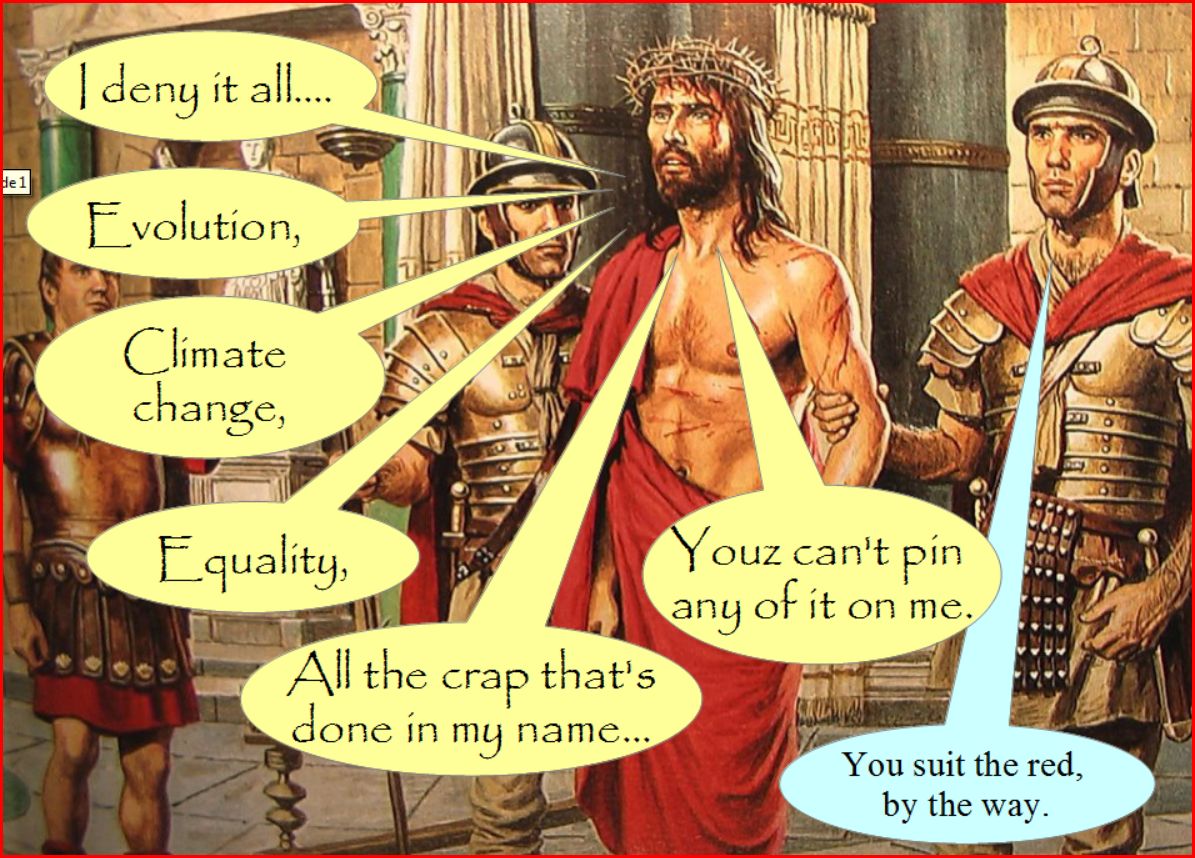
Deny yourself, deny your parents, deny your family. That’s what Jesus tells his followers they’ve to do. Today’s Christians can do better than that though! They’re in complete denial about everything, especially stuff for which there’s tons of evidence. Believing loads of made-up stuff is more their thing.

So, they deny climate change because God wouldn’t allow it (or something).

They deny that human beings contribute in any way to climate change because it’s not part of God’s plan.

They deny evolution because God created everything (in six days).

They deny how unpleasant, wasteful and cruel evolution is in order to believe that God used it to develop life here on Earth.

They deny that death existed before humans evolved because the Bible says it didn’t.

They want to deny gay people equality because the Bible says marriage is for one man and one woman (it doesn’t).

They seek to deny others their rights, often slanderously and viciously, but expect their ‘right’ to do so to be protected.

They deny that morality has anything to do with the way we treat other people and is really only about sex.

They deny that anyone can be moral or rational without believing in their God.

They deny that for most of us things are better than they’ve ever been and insist instead that things have only got steadily worse.

They deny the humanity of fellow human beings but believe in fantasy creatures like angels, spirits and demons.

They deny their own humanity, with its corresponding needs and limitations, and insist instead we’re designed to be spiritual creatures.

They deny most of what Jesus taught but tell everyone else they’re sinners.

They deny that Jesus said he’d be back in his disciples’ lifetime, and believe instead he’s still on his way.

They deny death and imagine they’re going to live forever in Heaven instead.


Christianity is a religion of negativity. Truth, reality and other people are the casualties of its life-denying efforts at self-preservation.


Christians’ Favourite Delusions 24: We stand for biblical truth!

Judge

Christian commentator Tony Perkins demands that Christians defend ‘biblical truth without compromise.’ What he really means – because he only ever uses it in this specific context – is that Christians should use the bible to condemn gay people.

He’s not so hot on standing up for the ‘biblical truths’ that say you should turn the other cheek. Or go the extra mile. Or that you should sell all you have and give the proceeds to the poor. No sir. Those are biblical truths that demand something of Christians themselves so of course they feel perfectly at liberty to disregard them.

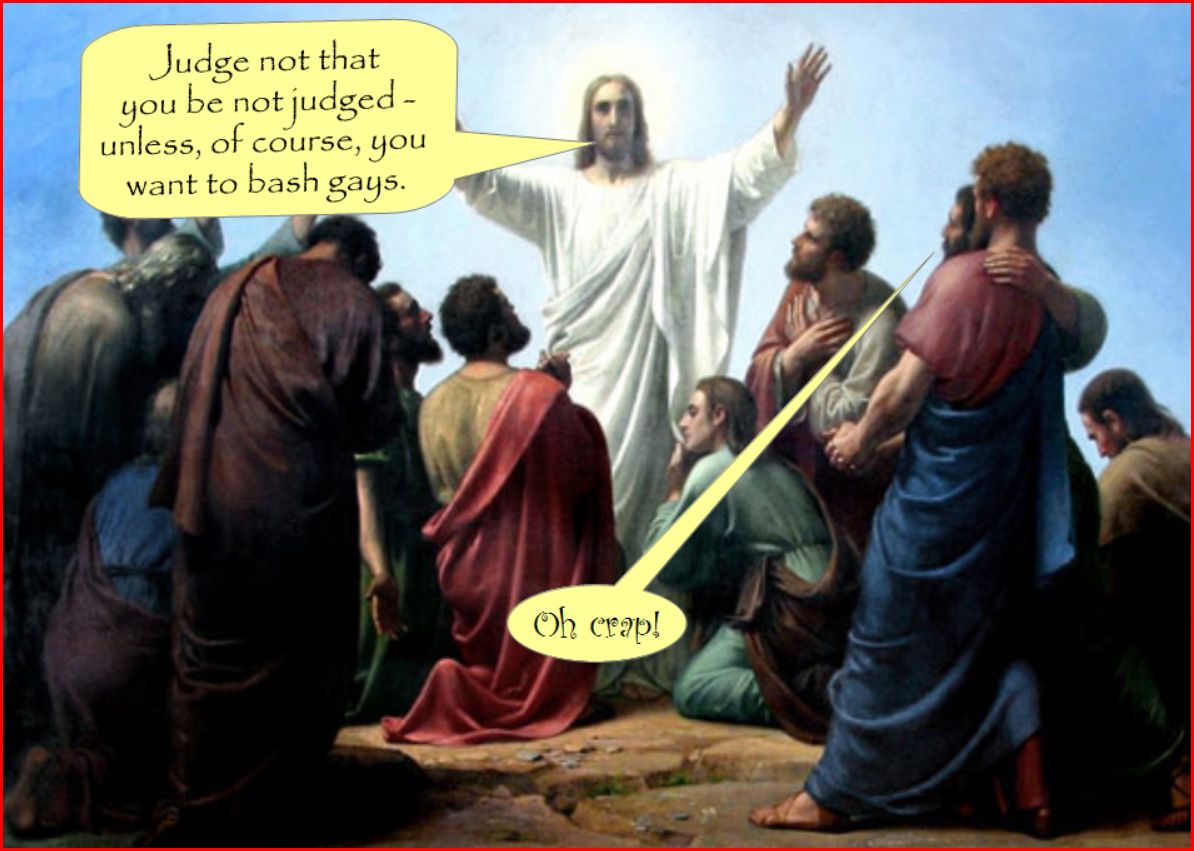
And what about ‘judge not that you be not judged’? Christians will tell you that this doesn’t mean they shouldn’t judge others, just that they should do it according to those same ‘biblical truths’.

This is not what Jesus is saying here though. He clearly means ‘do not judge others unless you’re prepared to be judged yourself’, which, we can only conclude, Christians are happy to have happen to them. They judge others and in so doing open themselves up to judgement; Jesus is very fond of this kind of yin and yang, measure-for-measure arrangement:

Judge not that you be not judged. For with the judgement you pronounce you will be judged, and the measure you give will be the measure you will get (Matthew 7.1-2).

It could also be the case that Jesus is referring here to God’s ultimate judgement as well, in which case those condemnatory Christians who believe that being ‘saved’ allows them to escape the final judgement are in for quite a shock. Still, they can always use the ‘I was only defending biblical truths’ excuse.

Christians’ Favourite Delusions 23: Jesus shows us how to live

Doctor

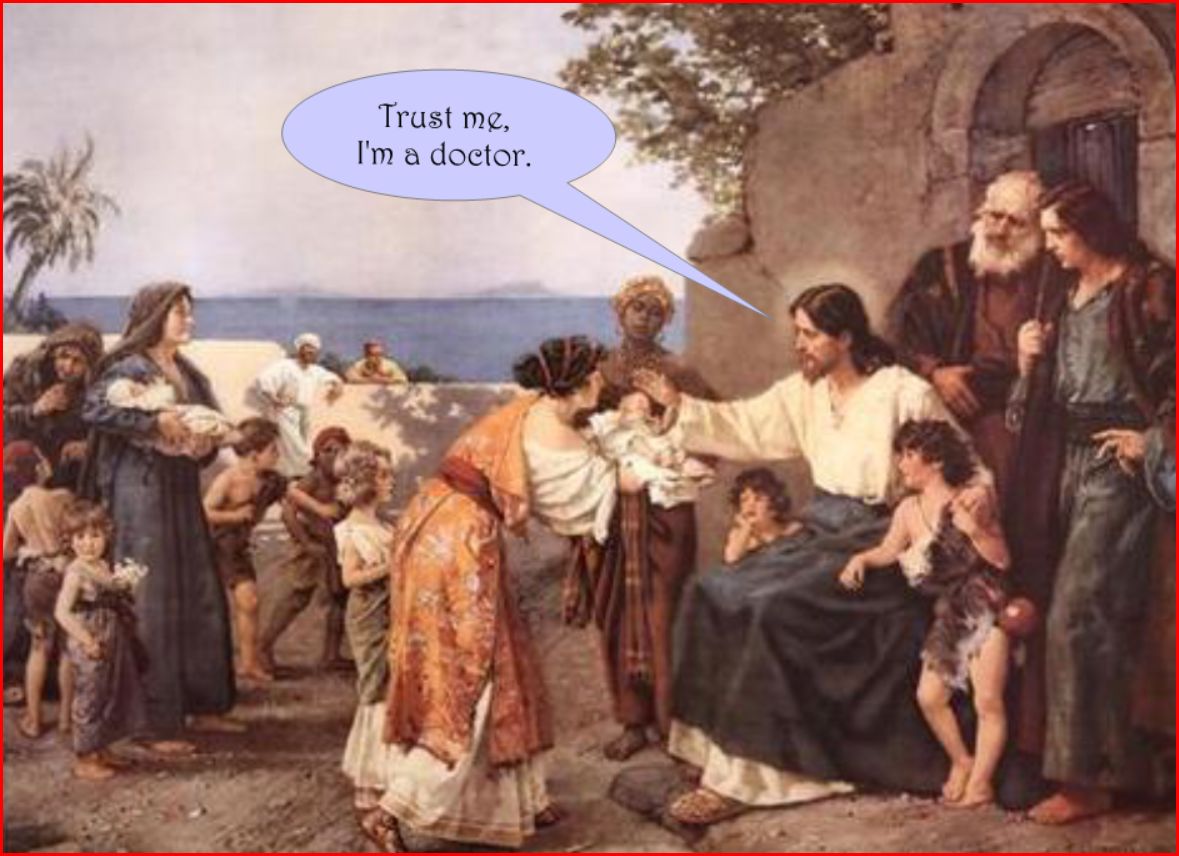
Was JC a great moral teacher?

No, the best things he said – do unto others, love your neighbour – had already been said eons before he came along. Some of the other stuff he came out with was ridiculously impractical – give away all you have; live only for today; turn the other cheek – that his followers have been unable to do from day one.

Did what he said about God turn out to be right?

No. He said God would establish his Kingdom on Earth while the disciples were still alive.

Did he commit himself to long-term responsibility for others and their needs?

Another no.

Did he experience the infirmities and difficulties of old age?

Nope.

Did he suffer from any of the serious illnesses we mere mortals are prone to?

Apparently not.

Did he give over his entire life to raising children or taking care of elderly relatives?

Not that we know of.

Did he have to work each day to earn a living?

No. He sponged off gullible female fans (Luke 8.1-3).

Did he have any understanding of science and of how the world works?

Erm, no. He thought people became ill because of sin and demon possession and that Heaven was in the sky.

Was he interested in anything but his own futile ‘mission’?

Yet another no.

Apart from his last few days did he know suffering, the everyday frustrations of life or the daily struggle to make ends meet?

Not so’s you’d notice.

Did he, in short, know anything of the life as it was lived and is lived by ordinary people?

Emphatically not.

There was nothing marvellous about Jesus. He was out of touch with ordinary people and at loggerheads with those cleverer than he was. He was a failed prophet who was turned into a supernatural being by those who came along afterwards – mainly Paul, who’d never met him – and is worshipped today by those who ignore most of what he said.


Christians’ Favourite Delusions 22: Jesus is gentle and humble

Humble

Without any humility, Jesus boasts in Matthew 11.29 about how gentle and humble he is. Let’s see how he qualifies:

He insists people should love him more than their own families (Matthew 10.37).

He says he’s not a peacemaker but intends creating strife (Luke 12.51).

He claims anyone who doesn’t follow him deserves to be burnt (John 15.6).

He wants the world to be destroyed by fire (Luke 12.49).

He commands people not to call others ‘fools’ (Matthew 5.22) but tells those he doesn’t care for that they’re ‘swine’, ‘dogs’, ‘snakes and vipers’, ‘whitewashed tombs’, and, yes, ‘fools’ (Matthew 7.6; 15.26; 23.33; 23.27; 23.17 & Luke 11.40).

He deliberately speaks in riddles so that people won’t understand him and won’t find forgiveness (Mark 4.12).

He tells his followers to love their enemies but says he’d have his own killed (Luke 19.27 & Matthew 13.41-42).

He endorses slavery and the cruel treatment of slaves (Luke 12.47-48).

He says people would be better off if they cut off their hands, plucked out their eyes and castrated themselves (Mark 9.43-48 & Matthew 19.12).

He endorses the Jewish law that demands the death penalty for those who disrespect their mother and father (Matthew 15:4-7).

He disrespects his mother (Matthew 12.48-49).

He tells people not to get angry but loses his own temper (Matthew 5.22 & Mark 3.5).

He callously kills a herd of pigs and, in a fit of pique, destroys a fig tree (Matthew 8.32 & Matthew 21.19).

He takes a whip to people (John 2.15).

He tells his mates he’ll soon be king of the world and promises them that they’ll rule alongside him (Matthew 19.28).

So, the marks of a gentle, humble man? Or the characteristics of an unpleasant, delusional megalomaniac?

The evidence is in front of you. You decide.


Christians’ Favourite Delusions 21: Jesus Keeps His Promises

Promises

Jesus keeps his promises? Let’s see…

‘I’ll be back while my disciples are still alive’.

For the Son of Man is going to come in his Father’s glory with his angels… I tell you the truth, some who are standing here will not taste death before they see the Son of Man coming in his Kingdom. (Matthew 16:27-28)

Oops. He got that wrong. Two thousand years later and his followers are still waiting. Despite what today’s believers claim, he didn’t say he’d reappear over two thousand years into his future. Safe to assume he’s not going to make it at this late date

‘Anything you ask for will be yours… whatever you ask.’

Very truly, I tell you, if you ask anything of the Father in my name, he will give it to you. (John 16.23)

Truly I tell you, if you say to this mountain, “Be taken up and thrown into the sea”, and if you do not doubt in your heart, but believe that what you say will come to pass, it will be done for you. So I tell you, whatever you ask for in prayer, believe that you have received it, and it will be yours. (Mark 11.24; also Matthew 21.21-22)

Christians hedge round this one by saying God answers prayers in his own time and in his own way. His answer might be ‘no, you can’t have that’. But that’s not what Jesus says. He says ‘Whatever you ask… anything… will be yours.’ What is this if not a false promise?

‘My followers will do even greater miracles than I have.’

Very truly, I tell you, the one who believes in me will also do the works that I do and, in fact, will do greater works than these, because I am going to the Father. I will do whatever you ask in my name, so that the Father may be glorified in the Son. If in my name you ask me for anything, I will do it. (John 14.12-14)

Believers regularly walk on water, turn water into wine, and – slightly less frivolously – raise the dead. Except… no they don’t. It doesn’t happen. They should be doing even more startling things than this too – Jesus promises ‘greater works’ than his – but again, two thousand years on and they haven’t even mastered basic mountain throwing. What a let down. What hokum.

‘You’ll be able to do the impossible.’ 

These signs will accompany those who believe:…. they will pick up snakes in their hands, and if they drink any deadly thing, it will not hurt them; they will lay their hands on the sick, and they will recover. (Mark 16.17)

Which is why, I guess, we have no need of hospitals, because Christians can heal everyone; why members of those fanatical snake-handling churches in America, who take Jesus at his word… erm… regularly die from snake bites. And not even these true believers are crazy enough to drink poison. There’s a limit to how much faith even gullible Christians have in Jesus’ empty words.

‘Don’t bother working or earning a living. God will provide.’

Therefore do not worry, saying, “What will we eat?” or “What will we drink?” or “What will we wear?” For it is the Gentiles who strive for all these things; and indeed your heavenly Father knows that you need all these things. But strive first for the Kingdom of God and his righteousness, and all these things will be given to you as well. (Matthew 6.25-7.1)

Yeah, right. His followers recognise how useless this one is too; they do strive to make a living and provide for their families. None of them wait for God to provide because they’d be dead before he got round to it.

‘God will look after your hair (because you’re worth it).’

But even the hairs of your head are all counted… You will be hated by all because of my name. But not a hair of your head will perish. (Luke 12.7 &  21.12-19)

Oh, come on. Now he’s just being silly.

And that’s only a few of them… Jesus’ promises. All as worthless as the proverbial chocolate fire-guard. Christians, of course, know this well. They neither trust in his promises nor demonstrate them in their lives. As it is, how they live is indistinguishable from everyone else; completely devoid of miracles and lacking in any supernatural provision. They tell themselves (and us) that Jesus is special but then disregard most of what he said – and who can blame them from that? Anyone else who made the sort of ludicrous promises Jesus did would be dismissed as a fool and a charlatan. It’s way past time we recognised Jesus as just that.

The Great Resurrection Miscalculation

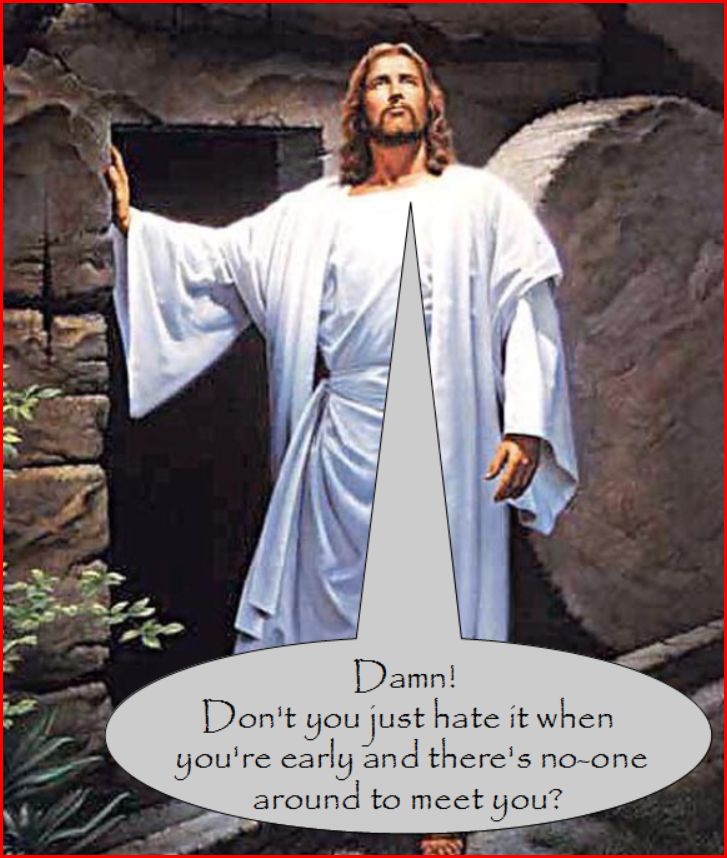
How long was Jesus in the tomb before he ‘rose again’? Three days you say? Wrong! Read on and discover the secret of the Great Resurrection Miscalculation.
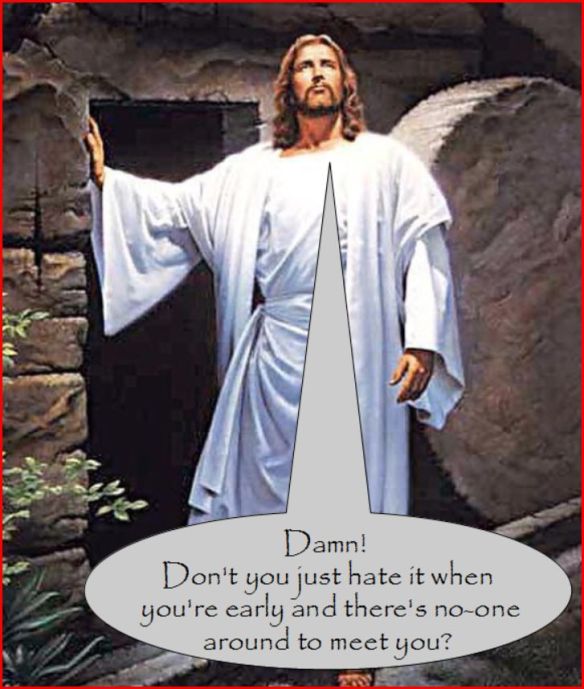
Resurrection

Jesus is wrong about no less an issue than his claim that he would rise from the dead after three days. In Mark 10.33-34 he prophesies:

the Son of Man will be handed over to the chief priests and the scribes, and they will condemn him to death; then they will hand him over to the Gentiles; they will mock him, and spit upon him, and flog him, and kill him; and after three days he will rise again.

On the surface, this seems pretty accurate for a prediction of events made some time before they actually happen (it wouldn’t be a prediction otherwise). Except, of course, this prophecy, like others of Jesus’, was written forty years or more after the event. Even then, Mark or whoever wrote the earliest gospel, can’t get it right. He tells us clearly in Mark 15.34 that Jesus dies at 3pm on Friday; Matthew and Luke agree. Jesus then reappears, fully recharged, ‘very early’ on the Sunday morning (Mark 16.2). But 3pm Friday to the ‘very early’ hours of Sunday is less than 48 hours – not three days, not even two.

What is the cause of this failed prophecy? For some reason, Mark assumes that ‘on the third day’, when he believed Jesus rose from the dead, means the same as ‘after three days’, the words he has Jesus prophesy. The third day after the crucifixion would indeed be the Sunday, but it wouldn’t be, and isn’t, three full days after it, as Mark’s Jesus seems to think.

The problem is not Mark’s alone, however. Matthew’s Jesus is even more emphatic that he will be buried for the three complete days:

For just as Jonah was for three days and three nights in the belly of the sea monster, so for three days and three nights the Son of Man will be in the heart of the earth. (Matthew 12.40)

Thanks to Jesus’ insistence in Mark and Matthew that he would spend three days in the tomb, the belief that he must have done so – contrary to the ‘evidence’ in those same accounts that it was less than two – appears to have become securely established by the time of the fourth gospel. Its writers, however, find their own unique way round the problem. Their thinking seems to have been along the lines that ‘if Jesus said he was going to be buried for three days and three nights, then he must have been. He was the Son of God after all, and he wouldn’t get a thing like this wrong. Therefore, if, as we know, he rose on the Sunday, he cannot have been crucified on the Friday. He must have died on the Thursday’. And so the writers of John’s gospel shift the crucifixion back a day, to around noon on Thursday (John 19.14). It’s an ingenious solution. Thursday to Sunday – near enough three whole days. There’s even some neat symbolism as a bonus: the earlier execution equates with the slaughter of the sacrificial lambs on the Thursday, ready for that evening’s Passover. Problem more than solved!

Except it creates a whole raft of new ones, not least the glaring inconsistency between the synoptic gospels’ accounts of the crucifixion on the Friday – after Jesus’ and the disciples’ celebration of Passover the previous evening – and John’s gospel’s account of the crucifixion during Thursday afternoon, well before the Passover meal would have been eaten. Significantly, no-one in the history of Christendom has ever been persuaded by John’s Thursday crucifixion, otherwise we’d remember it on ‘Good Thursday’ instead of ‘Good Friday’, and have a different day off work.

Does any of this matter? Probably not, but it does demonstrate that:

i) if Jesus’ words in the synoptic gospels are to be taken literally, then either he can’t count or he badly misjudges the timing of his resurrection. If scheduled for three days after the crucifixion it should have occurred on the Monday;

ii) the resurrection probably didn’t happen at all, and more than forty years later Mark and Matthew trip themselves up trying desperately to convince people that it did, and that Jesus knew it would;

iii) the gospel writers are prepared to rearrange already highly improbable events to make equally unlikely prophecies appear true;

iv) because the Bible cannot get its own faked, after-the-supposed-event prophecies right it can’t possibly be trusted about other claims it makes. 

Happy Easter, y’all.

Adapted from my book Why Christians Don’t Do What Jesus Tells Them To …And What They Believe Instead. Buy it on Amazon UK or Amazon US.

Why_Christians_Don't_Cover_for_Kindle


Unbelievable: Why, despite everything, Christianity makes absolutely no sense whatsoever.

Spufford2

There’s no real reason to believe in God.

 
Who says so? Francis Spufford in his book Unapologetic: Why, Despite Everything, Christianity Can Still Make Surprising Emotional Sense. Francis does believe though, because sometimes when he’s alone – specially after a tiff with his wife or while sitting quietly in church – he gets a funny feeling. And this feeling is so funny, as in weird, that it can only be God. Or so Frank says, slipping in as many four letter words as he can, just to show he’s not a namby-pamby sort of believer. (He’s especially proud of his new term for ‘sin’: ‘the Human Propensity to Fuck things Up’, or HPtFtU for short.)

 
What’s more, even though there are a hundred and one reasons to think there isn’t a God, at least not one who cares about us (think pain, suffering, death, evolution and his complete lack of interest in his creation, all of which Frank’s acknowledges) he nevertheless wants to say that he does believe because, you know… feelings.

 
That’s not all. This God Frank’s decided to believe in as result of feeling funny, is the Christian God. He could’ve turned out to be Allah or Zeus or Ra, but he isn’t, because Frank feels he’s the Christian God, for no other reason than he wants him to be. Then, in a final leap of faith, he decides that Yeshua, as he insists on calling Jesus, is the walking embodiment of this God, and he rewrites the gospel story so that it fits with the funny feeling that kick-started his delusion in the first place.

 
And so we have it from the horse’s mouth; a Christian who’s proud to admit there’s nothing remotely rational or empirical about believing in God. Faith, he confirms, is no more than some very human, very peculiar feelings that lead you merrily down whichever garden path you choose to take.

Stephen Green is Gay

Green2

Stephen always got his inspiration from the Lord…

Stephen Green of Christian Voice is unhappy. Gay Marriage, he insists, is a Very Bad Thing.

Green has had a lot to say about gay relationships and gay sex over the last few years. In fact, he’s obsessed with the subject. His latest ejaculation, called ‘Gay Marriage is a Farce’, helpfully informs us:

‘Gay’ relationships (are) built on perversion.

Homosexual desires are described as vile affections in the Bible.

‘Gay marriage’ is a massive step towards the social economy of Sodom.

We don’t say homosexuals are perverts because of what they are, but because of what they do.

Homosexual activity… is either dirty or abusive or both.

Homosexuals, frustrated by their inability to engage in true sexual intercourse, have to resort to activities which are abusive or dirty.

Homosexual acts fall a long way short of the God-ordained conjugal act.

Personally, I now use the word gay mostly in its modern sense of substandard (as in, ‘that coat’s gay’).

Never self-identify as ‘gay’. Never let someone else identify you as ‘gay’.

Green is himself ‘gay’. In the ‘modern sense’, of course. He preaches that marriage is between one man and one woman for life, yet is divorced and now with his second wife-for-life. He trashes charities that help young LGBT people and makes unwarranted personal attacks on gay celebrities, recently suggesting that Stephen Fry has a ‘porcine ancestor… not that we do evolution here’ and adding derisory inverted commas around the ‘Sir’ in Ian McKellen’s name. How big and clever is that?

Even though Jesus has more to say about poverty and homelessness than homosexuality (about which he says precisely nothing), Green never mentions them. He consistently avoids talking about his saviour’s commands to turn the other cheek, go the extra mile and avoid judging others. These, it would seem, don’t matter.

While he occasionally rants about evolution and complains Christians are persecuted, it is to homosexuality he constantly returns. Always with inverted commas around ‘gay’, to ward off the voodoo.

But Green is insecure in his beliefs and faith; he rarely publishes comments that dissent from his ‘biblical’ position and when he does, responds to those who make them with an uncharitable smugness that borders on abuse. There is no sense of any Christian charity in either his comments or on his site as a whole.

Worst of all, he washes his hands, Pontius Pilate like, of the harm his negative, destructive comments cause LGBT people. The real bullies, he says, are not Christians with poisonous views like his but rather:

homosexual activists who persuade young boys and girls that adolescent same-sex attraction indicates a permanent ‘orientation’ and who go around talking homosexuality up and giving bullies a weapon to use against shy boys and tomboyish girls. People like ‘Sir’ Ian McKellen, Elly Barnes, Jake Dyos and the rest of the low-life at ‘School’s Out’.

So now you know. Stephen Green, who calls ‘gay’ people perverts with ‘vile affections’, whose relationships and love-making are, he says, founded on dirt, disease and abuse, is in no way a bully whose views contribute to any ill-feeling towards gay people.

No, the vilification to be found on Christian Voice is actually Christian love™. The gospel according to Stephen Green: it’s so substandard.

Which Christians won’t be resurrected after they die?

Robertson

All of these well-known Christians are unworthy of the Kingdom of God and won’t live again after they’ve died. See if you can work out why:

Billy Graham, Justin Welby (Archbishop of Canterbury), Desmond Tutu, Pat Boone, Mel Gibson, John Sentamu (Archbishop of York), Stephen Green (Christian Voice), Bono, Her Majesty the Queen, Sarah Palin (politician), Pat Robertson (700 Club), Joyce Meyer (evangelist), Bryan Fischer (outspoken radio broadcaster), Rick Warren (pastor of US mega-church), Rob Bell (ditto), George W. Bush, Tony Blair, Cherie Blair (barrister), Graham Kendrick (songwriter), Tony Perkins (anti-gay preacher), Scott Lively (ditto), Matt Barber (ditto), Peter LaBarbera (ditto), Tom Wright (theologian), Fred Phelps (late of Westboro church), Joni Eareckson Tada (writer), Mike Ratcliff (minister and blogger), Kirk Cameron (actor)… and, in all probability, your local pastor  – and maybe even you yourself, Christian reader.

They’re not worthy of God’s Kingdom nor are they likely to be resurrected because they’re married. And who says this makes them unworthy? Not me… Jesus:

those who belong to this age marry and are given in marriage; but those who are considered worthy of a place in that age (of God’s Kingdom on Earth) and in the resurrection from the dead neither marry nor are given in marriage (Luke 20.34-35).

So next time one of these famous Christians or some other married believer tells you you’re not saved, tell them that they’re not either. Jesus says so.

They won’t care, of course, because they pick and choose the bits of the Bible they believe. They’re more than happy to pretend this tricky bit doesn’t exist or doesn’t apply to them. Obviously, or they wouldn’t be married. Naturally this doesn’t stop them going on about about God’s plan for marriage even though it’s one they’ve made up themselves that flies in the face of what Jesus says.

Which means these same believers also have to ignore Jesus when he says, ‘Why do you call me “Lord, Lord”, and do not do what I tell you?’, which is a very good question.

Proof that God is real?

Thor

Christians – can you prove God exists? J. Lee Grady of Charisma magazine thinks he can and offers ‘7 Things That Prove God Is Real’. Leaving aside the fact that it shouldn’t be necessary to prove God is real – the God of the universe, Creator of Heaven and Earth, Father of Mankind should be more… apparent, shouldn’t he? – what are Mr Grady’s incredible proofs? Glad you asked. You can read the full article here, but to cut a long story short, they are:

Babies, thunderstorms, flowers, the Bible, the global spread of Christianity, Jesus and a personal friendship with God.

I hope you’re convinced. I know I am.

Problem is, all of these things are also evidence that God doesn’t exist.

Babies: Babies are miracles, according to Lee. We’ve evolved to find human babies cute and appealing even when they’re yelling, pooping and spewing – it helps us nurture them. But they’re not miracles; nearly 37,000 are born every day. What’s more, over a million of them die every year on the day they’re born. Which might just suggest God is not real at all.

Thunderstorms: Mr Grady says that because storms are powerful they put him in mind of God. This, however, is not proof of anything. Unless of course it’s Thor, god of thunder in Norse mythology and star of Marvel Comics. Is this who you mean, Lee?

Flowers: Lee says flowers are proof of God because they’re pretty. He seems to be unaware that their appearance is the result of natural selection; it has developed in order to attract insects and birds who then unwittingly assist in the plant’s reproduction. Yes, flowers are pleasing to the human eye as well, but their job is emphatically not ‘to simply make the world beautiful’, as Lee claims. They are evidence of evolution, not of a flower-arranging god.

The Bible: Lee trots out the false assertion that the Bible, in spite of having numerous authors over thousands of years, presents a consistent message. It doesn’t. There are, for example, at least nine different ways of being saved expressed by writers in the New Testament (some of whom, including the one Lee quotes, are forgers) – and they lived within a few decades of each other! A book cobbled together more than 300 years after the supposed main event, by men – not God – with a vested interest in its success, is not proof of the divine.

The global spread of Christianity: Human beings have worked hard throughout the ages to spread their own particular version of Christianity – often converting others on pain of death. There are today over 34,000 Christian groups, sects and cults, which is ‘proof’ that there is no one Mastermind behind it all. Other religions spread too, so perhaps that’s evidence their God is real as well (or instead), and so do diseases. The spread of an idea only illustrates human preoccupation with that idea.

Jesus: Really? His broken promises, failed prophecies, impossible morality and shabby treatment of those who didn’t buy into his mission somehow ‘prove God’? Maybe Lee means that Christ proves God. But ‘the Christ’ is an invention of Paul’s and has little to do with the man Jesus. In any case, one mythical figure does not prove another. Unless it’s Thor, of course, whose existence definitely proves there’s an Odin.

A personal friendship with God: What goes on in Lee’s head doesn’t prove anything, never mind the existence of God. A person’s feelings are subjective, solipsistic and entirely unverifiable. Thinking he’s got a relationship with God doesn’t mean that he has. Unlike my friendship with Thor. That’s really real.

So, seven proofs of God that are no proof at all. Anyone else care to take a turn?