Invasion of the Body Snatchers

PissImagine the outcry there would be from Christians if having decided to hold an open-air service, a group of atheists turned up and started shouting through tannoys at them as they attempted to enjoy their celebration. Imagine those atheists shouting ‘Hypocrites!’ and ‘Losers. You need to come to your senses!’ Imagine if they said they were only doing this out of love to break the spell the Christians were under, the spell of religion. Imagine they held up signs the entire time with text inspired by Richard Dawkins and Christopher Hitchens, like ‘Free yourself from your God Delusion’ and ‘ Religion Poisons Everything’.

Yes, imagine the outcry; the Christians would see themselves as persecuted by ‘militant atheists’ out to spoil their day. And, who knows, perhaps they’d be right, though perhaps persecution is overstating it, though we all know Christians like their martyrdom. So long as it doesn’t entail any actual… erm… martyrdom.

This didn’t happen at the weekend in my home town – I doubt it happens anywhere – but pretty much the opposite did. A bunch of Christians, complete with loud speakers and placards with scripture verses on them, turned up at the Gay Pride celebration in the centre of town and proceeded to tell those out to enjoy their day that they were sinners in need of Christ and his salvation. They kept this up, because, they said, they loved the people whose afternoon they were trying to disrupt, for at least two hours. These were not members of a local church; according to the young man I spoke to they had come from various parts of the UK and from the States specifically to interfere with the event, or ‘preach the gospel’ as he put it.

The LGBT people at the Pride were having none of it, of course, and drowned out the tired old rhetoric with whistles and good natured chanting until the Righteous Ones accepted the futility of their mission and packed up to go home… but not before they transplanted themselves near the stage to show off their signs again.

Now, how is this different from the scenario we started with?

Christians would object if others gate-crashed their events and attempted to disrupt their celebrations; yet they think they have the right to do just that to others, with their message of hell and damnation. They’d cry ‘persecution’ and see the same kind of actions as militant (when they have no idea what the word ‘militant’ actually means) and part of an ‘anti-Christian agenda’, if it was they on the receiving end.

It’s Christians themsleves who have the agenda – to judge, impose on and convert those with different beliefs and philosophies. They think they have special knowledge of The Truth that no-one else has and which has never been heard before when all they really have is a superstition, a belief in a sky god and magical incantation, much like any other superstition. Even if this weren’t the case, even if their beliefs were what the Christians think they are, that does not give them the right to exercise their arrogant, shouty agenda by rudely imposing themselves on others’ special days.


Update: Evangelist Dale Mcalpine says it wasn’t his merry little brand of preachers that invaded Pride. Oh no. According to Dale, a bunch of irresponsible LGBT people tried to spoil a bona fide Christian event that just happened to be going on nearby at the same time.

These people’s self-delusion knows no bounds.


Idiotic Stuff Jesus Said 12: My words will never pass away

AndersonThe premise of my first ‘Jesus’ book* is that while Christians profess to believe in Jesus, they choose to ignore most of what he taught while he was alive. While they claim a vapid super-hero Christ as personal saviour, they replace what the human Jesus had to say with words of their own choosing. In reality, they have about as much time for Jesus’ ‘eternal words’ as the average non-believer or atheist. You don’t have to look very far to see how much his words have already ‘passed away’:

Jesus said, ‘Don’t judge so that you won’t be judged’ (Matthew 7.1). Our representative Christian says, ‘LGBT people are filthy and wrong.’

Jesus said ‘Love your enemies, pray for those who persecute you’ (Matthew 5.44). Our representative Christian says, ‘I’m gonna pray a transgender person dies and goes to Hell.’

Jesus said, ‘Love your neighbour as yourself’ (Mark 12.31). The Christian says, ‘The way to show love is to tell other people they’re going to Hell.’

Jesus said, ‘sell all you have and give to the poor’ (Mark 10.21). The Christian is concerned about where to buy jewellery: ‘…somewhere other than Tiffany’s, because Tiffany’s is gay friendly.’

Jesus said, ‘Forgive those who sin against you so you can be forgiven yourself’ (Matthew 6.14). Our believer rants, ‘LGBT people should be executed.’

Jesus said, ‘Don’t commit adultery and don’t get divorced’ (Matthew 5.27-28 and 19.9). Significant numbers of Christians , including our own Stephen Green, say, ‘that doesn’t apply to me.’

See what I mean? Christians regard the words of their saviour, not as having everlasting value, but as if they’re nothing more than worthless bits of fluff. Even if God were real, every word of the Bible true, every aspect of the Great Salvation Plan genuine, it wouldn’t change the fact that believers treat as optional almost everything Jesus commanded and live as if he never had.


* Why Christians Don’t Do What Jesus Tells Them To …And What They Believe Instead is available from Amazon worldwide (UK here, US here) but not, alas, from Tiffany’s.

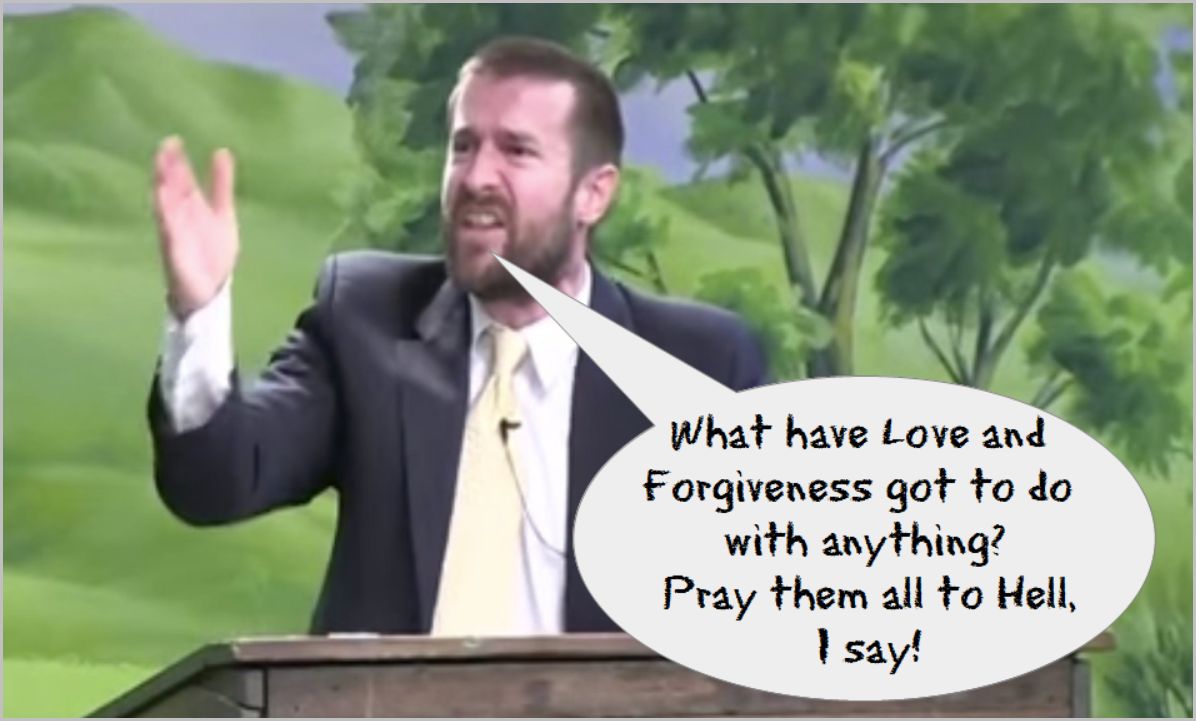
The picture shows the deplorable Pastor Steven Anderson (linked above). He knows better than Jesus ever did.


Idiotic Stuff Jesus Said 11: Build Your Lives on the Things I Say

WhoDoJesus demanded you base your life on his teaching. It’s the only way, he said, that you’re going to find meaning, as well as the principles you’ll need when the going gets tough:

Everyone then who hears these words of mine and acts on them will be like a wise man who built his house on rock. The rain fell, the floods came, and the winds blew and beat on that house, but it did not fall, because it had been founded on rock (Matthew 7.24-25).

And what exactly were those words of his? Here’s what he taught:

  • The Son of Man was coming to the Earth to establish God’s Kingdom within the lifetime of his original followers (Matthew 16:27-28; Matthew 24:27, 30-31, 34; Luke 21:27-28, 33-34);
  • His own people needed to be more ‘righteous’ in order to be part of this Kingdom (Matthew 5.20; Matthew 6.33; Matthew 13.49 etc);
  • Being righteous entailed some extreme behaviour; loving your enemies, giving away all you had, turning the other cheek, forgiving repeatedly, being perfect (Matthew 5.44; Matthew 5.42; Luke 6.29; Luke 6.37; Matthew 5.48; Matthew 19.21);
  • It was crucial to obey Jewish law, even if some of it could be reinterpreted (Matthew 5.17-18; Matthew 12.1-7);
  • Once the Kingdom arrived Jesus himself would be King of the world, aided and abetted by his pals (Matthew 19.28; Luke 22.30);
  • His followers would do even greater miracles than he did himself. Given he controlled the weather, healed the sick and raised the dead, that’s going some (John 14:12).

Anybody know anyone who believes all of this or lives this way? Anyone who operates on these exacting principles? I don’t know of anyone and never have. I didn’t even when I was Christian myself. Jesus demands are impossible. No-one can live according to them. ‘Of course not,’ say Christians. ‘You need supernatural help to live like this.’ So why don’t they, when they have God’s spirit living within them (John 14.16-17)? Why don’t we see Christians who perform spectacular miracles, who constantly go the extra mile, who give away everything they have, who are, as Jesus tells them they should be, perfect?

We don’t because no-one can live as Jesus insisted they should. Nor do we see Christians who believe his prophecies either, particularly the one about the Son of Man bringing God’s Kingdom to Earth two thousand years ago. Christians pretend he didn’t really say it, or if he did, that he meant something else entirely. They’ve changed his very words – the ones they should be building their lives on – to claim Jesus himself will be returning any time now (the synoptic gospels are confused about whether Jesus is this Son of Man, or someone else). When he does, they say, true believers will be going with him to Heaven. Never mind that Jesus teaches nothing of the kind and there’s absolutely no foundation for these beliefs in his words. As such, they’re the faith built on sand he tells them is worthless:

And everyone who hears these words of mine and does not act on them will be like a foolish man who built his house on sand. The rain fell, and the floods came, and the winds blew and beat against that house, and it fell—and great was its fall! (Matthew 7.26-27).

So, if Christians don’t do what Jesus tells them and don’t believe his promises or prophecies, then in what way can it be said they take his words as the foundation of their lives? Don’t they, rather, base them on Paul’s teaching, about a supernatural Christ who bears little resemblance to the zealous Jewish preacher they pretend is their ‘Lord’? Teaching that has nothing to do with that of the man who demands his pronouncements be the very basis of life? Paul doesn’t quote any of Jesus’ teaching.  The foundation Jesus speaks of is of no interest to him; so, naturally, this is whom Christians follow – not Jesus, but Paul and his mythical Christ.

Christians have no time for Jesus’ words – and who can blame them? All he offers is impossible morality, false promises and failed prophecies. Far better to go with what Paul offers, because that’s about what’s in it for them. But even Paul didn’t believe anyone was going to Heaven, so they ignore that bit in his teaching too.

The View from Higher Ground

PopesLast week, the good people of Ireland voted to legalise same-sex marriage. Predictably, the Holy Men of the Roman Catholic Church have emerged from wherever it is they secrete themselves when they’re not in their frocks to condemn the outcome. Sour grapes the Holy Spirit prompts Cardinal Raymond Burke to whinge:

I was deeply saddened by the result… I think that you cannot just talk of a defeat for Christian principles, but of a defeat for humanity… I mean, this is a defiance of God. It’s just incredible. Pagans may have tolerated homosexual behaviours, they never dared to say this was marriage.

Of course, same-sex marriage is not ‘a defiance of God’, because there is no God, and marriage is a wholly human institution that we can arrange and change exactly as we like – but perhaps I’m splitting hairs here.

Also lost on the Cardinal is the irony that he speaks for a church (one of several as it turns out) that systematically abused children for many years, attempted to cover up its crimes, lied to victims and, when finally caught out, denied it had done anything wrong. A church, in other words, that has voided itself of all moral authority and has forfeited the right, if it ever had it, to judge anyone else’s ‘principles’ or ‘behaviours’. Those who voted for equality in the Irish vote were right to ignore and defy an organisation as dissolute and hypocritical as the Roman Catholic Church. That this church now believes itself to be in a position to condemn same-sex marriage demonstrates just how shameless and arrogant it is.

To add insult to injury, this Burke goes on to declare that the church should respond to the growth of equality, not with humility and gracious acceptance, but by intensifying its efforts to convert others to a corrupted, lifeless religion:

The church must take account of this reality, but in the sense that it must strengthen its commitment to evangelisation.

Because believing in Jesus, Mary and a whole load of other dead people will make the gay go away. Or something.

Talk about a defeat for humanity.

BurkeCardinal Burke can be seen modelling a fetching chiffon two-piece in – what else – Cardinal red, with a dainty lace number to complement. Here he demonstrates the fabulous fullness of both items, which, regrettably, are no longer available in sack-cloth or ash grey.

Spontaneous Conversion

st-paul-conversionThe missionaries pressed on into the Amazonian jungle. They were now in uncharted territory. No-one had ever been this far in. And then, sounds from somewhere not too distant; human sounds, human voices – singing even. The missionary troupe emerged into the clearing to an amazing sight. Groups of Amazonian natives gathered together, a rudimentary cross in front of them, towards which they were undeniably directing their worship. These people, whose existence had hitherto been unknown, and who had never before encountered Westerners, were Christians!

Weeks later once basic communication had been established, the tribe’s chief priest and the head missionary communed together. The priest explained how, long ago in the past, his ancestors had recognised God’s presence in the incredible world around them and had opened their hearts to him. As a result – Miracle of Miracles! – God sent them a vision of Christ himself, much as he had to St Paul and the other disciples, and the whole tribe came to believe in Jesus. Ever since then, the tribe had worshipped the one true God and his only son, that same Jesus Christ.

“Amazing,” said the missionary, “so it looks like St Paul was absolutely right when he said God reveals himself in nature and speaks to our hearts to make himself known to us. It’s not as if we ever needed the Bible, or to go round telling people how to be saved. God is more than capable of doing it for himself. Praise the Lord and pass the communion wine!”

What a story! And it happened time and time again as the world was opened up by explorers and missionaries.

Or maybe not. Definitely not, in fact. But it should have happened if what Paul says in Romans 1.18-21 is right, as Ken Ham believes it to be:

For the wrath of God is revealed from heaven against all ungodliness and wickedness of those who by their wickedness suppress the truth. For what can be known about God is plain to them, because God has shown it to them. Ever since the creation of the world his eternal power and divine nature, invisible though they are, have been understood and seen through the things he has made. So they are without excuse; for though they knew God, they did not honour him as God or give thanks to him, but they became futile in their thinking, and their senseless minds were darkened.

If God is so obvious in the world that (supposedly) he created and if we humans can see and understand him through it, then why do Christians need to proselytise? Why doesn’t God make his personal presence felt just that tiny bit more clearly – with the odd ‘revelation’ like the one he provided Paul, say – so that people come to believe in him more fully? And by ‘him’, of course, I mean the proper God – the Jesus one. Why does he leave it so that folk seemingly pick up on the special vibes he’s placed in their hearts but then worship a ‘counterfeit’ god, like Allah or Jah or, back in Paul’s day, Zeus? Why doesn’t he provide revelations like he used to, to ensure everyone knows just who it is who’s standing at the door knocking?

If he did that, if God did indeed plant clues to his presence both around us and in us as Paul says he does, then the Bible wouldn’t be needed to convert people. But that’s not what we find, which is that the Bible is essential in perpetuating the God-myth. We wouldn’t even be aware of Paul’s ridiculous claims if they were not preserved in that ramshackle collection of writings.

The indoctrination of others is utterly reliant on two things and two things only. Not God-in-nature or inner prompting or visions, but on ‘the scriptures’ and those who are driven to spread the Jesus-meme. Now does that not strike you as odd? It strikes me as something entirely human, with nothing supernatural about it. If people have to be told, evangelised to and indoctrinated into Christianity, then it can hardly be the case that they see the one true God in nature or have an intuitive feel for him. If that were the case, then we would have discovered hitherto unknown groups of humans who already knew of him and the nonsensical clutter of beliefs that surround him. And we haven’t. Ever.

Christians’ Favourite Delusions 33: Atheists know in their hearts that God exists

DenyTwo tried cliches trotted out by evangelising (i.e. aggressive) Christians are that ‘atheism is a religion‘ and that in their ‘heart of hearts atheists know there really is a god’. Ken Ham of Answers In Genesis is fond of both assertions, as are other equally desperate promoters of unsupportable beliefs. We’ll come to the first in a later post, but here’s how Ham expresses the second:

They (atheists) know in their hearts that God exists, but they are actively suppressing this belief in unrighteousness (Romans 1:18). They fight so hard against a God that they claim doesn’t even exist because they know that He really does! We need to pray that, instead of fighting against God, these lost individuals will repent and put their faith and trust in Christ and in what He did for them.

Romans 1.18 that he cites says: For the wrath of God is revealed from heaven against all ungodliness and wickedness of those who by their wickedness suppress the truth.

Assuming Paul is saying here what Ham claims he is (it’s doubtful from this verse alone) both he and his hero are demonstrably wrong – as they are about so much. The evidence suggests that while young children look for meaning and assume agency, they do not necessarily attribute these to a god until they are taught to do so by others. The god they then come to acknowledge is the one already prevalent in their social environment. In a predominantly Christian context, they will come to be acquainted with – and may go on to develop a full-blown belief in – the interpretation of the Christian God common within their particular culture.

It is the same for conversion generally. You are more likely to be a Mormon in Salt Lake City, a Roman Catholic in East Timor. If raised in a Jewish environment, it’s more likely you’ll subscribe to YHWH; in an Islamic one, an interpretation of Allah; Buddha – not strictly speaking a god – in a Buddhist one. Statistically, those who adopt a religion and a belief in a god, almost always opt for that which is prevalent in the society into which they are born. This is not god ‘writing a knowledge of himself’ in their hearts, it is a cultural, human phenomenon.

Ham and others see this as evidence for their belief that we all have some sort of ‘god-shaped hole‘ in our psyche that we can just as easily fill with false gods as with the real one (theirs). But this is a shift in the argument; it’s not now that God makes himself known to everyone but that we all find a need for a god. This is not the same thing, nor is it true. Certainly humans have a history of creating gods to explain the strange, magnificent and sometimes hostile universe in which we find ourselves; but this does not mean these many gods exist, as Ham would be the first to admit (c’mon, there’s only one real God – his.) It means only that the human brain seeks pattern and meaning, and has often drawn the wrong conclusions in its quest for them. The gods – and God – are part of these wrong conclusions.

And what of Ham’s assertion that atheists deny their awareness of God because of ‘unrighteousness’ – because, he implies, we just want to live a life of rampant ‘sin’? Well, I admit, I like a bit of a sin as much as the next man, but that’s not why I’m an atheist. I’m an atheist because, like most others, I find no evidence for gods or God either in my ‘heart’, nor in the way the world works nor in collections of iron age stories. Morality doesn’t come into making this assessment. In any case, those who buy into a god don’t have a monopoly on ‘righteousness’, as their weak morals, judgemental attitudes and destructive behaviour regularly demonstrate. More than this, and as Ham admits, Christians are only concerned about others because the Bible says they should be: ‘The reason I care about poverty,’ he says, ‘is because God’s Word instructs me to care, and all humans are made in the image of God as God’s Word tells me.’ This is not righteousness, nor a morality that comes from any real concern for fellow human beings.

Finally, atheists don’t, as Ham claims, ‘fight so hard against’ a non-existent God that we secretly believe in. We oppose Christians and other purveyors of supernatural nonsense when they try to impose their irrational beliefs on others, when they condemn fellow human beings, seek to control them and try to limit their rights in the name of God and the cause of ‘righteousness’.

So, no, don’t condescend, Christians, to tell us we all know that there’s a God that we wilfully ignore. You’re wrong, and I’ll show you even more reasons why you are, next time.

Jesus: The Dark Side

SacrificeDo not think that I have come to bring peace to the earth; I have not come to bring peace, but a sword (Matthew 10.34).

Well, isn’t that a comfort. Jesus, who said ‘blessed are the peacemakers’ and for whom Christians like to claim the title ‘Prince of Peace’, declares himself to be anything but.

Of course, it’s possible these words were put into Jesus’ mouth once belief in him had indeed started splitting families and communities; between those who subscribed to his cult and those who saw it for what it was. Maybe though he really did advocate armed rebellion – against the Roman and Jewish authorities – rather more than later believers care to admit. Even as they’ve come down to us, the gospels retain references to taking up arms in the cause of God’s Kingdom. For example:

  • Jesus didn’t see the transition from the existing system to the Kingdom as a peaceful one:

Matthew 11.12: From the days of John the Baptist until now the kingdom of heaven has been coming violently and the violent take it by force.

Matthew 3.10: Even now the axe is lying at the root of the trees; every tree therefore that does not bear good fruit is cut down and thrown into the fire.

  • He instructed the disciples to arm themselves:

Luke 22. 36-38: He said to them… ‘the one who has no sword must sell his cloak and buy one. For I tell you, this scripture must be fulfilled in me, “And he was counted among the lawless”; and indeed what is written about me is being fulfilled.’ They said, ‘Lord, look, here are two swords.’ He replied, ‘It is enough.’

  • And evidently they did:

Luke 22.48-49: Jesus said to him, ‘Judas, is it with a kiss that you are betraying the Son of Man?’ When those who were around him saw what was coming, they asked, ‘Lord, should we strike with the sword?’ Then one of them struck the slave of the high priest and cut off his right ear. (Jesus promptly heals the slave and then says, sanctimoniously, that ‘those who live by the sword will die by it’, as if swords weren’t his idea in the first place!)

  • More than this, when, as he clearly believed he would be, Jesus is appointed King in God’s new Kingdom, he hints he will be happy to see all of his opponents put to death:

Luke 19.27: “But as for these enemies of mine who did not want me to be king over them—bring them here and slaughter them in my presence.”

  • Jesus was executed by the Romans as a revolutionary. Crucifixion made an example of those who actively opposed Roman rule. The charge against Jesus was that he was an intended usurper of power; two fellow ‘rebels’ are executed with him:*

Mark 15.26-27: The inscription of the charge against him read, ‘The King of the Jews.’ And with him they crucified two rebels, one on his right and one on his left.

So much for ‘love your enemies’ and ‘turn the other cheek’. So much for the Jesus who does nothing but preach love and forgiveness. So much too for Paul’s mystical Christ. There is a very dark side to Jesus that expresses itself in vengefulness and megalomania. That anyone so disturbed could be considered an emissary from God, let alone God the Son, beggars belief.


* Since writing this post I’ve read Marcus J. Borg’s Jesus: Uncovering the Life, Teachings, and Relevance of a Religious Revolutionary. Borg makes precisely the same point about the charges against Jesus (though he sees him as a non-violent revolutionary). He explains that the Greek word used to describe the two killed with him – rendered as ‘rebels’ above – ‘is the term more commonly used for those engaged in armed resistance against Rome – “terrorists” or “freedom fighters”, depending on one’s point of view (p265).

Always and Forever

nurseGod is trustworthy and true. He always keeps his promises. We know this because Christians, either in person or on web-sites, like to tell us so.

Let’s take a look at some of the promises God made back when he only liked Jewish people. How well do they hold up?

As part of his promise (covenant) with Jewish patriarch, Abraham, that he would look after his descendants in perpetuity, Yahweh came up with a particularly gross way for them to sign up:

I will always keep the promise I have made to you and your descendants, because I am your God and their God… Abraham, you and all future members of your family must promise to obey me. As the sign that you are keeping this promise, you must circumcise every man and boy in your family. This will be a sign that my promise to you will last forever. Any man who isn’t circumcised hasn’t kept his promise to me and can’t be one of my people… The promise I am making to you and your family will be for (your son) and his descendants forever (Genesis 17.7, 9-13, 21; my emphases).

‘Always’ and ‘forever’ obviously meant only until God changed his mind – which he did when he came up with the new ‘covenant’. You know the one: ‘believe in Jesus to be saved, no primitive surgery required.’ Of course, Jews still feel the original promise is in force and so keep up the old slicing’n’dicing membership requirement. So who’s right? Jewish people who feel that a promise is a promise? Or Christians who insist God eventually lost interest in mutilating penises? It’s hard to tell, but if it’s the Christians, then God, being omniscient and all, must have known he would change his mind eventually. So why tell ol’ Abe the agreement with him was ‘always’ and ‘forever’?

Then there’s the one where God promises there’ll be a descendant of King David’s on the throne forever:

I will establish your royal throne over Israel forever, as I promised David your father when I said, ‘You shall never fail to have a successor on the throne of Israel’ (1 Kings 9.5).

Oops. David’s line ceased ruling over Israel when the Assyrians defeated it in 586BCE. Since then there has been no king of the Davidic line ruling over Israel. Why didn’t God see this coming? And if he did, why’d he make a promise, with ‘forever’ and ‘never fail’, that he knew he wasn’t going to keep? Yes, I know Christians like to claim that Jesus took over the kingship when he came along, but he didn’t, not really. His descent from David is highly questionable and there’s still that awfully long gap between 586BCE and Jesus’ time that blows a hole in ‘never fail’ and ‘forever’. In any case, Jews, by definition, have never seen Jesus as their king and they’ve got a point: it’s difficult to see how someone dead and/or totally invisible can be king of anything.

Never mind, let’s try another. This time God’s promise that everything’s going to work out okay:

(The Lord) will judge between the nations and will settle disputes for many peoples. They will beat their swords into ploughshares and their spears into pruning hooks. Nation will not take up sword against nation, nor will they train for war anymore (Isaiah 2.4).

Safe to say this didn’t happen either. Not while people were still using swords and spears anyway.

Finally, what about the promise that’s trotted out every Christmas? –

For to us a child is born, to us a son is given, and the government will be on his shoulders. And he will be called Wonderful Counsellor, Mighty God, Everlasting Father, Prince of Peace. Of the increase of his government and peace there will be no end. He will reign on David’s throne and over his kingdom, establishing and upholding it with justice and righteousness from that time on and forever (Isaiah 9:6-7).

Whatever Christians might claim for these verses, they’re not about Jesus. At the risk of repeating myself, I’ll repeat myself: Jesus did not and does not reign on David’s throne. He said he would, it’s true, believing himself to be the fulfilment of ‘prophecies’ like this, but he was wrong, as events went on to demonstrate. He didn’t, in any case, fit the description of whoever it is who’s being spoken of here; an earthly ruler who – yes, you guessed it – has still to show up. We’d have spotted him if he had. Some Jewish scholars think they might have done, pointing to King Hezekiah who ruled Israel in the 8th and 7th centuries BCE, for almost 30 years. That’s hardly ‘forever’ though, is it. Yet more evidence that ‘prophecy’ doesn’t ever work, principally because it’s impossible to know the future.

God’s promises are like those of politicians: you just can’t trust them. There has to come a time when those who believe in them must face up to the fact they’re not promises at all, just ancient wishful thinking.

Jesus v. Paul Round 2: And the winner is…

Make-overI’m re-reading Barrie Wilson’s excellent How Jesus Became Christian. Wilson makes the case that Paul’s Christianity was, and is, an entirely different religion from that of the historical Jesus. He shows how Paul’s ‘Christification’ changed the original mission of Jesus – to alert his fellow Jews to the imminence of God’s kingdom on Earth – ‘from one focused on the teachings of Jesus to one about the Christ’ (p242).

How right he is. This very the dichotomy troubled me in my own church-going days when evangelical Christianity, as it still does, consistently excluded the demanding, extreme and human Jesus of the synoptic gospels to focus instead on this illusory supernatural being. They preach sermons about him, sing hymns to him and intone creeds that skip glibly over everything Jesus said and did when he was alive. The Christ was, I came to see over time, an invention of Paul’s, the product of his strange hallucination sketchily recounted in Galatians 1.11-12 and 1 Corinthians 9.1 & 15.45. The Jesus he talks about is a sort of cosmic super-hero, a god-man of the type found in pagan religions in the first century. He has little or nothing to do with Jesus the Jew preacher and would-be Messiah, preserved – just about – in the three synoptic gospels.

So, the differences between Jesus and the Christ are profound. Here are a few of them, that I’ve drawn up, demonstrating that Christianity as we know it – essentially Paul’s ‘Christified’ version with inconvenient bits removed – bears little relation to the ‘good news’ of Jesus:

Jesus’ good news: God’s Kingdom on Earth imminent (Mark 9.1 etc)
Paul’s good news: Salvation through a dying/rising god-man (Romans 3.19-26; 4.24; 5.1-2; 5.10 etc)

Jesus presents as: Jewish Messiah claimant: ‘Son of Man’; Self-appointed judge and king in near future (Matthew 16.28; 13.41; Luke 22.30 etc)
Paul presents: Mystical saviour: The Christ, who saves those who ‘share’ in his death and resurrection; Christ as judge and ruler of mankind in near future (Romans 3.25; 6.1-11; 13.11-12; 1 Corinthians 15.20-28; Philippians 3.20)

Jesus’ qualifications: Teacher, preacher and healer; ideas rooted in Jewish prophecy; full of his own importance (Matthew 5.17; 7.12; 9.35; 25.40)
Paul’s qualifications: Builds entire religion on single hallucination; borrows heavily from pagan cults; full of his own importance (1 Corinthians 15.8; Galatians 1.15-16)

Jesus’ position: Adherent of Jewish Law; emphasises its importance (Mark 6.2; Matthew 5.19)
Paul’s position: Disregards Jewish Law; implies it is ‘dung’ (Romans 3.28; Galatians 5.6; Philippians 3.7-9)

Jesus insists on: Obedience to Jewish Law (Matthew 5.17-20)
Paul insists on: Faith in Christ and his resurrection (Romans 1.16-17; 3.22)

Jesus’ salvation requirement: Be righteous/perfect (Matthew 5.48; 13.43)
Paul’s salvation requirement: Faith (Romans 5.1; Galatians 2:15-16)

Jesus expects: Right behaviours and attitudes (Matthew 5.38-48)
Paul expects: Right belief (Romans 10.10-13)

Jesus’ teaching: Measure for measure morality (Matthew 6.38; 7.2; Luke 6.37); Forgive in order to be forgiven (Matthew 6.14); Show mercy in order to be shown it (Matthew 5.7); Give in order to receive (Matthew 6.38); Treat others as you wish to be treated (Matthew 7.12)
Paul’s teaching: Profess right belief (Romans 10.9)

Jesus’ commands: Love God (Matthew 22.37); Love your neighbour (Matthew 22.39); Love your enemy (Matthew 5.44)
Paul’s commands: Embrace Christ (Romans 8.35-38; Galatians 3.27); Be filled with the Holy Spirit (Romans 5.5; Galatians 5.16-18); Avoid those with different teaching (Romans 16.17; Galatians 6.6-9)

Jesus’ extremism: Give up everything you have (Mark 10.21; Luke 14.33); Give to all who ask (Matthew 5.42); Turn the other cheek (Matthew 5.39); cut off own hands, remove eyes (Mark 9.43-47); Consider castration (Matthew 19.12)
Paul’s extremism: No interest in anything Jesus taught when was alive; intolerance of Jesus’ original followers (Galatians 2.11-21)

Jesus’ guarantees: Resurrection/eternal life through demonstration of one’s personal righteousness once the Kingdom comes (Matthew 25.31-36)
Paul’s guarantees: Resurrection/eternal life for those with right belief and faith when Christ returns soon to judge mankind (1 Corinthians 15.20-28; 51-52)

Jesus’ outcomes: No Kingdom on Earth; no appearance of the Son of Man or a returned Jesus; disappearance of the movement that subscribed to Jesus’ ‘good news’
Paul’s outcomes: No appearance of the Christ; no rapture; no resurrection; no cosmic judgement

Jesus’ result: Failure
Paul’s result: Becomes mainstream Christianity; Paul wins!

As Wilson makes clear, the two are, despite some small overlap, very different belief systems. The Christ Christians worship is not the same as the Jesus they ignore. Nonetheless, they continue to pretend they are one and the same, unable to see that the join is, and always has been, a gaping hole.

 
Notes:
i) Biblical references are by no means exhaustive; there are many others that support each point and difference.

ii) Details of Wilson’s book are:
Wilson, B. (2008) How Jesus Became Christian: The Early Christians and the Transformation of a Jewish Teacher into the Son of God. Weidenfeld & Nicolson, London.

Money, Money, Money

MoneyAfter the Kingdom-that-never-comes, what does Jesus talk about more than anything else? Love? Forgiveness? Marriage? Sin? No. While he does mention all of these, more of his teaching is to do with money and wealth. When he isn’t speaking about money specifically he’s using it as the background to a parable. Eleven of his thirty-nine parables involve it.

He had a thing about money. He resented the wealthy to such an extent he said it was unlikely they’d find a place in his new world order – the famous ‘camel through the eye of a needle’ saying of Matthew 19.24.

Come the revolution, he implied, the rich would have their wealth stripped from them (Luke 6.24-25).

He consigned the wealthy to Hell, not because they weren’t ‘saved’, but because they were rich and ignored the poor (Luke 6.19-25).

He seemed to think being poor was a virtue and that those who were, were especially favoured by God (Luke 6.20).

He preached against what he saw as the dangers of wealth and on more than one occasion (Matt 19.21 & Luke 12.33) and advised those with money and possessions that if they wanted God’s approval they’d have to give them away to the poor.

“No one can serve two masters,” he’s recorded as saying in Matthew 6.24. “Either he will hate the one and love the other, or he will be devoted to the one and despise the other. You cannot serve both God and Money.”

Jesus was no capitalist.

So what do Christians make of Jesus’ evident contempt for money? They certainly don’t give it all away as he said they should. Nor do they see it as an impediment to their salvation, even though Jesus was clear it is (Matt 13.22). As far as today’s Christian are concerned you can serve God and mammon, which is good news – just not Jesus’.

Most Christians in the modern west are incredibly wealthy in comparison with the rich of the first century whom Jesus castigated. Take a look too at the incomes of well known pastors and evangelists – Billy Graham is estimated to be worth $25 million, for example; Creflo Dollar $27 million (but he can still beg his flock for $60 million more to buy a new jet) and Benny Hinn $40 million (who did the same a few years ago). You can see why it’s imperative rich Christians get round Jesus’ injunctions about the evils of wealth somehow.

What is a Christian to do? What they always do when they don’t like what Jesus has to say: ignore him, or try to explain away what he actually said. So, enter the usual excuses: he was only speaking metaphorically/shouldn’t be taken literally/’really meant’ something else. And what did Jesus ‘really mean’ when he denigrated money? That it’s the love of money that’s the problem – doesn’t 1 Timothy say so? Indeed it does, but 1 Timothy was written a hundred years after Jesus. Already his message about wealth was being diluted; Jesus doesn’t make any nice distinction between possessing wealth and loving it. According to Jesus, having money is to love it (Matthew 6.21).

In that case, say those who really can’t countenance surrendering their wealth, money and/or the love of it is really only a problem when it comes between the believer and God. But to believe this necessitates overlooking Jesus’ repeated point that it always comes between the individual and God. Money, according to the radical, demanding Jesus of the synoptic gospels cannot be trifled with; it will always turn those who have it away from God, as well as from those who don’t have any (Matthew 6.21).

And that’s the problem, isn’t it. Jesus is – or was – just too radical and too demanding for those who profess belief in him. He can’t possibly mean that they should surrender their wealth and possessions for the sake of their spiritual well-being. And so they do exactly what he said they’d do: they put their money before God.

Never mind. They can always campaign against others’ so-called sin or whinge about the supposed loss of religious liberty, about which Jesus says nothing. Just so long as they don’t have to do what he says with their wealth because in an area where they have all the religious freedom in the world, they definitely don’t want to exercise it.