Try praying

TryPraying

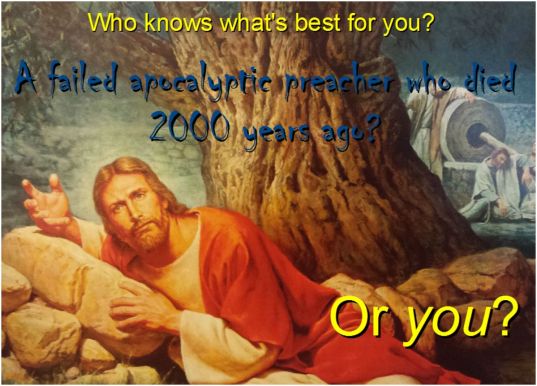
I was in Edinburgh recently and spotted posters, like the one above, on the backs of buses, advising people to ‘try praying’. There is, naturally, an entire web-site devoted to the campaign, created by Christians with more money than sense.

Here’s a thought: try praying that the bus on which one of these ads appears waits for you as you run for it and it pulls away from the stop. You think that would work? (No more than chance would allow.) Or try praying that if you do catch it, the driver will let you on, even though you’ve left your purse at home and can’t buy a ticket. Try praying that the pain you’ve experienced all day be taken from you as you set off walking home. Try praying for or about anything and see what God’s response is. Prayer, ‘tried’ or not, is no more effectual than wishful thinking or chatting with the fairies at the bottom of your garden.

Blog362a

(fixed it)

While in Edinburgh, I visited St Giles’ cathedral in the centre of the city. A friend I was with wanted to see a commemorative plaque there and I saw a chance to rest my aching legs. At the entrance was a sign that said the cathedral welcomed a donation of £5 ($6.55) per visitor to help with daily running costs. Evidently the ecclesiastical administrators haven’t realised they could ‘try praying’ and ask God to fund a building, the sole purpose of which is to honour him. Or perhaps they had ‘tried’ prayer and had discovered God wasn’t willing to provide the hundreds of pounds needed every day to keep it going.

Whichever, the only way churches like St Giles can survive is to have those humans who think they serve some meaningful purpose, fund them themselves. God couldn’t care less whether they flourish or not. If he did he’d keep them going from his abundant supply. That he doesn’t demonstrates not only his non-existence but also tells us that the church is an entirely human enterprise. Without human effort, and liberal amounts of filthy mammon, they invariably fail.

Desiderata

Blog361a

There’s really no secret to what life is about. It’s simple – simplistic even. All the same, it took me most of my life to discover it.

The best way to live your life is to be yourself.

That’s not as easy as it sounds, because you have to have pretty good sense of self to begin with and, for a multitude of reasons, such awareness can elude you.

It’s possible that this is because none of us truly has a self. Current thinking among psychologists and neuroscientists is that the self doesn’t exist. It’s an illusion, created by competing and often conflicting processes in the brain. I picture it like those optical illusions in which carefully arranged shapes make it appear, as in the figure below, that there’s a different shape in their midst, when in fact all that’s there is clear space. Maybe the neuroscientists are right about this, but even so, the self is a damn convincing illusion.

Kanizsa-triangle

Because the brain’s processes are ever active the illusory shape at the centre is subject to constant change – which we perceive as mood swings, changes to our personality, acting ‘out of character’ or being out of sorts with ourselves. Perhaps what I really mean by being yourself, then, is finding a point of equilibrium for the shape at the centre, where it isn’t constantly buffeted by the turbulence of the brain’s activities. However, this is merely to exchange one metaphor for another, so for now I’ll talk about the sense of ‘me-ness’ that we all experience subjectively and intuitively, and know as ‘the self’.

Perhaps you’ve never been in tune with who you are, living, as Plato called it, an unexamined life (he believed such a life wasn’t worth living). Perhaps like me, you drifted through the earlier part of life, allowing unplanned, random experiences to pull you along in their wake until you were left in a place you felt you don’t quite fit. Maybe though, you’ve heard a small inner voice calling you, telling you that this isn’t you. Perhaps, as I experienced for many years, the incongruity between who you are and where you’ve ended up is taking its toll on your mental health.

It’s also possible that you have heard your inner calling but have been told – by society, family or church that who you are is inconvenient, undesirable or unrealistic. ‘Just settle yourself down and conform to what we think is right for you,’ they’ve told you – and you have. They’ve convinced you that you won’t be accepted if you’re truly yourself, so you’ve suppressed or obscured who you know yourself to be.

Alternatively, you’ve assumed a role you know isn’t you. You’re doing a job that allows for no self-expression (because, after all, we all need to make a living), you’re in a relationship that suffocates the real you or you’ve been a church member, striving to conform to everyone’s unrealistic expectations of you. The result is you’re stressed, unhappy and uptight. You’re acting, as the term ‘role’ implies, without any authenticity. We all act from time to time, of course; there are occasions when it is unavoidable. But to live an entire life this way is to invite strife and depressive illness. To be healthy, happy and whole, you need to be authentic – true to yourself.

To adopt a religion is to assume a role. It is to deny your real self (Jesus demands you do: Matthew 16.24) and pretend you’re something you’re not. You can no doubt convince yourself God is doing a great work in you, sanctifying you and making you increasingly Christ-like, but the more you act out the part, the less like your genuine self you become. How can this be right for you, for your happiness and well-being? Adopting any ideology is to add a fake and unnecessary veneer to life that serves only to mask your true identity. Replacing who you are with a predetermined set of religious or political beliefs is mere play acting. Denial is not a solution; embracing your self is.

I hope that like me, you have reached a place where you know and embrace your real self. If not, and at the risk of sounding like a poor man’s Wayne Dyer, I’d ask you to take time to listen to your inner voice. Recognise it for what it is; it will not lead you astray. You know deep within who you are and who you should be, whether that’s an artist, teacher or baker; parent, celibate or gay; writer, performer or mystic; builder, musician or doctor, or a combination of these and other possibilities. You have to be what makes you happy. You owe it to your self.

Interlude: A word from God

Blog359

While nothing like Cyclone Idai that hit southern Africa recently, we had some terrible storms here in the north of England last weekend. The thunder woke me just after 2 a.m., each peal shaking the house, and with the flashes of lightning, it felt frighteningly apocalyptic.

And then it hit me: the Lord was sending a sign! He was angry about something we’d done! Maybe same-sex marriage, though as we’ve had that for a while now in the UK, I’d have thought he’d be used to that particular idea by now. So, maybe he was upset about abortion again. That could be it, though again, a bit late in the day. Still, with God a day is as a thousand years (and vice versa), so you never know. Maybe it’s Brexit. Perhaps the Lord’s angry we’re coming out of Europe. Or, perhaps he’s angry we aren’t coming out fast enough. Back in the 1970s, when Britain first joined the European Economic Community (as it was called then), he told his representatives here on Earth it was a Very Bad Thing, because it was like a recreation of the old Roman Empire and a sure sign of the End Times. He disapproved, but told only a few of his Chosen Ones how he felt and completely forgot to mention it to anyone else.

Christ! Don’t you just get fed up with religiously fixated nutjobs coming up with this sort of crap every time there’s a storm or a tsunami or an eclipse? Every natural disaster, every human catastrophe, every phenomenon in the night sky has to be interpreted as a message or warning from a deity who is otherwise as dumb as a rock. Only when weather does what weather is prone to do does he start communicating with us – incoherently and in code. Only a special few, those who’ve appointed themselves as his prophets and mouthpieces, are capable of telling us what he’s really saying. It’s a miracle if two or three of them ever agree about what that is.

If you need evidence there’s no God, then this is it. If he were real, we would have independent knowledge of him; knowledge that isn’t filtered through human messengers or delivered, garbled, by the weather or by a seriously flawed and obviously human book. He would be apparent; he wouldn’t need to be interpreted, explained and represented by people who give every impression of making stuff up as they go along.

What we have instead is a God who is very evidently human. It’s humans who interpret weather conditions, claim to know what God’s saying and declaim his messages and warnings. It is impossible to know anything, either about or from him, other than what humans – very often ones with very little brain and a penchant for self-promotion – tell us.

If there really were a God, I’d ask him to stop communicating with us through extreme weather, disasters and massacres, and instead to miraculously lift the curse of religion from the 7.7 billion of us here on Planet Earth. But there isn’t, so we’re stuck with it – with religion and those who have a vested interest in perpetuating its nonsense.

Pearl of Great Price

Blog358

Once Born Again™, I became involved with a local church, where my friend Simon took it upon himself to play Cupid, fixing me up with Jane. I was more than a little surprised a girl could be interested in me, but figured, in my flight from myself, that as she was interested, I should make the most of it. Sex wasn’t much of a problem: as good Christians we may’ve played about a little, but we stayed away from what the church liked to call ‘pre-marital intercourse’.

It wasn’t long, though, before Jane wanted to marry – she really wanted to get married. I wasn’t so sure and told her about my escapades with Sam, adding of course that I had since renounced such sin. She said that as long as it never happened again, she had no problem with my past transgressions. I felt pretty sure it wouldn’t happen again. After all, Jesus and his Holy Spirit were taking care of my old nature.

So Jane and I married and over time had three children. While I was very much involved with their upbringing, I would often feel I was ‘letting the Lord down’. When, as happened on holiday once, a group of younger men came round a corner minus their shirts, I found myself instinctually admiring them. What self-crucifying shame I would feel after occasions like these. I would even confess such ‘sins’ to a senior work colleague, a devout and very genuine older lady. I’d spare her the details of how exactly I’d ‘let the Lord down’, of course; I could never have brought myself to say I’d been turned on by naked male torsos. But somewhere deep within me I longed for intimacy and closeness with another man. I knew this was strictly forbidden so buried my desires deeper and deeper, suppressing and subjugating something vital about myself. I was on course, though I didn’t recognise it, to making myself ill. I was convinced that I was doing the right thing – for myself, for my marriage and for God.

My marriage, however, was in trouble. Jane seemed to have lost interest in our children, which hurt me greatly (and didn’t do them a lot of good either.) This and pressures at work, where my boss’ affair with a female colleague was creating some serious problems, made me question whether God really cared. When I needed him most, petitioning him for the wisdom to deal with these problems, the heavens, as the scripture almost says, were as brass. God, it seemed, just wasn’t interested. Perhaps, I started to wonder, he wasn’t even there. Added to this was the internal pressure I was still subjecting myself to; the tension and stress of sublimating my true nature. I was deeply unhappy. While the situation at work was eventually ‘resolved’ (by my finding a better job) I had become chronically depressed and remained so for several years.

Ultimately, once I had reached my fifties and the children were grown, Jane and I separated. I knew I couldn’t go on suffocating my feelings; the mind is not designed to be a pressure cooker – something has to give. I started to accept, though not yet embrace, my innermost nature. The relief was immediate and tremendous. I felt I had found myself and I didn’t care that society might not particularly like what I had I found. I had to be me, and not the uptight, miserable person I had become by denying my essential self. I squared up to the exciting yet daunting prospect of starting over, and acknowledged that if I were to have a new relationship it would be with another man. And so it was.

Over time I came to like myself – imagine that! All I’d felt for most of my life, since the time at the YMCA, was self-hatred. That was what Christianity, what Jesus, had done for me. Arguably, it had also ensured, by keeping me firmly in the closet, that I hadn’t died prematurely during the AIDs crisis of the 1980s. Perhaps though I’m giving it too much credit.

I’m ‘out’ now, in every sense: to my wonderfully supportive children, to you who read this blog (obviously) and to friends. Match-maker Simon, he who suggested going to the YMCA all those years ago, cut me off about a decade ago. As a born-again Christian, he regarded homosexuality as beyond the pale. His ‘principles’ meant more to him than our long-standing friendship. I still miss him, very much.

I don’t miss God. He has gone entirely and I’ve long recognise that he was never there to begin with. Instead, I have a sense of authenticity and my energy goes into living, not denial. I’ve become involved with the local LGBT Centre and I’m seeing a very nice man who I’m going to call Thomas, to spare his blushes. I’m very happy and feel, at long last, I really know what life’s about.

If you can stand it, I’ll tell you more next time.

Heaven’s Above

Blog356

I was struggling for inspiration this week with the homework assignment from my writing group. The title was ‘Heaven’s Above’ (or maybe ‘Heavens Above’, without the apostrophe) and possibly I was having difficulty with it because I don’t believe in a Heaven above, on account of there not being one.

The other night, in a local bar, this young guy came over to talk to my friends and me. He was a doctor from a nearby practice, and he started by asking how, when the time comes, we’d like to die. While perhaps not be the best way to start a consultation, his question provoked some interesting responses.

Then, having somehow detected that my friends and I had reached a certain level of maturity (we’re in our 60s), the young doctor asked what we felt was the point of life. He had, he said, a real need to know this, because having achieved all he wanted at 28, he was left wondering if there was any purpose beyond 30. I like to think we all gave him good answers. There’s life in these old dogs yet! For me, it was falling in love (yes, it happens to old people too) together with friends, lovers and other relationships, particularly those with my grown-up children and beautiful grandchildren. There’s also – though I didn’t bore him with the details – achieving authenticity, accepting yourself and living true to that self. Then there’s all the other things that make life worthwhile; being open to change, having new experiences, learning, helping others, reading, writing, conversation, music, walking… You will, I’m sure, have your own list.

I know that Sartre claimed that ‘Hell is other people’ and Lee Marvin thought much the same thing when he rumbled in Wand’rin’ Star that ‘Hell is in hello’, but Heaven is in these same things; in friendship and our other relationships. There may be some who think it’s easy for me to say all this. ‘After all,’ they say, without knowing me, ‘you have a good life. It’s pretty easy to feel positive about something that’s already going well,’ which is true. Except my life has had its share of traumas, problems and pains, and still does. But life is good and worthwhile in spite of these, and it’s purposeful too without recourse to God or Jesus. Who needs these two old frauds? We make our own Heaven here, now, in our own lives.

Am I saying count your blessings? Yes, I suppose I am, but not, I hope, in a glib way. There are so many good things in most of our lives; all we have to do is make them our own. ‘Lay hold on life,’ as the old hymn says, ‘and it shall be, thy joy and crown eternally.’ Maybe not eternally, but certainly beyond the age of 30.

What have reason and logic to do with faith?

Blog355

Last time I considered the Christian claim that reason and logic can only derive from God, and that non-believers’ use of them is nothing more than a illicit hijacking of powers supplied by the God they deny. Why is it important to modern day Christians to attribute reason to their God? After all, the bible only ever speaks disparagingly of reason. It is, it says, the path to self-delusion; Proverbs 3.5 warns ‘trust not in your own understanding,’ while faith, according to Paul far surpasses the limitations of reason and rationality. More than this, as I discuss here, the God of the bible is far from reasonable and logical himself. His response to every issue is the death penalty, mass murder and blood sacrifice.

According to Christians, human reasoning makes no sense if it is ‘merely’ the product of evolution. A random and undirected process cannot produce a reliable rationality on its own. Naturally, they are never entirely clear why this is the case; evolution has, after all, led to other distinctly human characteristics on which we regularly depend, imperfect though they may be: language, memory, social bonding and creativity among them.

However, having singled out reason and dismissed evolution as its cause, Christians then jump to the conclusion that the human capacity to think must come from God. According to Tim Keller, rationality is a ‘clue’, planted in every human being, to God’s existence.* It has evidently never occured to Keller that, by the same token, the human capacity for unbounded irrationality is likewise a ‘clue’ to the non-existence of any rational deity.

Human reasoning – and there’s no other kind – is, like every other evolved characteristic, flawed. It is only as secure as the premise from which it proceeds. Get that wrong, by adopting a premise with an insufficiency of evidence (such as ‘God is a God of Reason’) and human cognition will only ever abandon us in the blind alley of faith.

*The Reason For God, p141

Why logic, reason and truth have nothing to do with any god

Blog354

I’ve recently encountered again the ‘argument’ (it’s actually no more than an assertion) that without God logic and reason would not exist.

Here’s how ‘Liam’ puts it in a comment on Escaping Christian Fundamentalism:

If anything, the illogical nature of a godless universe is a massive pointer to a God, without Whom there is no reason or truth or logic…

To a degree this is right; if God made the universe and everything in it, including reason and truth and logic then, yes, they would owe their existence to him.

But it all hinges on that word ‘if’.

Equally, if God doesn’t exist, it follows he could not have created the universe and everything in it – including logic, rationality and truth.

One cannot take these things and say they are evidence that God exists and also that they only exist because God made them. Not unless you’re happy with a tautology – a feedback loop where each assumption is its own conclusion. Demonstrate, on the other hand, that God exists independently from the human imagination and then maybe you might be able to make the case that he created logic and reason. As it is, pointing to human attributes like logic and reason doesn’t ‘prove’ that God exists; it demonstrates only that these attributes are characteristics of the human mind. Logic, truth, reason (and mathematics), like God himself, have no independent existence outside of human cognition. They are ways of explaining life and the universe; they are not life and the universe themselves.

If, as seems probable, God doesn’t exist, then evidently, logic, truth and reason did not originate with him. Indeed, they took billions of years of slow evolution to develop. We know of no other way for intelligence to arise; and only intelligence produces logic, reason and truths. No God required


God’s deficient policy documents

Universe

If you have read even a small percentage of my posts then you know I focus a great deal on defining and presenting the Gospel of our Lord Jesus Christ. I also focus on the Word of God as our source of God’s Truth, which is absolute. We also have defined faith and what God has done to save His people from their sins, which is the purpose of Jesus’ incarnation, perfect life, crucifixion, and resurrection.                 

Mike Ratcliff on Possessing the Treasure


Is your job description at work expressed as a story or myth?

       Are the aims and objectives of your company based on the hallucinations of the owners?

                   Is the health and safety policy made up of spells and incantations devised by someone with no real connection to the company?

Can you imagine if the kind of documentation that determines your work conditions was composed of myths, stories of dreams and visions, historically unreliable accounts and largely incomprehensible, magical terms and conditions? Not only this, but you’re required to root around within this documentation to discover what it is you’re meant to be doing and when you have, you need to find someone who can explain it properly to you.

This, according to Christians, is how God chose to tell his creation what he expected of it. The omniscient, all powerful creator of the universe, whose thoughts are so much greater than ours, was unable to put together a clear, systematic and concise set of directions about how he wants us to live and what we should believe if we’re to avoid an eternity of torture.

These messages are so important, apparently, that he thought they’d be best conveyed in folklore and myth – much of it plagiarised from other cultures – fantastic stories written decades after the events they relate, and muddled, contradictory theology.

Why on Earth would he do this? Why would he not speak directly and clearly to fallible, sinful humans? Provide us, perhaps, with a list that sets out straightforwardly and unequivocally what we need to do if we’re to be ‘saved’. (It’s not as if he’s averse to supplying lists; the Ten Commandments are a list, as are the rules in Leviticus about beating slaves and what should and shouldn’t be eaten.) Why not communicate with us so that we know it’s him and not, say, some pre-scientific tribesmen or a bunch of superstitious zealots? Why not speak to us in ways that are not identical with the way we ourselves invent stories about imaginary beings and far-fetched events?

Why provide us with a ragbag of myths, legends and fables crammed with confused and inconsistent ideas, all of them created by those same fallible, sinful human beings, and stitched together, eventually, by a committee with a vested interest in the success of such a book?

It’s a mystery. Unless of course there’s no God behind the bible. Maybe that’s why we have much better policy documents at work.

God is revealed in Jesus… or not


Blog335CompositeOn his blog-site, humbly named after himself, Roger E. Olson trots out the tired old cliche that there’s no such thing as atheism. Atheists, Rog tells us, know in their hearts that God exists, they just choose to ignore him. As a result, Rog has little time for atheism. (I discovered Roger’s wonderfully smug site through Bruce Gerenscer’s excellent one.)

Rog says that if we want to see what this heart-implanted God looks like, then we shouldn’t look to the Old Testament and the tribal warlord we find there – goodness me, no; we can safely discard him! That God just doesn’t match up to our twenty-first century sensibilities. No, if we want to see God then what we must do is look at Jesus, for in Jesus we see what God is really like.

Oops! We’re right back at the problem I’ve been discussing these last few posts: just which Jesus are we talking about? There are so many. There’s the Jesus of the synoptic gospels (though he’s neither consistent nor pleasant), who is nothing like the self-obsessed Jesus of John’s gospel. Paul’s Christ is different again; he’s a complete invention, much like the Jesus of Hebrews who has morphed into a Jewish High Priest. The Jesus of Revelation meanwhile is an Evil Mutant straight out of the Marvel Universe, what with swords coming out of his mouth and all. So which Jesus has Rog got in mind? I think we should be told.

There are so many discrepancies in the various interpretations of Jesus in the New Testament, that it’s hard to see a clear, consistent picture of anything, let alone God, in such a shifting kaleidoscope of images. I’ve recommend that Rog should take atheism a little more seriously; the often incompatible Jesuses of the bible don’t reveal ‘the true nature of God’ anywhere as clearly as he claims. I’d go further: none of them show – can possibly show – what the non-existent is ‘really’ like. What they reveal instead are ideas about a God and a saviour made entirely in the image of the men who tasked themselves with creating them.

Hearing things

Blog332Pray

Don Camp has responded to my previous post, Voices In The Head, with a longish essay that he posted on Debunking Christianity. I want to use what he says to debunk the foolish notion that God speaks directly to people via their own  thoughts.

Those of us who do not believe in a God have, Don says, no ‘philosophical context’ for his speaking and are bound to ‘have trouble’ with the idea. I have to say, in fact, that I have no trouble at all with it. It’s easy: no God = no God speaking.

The rational thing to do, Don goes on, is for skeptics to fit those reports of God speaking into a context we do have, such as self-talk or schizophrenic delusions. This is another statement of the obvious; with no supernatural to account for such voices there can only be a rational explanation for this most irrational of phenomena.

Don then tries an analogy: ‘trying to explain God speaking to those who have no way to make sense of it is like explaining the color and beauty of a sunset to someone with no eyes.’ This is less than convincing. Those who are sceptical about God speaking (or doing anything) do have ‘eyes’: their rationality and critical faculties. A more accurate parallel for trying to persuade others the Almighty sends messages into his followers’ heads would be claiming that the events of a dream you had last night really happened in the world as we know it. ( I’ll have more to say about dreams later.)

‘I’ve said clearly,’ says Don, ‘what God speaking to people is not. It is not self-talk.’ Alas, Don does not tell us how he knows this.

‘Those who hear God speaking do not mistake it for self-talk,’ which is a pity because that’s what it is; Christians might choose to relabel it ‘God’ but that doesn’t mean it is. ‘It is also not schizophrenic delusions.’ It is a delusion though; I haven’t actually said that Don’s inner voice represents schizophrenia (he brought up the term) but I can’t see any difference between the voice he hears and those experienced, perhaps in more severe form, by schizophrenics.

‘Schizophrenic delusions, in which the sufferer either sees things that aren’t there or hears voices no one else hears, are characterized by self-isolation behavior, delusions, disorganized speech, bizarre behaviors, and flat affect. (see https://medical-dictionary…. )’ Whereas those hearing God’s voice gather together in self-contained enclaves separated, by choice, from ‘the World’. At other times they withdraw to talk to an imaginary super-being on their own and, according to Don, have him speak to them. If they’re really lucky, they’ll even get to see things that aren’t there. Obviously this kind of bizarre behaviour bears no resemblance to the true schizophrenic.

Don again: ‘Schizophrenic behaviors are very self-focused and their delusions are sometimes fearful or hateful and sometimes violent. It is the last that we see when people afflicted with schizophrenia pick up a gun and shoot up a school or a church or behead a girlfriend, as in the case you’ve noted in Mt. Vernon, Washington.’ Of course, schizophrenia is the same as most human behaviours; it exists on a spectrum. The Christian’s inner voice may not be as extreme or anti-social as that of the schizophrenic, but hearing it is on the same spectrum, perhaps at the safe end. Until it’s not, of course, as in the examples Don refers to.

‘But what about the person who hears God speak telling him that he should build a hospital in the Congo for AIDS patients or reach out to help the homeless? That is not the behavior of someone who suffers from mental illness. But that is the sort of thing that characterizes the lives of those ordinary Christians who report hearing God speak. So inner voices sometimes tell Christians to do good things. So what? This isn’t evidence they’re from God. What Don’s really arguing here, is that a ‘good’ message proves the Christian’s inner voice is God. And how do they know it’s God and not just self-talk? Because the message is ‘good’. This is circular and self-fulfilling, and doesn’t take into account all those instances when ‘God’ commands people to do bad things. According to the Old Testament it was the Lord himself who commanded Moses, Joshua and Samuel to massacre neighbouring tribes, the Lord who told Abraham to execute his own son in an especially cruel ‘test’. Doesn’t God do this any more? Has the unchanging God changed in this respect? Believers don’t just hear God telling them to do good things; the evidence is right there in the bible that (they imagine) he tells them to do wicked things too.

‘Does that kind of selfless compassion and determined service to mankind come from schizophrenic delusion or a disordered mind disconnected from reality? I do not think so. But that and many, many similar things are the result people having truly heard God speak.’ No, it’s the result of people interpreting an inner prompting as God. Interpreting it as such does not mean it is.

‘No physician would diagnose the many millions of ordinary Christians who report God speaking to them as schizophrenic.’ As I’ve already suggested, Don is creating a false dichotomy here: it isn’t necessary to be a diagnosed schizophrenic. It’s possible those hearing ‘helpful’ voices are much lower down on the delusional spectrum. They may never be schizophrenic in the medical sense, but this does not mean their voices are not self-generated.

‘But if God speaking is NOT self-talk or delusional, what is it?’ It is both of these things and Don hasn’t demonstrated otherwise. Still, let’s humour him and press on:

‘I think that J. Warner Wallace has as good an explanation as any. It is far more than voices in our heads. You can read his article here http://www.foxnews.com/opin…Fox News? Don really is in trouble.

‘What is significant for those who are convinced that there is no God out there to speak is that their conclusion contrasts with the experience (of) many billions of people over a very long time. It was the experience of those who wrote the Bible and many of those they wrote about. It has been the experience of billions since.’ Aah, now we’re playing the numbers game: ‘lots of people think this so it must be true.’ Well, okay, but many more billions dream while they’re asleep, and those dreams must come from somewhere; they can only be from God – there’s even biblical support for the idea that they are. So, if numbers of people demonstrate God’s involvement in our psyches then dreams are far more numerous than God merely speaking directly. However, God doesn’t create or speak through dreams, even though the bible suggests in places that he does. People may interpret them as God speaking but, as I’ve already said, interpretation is not evidence – and numbers prove nothing.

And now, having failed to present any sort of persuasive evidence that his inner voices are from God, Don leaps to this conclusion: ‘it is not really helpful for skeptics, who consider themselves in some way more grounded in reality than the rest of mankind, to Wave off this God speaking thing as delusional.’ Do we skeptics consider ourselves more grounded in reality – yes, I think perhaps we do. We look at evidence, not at what people believe they’re experiencing nor the numbers who believe, nor to the supernatural as an explanation for human phenomena. Voices in the head are generated by the brain; as Don concedes the mind commonly does this when we create a dialogue with ourselves. The nature of this dialogue is influenced and altered in those whose minds are saturated with religious ideas and mythology to the extent it is (mis)interpreted as the voice of God. This is the reality. I know, I’ve been there.

‘You need to consider,’ says Don in his coup de grace, ‘if there is not more to reality than you believe’? Do we? Do I? When a perfectly adequate explanation exists for voices in the head, why should any of us consider an alternative that relies on the supernatural? Actually though, I’ve done that too; for a long time I believed there must be ‘more to reality’ than we humans could conceive of or comprehend. So far, however, there is absolutely no evidence – zero, zilch – that what we don’t understand is Supernatural. Whether I ‘believe’ this or not is immaterial; it is a demonstrable fact. The Creator of everything-there-is cannot therefore be the source of voices in the head, dreams, visions or any other damn thing.

So, Don, a final point: if you stick, as I’m sure you will, with your belief that the voices you and other Christians hear are from God, then perhaps you could tell us why he says different things to different Christians – completely contradictory things (as I’ve written about here)? How do you account for God whispering one thing to you and the opposite to a fellow-believer? Do you dismiss as schizophrenic those who say God tells them not to commit massacres, but to shun gay people, control the weather, take possession of a new jet or prepare for the ‘great persecution‘ to come? Are these fellow Christians deluded? Maybe misinterpreting the voices in their head? If you dismiss them as deluded, muddle-headed or schizophrenic then you can perhaps see how we skeptics view you.