What Does Atheism Have To Offer? (Part Three)

Celia17. Atheism offers knowledge instead of belief
‘But you must,’ Christians have said to me, ‘believe in something greater than yourself’ and ‘You can’t deny your spiritual needs.’ Well of course there are things greater than me and of all of us. The universe for a start; love, beauty, friendship, music, great art, nature, the night sky – sex even. Who hasn’t had a spiritual experience through their appreciation of these things? The fact they exist though, makes ‘belief’ in them redundant. We only need ‘believe’ in those things for which there is no evidence – which is why you can’t ‘believe’ in evolution; you can only know it as fact. Similarly, atheists know there are greater things than themselves. They don’t, as a rule, worship them, but appreciate them, often in awe and wonder, for what they are. As for such experiences being ‘spiritual’, we do not, of course, have ‘spirits’ either to nurture or express. We are emotional creatures and the value we find in those things greater than ourselves often stimulates sublime emotional responses. Nothing wrong with that, of course, but our responses reflect conditions within us, not the supernatural without.

8. Atheism offers the embrace of reality
Part of the inherent honesty of atheism is its recognition that this life is all there is. Atheism faces up to the fact that we are organic beings and like all organic beings our lives come to an end; there is nothing in us, no part of us, that survives death. Knowing heaven and eternal life are impossibilities atheism promises neither. Religions do, of course, and that is their great selling point but no-one, apart from atheists, seems to notice that they never actually deliver what they promise (because they can’t.)

Christians also tell atheists that it takes more faith not to believe in God than it does to believe in him. They need only look to their own experience to realise this cannot be so: they don’t need faith not to believe in Allah, Santa Claus or any number of other mythical beings. Equally atheists don’t exercise any faith at all not believing in Yahweh.

9. Atheism offers, unfortunately, an unsatisfactory name
One thing I wish atheism made possible but doesn’t – not yet anyway – is a better term for one who is unencumbered by gods, the supernatural and superstition. I have no wish to be defined by what I’m not, which is how ‘atheist’ works. It also implies that being a theist is somehow the default position and that any other is an aberration. I quite like ‘humanist’, but that doesn’t quite capture it either, but I’m not keen at all on Richard Dawkins’ suggestion of ‘bright’. The tide is turning though and once absence of belief becomes the norm, the right name for the true default will present itself.

10. Atheism offers a sense of well-being
Happiness, tranquility, peace perhaps don’t come from atheism per se, but they do stem from it: the opportunity for the consciousness I think of as ‘me’ to experience life in the here and now. I know many are not able to enjoy being here to the same extent that I and many in the west are able to, but this only makes it more important that we all do something to help improve the lot of others. As the nineteenth-century atheist Robert Ingersoll expressed it, ‘the time to be happy is now, the place to be happy is here, and the way to be happy is to make others so,’

As I write, Queen’s ‘Who Wants To Live Forever?’ is playing on the radio. It hardly matters who wants to; we can’t and we don’t. And – same group, different song – it’s true that ‘nothing really matters’. Really, it doesn’t, and so we are free to get on with living instead of trying to impose our beliefs on others, exterminating those we don’t like or squandering our one and only life because we think there’s a better one waiting. Atheism is far from nihilistic – it allows us to see the value of this life and helps us live it to the full.

So, what has atheism to offer? Freedom, honesty, meaning, contentment. Or, to put it another way, and to paraphrase what somebody or other once said, atheism really is the truth that can set you free.
What Does Atheism Have To Offer? (Part Two)

Think4. Atheism offers genuine morality
Having no magic book to tell them how to behave (not that Christians derive their morals from theirs) atheists work out their own morality. They don’t do this in a vacuum, however, recognising that morality is culturally derived, evolving as the means by which primates with complex social arrangements relate to one another. It’s likely they adhere to their moral codes imperfectly, as do believers of various stripes. Not having an ideology they feel compelled to impose on others, they don’t regard their fellow human beings as mere conversion fodder. The atheists’ world is big enough to embrace all, though they lament the damage wreaked on it by religion. Atheist terrorists are a much rarer breed than their religious counterparts, while secular societies are among the most peaceful and prosperous in the world today (with the more religious generally at the opposite end of the spectrum.) Nor do atheists attribute their behaviour to supernatural forces; neither god nor the devil inspires them to act. Rather they recognise and take personal responsibility for what they do.

5. Atheism offers authenticity
An atheist is free to be him or herself. There is no striving to maintain the imagined standards of an imaginary god, no need to represent the perspective of a ‘sacred’ book or to defend the indefensible. The atheist does not see themselves or other people as lost, worthless, sinners, suppressors of truth, goy, infidels or any of the other disparaging terms used of non-believers in so-called holy books. The atheist can be a free-spirit, possessed of self-respect, and true to themselves and their nature, whatever that may be. Here’s how pastor-turned-atheist Ryan Bell put it in a recent blog post:

I don’t have secrets anymore, which is a huge mental and moral relief. I also wrestle with less cognitive dissonance than ever. All of this means I’m more at peace and more comfortable in my own skin. I give far fewer fucks about what people think of me and my decisions. My ire is raised, from time to time, by unfair attacks, and I will probably always struggle with my tendency to be a people pleaser, but I am in recovery. I’m learning to tell the truth on a more regular basis and trust that people can handle the truth (whether they actually can or not). I’m learning to trust myself and what I know while remaining open to critique and able to say I was wrong.

6. Atheism offers free thought
Having no dogma to represent or promulgate, no myths to restrict them and no cult leaders, shaman or gurus dictating to them, atheists are free to think for themselves. Religion demands that its adherents begin with myth or dogma, which the facts are then forced to fit. When they don’t, which is invariably the case, the believer is compelled to dismiss the facts to preserve the fantasy (if you think not, you’ve never visited Answers In Genesis). The atheist, on the other hand, can begin with the evidence and reason from it to make up their own mind about ethics, the issues of the day and the human condition.

to be continued…

What Does Atheism Have To Offer? (Part One)

Station-12-ArtistOver the next few posts I’m going to do my best to answer the question, ‘what does atheism have to offer?’ that a commenter on Facebook has put to me – that’d be you, Dave – because, he says, I’m too sneery about Christianity. Some of my response will of necessity be personal in nature, and you can take or leave whatever I say; you won’t go to hell if you disagree (or heaven either.)

1. Atheism offers the truth
Christianity wasn’t delivering; it didn’t ring true for me any more and lacked explanatory power. As a result, a need to know the truth of why we’re here and what life is about preceded my atheism. I set about examining the facts of our existence as we know them, together with all the evidence. I became committed to this pursuit regardless of where it might lead. I didn’t, initially, confine my questioning and subsequent reading only to secular or scientific sources, but continued to explore religious and spiritual explanations of life as well. These quickly paled in comparison with empirical evidence; they were vapid and unsubstantiated, relying as they did on talk about ‘energies’ and entities that no-one had ever seen and for which there was no evidence.

Drawn increasingly to scientific explanations of life – biology, genetics, psychology, astronomy – I became increasingly aware that God wasn’t and isn’t required to explain anything about life, the natural world, the universe or indeed anything. Natural phenomena (and they’re all natural phenomena) have, on the principle of Occam’s razor, natural, not super-natural, explanations. The only reasonable conclusion to be drawn from this was that he wasn’t and isn’t involved in any of them. His very superfluity demonstrates his non-existence; a god who is not evident in any aspect of reality is a god that doesn’t exist. This pursuit of truth therefore led to atheism as something honest and inherently truthful.

2. Atheism offers a real life in the here and now
Living without recourse to the supernatural is refreshing. There is no god (no angels, devils, spirits, ghosts or demons either) watching over us, waiting for an opportunity to punish or bless us; no god whom we are answerable to either in the present or at some future judgement; no god of vengeance who must be obeyed; no god who will vindicate us at the end of time; no god to grant us eternal life; no set of frequently bizarre rules to follow and no empty promises to claim. Atheists take full responsibility for their own lives and behaviour; they construct their own meaning, knowing this life is the only one they’ll get. Atheism alone grants this responsibility and privilege.

3. Atheism offers a humanist perspective and approach to life
This is not the End Times™ as salaciously envisaged by Christians ancient and modern, just as the first century wasn’t – even though Jesus and Paul both thought it was (Matt 16:27-28; 1 Thess 4.15-17 etc.) The atheist accepts that the only help we’re going to get in solving our problems is from ourselves. There is no god waiting in the wings to put things right; no end time scenario when he will come to rescue a chosen people. (This is, incidentally, one of the most pernicious ideas ever to have been devised by humankind, causing more strife and ‘excusing’ more inhumane treatment of others than any other we’ve devised.)

Apart from natural disasters – and we seem to be contributing increasingly to those – the cause of all of our problems is us. Equally, the solutions will have to come from us too. More positively, all of our endeavours, our achievements, our scientific, technological and social progress are ours alone too. We have the potential to do great good, and often do, just as we cause great harm. Free of religious restrictions, the atheist is at liberty to help others out of fellow-feeling, not because a (non-existent) god demands it.

to be continued…

Big Bang Theory

BigBang

You’re probably familiar with William Paley’s teleological argument for the existence of God. If you haven’t used it yourself then you’ll have been subjected to it by proselytising believers. A couple of days ago I had someone treat me to an updated version of the argument.

I was on the phone with a sales-person, talking about his company’s product, when he decided it would be a good time to dust off the old idea, give it a make-over and use it to convince me of God’s existence.

He started by asking me if I would agree that a computer must have an intelligent designer; I agreed this was so (though I have my reservations.) He responded with ‘how much more then must the universe and life on Earth – being so much more complex than a computer – also have an intelligent designer.’ He said this was ‘something to think about,’ and I agreed it was, though maybe this wasn’t the best answer I could’ve given.

Having ‘demonstrated’ that everything must be intelligently designed, my new friend announced that this was therefore irrefutable proof that Allah must have made everything.

Oops. I’m sure this isn’t what the Reverend Paley had in mind when he devised his watch analogy two centuries ago. His proof, however, is every bit as much a demonstration of Allah’s existence and creativeness as it is Yahweh’s. Or Vishnu’s or Marduk’s or any other of the multitude of deities credited with intelligently creating the universe and life in this insignificant part of it. Any one of them could’ve done it according to the teleological argument. Take your pick and sign up for the set of beliefs that corresponds with your choice.

But wait – complex machines like watches and computers bear no relation to anything in nature. A watch found on a heath, as Paley conjectures, or computers in hedgerows, can only have got there because a human being put them there (fly-tipping again). They would not be there because they’d arisen, like the rocks, grass and other plants that surround them, through the processes involved when nature creates something. Moreover, we know that machines have intelligent creators, because we are they. What doesn’t follow is that because man-made objects are demonstrably the product of intelligence that natural ones, which, remember, bear no relation to computers, watches, cars and CAT scanners, are as well.

We are gaining more understanding of how the universe came to be. Significantly, it doesn’t require that there is intelligence behind it. If it did, we would then need to explain how that intelligence arose, who created it and by what process. To say, as religious believers are wont to do, that this supreme intelligence has always existed is no explanation at all. If we’re to have something that has always existed then it is far more likely to be that which we know really does exist, rather than something we don’t. Conceding the longevity of the components of the universe, which we know to exist, is a far better bet than inventing deities to account for it. A God no more explains life, the universe and everything than do fairies the intricacies of my computer (gremlins maybe, but not fairies.)

For all that, life on Earth does have a creator. The genealogy of the universe tells us that physics begat chemistry begat biology. (‘But if life emerged from physical and chemical processes, then how come there’s still physics and chemistry?’) All life on Earth, including ourselves, is the product of these processes, ‘the blind watchmaker‘ that Richard Dawkins speaks of. They are not intelligent, do not have names like Yahweh or Allah and do not, on their own, create the machines that only humans can design.

Loose Threads

FamilyPick a thread. Any thread. And start pulling. Gently does it, no need for force. A gentle pull on any of the loose ends of faith and the whole fabric will come apart quickly.

Here, pull on this one marked ‘the infallibility of the Bible‘. See how easily it comes loose as soon as you realise that most of it, Old and New Testament alike, was written long after the events it purports to describe, some of it by imposters and forgers.

Or this one – the salvation thread, much of it stitched into place by an excitable chap prone to hallucinations. Pull it and see how its pattern is nothing like the one proposed by the man it claims to be about.

Pull the magic threads, the ones about Gods, supernatural beings, heaven and hell, eternal life. Watch them disintegrate in your fingers once they’re teased out into the real world.

Take hold of the threads about Resurrections, Second Comings, Raptures and Judgements; so fragile, these break away as soon as they’re touched. The only miracle is that they’ve lasted this long.

Then there’s the promises threads, about how believers are going to do fantastic miracles and heal the sick and raise the dead. Imaginative and colourful, these have never really fitted in.

Then there’s the prayer threads, whose embroidery tells us how prayer works, how God will give us whatever we ask for. Downright embarrassing, these – yank ’em out.

And how about the strands that those who say they love the cloth pick out themselves and throw away? You know the ones; the threads which tell them how to live their lives that they just don’t like the look of and think spoil the overall effect. These have definitely got to go.

What about the threads that weren’t originally there – the ones about ‘defending God’s standards‘ and having a ‘relationship‘ with a dead person? These grubby, greasy threads have been added in to replace the ones those who love the cloth have pulled out for themselves.

Choose any number of other threads – the ones that clash with other bits of the pattern, the ugly brutal ones, the fantastic, the ignorant – and give them a tug. Oh, look. They come away too.

And before you know it, the entire fabric has come apart in your hands. All that’s left is a pile of worthless, brittle threads, good for nothing but throwing in the bin.

Is there anybody out there?

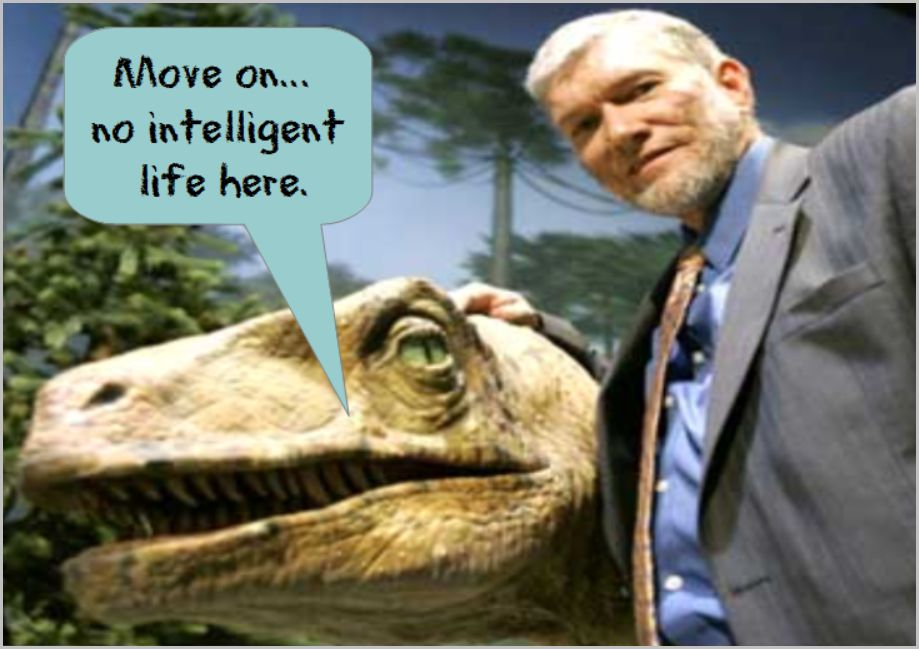
KenAnyone searching for extra-terrestrial life – NASA, SETI and so on – can stop now. We know definitively that there isn’t any out there. How do we know? Because Ken Ham says so. The Bible – Genesis specifically – doesn’t mention life on other planets so that means there isn’t:

(T)he notion of alien life does not square well with Scripture. The earth is unique. God designed the earth for life. The other planets have an entirely different purpose than does the earth, and thus, they are designed differently… where does the Bible discuss the creation of life on the “lights in the expanse of the heavens”? There is no such description because the lights in the expanse were not designed to accommodate life [this is utter gibberish; life within stars? Who has ever suggested that?] God gave care of the earth to man, but the heavens are the Lord’s. From a biblical perspective, extraterrestrial life does not seem reasonable.

But hang on a minute! The Bible doesn’t mention other planets, never mind whether there’s life on them. It doesn’t tell us anything about cultures outside of a small area in the Middle East, doesn’t mention the Americas or Australasia, doesn’t have anything to say about microbes, anti-biotics, computers or technology in general. It must follow, therefore – to use Ken’s logic – that none of these things exist either.

The reason the Bible doesn’t mention any of them, and a myriad of other things, is not because they don’t exist but because the primitive priests and ignorant scribes who wrote Genesis and the rest of Ken’s magic book didn’t know that they did. They had no concept that the Earth is a planet, let alone that there are others; they had no idea that the sun is a star, nor that other stars, which they thought were attached to the inner surface of a canopy surrounding the Earth, are suns. With such a limited cosmology, the possibility that there might be life on other planets was as alien to them as, well, aliens themselves.

Whether there is extra-terrestrial life, and whether any of it is intelligent, we may never know. But either way, Ham’s deity will have no bearing on it, nor it on the Christian God. The existence of aliens, like their absence, won’t breathe life into an already discredited idea.

The Holy Spirit: transparently nonsense

CageIf anything is unsubstantiated fantasy, it’s the Holy Spirit. It – I know Christians prefer ‘he’, but the pronoun used in the Greek of the New Testament is more often neutralit began life as the comforting, fuzzy feeling the early believers got when they remembered their recently deceased leader. The same feeling that convinced them he was alive again in a sort of not-really-alive but as-good-as kind of way:

“He’s, like, alive-in-our-hearts and, hoo boy, what a buzz there is when a few of us get together and share that vibe at the same time. Far out, man. Hey, let’s put it in the story that this is exactly what he said it would be like when he was still alive!” (Matthew 18.20, sort of)

High on this feeling some believers started imagining they were actually in the dead leader’s presence and – miracle of miracles – could see him and commune with him (1 Corinthians 15.5-8). Such an experience, they felt, could only be from God and must, in some inexplicable way, actually be a part of God (1 Corinthians 2.10). And so the Holy Spirit – the capital letter version – was born. Spiritual highs had taken on independent existence as an aspect of God.

Except, of course, they didn’t. They remained feelings, amplified in and by a communal setting. And that’s what they are today. Which is how, when a Christian tells you the Holy Spirit prompts him or her to say or do certain things, the result is always in line with the teaching of his or her particular church or sect. So, for example, the interpretation of the scriptures to which the Holy Spirit leads a group of believers is fully in keeping with that of their denomination, church and pastor. Dissent is actively discouraged and those with different views are apostate, deceived by the devil and not led by the Spirit at all. Maybe, they’re told, they were never really Christians in the first place, which is remarkable, when the dissenters’ experience of the Spirit is every bit as real as the rest of the community’s. Experiencing one’s own thoughts and feelings usually is.

It never seems to occur to Christians how odd it is that this supposed aspect of God, the Spirit, leads different groups of believers down different, often contradictory, paths. How could it do that if it was truly of God? Why would it do that? It’s erratic, idiosyncratic methods are clear evidence of the human origin of its ‘working’. The Holy Spirit’s prompting is, as it was in the beginning, a communal feeling given ’embodiment’ by corporate consent. It even works effectively when believers are separated from each other, social pressure producing conformity.

Experiencing the Holy Spirit is not unlike the way those involved in a séance or in a ‘haunted’ house convince each other there is a presence in the room. These ‘ghosts’ are socially constructed too, from shared feelings and often not a little ‘guidance’ from those who claim to know better. The Holy Spirit is ‘realised’ in the same way, most clearly among a ‘worshipful’ group of Christians whipped up into a state of euphoria attributed to the work of the Spirit.

But the Holy Spirit is without independent existence in both origin and manifestation. It is human make-believe through and through. Any Christians who think otherwise are invited to provide evidence of the Spirit’s independent existence, separate from human emotions and imagination.

On Being An Agnostic Atheist

GodSo, no evidence offered by Christians – and I know quite a few read this blog – that human beings can, as their religion promises, live forever. No surprise there. Dave did comment, on Facebook, that he knows, because of faith, that he’s promised eternal life, but as I said last time, faith is not evidence.

Moving on. Over at his Northier Than Thou blog, Daniel Walldammit notes how often he comes across apologist sites that say, ‘I don’t believe in atheists.’ I’ve noticed similar statements online and in the hands of street preachers: ‘atheism is a temporary condition’ (quite clever that one, if somewhat overused), ‘atheists are just in rebellion against God‘ and ‘there’s no such thing as an atheist‘.

atheism-1Given that atheism exists whether Christians condescend to believe in it or not, I want to explain how you can be both an atheist and agnostic.

Theism is the belief in a personal god, one that was involved in the creation of the world, has taken an interest in its development and who relates to his principal creation, humankind. This theist god has a personality of his own (they are almost all ‘male’), is hands-on, intimately concerned with people and their behaviour. I see no evidence for this type of god, for reasons I’ve explored here and here. As a result, I am an a-theist, one who denies the existence of such an imaginary being.

‘But,’ say some critics of this argument, ‘absence of evidence is not evidence of absence.’ Not so, as Irving Copi demonstrated long ago:

in some circumstances it can be safely assumed that if a certain event had occurred, evidence of it could be discovered by qualified investigators. In such circumstances it is perfectly reasonable to take the absence of proof of its occurrence as positive proof of its non-occurrence.

Without evidence there is no existence either for my pet dragon nor for the multitude of gods that humans have imagined for themselves throughout history. To claim that ‘absence of evidence is not evidence of absence’ is an appeal to faith and wishful thinking (they’re the same thing). It says in effect that just because I can’t prove my God (or Santa Claus or my dragon) exists, doesn’t mean he doesn’t. But evidence is all: an entity which cannot be demonstrated evidentially does not exist independently from the human imagination that conceives it.

For my part, I’m also an anti-theist, which does not mean, as Christians like to claim it does, that I’m in rebellion against God – just as Christians themselves are not ‘in rebellion’ against Allah, Vishnu or Santa Claus. It isn’t possible to rebel against fictional characters. It is possible, however, to oppose the mumbo-jumbo that has accumulated around them and the irrational belief and unreasonable behaviour which that engenders. This is what it means to be anti-theist.

Deism is the belief in an impersonal god. It is a hypothetical entity that may or may not exist and is entirely unknowable, which is why I use ‘it’ to describe it because it would be impossible to know, if it does exist, whether it is male, female or something else entirely. While there is an absence of evidence for this type of god too, it is more difficult, because of its hypothetical nature, to demonstrate in the same way as for a personal god, that it doesn’t exist. It easier to refute the supposedly known features of a theist god, than it is the unknown qualities of the unknowable. So, I concede this impersonal deity may exist somewhere. I’m almost entirely certain it doesn’t, because absence of evidence is, after all, evidence of absence, but it could and I have to acknowledge that remote possibility. In this minimalist sense I am agnostic. I don’t, I stress, believe in this only remotely possible god; it is so hypothetical and inconsequential it might as well not exist, if it in fact it does. The concession I make that it may have a presence in some distant part of the universe, or possibly out of it, makes no difference to my life, beliefs or behaviour.

So, it is possible to be an agnostic atheist; to deny the existence of personal gods like Yahweh and Allah on the grounds that there is no evidence for them, while admitting to not knowing whether an unknowable god exists.

Even though it doesn’t.


Primordial Soup for the Soul

CellsA commenter on this here blog thingie, Mike, has challenged me to present him with the evidence for evolution. Mike evidently sees me as something of an expert on the theory because I’m convinced of its validity. I’m no expert, of course – I’m not even a scientist – but having read widely about evolution over the years, I’ve attempted a response. Having spent time creating and evolving it, I thought I’d add it as a post rather than tuck it away in the comments.

Mike wrote: When it comes to the hoax of Darwin’s evolution, I’ve read and observed his tree of evolution. It is TOTALLY and complete without evidence. It is a false theory that humanist ” scientist ” have brainwashed the public with.
If you think it’s hoax then you won’t, I take it, have shots that immunise you against the latest strains of viruses? And you’re not concerned that some microbes have evolved to become resistant to antibiotics? Modern medicine is predicated on the fact that organisms evolve but at least, Mike, you’re consistent and avoid it all, knowing as you do that evolution is a hoax. God keeps you well and heals you when he doesn’t. Doesn’t he?

I have debated and studied how his theory is genetically impossible. DNA cannot gain nor contain information necessary for Darwin to be true.
You’ve studied this have you? On Answers in Genesis? How about what real scientists actually say? Try this New Scientist article which explains how mutations in DNA produce new information and new species. As it concludes, ‘the claim that mutations destroy information but cannot create it not only defies the evidence, it also defies logic.’

I suggest YOU… who claim Darwin is true, produce some evidence to confirm his theory. It should be easy. Certainly the truth would be in the fossils. That is why I requested some transitional fossils that would back up his theory. Why is it up to me to provide you with the evidence you so resolutely refuse to look up yourself? Your original comments were a response to my post about Jesus and Paul’s gospels, so I can’t see why I’m under obligation to enlighten you about evolution. However, I have attempted to do so by directing you to material you might read. Of course I’m betting that even if you do, you’ll conclude it’s wrong, because… you know, God and stuff.

There should be millions (of transitional fossils). Should there be? Why? Because you say so? You do realise that not every creature who ever lived became a fossil? Very few did, only where the conditions were right, and of all the fossils we have, only 1% are of land animals. However, this still leaves us with plenty of examples of transitional forms. Take a look here, here and here.

There is however a problem with presenting the fossil record to creationists: say, for example, there are two related creatures, which we’ll call A and C, that lived a few million year apart. There appears to be a gap between them – a missing link if you like. One day a fossil is discovered which provides the link between A and C – let’s call it B – and the link is missing no longer. ‘Ah, but hold on,’ says the creationist, ‘where previously we had one gap, now we have two; the one between A and B and the one between B and C. Darwin disproved!’ The scientist cannot win when the more gaps the fossil record fills the more gaps the creationist thinks he can see.

Certainly if every living creature came from ONE swamp of micro organisms billions of years ago…. we should have SOME evidence that a single cell can eventually divide into ALL and every creature on earth. Overlooking your strange idea that it was just ‘a single cell’ that ‘divided’, we do know that all life evolved from those original formations, as presented in the article above as well as here and here.

I’m sure science can take a swamp of micro organisms, and produce… Yes, it can. It did so first in1953! And it didn’t even begin with micro-organisms, just chemicals and electricity.

…and show us different creatures coming out of the slop. As I’ve already explained, this is not how it works. Giraffes, peacocks and lizards did not clamber out of primordial soup fully formed. Millions of years were needed for very elementary lifeforms to evolve in the ‘slop’. These eventually migrated to the oceans and eventually onto land. Millions of years and still no giraffes or peacocks and certainly no humans. Billions more years were need before those appeared. To look at it another way, today’s life forms did not come directly from the single-celled creatures that first emerged in the chemical mix. They evolved from creatures not too dissimilar from themselves, which in turn evolved from creatures not too dissimilar from themselves, ad infinitum back through billions of years. Try Dawkins’ The Ancestor’s Tale for a clearer picture of the long, painstaking process.

But first explain how life can come from nothing? I’ve already explained life didn’t come from nothing. It’s likely it emerged from groups of organised chemicals, which eventually evolved into RNA, then DNA, then, as this video explains, amino acids – the building blocks of organic life. A number of other scientific possibilities are explored here. Just because we don’t yet know precisely how the process worked, doesn’t mean everything we do know about the origin of life is rendered invalid. And it certainly doesn’t mean that a god must’ve done it.

Let’s say though that evolution is completely wrong. Does that make creationism – God creating life as we know it in six days, 6,000 years ago – the only alternative explanation? Of course not. The writers of the two creation myths in Genesis had no idea how life appeared on the Earth, suggesting as they do that humans had been around since a few days after its start. They may not even have regarded their stories as factual when what they were trying to explain was man’s apparent isolation from God. Science was as alien to them as the modern medicine I mentioned at the start of this post. I regret to tell you, but Genesis is not a scientific treatise.

You’re right about one thing – there’s no evidence for evolution as you perceive it. You condemn your own very limited understanding, not the theory itself. There is far more evidence for evolution than there is for a supernatural creator. There is no anti-God agenda to science or the theory of evolution. There is instead an attempt to discover how everything works, to get at the truth wherever the pursuit leads. That this has led away from gods and God is because of the nature of that truth, not to mention the nature of gods themselves.

Where was God?

GodGod

While they were communing with God, gunman Dylann Roof sat among them for forty-five minutes. Then he opened fire and killed nine of them. That’s forty-five minutes during which time God could have warned the Christians who believed he was listening to them that something terrible was about to happen. But he didn’t. The communication was all one way. They talked to him but he didn’t talk to them. He didn’t even listen. Why not? Because either he doesn’t care what happens to his people, despite what Jesus promised, or he isn’t there.

After the massacre, Christians across America resorted to pleading with this negligent God to comfort the bereaved and to help police find the killer. We can be sure God didn’t do any such thing because if he cared at all, he wouldn’t have let the massacre happen in the first place. 

Presidential hopeful Mike Huckabee declared that if only some of those at the prayer meeting had been ‘pistol-packing’ themselves, they could have taken out Roof before he did too much damage. And he’s right – absurd as it sounds, one of them could have done. So why didn’t the God who never forsakes his people prompt one of them to take a gun to church? Perhaps because, unreasonably, he thinks it’s better to turn the other cheek. Either way, mark God down for another fail.

Fellow crank, the ‘reverend’ E. W. Jackson, blamed the shootings on liberals, gays and Obama. So, God – pissed with those who don’t support ‘Christian values’ –  allowed a gunman to mow down nine of his own. Makes sense.   

Debbie Dills, meanwhile, spotted the killer’s car on the freeway and informed the police. She later claimed this was God’s doing; the very God incapable of warning his loved ones they were about to be murdered. This God, who allowed his people to be massacred, directed Debbie Mills, who cannot see that she was just happened to be in the right place at the right time, to notice the killer’s vehicle and report his whereabouts.

Let’s get real: a God who can’t prevent the murder of nine of his children but then behaves like a third-rate Jessica Fletcher is no God at all. He is an impotent creation, a being of trivial pursuits, who fails to materialise when he’s really needed; a mythical figure who keeps his super-powers to himself, except in the most insignificant and coincidental of occurrences; a figment of believers’ imaginations.

Show us he’s not, Christians, why don’t you. Show us how he loves you, never forsakes you and protects even the hairs on your heads. Where is he? Where’s the evidence he exists, outside your inconsistent, fallacious scriptures and your own wishful thinking? Where in this real world? The people of Charleston really need to know.