A Special Christmas Bible Study

An angel of the Lord appeared to (the shepherds), and the glory of the Lord shone around them, and they were terrified.

But the angel said to them, “Do not be afraid. I bring you good news that will cause great joy for all the people. Today in the town of David a Saviour has been born to you; he is the Messiah, the Lord. This will be a sign to you: You will find a baby wrapped in cloths and lying in a manger.”

Suddenly a great company of the heavenly host appeared with the angel, praising God and saying, Glory to God in the highest heaven, and on earth peace to those on whom his favour rests.” (Luke 2:9-16)

Another chunk of scripture that will be proclaimed from pulpits and in nativity plays again this year. Let’s take a closer look at the scenario Luke creates. Does it bear any relation to something that might occur in reality?

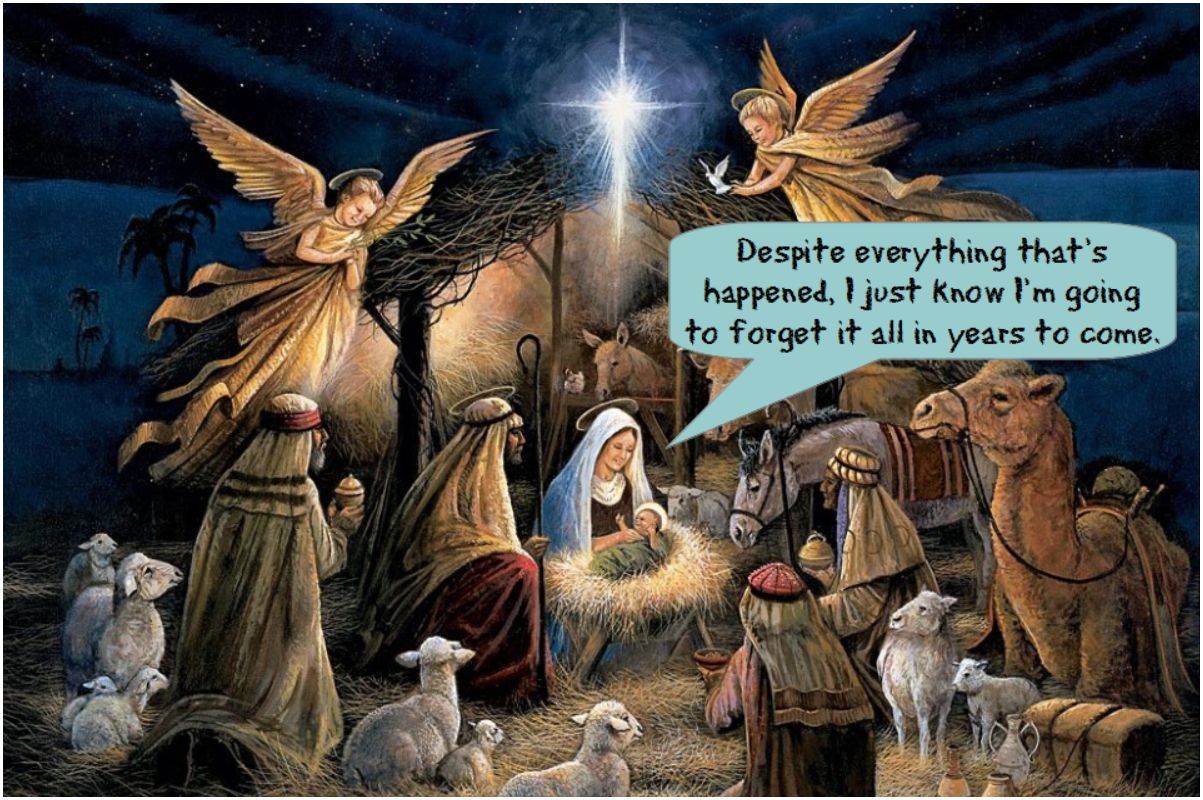
First, an angel. Doesn’t this tell us from the outset that we’re in the realms of fantasy fiction? You can’t fault Luke for trying though, he does his best to impress by adding a whole host of them. You can hear him thinking that ‘a great company of angels’ should convince all but the most hardened of hearts. He’s inventing freely, throwing in the tropes of the genre with abandon. Doesn’t he know angels are fierce, two-faced, six-winged creatures (Ezekiel 14:18; Isaiah 6), not handsome youths in glowing white robes? There’s a reason they prefaced their every appearance, including this one, with ‘Do not be afraid’.

Good news that will cause great joy for all the people: All? Even as Luke wrote this paean to wishful thinking he knew that the Jesus myth had not brought joy to ‘all people’. Most had rejected the claims of the new cult and joy was hardly the prevalent emotion in some of the churches Paul wrote to.

This will be a sign to you: You will find a baby wrapped in cloths and lying in a manger. A baby wrapped in cloths, as was the custom, and lying in an animal feeding trough is a ‘sign’? A sign that the Messiah had arrived? Really? Granted a manger is not a conventional place for a new-born but it’s hardly miraculous. And what if by the time the shepherds had abandoned their flocks to the night and its marauding wolves, Mary had, say, picked up the child or found a better place for it? Imagine the confusion! Sorry, Luke but this is a very poorly constructed story. You just didn’t think it through.

As for the angels’ last proclamation, what does it really mean?

Glory to God: this of course is fawning to a God whose ego is more inflated and fragile than Donald Trump’s. He demands continual praise not only from his heavenly messengers but from those here below, or else he’ll go off on one. You really want to spend eternity with such a tyrant, Christians?

…in the highest heavens: a reference to the fact that early Christians believed in different layers of heaven; Paul writes about them too. God resides, as acknowledged here, in the highest, the top floor executive suite. No-one ever gets to go up there. Emails are sent down from on high.

And on earth peace to those on whom his favour rests: what sort of peace? Certainly not the absence of conflict or war. We’ve now had two more millennia of these, some in the past initiated by Christians themselves. Do people who are at peace with themselves start wars? Peace within then. Do Christians know greater peace than anyone else? Hard to say when it’s not something that can be measured but I’m sure Christians will claim it’s so.

On whom his favour rests: who exactly is this? Who enjoys the favour of a capricious deity? How do they know when he visits all manner of trials and tribulations, testing and tempering on those who count themselves as his. I’m sure the early Christians who helped write the angels’ speech thought it was they who enjoyed the Lord’s favour. Today’s Christians probably think the same. YHWH has always played favourites. Everyone else can go to hell.

So, the heralds of Jesus’ birth didn’t exactly bring good news, did they. Not even in Luke’s imaginary, completely invented, never-happened-in-reality and isn’t-even-a-decent-metaphor scenario.

The Anunciation: A Ghost Story for Advent

The Nativity in Matthew and Luke begins long before Jesus’ birth. Matthew introduces Mary and Joseph once the former has been impregnated with The Holy Sperm. He doesn’t go into any detail about how this happened, he just drops in, in Matt 1:18, that the deed is done. Mary has had sex with a ghost.

This isn’t good enough for Luke though, who after reading Matthew’s tall tale, decides it needs some expansion. A lot of expansion, in fact. He takes the story back to before Mary’s non-consensual encounter with the Holy Spirit and picks on Elizabeth and Zechariah, an elderly couple well past the age of having kids. All the same, they do enjoy a tumble in the sack every now and then, and the Lord – ever the voyeur – decides he’ll bless one such union with fruitfulness. (There is much wrong with the details of this unbelievable yarn, some of which I consider here; I won’t reiterate them now for fear of awakening any amateur theologians who might be lurking here in the wings.)

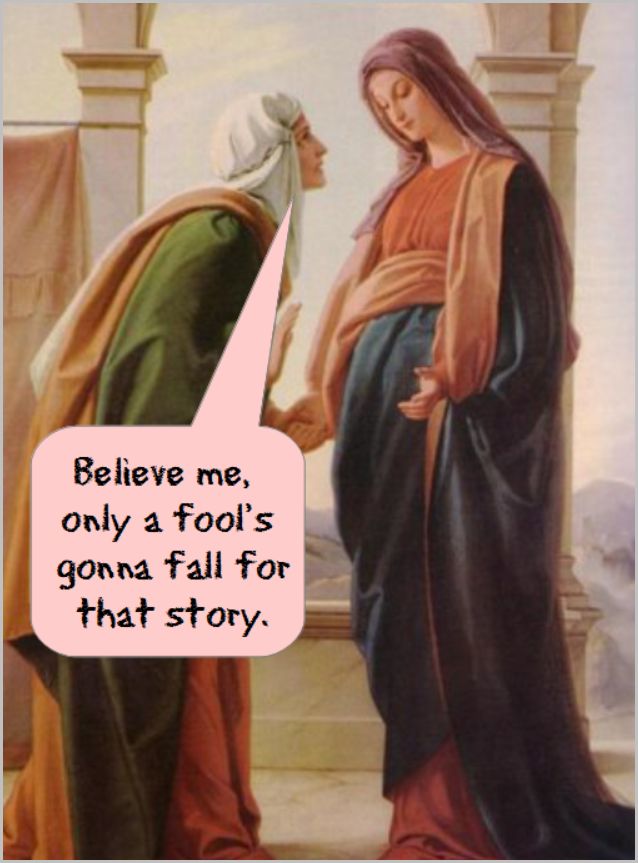
Suffice to say, Luke – for it is he, lest we forget, who is making this stuff up – decides that Elizabeth is a long lost cousin of Mary’s, like in one of those soaps where long lost relatives pop up all the time, usually to no good end. In this particular episode, however, all goes well and Mary visits Elizabeth, whose baby is, in a strange twist of fate, destined to be John the Baptist from the earlier two gospels. In this story his embryonic self jumps for joy inside his mother once he realises his uterine Saviour has come to visit.

But were getting ahead of ourselves. First Mary has to go through the rigmarole of getting pregnant. Obviously as a good Catholic girl she can’t have sex with her betrothed prior to their wedding and just when she’s considering when that might be, an angel appears unto her. It’s Gabriel who has quite a bit to do in the Nativity story as a whole. As angels do, he annunciates to Mary all about the pregnancy part of the plot and she acquiesces to the Lord getting her with child by magically transferring his seed into her womb. I’m guessing it was by magic. It’s possible some sort of actual rumpy-pumpy occurred but Luke delicately passes over the intimate parts. As apparently the Holy Spirit does too.

Mary is so overjoyed to be pregnant before her 13th birthday that she bursts into song on the spot and spontaneously produces a hymn based on the Psalms and the future teaching of the baby she has only just conceived. It’s hard to believe that no actual time travel was involved. It is instead, a miracle, as her impromptu ditty flourishes into the literary masterpiece now known as The Magnificat, which is not, it turns out, a feline super-hero. Fortunately, she can remember it all, word for word, decades later when Luke decides he needs to invent record it. Honestly, the whole thing puts Cole Porter to shame.

You’d think then Mary would dash off to tell her betrothed, Joseph, the wonderful news that she is pregnant without his or any other man’s assistance, but Luke makes no mention of it. Luckily, it’s covered by Matthew, where an angel drops in on Joseph, a person of great gullibility faith. On hearing what the angel has to say, he swallows the story hook, line and stinker.

Then it’s back to where we came in. Mary’s sets off down the road to see the cousin, the wonderful bearer of John. She pitches up there for three whole months, perhaps to avoid Joseph, who, it turns out, was not as gullible as she thought.

**********************************************

Honestly, this is really what happened. Would I lie to you? No, but someone would, and did. We’ll see what else he has in store in his over-worked imagination, next time.

**********************************************

PS. Don, I know you like indulging in a bit of biblical exegesis. If you’d like to borrow this totally respectful effort for your blog, get in touch and we’ll work something out.

Jesus the No-Hoper

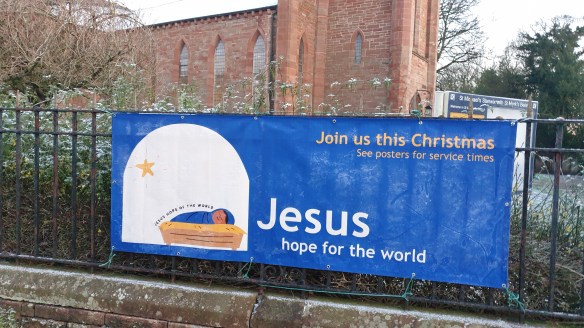
Jesus – Hope for the World declares the banner outside the church near where I live. I can’t help but wonder about the naivety of the people who came up with the slogan and what it means. What are the possibilities?

‘Peace on Earth, goodwill to all men’ (and maybe women)? If so, the world isn’t showing much of either, certainly none that can be attributed to Jesus and his fractured, fractious and frequently intolerant church.

How about inner peace then, even though that’s a long way from ‘hope for the world.‘ How many Christians exemplify this particular fruit of Spirit? Is this, in the end, all that Jesus offers: the hope of a nice fuzzy feeling inside? Of course, peace of mind can be spirit-generate, though personally I prefer wine. 

Hope of reconciliation with God then. Only if you believe in God in the first place, not to mention ‘sin‘, human sacrifice and magic. If this is the kind of hope Jesus represents, then really, what good is it? 

Possibly the hope of which the banner speaks is the hope the earliest Christians had, of Jesus coming back real soon to slaughter his enemies and set up the Kingdom with, naturally, themselves at the top of the pile? Hasn’t Jesus had two thousand years to deliver this hoped for outcome?  An idea well past its sell-by date, the Kingdom of God on Earth isn’t ever going to materialise, however much ‘hope’ people have.

Maybe, then, it’s a hope of eternal life. The gospel writers have Jesus make such a preposterous offer (e.g. John 10:27-28). If this is what Christians are hoping for they are sadly deluded, and, as Paul puts it, the most pitiable of all people (1 Cor 15:19). No human being outside of myth and comic books has ever lived forever. None ever will.

Hope of heaven? See above. Besides, the Bible really doesn’t offer a place in heaven to anyone. That’s a much later development. It’s a waste of this one and only life to live in the vain hope of something better after death. 

Maybe the hope referred to is hope in hope itself. How futile would that be? Hope is no substitute for food for the hungry, shelter for the destitute, treatment for the sick. 

When I go to the carol service at the church next weekend, I’m confident it will be made clear just what sort of hope Jesus offers the world. If not, I’ll be sure to ask. I’ll let you know.

Christmases With Grandad: Christmas Past (1960)

Part three of a three-part Christmas story written for BBC Radio Cumbria.

It was still really dark when I woke up. Really dark. Very, very quiet too. I knew it must still be the middle of the night but I couldn’t see my clock. Even if I could have done I might not have known what time it was because I was only just learning how to do that. I didn’t know if Father Christmas had been. I wriggled my feet down to the end of my bed where it was really, really cold, to see if I could hear any paper rustling down there. I wasn’t very sure I could. I was a bit worried then. If Father Christmas hadn’t been yet, he might not come at all if I stayed awake. I closed my eyes to try and get to sleep again but I couldn’t.

I thought maybe it’d be a good idea to sing one of the songs I’d learnt at school. We’d done a nice concert about a baby being born for our mummies and daddies and we’d learnt some songs for it. I’d had a piece of paper to read too. It said Mary and Joseph had to go to Bethlehem to have a baby, but as I couldn’t really read I just remembered what it said. Then we had sung Little Donkey. So I sang some of that in my head and then O Little Town of Bethlehem because we sang that too, but I could only remember the first bit so I did that two times.

When I finished singing in my head it was still dark, and still quiet and cold. I couldn’t think of anything else to do, so I decided I’d switch my light on. I got out of bed as quietly as I could, tiptoed across the cold lino and reached up to the switch. That’s when I saw that Father Christmas had been after all! There were my presents at the end of the bed. I pulled the red crinkly paper off the first one. It was the train engine I wanted! And the next one was some railway line. I got the rails out of the box and tried to fit them together but it was hard. I must’ve made too much noise because the next thing I knew was my mummy and daddy came in to my room. My mummy sat on the edge of my bed wrapped up in her eiderdown because there was ice on the inside of the window and she was very shivery. She said, ‘Neil, it is still only half past five. It’s far too early,’ but she didn’t mean it because she didn’t make me go back to bed. My dad fitted the railway line together into a big circle and we wound up the little engine and watched it go round and round the track. I knew then it was going to be a lovely Christmas.

A lovely Christmas to both my readers.

Go easy on the wobbly juice.

Christmases With Grandad: Christmas Present (2021)

Part two of a three-part Christmas story written for BBC Radio Cumbria.

I’m sure this piece goes here,’ says Granddad, doing his best to force a yellow plastic chute into a red tower. He has a construction in front of him that is designed to take coloured marbles through various tubes and chutes down to a collecting tray at the bottom, but which looks more like a Heath Robinson contraption. ‘Yes, that’s it,’ he says triumphantly as he wedges the yellow chute precariously in place.

”That’s not right,’ says Lana, hands on hips.

Granddad Neil looks at his handiwork. ‘Of course it is,’ he says. Lana picks up a marble and drops into the top of the red tower. When it reaches the yellow chute it falls out and lands on the floor. ‘See?’ she says. ‘It’s upside down.’

‘Granddad!’ Eva says with all the indignation a two year old can muster.

‘He’s had too much wobbly juice,’ Lana explains and takes herself off to the kitchen to complain to her mum that he’s not up to the job.

Granddad has to concede that the girls may well be right on both counts. He chastises himself for having had more than one glass of wobbly juice. He turns back to the precarious marble construction and realises that if the yellow chute is upside down, then several others parts must be too. He wonders as he starts to remove them, why it has fallen to him to fit the marble tower together in the first place. Construction is definitely not one of his better skills.

He looks round at the other adults. Dad is asleep on the couch. Dennis, who always enjoys doing the washing up, is helping mum clear away the dinner dishes. Uncle Mikey is half watching a film he’s downloaded, which, although it is an animation, is far from suitable for children. Fortunately, both Lana and Eva gave up on it after five minutes, which leaves him to entertain them. He feels he has let them down with his inability to put together a child’s toy. Uncle Mikey, finding his efforts more entertaining than the film, announces it would be better if he sorted it out.

Lana meanwhile has taken herself off to the front room, the toy room as she calls it, and is setting out her doll’s tea set, the one Santa brought with Alice In Wonderland characters on it. She arranges her dolls and teddies around it and shouts for Granddad Neil. All is forgiven! The two of them sit at the table having an imaginary tea party. Lana pours while she explains how last night Santa left very muddy bootprints in the hallway. When, much later, mummy appears at the door and asks what the two of them are doing, Granddad Neil says, ‘we’re having a lovely Christmas.’ And indeed they are.

Very Naughty Children

Remember when you were a child in primary school and the whole class was kept in at playtime because one or two individuals couldn’t behave themselves? Remember how unjust that felt? You’d done as you were told, as had most of your classmates, and yet there you were, stuck inside while other groups played out. All because of the actions of a few. When I became a teacher myself I vowed I would never do this to whole classes of children. Those who couldn’t behave would be the ones to face the consequences of their actions, not those who had. To the best of my memory, I kept this promise.

The sense of injustice I felt as a child when I was punished because of others’ misdemeanours returned this week, when UK health secretary Sajid Javid threatened the entire country with a Christmas lockdown if more eligible people didn’t take up their Covid booster jab. The ‘booster’ amounts to a third shot because, it turns out, the effects of the first two vaccinations last only six months. I have my booster booked for tomorrow. And yet, having done the right thing for myself and others, I could still be faced with the prospect of having Christmas curtailed because, according to Sajid Javid, too many people have been naughty children and haven’t done as they were told.

If this is the case, might it not be because the populace as a whole has grown tired, not to mention altogether sceptical, of politician’s promises about Covid?

       ‘Lockdown for three weeks to flatten the peak of the epidemic’ we were told by the Prime Minister in March 2020.

       Lockdown again, for a month, in November 2020, this time to protect the NHS.

        Stay locked down for over six months.

     Keep your distance, wear a mask, get tested – with which we all complied – and we’ll stop the infection from spreading.

       Get the injection and we’ll soon see off this pandemic;

       Get a second and save grandma;

     Vaccinate your children and erm… we’ll soon see off this pandemic (again).

      Get the booster jab and you can have Christmas. (What will it be after another six months? ‘Have your fourth shot or we won’t let you go on holiday’?)

While these measures may have been effective (the fact we’re still being threatened with lockdowns might suggest otherwise), the means by which we have been coerced into compliance has been through blackmail and bullying. Only a couple of days ago, NHS chief Amanda Pritchard claimed that hospitalisations are currently 14 times higher than they were this time last year. This was a lie. They are considerably lower, as the government’s own data shows. (Regrettably, Ms Pritchard neglected to mention that the NHS itself has been responsible for the deaths of about 11,600 people who caught Covid while in hospital for other ailments.)

I’ll be having my booster and I’ll be having Christmas too, regardless of what an authoritarian career politician and inept NHS chiefs tell me. If we have learnt anything as a result of the pandemic about those who govern us it is that they really do not have the first idea what they are doing. Nor do they know how to manage people. Bullying, blackmailing and punishing the whole class because of a few naughty children is not the way.

In which the Messiah loses his mind and his mother loses her memory

BlogXmas

So there it is; all the evidence you need that the nativity stories are pure invention, right there in the bible itself.

In Mark 3:20-21, Jesus’ family witness him spouting platitudes and setting himself up as a leader of his people. They think, not without reason, that he’s lost his mind.

When his family heard about this, they went to take charge of him, for they said, “He is out of his mind.”

As Bob Seidensticker says in a recent post, this could be because the writer of Mark’s gospel wanted to denigrate Jesus’ dumb old family in favour of Paul’s brand of Christianity. 

Luke 2:19, however, tells us that, back when she was still passing herself off as a virgin, Mary ‘treasured in her heart’ all the amazing things that happened at the time of her son’s birth.

Shouldn’t, then, Mark’s ‘out of his mind’ story be followed by something like this?:

And lo, when his brethren did decry Jesus, saying was out of his mind, Mary his mother did jump up and sayeth out loud, ”leave off, you bullies. I know from the way the Almighty impregnated me, from what Gabriel said and the miraculous things that on went on at his birth – wise men, armies of angels and magic stars – that my boy is the Messiah, the Son of God, maybe even God himself.”

And his brethren were amazed at this, because they’d never heard any of it, on account of those fanciful nativity stories not being invented for another fifty years.

I wonder why it isn’t?

A very happy Christmas to both my readers.


The Virgin Birth: what really happened?

mary2

Menachem Av: Month 2

I’ve missed twice. No pains or discharge now for two months. I thought the first time I was just late. I’ve not been having the uncleanness for long so it could have just been things not working like they should. That happens right? But then a second time. Not so good. And then I started to show. How as I going to explain it – to the family, the village and most of all to Yossef who they’ve decided I’m marrying?

It wasn’t him. We haven’t, you know, done anything. I’ve only met him a couple of times. He’s older of course, nearly twice my age. He seems nice enough, though it wouldn’t make any difference if he wasn’t. He’s going to be my husband. I’m going to be his wife. Or I am if I survive this.

So what am I going to say? Can’t tell them who it really was. Thaddaios, Shim’on the builder’s boy. Same age as me. We just got to messing about. I didn’t want to, knew it was wrong. Knew it would land us, specially me, in trouble one way or another. But I did want to do it too. It was nice. Nice being touched under my clothes. He was gentle and kind.

But then there was blood and mess. The blood was mine, the mess was his. I wasn’t expecting that – the blood, I mean. I was shocked. I touched it and cried. Touched myself after I’d touched him. That’s when it must’ve happened. Some of his mess found its way inside me, off my fingers, and that’s how the seed of his baby began to grow in me.

Technically, though, I’m still a virgin. I can tell Yossef that: ‘technically I’m still a virgin’, ’cause technically that’s true. Thaddaios never put his thing in me. I wouldn’t let him even though he wanted to, ’cause I know how important it is I’m a virgin on my wedding night. Yossef’s family could do bad things to me if they found out I wasn’t. But I am. Technically anyway.

So that’s the story. I’m a virgin but, you know, with child. Yeah, doesn’t make sense. Yossef’s going to have trouble believing it. I know I would. Maybe I can tell him the Lord had a hand in it somewhere. The Lord’s hand instead of my fingers! Maybe. He might go for that. His family’s very orthodox.

Ellul: Month 3

‘Come off it, Miriam,’ Yoseff said when I told him. ‘Who was it?’ But I stuck to my story. So he prayed about it and said the Lord told him he’d to stand by me, so he has done. He says that when it comes everyone’ll thinks it’s his and he’ll just let them. He’s not such a bad sort. It could be a lot worse. But, he says, it’d be best if we took off somewhere, away from all the questions, to hide my shame, he said, when I really begin to show So we’re trekking off to some God-forsaken part of the country where he has relatives or something.

Nissan: Month 9

So that’s how we ended up here, in one room where the animals come in at night. It could’ve been worse, I suppose. His aunt or whoever she is delivered it. The baby that is. It went okay, if you think having your body just about ripped in two is okay. The baby was fine though and I’m recovering. After, his aunt held it up; a bloody mess, arms outstretched. ‘Well,’ she said, ‘it won’t change the world, but you have a fine healthy baby.’ I might’ve smiled then. She cleaned it up and wrapped it in the swaddling. I looked and thought, maybe it’s not too bad.

Yoseff came in and peered at it.

‘So,’ he said, as if he was interested, ‘what you going to call her?’


Peace Off

angels

Glory to God in the highest, and on earth peace, good will toward men. Luke 2.14 as rendered by the King James Bible.

Whatever happened to that peace? There hasn’t been peace on earth ever since the angels were made to herald Christ’s birth with these words. Some of that absence of peace – the conflicts and wars – has been the result of religion, including that of Jesus himself. Then again, he did contradict the angels when he said he hadn’t come to bring peace but a sword and for once, he was right (Matthew 10.34). So what can the angels have meant? More to the point, what can those who created these words to put in the mouths of non-existent beings have been thinking? Is their declaration a promise? A prophecy? Something to look good on Christmas cards?

Other translations of Luke 2.14 avoid the whole peace on earth shtick by watering down the statement: ‘Glory to God in the highest heaven, and on earth peace to those on whom his favour rests’ reads the NIV. Now only those whom God ‘favours’ are granted peace, which presumably means only Christians, and it’s now a vague sense of well-being (complacency? smugness?) that isn’t of much use to the world at large. Certainly other New Testament writers, the creators of John’s gospel and the letter to the Ephesians for example, interpret ‘peace’ in this very limited way.

And yet, in Isaiah, in verses applied to Jesus (especially at this time of year; they were read out in the carol service I attended last night) we find him descibed like this:

For to us a child is born, to us a son is given, and the government will be on his shoulders. And he will be called Wonderful Counselor, Mighty God, Everlasting Father, Prince of Peace. (Isaiah 9.6)

Apart from the fact this is a specifically Jewish prophecy that has nothing to do with Jesus – which is why most of the titles don’t really apply to him (nobody has ever called him ‘Wonderful Counselor’ or ‘Everlasting Father’) – there again is the idea that he’s somehow connected with capital-letter Peace. He’s a Prince of it, no less.

But wait – there’s more:

Of the increase of his government and peace there will be no end. He will reign on David’s throne and over his kingdom, establishing and upholding it with justice and righteousness from that time on and forever. The zeal of the Lord Almighty will accomplish this. (9.7)

Of course; it’s all end time stuff! We should’ve guessed. Long term peace on the Earth, predicted by the angels and, ostensibly, by Isaiah is going to be in the future, after Jesus returns to establish God’s Kingdom on earth.

Have you noticed how it’s always in the future? Everything Christianity offers is going to happen later: heaven, eternal life, the second coming, the rapture, resurrection, God’s Kingdom, the lion lying down with the lamb, the end of war, everlasting peace. Not in Jesus’ own time as he thought; not in Paul’s, not in the gospel writers’, not any time since, but always just around the corner, any time now, soon. Never in the here and now. Peace on Earth, like all those other promises, is always just out of reach, like the pot of gold at the end of the rainbow – the closer you think you might be to it, the further it moves away.

A friend added one of those clever posters to Facebook recently. It said, amongst other things, that it wasn’t okay to ‘shame’ religion. I couldn’t disagree more. Scams must be debunked and the sham of religion’s empty promises held up to the light of reality. None of the things that the Bible says will happen is going to; not now, nor in an ever-elusive future.

A happy and peaceful Christmas to both my readers.

It’s Baby Jesus time again

Nativity2It’s that time of year again, when we’re expected to worship the baby Jesus and thank God for sending him. I do usually go to a church carol service with friends and sing along for nostalgic reasons, while marvelling at folk’s willingness to believe the fairy story. Plus, there’s always a drink or two afterwards to look forward to.

What would Jesus have made of it? The stories of his miraculous birth have been tacked on to the beginning of two of the gospels but even in Matthew and Luke there is no indication that he was aware of them. Neither he nor his mother mention them when it looks like aspersions are being cast on his legitimacy (eg: Mark 6.3; John 8.41). You’d think one or other would have done so as sure-fire proof that he was an emissary from God. In fact, apart from the two conflicting accounts in Matthew and Luke there are no other mentions of his spectacular nativity in the Bible; Paul, writing closest to Jesus’ lifetime, doesn’t refer to it even when he’s arguing in 1 Corinthians 15.42-52 that Jesus came from Heaven.

How do we account for this? The obvious answer is that the nativity narratives are much later inventions. We know they were not included in Matthew and Luke’s shared source material because the two are significantly different (as I discuss here). However, by the time these gospels were being compiled, in the 80s and 90s, such stories had begun to circulate – then as now, people liked origin stories for their super-heroes – and two such tales were incorporated into their accounts. The birth stories are invention, heavy with symbolism and designed to show that Jesus was not illegitimate but spawned by God in a supposed fulfilment of prophecy.

While the adult Jesus was a egotist who thought he was going to the end the system in which he lived (Matthew 24.34-35) and then rule the world with his mates (Matthew 19.28), he didn’t require that his followers worship him. It’s true that, like any other cult leader, he accepted others’ adulation when it was offered, especially when it was offered by women; one anoints him with expensive perfume in John 12.13, while another Mary – they were evidently short of female names back then – fawns over him in Luke 10.41-42. However, he doesn’t make it part of his mission to demand the worship of others. When early Christians started to think of Jesus as a supernatural-being worthy of adulation, they devised statements about how marvellous he was (Colossians 1.15-20 may be one such) but worshipping him through song does not appear to have been part of their agenda.

Modern Christians’ use of hymns and songs to tell Jesus how much they love him is, then, alien to the faith as it was originally practised, and to Jesus himself. The carols that’ll be sung this Christmas have no equivalent in Jesus’ life nor in that of his earliest followers. Even if he were hanging around in Heaven somewhere, which of course he isn’t, the last thing he’d want to be subjected to would be some badly sung Victorian carols telling him what a great guy he is. He was in no doubt about that when he was alive.