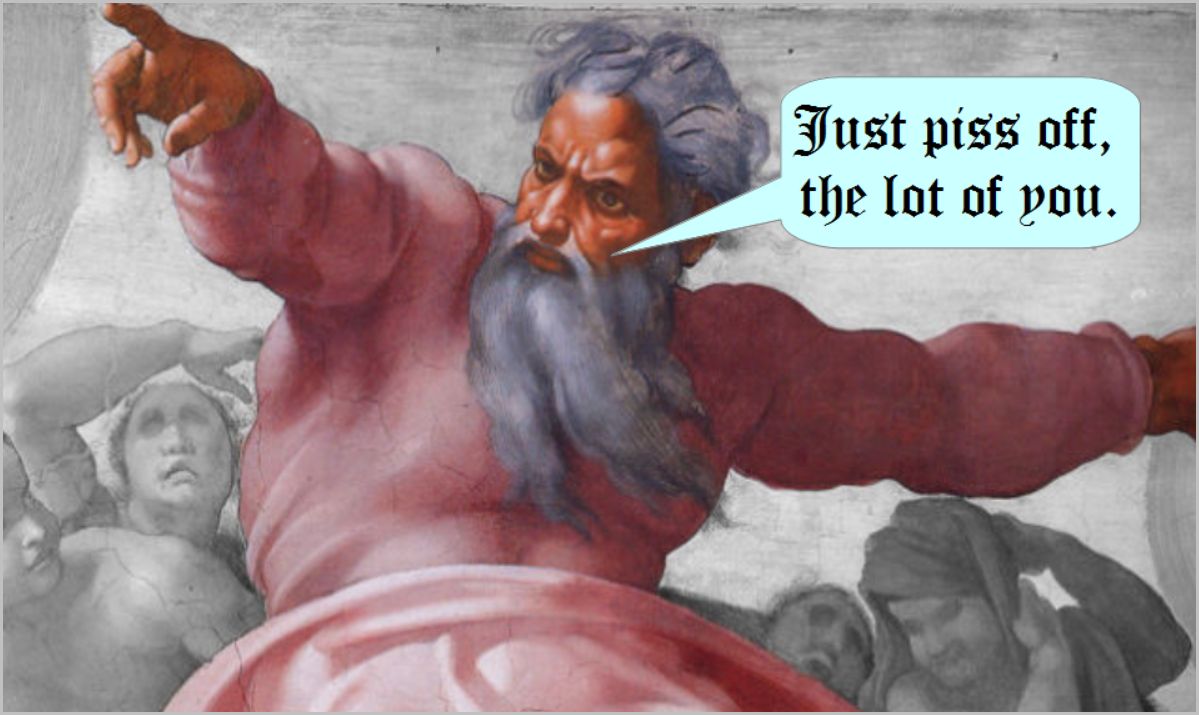
We owe it all to Jesus

MarySo the UK is a Christian country. Prime minister Dave Cameron has decreed it. In his hallowed Christmas message he proclaims that Britain derives all of its values from Christianity:

As a Christian country, we must remember what (Jesus’) birth represents: peace, mercy, goodwill and, above all, hope. I believe that we should also reflect on the fact that it is because of these important religious roots and Christian values that Britain has been such a successful home to people of all faiths and none.

‘Peace, mercy, goodwill, hope and tolerance’. Doesn’t it warm your heart? This country of ours has these wonderful sentiments at its core and all of them derive from the baby Jesus. I’m not sure about where our other values – capitalism, colonialism, democracy, free-thought and expression – originate but no doubt Dave will tell us they too spring from our ‘religious roots’.

What about the values he mentions though? Do they originate with Jesus as Dave claims?

Peace we covered last time: Christianity have not brought peace into the world, ever. Dave seems to have forgotten that Britain is currently at war; the so-called ‘war on terror’ Is he now suggesting that as a ‘Christian country’ we should turn the other cheek and propose peace, because that’s what Jesus would want? I doubt it, somehow.

Mercy? Here’s the kind of mercy Jesus proposed: ‘But those enemies of mine who did not want me to be king over them – bring them here and kill them in front of me’ (Luke 19:27). Nice.

Goodwill? Jesus always extended goodwill to others. Like here: ‘It is not right to take the children’s bread and toss it to the dogs (non-Jews)’. And here: ‘Do not give dogs what is holy, and do not throw your pearls before pigs (non-Jews again), lest they trample them underfoot and turn to attack you’ (Matthew 15.26 & Matthew 7.6).

Hope? The Bible does speak about hope – hope that this will all soon be over and God will consign non-believers to hell, set up his kingdom on earth and put Jesus in charge (Matthew 19:28 & 24.51). Is this what Cameron means by hope?

Tolerance? Paul on tolerance: ‘do you not know that wrongdoers will not inherit the kingdom of God? Do not be deceived: Neither the sexually immoral nor idolaters nor adulterers nor men who have sex with men’ (1 Corinthians 6:9). It’s difficult to see how modern notions of equality and acceptance can derive from bigotry like this.

No, Britain does not get its values from Christianity or the Bible or baby Jesus. It has worked them out for itself, principally through social progress and the reforms of modern times.

The UK is not a Christian country in any other sense either. Christians are required to turn the other cheek (Matt. 5.38–42), give all they have to the poor (Luke 14.33) and buy into a convoluted salvation scam plan (2 Timothy 1.9 etc). Can a country do these things? It would be unthinkable for it to give away its wealth, accede to other countries’ demands and respond non-aggressively to attack. Individual Christians don’t or won’t do these things and it would be nothing short of suicidal for a country to attempt to; yet this is what Jesus insists is involved in following him. It’s impossible for individuals to live this way, let alone entire nations.

Cameron can’t even claim that the majority of the population subscribes to the great salvation plan either. A recent government poll showed that only 49% of the population admits to being Christian and in any case, the plan is designed for individuals, not countries. So let’s hope (hah!) the Prime Minister will stop fawning over Christians, fatuously pretending that the UK is a Christian country when it isn’t. Let’s hope too he understands that our values, whatever they are, do not derive from an ancient, expired superstition. The UK is not a Christian country in any sense. Let us rejoice in that fact.

Peace Off

angels

Glory to God in the highest, and on earth peace, good will toward men. Luke 2.14 as rendered by the King James Bible.

Whatever happened to that peace? There hasn’t been peace on earth ever since the angels were made to herald Christ’s birth with these words. Some of that absence of peace – the conflicts and wars – has been the result of religion, including that of Jesus himself. Then again, he did contradict the angels when he said he hadn’t come to bring peace but a sword and for once, he was right (Matthew 10.34). So what can the angels have meant? More to the point, what can those who created these words to put in the mouths of non-existent beings have been thinking? Is their declaration a promise? A prophecy? Something to look good on Christmas cards?

Other translations of Luke 2.14 avoid the whole peace on earth shtick by watering down the statement: ‘Glory to God in the highest heaven, and on earth peace to those on whom his favour rests’ reads the NIV. Now only those whom God ‘favours’ are granted peace, which presumably means only Christians, and it’s now a vague sense of well-being (complacency? smugness?) that isn’t of much use to the world at large. Certainly other New Testament writers, the creators of John’s gospel and the letter to the Ephesians for example, interpret ‘peace’ in this very limited way.

And yet, in Isaiah, in verses applied to Jesus (especially at this time of year; they were read out in the carol service I attended last night) we find him descibed like this:

For to us a child is born, to us a son is given, and the government will be on his shoulders. And he will be called Wonderful Counselor, Mighty God, Everlasting Father, Prince of Peace. (Isaiah 9.6)

Apart from the fact this is a specifically Jewish prophecy that has nothing to do with Jesus – which is why most of the titles don’t really apply to him (nobody has ever called him ‘Wonderful Counselor’ or ‘Everlasting Father’) – there again is the idea that he’s somehow connected with capital-letter Peace. He’s a Prince of it, no less.

But wait – there’s more:

Of the increase of his government and peace there will be no end. He will reign on David’s throne and over his kingdom, establishing and upholding it with justice and righteousness from that time on and forever. The zeal of the Lord Almighty will accomplish this. (9.7)

Of course; it’s all end time stuff! We should’ve guessed. Long term peace on the Earth, predicted by the angels and, ostensibly, by Isaiah is going to be in the future, after Jesus returns to establish God’s Kingdom on earth.

Have you noticed how it’s always in the future? Everything Christianity offers is going to happen later: heaven, eternal life, the second coming, the rapture, resurrection, God’s Kingdom, the lion lying down with the lamb, the end of war, everlasting peace. Not in Jesus’ own time as he thought; not in Paul’s, not in the gospel writers’, not any time since, but always just around the corner, any time now, soon. Never in the here and now. Peace on Earth, like all those other promises, is always just out of reach, like the pot of gold at the end of the rainbow – the closer you think you might be to it, the further it moves away.

A friend added one of those clever posters to Facebook recently. It said, amongst other things, that it wasn’t okay to ‘shame’ religion. I couldn’t disagree more. Scams must be debunked and the sham of religion’s empty promises held up to the light of reality. None of the things that the Bible says will happen is going to; not now, nor in an ever-elusive future.

A happy and peaceful Christmas to both my readers.

It’s Baby Jesus time again

Nativity2It’s that time of year again, when we’re expected to worship the baby Jesus and thank God for sending him. I do usually go to a church carol service with friends and sing along for nostalgic reasons, while marvelling at folk’s willingness to believe the fairy story. Plus, there’s always a drink or two afterwards to look forward to.

What would Jesus have made of it? The stories of his miraculous birth have been tacked on to the beginning of two of the gospels but even in Matthew and Luke there is no indication that he was aware of them. Neither he nor his mother mention them when it looks like aspersions are being cast on his legitimacy (eg: Mark 6.3; John 8.41). You’d think one or other would have done so as sure-fire proof that he was an emissary from God. In fact, apart from the two conflicting accounts in Matthew and Luke there are no other mentions of his spectacular nativity in the Bible; Paul, writing closest to Jesus’ lifetime, doesn’t refer to it even when he’s arguing in 1 Corinthians 15.42-52 that Jesus came from Heaven.

How do we account for this? The obvious answer is that the nativity narratives are much later inventions. We know they were not included in Matthew and Luke’s shared source material because the two are significantly different (as I discuss here). However, by the time these gospels were being compiled, in the 80s and 90s, such stories had begun to circulate – then as now, people liked origin stories for their super-heroes – and two such tales were incorporated into their accounts. The birth stories are invention, heavy with symbolism and designed to show that Jesus was not illegitimate but spawned by God in a supposed fulfilment of prophecy.

While the adult Jesus was a egotist who thought he was going to the end the system in which he lived (Matthew 24.34-35) and then rule the world with his mates (Matthew 19.28), he didn’t require that his followers worship him. It’s true that, like any other cult leader, he accepted others’ adulation when it was offered, especially when it was offered by women; one anoints him with expensive perfume in John 12.13, while another Mary – they were evidently short of female names back then – fawns over him in Luke 10.41-42. However, he doesn’t make it part of his mission to demand the worship of others. When early Christians started to think of Jesus as a supernatural-being worthy of adulation, they devised statements about how marvellous he was (Colossians 1.15-20 may be one such) but worshipping him through song does not appear to have been part of their agenda.

Modern Christians’ use of hymns and songs to tell Jesus how much they love him is, then, alien to the faith as it was originally practised, and to Jesus himself. The carols that’ll be sung this Christmas have no equivalent in Jesus’ life nor in that of his earliest followers. Even if he were hanging around in Heaven somewhere, which of course he isn’t, the last thing he’d want to be subjected to would be some badly sung Victorian carols telling him what a great guy he is. He was in no doubt about that when he was alive.

Sin Nevermore

Second

Remember the old hit Spirit in the Sky? It had the line, ‘never been a sinner, I never sin, ‘cos I got a friend in Jesus’. It doesn’t seem likely, does it? I don’t mean that Norman Greenbaum, who wrote the song, never sinned (he was Jewish, not a Christian) but that friends of Jesus are entirely sin-free. The idea that Christians never sin would be preposterous.

But actually, it’s true; Christians never sin. How do we know? Because the Bible tells us so. 1 John 3.6 says,

No one who abides in Christ sins; no one who sins has either seen him or known him.

And just in case we miss the point, the writer of the letter (almost certainly not the same John who wrote the gospel, nor the John who came up with the trippy Revelation) repeats it in verse 9:

Those who have been born of God do not sin, because God’s seed abides in them; they cannot sin, because they have been born of God.

Christians love to say that awkward bits of scripture like these have been taken out of context, so please feel free to read them in context – you’ll find they say exactly the same thing. What John is claiming – without a glimmer of irony – is that anyone who really knows God/Christ ‘cannot sin’.

So next time you see Christians shooting people at family planning clinics, committing adultery, lying or even just judging others, remember they’re not really sinning. Yes, they may be behaving immorally, uncharitably or despicably but they are most definitely not sinning. That would be impossible because they’re incapable of it.

However, Christians are all too aware that they sin (that’s their choice of word, by the way; I’d prefer to say they sometimes – often – behave as badly as those of us who are not ‘saved’.) So where does this leave us or, more importantly, them? How do they square their capacity for sin with what the Bible says here? Does their behaviour demonstrate that God’s Word has it wrong? Or are they not really Christians, not really people who ‘abide in Christ’, not really born of God?

What a dilemma. Either the Word of God™ is wrong here, like it is in so many other places, or Christians are not as saved as they like to think they are. Perhaps it’s both.

Definitely it’s both.


A word from the WITLESS

Arun

We of the Wishful Thinking League of silly sods sausages – WITLESS for short – would just like to say how jolly unfair we think it is that our local cinema won’t show our new advert. All we want to do is remind everyone going to see the latest Flash Gordon film that they have three wishes. Three wishes from the special genie no-one can see but who we know is there. And, what’s really exciting, they can use their three wishes however they like! We just wish the cinema would stop being so jolly difficult and let us show our advert about the genie and the magic wishes. 

Damn! That’s one wish gone! And the man at the cinema still won’t let us show the ad. We wish we knew why not. He just says he doesn’t show adverts made by cranks, which is a little unfair when we’ve been recognised as the official cranks in this country for a very long time. Some other spoil-sports take the vue, er… view, that if the cinema goes ahead and shows our advert then other, unofficial cranks will want their adverts shown too. We quite agree this would be a very bad thing. Nobody else’s genie is as real as ours and noboby else grants three wishes the way he does.

We just wish the man who runs the place would come to his senses and agree to show our advert. It’s not a lot to ask. We wish too that…

What? What d’you mean, we’ve had all our wishes? But none of them have come true! That’s so unfair. It jolly well is, you know. And it’s all that rotter from the cinema’s fault.

Please, genie, can we have three more wishes? Can we, please?

What is the point?

Stairway

There isn’t any point. At least, not ‘out there’ somewhere, waiting to be discovered. The point, purpose and meaning of life is what we make of it. We make our own purpose.

The Christians among us claim to have real purpose. Not like we sad non-believers whose purpose is to do with raising and supporting our family, being creative, doing things for others or whatever. No, Christians get their real purpose from God, or so they say. Perhaps some of them would be good enough to share it with us; is it rushing from one church meeting to another? Singing badly written hymns badly? Cosying up to one another? Telling others about the great salvation plan?

Apparently not, though they do seem to spend a lot of time doing these things. According to CARM the purpose of life ‘is to praise God, worship Him… proclaim His greatness, and… accomplish His will.’ Got Questions, on the other hand, says it’s to ‘1) glorify God and enjoy fellowship with Him, 2) have good relationships with others, 3) work, and 4) have dominion over the earth,’ while Open Bible claims it’s ‘to love and serve God in order to help bring about God’s glorious plan for creation.’

That’s it? The purpose faith supplies is this woolliness? It’s about doing stuff we already do (‘work’, ‘have good relationships with others’) and fawning over a needy, insecure deity? God help us if this is all it amounts to. Those who claim to know the secrets of eternal life and the mind of God himself should surely be able to come up with something better than the rest of us.

As I’ve written before, this isn’t what Jesus told his followers life was for. No, he said it was to work to bring about God’s kingdom on Earth (Matthew 6.33; 13.44, Luke 9.62 etc). Try as you might you’ll struggle to find a Christian site that says this is the point. That’s because Christians long ago – almost two thousand years ago – stopped believing that God’s kingdom was due to arrive here and switched their expectation to one of an after-life in heaven. But that’s not what the Bible promises, and it’s certainly not what Jesus said.

So maybe, Christians, you’re missing the point of your faith and your purpose in life; it’s to bring about the Kingdom of God on Earth (Matthew 6.10) – in the first century (Mark 9.1). No wonder you’re now so rudderless, so lacking in direction and real purpose. You missed the boat, which sank without you two millennia ago.

Now you have to construct your own meaning, just like the rest of us. Except ours is better, lacking as it does the faux Biblical language and all those fairy tale elements.


You’re not as saved as you think

God2So now you’re a Christian. You’ve listened to the street preacher or that Christian at work and you’ve accepted Christ. You’re saved and going to Heaven when you die.

Or are you? You’re not going to Heaven that’s for sure, because Heaven isn’t on offer – as we saw here, the Bible doesn’t promise an eternal life in Heaven. But are you even saved? Has ‘the most important decision of your life’ really made you one of God’s own?

If you think you’ve chosen God, you’re wrong. You don’t choose God, he chooses you (or not, as the case may be). And if he hasn’t chosen you, then any decision of yours is of no consequence. You can shout all you like about how you’re now saved, born again and a follower of Jesus but if God says you’re not, then you’re not.

How do we know this? Because the Word of God™ says so:

Blessed be the God and Father of our Lord Jesus Christ, who has blessed us in Christ with every spiritual blessing in the heavenly places, just as he chose us in Christ before the foundation of the world to be holy and blameless before him in love. He destined us for adoption as his children through Jesus Christ, according to the good pleasure of his will… (Ephesians 1. 3-5)

In other words, you’re only saved if God decided you were going to be right back at the beginning of time. And if he didn’t, well, you can talk the talk and even walk the walk, but it will all be for nothing.

Jesus too is quite clear that it isn’t up to you whether or not you’re one of God’s chosen few. Here he is the middle of one of his tiresome parables about the Kingdom of God, where the King has told his slaves:

“Go… into the main streets, and invite everyone you find to the wedding banquet.” His slaves went out into the streets and gathered all whom they found, both good and bad; so the wedding hall was filled with guests. But when the king came in to see the guests, he noticed a man there who was not wearing a wedding robe, and he said to him, “Friend, how did you get in here without a wedding robe?” And he was speechless. Then the king said to the attendants, “Bind him hand and foot, and throw him into the outer darkness, where there will be weeping and gnashing of teeth.” For many are called, but few are chosen. (Matthew 22.9-14)

So, how do you know if you’re one of the special few hand-picked by God himself and not just one of those poor suckers who’s been invited along only to be thrown out? You don’t. Your capricious God won’t tell you till after you’ve died and you meet him face to face. There’s every possibility you’ll find out then that you’re not saved, because only a few of those called actually are. And then where will you be? Hell, that’s where. You’ll be no better off, according to the Bible anyway, than those who’ve not been duped by all of this nonsense.

So, you can believe all you like that God loves you. You can make all the right noises, study your Bible, pray, imagine you hear God’s voice in your head, go to church, sing the right songs and defend God’s standards, but there’s still a very good chance you’re not saved.

Jesus again:

Not everyone who says to me, “Lord, Lord”, will enter the kingdom of heaven, but only one who does the will of my Father in heaven. On that day many will say to me, “Lord, Lord, did we not prophesy in your name, and cast out demons in your name, and do many deeds of power in your name?” Then I will declare to them, “I never knew you; go away from me, you evildoers.” (Matthew 7.21-23)

But don’t worry, you were never ‘saved’ in the first place, nor lost, nor in need of Jesus; none of this mad fairy tale is real. Your only mistake – and it was a big one – was to think it was.

You’re all sinners!

BabyYou are a sinner. You deserve the wrath of God. After you die, you will meet God face to face and because of your sin he will throw you into the pit of hell for all eternity. But repent of your sin and believe the gospel and instead he will cast your sin away from you, as far as east is from west.

Or so said the street preacher in the centre of town at the weekend (yes, our old friend Dale McAlpine; he who suffers excessively from religion-virus).

I’m not a sinner. And neither, dear reader, are you. Sometimes in my life I’ve behaved badly, it’s true. I’ve hurt other people, though usually unintentionally, and I’ve been thoughtless. I’ve been unappreciative of loved ones and haven’t done enough for others. I’ve said things I shouldn’t and have occasionally lost my temper. I’ve even had sex when it wasn’t for making babies.

Maybe you’ve done similar things and, like me, have transgressed the moral law (which is entirely of human making) in all of these minor ways. Others have transgressed it, and the societal laws it gives rise to, in far worse ways, by deliberately hurting or abusing others, raping and murdering.

But still neither they nor us are sinners. Whether we have behaved reprehensibly or only a little thoughtlessly, we are still not sinners. We are human and we behave as humans behave; as evolved apes our developed brains jostle with animal natures, and we act as our distinct environments have taught us. ‘Sin’, on the other hand, is a distinctly religious concept, a component of a fantasy perspective of life with no purchase outside of its religious context. The problem with it is, however, that it has intruded for the best part of a two thousand years into reality, into life as it is lived by most people most of the time, and we’ve grown used to it. We give it credence when it’s talked about or preached from pulpit or soap box. But it is a meaningless concept.

The word for sin that is used most frequently in the New Testament (221 times) is ‘hamartia’, an archery term meaning ‘to miss the mark’. It means not being as good as we could be; not coming up to God’s standard: ‘for all have sinned and fall short of the glory of God,’ as old wingnut Paul puts it in Romans 3.23. And this is the secondary – some would say primary – application of the idea of sin; it denotes our separation from God. The thinking behind this idea goes as follows: there must be a reason God always seems so distant, remote, far away, elusive and absent from us. And because he’s God and so wouldn’t behave in such a cold-hearted way if we didn’t deserve it, it can only be our fault. His distance, therefore, can only be because of sin, our failure to behave and be, from the moment of our birth, as he would want us to. Yes, sin really is God’s kryptonite and, according to Christian doctrine, Jesus came to be the lead lining that blocks its rays.

But this is an unnecessarily convoluted way to account for the perceived divine distance. It is much better explained by God’s existential and literal absence. It’s not our fault he’s so far away – or rather it is, but not because we sin. In our childish need to have someone out there who both explained everything and cared for us, we made him up. We anthropomorphised an insentient, indifferent universe, which could only ever lead to a God who felt distant and remote.

So, as Dale was recommending on Saturday, free yourself from ‘sin’. Recognise that you don’t fall short of the glory of God, because no such thing exists, and that you behave as you do because you’re human. And then you will be free indeed.

Is there anybody out there?

KenAnyone searching for extra-terrestrial life – NASA, SETI and so on – can stop now. We know definitively that there isn’t any out there. How do we know? Because Ken Ham says so. The Bible – Genesis specifically – doesn’t mention life on other planets so that means there isn’t:

(T)he notion of alien life does not square well with Scripture. The earth is unique. God designed the earth for life. The other planets have an entirely different purpose than does the earth, and thus, they are designed differently… where does the Bible discuss the creation of life on the “lights in the expanse of the heavens”? There is no such description because the lights in the expanse were not designed to accommodate life [this is utter gibberish; life within stars? Who has ever suggested that?] God gave care of the earth to man, but the heavens are the Lord’s. From a biblical perspective, extraterrestrial life does not seem reasonable.

But hang on a minute! The Bible doesn’t mention other planets, never mind whether there’s life on them. It doesn’t tell us anything about cultures outside of a small area in the Middle East, doesn’t mention the Americas or Australasia, doesn’t have anything to say about microbes, anti-biotics, computers or technology in general. It must follow, therefore – to use Ken’s logic – that none of these things exist either.

The reason the Bible doesn’t mention any of them, and a myriad of other things, is not because they don’t exist but because the primitive priests and ignorant scribes who wrote Genesis and the rest of Ken’s magic book didn’t know that they did. They had no concept that the Earth is a planet, let alone that there are others; they had no idea that the sun is a star, nor that other stars, which they thought were attached to the inner surface of a canopy surrounding the Earth, are suns. With such a limited cosmology, the possibility that there might be life on other planets was as alien to them as, well, aliens themselves.

Whether there is extra-terrestrial life, and whether any of it is intelligent, we may never know. But either way, Ham’s deity will have no bearing on it, nor it on the Christian God. The existence of aliens, like their absence, won’t breathe life into an already discredited idea.

Once in a Blood Moon

HageeSomething’s going to happen today. Or maybe tomorrow. Maybe something happens every day. But evangelical pastor John Hagee says that because of last night’s Blood Moon and lunar eclipse, something special’s going to happen real soon. He can’t say whether it’s something good or something bad, but it’s something, okay? Because predictable lunar events are really secret messages from God, telling us he’s pissed  off again and warning us something big is going to happen, whether that’s something good or something bad. Who knows. But you will know when you see it and you’ll be able to say, ‘So this is what John Hagee warned/promised us would happen!’ He really can’t lose; ‘prophecy’ with the details filled in after the event – any event – is prophecy that can’t fail.

Christians, you are being short-changed. Your teachers and leaders, including, in all probability, those you sat listening to in church yesterday (maybe even writing down what they said) are feeding you inanities. The rest of us see it whenever we look at the God channels or stumble upon the pronouncements of the likes of Hagee or Robertson or Meyer. These people have nothing to say of any substance, sense or meaning. This isn’t just someone in an ‘unregenerate’ state saying so – analyse what they tell you for yourself and let your eyes be opened. See through the thin veneer of derisible pop-psychology and lunatic make-believe (pun intended) to the vacuousness at the heart of Christian ‘teaching’. Admittedly, this will entail doing some thinking for yourself rather then just absorbing uncritically the drivel these people send your way – but it will be worth it. Then you’ll finally see: the emperor’s self-appointed spokespersons really don’t have any clothes on.

Meanwhile look out for something happening today. Or tomorrow. Or some other damn time.