Can you be a Christian and… a rational thinker?

Blog390

This is the first in a series of posts that pose the question, ‘Can you be a Christian and..?’ It seems to me that certain ways of being are incompatible with religious belief. Any religious belief, that is, though here I’ll limit myself to the Christian faith as that’s the belief system I know best and the one on which I wasted a great deal of my life.

Conversion is, I’ve become convinced, an emotional response to being told God loves you (who doesn’t want to be loved?) and that Jesus sacrificed himself so that you – yes, you – can enter into a full and meaningful relationship with God. It’s an intuitive, gut-reaction to the ‘promise’ that once you’ve accepted Jesus as Lord and Saviour, he will  be with you always, guiding you through life and guaranting you’ll survive death.

What is rational about this? Nothing; it’s muddled supernaturalism, magic based on others’ dreams and visions, that appeals to your need to be wanted, to matter and your hope that your life means something and will go on beyond death.

The rationalisation comes after you’ve made this response and after your commitment. It’s rather like buying something incredibly expensive you’re not sure you actually need but which makes you feel good momentarily as you hand over your cash. On the way home, as doubts start to assail you, you start trying convince yourself that you were right to buy it, on the basis you deserve it, so that by the time you’re home you feel completely justified. Psychologists tell us we do this often: act first and then come up with the rationalisation for why we’ve behaved the way we have.

So it is that once you’ve made the emotional response to what Christianity purports to offer, you start justifying your decision to yourself. You know there’s really no evidence for what you’ve started to believe. All there is is the bible and other people’s enthusiasm for what it teaches, but still, there must be some sort of justification for it; all those others, including the guys who wrote the bible, can’t all be wrong. You’re helped in your rationalisation of the irrational by sermons in which a respected pastor explains what certain teachings mean, the warm and fuzzy feelings you get from fellowship with other Christians and from reading the bible with the aid of a study guide that smooths out its many inconsistencies and contradictions. You start reading too those devotional books that have been recommended to you, which give your new-found faith a respectable gloss. All after the event.

And before you know it you are fully invested in an entirely new belief system. Not only have you accepted the central mystery (magic) of salvation but you find yourself entertaining the notion that there exist all manner of supernatural beings; angels, demons, devils, spirits all engaged in spiritual warfare in higher places. You convince yourself, even when your intellect is telling you to exercise caution, of the existence of Heaven and Hell. You become persuaded that talking to yourself inside your head is communicating with the God of the Universe and that your very thoughts can change his mind. You assume what you are told is biblical morality and alter your world view so that it conforms to the bible’s: sin everywhere, yet miracles happen; God creating humans and not just (or even) evolution; Jesus returning at any time soon to change the word so it is more to your liking.

Yet there is no evidence for any of this. A book written by Iron Age tribesmen and first century religious zealots is not evidence. Nor is any of it rational. You know this, but you hold fast to your belief that God’s ways are not our ways. He likes, it says somewhere in the bible, to conceal his plans from the worldly wise. Like many other believers you are not stupid but you’ve happily sublimated your intellect to assume irrational, unsupported beliefs. You’ve subjugated your capacity for rationalisation in deference to these beliefs. If and when a rational objection forms itself in your mind, you dismiss it as a doubt, or worse still, a Satanic attempt to snatch you away from your salvation.

How do I know? Because I did so myself.

So, can you be a Christian and rational thinker? No. Because once you’ve tethered your intellect to ancient superstition you’ve denied yourself the possibility of independent thought. Rational thinking can go then in only one direction, towards the conclusions already established by the Faith. It isn’t possible to be an independent thinker and to adopt a worldview based on others’ emotions, dreams and visions. It isn’t possible to believe irrational things and be a rational thinker.
Metaphor, Hyperbole and Context

Blog387a

A moderate and self-styled ‘intellectual’ Christian told me in a online discussion recently that ‘most of the bible is metaphor’. When I asked what it was a metaphor for, he decided it was time to end the discussion. A metaphor signals a deeper or alternate meaning; the bible cannot be ‘mostly metaphor’ without there being something else – what Christians might regard as a ‘greater truth’ – the metaphor is intended to convey. So, yes, I can see that the Genesis creation stories might be interpreted metaphorically (though symbolically might be a better term) as the inclination of all humans to rebel against God… but then that’s only one of many interpretations, and not actually what the text says. If the bible is mostly metaphor then understanding what God is supposedly communicating through it becomes a matter of personal, subjective interpretation, which is why there are so many factions and sects within the Christian brand.

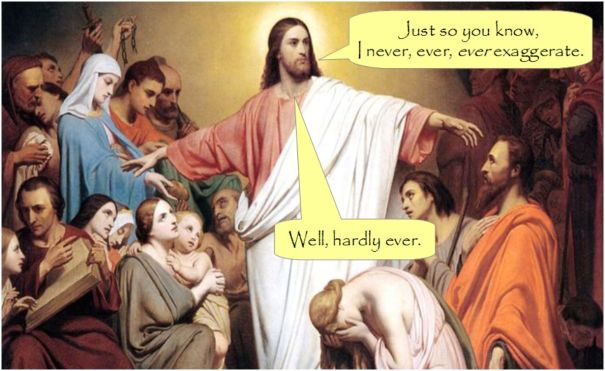
Similarly, when I challenged Dave Armstrong on Biblical Evidence for Catholicism, about why Christians don’t take everything Jesus said literally, he told me it’s because Jesus was fond of hyperbole and it’s the point underlining his hyperbole that matters. I knew, of course, that Jesus liked to exaggerate so I asked Dave how we know which of Jesus’ remarks are hyperbole and which are not. He declared that this was ‘obvious’. Perhaps it is, in sayings like ‘when your eye offends you pluck it out’, but it’s less apparent with pronouncements like ‘sell all you have and give to the poor’ or ‘abandon everything and follow me’. Again, it becomes a matter of subjective opinion, however learned that opinion might consider itself to be, about which of Jesus’ words are hyperbole and which are meant to be followed to the letter.

When I made this point, Dave decided that, rather than it being ‘obvious’, it actually takes years of study to know which is which: ‘It’s by studying Bible commentaries and linguistic aids, and the rules of hermeneutics and exegesis (Bible interpretation).’ Jesus as the incarnation of the God of the Cosmos, and the gospels in reporting him, could surely have made it clear. Instead, it seems, it takes armies of theologians and commentators, and years of study to work it out.

The third way Christians (of all stripes) manoeuvre around the bible’s shortcomings is to say that anything they’re keen to disregard is ‘context-bound’. There are some matters, they say, that are of their time and ancient place and are therefore no longer applicable today.

There are things in God’s timeless Word that pertain only to the time in when they were written? Who knew?

So, instructions like ‘greet each other with a holy kiss’ (which Paul advocates four times in his letters: Romans 16:16, 1 Corinthians 16:20, 2 Corinthians 13:12, and 1 Thessalonians 5:26); ‘women should always have their heads covered in church’ (1 Corinthians 11:2-16) and ‘heal the sick by anointing with oil’ (James 5:14) are now generally considered to be context-bound. This, however, creates the same problem that arose over Jesus’ hyperbole. How do we know which of the bible’s pronouncements are context-bound and which are still of significance today? Answer: we don’t.

It could be argued that, just as ‘greet each other with a holy kiss’ is a custom anchored in the first century, beliefs like

the world is populated by demons,

humans are capable of living forever,

and

incantations (that Jesus is the Saviour) work

are equally context-bound. We know categorically in the 21st century, that demons don’t exist, humans cannot live forever and magic spells don’t work. Only those in a pre-scientific age, dominated by superstition, thought so (together with those today who buy into these same ancient beliefs.)

Once believers start claiming – and it’s Christians themselves who do this – that significant parts of the bible are metaphor, hyperbole or are context-bound, then they’re acknowledging that the bible frequently makes little sense, and that significant portions  lend themselves to whatever interpretation suits the individual reader. Some parts can even be dismissed altogether, which is precisely what Christians do with them (how many Christians do you know who believe they can move mountains or heal the sick by laying on of hands?) What this shows is that they don’t really believe the bible is God’s Word, either in the literal, evangelical sense, nor in a moderate, quasi-intellectual way.

In practice, even to most Christians, the bible is a book of no particular merit.

Bible Truths

Blog387

If ever there was evidence that Christianity is an entirely human affair it’s the way believers constantly disagree with each another. If the bible really was, in some way, ‘the Word of God’ (they don’t all agree even with what this might mean) then surely it would offer greater clarity on what being a Christian entails. Given what’s at stake – heaven or hell, a life of fullness or one spent mired in sin, helping the poor and hungry or self-indulgence – you’d think God would be just a little more precise about what his expectations are.

Instead, what do we get? A rag bag collection of myths, pseudo-history, folklore, poetry, fantasy, yet more pseudo-history, letters, forgeries and invective. Muddled and inconsistent about what the Supreme Being requires of his creation, it ranges from a forever agreement that says following a set of arbitrary laws is what he wants, along with a spot of male genital-mutilation (Genesis 17.1-16), to a new scheme that involves magical incantation (Romans 10.19), to yet another that says helping those in need is what he requires (Matthew 25.31-40).

I’ve been involved at different times in my life with writing policy documents for a range of organisations. Despite creating what I’d estimate to be around 50 of these documents, it never occurred to me to cobble together myth, stories, letters and fake news in even one of them. They needed to be precise, detailing how the organisation worked, what its take was on various areas of operation and, most importantly spelling out for people as clearly as possible what was expected of them. This precision was important; the documents had to be water-tight and open to as little interpretation as possible. They couldn’t allow for the possibility of one part of the organisation acting in one way in a given area while another acted completely differently in that same area.

If I, a fallible human, could manage this more often than not, why couldn’t God?

Why could he not declare definitively how old the Earth is so as to leave no room for dispute?

Why could he not set out his requirements for pleasing him as one single, unequivocal list? (he’s not averse to bullet points – see his ten commandments, of which he manages to present two largely incompatible versions, both of them fairly useless.)

Why could he not ‘inspire’ scribes contemporaneous with the figures in the Old Testament to record what happened as they happened and not centuries later?

Why could he not ‘inspire’ eye-witnesses of Jesus ‘ministry’ to write about it at the time, instead of waiting decades before giving the job to strangers who’d never met him?

Why could he not say decisively what happens to people when they die?

Why could he not present one definitive way of how to get in his good books instead of offering a range of confused alternatives, about which he is prone to change his mind?

And so on and so forth…

If the managing director of an organisation produced policy documents as shoddy and shambolic as God’s they wouldn’t last five minutes. Nor would the organisation.

But of course God didn’t write, inspire or otherwise cause the bible to be written. It’s human through and through, culturally-bound (to a range of ancient cultures) and not intended by its myriad authors to be a single volume. This fact doesn’t trouble most Christians; they read it selectively, if they read it at all, and believe what they are told about it. Others, who are aware of the bible’s shortcomings, have a variety of ways of negotiating around them. All of these entail great dollops of cognitive dissonance. We’ll look at some of them next time.

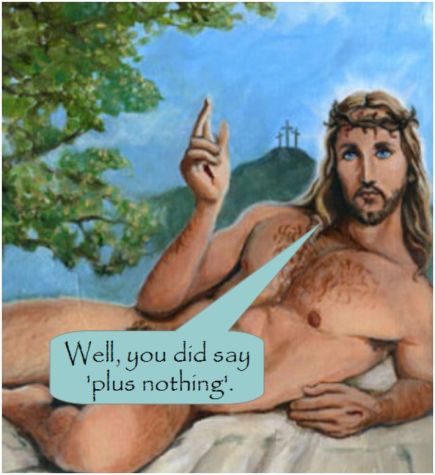
Jesus, plus nothing

Blog376

‘Jesus, plus nothing’ is the motto – the slogan – of ‘The Family’, a secretive, clandestine Christian group that for 60+ years has influenced, and been part of, the government of the USA. Yes, poor persecuted Christians, who find their rights eroded on a daily basis (or so they like to tell us) actually exercise a disproportionate amount of control over those in power. Controlled for many years by ‘the most influential Christian you’ve never heard of’, Doug Coe, this group disregards any notion of separation of church and state. The new Netflix series, The Family, based on Jeff Sharlet’s books The Family and C Street, documents their activities, which include affecting policy both at home and abroad, and taking the gospel of ‘Jesus, plus nothing’ to the mighty and powerful across the globe, often on the taxpayer’s dime.

But what does ‘Jesus, plus nothing’ really mean? There’s no doubt it’s intended to convey a stark honesty: this version of Christianity, it says, is without all the clutter that has accrued since Jesus walked the Earth, including all of Paul’s complicated theology. The Family’s holy book is not the bible in its entirety but a slim volume simply entitled Jesus that contains only the four gospels and Acts. The Jesus story, pure and simple.

Except there really isn’t anything simple about the Jesus story. It isn’t even a single story. Nor is there one, single Jesus. (As you’ll see at the links, I’ve written about both of these problems before.) The Jesus that The Family promotes is one of its own making. Of course, every version of Jesus is a construct, loosely based, at best, on bits and pieces from the bible, but manufactured entirely by what different groups and individuals would like him to be. It’s probable that the gospels themselves are constructs built on Old Testament ‘prophecies’ and references, and that the Jesuses they portray are no more than literary creations. Even so, the Jesuses held dear by modern believers, and The Family in particular, bear little resemblance to the constructs of Mark, Matthew, Luke and John on which he is supposedly based.

He is, as one of The Family’s Christian critics points out, a talisman, a magic word that opens doors for speaking ‘truth’ to dictators and tyrants. A Jesus synonymous with power; the power to control nations’ policies, direction and morality. A Jesus who chooses his men (always men) to wield this power; a Jesus who chooses ‘weak vessels’ to do his bidding; a Jesus who, The Family is convinced, chose Donald Trump to be president. And when Jesus chooses you – or when his agents on Earth do – then you are chosen indeed. They make sure of it.

To be continued.

Christian charity?

Blog367

Over at the distastefully named Cripplegate, Jordan Standridge has been considering what Christians should do when a homeless person asks for money. Jordan wants some means of weeding out the fakes (fair enough, though he doesn’t really have any clear strategy for doing this) and also attaches conditions to his giving – the recipient of his largesse has to listen to him ‘sharing the gospel’. Jordan reports that none of those he treats to a free meal object to him doing this – probably because they fear going hungry if they don’t listen to him droning on about Jesus.

Most of the comments following Jordan’s post betray the Christian eagerness not to have to follow the command of Jesus’ to give unstintingly. I felt moved to add one of my own:

It’s good that you’re considering ways you can help the poor and homeless, but Jesus says to ‘give to everyone who asks’ (Luke 6.30). ‘Everyone’ is a pretty inclusive! There’s no mention of ‘weeding out the fakes’; just give to all. Seems to me you’re hedging around this command.

This met with variety of responses, shown below in italics, followed by my replies:

Mike: By that logic, if a homeless person asks you for your home, are you then to sign it over to them? If they simply ask for your car, are you then going to hand them your keys? Of course not. That’s not what Luke 6 has in mind. Otherwise YOU would be left on the street naked and homeless simply because someone ASKED you for everything you owned…

You’re right, Mike – it’s completely absurd and unreasonable. But it’s Jesus’ absurdity and unreasonableness, not mine. If you want to say he’s wrong – as you do when you say ‘that’s not what Luke 6 has in mind’ (you know what it ‘has in mind’, I take it?) – then your dispute is with him, not me.

Jane: I believe your atheism qualifies you as the one having the dispute with Him.

Well, Jane, you’re the one who claims to obey him as Lord and Savior and yet here you are trying to figure out ways not to. It brings to mind another of his sayings from Luke 6: ‘Why do you call me “Lord, lord,” and not do what I tell you?’ Why indeed.

Craig: The passage in Luke 6 is not instructions for the body of Christ. In the gospels Jesus has come to Israel as their Messiah to bring in the kingdom that was promised to them. Jesus is telling them how it will be if they accept Him as Messiah.

It’s not, Craig? How’d you know?

What you’re really saying is ‘we Christians don’t much care for this commandment, so we’ve decided it doesn’t apply to us.’

However, if we were to go along with your argument, that Jesus is not addressing the ‘body of Christ’ here, then it follows neither can he be addressing it anywhere else in the gospels. You can’t simply delete the bits you don’t like.

4CommenceFiring4: “Give to everyone who asks” doesn’t specify what to give, or how much. The other commands–like going the second mile or giving them your cloak when they ask for your shirt–has to do with attitude, not mathematical formulas.

The Jews asked Jesus for a “sign” that He was the Christ. Did violate His own standards by not providing a sign? If you think He did, then it would be fruitless to get into the subject any further.

Really? It’s to do with attitude not action? Who says so? I thought the Bible was the literal word of God, meaning Jesus’ commands here should be taken at face value. Thanks for enlightening me; I’m relieved to learn there’s enough wriggle room not to have to do what Jesus says.

Oh, and according to John’s gospel, Jesus provided numerous ‘signs’ for ‘the Jews’ (which he was himself, of course.)

4CommenceFiring4: “The Bible is the literal Word of God” is the claim of someone–believer or otherwise–who hasn’t thought much about what that even means. There are theological debates by serious people about that, so don’t think for one minute that because “literal” means different things to different people means it doesn’t mean anything and we can go merrily on our way thinking we have nothing to which we owe our attention.

A devotion to strict literalism would lead to ridiculous conclusions, as you well know, so if you intend to use that as a defense for why the Bible isn’t to be taken seriously, try again. Smarter people than either of us have devoted their lives to debunking it, and it’s still standing long after they faded away. So don’t waste your time with that empty pursuit.

The bottom line is, are you ready for what comes next? And are you sure? It’s a bet you can’t afford to get wrong. Examine that, and everything else is secondary.

Great stuff. The ingenuity and effort that goes into avoiding doing what Jesus clearly commands is truly impressive.

Am I ready for what comes next? Sure. Oblivion never hurt anyone.

*****

Meanwhile, the homeless go on being homeless and Christians continue to demonstrate that the people who get the most out of their ‘discipleship’ is primarily they themselves.

Why the Nativity reflects the fantasist mentality of those who created it.

Blog348Angels

The Nativity story tells us nothing about Jesus’ origins but plenty about the mindset of those who created it, decades after he lived.

They believed in angels. There are several visitations in the two versions of the story in Matthew and Luke: ‘Gabriel’ appears to Zechariah and strikes him dumb. Gabriel, again, manifests in front of Mary to tell her she hasn’t really been knocked up by a Roman soldier but that she’s going to be impregnated by the Holy Spirit. He then makes a lot of false promises too about how the boy will turn out. Later, a whole host of angels appear to some shepherds to tell them they’ll find a baby in a manger, news, that for some reason, they find amazing.

The creators of the gospels also believed that spirits were everywhere and that one of them was holy. Never mind that, according to John 14.16 & 16.7, the Holy Spirit doesn’t make its appearance until after Jesus’ ascension. In the nativity story, the Holy Spirit ‘speaks’ to Elizabeth, Simeon and Anna (how?) to tell them that Mary’s baby will be special.

The creators of the nativity myth also believed in dreams and visions. Joseph has a dream telling him to take his family to Egypt and the misnamed ‘wise men’ have a dream (just the one or did all of them have the same dream?) telling them not to go back to Herod. What a pity they didn’t ‘dream’ they shouldn’t call on him in the first place.

Angels, spirits and dreams are the context from which the gospel stories emerge: the gospel writers, and those who created their sources, believed implicitly that angels (and devils and demons) were real and that God communicated with them through dreams and visions. More than this, these same people accepted that the dead could return to life. According to the gospels, long-dead people could manifest themselves, and would appear and speak to the living (e.g: Matthew 17.1-3).

Incredibly, 1 in 3 people in the UK, a largely secular society, believes in angels. People with such a mentality were the ones who, 2000 years ago, claimed to have seen Jesus resurrected. Yet Christians insist they were stable, rational, reliable witnesses (never mind that the accounts of such appearances were written third, fourth, fifth hand, decades later.) Any such witnesses were neither stable nor reliable. They were the product of a pre-scientific culture that thought angels and devils populated the very air (Ephesians 6.12); that ancient celebrities could reappear in new bodies (Matthew 11.14; 14.1-2; 16.14); that without doubt that gods spoke to humans in dreams and that angels could and did appear bodily in front of favoured believers. People of such a culture, like Jesus himself, his early followers and the gospel writers, were fully primed, as a result, to have ‘supernatural’ encounters – or at least to interpret other experiences as such. They literally knew no better.

The stories that they wrote, with their supernatural beings and premonitionary dreams and visions – the Nativity, Jesus’ miracles and the Resurrection – are just that: stories, and the truth is not in them.

A happy Christmas to both my readers.

God’s deficient policy documents

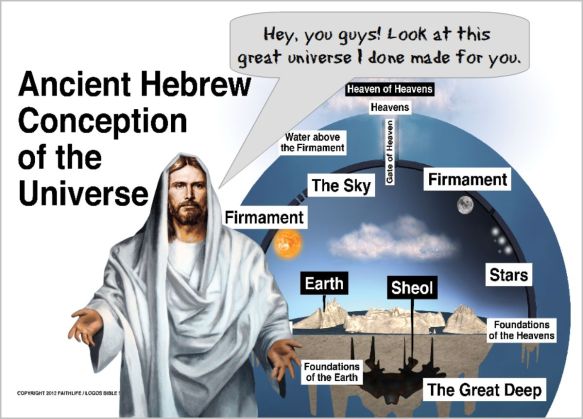
Universe

If you have read even a small percentage of my posts then you know I focus a great deal on defining and presenting the Gospel of our Lord Jesus Christ. I also focus on the Word of God as our source of God’s Truth, which is absolute. We also have defined faith and what God has done to save His people from their sins, which is the purpose of Jesus’ incarnation, perfect life, crucifixion, and resurrection.                 

Mike Ratcliff on Possessing the Treasure


Is your job description at work expressed as a story or myth?

       Are the aims and objectives of your company based on the hallucinations of the owners?

                   Is the health and safety policy made up of spells and incantations devised by someone with no real connection to the company?

Can you imagine if the kind of documentation that determines your work conditions was composed of myths, stories of dreams and visions, historically unreliable accounts and largely incomprehensible, magical terms and conditions? Not only this, but you’re required to root around within this documentation to discover what it is you’re meant to be doing and when you have, you need to find someone who can explain it properly to you.

This, according to Christians, is how God chose to tell his creation what he expected of it. The omniscient, all powerful creator of the universe, whose thoughts are so much greater than ours, was unable to put together a clear, systematic and concise set of directions about how he wants us to live and what we should believe if we’re to avoid an eternity of torture.

These messages are so important, apparently, that he thought they’d be best conveyed in folklore and myth – much of it plagiarised from other cultures – fantastic stories written decades after the events they relate, and muddled, contradictory theology.

Why on Earth would he do this? Why would he not speak directly and clearly to fallible, sinful humans? Provide us, perhaps, with a list that sets out straightforwardly and unequivocally what we need to do if we’re to be ‘saved’. (It’s not as if he’s averse to supplying lists; the Ten Commandments are a list, as are the rules in Leviticus about beating slaves and what should and shouldn’t be eaten.) Why not communicate with us so that we know it’s him and not, say, some pre-scientific tribesmen or a bunch of superstitious zealots? Why not speak to us in ways that are not identical with the way we ourselves invent stories about imaginary beings and far-fetched events?

Why provide us with a ragbag of myths, legends and fables crammed with confused and inconsistent ideas, all of them created by those same fallible, sinful human beings, and stitched together, eventually, by a committee with a vested interest in the success of such a book?

It’s a mystery. Unless of course there’s no God behind the bible. Maybe that’s why we have much better policy documents at work.

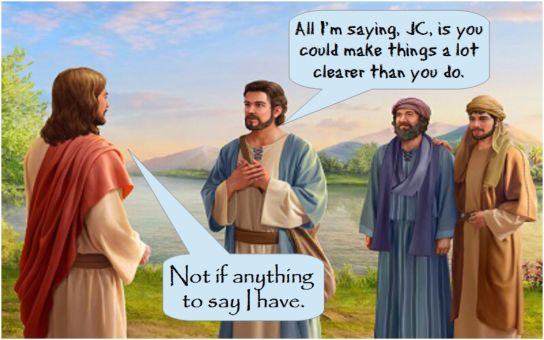
Jesus: Speak not clearly did he

Blog345JC

Why did Jesus not speak clearly? If he came from God, or was God in some way, why didn’t he express himself directly and with precision? Why did he obscure what he had to say with hyperbole, riddles and demands that even he couldn’t meet?

Don Camp, light-weight apologist and C. S. Lewis aficionado, has been giving me a little lecture over in the comments section of Debunking Christianity. He’s been providing the basics in how some of Jesus’ remarks in the gospels are hyperbolic and are therefore not to be taken literally. I am, of course, already aware of Jesus’ tendency to exaggerate (how far does this qualify as false witness, I wonder?) but Don and I were specifically discussing Matthew 5.29-30 where Jesus advises those who lust after a woman to pluck out their right eye and cut off their hand. Don asserted that obviously this is an exaggeration, to be understood figuratively, not literally. I asked him how one distinguishes between the two.

Don responded by saying one should look for clues in the scriptures (the bible as Murder, She Wrote); clues that might reveal how early Christians responded to Jesus’ assertions. If they ignored what Jesus said (while most did disregard his more extreme commands, such as the self-mutilation statements, there is evidence that some did indeed take him literally), then we can safely do the same. If, on the other hand (no pun intended) they acted on what he said, then it’s fair to assume it’s okay for today’s Christians to do the same. Sounds simple right? But it still doesn’t help anyone decide what is hyperbole and what is meant literally.

For example, Christians largely ignore Jesus’ commands to go the extra mile, give the shirts of their back to those who ask for them, turn the other cheek, love their enemies, disavow wealth, sell all they have, give no concern for the future and do all they can for the homeless, sick, naked and displaced. There isn’t a lot of evidence that even early followers did these things. Does their disregard for these commands mean that Jesus must have meant them figuratively? That there is spiritual truth to be discerned from them but that no practical action is expected or required?

Where do Jesus’ apparent assurances that his followers would heal the sick, raise the dead (Matthew 10.8) and do ‘works’ even greater than his (John 14.12) fit? Are these hyperbole or are they intended to be taken literally? Given early Christians serve as Don’s yard-stick for what is hyperbole and what is literal, what did they think? We don’t actually know, though evidently some considered the promises significant enough to include in the gospels. Among today’s believers, there are those – and not just on the fringe – who accept them as literal, while others scoff at the idea of taking them at face value.

What about Jesus’ promises that God’s Kingdom was imminent and that he would rise from the dead? Aren’t these just hyperbole too? Don says no, because people at the time didn’t ignore them (as they did his ‘obvious’ hyperbole) but believed they would happen. Therefore, they must have been meant literally. Unfortunately, Don fails to take into account that the promises of a resurrection were applied retrospectively; Jesus didn’t actually predict his own return from the dead (for reasons discussed here.) The Kingdom of God, meanwhile, failed to materialise when Jesus said it would. The extent to which early Christians believed these promises hardly demonstrates their literal truth. In any case, is ultimate truth to be determined by how ordinary, largely uneducated, superstitious back-water folks responded to what they heard or read? What a spurious and unreliable way to decide.

Which brings me back to my original question. Couldn’t Jesus have been a lot clearer about what he meant? Instead, he dressed up a lot of what he said in what might, or might not be, hyperbole. He issued other ‘truths’ in parables that he didn’t intend the hoi-polloi to understand (Mark 4.12). He offered advice that is of no practical use, some of it positively detrimental. He was neither systematic nor consistent and contradicted himself. So much of what he said is open to interpretation, to the extent that there are now thousands of Christian churches, cults and sects, all at odds with one another because they disagree about what he meant.

The New Testament as a whole too is a muddle of conflicting ideas and advice… though that’s a discussion for another time.

According to the Scriptures (not)

Blog344Jonah

Christ died for our sins according to the Scriptures. He was buried (and) was raised on the third day according to the Scriptures…

This is Paul’s claim in 1 Corinthians 15.3-4, where he is probably quoting an early Christian creed. He uses the phrase ‘according to the scriptures’ twice, meaning that what he’s claiming fulfils prophecy from the Jewish scriptures. He is not referring to the gospel accounts of Jesus’ death and resurrection as these ‘scriptures’ had yet to be written at the time of 1 Corinthians (circa 54/55AD.) Mark’s gospel was still fifteen or so years away.

So where in the Jewish scriptures – the Christian Old Testament – is there any prophecy that the Messiah would die for the sins of the people? Where the prediction that he would rise from the dead on the third day?

As Michael J. Alter notes, there is no prophecy either that the Messiah would die for the sins of the people nor that he would then rise from the dead. Not one. Passages that are pressed into service by Christians ancient and modern to demonstrate that Jesus’ death and resurrection were presaged in the Old Testament are either not prophecy or they don’t have any bearing on either Jesus’ death or supposed resurrection.

Let’s look at a couple:

In Matthew 12.40, Jesus is made to equate his time in the grave – three days and three nights – with the time Jonah spent in the belly of a great fish. But the Jonah story has nothing to do with events hundreds of years later. It is an ancient fable, not a prophecy delivered by one of the Old Testament’s recognised prophets. In any case, in the story Jonah is being disobedient and is running away from his God-given mission. Jesus, according the gospels, doesn’t do either of these things. Moreover, Jonah does not have to die to spend three days in a fish. He does not resurrect when the fish spews him out. The only aspect the two stories have in common is the period of three days and nights, which as we have seen, bear little relation to how long Jesus was actually in the tomb. Matthew has press-ganged an irrelevant story into service, in an attempt to show that Jesus really was the Messiah. Why does he do this? Because he can’t find any ‘scripture’ that points incontrovertibly to the Messiah dying and resurrecting. Jonah is literally the best he can do.

Modern Christians like to tell us that Isaiah 53 is a prophecy that Jesus would die as a sacrifice for sin. Significantly, none of the New Testament writers attempt to make Isaiah’s ‘suffering servant’ narrative fit Jesus. This is because the suffering servant it describes is the beleaguered Jewish nation; earlier chapters say so several times. To insist that Isaiah 53 describes Jesus’ death and resurrection is to render it incompatible with all the Old Testament prophecies that are actually about the Messiah. For those who created these scriptures, this figure was a warrior, a human who would route the enemies of Israel and usher in the Messianic age. Isaiah 53 is about how the rulers of the kingdoms of this world will stand in awe of this feat. Jesus does not fulfil this role; he was not a warrior, he did not redeem the Jewish nation, he did not route its enemies, he did not bring about the Messianic age. Jesus died an ignoble death and was ‘seen’ afterwards in visions; he was as far from the anticipated Messiah as could be envisaged.

Jesus’ death and resurrection did not happen ‘according to the scriptures’. There are no prophecies in the Old Testament that pertain to Jesus, no foreshadowing of what happened to him. Christian can try to retrofit selected scriptures as much as they like to make it seem as if there are, but none hold up under scrutiny.

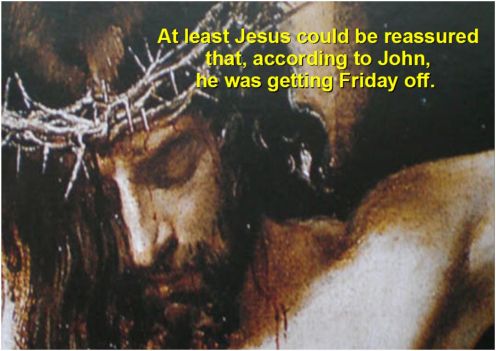
Jesus’ dates with destiny

Blog338Cross

I hope you’ll allow me a little speculation…

Here are the few days leading up to Jesus supposed resurrection as related by the synoptic gospels:

Nisan 15: Wednesday sunset to Thursday sunset. The Day of Preparation when thousands of Paschal lambs are slaughtered ready for the following day’s (i.e. Thursday evening’s) Passover. Jesus instructs his disciples on the arrangements he has made for the feast.

Nisan 16: a. Thursday evening: Jesus celebrates Passover.

b. Thursday evening and night: Jesus is arrested and tried.

c. Friday 9.00: Jesus is put to the cross

d. Friday 15.00: Jesus dies.

Nisan 17: a. Friday ‘evening’: The start of the Sabbath: Jesus is buried by Joseph of Arimathea.

b. Friday evening to Saturday sunset: Jesus body lies in the sealed tomb.

Nisan 18: Saturday sunset to ‘early’ Sunday: The body remains in the tomb overnight(?) but by early next morning is missing.

John’s timeline, however, is markedly different. He says that Jesus is arrested on the Day of Preparation for Passover – that’s Nisan 15 according to the synoptics, which started at sunset on Wednesday (John 13.1; 19.14.) In John, therefore, Jesus does not eat a Passover meal with his disciples. He shares an ordinary supper with them on the Wednesday evening, when he washes their feet. Judas slips out to inform on him just as he does in the synoptic gospels, a day later (Mark 14.16-17; Matthew 26.19-20; Luke 22.33-45.) John significantly alters the timing of events though he retains Judas leaving, though from a different meal. In the fourth gospel, Jesus is arrested on the Wednesday evening, the start of Nisan 15. John mentions in 18.28 that the temple officials involved in the arrest have yet to eat their Passover meal; it still awaits on Thursday evening.

In John, Jesus is tried during the night of Nisan 15, or the early hours of Thursday. Eventually, at around noon on the Thursday he is nailed to the cross and dies rapidly (John 19.14, 31, 42). By the time everyone else is eating the Passover meal later that day – a meal Jesus is present for in the synoptic gospels – John’s Jesus is well and truly dead. He is placed in Joseph of Arimathea’s tomb at some point Thursday evening, either the end of Nisan 15 or the start of Nisan 16. He remains there during Friday and Saturday (the Sabbath) but by Sunday morning his body, according to the story, is missing.

It has been argued – given we don’t know the year Jesus was crucified – that John has his Passover falling on the Saturday, the Sabbath (John 19.31), as happened on occasion, and that therefore John’s ‘Day of Passover Preparation’ was not the Thursday – as it is in the synoptics – but the Friday. According to this line of reasoning, Jesus’ arrest in John was also on Thursday evening, at the start of Nisan 16 and his crucifixion was on Friday, as in the synoptic gospels. But the Day of Passover Preparation cannot be freely moved around to accommodate both versions of events; either it was on the Thursday (Nisan 15) as the synoptics record, or it was on the Friday (Nisan 16) as those who seek to locate John’s crucifixion on Friday argue. Either John is wrong about when the Day of Passover Preparation fell or his Jesus was crucified a day earlier than in the synoptics on their Day of Preparation, Nisan 15.

There is further circumstantial evidence for John’s crucifixion being on the Thursday. While the synoptics have the chief priests, scribes and elders witnessing the crucifixion for themselves, John doesn’t mention their presence. In his Thursday scenario, they are too busy preparing for that evening’s Passover, overseeing the ritual slaughter of thousand of animals, to attend the crucifixion. Similarly, the various activities after Jesus dies – the buying of linen and spices, the removal of the body from the cross, the preparation for burial, sundry visits to Pilate and the posting of guards (though John does not report the latter.) – do not entail any infringement of the Sabbath regulations.

Moreover, John has Jesus in the tomb for three days and nights, more or less; the supposed resurrection does indeed occur ‘after three days’ as Jesus is made to predict numerous times (19 in total.)

Nisan 16: Jesus is buried at the start of Nisan 16 (our Thursday evening),

Nisan 17: Jesus remains in the tomb throughout Nisan 17; 6pm Friday to 6pm Saturday.

Nisan 18: 6pm Saturday to the early hours of our Sunday. He remains in the tomb until some indeterminate point, either before dawn (according to John) or just after (the synoptics.)

As well as a resurrection ‘on the third day’, John’s version of events provides an added bonus. By having his crucifixion on the Day of Passover Preparation, John  is able to draw an analogy between the slaughter of the sacrificial lambs and his ‘Lamb of God’ who, in his death, replaces them as an atonement offering.

I don’t know; maybe I’ve got this all wrong. There’s a problem, I concede, with John 19.30 which implies Jesus is on the cross on Friday (though by John 19.42, when Jesus is buried, it looks like the narrative has reverted to the day before the Sabbath; Friday day time.)

The effort to harmonise the two different timelines, that of the synoptics and that of John, involves having two different Days of Passover Preparation (Thursday and Friday) and indeed, two Passovers (Friday and Saturday). Does this seem likely to you? Two lots of lambs to be slaughtered and two celebrations on two consecutive days – I mean, these people weren’t made of money! Isn’t it far more likely there was one Day of Preparation and one Passover? If so, who is right about when they fell? John or the synoptic writers? They both can’t be. Whether apologists like it or not, isn’t it more likely that the fourth gospel has Jesus crucified on the same Day of Preparation that the synoptics mention (the Thursday), while in the synoptics – all based, let’s remember, on Mark’s account – he dies on the Friday after the Passover meal as they relate? It makes more sense of the conflicting timelines than attempting to mash them both together when they won’t. One or other, John or the synoptics, got it wrong about the day Jesus died; perhaps both did.

One thing’s for sure, what follows is pure unadulterated myth.