

The ‘F’ Word

Don Camp is defending Christians in the comments. They’re in the process of becoming ‘more like Jesus’, he says.

What does this even mean, Don? How can you know what Jesus was like when there are so many disparate versions of him in the Bible (as has been pointed out to you)? Does becoming more tempestuous, impatient, impossibly demanding and Jewish count? These are some of the traits his propagandists show him as having.

You then tell Jim not to measure Christians ‘by his (own) experience’. What other measure is there? Christians aggressively promote their beliefs on the internet, have infected politics and, at a lower level, are encountered as judgmental evangelicals and sanctimonious street preachers; these are the Christians of our experience and like it or not, the fragrance ain’ that sweet. As Jesus is supposed to have said, ‘by their fruits shall you know them’. We sure do.

Bottom line, Don: you Christians have had two thousand years now to make the world a better place by being ‘more like Jesus’. On balance, you’ve failed. Not surprising when Jesus himself failed even more. Where is he, Don? Following his ‘return’, the Righteous should have been living in peace and harmony for the past two millennia, tediously worshipping him and his Father in God’s Kingdom on Earth. They haven’t been, even though Jesus, Paul and several other NT writers said they would be ‘soon’, relative to their own lifetimes. 

Argue it how like, Don (and you will), Christianity merits one big ‘F‘.
Dear Evangelical: Why Aren’t You A Mormon?

Dear Don,

Why are you not a Mormon? I mean, you appeal to the evidence of consistency across the 66 books of the bible, claim that the gospel writers remained true to an oral tradition (despite John’s gospel being markedly different from the other three) and insist there is no difference between the original apostles’ gospel and Paul’s (when Paul is adamant there is.) In fact, there is even better evidence that Mormonism is true.

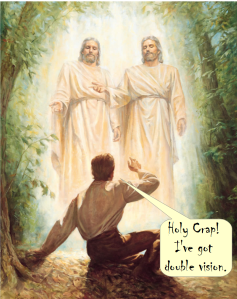
First off, Joseph Smith saw the resurrected Jesus in person! Not only Jesus but God the Father too. And they spoke to him! He relates the story himself, so unlike the gospels, this is no second hand reportage:

I saw two Personages, whose brightness and glory defy all description, standing above me in the air. One of them spake unto me, calling me by name and said, pointing to the other—This is My Beloved Son. Hear Him!

Following this, young Joseph was instructed to translate the Book of Mormon from some golden plates. We don’t have to take his word for it that these plates existed because Joseph had witnesses:

Eleven official witnesses and several unofficial witnesses testified to the existence of the golden plates and, in some cases, to dramatic supernatural confirmation of their truth. Meticulous research on these witnesses has confirmed their good character and the veracity of their accounts.

Impressive, don’t you think? We have no such affidavits for the gospel writers – we don’t even know who they were!

Also like the Bible, the Book of Mormon had multiple authors (Joseph Smith was only translating, remember):

Furthermore, in recent years, rigorous statistical analysis strongly indicates that neither Joseph Smith nor any of his known associates composed the English text of the Book of Mormon. In fact, research suggests that the book was written by numerous distinct authors.

And yet, the Book of Mormon tells a story even more consistent than the Bible’s!

Better still,

the Holy Ghost affirms the authenticity of the Book of Mormon, just as he does the Bible: the conclusion of the matter is that much modern evidence supports the more powerful witness of the Holy Ghost that the Book of Mormon is true. Joseph Smith, who translated it, had to be what he said he was, a prophet of God.

Finally, the growth of the Church of The Latter Day Saints demonstrates its truth and saving power. Its early expansion was greater than that of the first-century church.

Amazing, don’t you think, Don?

* * * * *

I expect like me, you reject all this so-called evidence and regard Mormonism as so much bunk. But on what basis? What causes you to dismiss the teaching of the Latter Day Saints while embracing the equally incredible, magic-infused stories of the Bible? As the Mormon church says (sounding not unlike yourself when talking about the Bible):

Persons who choose to dismiss the Book of Mormon must find their own ideas for explaining it and the mounting evidence for its authenticity.

When you arrive at the criteria you apply in rejecting Mormonism, you’ll have arrived at the reasons I and many others reject your beliefs.

Slippin’ and Slidin’

Recycled picture, new post

I’ve written before about how impossible it is to argue with Christians. It’s either that they have superior knowledge because an invisible ghost possesses them and is guiding them towards truths that non-believers can’t possibly perceive. Or it’s that the supernatural just cannot be understood in an evidential, naturalistic way. Science and empiricism – what we can detect with our own eyes, with specialist equipment that serves as an extension of those eyes or that can be mathematically demonstrated – just cannot detect, perceive or understand the supernatural. Gary Matson is currently experiencing this on Escaping Christian Fundamentalism, where a Catholic Christian (an oxymoron to many other religionists) is arguing that the things he believes in – hell specifically and his God generally – are just too sophisticated for the ignorant layman to understand. We’ve met this before too, from pseudo-intellectual Christians who think their faith, which its supposed founder said was best understood by becoming like a child, requires a degree or three in theology or philosophy.

It’s all a sleight of hand, and rather like wrestling with a jelly-fish. The assertion that the believer in the supernatural makes, that his or her particular brand of woo lies outside the purview of science, is mere flannel. ‘You can’t prove this because you haven’t the tools to’, applies to any form of magical belief – in heaven and hell, in an afterlife, in ghosts, and angels, gods who speak to mortals, mystical saints, flying horses, reptilian overlords, UFO abductions… you name it – does not stand up to scrutiny. If supernatural entities and states are outside the natural universe (and they are, by definition) then they will never be detected by science, observation and empirical measurement; but not because our means of detection is inadequate, but because they don’t exist. It isn’t that they are out there somewhere, detectable only with the right frame of mind or with the help of a spirit that itself has no physical presence; they are nowhere; they are not real. It is not the inadequacy of our means of detection that is at fault; it is that the invisible, non-physical and intangible have no substance outside the human imagination. As I’ve said before, remove human imagination from the equation and the supernatural goes with it. If humans were to become extinct tomorrow, so too would all the magical beings and places that humans have ever conjured up. They have no  existence independent of the human imagination.

Arguing that this isn’t so is to assume your conclusion in your premise: ‘Of course supernatural things exist, you just can’t see them. But I can prove them with my argument/philosophy/faith’. This, however, is a demonstration of irrationality, not of the supernatural. In any case, the fact the supernatural has to be argued for at all is evidence that it doesn’t exist. Nothing real has to be argued for, it can be detected, shown, demonstrated and measured by the senses, by instruments, by mathematical proofs. That gods and ghosts can’t be, but have to be argued for, tells us they are not real – not that they are beyond the scope of our capabilities.

The Jesus Story v. Reality

Recycled picture, new post

Whenever the Jesus story comes face to face with reality, it fails. The nativity stories, which only Matthew and Luke think to invent include, are a case in point.

  • Luke tells us the Emperor Augustus decreed there should be a census in what we now know as 4BC. He didn’t. The closest Roman census was in AD6, ten years later and it didn’t entail hordes of people trailing back to their ancestral village.
  • Matthew claims that Herod was so enraged about the birth of the ‘royal’ baby that he killed all little boys under two years old. Except he didn’t. This never happened.
  • According to the same story, a host of supernatural beings appeared announcing that a young woman who’d never had sex with a man had given birth, while a wandering star shone directly over her house.

Where in reality do these kinds of things happen? That’s right: in myths and stories. They are typical literary tropes found in fantasy fiction. The ‘miraculous’ events of the nativity are of this genre.

  • Christians who delude themselves into thinking theirs is an intellectual faith concede the nativity is mythical, its events symbolic. They’re not usually so hot on what they’re symbolic of but say the story conveys truth. Still, they insist, the rest of the Jesus story is true. Evangelicals go even further and say it’s literally true. So, Jesus walking on water really happened (or if your faith is, oxymoronically, intellectual faith, it didn’t.) After all, the illusionist Dynamo walked across the Thames a few years ago (see it here), and if he could walk on water then how much more capable of doing that was the Son of God. Except the modern illusionist‘s feat was – yes, you guessed it – an illusion. So even if Jesus did the same thing, his trick was also an illusion. Those who say the story is included in Mark and Matthew because it’s actually only a parable about faith (or something) are conceding, again, that it didn’t actually happen.
  • Likewise when Jesus turns water into wine, calms the storm, raises the dead, chats with apparitions of long dead Jewish folk-heroes and does every other ‘miracle’ he’s credited with. If they’re only symbolic then, by definition, they didn’t happen. Nor did they happen, if, as Evangelicals believe, they’re being passed off as real events. ‘Miracles’ do not happen in reality. Never have, never will. They happen only in stories.

Well, okay, more enlightened Christians might say, but nonetheless Jesus conveyed to the world what God wanted us to know. He was wise and compassionate and told us how our sins could be forgiven. Except his wisdom comes directly from Jewish scriptures; he had nothing new to say. He was no more compassionate than anyone else and could in fact be an absolute s**t. He was inconsistent across the gospels about how sins were forgiven and much of his teaching in the original Gospel (Mark’s) is lifted from Paul or reflects the beliefs of the early Christ cult. Jesus the holy man is a construct – or rather a series of constructs, a literary device, not a real man.

So, okay; the nativity didn’t happen as depicted. The astounding feats attributed to Jesus didn’t happen and Jesus is whoever the various gospel writers and Paul want to make him. Nothing we’ve seen so far is factually, historically or really (as in reality) true.

But, the crucifixion and resurrection are! Oh yes. The rest is made up, but these two events most certainly are not.

  • Even though Jesus’ trial is historically inaccurate and is, as a consequence, highly implausible.
  • Even though there was no-one to record Jesus’s snappy repartee (or silence depending on which gospel you read) with Pilate or Herod.
  • Even though there was no such Roman custom as releasing a prisoner on the Passover.
  • Even though the synoptics have Jesus crucified on Friday while John says it was a Thursday.
  • Even though characters like Barabbas, Joseph of Arimathea, Mary Magdelene and the ‘disciple whom Jesus loved’ are evidently and entirely fictional.
  • Even though there was no eclipse of the sun that lasted for hours.
  • Even though there was no earthquake that shook zombies loose from their graves before Jesus had a chance to rise and shine himself.

Such things are not historical. They’re not even feasible. They did not happen in reality. Well, if not the crucifixion per se, Christians say, then definitely the resurrection: that most unlikely of all unlikely events. That really happened.

  • Even though the reports of it are completely at odds with one another.
  • Even though angels are involved once again.
  • Even though Jesus behaves entirely like a ghost, walking through closed doors, altering his appearance and vanishing at will.
  • Even though he levitates into the clouds.
  • Even though some of the disciples find it impossible to believe he’s back.
  • Even though dead people rise only in stories, myths, legends and fantasies.
  • Even though, in reality, dead people do not come back to life after three days, which is why Jesus didn’t either.

Still, I’m sure I’ll be told when I go to a carol service with my friends in a few days, that the story of Jesus’ birth, emotionally powerful as it is, is true from start to finish. Why? Because people’s capacity for believing fantasy stories knows no bounds.

Religion Is Bad For You. Always.

There is no upside to religion. All of them, not just Christianity (though certainly including it.)

Religion makes its adherents judgmental. Those who don’t share their beliefs are ‘other’. Consider the terms that religion has spawned to describe non-believers: infidel, heathen, goy, kafir, lost, dissenter, apostate, scoffer, profaner, blasphemer, paynim, idolater, deviant. Needless to say, none of these is designed to flatter. If not being ostracised – ‘be not unequally yoked with unbelievers,’ says Paul with his usual magnanimity – then non-believers are viewed as sinners in need of redemption or enlightenment, as souls to be won, fodder for evangelism. Never as people to be respected or accepted for themselves.

Religion causes its adherents to abandon their critical faculties, accentuating their irrationality so that even those with some intellectual capacity sacrifice it to subscribe to a primitive, superstitious mind-set. They believe in miraculous resurrections, eternal life, covenants with the gods that necessitate the genital mutilation of children, prayer, ‘prophets’, demons, spirits, pantheons of supernatural beings and myths about the end of the world. There’s no evidence for any of this fantasy material, yet the believer trades in their good sense to embrace all of it to one degree or another.

Religion cultivates delusion. Otherwise intelligent believers are convinced their god talks to them in their heads while they, in turn, are capable of projecting their thoughts into the deity’s mind. They take part in rituals they believe appease him, assume  specific body positions and dress up in items of clothing they think, for some unfathomable reason, will help them gain favour in his sight. They believe they’re possessed by the spirit of the deity that enables them to do miraculous things, not least survive their own deaths.

Religion discourages thinking for oneself. Believers are told, either by a ‘holy’ book or by those who claim they know gods’ thoughts, what they should think about vaccinations, abortion, women, homosexuality, politics, guns, the significance of climate change, the state of the world and all those godawful infidels. Woe betide the believer who dissents from the views of their particular cult or sect.

Religion compels its adherents to deny reality. Believers are in a constant state of denial: about the world, evolution, education, the rights of others, the fact people can be moral without religion and death itself. They deny that the universe and nature are as they would be if there were no gods; that religion has contributed nothing to our understanding of the world, has discovered nothing, invented nothing. All of this is the equivalent of sticking one’s fingers in one’s ears and singing na-na na-na. Who needs facts when you’ve got third rate fantasy?

Religion causes hatred. There are those within every religion who seek to eliminate their enemies. They fly planes into buildings, shoot and stab innocent people in the street because they regard them as profaners or blasphemers, and call for the death penalty for those they regard as deviant.

Religion prevents people from being themselves. It convinces them they are worthless sinners in dire need of forgiveness and then imposes an inauthenticity on them. It makes them assume a role that reflects, or so they think, the nature of their saviour or prophet. It’s all an act, held in place by the collective pressure of fellow believers, in churches, synagogues, temples, mosques and kingdom halls. It is not life affirming but life denying. It is a lie.

Anyone care to defend religion? One particular version of it? What has your pet religion contributed to the world? What good does it serve?

Falling Into Belief

Texas author David Heeren appeared on a UK TV channel the other day in its ‘Uncancelled’ slot, wherein a sceptical presenter interviews, usually while trying to keep a straight face, individuals who have, or have had, a world outlook at odds with any conventional narrative. This is to express it kindly in the case of David Heeren. David believes that the Second Coming is not far off; in this he has much in common with other evangelical Christians. Where he differs from most of them is that David believes the end-times sign of which Jesus speaks in Matthew 24.30 is… a comet.

In fact, David sees comets everywhere in the Bible. Amongst others, there’s the star of Bethlehem, the fire that descended to destroy the followers of Baal and the comet that parted the Red Sea. David has this to say about the last of these:

The rod Moses stretched out toward the Red Sea was a mirror image of the “arm of the Lord” in the sky above his head. A comet-generated tornado parted the sea and froze it in place long enough for three-million or more Israelites to pass through. A comet-produced earthquake cracked the frozen walls, releasing the sea waters to flow back over the Egyptians.

He finds 54 such ‘cometical’ appearances in the bible. He is obsessed both with comets and with the Second Coming. David is evidently on the fringes of an already lunatic movement (Christianity, that is) but, and here is what is astounding, David claims his books, 17 in total, five of them about the End Times, are best-sellers. If he’s to be believed, other people swallow his unadulterated guff and pay good money to do it.

 Last night, the guest in the same slot was Radhia Gleis. Radhia was part of a new age cult, Buddhafield, for 22 years before finally breaking free a few years ago. She and others came under the thrall of a charismatic individual called, variously, The Teacher, Michel and Andreas but whose real name is Jaime Gomez (pictured above). Cult members believed him to be a enlightened being who would lead them into ‘universal love and spiritual awakening’, until, that is, some recognised the level of control Gomez exerted over them and discovered he was sexually abusing young men. (The documentary, Holy Hell, about the cult, can be seen on Netflix. Buddhafield still exists, with Gomez its leader though now called Reyji (‘god-king’) and operating out of Hawaii.)

All of which, Buddhafield and Neeren’s nonsense, serves to underline how readily people will believe almost anything: stories of resurrected godmen, returning saviours, portentous comets, the honeyed words of charismatic charlatans. How crucial it is we see and evaluate evidence for ourselves. Demand to see it. Find it, read it, assess it as objectively as we can; not through a lens of preconceived ideas, be it conspiracy theory, religious worldview or prevailing narrative. We are too easily manipulated and duped not to evaluate what we are told.

Of course, we are not always capable of minimising our preconceptions nor of evaluating evidence objectively. We come with a range of psychological needs and respond emotionally to what the guru, preacher or group offer. Members of Buddhafield speak of the sense of belonging and purpose that involvement in the group offered. Many talk about how they finally felt loved. Even those young men abused by Gomez professed at the time a belief in the enlightenment offered by The Teacher, completely at odds with how he was using them for his own sexual gratification. This is how cults, political and religious movements and churches work. They offer enlightenment, forgiveness, fulfilment, purpose, eternal life, peace and joy – you name it, they’ll claim they can provide it – and our critical faculties are overruled by psychological/emotional need.

I know, I’ve been there.


Jesus writes…

Image: Caleb Havertape (https://www.pinterest.co.uk/calebhavertapei/_saved/)

Ubi Dubium has posed the question, ‘why didn’t Jesus write his own gospel?’ It’s a good question. What better way to ensure his ideas were conveyed precisely without any margin for error or misinterpretation, than to do it himself? If he hadn’t the time or the ability to do so, why didn’t he dictate his message to one of his literate disciples (surely one of them could write) who could then, as an eye-witness, finish off the story accurately once Jesus himself had returned to Heaven. Why, instead, did he leave it to people he’d never met, most of whom wouldn’t be about for another few decades?

It seems to me there are three possible answers.

  1. Jesus believed the world as he knew it was soon to end. He was convinced God was about to intervene and sweep away the old order and inaugurate the Kingdom of God on Earth. If the gospels that have come down to us are to believed, this was the core of his teaching. Jesus mentions its imminence repeatedly across the synoptic gospels and the morality he proposes, wholly impractical in the long term, is designed for the ‘shortness of the hour’. In this scenario, Jesus and his followers had no interest in writing anything down for posterity. There was no posterity; the end was very truly nigh.

  2. God didn’t want his Son to write his own story. He wanted the job left to people whom Jesus never met, who were little more than children during his lifetime and who lived hundreds of miles from where events occurred. God was sure this was the best way to create a record of his Son’s visit to Earth, without inaccuracies, inconsistencies and contradictions. 

  3. The creator of Mark’s gospel bought into Paul’s celestial Saviour, his illusory ‘Lord Jesus Christ’. Mark set about creating a ‘what if’ back story for him, set in Palestine in the recent past and constructed from Paul’s ’revelations’ and Old Testament ‘prophecy’. Mark highlighted Paul’s teaching that the Christ, whom he calls the Son of Man in his gospel, would soon be coming to the Earth (not a second coming or a return) to rescue his Chosen and reset reality.

Are there any other possibilities? I can’t think of any, nor have I read of any. So which of the three is the most plausible?

Scenario 1 leaves us with a Son of God not knowing what he was talking about. This Jesus was wrong about when the Son of Man would appear, wrong about the End of the Age, wrong about the traumatic nature of God’s intervention, wrong about the Final Judgement, wrong about the fate of the unrighteous and wrong about the Kingdom of God being established on the Earth. This scenario gives us a Jesus who is a failure as both a prophet and Messiah. It’s a wonder anything at all was written about such a loser, let alone narratives that preserved his hopeless predictions about the Kingdom’s arrival.

Scenario 2 is of course ridiculous, though it is the one most Christians buy into, more or less. As well as its inherent implausibility, it relies on the hypothetical document Q, for which no evidence exists let alone any extant copy (or even fragment). It, and a supposedly reliable oral tradition, are speculative, needed only to counter the improbability of this scenario.

Scenario 3, while contentious, makes most sense of why neither Jesus nor any of his contemporaries wrote down or otherwise recorded a single thing he said or did. Mark’s gospel, created shortly after 70CE, was the first anyone had heard of a Jesus on Earth. The three subsequent gospels were all based, to varying degrees, on Mark’s fable. In this scenario there was no real Jesus, and no dozy disciples, to have recorded his exploits and teaching.

What you think, Ubi?

Will the real Jesus please stand up?: Conclusion

There will no doubt be Christians reading this blog who are keen to tell me that no-one in their right mind would believe in a made-up Jesus.

No? Yet the self-righteous are still making up Jesuses in their own image. Jesuses who bear little relation to any of those in the Bible. Jesuses that suit their own agendas: White Republican Jesus, America First Jesus, Catholic Jesus (with his heart outside his body), anti-LGBT Jesus, Evangelical Jesus, Social Justice Jesus, Prosperity Jesus, Mormon Jesus, Jehovah’s Witness Jesus, Jesus who gives glimpses of heaven, Jesus who communicates with his ‘prophets’ here on Earth… and many more.

Every single one of them is a made to order, manufactured Jesus, every single one imaginary. The Jesus worshipped by individual Christians and churches is a figment of the imagination. He may be loosely based on one of the Jesuses of the Bible (I’ll generously give them the benefit of the doubt) but he is unique to every sect and to every single person within it. Each individual sets up an altar to the idol in their head and worships him there.

Christians: your personal Saviour isn’t real. You worship a construct of your own making.

From which, two questions follow:

If no-one in their right mind would believe in an imaginary Jesus, what does this tell us about you?

Given you believe in an imaginary Jesus, why is it so difficult for you to accept that the earliest Christians did too?

Stories


  • Many Christians believe that God himself impregnated Mary and that her son, Jesus, was God Incarnate. Yet they don’t accept that numerous others, including Perseus, Buddha and Vishnu, who were all fathered by gods, are in any way divine. Why not?
  • Evangelicals and other Christians believe that Jesus performed many miracles. However, they dismiss other miracle workers as frauds or mythical beings. As John Oakes puts it on the Evidence for Christianity website, ‘religious figures (such) as Osiris, Empedocles or Krishna almost certainly were not real people, making stories of supposed miracles they worked irrelevant’. Why?
  • Christians believe Jesus fed 5,000 people with 5 fish and 2 loaves. They don’t believe the Qur’an’s story that Muhammed did much the same thing. Why not?
  • Christians believe Jesus was visited by the long dead Moses and Elijah. They believe Paul saw Jesus after he died. Yet they dismiss the Mormon claim that Joseph Smith saw Jesus and God himself. Why?
  • Christians believe Jesus came back to life a day and a half after he was killed. However, they regard the resurrection stories of Dionysus, Osiris and Attis as counterfeit. Why?
  • Christians believe Jesus rose into the sky to take up his place in heaven. Yet they think it preposterous that Muhammed went there on a flying horse. Why?

When it comes to their own stories Christians are adamant that they are reliable accounts of events that really happened. Jesus really was God’s son. He really did do magic; really did feed 5,000 people with a few scraps; really did rise from the dead and really did beam up to heaven. Paul really met him on the road to Damascus.

Even liberal Christians like Joel Anderson, while acknowledging there is much that is suspect in the Jesus story, argue with all the cognitive dissonance they can muster, that the gospels are nevertheless ‘historically reliable’. This really won’t do. Evidentially, the gospels are as ‘historically reliable’ as the tall tales involving Osiris, Buddha, Vishnu, Muhammed and Joseph Smith. Gods only make visits to the Earth in stories, individuals only rise from the dead in stories, magic and miracles only occur in stories. The Christian examples of these tropes are as imaginary as all the others. The heroes of such stories – be it Empedocles, Perseus, Mithras, Buddha, Krishna or Jesus – are fabrications too.

If it’s constructed like a story, has all the components of a story and reads like a story then that’s exactly what it is. 

Will the real Jesus please stand up? (part 2)

What evidence is there in the Bible that Jesus really existed? Let’s take a look*:

Paul’s Christ – imaginary (only in his head)

The crucifixion – invented (structured around and based on selected parts of the Old Testament. These aren’t prophecies of his death, they’re used as the template for people writing centuries later)

The Resurrection stories – made up (following various visions and ‘revelations’. The stories themselves are not in Paul or Mark; they’re made up later)

The empty tomb – imaginary (added to bolster resurrection stories. Unknown to Paul)

Miracles – made up (not in Mark where Jesus flatly refuses to perform them. Later miracles all have symbolic meaning. They are symbolic)

Nativity stories – make-believe (the two accounts in Matthew and Luke conflict and have all the properties of myth)

Jesus’ ‘I Am’ statements – invented (only in John: missing entirely from the other gospels. How did they miss them?)

Sermon on the Mount – made up by Matthew (not in Mark but suddenly in Matthew where it is clearly a literary construct)

Jesus’ teaching – invented (next to none of it is original, based as it is on Paul’s teaching, Old Testament ‘wisdom’ and what the gospel writers needed him to say to fit their agendas)

Cult rules – made up (by members of the early cult church)

The Beloved Disciple/Lazarus and Nicodemus – imaginary (not in the other three gospels. How could they not know about Jesus’ most impressive miracle, the raising of Lazarus?)

The woman caught in adultery – invented (a very late addition to the fourth gospel; possibly as late as 350CE)

The Ascension – make-believe (I mean, really?)

Paul’s adventures in Acts – made up (largely incompatible with what Paul himself relates)

Revelation – total lunacy (made up in its entirety: Jesus didn’t say any of the things attributed to him there: he didn’t dictate letters to churches, isn’t a cosmic warlord, hasn’t brought a celestial city to the Earth, etc, etc)

Satan, demons, angels, spirits, powers and principalities – imagined (all non-existent)

Old Testament tales – made up (Creation, Adam & Eve, Tower of Babel, Noah, the Exodus, Job, Jonah, Daniel. Too many to list)

Ephesians, Colossians, 2 Thessalonians, 2 Peter, James, Jude, 1 & 2 Timothy, Titus – forgeries

Jesus – imaginary? It makes you wonder. So much is demonstrably made up about him. If he did exist, he has been buried under layers of make-believe, myth and other fiction; a grave from which he will never rise.

To be continued…

* Examples derived from my own considerations, Richard Carrier’s On The Historicity of Jesus, Bart D. Ehrman’s Forged and Did Jesus Exist?, Michael J. Alter’s The Resurrection, Barrie Wilson’s How Jesus Became Christian &  Freke and Gandy’s The Jesus Mysteries, amongst others.