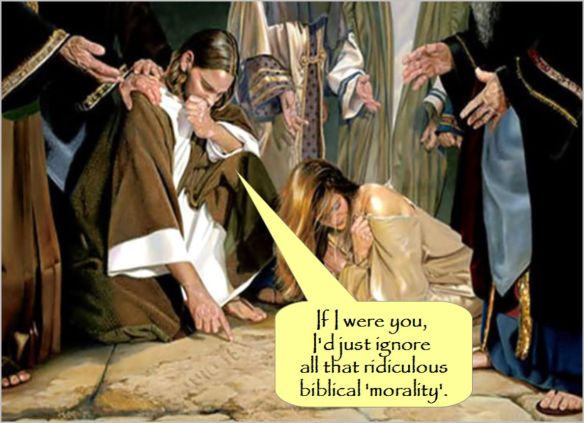
Christianity: a failure from the very beginning

Celia5

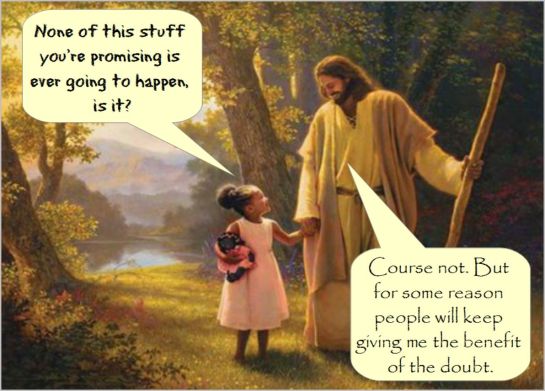
Christianity just doesn’t deliver. Jesus doesn’t deliver. None of his promises that I outlined last time have ever produced the goods. Not surprising really when he’s been dead for the past two millennia. He’s no more likely to deliver than anyone else who’s been regarded as a god by misguided devotees (and there’s plenty of them).

Yet for those 2000 years Christians have insisted that he does, even when there isn’t a scrap of evidence he’s listened to a single word they’ve said, answered even one of their prayers, enabled them to heal the sick or helped them move mountains – any of the stuff he promised he’d do. So why do they insist he really does? Partly because many of them haven’t a clue that he even said these things. Discussing their faith with Christians online, they often tell me that Jesus never said, for example, that God would give them whatever they ask for or would make their lives better or give them the ability to do miracles greater than Jesus did himself (which of course he does, in Mark 11.24, Matthew 11.28 and John 14.12-14 respectively). In short, they are ignorant of what the bible actually says and all the preposterous magical promises it makes.

Those who do know of its promises have a range of excuses for why they never happen; they were only meant for the early church; today’s believers don’t have enough faith; they were only ever intended metaphorically; God is currently withholding his good will (usually because Christians are too tolerant of everyone else’s ‘sin’). The fact is the promises of Christianity have never delivered.

I’ve been reading Bart D. Ehrman’s The Triumph Of Christianity, where, for entirely different reasons, he lists the problems that beset the church in Corinth (p291) that Paul addresses in his first letter to them. Here’s a summary:

Serious divisions within the church, with different members following different leaders (1 Corinthians 1.12)

Various forms of sexual immorality (1 Corinthians 5)

Men in the church visiting prostitutes and bragging about it (1 Corinthians 6)

Other men under the impression they shouldn’t have sex at all, not even with their wives (1 Corinthians 7)

Fractious arguments about whether Christians should eat meat from animals sacrificed to pagan gods (1 Corinthians 8 & 10)

Some women attending meetings without their heads covered (1 Corinthians 11)

The wealthy greedily eating the shared meals and leaving none for the less well-off (1 Corinthians 11)

Worship that was chaotic because those speaking in tongues were trying to show spiritual one-upmanship (1 Corinthians 12-14)

Members not using their spiritual gifts for the benefit of the community (1 Corinthians 12 & 13)

Some claiming they had already experienced ‘resurrection’ and so were more ‘saved’ than others (1 Corinthians 15)

Apart from one or two specifics, this could be the church of the 21st century! Paul, though, wrote his letter to the relatively small group of believers in Corinth around 54-55CE, a mere twenty or so years after Jesus’ death. Already by then, Christian communities were overcome with problems. There’s no indication they were experiencing the miracles Jesus promised, nor were they behaving like the ‘new creatures’ Paul’s says the Holy Spirit makes of believers:

If anyone is in Christ, the new creation has come: the old has gone, the new is here! (2 Corinthians 5.17)

The behaviour of the Christians at Corinth was, by any standard, appalling; they seem to have no more understanding of morality, no more sense of charity, no more demonstration of brotherly love than the ‘heathens’ around them. And yet they were new creatures ‘in Christ’, believers in Jesus, vessels of the Holy Spirit. With all this supernatural support they really should have been doing better – much better – than they were.

I’ve often wondered why Paul didn’t just give up at this point, especially when other churches he wrote to had similar problems. Any rational person would have looked at how these new converts were behaving and would have concluded that the new religion simply wasn’t working. The promises Jesus made (if Paul was even aware of them) and the changes he himself said accompanied conversion simply weren’t happening. None of them had materialised, even at this early stage.

But instead, Paul soldiered doggedly on. He travelled far and wide drawing others into the cult and then had to write to them too, to tell them how to behave and what faith in his Christ actually entailed (see his letter to the Galatians, for example, and that to the church at Philippi). Didn’t Paul ask himself where the Holy Spirit was in all this? Where was the guidance and supernatural assistance promised by Jesus? Despite the airbrushed version of the early church presented in Acts, Paul’s letters tell us what it was really like: a complete disaster.

And so it continued. As Ehrman shows, people converted to Christianity in part because of its promises that believers would avoid hell and live forever in heaven instead. Many convert for the same reason today. With the zero success rate of all of its other promises, it’s not difficult to predict how Christianity’s assurances of eternal life are going to pan out.

‘Why attempt to discredit Christian faith and the teaching of Jesus?’

Jesus8

Commenter Rebecca has asked me why I feel moved to ‘disparage or discredit the Christian faith’. It’s a fair question and one I set about answering in the comments section. However, my short answer there became rather too long so I’m posting it here instead. Apologies to those who’ve already read my reasons across many other posts here on RejectingJesus.com. I hope you’ll bear with me in this potted version.

I disparage Jesus, primarily, and Christian faith generally, because I want people to see Jesus as he really is – a man from two thousand years ago whose promises were false, prophecies fake and whose morality is impossible:

False Promises

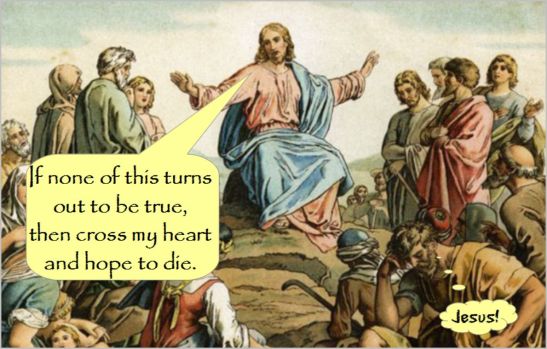
As I’ve joked before, ‘What do you call a man who always fails to keep his promises?’ – ‘Jesus!’

Nothing he promised (or is made to promise; his script-writers came a long time after him1) has ever come to pass. God’s kingdom did not arrive; believers did not, and do not,  perform miracles greater than Jesus himself; they don’t supernaturally heal the sick; God did not and does not supply whatever believers ask of him; he doesn’t provide every need when a person ceases to be concerned for the future; his Comforter doesn’t guide believers into the truth… You name it, none of Jesus’ promises has ever materialised.

Failed Prophecies

No prophecy Jesus is made to make has ever come to pass either: God’s kingdom and judgement did not arrive while the disciples were still alive; heaven and earth did not pass away; God didn’t judge the rich and powerful; he didn’t reverse the social order so the poor, meek and humble inherited the earth; he didn’t reward the righteous; Jesus himself didn’t rise bodily from the grave (all his appearances, including Paul’s ‘vision’ are suspiciously apparition like); he didn’t become ‘the Christ’ and go on to live forever at the right hand of God (Paul and later followers made this up) and no-one has ever been resurrected as result of believing in Jesus

Impossible morality

Nor is anyone capable of living in the way Jesus said his followers should; as a rule they don’t renounce wealth; don’t sell everything they have and give the proceeds to the poor; don’t go the extra mile; don’t turn the other cheek; don’t give the shirt off their back; don’t love their neighbours, let alone their enemies, as themselves. All of these are laudable goals, to be sure, but they’re simply not possible – not even with God’s supposed indwelling spirit. Just look at the majority of Christians today: they simply don’t do it. They can’t do it.

Why does any of this matter (to me)? In one way, it doesn’t. I couldn’t care less about a fraudulent prophet from 2000 years ago. Except…. except those very Christians who fail to live up to his standards have impacted my life in negative, destructive ways. As I’ve written elsewhere, I foolishly gave my life to Jesus at their behest. I allowed them to convince me that everything I was, everything I did, everything I thought was a sin, and that Jesus died for me so that my sin might be forgiven. As a result, I denied myself in the unhealthiest of ways, the cumulative effect of which was suffering for years from a deep, debilitating depression.

I came to realise through this, however, that the belief system I’d given my life to was a falsehood. When I needed God most, the heavens were, as Deuteronomy 28:23 suggests, ‘as brass’. That was because there was no God waiting to hear from me or to answer my prayers. And no God meant no Son of God, no heaven or hell, no panoply of supernatural beings – spirits, angels and demons – no god-inspired holy books. It became clear, as Rebecca concedes, that everything about the faith was entirely human. Ridiculously and fallibly human.

For a Christian friend, however, this decision of mine was untenable. He pressurised me to return to the fold because if I didn’t, I would surely suffer an eternity in hell. I had returned, he said, to a life of sin (principally because of my sexuality), had abandoned all that my saviour had done for me and consequently I would deservedly suffer God’s wrath. The only way to avoid the punishment to come was to get down on my knees, return to Christ and beg for forgiveness. This lengthy, fruitless correspondence – or at least my half of it – became the basis of my first book Why Christians Don’t Do What Jesus Tells Them To …And What They Believe Instead, and that in turn led to this blog.

I also encountered around this time more of the awful, scurrilous lies Christians tell about gay people – that we cause all manner of natural disasters and bring God’s indiscriminate wrath down on the world; that we are degrading and degraded, Satanic and deserve to be put to death – doesn’t the Bible say so? I couldn’t let this hypocrisy and dishonesty go unchallenged, not when it caused, and causes, so much pain, anguish, suffering and even death among LGBT people. Where, I asked myself, was the Christian love for one’s ‘enemies’, the absence of judgement, the determination not to bear false witness, all of which Jesus advocates? In light of most Christians’ inability to live as he commanded (I did say his moral expectations were impossible) I became convinced I had made the right decision, firstly to walk away from faith and, then, in my own small way, to oppose the nonsense spouted by those who propagate it.

My hope for this blog then is that those waivering in their faith might begin to see aspects of Christian belief from a different perspective. They might then start to realise that it is nothing more than a product of the human imagination; a superstition handed down by pre-scientific tribesmen and first century zealots who weren’t in a position to know any better.

I was told over forty years ago by a Christian leader that the most important thing one could do in life to was to pursue truth wherever it led. He was right. The truth turns out to be that, in all probability, there is no God. Knowing this does not leave one hopeless and without purpose – that’s another Christian lie. Instead, it equips you to make your own purpose, to love others in the knowledge that love, like life, is finite, and that this one-and-only life is to be lived to the fullest. To answer Rebecca’s question, atheism does lead to a much more honest and satisfying way of life than pinning one’s hopes on imaginary beings and the claims of a failed Messiah.

That’s the short answer. For the longer version, there’s always the rest of the posts on this blog.

1. Chapter and verse for all references supplied on request.

What is forgiveness, anyway?

Forgive

I’ve been grappling with the nature of forgiveness lately in my personal life. You might, as a result, find this post to be much more personal than usual, but I hope you’ll bear with me.

Recently, a close friend let me down in a particularly damaging way. This wasn’t just a careless action on his part, but a deliberate one that he knew would have significant impact on me. Indeed, it left me reeling, confused and deeply hurt. I won’t go into details as I’m still processing what happened and I’m sure, in any case, that my friend would not want what he did broadcast to the world (or at least, the small number of people who read this blog!)

He has asked for my forgiveness. He has not said he is sorry for what he did, rather he has apologised for the effect it had on me, which is not the same thing. I’ve told him I can, and do, forgive him, but having done so, I realise I don’t know, in practical terms, what forgiveness means. What does it entail? What does it feel like? What actions does it require on the part of the forgiver? Sixty+ years into life, twenty-five as a Christian, and I find I really don’t know. The bible, as I suggested last time, is of no help. For all its advocates blather on about how it, and the Christian faith generally, are all about forgiveness, it hasn’t anything substantial to say about how forgiveness actually ‘works’.

Does forgiveness mean I have to somehow forget what my friend has done? Popular songs seem to suggest that’s what it’s about; ‘let’s forgive and forget’; ‘a time for forgiving and for forgetting’ and so on. But how do I do that? I can’t delete the part of my memory that knows what happened and seems determined to bring it into my conscious mind at every opportunity (usually in the middle of the night). I can suppress it to an extent, think of other things, make myself busy ‘to take my mind off things’, but that’s not really forgetting. I suppose I can resist the temptation to muster up a grudge but that, I think, would be for my benefit, not his.

Does forgiveness mean then that I allow things to continue as normal? I’m not sure that’s possible when I can’t now trust my friend. He could do the same thing again and I’m not prepared to leave myself open to that possibility. Forgiveness doesn’t, I’ve discovered, restore trust; but does this mean I’ve not really forgiven him? We could renegotiate our relationship, put it on a different footing perhaps, but wouldn’t such caution and readjusting also suggest I’ve not been able to forgive him?

Does forgiveness simply mean I won’t seek out some form of retribution or revenge? Possibly, but as I’m not inclined to do these things anyway – I’ve never believed that two wrongs can somehow make a right – I’m not sure I’d actually be (for)giving much with such a semblance of magnanimity. Perhaps, then, I might quietly let the friendship he and I once enjoyed drift quietly away into oblivion. I have, after all, to protect myself from the effect of his doing something similar in the future. I could let time take care of the problem, its passage allowing the pain, along with the friendship, to pass.

This is, in fact, the course I’m taking, and I’ve told my friend as much, but he doesn’t see this as the forgiveness I promised him. In truth, neither do I, but it’s the best I can do.

According to some parts of the bible (but not others), God forgives us our sins. He does this by magically covering them up with the blood of his sacrificed Son. It’s mumbo-jumbo, of course, but perhaps those who invented it had the same problems I have with forgiveness. In the end they realised that the only way they could ‘explain’ it was with wishy-washy hocus-pocus. It’s not much use in the real world though. Anybody out there got any better suggestions?

Forgiven

Boy

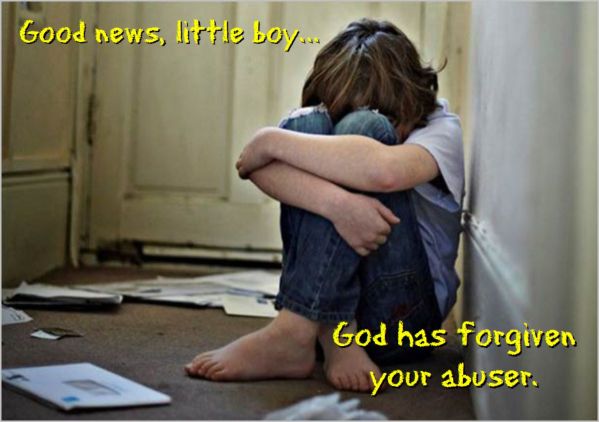
In the UK, as in the States, there has been a spate of sexual predators who, although admitting to their crimes, have claimed that God has already forgiven them their misdemeanours (the links provide only a couple of examples; there are many more out there). Naturally the abusers expect this to carry weight in any trial they face or in their rehabilitation into society, but it seems to me that such claims are, every one of them, bogus and fraudulent.

Overlooking the fact that God’s forgiveness is an impossibility – on account of there being no God – the idea is incompatible with the brand of Christianity, drawn from Paul’s theology, practised today. According to Paul’s reasoning – I use the term loosely – God doesn’t offer forgiveness. He provides the means to have one’s sins overlooked, covered by the blood of Christ. They are not forgiven, rather Jesus’ death serves as an atonement for sin. In those letters that are genuinely his (1 Thessalonians, Galatians, 1 and 2 Corinthians, Romans, Philippians and Philemon), Paul doesn’t mention divine forgiveness once.

On the other hand, Jesus, whose teaching is largely ignored by those who claim to follow him, does have plenty to say about forgiveness. This isn’t, however, the easy ‘get out of jail free’ card proffered by today’s offenders and populist preachers. Like all of Jesus’ morality, this forgiveness is hard to come by. If you want God’s forgiveness, Jesus says, it has to be earned; it is dependent on whether we ourselves forgive. Here’s how he puts it:

If you forgive others the wrongs they have done to you, your Father in heaven will also forgive you. But if you do not forgive others, then your Father will not forgive the wrongs you have done. (Matthew 6:14-15)

The same idea is preserved in the so-called Lord’s prayer: ‘forgive us our sins in direct proportion to the sins we have forgiven’ (Matthew 6:12). This measure-for-measure approach is central to Jesus’ teaching.

So are those who’ve hurt or abused others claiming they’ve forgiven everyone else for offences that they’ve been subject to and have so earned God’s forgiveness? Even so, is this good enough? ‘I have God’s forgiveness because I’ve forgiven those who’ve hurt me,’ doesn’t begin to cover the hurt I may have caused others. What about them? As usual Jesus’ morality here is inadequate in the real world.

He has another go at it in Matthew 18:21-22 where he commands his disciples to forgive others innumerable times. But again this covers only those who have offended me; it doesn’t do anything for those whom I might have offended. It’s not good enough. His parable of the unforgiving servant (Matthew 18:23-35) has the same problem.

If I’ve caused the hurt, have I the right to expect my victims to forgive me so that they in turn can earn God’s forgiveness for their sins? This seems to be the implication. And the answer is ‘no’, I can’t expect those I’ve hurt to forgive me just so they can be forgiven; it’s unrealistic. It doesn’t work.

Rather, when we have hurt or offended others the onus is on us to ask for forgiveness and to make reparation. This is how seeking forgiveness really works. You want forgiveness from others, you earn it. I need forgiveness from others, I earn it.

Jesus makes brief mention of this in Matthew 5:23-24:

So if you are about to offer your gift to God at the altar and there you remember that your brother has something against you, leave your gift there in front of the altar, go at once and make peace with your brother, and then come back and offer your gift to God.

‘Make peace with your brother’: it’s not enough, is it? Jesus doesn’t say how to ‘make peace’ and what sort of reparation he has in mind; his teaching is strictly ‘in-house’: believers are not being called upon to forgive those outside the fold at all, nor do women appear to be covered by his edict. This is a paltry, poorly thought-through version of how to seek and earn forgiveness.

The easy claims of abusers, rapists and other offenders, that God has forgiven them simply because they’ve asked him to, is cynical, insulting and cheap beside the sorrow and effort that is really needed to merit others’ forgiveness; not just cheap – worthless.


Judgement Day

Franklin2

And the Lord said to them, ‘Let’s have a look how you got on. You fed the hungry, right?’

And they answered, ‘Well, we gave some money to charity a couple of times and we’re pretty sure the charity fed the hungry for us.’

‘Okay,’ he said, ‘I suppose I can give you some credit for that, though I have to say I was looking for something a little more… hands on. How about when people were naked – you know, needing their material needs met. How’d you get on then?’

‘The charities did that too, we think. Maybe.’

‘And the sick and imprisoned? You bother with them?’

‘Not so much,’ they answered. ‘Look, Lord, if people can’t take care of their own health needs or choose to live lawless lives, then that’s up to them. It’s really not up to us to help them out, now is it.’

‘I see. So how about the stranger, the homeless, the immigrant? You take any of them in? You cared for them?’

‘Well, no. I mean, if you’d said that’s what you wanted doing we would’ve done it, wouldn’t we. But you didn’t make it clear.’

‘I thought I had,’ he said. ‘Maybe it got lost somewhere in translation. Selling all you have to give to the poor, then? Surely some of you did that.’

‘One or two extremists maybe, but look where it got them. Obviously that daft instruction was meant only for the guy you were talking to – you know, the rich young ruler or whatever he was.’

‘Well, not exactly. I said it so many times in so many ways you’d have thought you’d have got the message.’

‘We’re not socialists, you know, even if you are,’ they said.

‘So how about turning the other cheek, then? Or going the extra mile? Giving to all who ask? Surely you managed those?’

‘Well, no. We felt you were speaking metaphorically when you said all that. You didn’t seriously expect us to do such ridiculous things, did you? I mean, we’re not doormats.’

‘So what is it you did in my name?’

‘Well, we accepted you as Lord and Savior. That’s all that’s required, isn’t it?’

‘Not really,’ he said. ‘Not if you didn’t do as I asked.’

‘Lord, Lord,’ they said, becoming exasperated. ‘We’re washed in the blood of the lamb. Sanctified and redeemed.’

‘You’re what?’ he said.

‘Sanctified and redeemed. Made spotless. You know, like Saint Paul explained.’

‘Saint who?’ the Lord said.

‘We worshipped you and praised your holy name,’ they went on. ‘Filled with your Holy Spirit we witnessed unto you and defended your Holy Word.’

‘But you didn’t actually do as I commanded?’ he said. ‘And you think that’s good enough?’

‘We stood up for you and for family life. We spoke out against unbelievers and sodomites and all those who were unholy, lest they bring down the Father’s wrath on all of us.’

‘You didn’t consider that to be judging, then?’ he asked. ‘Something else I told you not to do?’

‘Oh no, Lord, not really. We decided what you really meant was it was okay to judge so long as it was done righteously. We always judged righteously, so that was fine.’

‘Well,’ he said, ‘what can I say? You came up with a much better agenda than the one I left you with. Come in and dwell in the house of the Lord forever. You’re my kind of people.’

And, lo, the self-righteous stepped forward, ready to surge into heaven.

But he stopped them in their tracks. ‘Now you just hold on,’ he said, ‘I was being metaphorical there,’ and he stood up to his full height and cleared his throat. ‘Here’s the deal,’ he said, ‘Not everyone who keeps saying to me, ‘Lord, Lord,’ will get into the kingdom from heaven, but only the person who keeps doing the will of my Father in heaven… So, get away from me, you who practise evil. I never knew you.’

‘What?’ they said. ‘We didn’t think you really meant that. We’re washed in the blood of the lamb, you know.’


Some Pig: Why God’s laws are not written on our hearts

Morals

According to Christians, everyone of us knows the right way to behave because God has written his laws in our ‘hearts’. We don’t always bother to consult what he’s written there, however, because we prefer to do our own thing, which is when our consciences start to bother us about our wicked ways. Here’s how Paul put in Romans 2.15:

Gentiles show that the work of the law is written on their hearts, while their conscience also bears witness, and their conflicting thoughts accuse or even excuse them.

There’s no evidence that this is how it works, of course; Paul never cared much for evidence nor even for making sense. We know that, provided we are not born with psychopathic tendencies, we learn values, morals and how to relate to others from care-givers in our early lives. They teach us to share (or not) and how we should treat other people, and while it’s true we do seem to be born with a sense of empathy – watch a young child respond to the distress of another – this needs to be cultivated and nurtured. A knowledge of the 613, frequently absurd stipulations of the Old Covenant (which is what Paul is referring to) is demonstrably not genetic; we do not have an innate or instinctive understanding of God’s requirements. Psychologists point to the fact that it is only when she is three that a child learns that stealing is wrong; she is not born knowing it.

All of which is a far cry from ‘God’s law being written in (our) hearts’. Even if Paul meant we have a sort of general, non-specific understanding of how we ought to behave – though this is not what he actually says – there is no evidence this has been planted in us by a supernatural being. Certainly not one that thinks slavery is okay and whose prohibition against killing doesn’t extend to tribes beyond one’s own.

The Christian approach to morality puts me in mind of Charlotte’s Web. In that great children’s book, Charlotte the spider adds messages to the webs she spins to help save her friend, Wilbur the pig, from slaughter. When the gullible humans in the story see ‘Some Pig’, ‘Radiant’, ‘Amazing’ and ‘Humble’ written in the webs, they inexplicably give the credit, not to Charlotte, but to Wilbur. No-one, either in the book itself nor in reviews, comments on the fact that it is not Wilbur who has these qualities, despite what the messages say, but the creature who made them (an anomaly I’m sure E. B. White was aware of when he wrote the book.)

If I might interpret Charlotte’s Web allegorically, we humans are Charlotte, while Wilbur, on whom everyone seems focused, is God. It is we who have developed moral codes throughout our existence, the latest versions of which our children learn from us, and attempt to follow (or not). Meanwhile, the likes of Paul and contemporary Christians refuse to give us one iota of credit. Instead, they insist, the credit goes to their god; a being nowhere near as pleasant as Wilbur, though he’s every bit as fictional – another of our creations, just like those moral codes we invented.


“When (a worldview) doesn’t include God, there is no basis for morality.” Roy Moore, 2008

Ravi3

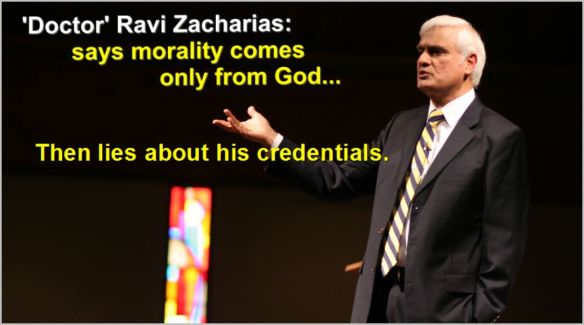
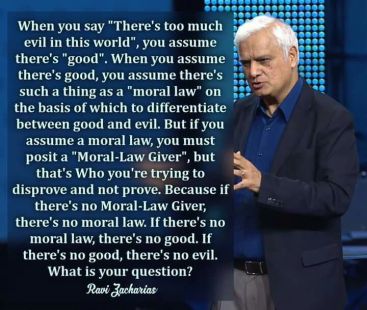
I planned to dissect Ravi Zacharias’ morality argument even before recent revelations that he lied about his credentials. I’m sure that, despite his fraudulent claims, he’s still a good Christian™, perfectly entitled to tell the rest of us what terrible sinners we are. If you’ve ever seen his grandiose sermonising, you’ll know he likes to pretend that Faith is something deeply intellectual, despite Paul’s contention in 1 Corinthians 1. 26-27 that it isn’t. Zacharias’ pseudo-intellectual Christianity is, like many of his qualifications, fake.

In common with other Christians desperate to prove their God, he relies too on circular reasoning. He tells us that our morality derives from God (you listening TC Howitt?) and then uses this to argue that, because of we have morality, God must exist. His unproven conclusion is his premise, with nothing in between to justify either.

Here’s his ‘argument’ in full:

Ravi3

Let’s take a closer look:

‘When you say “There’s too much evil in the world”, you assume there’s “good”. Who says this? How much evil is ‘too much’? Do people other than Christians see the world in terms of good and evil? Does acknowledging evil mean one also assumes there is good? How is this ‘good’ defined? So many unanswered questions in this first muddled statement.

‘When you assume there’s good, you assume there’s such a thing as a “moral law” on the basis of which to differentiate between good and evil.’ The only one making assumptions here is Ravi himself. The considerate treatment of others, which is how we might reasonably define morality, is easily recognisable when it occurs. This presumably, given he fails to define any of his terms, is what Ravi means by ‘good’ (and conversely, inconsiderate or malicious treatment of others is his ‘evil’). There’s no reason to suppose, however, that the demonstration of good is a component of an objective ‘moral law’ that exists somehow independent of human interaction. Morality and any resulting goodness (or ‘evil’), is human interaction.

‘But if you assume a moral law you must posit a “Moral-Law Giver.” Well, of course we’re not assuming a moral law, not in the magical way Ravi is assuming we’re assuming. And how about that imperative: ‘You must posit a “Moral-Law Giver”‘! Must we? Morality is socially determined by human beings themselves; we see this is in the different moralities that have emerged in cultures with shared heritage; we see it in the changing attitudes over the last fifty years to the treatment of women and gay people. Morality is fluid; it evolves. The ‘Moral-Law Giver’ then, if we must have such a term, is we ourselves.

‘But that’s Who you’re trying to disprove and not prove.’ Erm no. Ravi’s being disingenuous here. ‘We’ were not trying to disprove a Moral-Law Giver at all; he was trying to prove it (him? – note the capital sneakily added to ‘Who’). Let’s though, for the sake of argument say Ravi is right; let’s say there is a Moral-Law Giver out there somewhere. Why has he, over the expanse of human existence, issued such varying and often conflicting moral codes? Compare, for example, today’s moral standards with the harsh, brutal morality of the ancient Israelites, which demanded the death penalty for almost any infringement of the law. Compare that with the morality Christians today claim they derive from New Testament. Then compare Jesus’ impossible demands with how Christians actually behave. By and large, they’re happy to ignore him and, with the exception of one or two areas they get hot under the collar about (abortion, same-sex relationships), they go along with the consensus of the culture in which they live.

‘Because if there’s no Moral-Law Giver, there is no moral law.’ There is a ‘moral-law giver’: it is us. That is why moral laws vary according to culture and through time. Zacharias wants us to conclude that this capitalised ‘Moral-Law Giver’ is his God, yet he has neither demonstrated that a deity (any deity) decrees moral codes from on high, nor has he ‘proved’ (his word) that this cosmic law giver is his god, the barbaric and inconsistent YHWH. Rather, he ‘assumes’ this to be the case and hopes that his audience, failing to notice his assumptions, presuppositions and sleight of hand, will too. Given that most of them are Christian sheep  (Jesus’ term, not mine) they will no doubt do just that.

‘If there’s no moral law, then there’s no good. If there’s no good, there’s no evil.’ This is where the argument, such as it is, turns back on itself. Zacharias thinks he’s being very clever (he always thinks he’s being clever) but all he’s doing is declaring his premise over again.

Of course there are moral standards; humans have devised them throughout their existence. The ‘Golden Rule’ promoted by Jesus, for example, is first recorded thousands of years before him. We determine for ourselves what is good and therefore what is ‘evil’; these defintions are not delivered to us ready made from a “Moral-Law Giver” in the sky.

(While Zacharias doesn’t use the argument, there are those who like to say, on the basis of Romans 2.15, that God has written his (ever-changing) rules in our hearts, a fallacy I’ll address in the next post.)

‘What is your question?’ clever Ravi finally asks. We didn’t have a question. Here’s one for him anyway: how has he got away with such fraudulent drivel for so long?


Can you be good without God?

Good

You can’t be good without God, you can only be good with him – or so Christians like to tell us.

What is the evidence for this? What ‘goodness’ do we see in and from Christians (and other believers in God) that demonstrates they are directed in their morality by a supernatural being who, they say, dwells within them? ‘By their fruits ye shall know them,’ declares their leader in Matthew 7.16 – so what ‘fruits’ do we see?

How about Christians abusing the vulnerable? Sexual abuse of minors has long been widespread in the Catholic church and more and more cases are coming to light in Protestant ones too. Bruce Gerencser keeps a log of those accused and convicted of such crimes, adding names and cases from the States on almost a daily basis. Is this the ‘goodness’ Christians like to say comes from knowing God?

Or how about those believers whose ‘goodness’ manifests itself in cruelty, dishonesty or extreme right-wing views? (Never mind goodness, from these examples it would seem God doesn’t even provide his followers with common sense.)

Then there’s the likes of former judge Roy Moore, anti-LGBT politician who, when he’s not trying to erect monuments to the ten commandments, is excusing his history of grooming and abusing 14 year old girls? What part of this behaviour is ‘good’?

How about preachers like Franklin Graham, Stephen Green here in the UK and the self-righteous know-alls of Teens4Truth, all of whom persistently bear false witness? Perhaps demonising others with the intention of stirring up hatred and paranoia is somehow ‘good’ inside the Christian bubble.

‘Ah, but wait!’ say those Christians who insist we can only be good with God. ‘These people are not true Christians; if they were they wouldn’t be doing these things. Their behaviour tells us they’re not really Christians at all.’ And yet, they all profess faith in Jesus and are convinced his spirit lives in them; however they behave, and whether or not other believers accept it, they are Christians by virtue of this profession alone (Romans 10.9). Christian apologists can’t get out of the double-bind they’ve got themselves into by saying those who do wrong can’t be considered Christians and only those who are seen to be ‘good’ are true believers. They can’t reasonably demonstrate the goodness of God’s Chosen by discounting those who don’t manifest the characteristic they’re attempting to demonstrate, while pointing only to those who remain.

‘Well,’ Christians say, ‘non-believers and atheists are capable of behaving immorally too!’ which is true. But wasn’t their original argument that Christians are so much better (more good) than non-believers because of the indwelling Holy Spirit and their resulting spiritual discernment (or whatever)? Pointing out that some non-believers are capable of behaving as deplorably as some Christians is hardly a demonstration of the supernatural goodness that allegedly infuses Christ’s followers.

It has always seemed to me that religion is like alcohol. A little too much of either accentuates an individual’s true nature. If he or she is already a decent, kind person, drink and god-bothering tend to highlight these characteristics. If, on the other hand, a person is self-centred, greedy and unreasonable then that’s what we get more of. God has nothing to do with it; if it’s your nature, you can be good with or without him. As Bertrand Russell put it:

Cruel men believe in a cruel god and use their belief to excuse their cruelty. Only kindly men believe in a kindly god and they would be kindly in any case.

It is a pernicious lie that subscribing to a superstition imbues a person with ‘goodness’. It should be disputed at every turn.


The Moral Maze

Stoning

Where does morality come from? Ken Ham and others like to tell us it comes from the bible and the Christian ‘worldview’ they say they find there. Those non-believers who profess or practise morality in any meaningful way ‘steal’ it, they say, from this Christian worldview. They argue that without supernatural beings to dictate, with wild inconsistency, how we should behave, we simply wouldn’t know how to. That we do, by and large, means we can only have ‘stolen’ our morality from Christianity.

Unsurprisingly, the evidence suggests otherwise; versions of morality exist in all cultures – the secular, the pagan, the alternatively religious. Some of these are similar to those traditionally and often mistakenly associated with Christianity, some are not – which tells us they are socially determined. We decide ourselves, collectively, what is and isn’t morally acceptable. We don’t ‘steal’, or even need to, from the Christian ‘worldview’. Some of our morality might coincide with that espoused somewhere in the bible, but that doesn’t mean its taken from it. It means we value some of the same principles that ancient cultures valued – ‘do not steal’, is fairly ubiquitous, for example – because they too lived communally and needed rules like this one, as we do, to facilitate social cohesion. Of course, the collective understanding of a principle does not necessarily mean that everyone adheres to it, just as in those ancient cultures. Nonetheless we can all understand morality insofar as our culture defines and experiences it.

But let’s take a closer look at that ‘biblical worldview’ morality, that evangelicals think is the be-all-and-end-all, shall we?

T.C. Howitt, curator of the Oil for Light blog and commenter here, argues that ‘God’s moral law’, as demonstrated in the bible, is the only true (‘transcendent’ and absolute) morality. I’ve asked T.C. if he’s talking about the ‘morality’ that promotes the keeping and beating of slaves; the stoning of couples who have sex when the woman is menstruating; the execution of men who sleep with men, uppity teenagers and those who worship other gods, and which forbids work on the Sabbath (Friday evening to Saturday afternoon, that is).

It turns out it’s not (and yet it is) because, this, you see, is Old Testament morality and Jesus did away with all that. But nonetheless it’s still transcendent and absolute because it’s God’s Eternal Law. (I hope you’re following this so far.) However, in practical terms, what moralising believers seem to mean by biblical morality, is that which can be found in the New Testament. As I’ve pointed out to T.C., this is not the same thing as biblical morality.

So what does New Testament morality look like? Presumably it’s the morality promoted by Jesus, such as go the extra mile; sell all you have and give to the poor; turn the other cheek; give to everyone who asks; hand over your shirt when your jacket is demanded of you; don’t judge; love your neighbour as yourself; love your enemies; treat others as you like to be treated yourself, etc, etc.

If this isn’t what’s meant by New Testament morality then I don’t know what is. But forgive me – I don’t know many Christians who practise it, not even with an indwelling Holy Spirit and God’s personal support. That’s because it is an impossible morality. Consequently, Christians, like the rest of us, derive their moral standards from the culture around them, at the same time reserving the right to harangue the rest of us over our lack of ‘biblical morality’.

Doesn’t the bible have something to say about this? Oh my, yes it does. It goes something like this: attend to the log in your own eye, because it’s blinding you, and leave others to attend to the speck in theirs.

Now that’s what I call biblical morality.


God approves of slavery

slavery

Over on his blog site, Biblical Musing, Don Camp is trying to justify why God appears to condone slavery. It’s not the first time Don has tried to defend the indefensible; he’s recently been arguing much the same thing on Debunking Christianity.

The fact the Old Testament appears to endorse the keeping of other human beings as slaves is a problem for Christians. It’s a problem compounded by the fact that Jesus in Luke 12.47-48 and the imposter-Paul, in Ephesians 6.5, both support the practice. How can it be that God approves, or at least raises no objection to it? Wouldn’t an omniscient, all-loving God have outlawed slavery, as he outlaws so much else, in one of his innumerable laws and commandments?

Instead, he provides instructions about how to keep and look after slaves; what to do, for example, when you flog one to within an inch of his life so that he later dies (Exodus 21.20-21) or when you deliberately blind your slave – she’s your property after all – or rape her (Exodus 21.26; Numbers 31.17-18).

Don’s answer is that, despite God involving himself in the minutiae of slave treatment, he knew it would be a waste of time telling his people slavery was wrong. Why? Because he took the trouble to tell them lying and stealing were wrong and yet they ignored him. So, hey, why should he bother telling them about slavery? They’d just ignore that too.

But the point is – disregarding the fact that not everyone steals and lies – ‘God’ did issue laws prohibiting stealing and lying (and eating shellfish, and wearing garments of mixed fabric). It seems it was important to him to tell his pet-tribe that these were wrong, even though he must have known many of their number, and many more subsequently, would ignore him.

What can we conclude from this? Only this: that God didn’t feel the same way about slavery as he did about lying and stealing, which is why he didn’t bother making even the same token effort to prohibit slavery.

Or, and much more likely: the tribes who wrote the laws didn’t think slavery was wrong. In fact, they thought it quite useful to have slaves. Given this utility, they were unlikely to have devised laws preventing their ownership. The enslaved themselves no doubt thought differently, but then they didn’t get to write the rules.

We don’t find a commandment prohibiting slavery in the bible because those who wrote it liked having slaves. For this reason too, we find all those inhumane instructions about keeping slaves and what should happen if you maim or kill them.

Of course God didn’t write these laws. People did. And they wrote them according to their understanding of what was moral, fair and legitimate within their own primitive milieu. Thus it was that slavery got a free pass.