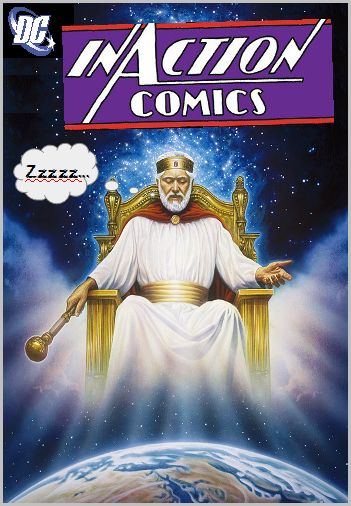
Evidence of God

As for evidence, you might be aware of Israel. That nation has been in the news much of late. So, without being flippant at all, I present Israel as evidence. Think about it. They are living the script written thousands of years ago. Not by chance.

Israel as evidence for the existence of God. I’m thinking about it as Don suggests.

Where did it all begin, this bizarre notion that one tribe in the Middle East was chosen by God to be his special people? According to the Genesis myth, it was when YHWH promised Abraham he’d be his best buddy forever and ever, so long as he mutilated his body and those of his sons in perpetuity. They would also have to keep every one of this bullying god’s 365 rules and regulations, including the petty and piffling ones. So far so good, apart from the fact it was all very one-sided, and the mutilation of course. You’d think this would’ve been a sign that things weren’t quite kosher, but no; Abraham and his descendants buy into it and almost straight away, YHWH begins to let them down.

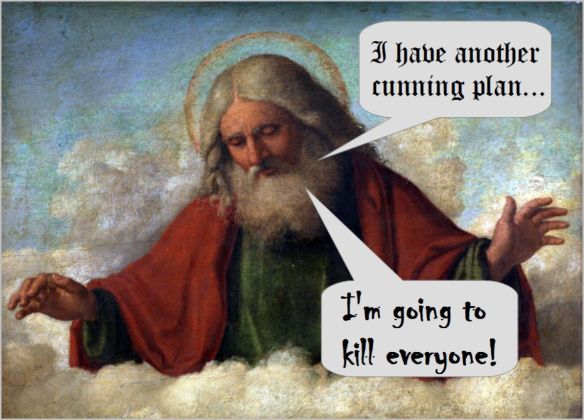
God’s Chosen Ones soon find themselves slaves in Egypt. A second mythical character is needed – up pops Moses – to get them out of this scrape. Unfortunately, after Moses has finished chatting with YHWH, who identifies as a burning bush on the top of a mountain, the sulky deity feels slighted by something the Israelites are doing. As is his way, he has many of them slaughtered and the rest he forces to troop around the same small plot of land for 40 years. This is how best buddies treat each other!

Later, the Jews find themselves defeated by the Babylonians and are carted off into exile. This exile, which YHWH does nothing to prevent, lasts 70 years. Still, it leads to a pleasant song made famous by Boney M in 1978 so I suppose it was worth it.

For the next few hundred years, Israel falls under the rule of other nations more powerful than itself. Not to worry though, YHWH is still ‘looking after them’, particularly those who are slaughtered in the rebellions that ensue. As Robert Conner says in a recent comment on Debunking Christianity, ‘If Yahweh ever threatens to bless you and your children, just kill yourself and get it over with.’

Fast forward to the Roman occupation of Israel. YHWH, having undergone a makeover, reneges on his promise to take care of his Chosen Nation forever and ever and comes up with a different plan to save people from his own cussedness. Now, if they want to continue as his friend, they have to believe a supernatural being has returned from the dead.

Abandoned by God, as he now wants to be called, Jews who haven’t defected to the new faith see their sacred, eternal temple destroyed by the Romans in AD70. Thousands of them are massacred and the Jewish nation ceases to exist.

This sets the pattern for the next two millennia in which God’s new friends organise pogroms, massacres and vicious persecution of Jews. This culminates in the Final Solution of the Third Reich which seeks to eliminate the Jewish people entirely. While awaiting extermination in a concentration camp, Andrew Eames scrawls on the wall of his prison: ‘If there is a God, He will have to beg for my forgiveness.’ God allows six million of his Chosen People die at the hands at the Nazis.

Following the second world war, Israel takes possession of the area surrounding Jerusalem, then occupied by Palestinian Muslims who are themselves descended from earlier immigrants. Thousands on both sides are slaughtered in the conflict that follows. In 1948, after almost 2,000 years, Israel becomes a nation once again; not through any miracle of God but as a result of human endeavour and bloodshed.

Tension and further skirmishes followed, leading to the present day when Israel finds itself under attack by Hamas terrorists. Thousands of innocents – women, children and babies – have been slaughtered without mercy. Israel is, as I write, retaliating and intends to enact further vengeance. And where is God in all this? You guessed it: nowhere to be seen.

All of this, according to some – including the naive writer at the top of this post – serves as evidence of God’s existence. That Israel has persevered for so long, despite opposition, persecution and the holocaust is not, however, evidence of God, any more than the great cathedrals of the world are. It is instead testimony to the resilience, resolve and sheer bloody mindedness of the people themselves. Perhaps their belief in YHWH (they don’t of course recognise his Christian counterpart) has fuelled their persistence, as it has their territorial claims.

Jewish beliefs and history are not evidence that YHWH exists. If anything, his apparent abandonment* during their many trials and tribulations is evidence to the contrary.

*Of course a non-existent entity can’t actually abandon anything, any more than it can lend its support or favour one group of people over another.

The Inflationary Vacuum

Not a simulation, not created by a God: so how did the universe come to be? Can something arise naturally from nothing, after all? Many scientists think so, but not because a god overturned the idea that something cannot come from nothing. They also answer the related question of why there is something rather than nothing.

I’m not going to reiterate their explanation here, as you can read a summary for yourself (I’ve linked to a simple one for the sceptical among us and of course the diagram above makes it all clear.) Suffice to say, the theory demonstrates that ‘something’ came about when quantum particles popped into existence from nothing. We know they are capable of doing this, making them the Uncaused Cause. These particles led to ‘a chunk of inflationary vacuum’, from which, everything else arose..  

And no, Don, unless he’s ‘a chunk of inflationary vacuum’, this is not your God. Nor did he conjure up the chunk .Before it appeared at the quantum level there was, according to this scientific theory, nothing: no God, nothing.

The God

So the universe isn’t a simulation created by a Mind in its mom’s basement. Shame. I thought Don was onto something there.

Let’s consider then another option. The universe, reality and we ourselves were made by a super-being, a God no less. How would that work?

The God looked round. There was nothing, only himself. He did not know for sure that he was a he because he had no Y chromosome or a penis. He hadn’t invented either yet and as an eternal being he had no need of such things. Heavens above, he didn’t even drink or eat so didn’t need dual purpose genitals, not even for urination. He did plan however to create, eventually, when billions of years had past, a sentient being who would have a Y chromosome and a penis. He intended calling this being A Man. This Man would be inherently male so it seemed only right that he, God, should identify as male too.

Damn, he’d digressed again. Where was he? He realised for the billion billionth time (though it was hard to count when time didn’t yet exist and even if it did he’d be outside it) he was nowhere amidst nothing and hadn’t created anything yet. It was time, bearing in mind no time existed, to create the universe, a reality outside of himself.

He looked round again. He was, he had to admit, a bit stuck. There was nothing around with which to create anything; no quarks, no gravity, elements or even Lego; none of the fundamental forces of the universe. There were no fundamental forces because there was no universe. He was going to have to create these things before he could even think about creating a universe. But how? He looked around for something with which to make the quantum realm and gravity and elements and all the other stuff from; but there was nothing. Even as God he was constrained by the principle that something cannot come from nothing. This was a truth universally acknowledged even if there wasn’t yet a universe.

What to do? Could he make a universe from himself, from his own essence as it were? But if he did, would that not diminish him in some way, make him less of a God? A God with a universe-shaped hole in his middle? He didn’t much like the idea of that. It really wouldn’t work.

Could he, he wondered, zap things into existence with just a word? But wouldn’t that be the same as making something from nothing? As such it couldn’t be done. In the far, far future those who believed in him would insist that something could not come from nothing in their arguments with those who doubted his existence. He couldn’t flout the rule and make his acolytes look foolish.

He decided he would have to abandon the whole project. He’d had such plans too, of making his Man and then destroying his descendants in a flood and every other way imaginable until he could send his other Big Idea down to rescue them with special magic. ‘Shit,’ God thought, though that didn’t exist either: ‘I’ll just have to get used to being here all alone with my Big Ideas, surrounded by all this nothing instead of something.’

God’s conundrum demonstrates that it is logically impossible that a God created the universe. Apparently, something cannot be made from nothing, even by a god.

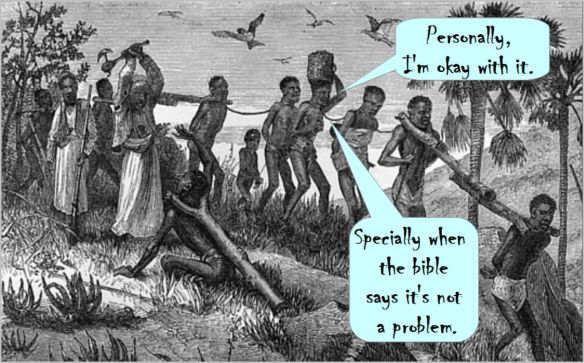
A Reply to a Slave

I’ve discovered this new gizmo that lets me look stuff up on the Interweb. Goober or somesuch. I used it to find the meaning of ‘doulos’ that the absence of dictionary prevented you from doing. All of the results Goober brought up described doulos thusly:

Doulos (Ancient Greek: δοῦλος, Greek: δούλος, Linear B: do-e-ro) is a Greek masculine noun meaning “slave”. Wikipedia

Doulos (a masculine noun of uncertain derivation) – properly, someone who belongs to another; a bond-slave, without any ownership rights of their own. Biblehub (Christian site)

…anyone could become a slave, in a sense. However, once someone was sold into slavery, they remained a slave for life, and all of their offspring automatically became slaves as well. The only standard way of obtaining freedom was to earn enough money to pay your owner back as much as he had paid for you in the first place. This was a nearly impossible task to accomplish because slave owners did not often facilitate their slaves ability to earn money on the side. As such, most slaves, and their offspring remained slaves for the totality of their lives. Slavesandsons (Christian site)

Doulos is a Greek word in the Bible that has only one true historical option for accurate translation into English, which is slave. It literally means to be owned by someone for a lifetime. This word is found at least 127 times in 119 verses in the New Testament scriptures. It is used in the context of human slavery, which, sadly, was very common throughout the ancient Roman Empire for hundreds of years. Recorder.com (Christian site)

You’ll see none of them say what you say, Don. None think slavery was a nice amicable arrangement. Christian sites especially emphasise how slavery was a downright awful thing so’s they can sermonise about how Jesus saves us from slavery to sin.

If you’re going to reduce real world, God-approved slavery to something akin to a nice comfortable arrangement, you diminish the metaphor of Christ’s redemptive work to… not much at all. (Which of course it isn’t.) I noticed you didn’t comment on this point when I mentioned it in an earlier post and here you are digging yourself in deeper with your ‘slavery wasn’t really all that bad’. Good work, Don!

You’re certainly enslaved to all this Christian mumbo-jumbo. To Christ though, not really. There’s no such being and you certainly don’t give the impression of being a slave in any real world sense. Perhaps that’s because you have no understanding of what slavery was and is.

On Climate Change

Climate Change is happening.

But, like young Sheldon, I have questions.

The UK’s carbon emissions are, according to the government’s official figures, 1.1%, while China, USA, India, Russia and Japan produce 58% between them: will the UK reducing its output by 1.1% to zero make any substantive difference to carbon levels and the climate?

Why, as Tony Blair asked last week, are ordinary households being expected to foot the bill for the UK government’s net zero measures? Why not those who produce the most carbon?

When China alone produces 28% of the world’s emissions, and is doing nothing to reduce these – in fact it is increasing them year on year – what use will it be if the UK impoverishes itself in its drive to net zero?

Why does the UK government feel the need to regard itself as a world leader in the drive to net zero when no-one cares what the UK is doing?

Is net zero achievable when the generation of power always produces some level of pollution? How is global net zero achievable when powers like China and Russia refuse to reduce their carbon emissions?

If there is widescale changeover to electric vehicles by 2030 (a UK target for new cars) will there be enough electricity to power them? How will all this extra electricity be generated?

Given most carbon emissions worldwide are from electricity plants, why is the population being ‘encouraged’ to change from oil powered vehicles to electric ones that require electricity plants to create their fuel?

Why do Just Stop Oil and other eco-activists travel to their demonstrations in transport powered by oil and other fossil fuels? Why do they heat their homes using these same fuels? Why do they have mobile phones made from plastic derived from oil, to communicate with each other? Why don’t they demonstrate themselves the kind of behaviour they demand from everyone else?

Why does one of Just Stop Oil‘s leading spokespersons, Dr Grahame Buss, take a £1 million pound pension from Shell Oil while demanding ‘the masses’ must be the ones to make radical changes?

Why do politicians travel by private jet and in motorcades to Climate Change conferences? Why don’t they demonstrate themselves the kind of behaviour they demand from everyone else?

Why, when climate is defined as weather over prolonged periods of time, does the media show us pictures of isolated weather conditions to illustrate climate change?

Do forests spontaneously and naturally combust?

Did the recent wildfires in Greece and elsewhere spontaneously combust as the direct result of high atmospheric temperatures or were they, as the evidence suggests, started either deliberately or through human carelessness? If so, why does the media portray them as examples of the effects of climate change?

Who decided that scrub and undergrowth in forests should no longer be cleared? Why did they, when layers of scrub and undergrowth, once alight, ensure fires spread more rapidly?

If, according to NASA, there has been a decrease in the total number of square kilometers burned each year (and) between 2003 and 2019, that number has dropped by roughly 25 percent’, why are recent, highly localised fires being represented – even by NASA! – as an increase attributable to climate change? 

According to UN Secretary General António Guterres, ‘the era of global warming has ended. The era of global boiling has arrived’. What exactly is it that is ‘boiling’? Is it oceans, rivers and lakes? Soil and rocks? Animal bodies? If so, where is the evidence that this is happening? Is such alarmist hyperbole persuasive or remotely helpful in combatting climate change? Or does it lead ‘the masses’ to believe politicians exaggerate the extent of climate change?

Can we slow down or even reverse climate change when it is a natural, inevitable part of nature’s cycle and, in terms of our own contribution, the biggest polluters are not interested?

Are we all doomed?  

End Of Term Test

Which of the terms mythological, symbolic, theological is most appropriate when discussing biblical tropes?

Apparently, it’s ‘theological’ because it has an air of respectability, whereas the other terms suggest something with only theoretical underpinning. In fact, this also applies to ‘theological’, which by definition is the study of deities, for which there is no evidential verification. The use of ‘theological’ therefore is as unsubstantive as arguing that a concept is metaphorical or symbolic. None of these terms represents a sound, reliable way to determine the accuracy, historicity or truth of religious claims.

With this in mind see how you do with these questions:

1. Did the original hearers of the Genesis creation story regard it as –

a) true.

b) a theological statement.

c) an entertaining myth.

Of course we’ve no way of knowing what the story’s original hearers thought but there is nothing in the text that suggests they would have regarded the creation story as anything but true. The creators of Jesus’ script certainly seemed to think so, a few centuries later and its original hearers would not have felt the need to preserve it otherwise. In this belief they were wrong.

2. Which of these gospel stories is true, as in ‘really happened more or less as described’ –

a) The virgin birth with its surrounding detail.

b) Jesus meeting with Moses and Elijah (the transfiguration).

c) Resurrected corpses roaming around Jerusalem.

d) The resurrection.

The answer is that either all of them are true or none of them are. If only one of them is mythic, symbolic or ‘theological’ (and more than one of them most certainly is) then it is highly likely the others are too. If we are scrupulous, we cannot assert that one story is symbolic because it’s making a theological point while another equally implausible story is historically accurate because we want it to be.

The criteria for determining the historicity of any story from antiquity are corroborative evidence and, failing that, plausibility. We have already established that there is no independent corroboration for many of the gospel stories. There is no corroboration for some of them even in the Bible itself. We are left then with plausibility: how plausible is it that a virgin gave birth or that resurrected corpses presented themselves to Jewish authorities? Vanishingly small. Jesus’ encounter with Moses and Elijah is equally improbable.

Is his resurrection the exception? No, because dead people do not spring back to life 36 hours after being buried. If the virgin birth, the transfiguration and the resurrection of dead saints are all highly implausible (and they are) then so is the resurrection. It is at best, a story making a theological point but it is not history. The implausibility it shares with many of the other implausible stories in the gospels discounts it as history. There are no grounds for saying it is the exception.

There is also the cumulative effect of implausibility. It is highly unlikely that one of the implausible events above is historical, but it is impossible that all four of them are. Add all the other implausible stories in the gospels – the other miracles; the healings; exorcisms; Jesus sparring with the devil, walking through locked doors and beaming up to heaven: piling implausibility on top of implausibility doesn’t make any of the component implausibilities more plausible. It makes all of them less plausible and collectively impossible.

The things the gospels tell us happened to Gospel Jesus, and those they say he did himself, are equalled only by heroes of myth. Did Osiris or Romulus rise from the dead, as their stories claim? Did Augustus really become a god once he died? Of course not. These are the implausible, improbable events we find in myth. Jesus’ story is no different.

3. While many or all of the gospel stories are highly improbable as history because they are intended to convey a theological point, the words attributed to Jesus in the gospels –

a) are completely accurate.

b) are more or less what he said.

c) passed through an inestimable number of people, being invented, edited and altered in the process, before being written down 40+ years after Jesus supposedly uttered them.

d) are inventions of the gospel writers and/or their particular sect and frequently copied between gospels.

If you’re opting for a or b, you’re now making the logia the exception; the one oasis of historical truth in a desert of implausibility. That’s a big ask. To get this one off the ground, you have to call upon contrivances like –

completely reliable (but different and conflicting) oral traditions;

     hypothetical lists of sayings;

         Peter’s dictation to Mark;

             eyewitness authors;

                  secret teachings;

                     super-translators and

                         the odd spot of collaboration.

So, c and/or d is far more likely to be the answer to this one, representing the explanation that requires the least conjecture and fewest hypothetical components.

How did you do? I expect most of you aced this end of term quiz. If not, better get down to some extra study and repeat the semester next year.

The Gospels and Other Fiction, part 3

The final part of my critical look at Christians’ defence of scripture as truth.

‘The logia of the Lord in all three of the synoptics stand out from the narration of the author by style and grammar.’

The same way Elizabeth Bennet’s/Jay Gatsby’s/Hermione Granger’s dialogue stands out from the narration and the speech of other characters in Pride and Prejudice/The Great Gatsby/Harry Potter. A skilled author can make all of their characters speak in different and distinctive styles, with their own particular grammar and syntax. This doesn’t mean those characters are real. Nor does the fact that some of the ‘logia of the Lord’ was carried over from Mark into Matthew and Luke mean the two later authors were at pains to preserve the real words of Jesus. They were, as scholars, including the evangelicals Dr Strauss and Dr Wallace suggest, copying, plagiarising, editing, amending and inventing his script.

There are also the omissions to take into account: words recorded by Mark that Matthew and Luke didn’t see fit to copy into their gospels. Were they not convinced these were genuine sayings of Jesus? Did they just not like them? On what basis did they jettison these ‘logia of the Lord’?

If only there were a fourth gospel that didn’t lift its logia from Mark, one whose Jesus speaks in a very different style, with different content, vocabulary, syntax and grammar from the synoptics, but which is itself internally consistent. We would know then his script could be made up.

Miracles of miracles, we do have such a gospel, one in which Jesus is completely different from the version in the synoptics. Where does this character’s logia come from? A different oral tradition, one totally separate from and uninfluenced by that used by Mark but which existed in parallel to it? Highly unlikely. An eyewitness? One who heard Jesus speak an entirely different set of words from whoever supposedly heard those eventually used by Mark? Of course not. The fourth gospel’s logia was invented by a much later author and his collaborators, with no direct experience of Jesus (if he existed). He and they do a pretty good job of writing his fake lines.

And if they can do it, why not Mark forty years earlier?

‘There are, in the synoptic gospels, fewer variations in the logia than in the surrounding shared narrative.’

This doesn’t mean there aren’t any. There are. For example:

Whoever is not against us is for us’ (Mark 9.40) v. ‘Whoever is not with me is against me.’ (Luke 11.23). 

‘And these are the ones sown on the good soil: they hear the word and accept it and bear fruit, thirty and sixty and a hundredfold.’ (Mark 4:20) v. ‘But as for that in the good soil, these are the ones who, when they hear the word, hold it fast in an honest and good heart, and bear fruit with patient endurance.’ (Luke 8:15) [Luke makes a terrible job transferring this parable from Mark to his own gospel. His is full of errors and discrepancies, generally attributed to ‘author fatigue’. He was just so tired of cribbing from Mark and Matthew.]

The time has come,’ he said. ‘The kingdom of God has come near. Repent and believe the good news!’ (Mark 1:15) v. ‘The kingdom of God is not coming in ways that can be observed, nor will they say, ‘Look, here it is!’ or ‘There!’ for behold, the kingdom of God is in the midst of you of you.’ (Luke 17.21)

It looks like isolating the logia and claiming because they are similar across the gospels they must be the actual words of Jesus. Matthew and Luke copying from Mark (and each other?) while John invents his own unique dialogue, makes for a far better explanation of both the similarities and the differences.

The Circular Reasoning of Apologists

This is what what we’ve got so far:

Human behaviour is controlled by beings from an invisible, undetectable spiritual realm. We know this invisible, undetectable spiritual realm exists because of the effect it has on human behaviour (even if dumb old atheists can’t wrap their minds round the fact.)

Circular reasoning, not evidence.

The synoptic gospels rely on an earlier oral tradition. We know there was an earlier oral tradition because the synoptic gospels rely on it.

Circular reasoning, not evidence. (The same applies to Q.)

We know the stories about Jesus are indisputably true because they’re in the gospels that no-one at the time disputed. We know the gospels are indisputably true because they tell us stories about Jesus that at the time no-one disputed.

Circular reasoning, not evidence. There is no corroborative, independent evidence for any of the stories about Jesus. (I’ll get to the indisputable claim soon.)


My Gay Demon

I am demon possessed. I know this for a certainty because Christians all over the Internet tell me. I am gay therefore I am possessed by a demon. Maybe more than one, I don’t know.

I’ve been trying to get in touch with my inner demon but he’s been keeping schtum. I assume he’s a him given he’s a demon of gayness, but again who knows. I’ve enquired in the deepest, darkest recesses of my mind and have searched my heart (though if I’m honest I wasn’t really sure how to do this) and can’t find him anywhere.

I was going to ask him why, if he’s a demon and therefore a real nasty piece of work from the pit of hell, why he’s led me to a happy and loving relationship with Dennis, one that has taken each of us from loneliness and depression to peace and contentment. I just didn’t know demons were so… well, so positive and creative. I always thought they were destructive and devious, like C. S. Lewis’s Screwtape. I think mine must be shy and more like Casper the Holy Ghost.

Alternatively, maybe there’s no such thing as demons, invisible evil super-beings who can’t be detected in any way. In my ‘worldview’ anything that’s invisible, undetectable and is a figment of rather dim-witted people’s imaginations is a being that doesn’t exist.

But then maybe that’s just me.

  And science.

    And every other academic discipline.

       And rationality.

         And reality.

It’s possible, after all, that a book written thousands of years ago by ignorant religious zealots trumps all of that.

Everything, Everywhere, All At Once

Sadly, we’ve failed to locate Jesus, the celestial super-being who is everything, everywhere, all at once yet nowhere at all. We’ve been presented with some possibilities, specifically that he exists in another dimension, which may or may not exist, from where he whispers directly into the brains of those who, over in this reality, call upon him. He even appears occasionally in visions, when the two dimensions ‘intersect’, which, as everyone knows, they’re capable of doing.

Unfortunately, all of this is undetectable by science but there’s no reason for concern because there is more to reality than that which science can observe. Equally regrettably, there’s no way of verifying this claim either; this is because science is deficient, limited as it is to investigating only ‘dirt and rocks’.

* * * *

It is far more likely that science can’t detect heaven and the eternal Jesus in precisely for the same reason it can’t detect Narnia, Valhalla and all the other fantasy worlds created over the millennia by human minds. Applying Occam’s razor, the imagination accounts for all these other ‘realities’ and the immortals that inhabit them.

No further explanation necessary.