Whatever happened to the Kingdom of God?

Cross4

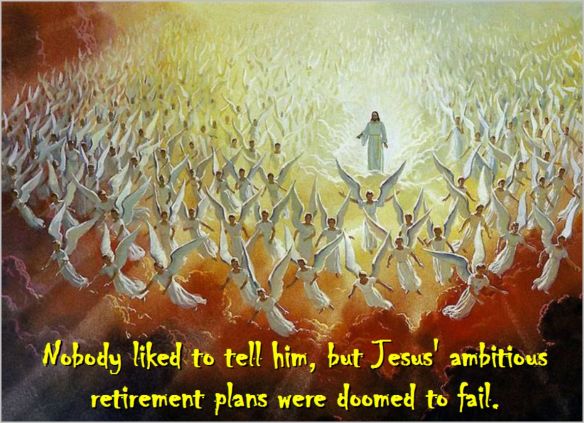
Jesus clearly and unequivocally announced that the Kingdom of God would soon be coming to the earth (Matthew 16.27-28; Matthew 24.27, 30-31,34; Luke 21.27-28, 33-34 etc).

This was his Good News. According to the synoptic gospels his entire ministry was about announcing the arrival of this Kingdom and demonstrating it was just around the corner (Mark 1.15; Luke 11.20 etc). All of his teaching was predicated on his belief that God was soon to intervene in human affairs to right all wrongs, repair injustices and punish the wicked (Matt 5.3-12; 25.31-46). He had no message other than this.

Yet many – most? – Christians refuse to acknowledge any of this. For Christians, Jesus was about something else entirely. Many of them argue that even though he might have appeared to say that God’s Kingdom was imminent, this wasn’t what he really meant.

When he promised it would happen ‘within this generation’ (Matt 24.34), they say, what he really meant was the generation alive after certain calamities had taken place (Matt 24.15-31), evidently more than 2000 years into the future. As I’ve suggested before, this makes him one heartless bastard, standing, as he did, in front of the meek, the hungry and the downtrodden and promising them all would soon be well, when he was ‘really’ referring to people who wouldn’t be born for another two millennia.

But then he’s more specific about who he intends the promises for, when says in Matthew 16:28, “Truly I tell you, some who are standing here will not taste death before they see the Son of Man coming in his kingdom.” ‘Some who are standing here’ – the people who were physically present, there in front of him, being addressed by him. It’s difficult to maintain that he meant people in the far future when he specifies those who are ‘standing here.’ Yet Christians maintain just this.

“Aah, yes,” they say, “but he was clear no-one knew the hour of the Kingdom’s return – not even himself.” Yes, he did say this – in Mark 13.32 – but there’s no conflict between this claim and his insistence the Kingdom would arrive soon. We all do this sort of thing when we say, ‘my parcel is due to be delivered some time today but I don’t know when exactly.’ This is what Jesus is claiming: ‘the Kingdom will be here very soon, though I don’t know precisely when.’ Too right he didn’t.

Nonetheless he thought he had a pretty good idea. In Matthew 10.23 he sends the disciples off to announce its arrival to the cities of Israel and tells them the Kingdom will have arrived before they return. When they get back (in the next verse!) the Kingdom is still conspicuously absent, so he and the gospel writers conveniently forget all about his rash promise. Where’s a good editor when you need one?

And then it all goes wrong for him. Jesus is arrested for his seditious idea that the existing system is about to be overturned and replaced (Matt 19.28), and he’s sentenced to death. Did he continue to hold out hope that God would act before the execution could be carried out? Did he expect his Heavenly Father to carry out a last minute rescue by bringing in the Kingdom with a great show of power? It seems likely, but as he hangs on the cross he realises, finally, that God is not going to act. God has let him down, as he always must, and a deserted and despondent Jesus cries out in dereliction: “My God, my God, why have you forsaken me?” (Mark 15.34). How could he have got it so wrong?

‘No, no, It can’t end like this,’ cry the Christians in return (and indeed it didn’t). But how to explain (away) the great failure of Jesus’ mission heralding the arrival of God’s Kingdom on earth?

Don’t worry, our Christian friends are up to the task.

Next time…


How to argue like a Christian (part two)

Street-preachers

Five more ‘arguments’ offered by Christians in defence of their insupportable beliefs:

You’re not entitled to speak because you have no objective basis for your morality; morality comes only from God/the Bible.

Except it doesn’t, of course; moral codes existed long before the Bible or even the invention YHWH, who is, in any case, morally bankrupt. This ‘most unpleasant character in all fiction’ ‘wallows’, if I might borrow the term, in genocide (1 Samuel 15.2-3 etc) and slavery (Leviticus 25.44-46; Exodus 21.20-21 ); he relishes the death penalty for the most minor infringements of his petty rules (Leviticus 24.16; Deuteronomy 21.18-21, etc ad nauseam); fails to keep his promises (Genesis 17.7; Mark 11.24); does nothing to relieve human or animal suffering and lets millions of children die needlessly, year in, year out. It just doesn’t suit his mysterious ways, apparently, to behave like any halfway-decent human being would.

And even if he were the morally-upright paragon of virtue Christians delude themselves into thinking he is, they would ignore his moral guidance at every turn, just as they do now. Ministers, priests, evangelists as well as run-of-the-mill believers are convicted every day of the most despicable of crimes (Bruce Gerenscer keeps a tally on his blog-site) and that’s before we get to the more exacting moral demands Jesus makes. Going the extra mile (Matt 5.41), loving neighbour (Mark 12.31) and enemy alike (Luke 6.27), giving to all who ask (Luke 6.30) – these most Christians simply ignore. ‘We’re forgiven, not perfect,’ they whimper, even though ‘perfect’ is precisely what their unreasonable saviour tells them to be (Matt 5.48). But then I’m probably quoting out of context again… or something.

You’ve been hurt in the past.

This weak, ad hominem response is the converse of the charge that you’re immoral; good cop as opposed to bad cop. The Christian who says this is all-seeing and all-knowing and is able to evaluate your entire psychology and personal history from a single comment you’ve made. They can tell that you’re only disputing an aspect of Christianity because obviously at some point in your past a Christian – who wasn’t really a true Christian – hurt you. Or maybe it was a church you once belonged to that let you down. Well, you’ve every right to feel hurt! But that doesn’t mean there’s anything wrong with the True Faith™ or those who subscribe to it! And so your point is neatly invalidated; you’re only responding emotionally and you’ll get over it.

If there’s no God then life is meaningless.

Used extensively by some Christian blog-sites, this non-sequitur translates as, ‘I’m not going to address anything you say. My neediness demands there’s some point to life and I’ve decided that it comes from the fantasy I’ve bought into.’ Questions of whether that fantasy is actually true (which by definition it can’t be) and whether life is meaningless without it, are never considered. Believers’ need for the delusion to be true, their fear of working out meaning for themselves and their subsequent investment in Christianity’s empty promises, compel them to hide behind what is an essentially… er, meaningless solipsism.

Unbelievers have no right to criticise those who belong to Jesus.

Haven’t we? We put up with all the nonsense Christians spout, their attempts to influence everything from elections to what we can see on TV, from their opposition to gay rights, same-sex marriage, women’s rights, abortion and adoption issues to the restrooms people can or can’t use and their judging of the rest of us as hell-bound sinners. In return, we unbelievers are perfectly entitled to hold Christians accountable. At the risk of repeating myself, do they do what Jesus tells them to? Do they turn the other cheek (Matt 5.39)? Sell their possessions to give to the poor (Mark 10.21)? Give more than is demanded of them (Matt 5.40)? Avoid judging others so they’re not judged in return (Matt 7.1-3)?

What do you think?

You’re of the devil/an enemy of the cross/wilfully blind/apostate/a troll.

If all else fails (and it will) the faithful resort to an insult carefully selected from the extensive bank of Christian cliches. That way, there’s no need to engage the brain at all. God love ’em!


The original ‘good news’ had nothing to with any mystical salvation plan (part two)

Disciples2

Last time, I provided evidence that Jesus’ original ‘good news’ had nothing to do with any mystical salvation plan constructed around his supposed resurrection. My six references demonstrated that, even after his death, the disciples adhered to Jesus’ original message: God’s Kingdom was coming soon and they were going to rule over it. Here are six more reasons we can be sure this was the case:

7. Our earliest sources, Q and the gospel of Mark, do not give much credence to the resurrection as an actual event: Q records no sayings of the risen Jesus and Mark has no resurrection appearances; it ends with the women who discover the empty tomb deciding not to tell the disciples about it. In Mark’s gospel, then, the disciples are not even aware the tomb is empty, let alone that Jesus has returned from the dead. We can conclude from this that the community that produced Mark’s gospel, the supposed resurrection was not significant in and of itself.

8. Paul tells us that the disciples’ gospel was not the same as his, despite the fact he too believed the Kingdom wasn’t far off (1 Thessalonians 4:17). The disciples, he says in 2 Corinthians 11.4-5 and Galatians 1.6; 2.11-21, were preaching ‘a different gospel’. Different from his, certainly, but the same as the ‘good news’ Jesus proclaimed: Jewish people should prepare for the imminent arrival of God’s Kingdom on Earth (Mathew 9.35; 15.24), when, as Jesus himself had promised them, the disciples would judge the restored tribes of Israel and rule over them. It is, as we have seen, out of the question that they would jettison this aspect of the ‘good news’, given to them by Jesus himself.

9. Because the disciples – and Jesus’ brother James – saw the new Kingdom as intended for Jews only, as Jesus had before them (Matthew 10.23), they insisted that any Gentile converts must be circumcised; must become Jewish (Galatians 2.7). Paul, of course, objected to this requirement and throws tantrums about it in his letters (Galatians 5.1-12; Philippians 3.3). But like Jesus, the disciples saw no place for Gentiles, the unrighteous, in the new age; those who didn’t convert would, of necessity, be dispatched to eternal punishment (Matthew 25.31-46).

10. As far as the disciples were concerned, therefore, it was entirely for their own good that converted Gentiles be circumcised (Galatians 6.12-13) as this was their only guarantee of a place in the new Kingdom. What this tells us is that a salvation formula, such as that dreamt up by Paul, had no part in the disciples’ ‘good news’.

11. Wherever they appear – in Paul’s writing, the gospels, Acts – the disciples are portrayed as being at odds with an incantational, faith-based Christianity. The Bible attests, even with Paul’s new religion superimposed, that they held to a different gospel, a different sense of what Jesus’ life meant and a different notion of their place in the coming Kingdom. And wouldn’t they be the ones to know? They knew Jesus, spent time with him, listened to his teaching, bought into his misguided mission and had sufficient understanding of it to spread his ‘good news’ to fellow Jews, both while he was still alive and afterwards (Matthew 10.23; Luke 9.1-2).

12. The New Testament is testimony to the failure of everything Jesus and the disciples stood for; their ‘news’ that God was soon to turn the Earth over to the meek and that they would then rule the only people who mattered, the twelve tribes of Israel, with everyone else thrown into outer darkness (Luke 13:28). Jesus himself, of course, would return at some point to be top dog, God’s representative on Earth – his anointed one. None of this happened.

If only it had been allowed to rest there, we might not know today of Jesus and his mad ideas. Instead, Paul stepped in, reinterpreted the whole ridiculous enterprise and bequeathed the world a set of different but equally absurd beliefs. And the rest is history: religious wars, pogroms, inquisitions, suppression, superstition, clerical child abuse, Pat Roberston. Is this the Kingdom that Jesus and his closest associates foresaw? Decidedly not. But it is their legacy.

The original ‘good news’ had nothing to do with any mystical Salvation Plan™


Pentecost

As I discussed last time, there are indications throughout the New Testament that Jesus’ original ‘good news’ had nothing to do with a mystical salvation plan. There are clues too that the disciples clung to this original message – they’d heard it from Jesus himself, after all – even as other interpretations began to supersede it.

Let’s take a look at the evidence:

  1. Jesus tells his chosen twelve, which includes Judas, that they will rule with him in the age to come (Matt 19.28). As Bart Ehrman points out1, the fact that Jesus evidently had no foreknowledge of Judas’ later betrayal means this promise undoubtedly goes back to Jesus – it is unlikely later believers would have made it up. Though their names vary between gospels, Jesus hand-picked twelve men to rule with him.

  2. He appoints twelve disciples quite specifically and later tells them privately that this is so they can judge and each rule one of the twelve tribes of Israel once God’s Kingdom arrives (Luke 22.30).

  3. When Judas kills himself, the remaining eleven disciples think it vital to appoint a replacement twelfth (Matthias, in Acts 1.21-26). The number remains significant to them. How would they be able to rule the twelve tribes of Israel if there were only eleven of them? There had to be twelve for this very purpose. Even after Jesus’ death and supposed resurrection, the disciples are still preparing for the end of the age he prophesied and for their positions of power in God’s Kingdom.

  4. By the time the synoptic gospels were written, Jesus secret teaching that the Twelve would rule alongside him in the new kingdom had become common knowledge (hence its inclusion in the gospels). Given that he told them in private they’d be judges and rulers, it can only have been the disciples who later broadcast this information. And why would they do this? Because it was an integral part of their good news. Furthermore, all three synoptic gospels include a range of episodes in which the twelve are castigated for their presumption (eg: Mark 10.37-41; Matthew 20.22-24; Luke 22.24-30). These have all the hallmarks of stories created later, when a different ‘good news’ was emerging, specifically to mock the disciples’ belief.

  5. In much the same way, the disciples are consistently depicted as having no real understanding of Jesus’ mission (Mark 9.30-32; 10.35-45). And they don’t, in that they have no understanding of the later reinterpretation of Jesus’ significance. How could they? By the time the gospels came to be written, the mystical-Christ version of Christianity had started to take hold. Paul’s salvation plan and the supposed resurrection were beginning to assume greater importance than Jesus’ original message. How could the disciples, 40 years earlier, have known that this was going to happen? How could Jesus? They have to be portrayed as being largely ignorant of later developments – developments which, in any case, they opposed when they did encounter them (Acts 9.26; Galatians 1.6; 2.11-14; 3.1-3).

  6. In fact, Jesus teaching – all of it – was predicated on his belief that the Kingdom of God was ‘at hand’, imminent, about to happen real soon (Mark 1.15; 9.1; 13.30; Matthew 10.23; 16.28; 24.34), and that when it did, he and his chums would be there ruling it. It is unthinkable his inner circle would abandon this teaching, even after he died, in favour of something else. Any visions they had of him returned from the dead would only have reinforced their commitment to his ‘good news’; resurrection, after all, was a sure sign of the Kingdom’s arrival (Daniel 12.2-3).

To be continued…

1 Ehrman, Bart D., The Lost Gospel of Judas, p146

The Eye-witness Fallacy

MaryM2

The falsehood that the gospels are in some way eye-witness reports just won’t go away. There is no evidence they are or even that they are based on reports by eye-witnesses. Scholars speak of ‘sources’ for all elements of the gospels (Mark, Q, M & L); these were almost certainly pre-existing written and oral traditions from before the gospels’ creation.

This really is problematic for those propagating the idea that the gospels are eye-witness accounts. If they were even so much as based on eye-witness reports, then why would they need to rely so heavily on other traditions? If, as is claimed here, the scattered gospel communities who wrote them were in some sort of immediate contact with the fanned-out eye-witnesses, then they would have no need to use sources and traditions from elsewhere. Yet they do; Matthew and Luke borrow extensively from a shared source (Q) and also from Mark, particularly for their resurrection stories.

This is akin to someone today interviewing witnesses to John F. Kennedy’s assassination, – a similar interval to that between Jesus and the gospels of Matthew, Luke and John – and then, before publication, replacing what the eye-witnesses say they saw with the more far-fetched elements of Oliver Stone’s movie JFK. If there were eye-witnesses to hand, there wouldn’t be any need to do this. It doesn’t make the slightest sense that the gospel writers would do so. Yet they do.

As far as the stories of the resurrection are concerned, it is much more likely they are based, not on any eye-witness accounts, but on the scant mentions of the mystical, risen Christ of the kind we find in Paul’s letters, filtered, primarily, through Mark. As such, they are a fleshing out (almost literally) of hearsay reports of a limited number of visions that, by the time the gospels came to be written, had embedded themselves in the traditions of the early church.

Ken Ham’s ‘Five Evidences that the Bible is True’

cut

Yes, that’s what he says: ‘evidences.’ Good use of English there, Kenny. Actually, the article is anonymous, but as it’s on Kenny’s site, and as it features inside his Noah’s Ark vanity-project, we can safely assume he authorised and approved it. That being the case, he can take responsibility for it.

Anyway, here are those ‘evidences’. Be prepared to be underwhelmed:

1. The Bible Is God’s Word

The ‘reasoning’ here is that God inspired the writers so, ipso facto, the Bible must be God’s words.

How do we know God inspired the Bible? Because the Bible appears to say so. But how do we know we can trust what the Bible claims about this and everything else? Duh… because God inspired it. Circular reasoning that gets us nowhere.

But wait, more ‘evidence’ from Kenny: ‘the Bible is authoritative in every subject it addresses’. I guess that’s so long as you exclude all the areas where it isn’t, like those that are scientifically, historically and geographically inaccurate, including the early chapters of Genesis that Kenny loves so much. Then there are those parts that are evidently myth, legend or fantasy.

Yes, apart from all those bits, the Bible is accurate and authoritative.

Isn’t it?

2. The Bible is Unique and Unified

Two claims in one. The Bible is far from unique; there are many religious texts in the world – the Qur’an, the Vedas, the Pali Canon, the Book of Mormon… many with evidence of several authors at work in them. Neither is the Bible unique because it is ‘unified.’ It is not unified. It is contradictory and inconsistent: the so-called ‘new covenant’ cuts across the ‘everlasting’ agreement God allegedly made with the Jews and YHWH himself evolves, even having a personality transplant somewhere between the Old and New Testaments. Most significantly, for what is supposedly its central message, the Bible offers several, frequently mutually exclusive, ways to salvation.

3. The Bible Has Been Faithfully Passed Down.

This is empirically, demonstrably false. Many books of the Bible were written decades, even centuries, after the events they purportedly describe; the oral tradition is an unreliable means of transmission; texts were altered both by accident and on purpose; some books are patent forgeries; ninety percent of surviving manuscripts were created 800 years or more after the originals, and none of these ‘autographs’ survive for anyone to determine how ‘faithful’ later copies might be.

4. The Bible Contains Fulfilled Prophecy

It does? Where? Is it in the gospels where Jesus prophesies that the Son of Man will, in the lifetime of his listeners, return through the clouds to judge the tribes of the Earth and establish God’s Kingdom? Is it in the contrived symbolic events imposed on Jesus’ life to make it look like he fulfilled prophecy, even when the earlier ‘prophecies’ were not prophecies at all? Is it in Paul’s letters where he promises the rapture will be coming while those in his churches still live? Is it in the many prophecies that were written after the events they were supposedly predicting? Is it in the innumerable prophecies that didn’t come to pass?

That’s right; not one of these bits of malarkey constitutes ‘fulfilled prophecy’.

5. The Bible Holds the Key To Eternal Life

No, it doesn’t because there’s no such thing. This is the great swindle at the heart of Christianity; a fantasy dreamed up by fanatics, fantasists and psychotics, and preserved in the Bible. Christians are singularly unable to provide any evidence that anyone has ever gone on to have a life after death, nor that they ever will. We know now, as we may always have suspected, that when the body dies ‘we’ die with it. End of.

So, every one of Ham’s ‘evidences’ is false; a sham like his beliefs and the book from which they spring. You’ll struggle to tell him so, however, because like so many Christian web-sites, there’s no posting of comments; Kenny broaches no dissent. That’s how confident he is of his case. Best not to entertain any views other than your own weak, unfounded assertions.


The disciples would not have died for a lie (part two)

Rule

As we have seen, the available evidence does not support the idea that Jesus’ original followers subscribed to a miraculous physical resurrection. It suggests instead that their beliefs centred on the promises Jesus had made about returning from heaven as ‘the Son of Man’ to establish God’s Kingdom on Earth, which they would then rule with him.

Elements of this promise survive in the gospels as we have them, even if there are, in all four, obvious concessions to Paul’s Christ figure; the gospels were, after all, written after Paul’s version of Christianity had begun to take hold. Significantly, the promise of the triumphant appearance of the Son of Man ‘within this generation’ is present in Q, the source of many of the sayings common to both Matthew and Luke’s gospels that they didn’t get from Mark. It’s also there in the sources (L and M) peculiar to each of the gospels. Obviously L, M and Q pre-date the gospels that later made use of them. Scholars think Q could have been written as early as 40CE, a few years after Jesus’ death, with some sayings earlier than that. It pre-dates Paul too and reflects a tradition that has nothing to do with him or his convoluted theology.

Q, in fact, has no sayings attributed to the resurrected Jesus, nor anything from his trial, the crucifixion or resurrection.1 How can that be? Were they not important to the early believers who compiled it? The answer can only be, no, they weren’t. For the creators of Q what mattered was what Jesus said – his ethical teaching and his promise to return as the Son of Man, within his hearers’ lifetime, to inaugurate the Kingdom of God on Earth in which the disciples would reign alongside him (Matthew 19:28). To be part of this Kingdom, people had to become righteous, not have it gifted to them (Matthew 5.20 & 48). This was the ‘good news’ for Jesus’ earliest followers, the gospel as it is preserved in the Q source.2 The lie that the disciples were to rule the world with Jesus inspired them to spread the news of the coming Kingdom; they demonstrate little interest in a reanimated dead man or a magical salvation formula.

So, did the disciples die for their faith in the Risen Jesus? Highly unlikely. They don’t seem, despite the later stories in which they feature, to attach any importance, at least in Q, to visions of a resurrected god-man.

How did they die, then? The simple answer is that, for most of them, we don’t know. They could have met their end when the original church community in Jerusalem was annihilated by the Romans in 70CE. The Romans didn’t particularly care what a minority group of fanatics believed – they were rebellious Jews who needed to be taught a lesson.

If not slaughtered by Romans in their capture of Jerusalem, then perhaps the disciples died for their seditious belief in the imminent arrival of the Kingdom of God, just as Jesus had before them. The Bible records the deaths of only two of them: Judas, who appears to have committed suicide using two different methods depending on which account you believe (Matthew 27:5-8 or Acts 1:18-19), and James, brother of John, who, according to Acts 12.1-2 was executed by Herod Agrippa 1. By the time Acts was written, however, somewhere between 80-90CE, the beliefs of the original followers had been swallowed up by Paul’s alternate version of the faith; we have no way of knowing how accurate the report of James’ death is. It’s hard to believe it was merely because he thought an old pal had risen from the dead. It is hard to believe this of any of them. For the other disciples there are only traditional accounts of how they died ‘for their faith’ with nothing to corroborate these legends.

It is quite possible Jesus’ original followers died for reasons unconnected with their outlandish beliefs in an imminent supernatural kingdom. They could just as easily have died of natural causes. One thing seems probable – they did not die because they believed in a resurrected Messiah. It’s not that they didn’t believe in a physical resurrection – they did – but they were convinced it would only happen with the arrival of God’s Kingdom on Earth, as prophesied in Daniel 12.1-4.

That it had already happened to their former leader did not figure in their beliefs, their writing or even their thinking.


1 Bart D. Ehrman, Jesus Before the Gospels, p279-280

2 ‘But for Q, Jesus was indeed principally remembered as a teacher of great wisdom and high moral demands, as an apocalyptic prophet anticipating the imminent end of the age, and one whose miraculous activities showed that the day of judgement was soon to come. For the author of Q, Jesus’ teachings provided the goal of the Christian life. Followers of Jesus are those who adhere to his directives for how to live, in anticipation of the coming kingdom of God.’ Bart. D. Ehrman, Jesus Before the Gospels, p280

Updated to include link to Matthew Ferguson’s celsus blog.


The disciples would not have died for a lie (part one)

SonOfMan

The disciples would not have died for a lie, or so Christians like to argue.

Would they not?

Fanatics today do and it is more than likely the disciples believed their lie was true, if indeed they died for it at all. There’s not much evidence that they did. But if they did, maybe the lie they believed to be true was not the one today’s Christians think it was.

There is no evidence anywhere that Jesus’ original followers were martyred because of their faith in a physically resurrected Jesus – for their beliefs, maybe, but not necessarily because they believed Jesus had returned in bodily form from the dead. On the contrary, the evidence suggests that they holed up in Jerusalem to await his return through the clouds as the Son of Man, with a phalanx of hostile angels by his side (Heaven was, after all, just on the other side of those clouds). This was the crux of their beliefs.

How do we know?

There was significant tension between the disciples and Paul, which Paul himself relates, not only because he was convinced his message should be taken to the Gentiles but because of the very nature of that message. Paul and the disciples meant different things by ‘the gospel’. Paul’s irritation that others were preaching a different gospel is apparent in 2 Corinthians 11 & 12 where he calls the original disciples, ‘false apostles, deceitful workers, disguising themselves as apostles of Christ’ and bitterly refers to them as ‘the most eminent apostles’. He is arrogant enough to suppose, and to proclaim, that he has it right and they are wrong.

Paul’s good news was about the resurrected Christ of his visions, who magically made those who put their faith in him righteous in God’s eyes. As he puts it in 2 Corinthians 5:21, ‘God made him who had no sin to be sin for us, so that in him we might become the righteousness of God.’ Paul also believed this supernatural being would soon descend from the skies when he would give believers new bodies (Philippians 3.20) but this is a very different figure, and agenda, from the Jesus known to the disciples.

What then of Paul’s insistence, in 1 Corinthians 15.5 (written circa 55CE), that ‘the Twelve’ experienced the Risen Christ in much the same way he did? Firstly, of course, we have only Paul’s word for this. We have no first-hand corroboration (just the opposite in fact) and Paul had a vested interest in showing how significant his own experiences were. What better way to do so than by claiming Jesus’ original followers had had the same sort of hallucinations? Secondly, we don’t know what these ‘visions’, if they had them, meant to the disciples. Their belief would undoubtedly have been in a physical, bodily resurrection (cf: Daniel 2.12; Matthew 27.52), not in the beam-of-light manifestation of hallucination; this was much more Paul’s thing. Perhaps this is why any words uttered by vision-Jesus (for surely he would have spoken to his old chums) were not considered significant enough to be included in the earliest written record, ‘Q’.

The fully-realised resurrection appearances found in the gospels, then, in which Jesus declaims ‘blessed are they that have not seen, and yet have believed’ and ‘go and make disciples of all nations,’ are very clearly later developments, based, not on Q but on the visions suffered by Paul and others of influence and ‘written back’ into the gospel accounts.

Despite claiming that the Twelve experienced the Risen Christ in much the same way he did, Paul is critical of the disciples for preaching a different gospel, a different Jesus even, from the magical salvation-formula gospel he expounds. So what did the disciples believe – what was this other gospel that Paul disparaged so much?

We’ll see next time.


Faith by any other name (is still a waste of time)

celia3Faith; the brand name for ‘wishful thinking’. In what other area of life, other than the religious, do we have faith in faith? Christians like to say we do – we have faith, they say, in the pilot who’s controlling the aircraft we’re flying in, or we have it in the surgeon who’s operating on us. But this is not faith in the sense religious people usually use the term. ‘Faith’ in pilots, surgeons and even our own abilities is more like trust or confidence; trust that the pilot is qualified to fly the plane, confidence that the surgeon is trained and skilled or that we have the ability to complete the task we’ve set ourselves. This is not faith in the sense of ‘belief in things that can’t be seen and for which there’s no evidence’. It’s not faith in the sense of wishing and hoping there really is a God and that he cares enough about us to grant us eternal life, much in the manner of the magic fountains and wish-granting genies of folk tale.

Religious faith – Christian faith particularly – is of this latter kind. It’s not trust in a real person’s capabilities, be it our own or a specialist’s. It’s a blind belief in a God who evolved from being one tribal deity among many into the everlasting, omniscient creator of all things. A God who, if he did create everything, set us on the Earth together with viruses, microbes, infections, disease, sickness, cancer, AIDs and Alzheimer’s. A God who thought putting us in an environment so frequently hostile to our well-being on an insignificant planet in the corner of a vast and indifferent universe was just the right place for us.

This is a God who doesn’t seem to understand us but who is swift to punish us while he himself stands by as half of his favoured creation endures poverty, starvation and the cruelty of much of the other half. His ways are not our ways, believers say, making what they surely know is a flimsy excuse – the flimsiest – for his failure to interact with us in any meaningful way.

Faith is the wishful thinking that despite the evidence, this neglectful, capricious God really does care for us. He cares so much he has devised an illogical, incomprehensible plan (or two) that, with its blood sacrifice and magical overtones, we must believe if we want his forgiveness for the way he made us in the first place.

We need to have faith that this cosmic madman will bring us back to life us after we’ve died and take us to Heaven to live with him, but we must first have the right sort of belief, even if it’s difficult to work out what that is. Faith is necessary for all of this because there isn’t a scrap of evidence anyone has ever been returned to life after they’ve died, or that Heaven exists, or that anyone has ever gone there. That’s why it takes, not trust, but a great wallop of wishful thinking that this fantasy is not only real but more real than the reality in front of us.

As for me, I can’t believe any of it.

  – I can’t believe the claims of those who even today say they’ve seen or heard from God or Jesus or Mary, who reckon they’ve had visions the same way Paul or Peter, Joseph Smith or Mary Baker Eddy did.

  – I don’t believe those who say they almost died and went to Heaven, because what these visions of fantasy figures and make-believe places have in common is that they take place, so far as they occur at all, entirely within people’s heads.

  – I won’t believe that those who say all of this magic, hallucination and mumbo-jumbo is true because it’s in the Bible, when the creators of that book were men far more ignorant and superstitious than any reasonably educated person today.

  – I am unable to believe muddled nonsense that is designed to appeal to our vanity and fear of obliteration.

  – And I really don’t care that some say they get comfort, joy and morality from their belief; their morality no more derives from God as mine does from Superman and emotions don’t make any of it true.

So, faith – what good is it? If your answer is it enables you to believe the impossible, then isn’t it just another word for delusion?


Have Faith

reason

So there we were in court. First time I’d been on a jury. Pretty serious case too. If it went against the defendant, he’d be facing the death penalty. So I suppose it was pretty serious for him too.

First up was the arresting officer. ‘Oh, yes,’ he said. ‘I have every faith this guy’s the culprit.’

‘How much faith?’ said the judge. ‘Is it real, deep-down, sincere faith?’

‘Oh, yes,’ said the cop. ‘Really unshakeable, supernatural faith. That’s him okay. We’re not looking for anyone else. Genuine conviction, you see.’

‘Yes, I do see,’ the judge said. ‘And very commendable it is too.’

‘But…’ spluttered the guy in the dock.

‘Wait your turn,’ the judge snapped. ‘We gotta hear the expert testimony before we get to you.’

The expert took the stand. ‘I believe it was this guy,’ he said, pointing to the man in the dock. ‘Yes sir, I’m sure it was. I have a really good feeling about it. This is him, definitely.’

‘You really, really truly believe?’ the judge asked and the expert nodded. ‘Well, that’s good enough for me,’ the judge said. ‘So… anybody got anything to add before I pass sentence?’

‘Er, yeah,’ said he guy in the dock. ‘What about the evidence?’

‘The evidence?’ said the judge. ‘Who needs evidence when we’ve got all this belief, faith and deeply held conviction?’

‘Well,’ the guy said, ‘far be it from me to say so, but isn’t the evidence important?’

‘Important?’ snorted the judge, resulting in guffaws all around the courtroom, including from my fellow jurors.

‘Yes,’ said the accused. ‘Important evidence like my watertight alibi. Like the DNA and finger prints that weren’t mine. Like the CCTV footage. Like… that other guy’s confession.’

‘Oh, come on,’ said his defence lawyer jumping up. ‘We’ve been over this. It means nothing. What’s really important is what people believe. Faith, like the officer here said.’

‘Well,’ said the guy in the dock, ‘I have my doubts about that.’

‘Oh, but doubt is of the devil,’ said his lawyer, ‘It’s faith that matters – faith and right belief.’

‘That hardly seems reasonable to me,’ said the man. ‘After all, it’s my life that’s on the line here.’

‘Now you’re just being absurd,’ said the judge. ‘What has reason got to do with anything?’

‘But I thought…’ began the accused, looking more perplexed than ever.

‘We’re none of us here to think,’ said the judge, ‘least of all you. How many more times must we tell you? Faith is all that matters.’

‘Well,’ said the defendant doubtfully, ‘if you say so…’

‘Great!’ said the judge, jumping in quickly. ‘I’m glad you’ve finally seen the light.’ Then he turned to us, the jury, and said: ‘I’m going to direct you to find the defendant guilty. The belief and faith of those here today is all we need to convict him.’

So we did, and the judge passed the death sentence. The condemned guy didn’t seem too pleased and as they led him away, started yammering all over again about evidence. I guess some people never learn. But I mean, faith, belief, conviction – call ’em what you will – they trump evidence any day.