More fairly random, half-formed thoughts on Evolution

Flintstones42

(Note to self: check the captions to this and last time’s pictures are the right way round.)


3. On God in Nature

God is revealed in nature! The bible says so (Romans 1.20) and you don’t even have to be a Creationist to see it – the evidence is there in plain sight.

But to suggest that, because aspects of nature are beautiful (or stunning or endearing) from a human perspective, the natural world can only have come from the hand of a loving Creator is merely to argue from a position of incredulity: “I can’t conceive how such beauty came to be; it must have been God.”

I live close to the countryside and although there is much that is impressively beautiful, the mercilessly cruel working of nature is also apparent: ruthless competition, even between plants and certainly among animal wildlife; waste on a vast scale; predation – young blue-tit (chickadee) chicks in my garden eaten a few weeks ago by magpies – death and sex.

The incredulous believer who refuses to see these aspects of nature and sees only beauty – and much of it is undeniably beautiful – is being disingenuous in their selection of evidence (confirmation bias in action). If God reveals himself in nature, then just as it is, he has to be callous, cruel and indifferent to suffering too.

“Ah, yes,” says the Christian, “but that’s because we live in a fallen world,” which is having it both ways: God is apparent in nature, except when he isn’t… because then it’s a fallen world.

Speaking of which –


4. On This Being a Fallen World

Creationists, such as those at Answers In Genesis, like to argue that genetic mutations in humans and animals fail to ‘increase the information’ and, further, that such errors would only lead to malfunction and the death of the organism. They’re right about the latter; significant mutation is almost always detrimental. However, according to Nature, ‘others have little or no detrimental effect. And sometimes, although very rarely, the change in DNA sequence may even turn out to be beneficial to the organism.’ A mutation that increases the chances an animal will survive and reproduce ensures that the particular mutation is passed on to its offspring.

The constant shuffling and recombining of genes in sexual reproduction also changes and ‘increases the information’ within the genome with the consequent effect on the phenotype (the genome’s physical expression). This is analogous with the twenty-six letters of the English alphabet producing new, unique sentences, paragraphs and texts every time they are recombined.

Creationists are wrong therefore to insist that mechanisms do not exist to change or add to genetic ‘information’. They are wrong too that variations caused by mutation cannot contribute to the evolution of an organism; while most born with such variance are likely to die before they can reproduce (natural selection in action) a minority are able to pass on the changes. Mutation and sexual recombination of genes are integral to evolution and the development of the organism.

I mention this because the bible presents quite a different scenario. In Genesis, the world and everything in it is created in a state of perfection. Then, because of human disobedience and sin, God feels compelled to curse his entire creation and the sudden or gradual – Christians are none to clear about which it is – transition to degradation, entropy and death begins.

It’s here that creationists’ objection to the role of mutation in evolution proves a stumbling block for their own scenario: a system designed to function in a particular way cannot continue to operate effectively after undergoing such a radical, brutal overhaul. We know of no other system that, having undergone such demolition, can continue to work in the way it was intended to, and certainly not as effectively as the ecosystem has for millennia. Look, for example, at how human activity has contributed recently to radical changes in climate.

Nature relies on those things that Christians say arose because of God’s curse on it: death, disease, waste, competition, cruelty. A system with such inherent ‘faults’, so far removed from how it was ‘designed’ to operate, would have failed long ago.

From this we can conclude that:

Nature/ecosystems/life were not ‘designed’ at all.

     They were never part of a ‘perfect’ creation.

         They were not cursed and are not now faulty components of a fallen,     malfunctioning world – nor could they be.

                       They could not operate any differently from the way they do.

                             They will not, despite what the bible says (Romans 8.20-21), be restored one day to a state of perfection they didn’t have in the first place.


How the bible gets almost everything wrong: volume 3

Paul4

So there we have it. The bible is historically, scientifically, medically, morally, and psychologically inaccurate. It is a muddle of contradiction and confusion, written by pre-scientific, bronze-age tribesmen and religious zealots who made guesses about how the world worked. In almost every respect they got it wrong.

So what does this mean for the central premise of the book, its claim that the Creator of the universe, the Father of mankind speaks through it? Why should we suppose that when it gets everything else wrong, it manages to get this right?

We shouldn’t. The bible’s knowledge of God comes from the same source as the rest of its information: the wild imaginings of men who knew no better. The bible itself tell us so, many times. By its own admission, it is a catalogue of dreams, visions and inner ‘revelations’. In the New Testament alone there are at least twenty ‘meaningful’ fantasies of this sort, including the entirety of its final book, the aptly named ‘Revelation of St John’. The bible comes from an era when dreams and other subjective internal experiences were widely regarded to have significance as messages – revelations – from the gods, not the routine and not-so-routine workings of the human mind we now know them to be. Every era, before the scientific, regarded them in this way.

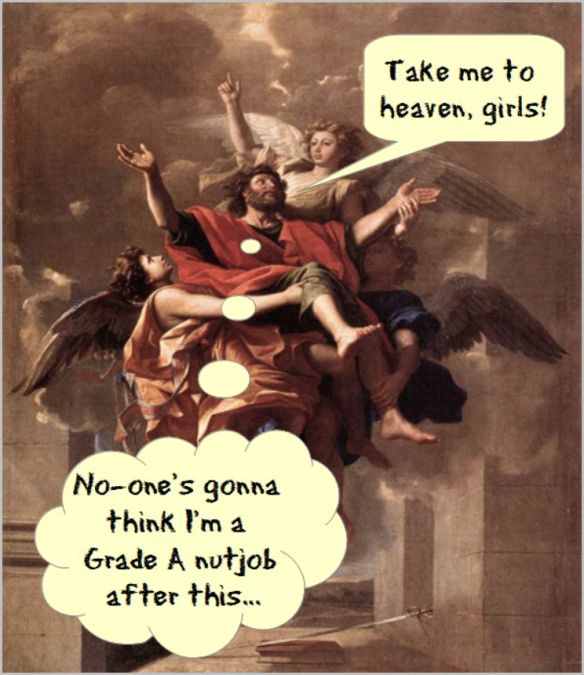
So Paul interpreted his psychotic episodes, depicted as a disembodied voice and bright light in Acts but far more dreamlike and hallucinatory in Paul’s own descriptions, as experiences of the risen Jesus himself (1 Corinthians 9.1 & Galatians 1.11-12) and of heaven (2 Corinthians 12.1-4). From these he built up all of his fanciful ideas of ‘the Christ’, not one of them based on anything demonstrable or real. All of them mere notions in his head, notions that others were all to willing to accept as the words of a god. After all, wasn’t that how the Almighty always communicated with mere mortals?

Still today people surrender to these ‘revelations’; Paul’s theology built on out-of-body experiences, the disciples’ grief-induced visions, John’s hallucinogenic ‘bad trip’. These are the foundation of Christianity as we have it, providing all we know of God, Christ and salvation, and all of them without any basis in reality. Some believers even claim to have the same sort of ‘revelations’ themselves; God speaking to them, Christ bathing them in light, visions of Heaven. All of these, again, entirely within their heads and no more real than the occasional appearances of my long dead grandfather in my own dreams. However much Christians might insist on a rational basis for their beliefs, it is an inescapable fact that the faith has its origins in ancient people’s dreams and hallucinations. Rationalising after the fact doesn’t alter this.

I don’t know about you, but I’m not interested in basing my life on others’ emotionally-induced inner visions, whether those of a Paul, or a Joseph Smith or a contemporary whack-job. I don’t want to learn about the world and life from people whose understanding and knowledge derive from their sub-conscious and hallucinatory fantasy life. Give me science any day, with its attempts to minimise subjective, human biases from its exploration of how things are. Give me its discoveries that have enhanced life, however imperfectly, in the here and now. Above all, give me honest rationality over sub-conscious imaginings and psychoses.

I have no interest in a god, or a saviour, constructed from other people’s dreams, visions or hallucinations, even, or especially, when they’re recorded in that most unreliable of sources, the bible.


How the bible gets almost everything wrong: volume 2

bible-questions

The bible’s moral inconsistencies:

As we saw here and here, the bible’s morality is confused and frequently contradictory. Jesus himself adds to the confusion with pronouncements like:

You have heard it said (in Exodus 21.24), ‘Eye for eye, and tooth for tooth.’ But I tell you, do not resist an evil person. If anyone slaps you on the right cheek, turn to them the other cheek also. (Matthew 5:38-39)

and

You have heard it said, ‘You shall not commit adultery.’ But I tell you that anyone who looks at a woman lustfully has already committed adultery with her in his heart (Matthew 5.27-28).

God’s ‘standards’ change depending on who thinks they’re channelling him:

In Joel 3.8 he advocates slavery but in Exodus 21.16 he forbids it.

In Matthew 6.1 Jesus insists good deeds should be done secretly forgetting he’s already said, in Matthew 5.1, that they should be done openly to impress others.

In Matthew 7.1-3 Jesus says judging others is to be avoided while in 1 Corinthians 6.2-4, Paul gives it the go-ahead; judging others is fine.

In Matthew 19.10-12 Jesus disparages marriage but the writer of Hebrews approves of it (13.4)

God allows divorce in Deuteronomy 21.10-14 but in Matthew 5.32 Jesus doesn’t.

And on and on. Like everyone else’s, Christians’ morality is socially determined. Unlike everyone else’s, their morality reflects the bible’s own confusion and inconsistencies. To accommodate its contradictions, Christians cherry-pick from it to bolster their pre-existing prejudices and biases. The rest of us are then measured – judged – against the resulting pick’n’mix morality and, boy, are we found lacking. ‘Biblical morality’ is nothing if not projectile.


The bible’s weak understanding of psychology:

Many of those who wrote the bible had a particularly bleak view of human beings. To these men we are totally depraved and our every thought is ‘continually evil’ (Genesis 6.5) Our ‘hearts’ are supremely deceitful and desperately sick (Jeremiah 17.9) and we’re under the control of the devil (Ephesians 2.1-3). We are incapable of doing good (Romans 3.10-13) and as Jesus himself puts it:

That which proceeds from a person, defiles that person. For from within, out of the heart, proceed the evil thoughts, fornications, thefts, murders, adulteries, deeds of coveting and wickedness, as well as deceit, sensuality, envy, slander, pride and foolishness. All these evil things proceed from within and defile a person. (Mark 7.20-23).

I don’t recognise this as a description of myself and I’m sure you don’t of yourself. Of course human beings are capable of terrible acts (I’m writing this not long after a fanatical Muslim murdered 22 young, innocent people in a terrorist bombing in Manchester, here in the UK) and, on a more mundane level, we can behave in thoughtless or vindictive ways, entirely out of self-interest.

But we’re also capable of great kindness, compassion and concern. We are a complex mixture of these traits, the good and the bad. The biblical view that we are only ever hateful, devoid of any good, is jaundiced and unnecessarily negative. If parents were to spend their time telling a child he or she is only ever bad, wicked and evil, they would rapidly deprive the child of their self-worth, self-confidence and ability to relate in positive, loving ways to others. The description would become self-fulfilling. This is what the God of the bible does to his children.

Neither are we awash with sin. Sin is a religious idea, used to describe how humans fall short of the glory of God. It need not concern us here. There is no God to fall short of; sin therefore is a concept without any traction in the real world.


The bible’s fantasy perspective of the world:

Did you know this world is controlled by the devil and his demons? That powers and principalities of the air are at war with God and the powers of holiness all around us? In fact, the devil is always looking for ways to discredit the bible and is constantly trying to weaken Christians’ faith. He smuggles false doctrine into the church in order to mislead believers, and uses the hoax that is evolution to prevent unbelievers from accepting Christ as their saviour. He gives women ideas above their station, which God says is to be submissive, and has unleashed a wave of homosexual behaviour and gender confusion to blind people to God’s goodness and to kindle his wrath.

Did you know, though, that this fallen world and the ‘heavens’ above it are soon to be destroyed and replaced by a new earth and new heavens, where Jesus will reign over the select few God decides to raise from the dead? Despite Satan thinking he’s in control, it’s actually God who is. God only allows the devil to think he’s top-dog while he, God, is secretly pulling the strings.

If you do know these things, and if you believe them, then you have a ‘biblical worldview’. Or, to put it another way, you’ve bought into third-rate hokum that bears no relation to the world – the universe, even – as it is.


How the Bible gets almost everything wrong: volume 1

Jesus7

Scripture is under attack! Yes, really. Answers in Genesis says so, so it must be true. The Enemy with a capital letter is out to undermine its authority. That Satan and his school-boy pranks! What will he think of next?

It doesn’t, though, need an all-powerful personification of evil to undermine the bible. It does it all by itself. In any aspect we might care to mention; scientific, medical, historical, moral, psychological – even how the universe operates- the bible is mistaken, confused and just plain wrong. The truth is not in it.

Let’s take look at some examples:

The bible’s scientific blunders

According to the bible:

the Earth was created before the sun (Genesis 1:9-16)

Stars are points of light in the canopy – ‘the firmament’ – that surrounds the Earth (Genesis 1:16-17)

Beyond this canopy is water (water comes for the sky doesn’t it? I guess the canopy leaks. God opens its ‘windows’ during Noah’s flood) (Genesis 1:6-7)

The sun moves, though it can be made to stop in its tracks with the right magic (Joshua 10:12-13)

Genetic characteristics can be changed by whatever animals look at while they’re copulating (Genesis 30:37-39)

Hares and coneys chew the cud (Leviticus 11:5-6) and flying insects sometimes have four legs (Leviticus 11:20-23)

The value of Pi is 3 (1 Kings 7:23-26)

More here if you can bear it: http://skepticsannotatedbible.com/science/long.html

The bible’s historical inaccuracies

The ‘history’ of the Old Testament is largely fabricated. Much of it is myth and legend, created centuries after the events it purports to describe. There is no evidence, for example, that the Israelites were slaves in Egypt, wandered the wilderness for forty years and then invaded the land of Canaan. Historians are now fairly sure that the people who would later fashion themselves as the Israelites were rabble-rousers within Canaan and that they set about eliminating, by one means or another, other populations that lived there. The ‘great kings’ of Judaism – David, Solomon – were no more than tribal leaders; think ‘Taliban commanders’ and you’ll have a pretty accurate picture of what they were really like.

There’s no evidence either for Noah’s ark and a global flood, the events of the tower of Babel, Joshua’s destruction of the walls of Jericho, Daniel’s adventures in the palace of Nebuchadnezzar… you name it. Each and everyone of these stories was created to make theological points, to aggrandise the people who created them.

There are similar problems when it comes to the historicity of Jesus’ life.

The bible’s medical ignorance

According to Jesus – God Incarnate, no less – many disabilities and diseases are caused by demons:

A man in the crowd answered, “Teacher, I brought you my son, who is possessed by a spirit that has robbed him of speech… Jesus rebuked the unclean spirit, saying to it, “You deaf and dumb spirit, I command you, come out of him and do not enter him again.” (Mark 9:17 & 25)

The way to cure illness therefore is to ‘drive out the unclean spirits’ that cause it. Jesus does so many times (Matthew 12.22 etc) and sends his chums out to have a go as well (Matt 10.1). Now, is this because God knows that sickness and disease really are caused by supernatural baddies, or is it because Jesus’ understanding of illness was as limited as that of any other first-century peasant? You got it – Jesus (and his later script-writers) merely reflect first-century ignorance about the causes of illness. However, if, as today’s Christians believe, Jesus was somehow God himself, then why don’t they opt for exorcism every time they’re ill? There are some nut-jobs who do, of course, but why don’t all of them trust their lord and saviour on the matter?

There’s equally ludicrous medical advice elsewhere in the New Testament: James 5.14-15 tells us that the cure for any ailment is prayer:

Is anyone among you sick? Let him call for the elders of the church, and let them pray over him, anointing him with oil in the name of the Lord. And the prayer of faith will save the one who is sick, and the Lord will raise him up.

Sure enough, some believers have taken this ridiculous advice seriously. Instead of medical treatment, they’ve done as the bible commands and prayed for their sick children, frequently with fatal consequences.

More next time…


Making Excuses for Jesus

Hokum2

Excuse 3. When Jesus said ‘Kingdom of God’ what he really meant was ‘heaven’.

According to many Christians, the Kingdom of God is a supernatural realm where those whom Jesus has redeemed are going to go when they die. This kingdom is not, despite what Jesus said, coming to the Earth; believers are going to it, and it’s called heaven.

This is probably the most prominent view among Christians today and it couldn’t be more wrong. As we’ve established, Jesus says repeatedly and consistently that the Kingdom is coming here, to the earth. As well as all of his assurances (cited in earlier posts), he taught his followers to pray to God that ‘thy kingdom come, thy will be done on earth as in heaven’ (Matt 6.10), a petition Christians affirm whenever they repeat ‘the Lord’s prayer’.

Nowhere does Jesus promise his followers that they will spend eternity in heaven with God. Neither does Paul, nor any of the New Testament writers. Heaven, according to the bible, is God’s abode beyond the clouds; it is not a theme park open for visitors or long term guests. True, Paul believed that deceased souls would enter the presence of Christ to be kept safe until the Kingdom’s arrival, at which point they would be housed in new, spiritual bodies (1 Corinthians 15:35-58; 1 Thessalonians 4.13-18). These new bodies would not be for life in heaven, however, but for a resurrected existence here on earth, once the Kingdom had been established.

Amazingly, Paul expected people to believe this appalling drivel. Later Christians evidently couldn’t, and so invented the idea that they would be going to Heaven permanently post-mortem. John 14.3, which makes Jesus say he’s going to prepare a place for his disciples ‘in his father’s house’, might be an early sign of this wishful thinking. On the other hand it might mean something else altogether – as usual Jesus is made to speak in obtuse riddles.

Whichever it is, Christians are not promised an existence in heaven when they die. The only offer is of a place in God’s Kingdom on Earth, which both Jesus and Paul thought was coming very soon.


Excuse 4. When Jesus said ‘Kingdom of God’ what he really meant was ‘an internal kingdom of the heart’.

The Kingdom of God, then, must be, as a commenter on Answers in Genesis recently assured me, ‘an internal kingdom of the heart’. But you’d be hard pushed to find this bit of fluff in the bible. The closest it comes to saying any such thing is in Luke 17.20-21 where Jesus announces that the Kingdom of God is ‘entos hymon,’ a phrase sometimes rendered as ‘within you’ but which is more accurately translated ‘among you’. It is not an assurance that the Kingdom of God is some sort of silopsistic comfort blanket for believers in the far-flung future. It is yet more evidence that Jesus (or his script-writers) regarded the Kingdom as imminent in his and their own immediate context: first century Palestine. 

That’s four excuses – four explanations that what Jesus really meant was what today’s Christians want him to have meant. It’s tough facing up to the reality that God’s Son – God himself according to some Christians – was so mistaken, so disastrously wrong. But he was.

So naturally, more excuses are needed…


Whatever happened to the Kingdom of God?

Cross4

Jesus clearly and unequivocally announced that the Kingdom of God would soon be coming to the earth (Matthew 16.27-28; Matthew 24.27, 30-31,34; Luke 21.27-28, 33-34 etc).

This was his Good News. According to the synoptic gospels his entire ministry was about announcing the arrival of this Kingdom and demonstrating it was just around the corner (Mark 1.15; Luke 11.20 etc). All of his teaching was predicated on his belief that God was soon to intervene in human affairs to right all wrongs, repair injustices and punish the wicked (Matt 5.3-12; 25.31-46). He had no message other than this.

Yet many – most? – Christians refuse to acknowledge any of this. For Christians, Jesus was about something else entirely. Many of them argue that even though he might have appeared to say that God’s Kingdom was imminent, this wasn’t what he really meant.

When he promised it would happen ‘within this generation’ (Matt 24.34), they say, what he really meant was the generation alive after certain calamities had taken place (Matt 24.15-31), evidently more than 2000 years into the future. As I’ve suggested before, this makes him one heartless bastard, standing, as he did, in front of the meek, the hungry and the downtrodden and promising them all would soon be well, when he was ‘really’ referring to people who wouldn’t be born for another two millennia.

But then he’s more specific about who he intends the promises for, when says in Matthew 16:28, “Truly I tell you, some who are standing here will not taste death before they see the Son of Man coming in his kingdom.” ‘Some who are standing here’ – the people who were physically present, there in front of him, being addressed by him. It’s difficult to maintain that he meant people in the far future when he specifies those who are ‘standing here.’ Yet Christians maintain just this.

“Aah, yes,” they say, “but he was clear no-one knew the hour of the Kingdom’s return – not even himself.” Yes, he did say this – in Mark 13.32 – but there’s no conflict between this claim and his insistence the Kingdom would arrive soon. We all do this sort of thing when we say, ‘my parcel is due to be delivered some time today but I don’t know when exactly.’ This is what Jesus is claiming: ‘the Kingdom will be here very soon, though I don’t know precisely when.’ Too right he didn’t.

Nonetheless he thought he had a pretty good idea. In Matthew 10.23 he sends the disciples off to announce its arrival to the cities of Israel and tells them the Kingdom will have arrived before they return. When they get back (in the next verse!) the Kingdom is still conspicuously absent, so he and the gospel writers conveniently forget all about his rash promise. Where’s a good editor when you need one?

And then it all goes wrong for him. Jesus is arrested for his seditious idea that the existing system is about to be overturned and replaced (Matt 19.28), and he’s sentenced to death. Did he continue to hold out hope that God would act before the execution could be carried out? Did he expect his Heavenly Father to carry out a last minute rescue by bringing in the Kingdom with a great show of power? It seems likely, but as he hangs on the cross he realises, finally, that God is not going to act. God has let him down, as he always must, and a deserted and despondent Jesus cries out in dereliction: “My God, my God, why have you forsaken me?” (Mark 15.34). How could he have got it so wrong?

‘No, no, It can’t end like this,’ cry the Christians in return (and indeed it didn’t). But how to explain (away) the great failure of Jesus’ mission heralding the arrival of God’s Kingdom on earth?

Don’t worry, our Christian friends are up to the task.

Next time…


How to argue like a Christian (part two)

Street-preachers

Five more ‘arguments’ offered by Christians in defence of their insupportable beliefs:

You’re not entitled to speak because you have no objective basis for your morality; morality comes only from God/the Bible.

Except it doesn’t, of course; moral codes existed long before the Bible or even the invention YHWH, who is, in any case, morally bankrupt. This ‘most unpleasant character in all fiction’ ‘wallows’, if I might borrow the term, in genocide (1 Samuel 15.2-3 etc) and slavery (Leviticus 25.44-46; Exodus 21.20-21 ); he relishes the death penalty for the most minor infringements of his petty rules (Leviticus 24.16; Deuteronomy 21.18-21, etc ad nauseam); fails to keep his promises (Genesis 17.7; Mark 11.24); does nothing to relieve human or animal suffering and lets millions of children die needlessly, year in, year out. It just doesn’t suit his mysterious ways, apparently, to behave like any halfway-decent human being would.

And even if he were the morally-upright paragon of virtue Christians delude themselves into thinking he is, they would ignore his moral guidance at every turn, just as they do now. Ministers, priests, evangelists as well as run-of-the-mill believers are convicted every day of the most despicable of crimes (Bruce Gerenscer keeps a tally on his blog-site) and that’s before we get to the more exacting moral demands Jesus makes. Going the extra mile (Matt 5.41), loving neighbour (Mark 12.31) and enemy alike (Luke 6.27), giving to all who ask (Luke 6.30) – these most Christians simply ignore. ‘We’re forgiven, not perfect,’ they whimper, even though ‘perfect’ is precisely what their unreasonable saviour tells them to be (Matt 5.48). But then I’m probably quoting out of context again… or something.

You’ve been hurt in the past.

This weak, ad hominem response is the converse of the charge that you’re immoral; good cop as opposed to bad cop. The Christian who says this is all-seeing and all-knowing and is able to evaluate your entire psychology and personal history from a single comment you’ve made. They can tell that you’re only disputing an aspect of Christianity because obviously at some point in your past a Christian – who wasn’t really a true Christian – hurt you. Or maybe it was a church you once belonged to that let you down. Well, you’ve every right to feel hurt! But that doesn’t mean there’s anything wrong with the True Faith™ or those who subscribe to it! And so your point is neatly invalidated; you’re only responding emotionally and you’ll get over it.

If there’s no God then life is meaningless.

Used extensively by some Christian blog-sites, this non-sequitur translates as, ‘I’m not going to address anything you say. My neediness demands there’s some point to life and I’ve decided that it comes from the fantasy I’ve bought into.’ Questions of whether that fantasy is actually true (which by definition it can’t be) and whether life is meaningless without it, are never considered. Believers’ need for the delusion to be true, their fear of working out meaning for themselves and their subsequent investment in Christianity’s empty promises, compel them to hide behind what is an essentially… er, meaningless solipsism.

Unbelievers have no right to criticise those who belong to Jesus.

Haven’t we? We put up with all the nonsense Christians spout, their attempts to influence everything from elections to what we can see on TV, from their opposition to gay rights, same-sex marriage, women’s rights, abortion and adoption issues to the restrooms people can or can’t use and their judging of the rest of us as hell-bound sinners. In return, we unbelievers are perfectly entitled to hold Christians accountable. At the risk of repeating myself, do they do what Jesus tells them to? Do they turn the other cheek (Matt 5.39)? Sell their possessions to give to the poor (Mark 10.21)? Give more than is demanded of them (Matt 5.40)? Avoid judging others so they’re not judged in return (Matt 7.1-3)?

What do you think?

You’re of the devil/an enemy of the cross/wilfully blind/apostate/a troll.

If all else fails (and it will) the faithful resort to an insult carefully selected from the extensive bank of Christian cliches. That way, there’s no need to engage the brain at all. God love ’em!


The original ‘good news’ had nothing to with any mystical salvation plan (part two)

Disciples2

Last time, I provided evidence that Jesus’ original ‘good news’ had nothing to do with any mystical salvation plan constructed around his supposed resurrection. My six references demonstrated that, even after his death, the disciples adhered to Jesus’ original message: God’s Kingdom was coming soon and they were going to rule over it. Here are six more reasons we can be sure this was the case:

7. Our earliest sources, Q and the gospel of Mark, do not give much credence to the resurrection as an actual event: Q records no sayings of the risen Jesus and Mark has no resurrection appearances; it ends with the women who discover the empty tomb deciding not to tell the disciples about it. In Mark’s gospel, then, the disciples are not even aware the tomb is empty, let alone that Jesus has returned from the dead. We can conclude from this that the community that produced Mark’s gospel, the supposed resurrection was not significant in and of itself.

8. Paul tells us that the disciples’ gospel was not the same as his, despite the fact he too believed the Kingdom wasn’t far off (1 Thessalonians 4:17). The disciples, he says in 2 Corinthians 11.4-5 and Galatians 1.6; 2.11-21, were preaching ‘a different gospel’. Different from his, certainly, but the same as the ‘good news’ Jesus proclaimed: Jewish people should prepare for the imminent arrival of God’s Kingdom on Earth (Mathew 9.35; 15.24), when, as Jesus himself had promised them, the disciples would judge the restored tribes of Israel and rule over them. It is, as we have seen, out of the question that they would jettison this aspect of the ‘good news’, given to them by Jesus himself.

9. Because the disciples – and Jesus’ brother James – saw the new Kingdom as intended for Jews only, as Jesus had before them (Matthew 10.23), they insisted that any Gentile converts must be circumcised; must become Jewish (Galatians 2.7). Paul, of course, objected to this requirement and throws tantrums about it in his letters (Galatians 5.1-12; Philippians 3.3). But like Jesus, the disciples saw no place for Gentiles, the unrighteous, in the new age; those who didn’t convert would, of necessity, be dispatched to eternal punishment (Matthew 25.31-46).

10. As far as the disciples were concerned, therefore, it was entirely for their own good that converted Gentiles be circumcised (Galatians 6.12-13) as this was their only guarantee of a place in the new Kingdom. What this tells us is that a salvation formula, such as that dreamt up by Paul, had no part in the disciples’ ‘good news’.

11. Wherever they appear – in Paul’s writing, the gospels, Acts – the disciples are portrayed as being at odds with an incantational, faith-based Christianity. The Bible attests, even with Paul’s new religion superimposed, that they held to a different gospel, a different sense of what Jesus’ life meant and a different notion of their place in the coming Kingdom. And wouldn’t they be the ones to know? They knew Jesus, spent time with him, listened to his teaching, bought into his misguided mission and had sufficient understanding of it to spread his ‘good news’ to fellow Jews, both while he was still alive and afterwards (Matthew 10.23; Luke 9.1-2).

12. The New Testament is testimony to the failure of everything Jesus and the disciples stood for; their ‘news’ that God was soon to turn the Earth over to the meek and that they would then rule the only people who mattered, the twelve tribes of Israel, with everyone else thrown into outer darkness (Luke 13:28). Jesus himself, of course, would return at some point to be top dog, God’s representative on Earth – his anointed one. None of this happened.

If only it had been allowed to rest there, we might not know today of Jesus and his mad ideas. Instead, Paul stepped in, reinterpreted the whole ridiculous enterprise and bequeathed the world a set of different but equally absurd beliefs. And the rest is history: religious wars, pogroms, inquisitions, suppression, superstition, clerical child abuse, Pat Roberston. Is this the Kingdom that Jesus and his closest associates foresaw? Decidedly not. But it is their legacy.

The original ‘good news’ had nothing to do with any mystical Salvation Plan™


Pentecost

As I discussed last time, there are indications throughout the New Testament that Jesus’ original ‘good news’ had nothing to do with a mystical salvation plan. There are clues too that the disciples clung to this original message – they’d heard it from Jesus himself, after all – even as other interpretations began to supersede it.

Let’s take a look at the evidence:

  1. Jesus tells his chosen twelve, which includes Judas, that they will rule with him in the age to come (Matt 19.28). As Bart Ehrman points out1, the fact that Jesus evidently had no foreknowledge of Judas’ later betrayal means this promise undoubtedly goes back to Jesus – it is unlikely later believers would have made it up. Though their names vary between gospels, Jesus hand-picked twelve men to rule with him.

  2. He appoints twelve disciples quite specifically and later tells them privately that this is so they can judge and each rule one of the twelve tribes of Israel once God’s Kingdom arrives (Luke 22.30).

  3. When Judas kills himself, the remaining eleven disciples think it vital to appoint a replacement twelfth (Matthias, in Acts 1.21-26). The number remains significant to them. How would they be able to rule the twelve tribes of Israel if there were only eleven of them? There had to be twelve for this very purpose. Even after Jesus’ death and supposed resurrection, the disciples are still preparing for the end of the age he prophesied and for their positions of power in God’s Kingdom.

  4. By the time the synoptic gospels were written, Jesus secret teaching that the Twelve would rule alongside him in the new kingdom had become common knowledge (hence its inclusion in the gospels). Given that he told them in private they’d be judges and rulers, it can only have been the disciples who later broadcast this information. And why would they do this? Because it was an integral part of their good news. Furthermore, all three synoptic gospels include a range of episodes in which the twelve are castigated for their presumption (eg: Mark 10.37-41; Matthew 20.22-24; Luke 22.24-30). These have all the hallmarks of stories created later, when a different ‘good news’ was emerging, specifically to mock the disciples’ belief.

  5. In much the same way, the disciples are consistently depicted as having no real understanding of Jesus’ mission (Mark 9.30-32; 10.35-45). And they don’t, in that they have no understanding of the later reinterpretation of Jesus’ significance. How could they? By the time the gospels came to be written, the mystical-Christ version of Christianity had started to take hold. Paul’s salvation plan and the supposed resurrection were beginning to assume greater importance than Jesus’ original message. How could the disciples, 40 years earlier, have known that this was going to happen? How could Jesus? They have to be portrayed as being largely ignorant of later developments – developments which, in any case, they opposed when they did encounter them (Acts 9.26; Galatians 1.6; 2.11-14; 3.1-3).

  6. In fact, Jesus teaching – all of it – was predicated on his belief that the Kingdom of God was ‘at hand’, imminent, about to happen real soon (Mark 1.15; 9.1; 13.30; Matthew 10.23; 16.28; 24.34), and that when it did, he and his chums would be there ruling it. It is unthinkable his inner circle would abandon this teaching, even after he died, in favour of something else. Any visions they had of him returned from the dead would only have reinforced their commitment to his ‘good news’; resurrection, after all, was a sure sign of the Kingdom’s arrival (Daniel 12.2-3).

To be continued…

1 Ehrman, Bart D., The Lost Gospel of Judas, p146

The Eye-witness Fallacy

MaryM2

The falsehood that the gospels are in some way eye-witness reports just won’t go away. There is no evidence they are or even that they are based on reports by eye-witnesses. Scholars speak of ‘sources’ for all elements of the gospels (Mark, Q, M & L); these were almost certainly pre-existing written and oral traditions from before the gospels’ creation.

This really is problematic for those propagating the idea that the gospels are eye-witness accounts. If they were even so much as based on eye-witness reports, then why would they need to rely so heavily on other traditions? If, as is claimed here, the scattered gospel communities who wrote them were in some sort of immediate contact with the fanned-out eye-witnesses, then they would have no need to use sources and traditions from elsewhere. Yet they do; Matthew and Luke borrow extensively from a shared source (Q) and also from Mark, particularly for their resurrection stories.

This is akin to someone today interviewing witnesses to John F. Kennedy’s assassination, – a similar interval to that between Jesus and the gospels of Matthew, Luke and John – and then, before publication, replacing what the eye-witnesses say they saw with the more far-fetched elements of Oliver Stone’s movie JFK. If there were eye-witnesses to hand, there wouldn’t be any need to do this. It doesn’t make the slightest sense that the gospel writers would do so. Yet they do.

As far as the stories of the resurrection are concerned, it is much more likely they are based, not on any eye-witness accounts, but on the scant mentions of the mystical, risen Christ of the kind we find in Paul’s letters, filtered, primarily, through Mark. As such, they are a fleshing out (almost literally) of hearsay reports of a limited number of visions that, by the time the gospels came to be written, had embedded themselves in the traditions of the early church.