Gentle Jesus – meek and mild?

StonedWhen it comes to derogatory and hateful remarks about minorities, Jesus is frequently given a pass. His ‘meek and mild’ persona – not one he actually had, but one he’s acquired over time – is brought into play to absolve him of all unpleasantness.

For example, and as liberal bloggers are fond of saying, here’s what he had to say about gay marriage:

“

                                                                                                                                            ”


Yup, that’s right; he said absolutely nothing about it – not directly anyway. But what Jesus did say, if ‘Matthew’ is to believed, was that he upheld the Jewish Law in its minutest detail:

Do not think that I have come to abolish the law or the prophets; I have come not to abolish but to fulfil. For truly I tell you, until heaven and earth pass away, not one letter, not one stroke of a letter, will pass from the law until all is accomplished. Therefore, whoever breaks one of the least of these commandments, and teaches others to do the same, will be called least in the kingdom of heaven; but whoever does them and teaches them will be called great in the kingdom of heaven. (Matthew 5.17-19)

That’s the Law that prescribes death for even the smallest infraction that he’s endorsing there. Here’s a brief sample of that Law and the penalty for breaking its petty rules:

Stone to death anyone who works on the Sabbath. (Exodus 35.2 and Numbers 15.32-36)

Kill publicly children who dishonour their father or mother. (Leviticus 20.9)

Stone to death anyone who blasphemes the name of the Lord. (Leviticus 24.16)

Execute a married couple who have sexual intercourse during the woman’s period. (Leviticus 18.19)

Put to death those involved in adultery. (Leviticus 20.10)

Execute any man who lies with another man, as with a woman. (Leviticus 20.13)

Stone to death at her father’s door any woman who is not a virgin on her wedding night. (Deuteronomy 22.13-14 and 20-21).

Sound familiar? With its oppressive brutality and liberal use of the death penalty, this sort of behaviour is like IS practices today. They’re both desert ‘moralities’, after all. And this is the law that Jesus advocates and insists remains in place until ‘heaven and earth pass away’. As that hasn’t happened yet, the Law, according to Jesus anyway, remains in effect. Never mind that Paul says it doesn’t – God himself, in the shape of Jesus Christ says it does. How’s that for meek and mild?

(Cue Christians referencing the story of the woman caught in adultery. That, however, is a late addition to the Bible and, in any case, Jesus only saves the woman because his beloved Law hasn’t been properly complied with.)

Thankfully, civilised human beings – and civilised Christians too – ignore Jesus and don’t seek to apply such old barbaric laws (though there are some believers who want to when it comes to LGBT people; see my previous post.) But if you want to know Jesus’ position on moral issues that he doesn’t pontificate on explicitly, just remember he fully supports the death penalty for adultery, homosexuality, working on the Sabbath, not being a virgin on your wedding night, having sex at the wrong time of month, dancing, listening to the radio, tweeting and texting… oh wait… now I have got him confused with Islamic extremists. It’s so easy to do.
Next time: Jesus says that the only way to gain eternal life is to follow this vicious Law with all its unreasonable demands.
Christian love… but not so’s you’d notice

Church2Today, the world commemorated the relief of Auschwitz seventy years ago, following the murders of millions of Jews, homosexuals and gypsies.

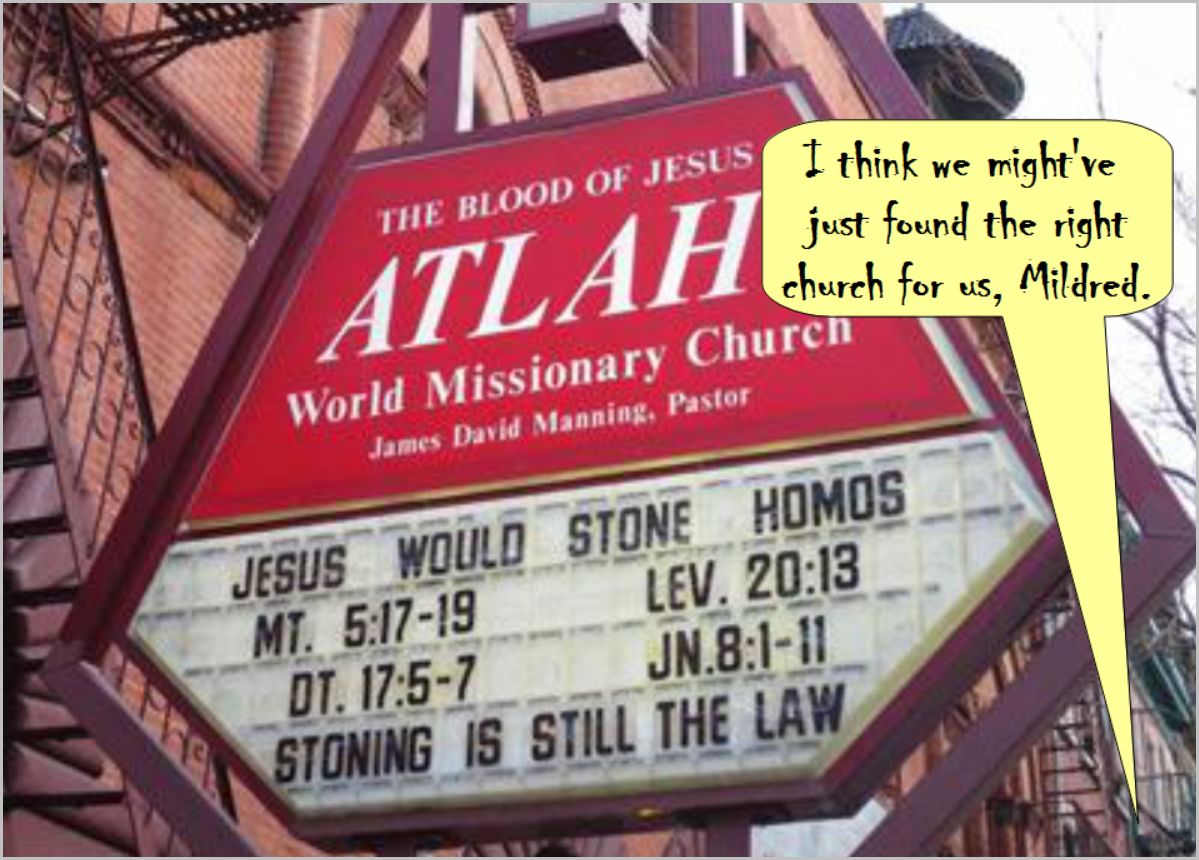
Also today, Christian pastor James Manning said Islamic militants are justified in executing gay people. Another man of God, Ben Carson, implied that Christian bakers might want to add poison to wedding cakes they are ‘forced’ to make for same-sex couples. And just before Christmas, pastor Stephen Anderson said gay people should be exterminated as the means of eradicating AIDS.

Whatever happened to ‘do not kill’? You know, the sixth of the much vaunted ten commandments that believers think should be displayed in public places so that the world might become a better place. I guess it’s far easier to display the commandments than it is to obey them.

What happened too to ‘love your neighbour as yourself’? This doesn’t – big surprise, Christians – mean endlessly pointing out others’ ‘sin’ while relentlessly banging on about ‘the Lord Jesus Christ’ like we’ve never heard of him before. Though again, I guess that sort of ‘love’ is a lot easier than actively caring for other people, regardless of their beliefs, values or sexuality, as much as you care for yourself. That, after all, is the whole point of the story of the Good Samaritan; the Samaritans were despised by the Jews of Jesus’ day in much the same way that homosexuals are despised by many of the righteous today. Yet it is a Samaritan whom Jesus makes the epitome of sacrificial neighbourly-love in his story. Still, what did he know?

And really, that’s my beef with Christianity. It just doesn’t work. Believing in Jesus, following him, as he insists you must, to the point of death doesn’t make you a better person. It doesn’t make you loving if you’re not already. Doesn’t make you meet the demands of the very one you claim was God on Earth. It certainly doesn’t make you more compassionate or even more intelligent, as the men of God above more than amply demonstrate.

So what use is it?


Where is the love?

ExecutionThe picture above has shocked and affected me deeply. It shows a man about to be thrown to his death from a high building in Iraq. According to the original news source, a large crowd was gathered below to watch him fall and then die as he hit the ground many metres below. Another man was then killed in the same way. This happened within the last couple of days; the photo, along with some others, was released by IS on Friday.

The men’s ‘crime’ was that they were deemed to be gay. The method of execution is that prescribed by the Koran.

Religion – in this case Shari’a Islam – lies behind and motivates behaviour of such profound inhumanity. It could be argued too that this is part of the culture in which these people live and as such, must be respected. Really? So what is ‘cultured’ about murdering people?

I’ve been asked recently whether I shouldn’t respect the right of people to hold religious views. But how can I – or anyone in a civilised society – accept the right of others to believe that, simply because someone’s perceived sexuality ‘offends’ an imaginary god, that person should die? And not only that, but that they merit a sentence of such barbarity?

I can’t respect such views, nor anyone’s ‘right’ to hold them; they will, inevitably, act upon them, just as we see here.

There are Christians too who support the death penalty for homosexuals (for example, here, here, here, here and here). Well, you men of God, this is what it looks like, though I guess your preferred method of execution would be to stone them to death, just as your own ‘holy’ book advocates (Leviticus 18.22, 20.13).

No respect is due to people who behave like this towards others, nor to the religions that ‘inspire’ them. Bullies who believe fellow human-beings should be executed because of who they are, and thugs who justify murder because it’s done in the name of an invented deity, are not worthy of anyone’s respect.

Where is the international outcry about this? The solidarity? The politicians linking arms? The advocacy of the civilised world?

Je suis découragé.


Thank you, Nick, for your question and to Joe.My.God.

Predictions for 2015

BrideMy predictions prophecies for the year ahead:

1. There’ll be no Second Coming in 2015.
Jesus won’t be back this year. Just like he wasn’t back in 2014, 2013, 2012… 1985… 1914… 1868… 1497… 1000… 446… 35. Just think of all those years – count ’em, nearly two thousand – when he’s failed to return so far. Actually, he promised he’d be back while his disciples and those daft enough to listen to him were still alive – around AD30 or thereabouts (Matthew 16:27-28; Matthew 24:27, 30-31, 34; Luke 21:27-28, 33-34). Safe to say he’s not coming back at all now, just like dead people don’t. Not in 2015, not ever.

2. Christians will go on insisting Jesus is going to return any time soon.

3. There’ll be no natural disasters or human calamities as a result of same-sex marriage.

4. Christians will claim natural disasters and human calamities are the result of same-sex marriage. Shaking our fists at God… the wrath of the Almighty… sign of the End Times… blah, blah, blah.

5. More than one prominent Christian will call for the execution of gay people.

6. Christians in the west will claim they’re being persecuted when they’re being expected to treat others fairly and equally, and not to discriminate against them.

7. Christians will respond to criticism with clichés like ‘they wouldn’t dare say that about Muslims’… ‘Christians are the last group who are fair game’… ‘It’s time for Christians to speak out’… ‘Stand up for God’s standards…’ etc.

8. Christians will continue to dismiss and disparage anyone who doesn’t share their views, especially atheists. Look out for ‘atheists have no morality’, ‘the fool hath said in his heart there’s no God’ and ‘atheists want to oppress Christians’ occurring with tedious regularity.

9. There will be more revelations about the abuse of children by church ministers.

10. Church hierarchies will attempt to cover up the abuse of children by their ministers.

11. There will be the usual manufactured ‘war on Christmas’.

12. These predictions have far more chance of coming to pass than any of the so-called prophecies of Bible. I’ll return to them at the end of the year so we can see.

A happy new year to you all!


Original picture: Ursula Klawitter / zefa / Corbis

Answers to this year’s all-new Christmas Quiz

saving-christmas-posterGod save us all from this, this Christmas time.

1. Where does the word ‘Christmas’ come from?
The answer is b, the name comes from the Catholic Mass held on the supposed date of Jesus’ birth. So all you anti-Catholic Christians need to find a new name for it fast.

2. When was Christ born?
a) is the answer here: Christ wasn’t born. Maybe Jesus was, but ‘the Christ’ is an invention of later Christians (Paul, for example, in Romans 8.3 and John’s gospel, written up to a century after Jesus lived.) The Christ is a mythic, supernatural being who’s always existed. He bears little relation to the itinerant Jewish preacher Yeshua who wasn’t born on 25th December or in the year 0.

3. Which gospel writers didn’t think the nativity story worth including in their accounts?
Mark and John (b & c) don’t bother including it. Did they not know it? The two gospels that do have bits of the story – Luke and Matthew – contradict each other.

4. How well attested are the events surrounding the birth in historical documents of the time?
a) Not at all. You’d have thought the Romans, who were pretty good at keeping records (lots of which have survived) would have noted Herod’s massacre of little boys or the appearance of a new, magic star in the sky – they were, after all, a superstitious lot. Not even Josephus, who, in the late first century, acknowledges the existence of Christians, sees fit to mention any of it.

5. Following the miraculous events of Jesus’ birth, what did Mary do?
According to Luke 2.19, she treasured them in her heart. However, the answer is c) because only a few verses further on, she hasn’t a clue about what her son is up to (Luke 2.48). Later still, she is part of the family’s efforts to ‘restrain him’ (Mark 3.21 & 31). Why, on these occasions, doesn’t she recall his miraculous beginning and think, ‘oh yes, I remember now. He behaves like a lunatic because he’s the son of the Most High.’ She certainly didn’t write down the details of his miraculous birth for later use in the gospels. No-one did. On account of them not really happening. Just sayin’.

6. How many times does Jesus refer to his miraculous birth?
a) Never. Strange that.

7. How many times does the rest of the New Testament refer to Jesus’ miraculous birth?
c) Never, even more strangely. Evidently the story hadn’t been invented when the rest of the New Testament was written.

8. When did Christians first start celebrating Christmas?
a) hundreds of years later.

9. Which of these Christmas traditions originate in the Bible?
None of them. Despite what Kirk Cameron might think, Christmas trees, kissing under the mistletoe and giving presents all have pagan origins. The giving of gifts did not come about because the wise men did it first. The tradition pre-dates Christianity.

10. Which of these groups has benefited the most from Jesus’ birth?
Yes, you’re right; none of them. Not women, not black people and not LGBT people. Christianity has a history of oppressing all three groups.

Speaking of which…
11. What does Pastor Steven Anderson want for Christmas?
c) he’d like to see the execution of all homosexuals so that AIDS – which, as far as the reverend understands it (I use the term loosely) only gay people get – might be wiped out. Peace and joy to you too, Stevie.

12. How will Christians celebrate Christmas this year?
The answer is a, b and c: by fighting the War On Christmas, putting the Christ back into Christmas and by telling us that Jesus is the Reason for the Season. Just like they do every year. As you can see, Kirk Cameron’s disaster of a movie, Saving Christmas, has two of these blessed clichés on its promotional poster alone.

So how did you do?
If you scored –
between 10-12: well done. Betcha don’t believe in Santa Claus either.
Between 7-10: your cynicism needs a little work. Order my book for Christmas – it’ll help.
Between 4-6: oh dear. You’re new around here, aren’t you. There’s hope for you though, so stick around. Oh yeah, and order my book for Christmas – it’ll definitely help.
Between 1-3: Like Christmas, you are in need of saving, my friend. May the scales fall from your eyes this holiday period. Amen.

This Year’s All-New Christmas Quiz!

SantaBack by popular demand (well, mine anyway), try this year’s all-new Christmas quiz!

Answers in the Bible or not, as the case may be. Real answers next time.

1. Where does the word ‘Christmas’ come from?
a) the Bible
b) the Catholic Mass held on the supposed date of Jesus’ birth
c) the Greek, meaning to pull the wool over people’s eyes

2. When was Christ born?
a) he wasn’t
b) 25th December
c) in the year 0

3. Which gospel writers didn’t think the nativity story worth including in their accounts?
a) Luke
b) Mark
c) John

4. Following the miraculous events of Jesus’ birth, what did Mary do?
a) she remembered them all in her heart
b) she wrote them down for later use in the gospels
c) she forgot all about them

5. How many times does Jesus refer to his miraculous birth?
a) never
b) twice
c) he doesn’t shut up about it (well, would you?)

6. How many times does the rest of the New Testament refer to Jesus’ miraculous birth?
a) repeatedly, showing how important it was
b) only when making an important theological point
c) never

7. How well attested are the events surrounding Jesus’ birth in historical documents of the time?
a) not at all
b) quite substantially
c) as you’d expect when mass murder and strange astronomical events are involved, they’re mentioned everywhere

8. When did Christians first start celebrating Christmas?
a) hundreds of years after the event
b) not long after Jesus died
c) immediately

9. Which of these Christmas traditions originate in the Bible?
a) Christmas trees
b) kissing under the mistletoe
c) giving presents

10. Which of these groups has benefited most from Jesus’ birth?
a) women
b) black people
c) LGBT people

11. What does Pastor Steven Anderson want for Christmas?
a) his two front teeth
b) peace and joy
c) the execution of all homosexuals

12. How will Christians celebrate Christmas this year?
a) by fighting the War On Christmas
b) by telling everyone that Jesus is the Reason for the Season
c) by putting the Christ back into Christmas


Picture from memegenerator.net


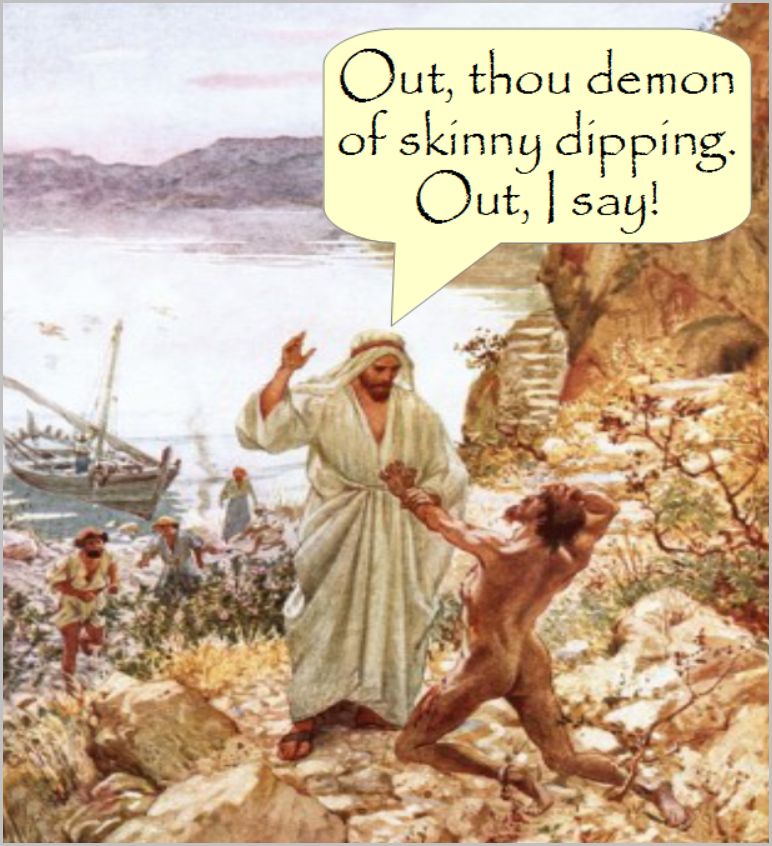
Who Ya Gonna Call?

DemonAnd when they came to the crowd, a man came up to him and, kneeling before him, said, “Lord, have mercy on my son, for he is an epileptic and he suffers terribly. For often he falls into the fire, and often into the water. And I brought him to your disciples, and they could not heal him.” And Jesus answered, “O faithless and twisted generation, how long am I to be with you? How long am I to bear with you? Bring him here to me.” And Jesus rebuked the demon, and it came out of him, and the boy was healed instantly. (Matthew 17.14-20)

Do you believe in spirits and demons? When you’re ill, do you visit the nearest exorcist or do you take yourself off to the doctor or hospital? Of course, most Christians (but by no means all) have more faith in the medical profession than they do in the wingnuts who’d tell them their ailment was the result of demonic activity and command the demon to leave in the name of Jesus.

Why? Because, even Christians know, in spite of what they might tell you, what causes disease and illness. They know what cures them too; and it has nothing to do with Jesus. ‘The Son of God’ is among the wingnuts when it comes to believing unclean spirits are at the root of human ailments and behaviour (Mark 5.1-8; Matthew 8.28-34; Matthew 12.43-45; Luke 4.33-36; Luke 8.29 etc.)

In spite of the fact there’s absolutely no evidence that demons exist, Jesus thought that invisible supernatural creatures were responsible for conditions like epilepsy. Like everyone at the time he thought that if these unclean spirits could be driven out, then the condition would be ‘cured’. Some follow in his misguided footsteps today; the Catholic church has an entire coven of exorcists, and charlatans like the Reverend Bob Larson make a living driving out the demons of pride, lust, homosexuality and greed from stooges and the gullible (except of course they don’t.)

If you’re a Christian, you should believe in demons and unholy spirits; you believe everything Jesus uttered was true, don’t you?

Of course, Jesus was a product of the pre-scientific era in which he lived; his ignorance might be excusable if it wasn’t offered up as God’s Truth. All that Jesus’ belief in devils and unclean spirits demonstrates is that he was very much a man of his time – evidence, if more were needed, that he wasn’t remotely divine. Unless, of course, the God he also believed in was as ignorant of the causes of illness and human behaviour as he was.

But next time you’re unwell, Christian, or you’re feeling a mite greedy or lustful, don’t go to the doctor’s. Don’t even ask the Lord for forgiveness. Have a little faith and, in the name of Jesus, command that hell-spawned demon within you to leave. See how that works out for you.


Update: New this week in ‘It Can All Be Blamed On Demons’:

Right-wing American broadcaster, Bryan Fischer, claims unarmed black teenager killed by cop was in fact possessed by a ‘homicidal demon’.

Tele-evangelist Pat Robertson asserts playing Dungeons and Dragons leads to demon possession.

Thank you, Lord, for your endorsement of fantasist rubbish like this.


This week in the wacky world of religion…

AtrocitiesBecause my invisible super-being is better than yours, this week I’ve:

murdered you at prayer;

beheaded you as an infidel;

denied you an education;

raped your girls and young women;

committed brutal acts of terrorism;

denigrated LGBT people;

flogged you and imprisoned you.

…And all because of my invisible super-being. Isn’t he wonderful?

As for me, I’m just glad I don’t have an imaginary god if this is the kind of thing he tells his followers to get up to.

Banned from the Kingdom of God

PaulHere’s ‘Saint’ Paul’s list of those who won’t be allowed in God’s Kingdom:

Do you not know that the unrighteous will not inherit the kingdom of God? Do not be deceived; neither the immoral, nor idolaters, nor adulterers, nor sexual perverts, nor thieves, nor the greedy, nor drunkards, nor revilers, nor robbers will inherit the kingdom of God. (1 Corinthians 6. 9-10)

We can do better than that though. Who else could we add? How about the self-righteous? The converted? The born-again? The saved? Fundamentalists? Evangelicals? Evangelists? Ministers, bishops and popes? Christians of all stripes and persuasion? Will they all make it into the Kingdom?

No, they won’t. Not one of them will enter the magic Kingdom.

Why not?

Jesus, Paul and other New Testament writers were sure that the Kingdom of God would be arriving on the Earth soon. That’s ‘soon’ as in their own time, 2000 years ago*, and, as you’ll have noticed, the Kingdom, promised in the past for the past, never arrived. It’s not going to now either; neither Jesus nor Paul thought their fantasy was going to materialise some time in the distant future.

More than this, both were wrong that God was preparing to establish a heavenly kingdom on Earth at all. They were religious fanatics caught up in the religious zeitgeist of their day, religion being all they had to explain life, the universe and everything. Their interpretation was wrong on so many levels – but they were stuck with it. And so, when so much seemed unjust, unfair and unreasonable to them, Jesus in particular felt sure the only solution was for God to intervene to set things right; the meek would inherit the Earth, those last would be first and the first last. It was a dream, a vain hope, a complete invention. Not only did the Kingdom not arrive when Jesus and Paul said it would, it was never going to. There was no God waiting in the wings to make everything better.

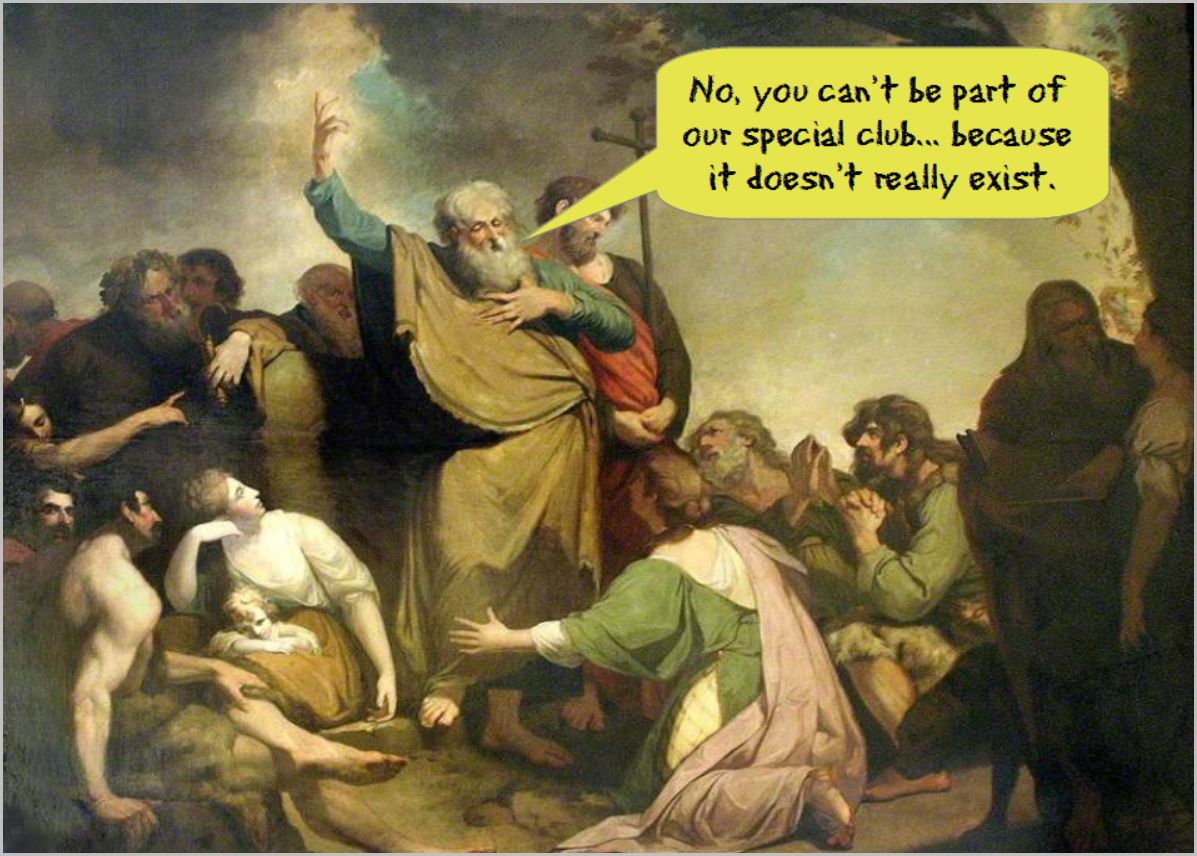
So don’t worry if you’re gay or you like sex with more than one partner or you drink a bit too much or you’ve not been as honest as you might have been. You won’t be part of the Kingdom of God, to be sure, but that won’t be because of your sexuality or your morals or your ‘lifestyle’. You won’t be part of the Kingdom because it isn’t real. You’ll be in good company though – those who love the Lord won’t be getting in either. They’re just as far from Jesus and Paul’s land of make-believe, their special magic club, as you are.


* See Matthew 24:27, 30-31, 34; Luke 21:27-28, 33-34; Matthew 16:27-28; Matthew 19.28; 1 Corinthians 15.51-52; 1 Thessalonians 4.15-17; 1 John 2:17-181 and Peter 4.7 for predictions by Jesus, Paul and other NT writers that the Kingdom was coming real soon.

No True Christian

WeekendA favourite response of Christians to any criticism is, ‘it doesn’t apply to me. I’m not that sort of Christian. The people who do or believe or think those things are not true Christians.’ This the ‘no true-Scotsman‘ fallacy.

  • You get it when you point out how God’s People™ agitate in Africa and Europe to deprive LGBT people of rights, protection and safety (unless of course you’re talking to a Christian who thinks this is a loving thing to do.)
  • You get it when you challenge Christians about Westboro baptist church’s activities, (the latest of which is claiming that Ebola is God’s punishment for Obama, which must be why he’s smiting poverty-stricken Africans.)
  • You get it when you mention those Christians who believe mumbo-jumbo that’s slightly different from theirs.
  • You get it when you ask them about any of the other deplorable things Christians do in Jesus’ name.

‘These other people are not true Christians,’ they say. ‘Their theology isn’t the same as mine; they’re misinterpreting the Bible; I wouldn’t do those kind of things; you’re picking out extremists.’

And do you know, Christians, those very people you say are not true Christians would say the same about you.

So what defines a Christian? Isn’t it that you accept Jesus Christ as your Lord and Saviour, profess him as such, and avail yourself of the salvation you think he offers?

Indeed it is. And it’s precisely this that you have in common with the Westboro baptist church, with those who peddle the absurd, with those who seek to damage LGBT people, with those who use their positions to abuse others and those with different ideas about what being a Christian is really all about.

You and they have bought into the same fantasy: they, like you, have accepted Jesus; they, like you, have his Holy Spirit in their hearts. That they do things you don’t approve of, or regard as embarrassing or despicable, doesn’t alter that fact. You’re all in it together; they represent Jesus just as much as you do; are as much a part of the ‘bride of Christ’ as you are. The zealots, extremists and wackos are your brothers and sisters in Christ, and if you’re right about Jesus being your Saviour – which of course you’re not; I’m being generous here – you’re going to be spending all of eternity with them.

So time to knock the ‘no true Christian’ excuse on the head – it’s going to be so embarrassing for you when you get to heaven.