Can you be a Christian and… accept Evolution?

Hoax

People of faith have a problem with evolution. Some of them can’t seem to see it, but the Theory of Evolution is a significant encumbrance to faith, as it has been since Darwin first proposed it in 1859.

There are essentially four ways Christians (and those from other religions) deal with evolution.

1) There are those who recognise that evolution and faith are incompatible and consequently compartmentalise them both to avoid thinking about the problem: ‘Yes, evolution probably happened but my faith is important to me so I’m going to pretend it didn’t.’

It’s impossible to argue with this head-in-the-sand position, so let’s not bother.

2) Others insist that evolution is ‘just a theory’ and as such is in conflict with what the Bible teaches about the creation of life. But this is a double misunderstanding: of what ‘theory’ means in science, and of what the Theory of Evolution proposes. It has nothing to tell us about how life began, but how it developed. Nonetheless, it contradicts the order of creation found in the two creation accounts in Genesis.

Some believers are content to dismiss evolution on these grounds: a theory, in the popular sense, that is trumped at every turn by the Bible’s accounts of creation. Ken Ham and the laughable Answers in Genesis hold to this position:

The real issue is one of authority—is God’s Word the authority, or is man’s word the authority? So, couldn’t God have used evolution to create? The answer is No. A belief in millions of years of evolution not only contradicts the clear teaching of Genesis and the rest of Scripture but also impugns the character of God. He told us in the book of Genesis that He created the whole universe and everything in it in six days by His word: “Then God said … .” His Word is the evidence of how and when God created, and His Word is incredibly clear.

Hammy and his acolytes do accept what they call micro-evolution, the small incremental stages made within a species over time. Macro-evolution, as they like to call it, when one species gives rise to another over significant amounts of time apparently never happens. Why? Because the Bible says so (but good luck finding where.)

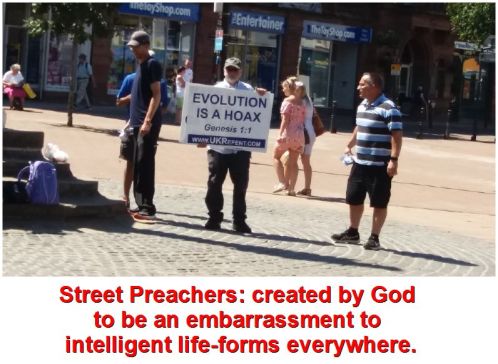
3) Still others extend this dismissal on the basis of ignorance: they are positively hostile to the idea of evolution. Street preachers who set up shop in my home town from time to time are always accompanied by a sign that says ‘Evolution is a Hoax’ (see above.) These kind of believers are not content simply to dismiss evolution as ‘theory’, nor do they accept that it occurs within species. They rail against evolution and disparage the vast amounts of evidence that exist for it. Evolution they declare over their megaphones, is not only a hoax, it is of the devil, who uses it to deceive people and lead them away from God. This is ignorance of a more wilful sort.

Christians in both these last two camps would themselves say that one can’t be a Christian and accept evolution. Actually, they’d say one can’t ‘believe’ in evolution, a word I’ve avoided. Evolution can no more be ‘believed in’ than gravity (itself a theory in the scientific sense.)

4) The fourth way Christians have of dealing with evolution is to attempt to marry the theory with their faith. They acknowledge that evolution has occurred, that life on earth has developed much as Darwin proposed and that the evidence from paleontology, geology, genetics and developmental biology fully substantiates this explanation.

Where then to fit God when he is superfluous to the explanation of life’s development, in much the same way the tooth fairy is superfluous to dentistry? This doesn’t stop these believers finding a place for him. They regard the apparent randomness (their term) of evolution impossible to accept and see a place for God in countering it. As Greg Allison puts it on Desiring God, without a hint of irony, the ‘entire process (of evolution) was undirected and purposeless, without God.’

Consequently, Christians who accept evolution have come up with a couple of ways of injecting God into the process, regardless of the fact he is not needed and there is no place for him. So-called Theistic Evolution, in both its forms, is the belief – and it’s nothing more than a belief – that God set evolution in motion and then let it take its course. One school proposes he occasionally gave it a nudge so that it went in the right direction, the other that he just sat back to see what would happen, though presumably he knew this from the start, being omniscient and all that.

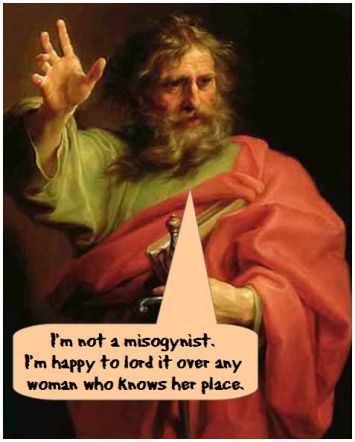
This a hopeless compromise; the prevalence of suffering, death and extinction as drivers of evolution discount any involvement of a benign creator. Such a being’s disinterest in the constant struggle for survival of his created pets, every one of which perishes once past reproductive age (if they reach it in the first place) does not point to a loving God. Paul, who of course had no understanding whatsoever of evolution, believed that death entered creation only when Adam first ‘sinned’. Yet death and suffering existed eons before human beings first appeared. The ‘Evolutionary Creationists’ at BioLogos have a hard time trying to explain this one away. (Spoiler alert: they can’t.)

And let’s not even mention sex; sexual reproduction is a massive problem for the creationist.

As Greg Allison concedes, one cannot be a Christian and subscribe to a theistic model of evolution. Having considered the possibilities, Greg concludes that neither form of theistic evolution is compatible with faith. In this he is right. He comes back to the scriptural accounts of creation as the best explanation of life’s development. In this he is wrong.

No doubt there are commenters out there who think that some form of compromised Christianity and a diluted evolutionary theory are somehow compatible. They have no doubt discovered a way to put God at the heart of evolution or have a misunderstanding of the theory that somehow leaves room for him. Such arguments are unconvincing. Evolution and God are incompatible. One is true (as in observable, supported by evidence and predictive), the other imaginary. There’s no need to pollute the former with the latter.

Can you be a Christian and… gay? (part two)

Blog391b

So, you’ve become a Christian. Your sins have been forgiven and you’re a new creature, or so you’ve been told. Christ/the Holy Spirit/your church are about to free you from the shackles of same-sex attraction.

This is a lie. While undoubtedly the pastor/priest/minister and your church/assembly/fellowship will exert subtle, and not so subtle, pressure on you to conform and suppress your sexuality – and for a time you might be able to – you will never change it. Certainly Christ and the Holy Spirit won’t be working any miracles. They don’t exist.

You will do the work of denying, suppressing and repressing who you are. In the process of doing so you’ll cultivate self-hatred, discover just how depressed and lonely you can be, and make yourself ill – I speak from experience. People on Living Out are doing just that right now. I predict that one day everyone of these so-called ‘Side B’ gay people will regret the awful compromise they’re making for the sake of an hallucinatory salvation. What they’re actually doing is trying to please the church, showing everyone how serious they are about dealing with ‘sin’ and ‘living out’ their faith. No good will come of it.

Being gay is no sin. Homosexual sex isn’t either, including when it’s just for fun (like a lot of heterosexual sex.) How do we know? Because there’s no such thing as sin: it’s a fabrication of an ancient, superstitious mindset. Nor are committed same-sex relationships ‘dishonourable’; they’re as wonderful as any other loving relationship. Same-sex marriage – without scare quotes – is too. If your desires are for intimacy with someone of the same sex, then that is how you will find your life’s fulfilment. That is who you are.

So, here’s the dilemma for the wannabe Christian who knows they’re attracted to people of the same sex:

Do you want to compromise who you are for the sake of conformity or do you want to live as yourself?

Do you want to become ill, depressed and lonely for Jesus’ sake, or do you want to find happiness and fulfilment in life?

If the latter, then you really must see Paul’s ranting for what it is and walk away from the discredited belief system that is Christianity. Instead, ‘live out’ your life, true to your nature. It’s not easy, I know, but, as someone or other once said, when you find the pearl of great price, all else is worth abandoning for it.

One thing seems clear: you can’t be gay and a Christian. Not really.

Can you be a Christian and… gay?

Blog391

No. You can’t. The church regards your gayness, your same-sex attraction, as sinful. If you act on your feelings you are, according to the bible, an abomination. You cannot enter the Kingdom of God if you have sex with someone who’s the same sex as yourself, not even if that’s within a committed, loving relationship:

…do you not know that wrongdoers will not inherit the kingdom of God? Do not be deceived: Neither the sexually immoral nor idolaters nor adulterers nor men who have sex with men (1 Corinthians 6:9)

Paul doesn’t mince his words in Romans 1:25-28 either:

…God gave them over to degrading passions; for their women exchanged the natural function for that which is unnatural, and in the same way also the men abandoned the natural function of the woman and burned in their desire toward one another, men with men committing indecent acts and receiving in their own persons the due penalty of their error… God gave them over to a depraved mind, to do those things which are not proper…

There’s no getting away from this: the bible is emphatic and unequivocal about how it views homosexuality and those who ‘practise’ it. There’s no ‘hate the sin, love the sinner’ here. Gay people are unnatural, degraded, indecent, dishonourable, wicked, unrighteous, sinful and more: this, Paul is clear, is how God sees it too.

Some people, however, want to be both; they’re gay and they also consider themselves to be Christians. They’ve answered the altar call/been born again/baptised into the family of God and have made a commitment to Jesus/God/the church in whatever way their particular ‘fellowship’ teaches they should. Now they’re faced with what to do about their sexuality, when the bible, and in all probability their church too, finds it abhorrent. What to do?

Not all Christians are alike, of course, and not all churches the same. Some, a scattered few, are gay affirming. They say it’s okay for you and your partner to be gay, they still welcome you and see your homosexuality as a cause for celebration: you can, they say, be gay and Christian. To do this, however, they have to find ways around what the bible says about homosexuality. So they argue that the condemnation of the Old Testament is no longer applicable and doesn’t, in any case, refer to committed same-sex relationships. They make the case that Paul is really only referring to temple prostitution and promiscuity, not to loving couples.

If they’re honest, they acknowledge that these are pretty weak arguments and resort instead to ignoring everything the bible says about homosexuality (which is actually very little) and find comfort in the fact Jesus himself doesn’t appear to have mentioned it.

There are several problems with this way of thinking:

  • If you’re going to ignore these parts of the bible, what else can safely be ignored? It’s a slippery slope, brethren, a slippery slope;
  • Dismissing the bible’s grave warnings about same-sex sex, doesn’t mean that they’re not still there;
  • you’re engaging in a form of collective cognitive dissonance in pretending they’ve somehow disappeared or are no longer applicable;
  • You’re out of step with most other branches of Christianity, nearly all of which noisily disapprove of homosexual sex, relationships and even “marriage” (note obligatory scare quotes.)

In any case, gay-affirming churches are few and far between. The chances of living close to one are remote. Chances are, you’re stuck with a common-or-garden church. Chances are it disapproves of you. Chances are it will want you to renounce your sexuality. But there’s good news! If you’ve been saved/washed in the blood of the lamb/baptised, it’s easy. Your sins are forgiven and you are a new creature: God/Christ/the Holy Spirit will free you from the shackles of same-sex attraction. Here’s how Paul puts it in 1 Corinthians 6:10-11:

And such were some of you (idolaters, adulterers, homosexuals, that is). But you were washed, you were sanctified, you were justified in the name of the Lord Jesus Christ and by the Spirit of our God.

So that’s it then. You can’t be a Christian and gay. The gay has to go.

That’s the Christian perspective anyway. I hope I’ve represented it fairly enough. I can’t help but feel there’s more to it than that, however. We’ll consider whether there is next time.

The only True Christians

Blog384

Pete Buttigieg, mayor of South Bend, Indiana and Democratic hopeful, isn’t a Christian. No, he isn’t, because, you see, despite saying he is, despite being committed to Jesus and regarding himself as saved in some way, he can’t be a Christian™. Why not? Because he’s gay. That precludes him from being a Christian of any sort. We all know how much God hates gays and their ‘lifestyle’, don’t we. It says so right here in this article from Charisma News, reposted on Bruce Gerencser’s blog.

Catholics are not Christians either. Nor are Mormons and Jehovah’s Witnesses. Yes, they say they are, but True Christians™ know better. Catholics, Mormons and Jehovah’s Witnesses are not True Christians because they’ve added to the simplicity of biblical faith: popes and saints and alternate holy books. Only those who believe exclusively in the original holy book are True Christians.

Except those who don’t interpret it properly. Charismatics, for example, are not true Christians. Yes, they profess Jesus with their hearts and voices, but the age of special spiritual gifts, like speaking in tongues and prophesying, has ceased. Christians with the wisdom to reject such things are clear about this. (I’ve no idea where this leaves Charisma News. Maybe it’s heretical too.)

Preachers like Beth Moore, Paula White and Joyce Meyer are not Christians. They’re not doctrinally sound. They’re false teachers, wolves in sheep’s clothing misleading the flock. I know this because respected Christian leaders say so (here and here and here.) In any case, they’re women, and women shouldn’t teach or be in a position of authority over men (1 Timothy 2:12.) That alone rules them out from being True Christians.

Moderates aren’t True Christians either. They’re too… well, moderate. They’re bland and compromising. Christ calls for Christians to be bold and zealous in spreading the gospel. Moderates though are neither hot nor cold, so he spews them out of his mouth (Revelation 3.16).

At the same time, extreme Christians aren’t True Christians. Westboro Baptist Church, for example, is just an embarrassment to real True Christians. So are Steven Anderson and other fanatical preachers. They might be getting their hatred and prejudices from the bible, and what they say may be what True Christians believe in their hearts, but, really, such people need to be kept at arm’s length. Even though they profess faith in Jesus, their fanaticism prevents them from being considered True Christians.

No, the only True Christians are the ones who agree with me. I know it sounds stark when put like that, but it’s the truth. Only those who have the same beliefs as me, who interpret the bible the same way I do and have arrived at the same doctrinal position as me are True Christians. There aren’t many of us, it’s true, but isn’t that what the bible says? That in the last days only a remnant will survive as the true church, being faithful to the Words of the Savior while others succumb to apostasy? Yes, it does, in Romans 11.2-5, and I and my church are that remnant.

Not that lot over there who say they are. They’re not true Christians at all, despite the fact they claim to believe in Jesus. They’re apostates who delude themselves and others.

Measure for measure

Blog383b

I get so tired of being told how I should live my life. Christians do this quite often, either directly or indirectly. Most don’t know me but they think they have a God-given right to tell me, purely out of love of course, that I’m a sinner who lives life in such a way that it’s going to cost me my eternal existence. God has, apparently, given me over to the wickedness of my own depraved mind (Romans 1.26-29) and they just can’t stop telling me. Being judged relentlessly, and condemned, by a couple of Christian ‘friends’ a few years back was what started me writing and blogging about Christianity in the first place.

When the self-righteous tell me how I should be living my life I usually point them to Matthew 7.1-2 where Jesus is fairly clear about where he stands on the judgement issue:

Do not judge, or you too will be judged. For in the same way you judge others, you will be judged, and with the measure you use, it will be measured to you.

His followers today, however, as they’ve always done, have all sorts of reasons why Jesus didn’t really mean what he said. He never does when they don’t like what he’s saying. Doesn’t he elsewhere, they point out, judge people for their sins? Yes, he does, which only goes to show how inconsistent he was – or at least how inconsistent those who were inventing his stories were. It’s an own goal, but what do his modern day followers care if it gets them off the hook?

So instead, I try 1 Corinthians 5.12 where Paul says,

What business is it of mine to judge those outside the church? Are you not to judge those inside?

Now, I’m quoting out of context. Paul is, in any case, speaking rhetorically/metaphorically/symbolically/out of his arse. (Actually they don’t suggest the last of these even though it’s the closest to the truth.) Christians demand the right to judge. From prominent Christians like Franklin Graham and Pat Robertson to common or garden evangelicals, they are commissioned to tell you the good news of Jesus, an integral part of which is to judge you for the louse they think you are. Conveniently, they ignore the fact that Jesus is emphatic that they themselves can expect to be judged in exactly the same way they judge others. Should you object to their sanctimonious condemnation, or worse still, if they have to face the consequences of judging those outside the church, they claim they’re being persecuted, denied their freedom of speech and are having their religious ‘rights’ trampled on.

I grow increasingly intolerant of their intolerance, which I’d say is the sort of measure-for-measure Jesus says can be expected. As far as I’m concerned, they can all take their ‘good news’ and shove it where the son don’t shine.

You too can be free

Blog381

One of the most liberating aspects of jettisoning Christianity was the realisation that nothing I did had cosmic significance. Nothing anybody does has cosmic significance. Yet to hear the cult’s leaders and spokesman talk, now as then, everything matters.

First and foremost, what you believe determines whether you lived forever in Heaven or not. Can you credit that: what you believe. So better get that doctrine sorted out! Right thought makes all the difference. You only have to read a few Christian blogs to realise how important this still is. Believe something only minimally unorthodox and your eternal life is in jeopardy. Not only that, but what you think in the privacy of your own head about issues like abortion, homosexuality, politics and society is subject to the Lord’s scrutiny. Better get it right – ‘Right’ being the operative term. It means recognising that Trump is God’s Chosen One because the Almighty is really only interested in the USA. He has much less time for other nations, except maybe Israel, so better get your thinking straight on that score, buddy.

God is, or so his self-appointed mouthpieces like to tell you, obsessively interested in how you, as an individual, spend your time, the language you used and whether you’re a faithful steward of the money he supplies (that’s the money you work hard for yourself). He lays it on your heart about how you should spend your time, the only valuable way being in the service of his Kingdom-that-never-comes. You’re made to feel that if your marriage isn’t close to perfection then you’re not really working at it (though god knows the biblical view of marriage is nothing like the one promoted by today’s Christian leaders). You’re made to feel you must share the gospel with everyone else you have relationships with: children, friends, colleagues, acquaintances, complete strangers. Don’t they too deserve to have a chance at eternal life? You don’t want them denied it because you failed to speak up, do you? Well, do you?

And then there’s the guilt when you can’t do all of this. You’re not sure you believe all the right stuff. You think you do but then you’re told about some point of doctrine you hadn’t considered and it is, apparently, really essential you do. So you consult the Holy Spirit who you think lives in your heart and you wonder why he hasn’t spoken up before now. Maybe you have liberal views about abortion. And really, you can’t find it in yourself to condemn all those ‘sodomites’ you’re told about; what difference does it make if you do or don’t? And your marriage is less then perfect. In fact, it’s a little bit messy, like human relationships tend to be, and sometimes you want just to relax, maybe laze a little bit. Not everything you do has to contribute to the Kingdom, after all.

But the guilt won’t let you. What kind of Christian are you, anyway? And as for witnessing at every opportunity, you wonder why you feel like a dog that’s compelled to pee at every lamp-post. Can’t friends just be friends? Can’t you just appreciate others for who they are, not as sinners who need saving? Apparently not.

What a wonderful release it is then, when you finally realise that none of this crap matters. Nothing you do, say or think makes the slightest bit of difference to whether you or others live forever (Spoiler: you won’t, they won’t.) How you act may help others feel a bit better about themselves or provide you with a sense of fulfilment but that’s the extent of it. Outside your immediate context, you’re insignificant, and there’s great significance to that. The pressure is off; God is not watching you to see whether you’re a good and faithful servant. Your time, money and thoughts are yours and yours alone. It’s entirely up to you how you use them, free from the tyranny of religion.


Hope v. Miserable Christians

Blog380c

I am without hope.

Well, I’m not actually, but I am according to many of the Christians who engage me in futile dialogue about how lost I am, how much in need of repentance I am and how not believing in Jesus leaves me entirely adrift in life. ‘Hope of what?’ I invariably ask, and they tell me of being resurrected after I die, of avoiding the judgement of God in the post-mortem state and of spending eternity thereafter with the Lord.

And I have to agree, I am without hope of these things. In return I tell them that evidence shows us that people do not live forever, that because no-one survives death there can be no judgement after it and that no-one therefore gets to spend eternity with the Lord (never mind the fact there’s no Lord to spend it with.) No-one in the entire history of humankind, I tell them, has ever done such things. They say then that they feel sorry for me, because the bible promises they will happen and that only as a Christian (repent! repent!) can I have hope that I will enjoy them for myself.

Just in case you were wondering, all this Christian ‘hope’ in impossible events might sound like it’s indistinguishable from wishful thinking, but it’s not! Here’s how the Desiring God website puts it:

When you read the word “hope” in the Bible (like in 1 Peter 1.13* ‘set your hope fully on the grace that will be brought to you at the revelation of Jesus Christ’), hope is not wishful thinking. It’s not “I don’t know if it’s going to happen, but I hope it happens.” That’s absolutely not what is meant by Christian hope.

Christian hope is when God has promised that something is going to happen and you put your trust in that promise. Christian hope is a confidence that something will come to pass because God has promised it will come to pass.

*written by someone who wasn’t Peter, but we’ll overlook that.

So, you see, Christian ‘hope’ is fixing one’s own wishful thinking onto the wishful thinking of people who lived two thousand years ago, people who believed with certainty that Jesus would be coming to the Earth through the clouds to rescue them at any moment. Having hope today is trusting in this mistaken belief; wishing and hoping that these guys were right, when clearly they were wrong. The hope of today’s wishful thinkers is that the wishful thinking of the past will eventually happen. But these first century wishful thinkers were making it all up; wishing and hoping and praying that Jesus would be back soon, that the resurrection process that they thought he’d begun would continue with them and that they’d inherit the Earth and live forever. As Word of God for Today puts it:

Paul spoke* of the “…hope of eternal life, which God, who does not lie, promised before the beginning of time… (Titus 1:2). Only in Christianity is there such a promise of glorious life beyond the grave. The hope of eternal life is very important, and even if we Christians have hope only in this life we are of all people most miserable (1 Cor. 15:19).

*Not Paul, but we’ll overlook that too.

I sometimes ask Christians to point me to one person, one ordinary mortal who has ever achieved immortality – not someone from a story or (biblical) myth; not Jesus who wasn’t, according to them, an ordinary man, but an incarnate deity – who has survived death and gone on to live with God forever. They can’t, of course. None of the bible’s scenarios for the end of the age, the return of Jesus, the resurrection of believers and the rest has ever come to pass. Nor will it.

Despite their denials, hope that all these fantasies will come true is wishful thinking, just like the Rastafarians hope that Haile Selassie will return from the dead to rescue the descendants of slaves from Jamaica, or my fantasy that one day I’ll win the lottery when I don’t even buy a ticket. It’s wishing, as countless people from different cultures and religious background have throughout history, that life doesn’t end when we die.

Christian hope is futile wishful thinking in an impossible dream. I for one am glad to be without it.

The Chosen One

Blog377

Donald Trump is chosen by God. His powerful friends in The Family have decided. Other influential Christians, like the odious Franklin Graham, have endorsed it. Trump himself made reference to it in a speech recently. He claims this was a joke, but we know what’s said about words spoken in jest; the Donald believes what his Christian chums have told him.

Evidently Trump cannot have been chosen by God when there is no God to do the choosing. Nor does Trump’s behaviour indicate that he’s God’s man. He is ignorant, self-obsessed, spiteful, vindictive, boorish, narcissistic and cruel. Not only is he ignorant generally, he is ignorant about the bible, has no idea about what being a Christian entails and is unable to answer any questions about his supposed faith.

Why then do Christians of all stripes claim he is specifically chosen by God to be president? How do they know? Allowing for a moment that there is a God, the notion that he chooses his agents here on Earth is fraught with insurmountable problems. That he predetermines who will serve him or even who is saved is an insoluble paradox that I’ve written about before, here and here.

No, Christians who say Trump is God’s Chosen are convinced of this only because he supports and implements their agenda; he is anti-abortion, anti-gay and anti-immigrant. He favours guns, white people, Israel, the wealthy and evangelicals. This is why Christians like him, why The Family says he is chosen by God, because these are their priorities and therefore, they conclude, they must be God’s priorities too.

Blog377a

For any Christians reading, particularly in the U.S., the process goes something like this:

1. You decide what is important to you.

2. You find support for your priorities in the bible (because support for just about anything can be found somewhere in the bible. Alternatively, you can just say what you believe is in the bible. Nobody’s checking.);

3. You disregard any apparent contradiction in the words attributed to Jesus;

4. You tell yourself that because God supports your agenda somewhere in the bible, this must therefore be his agenda also;

5. You exercise cognitive dissonance, a.k.a. dishonesty, to enable you to conclude that any influential agent who is prepared to support your priorities must therefore be chosen by God.

Naturally your agent need not demonstrate any other traits that might reasonably be expected of a God-follower (humility, love, hospitality, treating others like they themselves like to be treated and so on.) These things are unimportant so long as the agent is carrying out your agenda.

6. You tell others only of point 5, thus furnishing the entire process with a high-sheen spiritual gloss;

7. You accuse anyone who doesn’t support your agenda and your Chosen One of betraying God.

A good deal of self-deception and deceiving of others is required to pull this off, but Christians are more than up to the job. That’s why Trump is in the White House and why his Christian fixers are never far from his side.

Jesus, plus nothing

Blog376

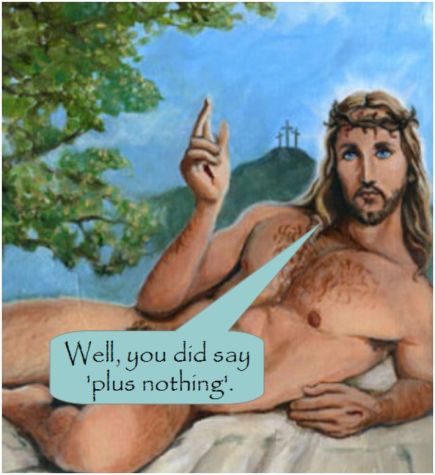
‘Jesus, plus nothing’ is the motto – the slogan – of ‘The Family’, a secretive, clandestine Christian group that for 60+ years has influenced, and been part of, the government of the USA. Yes, poor persecuted Christians, who find their rights eroded on a daily basis (or so they like to tell us) actually exercise a disproportionate amount of control over those in power. Controlled for many years by ‘the most influential Christian you’ve never heard of’, Doug Coe, this group disregards any notion of separation of church and state. The new Netflix series, The Family, based on Jeff Sharlet’s books The Family and C Street, documents their activities, which include affecting policy both at home and abroad, and taking the gospel of ‘Jesus, plus nothing’ to the mighty and powerful across the globe, often on the taxpayer’s dime.

But what does ‘Jesus, plus nothing’ really mean? There’s no doubt it’s intended to convey a stark honesty: this version of Christianity, it says, is without all the clutter that has accrued since Jesus walked the Earth, including all of Paul’s complicated theology. The Family’s holy book is not the bible in its entirety but a slim volume simply entitled Jesus that contains only the four gospels and Acts. The Jesus story, pure and simple.

Except there really isn’t anything simple about the Jesus story. It isn’t even a single story. Nor is there one, single Jesus. (As you’ll see at the links, I’ve written about both of these problems before.) The Jesus that The Family promotes is one of its own making. Of course, every version of Jesus is a construct, loosely based, at best, on bits and pieces from the bible, but manufactured entirely by what different groups and individuals would like him to be. It’s probable that the gospels themselves are constructs built on Old Testament ‘prophecies’ and references, and that the Jesuses they portray are no more than literary creations. Even so, the Jesuses held dear by modern believers, and The Family in particular, bear little resemblance to the constructs of Mark, Matthew, Luke and John on which he is supposedly based.

He is, as one of The Family’s Christian critics points out, a talisman, a magic word that opens doors for speaking ‘truth’ to dictators and tyrants. A Jesus synonymous with power; the power to control nations’ policies, direction and morality. A Jesus who chooses his men (always men) to wield this power; a Jesus who chooses ‘weak vessels’ to do his bidding; a Jesus who, The Family is convinced, chose Donald Trump to be president. And when Jesus chooses you – or when his agents on Earth do – then you are chosen indeed. They make sure of it.

To be continued.

Whatever happened to the Golden Rule?

Blog375a

So in everything, do to others what you would have them do to you, for this sums up the Law and the Prophets. (Matthew 7.12: New International Version)

In everything, treat others as you would want them to treat you, for this fulfils the law and the prophets. (Matthew 7.12: NET Bible)

I went to see a performance at the Edinburgh Fringe on Saturday. Actor David Benson presented a one-man show about the Cato Street Plot, which was an 1820 plan to assassinate the British Prime Minister and government (or possibly not. It was probably a set-up.)

During the show, Benson riffed on some of Jesus’ sayings, including the one above, about how we should treat one another in a country that claims to be Christian (as Britain did in 1820). ‘Do unto others’ has become known as The Golden Rule and like most rules it is largely ignored, even (or especially) by many who profess to be disciples of the man said to have formulated it. The principle is of course much older than the gospels.

When I returned home I caught up with some of my favourite blogs and read about:

A military organisation that promotes the separation of church and state in the U.S. on the receiving end of Christian hate mail.

A preacher who thinks the comedian Sarah Silverman should have her teeth smashed before dying prematurely and being sent to Hell.

The same preacher promising that the Jews, who he says are not God’s Chosen People, will be made to bow down before male Christians, who are.

A different pastor who recited Bible verses while allegedly assaulting an under-aged girl.

The cover-up of the sexual abuse of minors by the Jehovah’s Witness cult.

A Baptist Preacher charged with sexual assault.

Thousands of hateful messages, many from Christians, sent to Montreal Pride organisers.

They just don’t get it, do they? Being a Christian means doing what Jesus says (doesn’t it?) and he says that in everything we should to treat others as we ourselves like to be treated. Note how all encompassing that is: in everything, meaning ‘in every circumstance, with no exception’.

My guess is that the majority of Christians like to be treated fairly, with kindness and respect. I know they do because they whine endlessly when they think they’re not being. Yet so many of them won’t extend the same fairness, kindness and respect – in every circumstance – to other people.

I recently saw a slogan that said ‘Why be racist, sexist, homophobic or transphobic when you could just be quiet’; too many Christians can’t even manage that. They feel compelled to hurl vitriolic insults and threats in defence of the most powerful being ever imagined (and he is imagined). Others think that people more vulnerable than themselves, children included, exist only for their own sexual gratification. These Christians have no interest in ‘In everything, treat others as you like to be treated’. It just doesn’t apply to them.

Strike up another failure for their Lord and Saviour, Jesus Christ.