Assertions

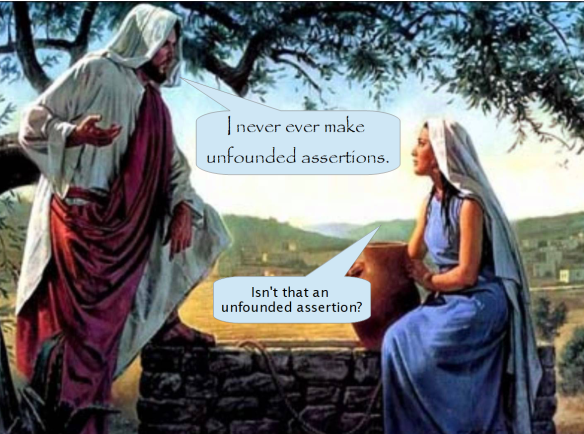
Don likes to take me to task for what he says are assertions in my arguments. I do make assertions, as do we all, because not all points in an argument need to be demonstrated every time they’re used. Indeed, not all assertions can be.

There are assertions that we all accept are likely to be true: the sun will ‘rise’ tomorrow; the Earth is a sphere; evidence is better than no evidence and so on. There are those who dispute these assertions but the onus is then on them to provide the evidence or argument that their counter-assertion is true. Yes, there may come a day when the sun doesn’t rise but it is statistically improbable; the Earth is demonstrably not flat; faith is not an reliable substitute for evidence. There is abundant evidence and sound argument why these things are not the case. But – and this is my point – this evidence does not have to be trotted out every time an argument relies on such probabilities; they can be asserted.

I write, and indeed live my life, on the basis of the fact (‘assertion’) that the supernatural does not exist. Over the last ten years, I’ve posted several arguments why this is the case. I frequently provide a link to these arguments when asserting that, outside of the human imagination, gods, spirits, angels, devils, demons, powers, principalities, ghosts, avatars, heaven and hell do not exist. These arguments form the backbone of any subsequent assertion that the supernatural is not real.

Nonetheless, the onus to ‘prove’ that this is the case does not rest with me. First, because it is impossible to prove a negative. Consider, for example, the Christians challenge to prove their God doesn’t exist. While there is plenty of circumstantial evidence that this is the case, there is no absolute ‘proof’ of God’s non-existence (as I’ve argued before, it all comes down to probability, or, in God’s case, improbability.) Absence of evidence is invariably evidence of absence.

The onus instead lies with the one making the incredible claim. Those who take it as fact that the supernatural and God are real need to demonstrate to the rest of us that this is the case. They have, in my long experience, failed to do this. The best they can do are the various arguments (the ontological, Kalam cosmological, teleological, fine-tuning and the argument from design) that suggest the possibility of the supernatural but fall far short of convincing evidence that the supernatural is real, and further still that the Christian God exists. They depend in the end on the feelings they have in their heads and the Bible (or some other holy book.) This is wholly inadequate

Consequently, I’ll continue to operate from and make my assertion that the supernatural does not exist until such time as Don or any other of his co-religionists demonstrate the probability that it does.

From my assertion, backed up, remember, by earlier arguments, a number of other facts follow:

With no supernatural, there are no gods; YHWH in all his incarnations is a God, therefore YHWH does not exist.

Much follows from this:

If YHWH does not exist, Jesus cannot have been either his avatar, Son or incarnation;

Jesus cannot have been raised from the dead by a being who doesn’t exist;

Stories that he did so must therefore be merely that: stories;

The celestial, eternal Jesus who sits at the right hand of God in heaven is not real;

Any experience people have of this being is entirely within their own imaginations;

The Bible is based on such imagined encounters with these imagined characters;

There is no after-life or judgment;

The Christian faith, including my own, cannot be explained in terms of the supernatural;

Only explanations that are rooted in naturalism, as in science, have any validity.

There are more implications that can be drawn from the premise that there is no supernatural, including the fact that the world makes much more sense (if it makes any sense at all) without drawing gods and demons into it.

Consequently, I shall continue to make my assertions, like those above, supported as always by previous argument. Any religious believer who wants to challenge them is welcome to do so, but must do more than point out the obvious, that they are assertions. They must provide the evidence for the supernatural, and all that follows from it, independent of the goings on in their heads and without reference to holy books written by those with similar subjective feelings.

Prophecy: The Bible’s Track Record

In earlier posts we saw how the authors of Mark and Matthew’s gospels rooted around in the scriptures for anything that might be passed off as a prophecy. They then turned what they found into stories about Jesus.

What though about passages in scripture that actually declare themselves to be prophecy? How do these fair in the fulfilment stakes? As you might guess, not well. There are many failed prophecies in both Testaments; here I’ll take a select few, just to give you a flavour of how hopeless they are:

In Exodus 23:27, YHWH declares that all of Israel’s enemies will run from them:

I will send my terror ahead of you and throw into confusion every nation you encounter. I will make all your enemies turn their backs and run.

Oops! The scriptures themselves are replete with examples of the Israelites’ defeat at the hands of their enemies.

In Ezekiel 29:8-12, the Lord proclaims his intentions towards the hated Egyptians:

The Nile is mine; I made it, therefore I am against you and against your streams, and I will make the land of Egypt a ruin and a desolate waste from Migdol to Aswan, as far as the border of Cush. The foot of neither man nor beast will pass through it; no one will live there for forty years. I will make the land of Egypt desolate among devastated lands, and her cities will lie desolate forty years among ruined cities. And I will disperse the Egyptians among the nations and scatter them through the countries.

None of this ever happened.

Isaiah has it in for Egypt too. In 19:1-8 the Lord promises:

The waters of the river will dry up, and the riverbed will be parched and dry. The canals will stink; the streams of Egypt will dwindle and dry up. The reeds and rushes will wither, also the plants along the Nile, at the mouth of the river. Every sown field along the Nile will become parched, will blow away and be no more. The fishermen will groan and lament, all who cast hooks into the Nile; those who throw nets on the water will pine away.

The Nile has never dried up.

In 2 Samuel 7:13-16, the Lord promises that the descendants of David will rule forever:

(David) is the one who will build a house for my Name, and I will establish the throne of his kingdom forever… Your house and your kingdom will endure forever before me; your throne will be established forever.

The Davidic line ended with King Zedekiah in about 586BC. Much is made in the New Testament of Jesus’ descent from David on his father’s side (while also insisting he didn’t have a human father!) and this prophecy is altered in Acts 2:29-31 to make it fit Jesus’ supposed kingship. This is neither what it says nor means in its original context.

The deranged Zephaniah, writing in the 7th century BC, prophesies that the end of the world is imminent:

The great day of the Lord is near – near and coming quickly. The cry on the day of the Lord is bitter; the Mighty Warrior shouts his battle cry. That day will be a day of wrath – a day of distress and anguish, a day of trouble and ruin, a day of darkness and gloom, a day of clouds and blackness – a day of trumpet and battle cry against the fortified cities and against the corner towers.

Another failure, unless you’re prepared to consider 2600+ years and counting as being ‘near and coming quickly’.

The earliest prediction we have of the Christ’s appearance on Earth is from Paul, in 1 Thessalonians 1-8. You’ll note how he says how everything he describes will happen soon to the people he is writing to:

Now, brothers and sisters, about times and dates we do not need to write to you, for you know very well that the day of the Lord will come like a thief in the night. While people are saying, “Peace and safety,” destruction will come on them suddenly, as labour pains on a pregnant woman, and they will not escape. But you, brothers and sisters, are not in darkness so that this day should surprise you like a thief. You are all children of the light and children of the day. We do not belong to the night or to the darkness. So then, let us not be like others, who are asleep, but let us be awake and sober… For God did not appoint us to suffer wrath but to receive salvation through our Lord Jesus Christ. He died for us so that, whether we are awake or asleep, we may live together with him.

Notch that up as another non-event.

How about the prediction in 2 Thessalonians 2:1-4, thought to have been written circa AD50, that the Christ will not appear from heaven until ‘the man of lawlessness’ takes up residence in the Temple?

Concerning the coming of our Lord Jesus Christ and our being gathered to him, we ask you, brothers and sisters, not to become easily unsettled or alarmed by the teaching allegedly from us – whether by a prophecy or by word of mouth or by letter – asserting that the day of the Lord has already come. Don’t let anyone deceive you in any way, for that day will not come until the rebellion occurs and the man of lawlessness is revealed, the man doomed to destruction. He will oppose and will exalt himself over everything that is called God or is worshiped, so that he sets himself up in God’s temple, proclaiming himself to be God.

The Temple was destroyed by the Romans in AD70 before the man of lawlessness could make his appearance. Unsurprisingly, not a single prophet foresaw the catastrophe. (No, not even Jesus. It is generally agreed that Mark’s gospel was written around AD70 and that Jesus’ ‘prophecy’ about the temple’s destruction was composed after it had happened.)

And then, finally, prophecies about the end times, whether from the scriptures or from Paul, are inserted into the synoptic gospels so, miraculously, they become the words of Jesus:

‘the sun will be darkened, and the moon will not give its light; the stars will fall from the sky, and the heavenly bodies will be shaken.’ (a quote from Isaiah 13:10; 34:4.) At that time people will see the Son of Man coming in clouds with great power and glory. And he will send his angels and gather his elect from the four winds, from the ends of the earth to the ends of the heavens. Now learn this lesson from the fig tree: As soon as its twigs get tender and its leaves come out, you know that summer is near. Even so, when you see these things happening, you know that it is near, right at the door. Truly I tell you, this generation will certainly not pass away until all these things have happened. Heaven and earth will pass away, but my words will never pass away (Mark 13.34).

And thus, Jesus is likewise made into a false prophet.

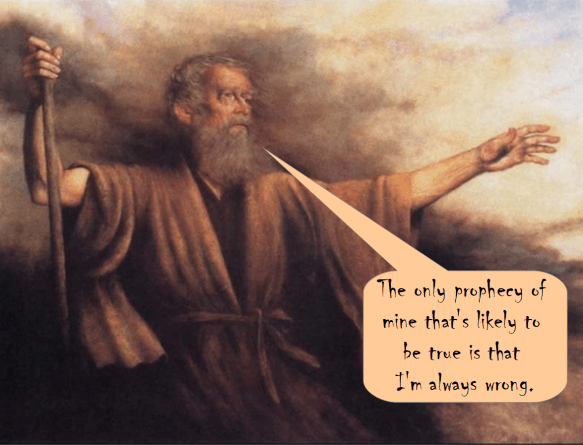
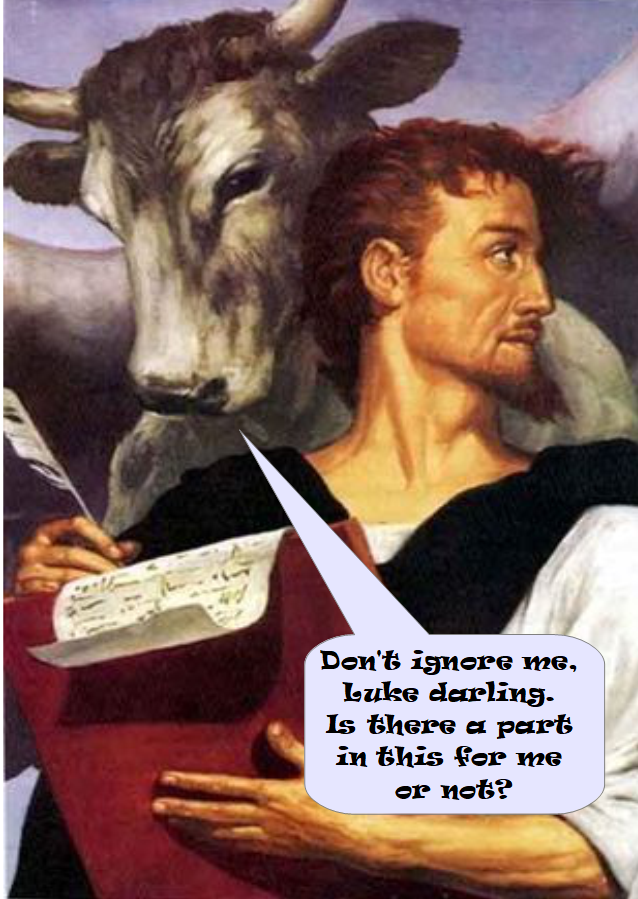
Then again, what other sort is there? Prophets are zealots who believe they’ve been granted special access to the Lord’s plans. There are still fantasists today who believe the Lord speaks to them with portents of future disaster. It would be generous to say that all of them – those in the Bible and their modern descendants – are wrong far more often than they are right. In fact, they are always wrong; it is impossible to know the future. Meanwhile, so-called interpreters of prophecy, like Matthew, Mark, Luke and their equivalents today, alter ‘prophecy’ and unrelated statements to suit their needs, shaping their stories to create the illusion they have been miraculously ‘fulfilled’.  

Fakin’ It

Here’s my dilemma. I got this letter from a group of students at the university of Selcuck in Turkey. Well, when I say I received the letter, it was addressed to Professor Paulson who was head of the Philosophy department here in the 90s. He’s been dead now over 20 years of course, so when I picked up the letter, I thought I’d just write back and tell them that and that they’d have to work out their problems for themselves. Then I thought, ‘well, hang on a minute, the Professor was your tutor back in the day. You know how he thought and how he’d address these particular problems. Hell, you’ve even got some of his old papers locked away in your filing cabinet. You could take one or other of those and with a bit of tweaking, concoct a reply yourself. That’d be perfectly legitimate wouldn’t it?’ I mean I occupy the chair he once did so I am in effect his replacement.

So that’s what I do. I take one of Professor Paulson’s papers and I use it as the basis of a letter. Of course, matters in philosophy have moved on a bit since the Professor’s time so I add quite a bit of my own stuff, which is all pretty good and in line with what he might have thought, had he lived this long. After all, I studied under him in the ’80s so I have a pretty good idea of what he might think today, if he were still with us. If I do say so myself, it’s pretty good stuff. Nobody could tell Paulson didn’t write it.

Now, I do consider admitting at the start of the letter, or maybe the end of it, that I wrote the letter and not the Prof. But then I think, well, these folk don’t know he’s no longer with us so what’s the harm? I’ll just send it and they can reach their own conclusions. I mean, it wouldn’t be my fault, would it, if they jumped to the wrong conclusion. And then I think, well, if they’re going to do that I might as well sign it as if it is from the Professor. I mean, who’s to know? And maybe I could add that bit at the beginning suggesting it was from him. Suggesting? Saying it is from him. That’s what I do, and off it goes.

I hear later, on the grapevine, it’s gone down pretty well. They like what it says and are convinced it’s from Paulson. Everybody’s happy.

And then I find out, a couple of months down the line, that it’s been published. The Selcuck students have had it published, in an influential journal no less, and the academic world is celebrating the final lost paper of Professor Paulson’s. And here’s my dilemma: it’s not, is it. It’s me. I’ve taken his old paper, embellished it and sent it out into the world as if it’s his. What do I do? What would you do? Confess it’s not what it seems? Or bask in the knowledge that what I’ve written is as good as anything he wrote in life? A fake, yes, for sure, but a damn good one that, with a bit of luck, no-one’s ever going to spot. Do you know, I think I’ll leave it, say nothing. The joke’s on them.

Of course such a thing could never happen. Or could it? The letter to the Ephesians in the New Testament claims to have been written by Paul. It starts with this greeting:

Paul, an apostle of Christ Jesus by the will of God, To God’s holy people in Ephesus, the faithful in Christ Jesus: Grace and peace to you from God our Father and the Lord Jesus Christ.

and ends with some vaguely autobiographical details.

But it wasn’t written by Paul. Scholars think it was created in the 80s, about twenty years after Paul died. Much of the letter is a reworking of Colossians, the authorship of which is similarly disputed. Here’s the opening of Colossians:

Paul, an apostle of Christ Jesus by the will of God, and Timothy our brother, To God’s holy people in Colossae, the faithful brothers and sisters in Christ: Grace and peace to you from God our Father.

The Ephesians opening is a direct lift. None of Paul’s genuine letters follow this format. The letter itself has a style and vocabulary unlike that in the genuine Pauline letters and there are significant differences in theology too. Here’s how Bart Ehrman summarises the problem (though note he is not the only scholar who disputes Paul’s authorship of Ephesians; it is the consensus view): 

Ephesians does not resemble Paul’s writing style and the letter contains an inordinate number of words that Paul does not use in any of his undisputed letters. As in Colossians, Ephesians suggests that the believer has already been raised with Christ-a view that contradicts Paul’s undisputed writings. The author of Ephesians, moreover, uses the term “works” differently than Paul. For Paul, “works” refers to adherence to the Jewish law, actions that cannot save. The author of Ephesians, however, understands “works” to mean those actions that demonstrate one’s faith.

Some generously describe Ephesians and other letters attributed to Paul that aren’t by him, as Deutero-Pauline: ‘in the tradition of Paul’. Some speculate that they were written by one of Paul’s disciples but there’s no way of knowing this for sure. Others prefer the term Pseudepigrapha, literally ‘false inscription or writing’, which is nearer the mark.

The author of Ephesians, like those of other pseudepigraphical letters, such as the pastorals (1 and 2 Timothy and Titus) claims explicitly to be Paul knowing full well he is not. This is not some disciple trying to express the views of the master, this is someone passing themselves off as someone else, pretending they are the more well-known, revered and authoritative figure. Even if they were someone familiar with Paul’s teaching (the differences in theology suggest otherwise) would it be legitimate for him to claim he is Paul?

Like my fictional individual above, the author of Ephesians is a deceitful impostor, his work a forgery, designed possibly to ‘correct’ Paul’s position on certain issues. And yet here is his letter in the New Testament; God’s Holy Word no less. While there is a very human history of how works were selected for inclusion in the New Testament, how on Earth did God, in the guise of the Holy Spirit, allow this and other forgeries to become part of the canon?

Of course, God had nothing to do with it. The author of Ephesians duped not only the letter’s original audience, but also the later believers who included it in the Bible. He continues to deceive the faithful down to this day.  I know: I was one. 

Where did Luke get his Bethlehem story from?

Previously on RejectingJesus:

Matthew creates his nativity story, specifically Jesus’ birth in Bethlehem, from Micah 5.2, which prophesies that a ‘ruler over Israel’ will be born there. This prophecy is imposed on Jesus who was not a ruler of Israel – though he may have aspired to be – and certainly was not the Messiah envisaged by the creators of such prophecies. I suggest that subsequently, Luke embroidered Matthew’s fairly basic story and contrived to get Jesus born in Bethlehem by inventing a Roman census that required his parents to travel there.

A Christian commenter (let’s call him Don) then challenged this scenario by claiming, without offering any evidence, that Luke did not have access to Matthew’s gospel, so must have known that Jesus was born in Bethlehem from an independent source. (Christians are fond of attributing suspect gospel material to oral traditions and the hypothetical Q. Don is no exception.)

In fact, a number of scholars, including Michael Goulder, Mark Goodacre, Richard Carrier and others, think that Luke did know Matthew’s gospel. This is the so-called Farrer hypothesis, named after Austin Farrer who first proposed the idea in 1955. As well as his plagiarising 55% of Mark, these scholars show that Luke also used material from Matthew, including the Bethlehem story. The structure of Luke’s version and some of his phrasing is identical to Matthew’s. It is unlikely this would be the case if Luke wasn’t lifting directly from Matthew’s account.

Luke goes further and replaces some of the details in Matthew’s story that don’t suit his purpose (e.g. the magi) with his own (the shepherds), which is why the two accounts diverge. Nonetheless, both versions of the story stem from the ‘prophecy’ in Micah 2.5. Luke doesn’t cite it explicitly but then he is non-specific elsewhere in his gospel about events that supposedly fulfil prophecy. Unlike Matthew, Luke was writing for a gentile audience who would not be as familiar with Jewish scripture; he didn’t need to be as explicit about the source for his stories that were based on these scriptures. Nonetheless, the two nativity accounts, Matthew’s and Luke’s, likely had the same basis (the Micah prophecy) with Luke adapting the narrative that Matthew had already created from it. Moreover, the differences in detail between Matthew and Luke’s accounts demonstrate clearly that both authors were inventing their respective stories. As Neil Godfrey puts it,

Luke, attempting to adapt Matthew’s Bethlehem as the place of birth of Jesus to his more universalist theme, feels obliged to concoct a silly story of everyone being required by imperial edict to return to their places of birth for a special tax registration. Not to mention the necessary anachronism of his Quirinius timing, too. It is not hard to see that Luke is struggling to incorporate Matthew’s Bethlehem setting into his own tendentious narrative.

It’s possible, of course, that all of the scholars who think Luke knew Mathew’s gospel are wrong, but even so, this doesn’t rescue Luke’s nativity from its fictional moorings.

First, it could be argued that both Matthew and Luke knew about Jesus’ birth from their respective sources. Our Christian commenter would say, and does say, that the details of Jesus’s birth were well known in the early, pre-gospel cult (he disputes that Jesus was in any way famous beyond this select few) and that these details were preserved in a reliable oral tradition or in Q. If the former was the case, however, the two nativity accounts would not differ to the extent they do, unless the oral traditions weren’t as reliable as our commenter likes to say they were. On the other hand, Q, if it existed at all, was comprised primarily of sayings and certainly did not include any Bethlehem narrative.

Second, Don will no doubt say that all of this is mere atheist grumbling and is therefore entirely fallacious. He believes that God inspired his anonymous agents to use prophecy, foreshadowing and typology to point the way to Jesus and his birth in Bethlehem. Don believes that both Matthew and Luke had independent knowledge of Jesus’ birth there, which means it must’ve been his birthplace. Of course it indicates nothing of the sort. If Matthew and Luke settled on Bethlehem independently, it would demonstrate only that they had independent knowledge of Micah 2.5.

Third, if the circumstances of Jesus birth in Bethlehem were so remarkable – miraculous, even – then why does Mark not mention them? According to Don (though no serious scholar shares his view) Mark’s gospel is comprised of the recollections of Peter, Jesus’ closest, dim-witted pal in the synoptic gospels. Did Jesus never mention his birth to Peter? Did Peter then fail to pass the details on to Mark? Did Jesus’ mother Mary, who treasured memories of the miraculous birth, never allude to them when she and Peter reminisced together over a glass of water wine? (Yes, Don, I know this is in John’s gospel, but they are meant to be the same characters.) Why does the Bethlehem birth only emerge in Matthew, who built much of his gospel around ‘prophecies’ from scripture, and in Luke, who, in all likelihood, copied from him?

We can be fairly certain that Jesus was not born in Bethlehem. Someone somewhere, other than these two, would have mentioned it outside of symbolic stories that owe far more to myth and legend than they do to fact.

More Matthew Make-Believe

Don Camp and other Christians contest that Matthew’s gospel was constructed by snippets from the Old Testament. Those snippets, they say, however unrelated to the use to which Matthew puts them, are prophecies about Jesus, written centuries before his birth. This is the direction of travel: from ancient text to fulfilment in the first century. They refuse to see that for random verses in the scriptures to foreshadow later events involves significant amounts of magic.

Don talks about the bible authors’ use of foreshadowing, which is a recognised technique in literature. A single author in control of their text from start to finish can plant hints early in the narrative that only come to fruition much later on. Don cites Neil Gaiman’s use of the technique, but then equates the use of foreshadowing by a single author over the restricted amount of time it takes to complete a novel, to its apparent use in the bible. But there’s no equivalence. Yes, the bible is largely fiction too, but that’s where similarities end. In the case of the bible, we have to believe that over many, many years, multiple authors set about planting clues – prophecies – for events that would not occur until centuries later. But this just doesn’t work; not without a controlling agent, like a single author who creates and manages the entire narrative. Of course, Don believes that as far as the bible is concerned, that single author is YHWH. He’s not alone in this wishful thinking; there is a whole industry dedicated to arguing that God controlled the subconscious of everyone who contributed to the biblical texts.

But this scenario makes no sense. In the first instance because many of the so called prophecies are nothing of the sort. As we’ve seen, some are random lines in a story about something else entirely. Let’s look at another example of that, again from Matthew’s gospel:

In Hosea 11.1 YHWH is being made to boast about how he rescued the Israelites from Egypt:

When Israel was a child, I loved him, and out of Egypt I called my son.

God’s ‘son’ in context and as plainly stated, is Israel (note the use of parallelism again.) All the verse is saying is that YHWH brought his son, Israel, out of captivity of Egypt, which is itself a fiction. Nothing more; nothing about the future. Yet years later, Matthew (2.16-18) rewrote the verse as an event in the young Jesus’ life:

So (Joseph) got up, took the child and his mother during the night and left for Egypt,  where he stayed until the death of Herod. And so was fulfilled what the Lord had said through the prophet: “Out of Egypt I called my son.”

Matthew expects us to believe that what the Hosea verse really means is that the baby Jesus would flee to Egypt and would be ‘called out’ again only when it was safe. That is, after Herod stopped massacring baby boys, another event that never happened but is itself a rewrite of Exodus 1.22. Only Matthew has this preposterous Egypt story, because only Matthew invented it. Luke simply has Mary & Joseph returning to their home in Nazareth.

Matthew is dishonest on two counts. He knows the original line is not a prophecy and he also knows his fable about the family’s escape to and return from Egypt is not a fulfilment of prophecy. And he knows this because it didn’t happen. He made it up.

Secondly, even if we grant that the bible contains what appear to be more precise prophecies, a God who has engineered their inclusion is mere speculation. One cannot offer up fulfilled prophecy as evidence of that God’s existence and then argue that prophecy comes to be fulfilled only because God is its controlling agent. That is circular reasoning. In any case, most, if not all, of these less indistinct predictions are the very ones that have never been fulfilled. We’ll take a look at some of these next time.

So, which is more likely? A supernatural entity who controls the entire narrative of a collection of books written over centuries, who hides unlikely clues to the future in a select number of verses, or a first century author who plunders ancient scriptures to find snippets that he thinks might parallel his hero, and then rewrites them to furnish his narrative?

An interfering but non-existent God looking forward or a duplicitous author looking back? Even Don knows which it is.

The Meaning Of Matthew’s Mistakes

So Matthew likes quite a lot of what he finds in Mark. Likes it so much he decides to lift over 90% of it into his own Jesus story. Of course he’ll tweak it a bit because, disappointingly, Mark hasn’t emphasised Jesus’ Jewishness enough. That definitely needs bumping up; it’s what his readers will expect. And Mark has missed a trick or two: he starts his story with Jesus’ baptism, when, as everyone knows, every godman needs a magical origin. Just look at Tammuz, Horus, Romulus and, according to some, the Jewish high priest Melchizedek. So Matthew sets about scouring the scriptures for a prophecy or fable, anything really, that hints that the Messiah would have a miraculous birth. And he comes across this in Isaiah (7.14):

Therefore, the Lord, of His own, shall give you a sign; behold, a virgin is with child, and she shall bear a son, and she shall call his name Immanuel.

It’s not really a prophecy about the Messiah as the context makes clear, but that’s okay. There’s enough of a hint that it could be about a future Messiah that it’ll do. So Matthew sets about creating a birth narrative for his godman based on this verse, yanked from its context. His godman is going to have a virgin birth too.

What Matthew doesn’t realise, however, is that he’s made a mistake. He’s picked up the verse in the Septuagint, a Greek translation of the scriptures. If he’d checked, or even been able to read the original Hebrew, he would have soon seen that the verse actually reads:

Therefore, the Lord, of His own, shall give you a sign; behold, the young woman is with child, and she shall bear a son, and she shall call his name Immanuel.

The Hebrew word for ‘young woman’ is alma and that is the word used in Isaiah 7.14. The word for virgin is betulah. It does not appear. The use of it in the Septuagint is a mistake, a mistake that Matthew is not aware of. So he misappropriates the mistranslated verse to create a miraculous birth for Jesus and the myth of his virgin birth is born.

But Matthew hasn’t finished scouring the scriptures for prophecies that appear to be about Jesus. This time he alights on Zechariah 9:9:

Rejoice greatly, Daughter Zion! Shout Daughter Jerusalem! See your king comes to you, righteous and victorious, lowly and riding on a donkey, on a colt, the foal of a donkey.

Incredibly, this time Matthew has stumbled upon a prophecy about the Jewish Messiah! According to Zechariah, the Messiah-King’s victorious entry into Jerusalem will follow the defeat of his enemies and the establishment of universal peace. Matthew likes the sound of this. If he can shoehorn an episode into his story where Jesus rides into Jerusalem on a donkey, this will show his readers that Jesus really is the long-awaited Messiah-King. Never mind that the Jesus version bears little resemblance to the scenario predicted by Zechariah: Jesus is not an anointed king, he has not recently defeated his enemies nor has he just established universal peace. The only thing the original prophecy and Matthew’s version have in common is that the two principle figures, Zechariah’s Messiah-King and Jesus, ride into Jerusalem on a donkey.

Oh, no, wait. That’s wrong. According to Matthew Jesus approaches on two donkeys; a mother and her colt. He’s made another mistake. He doesn’t know that the use of ‘donkey’ and ‘colt’ in the prophecy refers to the same animal. He thinks there has to be two: a larger one and a smaller one. He is not familiar with the practice of parallelism, common in Jewish writing to emphasise a point by repeating it  but using alternative terminology. There aren’t two animals on which Jesus sits lop-sidedly, there’s one: a donkey, otherwise known as a colt which, to state the bleedin’ obvious, is also the foal of a donkey. Matthew misses all of this and places Jesus precariously on two mismatched animals.

What does this tell us? That Matthew is not describing an actual event. He has, rather, created a story based on a prophecy, designed to illustrate to his readers that Jesus is the Messiah-King prophesied by Zechariah. There is nothing historical about this story; it is an actualisation-in-fiction of a prophecy. A prophecy,  which, incidentally, still has not been fulfilled.

So Matthew is caught out at least twice. There are more examples in his gospel of his forcing an episode from the scriptures into his Jesus fable: other aspects of his birth narrative are clearly based on elements of Moses’ story; Judas’ thirty pieces of silver are based on a story from Zechariah 11, which has no relevance at all to the use he makes of it. There is also evidence that Matthew invented prophecy that he could then show Jesus ‘fulfilling’ (Matthew 2.23, for example.)

What all of this demonstrates is not that Jesus was foreshadowed in the Jewish scriptures, (foreshadowing being a technique beloved of some authors who use it to hint at future events in their fiction) but rather that many aspects of the Jesus story are literary re-imaginings of ‘prophecies’ and often unrelated episodes from the scriptures.

And if some, why not all?

How Prophecy Works

Like many evangelicals and others afflicted by Christianity, Don Camp believes that the Old Testament is jam-packed with prophecies about Jesus; his origin, background, mission, teaching, sacrifice and resurrection. He quotes a couple in one of his recent comments, which we’ll get to soon, and thinks that the general direction of travel is from ancient prophecy to later fulfilment in Jesus. Don and those like him will not entertain the possibility that this is an illusion created by those who constructed the Jesus’ stories.

Here’s how the illusion was created: the gospel writers, and Paul too, looked back at the Old Testament (‘the scriptures’) and found there what Don describes as ‘indistinct’ references to events they believed had happened in their own time. From these and other sources, they built their stories about Jesus. More often than not, these scriptural references were not in themselves prophecies or predictions of Jesus’ life, death or resurrection. We know this by a) reading them in their original context, b) recognising that the Jewish scriptures as a whole never speak of a Messiah who must die an ignoble death for his people, and c) noting the number of times these ‘indistinct’ statements have to be altered by the gospel writers and others, to make them ‘fit’ their conception of their God-man.

Let’s start with one of Don’s picks, from Isaiah 53:11:

After he has suffered, he will see the light of life.

It has to be conceded that all of Isaiah 53 does indeed look like it’s a prophecy of Jesus’ suffering, death and resurrection. In context, however, the suffering servant it describes is Israel itself, as surrounding chapters make clear. Furthermore, on closer inspection, some of it doesn’t seem to apply to Jesus at all. Verses 2&3 really don’t describe a man followed around by multitudes and later worshipped by millions:

He grew up before him like a tender shoot, and like a root out of dry ground. He had no beauty or majesty to attract us to him, nothing in his appearance that we should desire him. He was despised and rejected by mankind, a man of suffering, and familiar with pain. Like one from whom people hide their faces he was despised, and we held him in low esteem.

Unsurprisingly, Don doesn’t quote these verses. Sure, it’s possible to make them fit; to say that these verses 2-3 describe Jesus on trial with the crowd baying for his blood; but it’s a stretch. We’ll come back to Isaiah 53 shortly.

Don then refers to ‘the prophecy about (Jesus) not seeing corruption as a dead body’. This is actually Psalm 16:10:

You (YHWH) will not abandon me to the realm of the dead, nor will you let your faithful one see decay.

And, my, yes it does seem to fit Jesus once again, if we believe he died and rose again before his body could deteriorate. But it isn’t about him. It’s about the writer of the psalm, traditionally David, expressing his belief that his God will preserve him. Plucked out of context, it can sound like it’s Jesus being described, just as any number of other verses can be said to be about future events when they’re not. For example, some Christians, including Pat Robertson, are currently claiming that Ezekiel 38:1-2 is a prophecy of Russia’s invasion of Ukraine:

Son of man, set your face against Gog, of the land of Magog, the prince of Rosh, Meshech, and Tubal, and prophesy against him.

That works, don’t you think?

No. Me, neither. Such nebulous statements can easily be applied to much later events on which they have no actual bearing.

Which brings us neatly to the gospels. These claim that the events they describe were foretold by the prophets of old (Luke 24:44). It would be truly remarkable if, as Don believes, all of the prophecies about Jesus in the scriptures were actually fulfilled by him. Some Christian sources claim there are as many as 300. But, as we’ve seen, some of these are so vague they can be made to apply when in fact they don’t.

And this is how the Jesus story came about; it is structured around many of these indistinct prophecies. The authors of the gospels, and Paul too, knew their scriptures and built up a story about the Messiah using them. Like Paul, Mark had little knowledge of the circumstances of his Messiah’s earthly life, so he set about creating a biography for him using ‘prophecies’, scenarios and statements from the scriptures. We might ask here why he should do this if Jesus was as remarkable as early cultists claimed. There is no need to invent stories about a remarkable figure if that figure has already lived an amazing life that is widely known about. Be that as it may, Mark and the other gospel writers set about creating an elaborate life for their hero, largely based on ancient scriptures.

Mark quotes Isaiah 53 directly in 15:38 and makes extensive use of the chapter in his account of Jesus’ passion. Let me stress: Isaiah 53 is not a prophecy of the passion, it is the blueprint for it. Mark’s account is Isaiah 53, down to Jesus’ silence at his trial and his being buried ‘with the rich’.

Matthew and Luke later embellished Mark’s efforts by doing more of the same thing, adding fresh episodes to Mark’s core gospel. Most of these embellishments  are based on ‘prophecies’ that Mark somehow missed. None of them necessarily happened – I’m persuaded they didn’t – but are ‘actualisations’ of parts of ancient scripture. We know this because of mistakes Matthew made in expanding the story, using the additional ‘prophecies’ he ‘discovered’ in scripture. We’ll get to these mistakes next time.


In Which Don Gets It All Back To Front

Let’s take a look at one of Don Camp’s latest contributions regarding the authenticity of the Jesus story and how it was all prophesied beforehand and explained after the fact:

Don: You mean all the Old Testament prophecies that spoke of the eternal continuance of the Messiah king were mistaken?

What prophecies, Don? You mean all those tenuously connected Old Testament stories that the gospel writers, especially Matthew, pressed into service to construct their Jesus stories? That this is how it happened is the scholarly consensus and once we exclude the possibility of magic, the only way ‘prophecy’ can later be ‘fulfilled’.

Don: “After he has suffered he will see the light of life and be satisfied; (Isaiah 53:11).

Which proves my point. You think this is a prophecy? It could mean anything about anyone!

Don: The prophecy about him not seeing corruption as a dead body was mistaken?

And again. Not mistaken: lifted from the OT around which to build the resurrection story.

Don: The words of Jesus as he repeatedly told his disciples of his resurrection were mistaken?

He didn’t. The stories were written long after Jesus supposedly lived. Those who created his story gave him this ‘foreknowledge’ long after the event.

Don: Paul made nothing up; his simply explained what it all meant.

Oh come on, Don. Why would God leave it to someone who’d never met Jesus, and appears to know nothing about him, to explain ‘simply’ what he was all about? Of course Paul made it all up, after he had some sort of vision, in his head, from which he developed a fanciful theology, one that was very much at odds with that put in Jesus’ mouth years later. Hence Paul’s disputes with the ‘pillars of the church’ whom he held in such disdain.

I know you’ll have some convoluted explanation about how everyone else has got it wrong, Don, but it’s you who’s got it all back to front!

Battle Of The Magic Books

Don Camp replies (in blue) to my previous post. My responses are in black.

There are multiple reason for rejecting Mormonism. The primary reason is similar to discerning between a fake $20 bill and the real thing. The fake just doesn’t feel like the real thing. Of course, that test requires that one knows what a $20 bill feels like. Anyone who does not know is easily fooled.

In fact, if you don’t know what the real thing is like, it is impossible to identify a fake. You might notice an ink smudge and a difference in paper, but who is to say one is fake and the other is not?

This presupposes that your version of Christianity is ‘the real thing’. For a Jew, Judaism is the real thing and Christianity the Johnny-come-lately fake. All you’re saying here is that you ‘feel’ your version of Christianity is the real thing and you ‘feel’ Mormonism isn’t. This isn’t persuasive. I know, for reasons other than intuition, that Christianity isn’t the real thing. To use your analogy, it is the twenty dollar bill received in change when in the UK a twenty pound note is the ‘real thing’.

But since you have a knowledge of literature, Neil, why not apply those standards? Nice concession there, Don. The Bible is indeed literature and as such deserves to have the same standards applied to it as any other work of fiction.

Is the Bible and the narrative in the Bible coherent?? No. Its central character is ridiculously inconsistent. Described as an unchanging God, he changes from book to book and most noticeably between the Old and New Testaments. As someone commented on Debunking Christianity recently, it’s as if he ate a Snickers bar between the two. (He does get hungry again towards the end of the NT, when he reverts to being an omnipotent Putin.)

As the protagonist undergoes his major rewrite, the plot also suddenly deviates, becoming a completely different story. It starts by being about this poorly conceived character’s ‘everlasting covenant’ with his chosen people, but then two thirds of the way through, this everlasting covenant is scrapped and replaced with a new, largely incoherent deal involving a human sacrifice that the unchanging God has previously said he finds abhorrent.

Does it stick together and develop a single theme across the whole? No, it doesn’t ‘stick together’, not unless you ignore the gaping inconsistencies in character and plotting, and its overall implausibility.

Do you know what the theme of the Bible is, Neil? Yes, thank you, Don. Condescending of you to ask. Any apparent consistency is because the writers of the second part of the story had access to the first part. They plundered it for their own purposes, drastically altering it so that it suited their new theme. That is why much of the Jesus story appears to be foreshadowed in the Old Testament. The Jesus story – and it is a story – is built on events and episodes they found there.

Remember that the Mormons tell us that the Book of Mormon is an extension of the Bible and that the people of the Americas were related to the Jews and held to the basic truths of the Jews. (Remember also the Mormons believe that Jesus appeared to these people in the New World shortly after his resurrection.) So if you put the Torah and the Book of Mormon together, is the narrative coherent? Does it develop a single theme? The Old testament and the New Testament are a coherent whole, but I do not think the Old Testament and the Book of Mormon are. As you can tell, I dispute that the Old and New Testament are a coherent whole. The Old Testament and the Book of Mormon aren’t either. That lack of coherency becomes even more obvious when we compare God in the Old Testament with God in the Book of Mormon. The person of Jesus is also inconsistent in the Book of Mormon with the Bible.

But they’re inconsistent within the Bible too, Don. Compare John’s Jesus with Mark’s. Compare Paul’s beatific Christ with Revelation’s grotesquely super-powered warlord.

Of course, the standard explanation by Latter Day Saints is that the Bible has not been adequately translated, though I know of no place where they can demonstrate that claim. There are significant translation problems with the Bible, which mainstream scholars consider at length. Mormon desperation to resolve these conflicts is the same as that demonstrated by Christian theologians.

Finally, there is a matter of provenance. We know in very good detail where the Bible came from.

We do? We know who Matthew, Mark, Luke and John actually were? No, we don’t nor do we know where they wrote or what their sources were. We don’t have the autographs (originals) of any of the New Testament documents but we do know some of them are forgeries and others have been tampered with.

There are many copies, especially for the New Testament, and there are many commentaries of both the OT and NT from very early in the their history. Proving what? Only that they were copied, frequently inaccurately. The copies are all much later than the probable time of composition. The commentaries are similarly far removed from them; there are commentaries on the Book of Mormon much closer to its composition.

What is the provenance of the Book of Mormon? It apparently appeared magically out of nowhere pretty recently. No mention in any other literature of its existence. It did appear magically! Oh ye of little faith! God sent an angel, like he does numerous times in the Bible, and told Joseph Smith to translate the golden tablets. The NT books were similarly created, with God breathing his word into cult followers as they wrote. God, angels, Holy Spirit, magic – all of a muchness, don’t you think?

No copy is available to examine. Nor of the original copies of anything in the Bible.

That is not to speak of the total lack of any archaeological evidence for the Mormon claims of Jews in the Americas. Mormons dispute this, of course. There are similar problems with some locations mentioned in the Bible. More fatally, most of what the Bible promises has proven false. For example: Jesus’ imminent return, his guarantee of miracles, believers becoming new creations. (Paul spends much of his time ticking off these ‘new creations’ who remain resolutely unreformed.)

So, I would say the Book of Mormon fails on all levels.

I would too. As does the Bible for the reasons I’ve outlined, and despite your special pleading. You don’t apply the same rigour in your consideration of the Bible that you do to Latter Day Saint fiction. Why is this, Don?

How Do Christians Explain Those Who Renounce Their Faith?

Aka The Death of Ananias by Raphael (Acts 5)

What was original Christianity like, long before it acquired that name? Before Paul’s ideas took hold? Clearly the cult existed prior to Paul. He tells us so himself: worship groups were around – the one he writes to in Rome, for example – before he  established his own. 

The early faith seems to have emanated from the visions of early believers such as Cephas and James. Quite what they ‘saw’ is open to debate but it led to them setting up a sect within Judaism that focused on the saving power of a risen celestial being.

And everything was absolutely hunky dory within these early communities. Members shared all their possessions (except when they didn’t, in which case they were annihilated on the spot) and lived in perfect harmony together, worshipping Jesus and experiencing miracles on a daily basis.

According to Acts, that is. According to Paul, by the time he came to be involved, it was all very different. Many of the early ‘churches’ were characterised by squabbling, greed, legal disputes, confusion about doctrine, sleeping around, visiting prostitutes and power struggles (Galatians 5.20; 2 Thessalonians 3.14-15; 1 Corinthians 1.10, 4.21; 1 Corinthians 6.1-10; 1 Corinthians 6.12-20; Galatians 1.6-9; 1 Corinthians 5.9-13 etc.) Worse still, there were defections by converts who came to their senses and left the cult.

How can this be when, according to Paul these people were inhabited by God’s holy spirit and saved once and for all by the redeeming blood of Jesus? Just as today, early believers, including Paul, had a hard time explaining how a person could be once saved and then lose their faith. They came up with various excuses how this could happen:

Excuse #1. Apostates were never really been saved: they were faking it in some way, their faith hadn’t been deep enough or Satan had snatched it away from them. One enterprising and influential cult member even came up with the sneaky idea of putting these explanations into the mouth of Jesus (because of course he would have foreseen the problem.) So arose the parable of the sower. According to Mark 4.1-20, the ‘word’ doesn’t always ‘take’. It might seem as if it has but sometimes it is uprooted by the cares of this world. Alternatively, it falls on stony ground and really doesn’t stand a chance of growing. Or Dick Dastardly Satan intervenes and destroys the faith of those who once believed. As a cultist called John later put it,

They went out from us, but they did not really belong to us. For if they had belonged to us, they would have remained with us; but their going showed that none of them belonged to us… (1 John 2.19)

Which really says nothing: ‘they left, so really they weren’t part of our gang to begin with.’ A brilliant bit of exposition.

Excuse #2. Apostates are still saved. In direct contradiction of the parable of the sower, some Christians invented a different way of accounting for those who had ‘fallen away’: the ‘once saved always saved’ argument, based on a few cherry-picked bible verses. Despite appearances, those who’ve left the faith are nonetheless still savedThe ‘reasoning’ is that because salvation is a work of God, it cannot be undone, no matter how much one refutes the faith, or provides reasons for leaving it or demonstrates the untruthfulness at the heart of it. Salvation is like a tattoo you regret getting but with which you’re stuck for the rest of your existence. (Except not really, for a whole host of reasons but principally because there’s no God to work the magic in the first place.) This line of reasoning runs entirely contrary to the acknowledgement in the parable of the sower that there are always those who will leave the faith.

Excuse #3. Apostates have been hurt by the church and as result have abandoned the faith (but Jesus is waiting for them to return!) While I don’t know anyone who has renounced Christianity for this reason alone, it does play a small part in some defections. Why? Because self-serving and vindictive Christians are evidence that Christianity simply doesn’t work. It doesn’t make ‘new creations’, infusing people with a holy spirit that makes them better people. Believers, despite their claims, are no more moral than those who are unsaved. You’ll know this if you’ve been on the receiving end of Christian judgment or condemnation. When Christians themselves undermine the claims of their religion it creates a justifiable scepticism in one-time brothers and sisters.

Excuse #4. Apostates just want to wallow in sin. Back to the parable of the sower for this one: ‘Satan has ensnared you into life of sin and debauchery and you have abandoned the one true way’. I have to say this is not true of any ex-Christians I know.  They’ve dispensed with the wholly religious idea of ‘sin’, and now live their lives as authentically as they can, looking after their loved ones and helping others where possible. Then again, so what if people want to wallow a little bit?   

The one reason that causes others to leave the fold that is never recognised by Christians is the gospel itself. No sir. That some people are able to see how irrational, contrived and downright untrue it is, is not a possibility Christians are willing to entertain. Jesus himself, however, seems to recognise that some people are just too intelligent to go along with it:

I praise you, Father, Lord of heaven and earth, because you have hidden these things from the wise and learned, and revealed them to little children (Matthew 11.25).

Even he knew – or, far more likely, the sect that put these words into his mouth – that for anyone capable of a modicum of critical thinking (‘the learned and the wise’), the cult’s claims simply don’t stand up to inspection.