Spiritual Forces of Evil in the Heavenly Realms

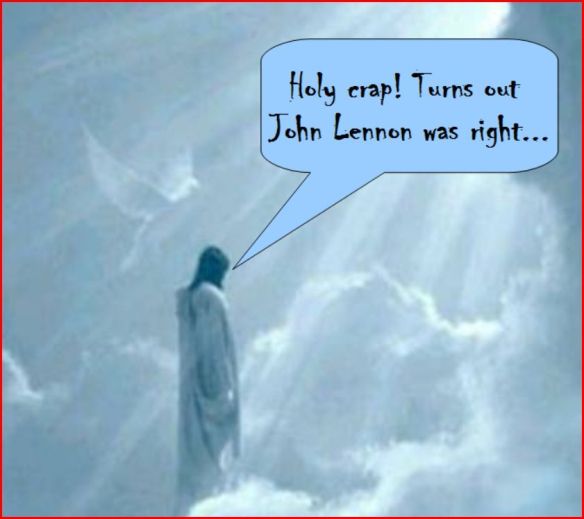
Original AI image from Night Cafe 

For our struggle is not against flesh and blood, but against the rulers, against the authorities, against the powers of this dark world and against the spiritual forces of evil in the heavenly realms. (Ephesians 6:12)

…you followed the ways of this world and of the ruler of the kingdom of the air, the spirit who is now at work in those who are disobedient. (Ephesians 2:2)

the prince of this world now stands condemned. (John 16:11)

The first-century worldview of early Christian cultists was that somewhere above the Earth a battle raged between God and Satan. The powers of darkness – the devil and his demons – had in ages past launched an attack on the Lord and his angels. This war in the spiritual realm continued unabated up to the time when a cultist wrote Ephesians, pretending to be Paul. Paul himself had already alluded to Satan as the god of this age (2 Corinthians 4:4), while the authors of the fourth gospel would later refer to him as the archon – ruler and prince – of this world (John 12:31; 14:30).

Which just goes to show how the Almighty God they believed in was nothing of the sort. He had tussled with his arch-enemy for eons without quashing his rebellion and putting an end to his persistent attacks. The stand-off had gone on for millennia, and, according to today’s Christians, is still happening. A puny god it is who cannot get the better of one of his far less powerful creations.

And what are God and Satan fighting over? Us, apparently. The devil wants control of human beings.

Why? Who knows. In fact, according to Paul, Satan already has control over us. He enslaves us to sin, which in turn leads to death (Romans 5:12, 6:23). 

Not to worry though, Paul, fake Paul and the fourth gospel writers assure us that their enfeebled God has a cunning plan! He’ll allow a being who is precious to him – like a son, in fact – to be sacrificed so that anyone who believes in him will no longer be enslaved to Satan and sin and will be granted eternal life. How’s that for special magic!

Who shouted out from the back that that sounds like a cop-out? It’s a fantasy bordering on the insane. Like it or not, we are somehow embroiled in heavenly warfare, specially if we’re of the number who’ve bought into this malarkey.

While we’re at it, have you noticed how so many of the wars and skirmishes currently afflicting the world have religion at their heart? YHWH is scrapping with Allah, Allah is up against the Great Satan while Jesus – no stranger to war-mongering himself – presides over it all, leading the world to Armageddon and his own ultimate ‘return’.

Here’s my suggestion. All the gods and demons need to get their act together. They should agree to an ultimate slug-fest, a final battle in the spiritual realm to decide who’s really the Supreme God – the last deity standing – and leave us humans out of it entirely. Surely, being gods, they’re up for finding out who can piss furthest up the wall.

A preposterous idea? Of course it is. None of these fantasy beings exist. There’s no YHWH, Allah, Heavenly Father, Jesus, Krishna, angels, archons, Satan or ‘spiritual forces of evil’ to duke it out. There’s no ‘heavenly plane’ where they can get to it. Everyone of these despotic characters is a human creation, as are the wars, disputes and skirmishes they underpin. It follows that none of them can be the supreme god and certainly none of them are worth fighting over. It’s time we grew up and put away all of our childish imaginary tyrants.

The End Is Nigh

The End is Nigh. Yes, really. Climate change activists waste energy on a daily basis letting us know. Unless we listen to them, our self-appointed Saviours, and immediately give up fossil fuels, the world is headed for calamity and will end soon. Never mind the pollution caused by Russia’s war-mongering and that of the 21 wars and 108 other armed conflicts (what’s the difference?) in the world today. It’s the way you heat your home that is going to bring about the end.

Not with the same focus as today’s climate fanatics but with the same religious fervour, the Jews of two and a half millennia ago waited expectantly for their very human Mashiach (anointed one) to appear. He was to deliver them from their oppressors and make them oppressors instead. He failed to arrive.

Years later, in the first century CE, a small enclave of Jews became convinced their Messiah was on his way. He had by this time transmogrified into a heavenly being but would soon be arriving to set the world aright and deliver his little band of followers from evil and, they decided, from death too. He didn’t make it, but such irrational wishful thinking is how all religions get going and Christianity was no exception.

Muslims, meanwhile, believe that the Day of Judgement is not far off. Everyone will then be judged according to their service to Allah, the faithful rewarded with eternal life, the rest sent to Jahannam (hell).

So here’s a question for you: what do these years have in common? 66-70CE, 365, 370-400, 500, 793, 800, 847, 1000, 1033, 1200, 1284, 1504, 1585, 1600, 1705, 1792, 1833, 1836, 1874, 1901, 1918, 1936, 1967, 1977, 1982, 1994, 1997, 2000, 2007, 2011 and 2021.

They are, of course, a few of the innumerable predictions that the end isn’t far off, after which there will be a great reset. As I suspect you already know, none of these predictions came to pass.

Neither will any of the numerous predictions of future apocalypses– lots of them here – either. It’s not that we’re incapable of wiping ourselves out; it’s possible we will one day, but there won’t be a Mashiach, Christ or God who will step in at the last minute to rescue a favoured few so that everything can start again. There’s no simplistic fix of the sort climate zealots, Islamist terrorists and bumptious politicians insist. Like their apocalyptic predecessors they’re only deluding themselves and lying to the rest of us.

We are, it seems, obsessed with End Times scenarios, and always have been. Our only saviours, however, will be ourselves, if we’ve the will to be. I’m not sure we have, but a first step might be recognising that there’s no Starman (Starmer?) waiting in the sky, or anywhere else, eager to save us. There’s no magic panacea that will rescue us and reset the world.

Seek and Ye Shall Find

Thanks to all the Christians who responded to my questions last week. Here’s the answers (in red) they helped me reach.

I asked –

1. What happens to you, as a Christian, when you die:

a) You go immediately to heaven (The Bible says this precisely nowhere)

b) You go into suspended animation until Christ’s coming and the final judgement (Paul implies this is the case in 1 Thessalonians 4:13-18. You have to ask yourself how he knew this)

c) You cease to exist (Yup, this is it. So, as Dolly says, better get to livin’)

2. According to the first three gospels, how long was Jesus in the grave?

a) About 36 hours (Friday tea-time till just before sunrise on Sunday. You do the Math)

b) 3 whole days (see above. Despite saying in Matthew 12:40 that this is how long he’d be dead, he fell way short. The fourth gospel, on the other hand, alters the timeline to make things fit)

c) He wasn’t: he went down to hell (according to 1 Peter 4:6 and the so-called Apostles’ Creed this is exactly what he did. Some people are daft enough to believe it)

3. Which of the following does Paul refer to in his letters?

a) Jesus’ miraculous birth (he mentions this zero times)

b) Jesus’ parables, teaching and miracles (likewise; not a single mention)

c) The Empty Tomb (nor this. Don’t you think that’s strange?)

4. How often did Paul refer to Jesus’ second coming?

a) In all of his letters (Nope)

b) 2 or 3 times (Nope)

c) Never (That’s it: not once. Paul looks forward to Jesus coming soon, as if it’ll be his first visit: 1 Thessalonians 4:13-18 again. Don’t you think that’s significant?)

5. How often did Jesus refer to his second coming?

a) Once or twice (No)

b) Frequently (Again, no)

c) Never (Yes, never. The fictional Jesus of the gospels says someone called ‘the Son of Man’ would be arriving real soon: Mark 14:62. Occasionally Jesus’ creators suggest he and the Son of Man are one and the same, which they are in that both are fictional)

6. When did Paul say the Messiah would be coming to the Earth?

a) Thousands of years in the future (To hear modern Christians talk you’d think this was it, but no: Paul never said this.)

b) While he himself was still alive (He says clearly that he expected he’d still be alive when Jesus came down from heaven: 1 Thessalonians 4:13-18. How many more times?)

c) He didn’t say (course he did: see above)

8. According to the gospels, when did Jesus say the Son of Man would be coming to the Earth?

a) He didn’t (he did)

b) Thousands of years in the future (Nope)

c) While those he was talking to were still alive (Yes: in Mark 9:1; 13:26 and 14:62)

8. What, according to the Bible, is the Word of God?

a) The Bible itself (‘Fraid not)

b) The Church (No)

c) Jesus (Yes, but not as often as you might think: only in John 1:1-3)

9. Which was written first?

a) Mark’s gospel (made up about 70CE)

b) Paul’s letters (the earliest, in the 50s)

c) Acts of Apostles (invented circa 80-90CE)

10. When the New Testament mentions ‘the Scriptures’, what is it referring to?

a) Ancient Jewish writings (exclusively so)

b) The whole of the Bible as we now know it (the Bible as such probably didn’t exist until the 4th century)

c) The New Testament (there was no New Testament when the writers who would later be included in it were writing. So, no)

11. How did the New Testament writers ‘prove’ Jesus was the Messiah?

a) By claiming the scriptures predicted he would be (Exclusively so)

b) By pointing to his miracles (Never)

c) By quoting things he said (Never)

Now isn’t that odd.

12. According to the Bible, how did Jesus want his followers to spend their time?

a) By witnessing to atheists on the internet (You think?)

b) By worshipping him (Never)

c) By feeding the hungry, healing the sick and helping the weak (This. See Matthew 25:31-46. So why you spending your days and nights harassing non-believers on the Net?)

Actually, no Christian helped out with this. The answers are those that scholars (and I, in my own humble little way) have arrived by actually reading the friggin’ Bible. 

Flourishing

The solution to all our problems is to return to God.

How many times have we been told this recently? It seems here in the UK that hardly a week goes by without a new book, report or high-profile article appearing advocating a return to ‘Christian values’ or acknowledging Something Greater Than Ourselves (invariably the Christian God). This, it invariably assures us, is the only way to bring us back to our senses and solve all our problems. Even previously atheist/agnostic writers – Richard Dawkins, Douglas Murray, Tom Holland, Jordan Peterson, Aaran Hirsi Ali and Russell Brand (how’d he get in here?) – suggest that Christianity must be revived to prevent the vacuum created by its decline from being filled by the less humane Islam.

I’ve written about this fallacy before – here and here – so won’t go over the same ground again. Instead, I want to highlight a recent report, The Global Flourishing Study, carried out by Harvard University and funded primarily by the Templeton Foundation. Alarm bells! The Templeton Foundation is a religious organisation, so already the study’s conclusions are thrown into question. What were participants asked? What was their background? What bias did the questions convey?

Not surprisingly then, the study concluded that many people in the world are not flourishing and that those who are, are flourishing – surprise, surprise – largely as a result of religion:

Religious service attendance was one of the factors most consistently associated with present or subsequent wellbeing, across countries and across outcomes.

Religious groups have leapt on the conclusions as evidence that humans need God to live fulfilling lives. The key word here, however, is ‘attendance’. The study itself acknowledges that human community – being with other, like-minded people with a common interest or cause – is a significant aspect of the resulting flourishing. But we knew this already so maybe the $43.4 million spent on the study might have been better spent: feeding the hungry, perhaps? An earlier 2017 study also by Harvard was headlined:

Harvard study, almost 80 years old, has proved that embracing community helps us live longer, and be happier.

Numerous other recent studies have reached this same conclusion (see here, here, and here for more).

The god factor injected into Harvard’s more recent study to satisfy the Templeton Foundation and its affiliates is further complicated by the fact that there isn’t only one god involved in making us all feel jollier. There are currently thousands in use throughout the world (the internet is unable to provide an actual figure, however approximate). Thus, those who congregate in the mosque to praise Allah enjoy the same ‘flourishing’ as those who meet at the synagogue to worship Yahweh. Likewise, those who come together to worship Brahman experience the same benefits as those who gather to praise Jesus. Not because any one of the gods in question is the real one – they can’t all be – but because the participants are worshipping and serving together, collectively as a community. That is where the ‘blessing’ comes from. The innumerable gods involved are incidental. Indeed, each is dismissed, if not held in contempt, by the adherents of the others.

In the end then, what enables us to flourish and live longer healthier lives is company – human company. This doesn’t require a church, mosque, synagogue or temple. There are other, superstition-free ways: time spent with family; volunteering with others; joining a drama/bridge/walking/sports/writing/LGBT (worked for me) /whatever-you’re-interested-in group. The song from Funny Girl gets it right: ‘people who need people are the luckiest people in the world’. Of course other people can be frustrating (present company excepted) but unlike the gods they’re real and provide the companionship, fellowship and company we need to thrive. As ever, no God required.

Where are those stories?

Those opposed to the idea that Jesus was only ever a mythical figure are generally dismissive of those who point to the evidence of the New Testament that this is precisely how the earliest Christians saw him. These critics lambast as ‘amateurs’, ‘pseudo-historians’ and ‘fringe’ enthusiasts those who don’t see any evidence for an historical Jesus. But such ad hominems are not arguments and they’re certainly not evidence that a human Jesus existed. When the books of the New Testament are arranged in chronological order, the very earliest writing about Jesus – Paul in the 50s and the creed of 1 Corinthians 15 – appear to view him only as a scripture-fulfilling spiritual manifestation.

So, was Jesus actually an itinerant preacher who traipsed the Earth in the 30s before rapidly evolving into Paul’s mythical Christ or was he a mythical being to begin with, only later to be cast as an historical figure?

It has to be one or the other. 

Within twenty years of his supposed death, Paul and others had experienced dreams, visions and hallucinations (Acts 2:17) that convinced them Jesus was a supernatural being in heaven. This doesn’t of course rule out that a human Jesus had actually existed, but it makes it unnecessary for him to have done so. Paul and almost all the creators of the New Testament books treat his earthly existence as irrelevant. Even when ‘proving’ their celestial Superman is the promised Messiah, they refer not to his activities on Earth, but appeal exclusively to what they believed Jewish scripture revealed about the Messiah.

According to these men, this is how they knew the Jesus of their dreams was truly the Saviour: the ancient scriptures. Not a single one of them says, ‘I refer you to Jesus’ miraculous birth in Bethlehem; I remind you that he changed water into wine, controlled the elements and miraculously multiplied food.’ Not one of them references his many healings, exorcisms and raising of people from the dead. Not one mentions the historical details surrounding his crucifixion, the empty tomb or the women who first saw him alive again. Not one relates a single resurrection appearance (beyond their own visions) nor do they mention the ascension or a looked for ‘second’ coming. Why not? Surely these would be the definitive indicators that Jesus was the Messiah, instead of, or at least alongside, the so-called prophecies of ancient scriptures.

The ‘why not?’ is because these stories – the birth, the miracles, the healings, the empty tomb, the bodily resurrection, the ascension and the rest – had, at the time Paul was writing, not yet been created. Consequently, they couldn’t be passed on to Paul when he met Cephas and James. There was no much-vaunted ‘oral tradition’ for him to call upon to fill in the gaps in his knowledge about an Earthly Jesus. There was no oral tradition because there was no Earthly Jesus to relate stories about when Paul was active in the 50s. This version of Jesus, created from Jewish scripture, Paul’s teaching and cult rules, didn’t appear until the early 70s. Even after Mark’s gospel and its copycat sequels, most of the writers of later New Testament continued to believe in and refer only to a heavenly saviour verified by ancient Jewish scripture.

But, apologists say today, no-one at the time would be taken in by talk of a Messiah who existed only in the heavenly realm. And that’s true; despite the Bible’s claims to the contrary, very few people were persuaded. But some bought into it, just as others at the time bought into Mithras. Mithraism was, for a while, more successful than the fledgling Christian cult. Yet its adherents knew Mithras himself manifested only in the heavenly plane. This didn’t stop multitudes of military men from joining the cult to worship him. It was the same for the other deities of the day. They too didn’t exist even if stories about their adventures on the Earth were widely circulated and, in all probability, believed by the gullible.

If, however, Jesus’ life on Earth had happened in the early part of the first century, how was it that 20 years after his death he had already become an angelic being without a past? Why had Paul, the writer of Hebrews, the pseudo-Pauls, James and John of Patmos never heard any of the stories about him, or didn’t care about them or felt they weren’t really evidence of Jesus’ Messiahship? Where are those stories? Outside the later gospels they don’t exist. It’s as if, when Elvis Presley died, no one cared any more about all the hit records he’d made and were instead only interested in his post-mortem sightings in laundromats and shopping malls. The process just doesn’t happen this way round.

No, it is far more likely that Jesus went from being a celestial saviour to having stories written about him, stories that are based on prophecies in Jewish scripture and Paul’s ‘revelations’. They are allegorical and metaphorical, wholly made up as the writer of Mark 4:11-12 tells us with the equivalent of a Clark Kent wink:

The secret of the kingdom of God has been given to you. But to those on the outside everything is said in parables so that ‘they may be ever seeing but never perceiving, and ever hearing but never understanding; otherwise they might turn and be forgiven!’


Later ‘evidence’

The Didache is an early Christian manual discussing ethical behaviour and outlining liturgical practice. Scholars disagree about when it was created, most opting for a date around 100CE. Despite referring to itself as ‘The Teaching of the Lord Through the Twelve Apostles to the Gentiles’ in the only extant complete copy, the Didache doesn’t mention Jesus by name nor refer to any of the historical details of the kind provided in the gospels. Instead, it refers to ‘the Lord’ or ‘the Messiah’, the same terms Paul uses for his angelic Christ, and makes use of ‘teaching’ similar to that in the (invented) gospels, from which it almost certainly draws.

We’re now heading into a period when the gospels were in wider circulation and any reference to Jesus cannot be regarded as independent from them. We need, consequently, to be suspicious of any ‘evidence’ that appears to affirm his historical existence. Documents that appear after the gospels is unlikely to be from independent sources (not that they always reference their sources) but are merely relying on gospel data as filtered through contemporary Christian believers. Hence the Roman historian Tacitus, who wrote in his Annals circa 115CE:

Nero fastened the guilt (for the fire in Rome in 64CE) and inflicted the most exquisite tortures on a class hated for their abominations, called Chrestians by the populace. Chrestus, from whom the name had its origin, suffered the extreme penalty during the reign of Tiberius at the hands of one of our procurators, Pontius Pilatus, and a most mischievous superstition, thus checked for the moment, again broke out not only in Judæa, the first source of the evil, but even in Rome, where all things hideous and shameful from every part of the world find their centre and become popular.

Chrestians? Chrestus?

Pilate as procurator instead of prefect? Christianity as a ‘mischievous superstition’?

Actually, this last I can see. The other peculiarities are a problem for those who claim this is evidence for an historical Jesus. Written some 85 years after Jesus was supposedly active, this first extra-biblical reference to something approaching an historical figure is simply too late. Likewise everything after it.

We’ve exhausted the paltry references to ‘the Christ’ or ‘the Lord’ that exist prior to and just after the gospels. An historical Jesus there is not, in any of them. What does this all mean? 

Jesus outside the New Testament

So what about other 1st century writing? Doesn’t this provide extra-biblical evidence for an historical Jesus?

The Jewish historian Josephus wrote his Jewish Antiquities around 93/94CE. In the section known as the ‘Testimonium Flavianum’, he appears to talk about Jesus in glowing terms:

Now there was about this time Jesus, a wise man, if it be lawful to call him a man, for he was a doer of wonderful works, a teacher of such men as receive the truth with pleasure. He drew over to him both many of the Jews, and many of the Gentiles. He was the Christ; and when Pilate, at the suggestion of the principal men amongst us, had condemned him to the cross, those that loved him at the first did not forsake him, for he appeared to them alive again the third day, as the divine prophets had foretold these and ten thousand other wonderful things concerning him; and the tribe of Christians, so named from him, are not extinct to this day.

I’m not here going into great detail about why many scholars believe this to be an interpolation; suffice to say they do. A later Christian added the entire passage in the middle of an account Josephus is relating about Pontius Pilate that has nothing to do with Jesus. It employs language and a style alien to anything else Josephus wrote and appears to be a rewrite of the appearances of the resurrected Jesus on the road to Emmaus in Luke 24:13-35. None of it is testimony to any Earthly Jesus.

Josephus’ apparent second reference to Jesus is in a later section of Jewish Antiquities. There he relates a story about the execution of a certain James who happens to have a brother called Jesus. Unfortunately, despite the two names corresponding to gospel characters, the two are, as the context makes clear, two entirely different people. This James is a Jewish High Priest who, Josephus mentions incidentally, had a sibling called Jesus. They lived at a later time. Unfortunately, at some point, a scribe or someone else added the phrase, ‘called Christ’ after the second mention of this Jesus. This may have been accidental when a marginal note (who wrote it and why?) was transferred to the main text. This Jesus is not remotely ‘the Christ’.

Josephus, therefore, tells us nothing about Jesus, neither as a celestial super-being nor as a real person. 

Around the same time as Josephus’s Antiquities, the document now known now as 1 Clement appeared. Thought to have been written circa 95CE (though Carrier thinks it might be as early as 65), 1 Clement appears to quote gospel Jesus:

(Be) especially mindful of the words of the Lord Jesus which He spoke teaching us meekness and long-suffering. For thus He spoke: ‘Be merciful, that you may obtain mercy; forgive, that it may be forgiven to you; as you do, so shall it be done unto you; as you judge, so shall you be judged; as you are kind, so shall kindness be shown to you; with what measure you measure, with the same it shall be measured to you.’

Certainly this sounds like the things Jesus is reported as saying in the gospels, Matthew in particular. Nevertheless, it is not identical to anything Jesus does say there. These words sound suspiciously like an exposition of the behaviour the early cult expected of its members (though didn’t always experience, 1 Clement addressing this very issue). Similar words had already been put into the mouth of Jesus in Matthew’s gospel allegory. Of course if Carrier is right with his dating, Matthew might easily have appropriated them from 1 Clement itself. Whichever it is, they could as easily have been ‘spoken’ by an imaginary saviour in heaven than from a man who had lived on Earth several decades earlier.

Outside of these ‘words of the Lord Jesus’, every other reference in 1 Clement is to the Jewish scriptures. Its author makes all of his points using the scriptures, even when a reference to Jesus’ teaching, miracles or parables would be far more apposite. Like almost all of the New Testament writers, Clement appears not to know any of these details. When he addresses suffering, he uses Peter and Paul’s deaths as his examples, not Jesus’ crucifixion, which gets no mention at all.

Clement’s ‘Lord Jesus’ is, like that of Paul and other New Testament writers, a supernatural superman, whose existence is exclusively proven by ‘prophecies’ in ancient scripture.

And that’s it. No first century writer outside the Bible tells us anything about an Earthly Jesus. Those who appear to mention him, do so only briefly and offer no information about his life. The majority of first-century writing about Jesus then, both inside and outside the Bible, speak only of a mythical Christ who had cultic followers.

We’ll take look at some early 2nd century documentation next time.

You can already guess what this offers though, can’t you.

Conclusions

So what do we see when we arrange the books of the New Testament in chronological order?

  1. In all probability, Jesus was first experienced in visions experienced by a few Jewish zealots looking for the arrival of the Messiah. His name – Yeshua – is symbolic and means ‘The Lord is Salvation’.

  2. These visions led to ‘revelations’ that convinced these zealots that the Messiah would soon arrive on the Earth to set God’s plans in motion.

  3. A small number of Jews were convinced of the veracity of these claims and sought to spread the message that the Messiah/Jesus was soon to arrive on Earth.

  4. A few years later, a Hellenized Jew who called himself Paul, argued that the Messiah – ‘Christ’ in Greek – had died in the heavenly realm and been raised from the dead by God. His sacrifice, Paul insisted, was a propitiation for human sin, both Jew and Gentile.

  5. Also according to Paul, the Christ’s arrival would trigger the resurrection of the dead, prophesied in Daniel 12:1-3 and Isaiah 26:19-20, the final judgement (Daniel 7:22) and the establishment of God’s kingdom on Earth, governed by God’s Chosen (Daniel 7:27). Regrettably, he drew most of these conclusion from a book, Daniel, now known to be fake.

  6. Paul ‘proved’ that the Messiah-figure he’d seen in his visions really was the Messiah prophesied in Jewish scripture by quoting from them extensively.

  7. Soon after Paul died, the original group of visionaries, who had had their differences with Paul, were all but wiped out when the Romans destroyed Jerusalem.

  8. Around the same time, an unknown cultist took it upon himself to write an allegorical history of the Christ’s activities. He based this allegory on Paul’s teaching about the Christ as well as events from Jewish scripture. He set his story in Galilee some forty years earlier and has his fictional Christ, Jesus, prophesy the arrival on Earth of the real Messiah whom he calls the Son of Man, after Daniel 7:13-14.

  9. Two other cultists set about altering and improving this original history. One re-establishes the Christ’s Jewish credentials, and extending references to and allegorising aspects of Jewish scripture.

  10. A completely imaginary history of the early cult was created by one of these writers, smoothing over the differences between the beliefs of the earliest visionaries and Paul.

  11. Other writers, including some pretending to be the late Paul, continue to write of Jesus the Christ as a celestial saviour.

  12. A fourth history of the Christ was created, this time providing Jesus with a bodily resurrection (contrary to Paul) and discarding some of the cult’s earlier beliefs, the imminence of God’s kingdom on Earth included. The authors of this account imply that dead believers will awaken to new life in heaven (John 14:2)

  13. The idea that the Messiah will arrive imminently was, however, kept alive by other writers. One anticipated the Christ would soon purge the world of evil-doers and bring a holy, bejewelled Jerusalem down to Earth.

  14. Others soon abandoned the idea that any of this would happen soon. The arrival of the Christ was postponed indefinitely.

  15. The notion the Son of Man/Messiah/Jesus had yet to appear was also dropped as the church adopted the allegorical gospels as real history. It began to expel those who disputed the gospels’ veracity and denied that Jesus was the Christ incarnate.

  16. While the term is not used in the New Testament the Christ’s delayed arrival was, from the early second century, thought of as a second coming.

  17. The church, once well established went on to embellish doctrine, adding the Triune God; eternal life in Heaven; the elevation of Mary and the saints; the New Testament as the Word of God and the infallibility of the Bible as a whole. Some of these were, and are, in direct contradiction of the beliefs of the earliest Christians.

  18. Believers today, if they read the New Testament at all, take its traditional order at face value, which distorts the evolution of its ideas. They allow their preachers to smooth over what now appear to be random contradictions (hermeneutics).

  19. Today’s Christians believe primarily in the heavenly Christ, who forgives their sins and guides their lives from Heaven. They also hold on to the belief that he was manifested as a human, and vociferously oppose the idea he was and is only an imagined supernatural being.

  20. At the same time they prioritise Paul’s teaching about him over anything he is made to say in the gospels .

That how I see it anyway. The more time I spend looking at the New Testament books in their correct order, as well as what this reveals about the beliefs of early Christians, the more I’m driven to these conclusions. They’re the only ones that make sense of all that we find in their writings. I realise this is contentious. Mythicism is not widely accepted but it is the only position that explains the recorded facts as we have them. The original Jesus was seen (in the mind of the first visionaries and by many later) as a heavenly Messiah. While the gospels were generally accepted as historical many decades after they were written, they are anomalies in the expression of the early faith. They can only be seen as allegories of the living, dying and rising of a cosmic saviour, a sequence not uncommon in the mythologies of the ancient world.

I recognise too that there may well be other problems with this position, which I’ll get to soon.

The New New Testament: part 3

Following the fourth gospel is the epistle of Jude, written at the end of the first century. It is certainly not by a brother of Jesus, despite this traditional attribution. Rather, it addresses false teaching in the Christian community of its day. It makes its points with reference to characters in Jewish scriptures and even mentions the apostles (those who had visions of Jesus) but knows nothing about an earthly Jesus. Parts of Jude are lifted wholesale into the later forgery of 2 Peter.

And then… another made up Jesus! This time the avenging angel of Revelation. I’ve written about Revelation recently so won’t repeat it all here. Suffice to say, this revealing is completely within a disturbed cultist’s head. He wants to see those who oppose the cult to suffer at the hands of his the Messiah who sweeps down from heaven determined to wipe out unbelievers and set the chosen few up as rulers of a reformed Earth. This Jesus seems to have forgotten he once told people to love their neighbours, pray for those who persecuted them, humble themselves, give all they had to the poor etc etc. Revelation Jesus has no time for this sorta shit! Of course, he’s no more real than any of the gospel Jesuses. He’s simply another made-up version, ‘revealed’, or so his creator would have us think, from Heaven. Revelation is chockful of symbolism – The Whore of Babylon, the Number of the Beast, the Marriage Supper of the Lamb etc – all of it applicable to the time when it was written. It has no bearing on anything after that time and doesn’t, despite sloppy interpretations, feature ‘the Anti-Christ’.

The letters of John were all probably written by the same person. This is not the John credited with creating the fourth gospel nor Revelation’s nut-job. This John, or whatever he was really called, is concerned with divisions within his community, chiefly those caused by a group who denied that Jesus was the Christ (1 John 2:22). They were literally anti-Christ. This is where the term occurs in the New Testament and it doesn’t refer to a future madman who will crush Christians in his attempt to rule the world. It seems likely that John’s anti-Christs believed Jesus did not visit Earth as a flesh and blood human being. They were perhaps the last remnants of those Christians who, like Paul and most of the preceding New Testament letter writers, held that Jesus was a divine being, active only in Heaven. With these epistles then, written around CE 100, we turn a corner. Belief in the symbolic Jesus depicted in the gospels as a real man, has become the orthodoxy. It took some time to get here.

And chronologically, that’s about it. There are four forged books left, making the properly ordered New Testament end, not with a bang but a whimper. While 1 & 2 Timothy and 2 Peter claim to be written by Paul and Peter respectively their late date rules this out. 1 Timothy provides the infamous line that women should remain silent in church and obey their husbands at all times. 2 Peter has all the nonsense about a day being the same as a thousand years in God’s eyes. Its duplicitous author argues that God is delaying bringing punishment to the world so that more people might be saved. Evidently he lacks any mathematical understanding. You would think at this point the cultists would have realised that the cultists of the previous century, so certain of the Lord’s imminent arrival had got it disastrously wrong. But no. They reinterpreted their ‘revelations’ and prophecies so that instead of his arrival being ‘at hand’ it was now set to happen at any time in the future, even thousands of years ahead.

Christianity was all but dead at this point. It simply refused to admit it.

The latest, most accurate translation of 2 Corinthians 12:1-5

I met this bloke down the pub, oh, I dunno, 14 years ago maybe, and he was telling me how he’d taken a wild trip to another dimension. Yes, really. I believed him and so should you. I mean, why would he lie? He said it was absolutely fab and totally mind-blowing. The incredible beings he met in this other dimension told him that once he sobered up got back to reality he’d have to keep schtum about what he’d seen and heard. So really he couldn’t say much about it. Now, I mean, why would he make up stuff like this? He wouldn’t, right? Specially when people would say he was a nutter if he did. So it really happened, right?

Anyway, I promised I’d write it up for him if ever I started a blog, so I did, way back here. Honest to God, even after all that time I could remember what he told me word for word.

I might though have claimed it was me who’d tripped out in the other dimension (a spliff or two can do that to ya) so I’m here to set the record straight.

You do believe me, don’t you?

Your best mate,

Paul