The Embarrassment that is the Old Testament

bible2

When does the Old Testament count and when doesn’t it? When does what it says matter and when doesn’t it?

The answer to both questions is when Christians say so. It counts when something from it can be used to underline how wicked the rest of us are and when they think it’s pointing to the coming of Jesus, many years in its future. It doesn’t, of course, foretell of Jesus as such, despite its predictions of a coming Messiah and/or Son of Man. Jesus doesn’t fit its descriptions of either of these figures. Rather, Jesus’ story is read back into the older texts, their characters and events forced to serve typological and prophetic purposes for which they were never designed. The entire endeavour, which began very early in the development of Christianity, is entirely back to front, with the gospel writers, Paul and other New Testament authors pillaging older Jewish texts and forcing them to fit Jesus retrospectively (and often laughably.)

Regarding ancient Jewish texts as an Old Testament – that is, as representing a previous agreement/covenant between God and his people that has since been superseded – is a political, interpretive manoeuvre of the later religion. (While it’s true Jesus is made to speak of a new covenant, it is debatable how authentic his words are; rewriting the past is not only confined to the New Testament’s treatment of the Old.) This kind of slippery manoeuvring was also endorsed by those who later compiled the Bible as we now know it,* when they relegated the writings that Jesus and all the New Testament writers would have regarded as sacred Scripture to nothing more than a forerunner of the real thing.

Believers want to hang on, naturally, to Genesis, because that’s where it tells them God created everything using nothing but magic and breath from his holy lungs. It relates too how everything went pear-shaped after some mythical people ate some fruit. Noah’s ark is there too, which is a jolly good fantasy, apart from that weird bit at the end where Ken Ham gets an eyeful of his old man’s old man (Genesis 9.20-27). Christians are less keen on those Old Testament stories where God instructs the Israelites to massacre other tribes (1 Samuel 15.2-3; Deuteronomy 2.34 etc) and rape their women (Isaiah 13.15; Zechariah 14.1-2 etc) but nonetheless they’ll defend these unpleasant, barbaric stories just because they’re in the Bible. The Psalms are nicer, what with their words of comfort and paranoia, but best of all are the Old Testament pronouncements that can be used for clobbering sinners. Leviticus 20.13 – ‘If a man lies with a male as with a woman both of them have committed an abomination; they shall be put to death; their blood is upon them’ – is a particular favourite, as is the story of Sodom and Gomorrah for much the same reason. But when it comes to other diktats, Christians are less interested; rules about not eating shellfish or wearing clothes of mixed fabrics, they are quick to point, are entirely negated by the new covenant; they don’t count any more, even though they’re in the same list of largely petty rules as the homophobic one (Leviticus 11.10 & 20.9.)

So how do Christians decide which Old Testament laws are applicable and which are now inessential? There is no shortage of know-alls Christian scholars who make it up as they go along and can tell them. It’s easy you see; the old ‘ceremonial’ rules of the old covenant are now redundant while the moral precepts still stand. Needless to say, the Bible itself suggests no such thing, with Jesus saying precisely the opposite in Matthew 5.17-18 and Luke 16.17; evidently another of his strange ideas that can safely be ignored.

So how do we know which of the Old Testament’s prescriptions are ceremonial and which moral? The same self-appointed experts can tell us this too, though it’s actually easy to work it out for oneself. As a general rule of thumb, verses that condemn other people are still applicable while those that Christians themselves don’t care for are not. So the shellfish and mixed fabrics directives can be disregarded, because obviously they’re ceremonial, while the anti-gay stuff isn’t – obviously. And there’ll be no public stoning of wayward teenagers (Deuteronomy 21.18-21) because that’s obviously ceremonial too – and don’t even think of having sex with the slaves, not even ceremonially. These days, thank God, it’s considered so uncivilised (even if, in Numbers 31.17-18, Yahweh says it’s okay. )

The Old Testament then; an embarrassment Christians are compelled to defend as part of their magic book but which they nevertheless feel free to use selectively, according to taste. Not unlike the New Testament really.

*There are, we should note, several variations of the Bible within Christendom; God can’t seem to decide which books are or are not part of his Holy Word.

What Does Atheism Have To Offer? (Part One)

Station-12-ArtistOver the next few posts I’m going to do my best to answer the question, ‘what does atheism have to offer?’ that a commenter on Facebook has put to me – that’d be you, Dave – because, he says, I’m too sneery about Christianity. Some of my response will of necessity be personal in nature, and you can take or leave whatever I say; you won’t go to hell if you disagree (or heaven either.)

1. Atheism offers the truth
Christianity wasn’t delivering; it didn’t ring true for me any more and lacked explanatory power. As a result, a need to know the truth of why we’re here and what life is about preceded my atheism. I set about examining the facts of our existence as we know them, together with all the evidence. I became committed to this pursuit regardless of where it might lead. I didn’t, initially, confine my questioning and subsequent reading only to secular or scientific sources, but continued to explore religious and spiritual explanations of life as well. These quickly paled in comparison with empirical evidence; they were vapid and unsubstantiated, relying as they did on talk about ‘energies’ and entities that no-one had ever seen and for which there was no evidence.

Drawn increasingly to scientific explanations of life – biology, genetics, psychology, astronomy – I became increasingly aware that God wasn’t and isn’t required to explain anything about life, the natural world, the universe or indeed anything. Natural phenomena (and they’re all natural phenomena) have, on the principle of Occam’s razor, natural, not super-natural, explanations. The only reasonable conclusion to be drawn from this was that he wasn’t and isn’t involved in any of them. His very superfluity demonstrates his non-existence; a god who is not evident in any aspect of reality is a god that doesn’t exist. This pursuit of truth therefore led to atheism as something honest and inherently truthful.

2. Atheism offers a real life in the here and now
Living without recourse to the supernatural is refreshing. There is no god (no angels, devils, spirits, ghosts or demons either) watching over us, waiting for an opportunity to punish or bless us; no god whom we are answerable to either in the present or at some future judgement; no god of vengeance who must be obeyed; no god who will vindicate us at the end of time; no god to grant us eternal life; no set of frequently bizarre rules to follow and no empty promises to claim. Atheists take full responsibility for their own lives and behaviour; they construct their own meaning, knowing this life is the only one they’ll get. Atheism alone grants this responsibility and privilege.

3. Atheism offers a humanist perspective and approach to life
This is not the End Times™ as salaciously envisaged by Christians ancient and modern, just as the first century wasn’t – even though Jesus and Paul both thought it was (Matt 16:27-28; 1 Thess 4.15-17 etc.) The atheist accepts that the only help we’re going to get in solving our problems is from ourselves. There is no god waiting in the wings to put things right; no end time scenario when he will come to rescue a chosen people. (This is, incidentally, one of the most pernicious ideas ever to have been devised by humankind, causing more strife and ‘excusing’ more inhumane treatment of others than any other we’ve devised.)

Apart from natural disasters – and we seem to be contributing increasingly to those – the cause of all of our problems is us. Equally, the solutions will have to come from us too. More positively, all of our endeavours, our achievements, our scientific, technological and social progress are ours alone too. We have the potential to do great good, and often do, just as we cause great harm. Free of religious restrictions, the atheist is at liberty to help others out of fellow-feeling, not because a (non-existent) god demands it.

to be continued…

2015: How was it for you?

2ndComingI promised this time last year to revisit my predictions for the year that lay ahead. So how did I do in my prophecies for 2015?:

The first was that there would be no Second Coming in 2015. Well, how wrong could I be! As we all know Jesus returned on September 13th, just as John Hagee hinted he would be. It’s been so great, hasn’t it, living in Hell / God’s Kingdom on Earth (delete as appropriate) since that time. Fantastic. I’m so pleased to have been wrong about this one.

On the other hand, maybe what I said last year still stands: Jesus won’t be back this year. Just like he wasn’t back in 2014, 2013, 2012… 1985… 1914… 1868… 1497… 1000… 446… 35. Just think of all those years – count ’em, nearly two thousand – when he’s failed to return so far. Actually, he promised he’d be back while his followers and those listening to him were still alive, around AD30 or thereabouts. Safe to say he’s not coming back at all, just like dead people don’t. Not in 2015, not ever.

Of course it still stands. As ever Christianity fails to deliver. That hasn’t stopped True Believers™ from telling us that he’ll be back very, very soon. Which was prediction number 2: Christians will go on believing that Jesus is going to return any day now. I gave up collecting examples well before the end of the year – there were just too many – but here’s a few of them: here, here, here, here, here, here and here. Will the gullible Born Again ever come to their senses and stop listening to idiots like these? (Nope).

Prediction 3. There’ll be no natural disasters or human calamities as a result of gay marriage. There have been lots of disasters and calamities during the year, but here’s the thing – natural disasters have natural causes, not supernatural ones, and similarly, human calamities have human causes. Not one of the events this year (or any other) was the direct result of gay marriage. This hasn’t stopped the religious from claiming – as I predicted they would in prophecy number 4 – that disasters and calamities are God’s punishment for gay marriage; here, here , here, here, here, here and here, for example.

Prediction 5: More than one prominent Christian will call for the execution of gay people. Yup. Here are those loving men of God doing just that (and here, here and here too). Jesus would be so proud.

Prediction 6: Christians in the west will claim they’re being persecuted when they’re being expected to treat others fairly and equally, and not to discriminate against them. Yes, I know Christians are persecuted in some parts of the world, but the moaners I’m talking about are only focused on their own self-serving, self-inflicted ‘marytrdom’. Again, there are just too many of these to link to them all, but here are a few (and here, here and here).

Prediction 7. Christians will respond to criticism with clichés like ‘they wouldn’t dare say that about Muslims’… ‘Christians are the last group who are fair game’… ‘It’s time for Christians to speak out’… ‘Stand up for God’s standards…’ etc. Yes, predictable in more ways than one

Prediction 8: Christians will continue to dismiss and disparage anyone who doesn’t share their views, especially atheists. Look out for ‘atheists have no morality’,’the fool hath said in his heart there’s no God’ and ‘atheists want to oppress Christians’ occurring with tedious regularity. And they didn’t disappoint: here, here, here and here.

Prediction 9: There will be more revelations about the abuse of children by church ministers. Of course there were. Christians may be new creatures in Christ but that doesn’t stop some of them behaving in the same old despicable ways, God love ’em.

Ditto number 10: Church hierarchies will attempt to cover up the abuse of children by their ministers. And here they are at it. The body of Christ certainly seems to have an unhealthy interest in the bodies of others. Still, they always ever so modestly cover up afterwards.

Prediction 11. There will be the usual manufactured ‘war on Christmas’. Ho-hum. And you can guess who did the manufacturing.

And finally I offered number 12: these predictions have far more chance of coming to pass than any of the so-called prophecies of Bible. And do you know, they did. That’s because none of the Bible’s predictions have ever come to pass – not those purportedly about Jesus himself, nor of the second coming, nor the judgement of sheep and goats, nor God’s Kingdom on Earth – and (here’s another prediction) they never will.

So, another year of empty promises, failed prophecies and superstitious fantasy in the wonderful, wacky world of religion. May you all be safe from the effects of faith and fundies in the one that lies ahead.

Sin Nevermore

Second

Remember the old hit Spirit in the Sky? It had the line, ‘never been a sinner, I never sin, ‘cos I got a friend in Jesus’. It doesn’t seem likely, does it? I don’t mean that Norman Greenbaum, who wrote the song, never sinned (he was Jewish, not a Christian) but that friends of Jesus are entirely sin-free. The idea that Christians never sin would be preposterous.

But actually, it’s true; Christians never sin. How do we know? Because the Bible tells us so. 1 John 3.6 says,

No one who abides in Christ sins; no one who sins has either seen him or known him.

And just in case we miss the point, the writer of the letter (almost certainly not the same John who wrote the gospel, nor the John who came up with the trippy Revelation) repeats it in verse 9:

Those who have been born of God do not sin, because God’s seed abides in them; they cannot sin, because they have been born of God.

Christians love to say that awkward bits of scripture like these have been taken out of context, so please feel free to read them in context – you’ll find they say exactly the same thing. What John is claiming – without a glimmer of irony – is that anyone who really knows God/Christ ‘cannot sin’.

So next time you see Christians shooting people at family planning clinics, committing adultery, lying or even just judging others, remember they’re not really sinning. Yes, they may be behaving immorally, uncharitably or despicably but they are most definitely not sinning. That would be impossible because they’re incapable of it.

However, Christians are all too aware that they sin (that’s their choice of word, by the way; I’d prefer to say they sometimes – often – behave as badly as those of us who are not ‘saved’.) So where does this leave us or, more importantly, them? How do they square their capacity for sin with what the Bible says here? Does their behaviour demonstrate that God’s Word has it wrong? Or are they not really Christians, not really people who ‘abide in Christ’, not really born of God?

What a dilemma. Either the Word of God™ is wrong here, like it is in so many other places, or Christians are not as saved as they like to think they are. Perhaps it’s both.

Definitely it’s both.


Human Sacrifice

Swanson

Mesoamerican cultures would ritually kill other human beings to appease their gods. Thousands were sacrificed either willingly or under compulsion.

Thank goodness we have progressed beyond this. We no longer allow superstition to dictate that others should be deprived of their lives to curb gods’ anger and bless us instead.

Unless we’re Christians like pastor Kevin Swanson, pastor Phillip Kayser, Ted Shoebat (loony name, loony guy!) and pastor Rob Gallaty, who call for the execution of LGBT people. It’s gay people, they say, who are bringing down’s God’s wrath on the world because of their wicked ways. Judgement, destruction and death shall surely befall us – or America, anyway, as that’s the only place God has any interest in – because of the gay peril. Unless homosexuals repent, they must be put to death. Only then is God likely to back off.

And just in case you think I might be misrepresenting them, here are those loving, gentle Christian folk to tell you all about it in their own words:

Swanson:

Homosexuals are worthy of death… It’s not so much an issue of the death penalty. It’s an issue of God’s judgement that’s hanging upon this nation today.

This, Swanson says, is ‘the gospel of Jesus Christ’ of which he is not ashamed.

Kayser:

And if we love our country and we don’t want to see God’s intense wrath falling upon it, we cannot ignore the abominations found in the radical LGBTQ movement. It is not just the sinfulness of homosexuality that is known, but also the justice of the death penalty for homosexuality.

In fairness, Kayser also wants the death penalty for breaking the Sabbath, blasphemy and cursing God publicly, publicly sacrificing to other gods and apostasy. He’s nothing if not fair-minded.

Shoebat:

The sodomite, the atheist, the fanatic feminist, the Muslim — all such must be deemed as criminals and enemies to civilization, for they war against the Faith, promote death and hate life…
They should be told to leave their wicked ways under coercion, and if that does not work, then death and strong suppression is the only solution.

Gallaty:

God said that the sins of the people had infected the very land in which they live. So what happens to people who engage in this activity, this sexual immoral activity? Go to Leviticus 20, God gives us the punishment for engaging in these sins… ‘If a man sleeps with a man as with a woman, they have both committed a detestable thing. They must be put to death. And their blood is on their own hands.’

These enlightened men, and others, advocate a return to primitive, barbaric practices like that of the Aztec and Mayan cultures that sacrificed humans to imaginary gods. They have much in common with ISIS and the Taliban too, who are also motivated by religion to murder others. Perhaps we haven’t made as much progress as we like to think.

With or without religion, you would have good people doing good things and evil people doing evil things. But for good people to do evil things, that takes religion.

Steven Weinberg

You’re all sinners!

BabyYou are a sinner. You deserve the wrath of God. After you die, you will meet God face to face and because of your sin he will throw you into the pit of hell for all eternity. But repent of your sin and believe the gospel and instead he will cast your sin away from you, as far as east is from west.

Or so said the street preacher in the centre of town at the weekend (yes, our old friend Dale McAlpine; he who suffers excessively from religion-virus).

I’m not a sinner. And neither, dear reader, are you. Sometimes in my life I’ve behaved badly, it’s true. I’ve hurt other people, though usually unintentionally, and I’ve been thoughtless. I’ve been unappreciative of loved ones and haven’t done enough for others. I’ve said things I shouldn’t and have occasionally lost my temper. I’ve even had sex when it wasn’t for making babies.

Maybe you’ve done similar things and, like me, have transgressed the moral law (which is entirely of human making) in all of these minor ways. Others have transgressed it, and the societal laws it gives rise to, in far worse ways, by deliberately hurting or abusing others, raping and murdering.

But still neither they nor us are sinners. Whether we have behaved reprehensibly or only a little thoughtlessly, we are still not sinners. We are human and we behave as humans behave; as evolved apes our developed brains jostle with animal natures, and we act as our distinct environments have taught us. ‘Sin’, on the other hand, is a distinctly religious concept, a component of a fantasy perspective of life with no purchase outside of its religious context. The problem with it is, however, that it has intruded for the best part of a two thousand years into reality, into life as it is lived by most people most of the time, and we’ve grown used to it. We give it credence when it’s talked about or preached from pulpit or soap box. But it is a meaningless concept.

The word for sin that is used most frequently in the New Testament (221 times) is ‘hamartia’, an archery term meaning ‘to miss the mark’. It means not being as good as we could be; not coming up to God’s standard: ‘for all have sinned and fall short of the glory of God,’ as old wingnut Paul puts it in Romans 3.23. And this is the secondary – some would say primary – application of the idea of sin; it denotes our separation from God. The thinking behind this idea goes as follows: there must be a reason God always seems so distant, remote, far away, elusive and absent from us. And because he’s God and so wouldn’t behave in such a cold-hearted way if we didn’t deserve it, it can only be our fault. His distance, therefore, can only be because of sin, our failure to behave and be, from the moment of our birth, as he would want us to. Yes, sin really is God’s kryptonite and, according to Christian doctrine, Jesus came to be the lead lining that blocks its rays.

But this is an unnecessarily convoluted way to account for the perceived divine distance. It is much better explained by God’s existential and literal absence. It’s not our fault he’s so far away – or rather it is, but not because we sin. In our childish need to have someone out there who both explained everything and cared for us, we made him up. We anthropomorphised an insentient, indifferent universe, which could only ever lead to a God who felt distant and remote.

So, as Dale was recommending on Saturday, free yourself from ‘sin’. Recognise that you don’t fall short of the glory of God, because no such thing exists, and that you behave as you do because you’re human. And then you will be free indeed.

Is there anybody out there?

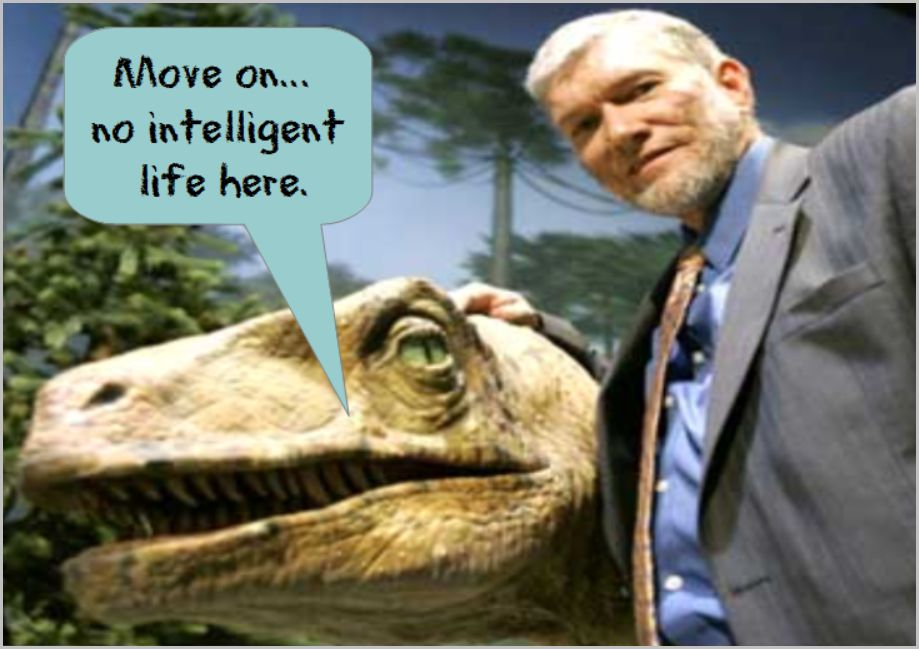
KenAnyone searching for extra-terrestrial life – NASA, SETI and so on – can stop now. We know definitively that there isn’t any out there. How do we know? Because Ken Ham says so. The Bible – Genesis specifically – doesn’t mention life on other planets so that means there isn’t:

(T)he notion of alien life does not square well with Scripture. The earth is unique. God designed the earth for life. The other planets have an entirely different purpose than does the earth, and thus, they are designed differently… where does the Bible discuss the creation of life on the “lights in the expanse of the heavens”? There is no such description because the lights in the expanse were not designed to accommodate life [this is utter gibberish; life within stars? Who has ever suggested that?] God gave care of the earth to man, but the heavens are the Lord’s. From a biblical perspective, extraterrestrial life does not seem reasonable.

But hang on a minute! The Bible doesn’t mention other planets, never mind whether there’s life on them. It doesn’t tell us anything about cultures outside of a small area in the Middle East, doesn’t mention the Americas or Australasia, doesn’t have anything to say about microbes, anti-biotics, computers or technology in general. It must follow, therefore – to use Ken’s logic – that none of these things exist either.

The reason the Bible doesn’t mention any of them, and a myriad of other things, is not because they don’t exist but because the primitive priests and ignorant scribes who wrote Genesis and the rest of Ken’s magic book didn’t know that they did. They had no concept that the Earth is a planet, let alone that there are others; they had no idea that the sun is a star, nor that other stars, which they thought were attached to the inner surface of a canopy surrounding the Earth, are suns. With such a limited cosmology, the possibility that there might be life on other planets was as alien to them as, well, aliens themselves.

Whether there is extra-terrestrial life, and whether any of it is intelligent, we may never know. But either way, Ham’s deity will have no bearing on it, nor it on the Christian God. The existence of aliens, like their absence, won’t breathe life into an already discredited idea.

The Late Great Planet Earth

burning_earth1The scene yesterday as the Earth finally came to an end.


Today is an illusion. You are not really here. Yesterday, the world ended, destroyed with the fire predicted in 2 Peter 3. The Lord finally had enough and set fire to the Earth and obliterated it.

So how was it for you?

And here we are today, the day after it all ended. Doesn’t it seem remarkably like it was before the terrible events of yesterday?

As ever, God mispoke to his trusted servants who took the time to tell us of our impending doom.

Never mind. Let’s set another date. Oh wait – we already have. Plenty to choose from here. You can’t have too many ends-of-the-world, can you?


Once in a Blood Moon

HageeSomething’s going to happen today. Or maybe tomorrow. Maybe something happens every day. But evangelical pastor John Hagee says that because of last night’s Blood Moon and lunar eclipse, something special’s going to happen real soon. He can’t say whether it’s something good or something bad, but it’s something, okay? Because predictable lunar events are really secret messages from God, telling us he’s pissed  off again and warning us something big is going to happen, whether that’s something good or something bad. Who knows. But you will know when you see it and you’ll be able to say, ‘So this is what John Hagee warned/promised us would happen!’ He really can’t lose; ‘prophecy’ with the details filled in after the event – any event – is prophecy that can’t fail.

Christians, you are being short-changed. Your teachers and leaders, including, in all probability, those you sat listening to in church yesterday (maybe even writing down what they said) are feeding you inanities. The rest of us see it whenever we look at the God channels or stumble upon the pronouncements of the likes of Hagee or Robertson or Meyer. These people have nothing to say of any substance, sense or meaning. This isn’t just someone in an ‘unregenerate’ state saying so – analyse what they tell you for yourself and let your eyes be opened. See through the thin veneer of derisible pop-psychology and lunatic make-believe (pun intended) to the vacuousness at the heart of Christian ‘teaching’. Admittedly, this will entail doing some thinking for yourself rather then just absorbing uncritically the drivel these people send your way – but it will be worth it. Then you’ll finally see: the emperor’s self-appointed spokespersons really don’t have any clothes on.

Meanwhile look out for something happening today. Or tomorrow. Or some other damn time.

Who Decides?

DavisI’ve written before about how some parts of the Bible are more important than others; about how Christians relegate some of it – ironically much of what Jesus is purported to have said – while elevating other bits. These latter aspects trump the former, so that if there’s ever any dispute about how Christians should behave in a given context, they’ll happily cite the elevated parts while overlooking those that are less to their liking. This happened recently in the Kim Davis case,* which I talked about last time. In that context, the verses from Romans I quoted, in which Paul instructs believers to obey civil authorities, are explained away and dismissed in favour of other passages. Here are commenters doing just that on the crackpot Christian site, World Net Daily:

Have you not read Acts 4:19 and 5:29? There is a time when God’s authority trumps human authority. In this case, Kim Davis stood up for God’s authority. God’s word calls homosexuality an abomination. Ephesians 5:11 teaches that Christians must have nothing to do with the works of darkness, but instead expose them.

and

Sometimes…when you give to God…what is God’s…you will have to disobey the civil authorities that are over you. Kind of like Paul…refused to stop preaching and jailed…God took care of him, though, I do believe. Although never truly jailed, except at the end…didn’t Jesus disobey the “law”, Mosaic Law, when He preached?

It’s not as if Paul was writing about ‘authorities’ that conducted themselves in considered or considerate ways; this was the Romans, after all. They would eventually execute Paul – so much for God taking care of him! – just as they had Jesus himself. Nonetheless, Paul tells the brethren they must honour Roman authorities. But somehow, if Christians today are to be believed, he just didn’t understand what it’s like to obey civil (in both senses of the word) secular authorities in the 21st century. They consider his teaching in the early part of Romans 13 to be invalid, no longer applicable, irrelevant to the very situation it was designed to address. Other passages from the Bible are far more important and therefore trounce it easily.

But who decides this? Who decides, in what these same Christians deem to be the literal Word of God, which words are less literal than others; less applicable; less relevant? And, consequently, which are more important, more applicable, more ‘of God’?

The evidence would suggest it’s the individual Christian who does, led, no doubt, by the Holy Spirit, who inexplicably leads different believers to different conclusions about the same source material. There’s no ‘free-will’ involved in this process, however; individual interpretations of scripture are informed by the consensus of the church or the movement with which individual Christians align themselves. But who in these institutions determines the order of priority for the Bible’s many confused and often contradictory injunctions?

Determining what is important in the Bible, and what isn’t, is the result of a consensus of prejudices and biases. It’s easy to find ‘teaching’ in the Bible that supports one’s own views and opinions and equally easy to find that which doesn’t and is incompatible with the position one already holds. To reconcile the two, and to deal with the discomfort of any cognitive dissonance, Christians demote any teaching that doesn’t correspond with their pre-existent world-view – sorry, Paul, but this includes your silly suggestion that we should obey the authorities – while promoting those ideas that conform to and confirm that outlook (so hurray for those verses that say gay people are abominations and have no place in the Kingdom of God!) The very words of God are ranked according to the whims and prejudices of those reading them.

Again, I’ve written before about Christian priorities, about how those parts of the Bible they find unpalatable and challenging – such as those that say they should give away all they have and love their enemies – are explained away or ignored. But as for those passages that tell Christians how superior they are while excoriating others as ‘works of darkness’ – well, now you’re talking!  


*While Davis claims all her husband swapping took place before she met Jesus, she was a member of the Baptist church while she was busy trying them all on for size. At least three of her wedding ceremonies were conducted by Baptist ministers. All that happened in 2011 was that she joined the more extreme pentecostal movement, which empowered her to ignore the log in her eye and concentrate on the speck in others’.