Con Texting

Cross2Pastor Chris Linzey didn’t like my previous post. He attacked its shoddy journalism(?), complained I exercised faulty hermeneutics and was upset I quoted bits of the Bible ‘out of context’. What he didn’t do, of course, was address the point made in the post, that Christians are selective about the parts of the New Testament they’ll accept, nor did he answer my question about how they decide which commands to follow and which not. Ironic, really, for someone whose blog has the strap line ‘Turning the Bible into Behavior’.

Christians are inherently dishonest about which parts of the supposed ‘Word of God’ – the New Testament specifically – they’ll acknowledge, believe and apply to their own lives. They mask this dishonesty, from themselves as much as anyone else, with a sleight of hand they mistake for hermeneutics (more on this in two post’s time) and by wilfully misinterpreting those who draw attention to their inconsistency. Pastor Chris didn’t seem to understand the fairly simple points I made in ‘Pick and Mix’ so came up with a couple of avoidance strategies. First, he took a swipe or two at my writing style (fair enough, though no-one was compelling him to read it) before, secondly, setting up strawman arguments to attack. They certainly weren’t my arguments he was tilting his lance at, that’s for sure. I guess this is what Christians mean by putting on the armour of God; you gotta deflect criticism by whatever means possible.

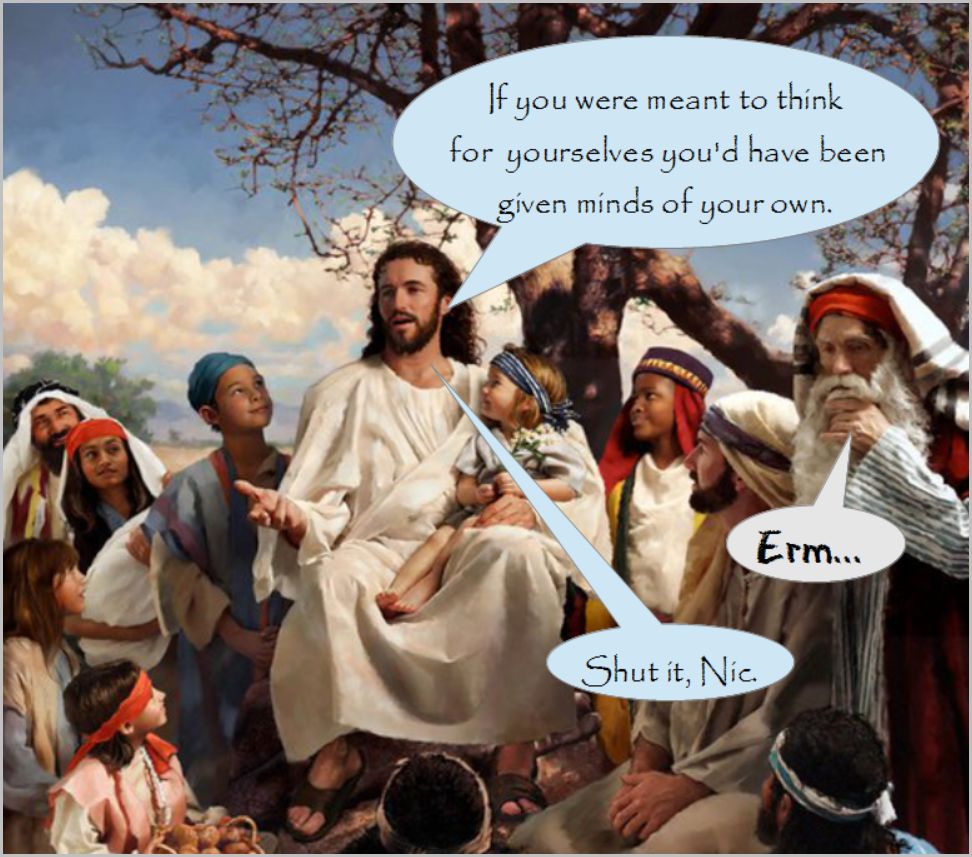
I’d like here to address though, Chris’s claim that I was quoting the Bible ‘out of context’. I have to say I find this one of the most unconvincing rejoinders – it hardly qualifies as an argument – that Christians offer in defence of their beliefs, right up there with ‘you wouldn’t dare say this about Islam’.

A quotation from any source, not just the Bible, is necessarily out of context no matter how much of it one uses. There is no way round this, even if one resorts to quoting extensive amounts of material, which I do when the meaning isn’t apparent from a short quotation, like here, for example. Nonetheless, a lengthy quotation is still decontextualised, from its letter or gospel as well as from the original time, place and culture in which it was written. In addition, while long quotations might be appropriate for longer academic papers (I have some experience of these and even there, great chunks are rarely necessary) they’re not always suitable for short, pithy blog posts.

In any case, the objection really only has validity if quoting ‘out of context’ somehow distorts the meaning. If it doesn’t, if the meaning is apparent from the lines referenced, then quoting more isn’t necessary. Readers who have any doubts can always check the source material for themselves – I always provide chapter and verse – to gain a sense of the wider context for themselves. Remarkably, the verses I cite invariably turn out to have the same meaning in their greater context as they do when quoted in isolation. The Christian objection to them being ‘out of context’ is usually nothing more than a smoke screen to avoid addressing the point being made.

What of Christians themselves? Do they ever take ‘scripture’ out of context? Oh my, yes, and they’ve been doing it from the very beginning. The gospel writers, particularly Matthew, wrenched snippets from the ‘Old Testament’ to make ‘fulfilled’ prophecy out of verses that weren’t prophecy to begin with, and, as we’ll see next time, Jesus too lifted lines from their original context to allow him to make theological points.

Nor are Christian bloggers and apologists today averse to doing the same. Then there are those devotional posters with a single, ‘comforting’ verse of scripture on them (like the one I used to have that said, ‘Heaven and earth will pass away but my words will never pass away’); the placards that surround street preachers with ‘For God so loved the world he gave his only begotten Son’ and ‘Ye must be born again’; the banners at marches and parades that declare ‘Repent or Perish’ or ‘Christ died for the Ungodly’. Each and every one out of context. I suppose if the original sense is more or less preserved then these might be seen as legitimate (if not entirely useless) but evidently taking scripture ‘out of context’ is something Christians are allowed do but others shouldn’t. Yet another case of do as I say, not as I do.

Next time, we’ll take a closer look at how believers ease their cognitive dissonance – between what the Bible says they should believe and do and what they actually believe and do – by disregarding context when it suits them.


Pick and Mix

Kiss2If the Bible is the Word of God™ why, Christians, are you so selective in your use of it? I’ve previously considered how you dismiss much of what Jesus said as well as how you ignore the brutality of the Old Testament and the rest of the New Testament isn’t immune from your selectivity. You disregard, for example, verses like these:

Women should remain silent in the churches. They are not allowed to speak, but must be in submission, as the law says. (1 Corinthians 14.34)

I do not permit a woman to teach or to assume authority over a man; she must be quiet. (1 Timothy 2.12)

For if a woman does not cover her head, she might as well have her hair cut off; but if it is a disgrace for a woman to have her hair cut off or her head shaved, then she should cover her head. (1 Corinthians 11.6)

Wives, submit yourselves to your husbands, as is fitting in the Lord (Colossians 3.18)

Slaves, obey your earthly masters with deep respect and fear. Serve them sincerely as you would serve Christ. (Ephesians 6:5)

Let everyone be subject to the governing authorities, for there is no authority except that which God has established. (Romans 13:1)

Your beauty should not come from outward adornment, such as elaborate hairstyles and the wearing of gold jewellery or fine clothes. (1 Peter 3.3)

Greet one another with a holy kiss. (Romans 16.16)

Why don’t you obey these commands? You should if the Bible really is the Word of God, like you say it is. I’d suggest you don’t because like the rest of us, you derive your morals and values from the culture around you. As these change so too do your Christian beliefs; always much more slowly than the rest of society and with much resistance and tantruming, but eventually your views evolve and catch up with the rest of society. Provided you’re not part of the lunatic fringe (in which case I doubt you’d be reading this), you now generally accept values and practices that were unthinkable in the relatively recent past:

You don’t support the idea women should keep silent in church;
You accept them as preachers, ministers and bishops;
You don’t insist they keep their hair covered;
You don’t promote the idea they should be subservient to men.

You don’t see a man’s hair style as having anything to do with his faith or place among you.

You don’t endorse slavery.

You do oppose governments and authorities when you think they’re denying you your rights.

As for holy kisses… not so much.

You excuse yourself from adhering to the Biblical position on these matters by saying that here (and here alone) its teaching is culturally bound. These stipulations, and these only, you say, stem from views of women, conduct and practices at the time Paul and others were writing. As such, you claim, they are not binding today. You’re right of course, but then you insist that other of the Bible’s pronouncements, many of which, like its invective against gay people, are equally insupportable, are absolutes and binding for all time. How, I wonder, do you know which is which?

I’m confident that you don’t research the Graeco-Roman culture of the first and second centuries to determine where the New Testament’s writers are reflecting the mores of their day and where they’re providing eternal truths. No, what you do is decide arbitrarily, occasionally with the help of ‘experts’ who know no more about it than you do, which of the teaching you will accept and which you won’t.

It all comes down to a matter of taste, personal biases and what is compatible with your particular culture’s values. This is why you will, before long, come round to accepting gay people – unless you live in a part of the world that still reviles homosexuality, in which case your views will continue to reflect that of your culture. You can then go on claiming, for a little while longer, that your prejudice is derived from the scripture.

But let’s have no more insistence that the Bible is the Word of God offering eternal values and absolute standards. You don’t believe it yourself; if you did, you would apply all New Testament values and standards consistently and completely in your own life and within your church. You don’t. To paraphrase Paul Simon, you believe what you want to believe and disregard the rest.

A Long Long Time Ago

ShinyJesusHe was a man of great charisma, a provocative individual who challenged the establishment and the norms of his day. Some said, as he implied himself, that he had come to visit the Earth from a higher plane and that perhaps, again as he occasionally hinted (though maybe he was only being contentious) that he was some sort of Messiah. He certainly inspired and gave hope to others who, like himself, found themselves on the fringes of society, who felt unaccepted and down-trodden. Some of what he said and did may have enabled such people to accept who they were or, better still, who they wanted to be.

He refused to accept that he was ‘good’, and certainly he acted as he did because it suited him to do so, not because he felt any need to impress others. Nevertheless, many found him to be humble and kind. His detractors said he was a charlatan and claimed he was demon-possessed; he was all things to all people.

His death came as a shock, what with its suddenness and the manner in which it happened, but nonetheless he seemed to have been prepared for it. In his final messages he suggested he was returning to the higher place from where, perhaps, he’d originally come.

Those who had followed him mourned him and talked of him as an important figure in their lives. They couldn’t, they said, believe he was gone. Some felt that even though he was no longer a physical presence in the world, what he had meant to them would always live on in their hearts, especially when a few of them would gather together to reminisce about him. Others talked of how they hoped and prayed God would raise him from the dead and allow him to live again.

It wouldn’t be long before someone claimed to have seen him back among the living.

So much for David Bowie (there really is a petition asking God to bring him back to life, in spite of his already having been cremated and there being no God.) Within hours of his death being announced, Bowie was elevated to a sort of godhood, his work and sense of alienation imbued with a kind of profound mysticism. The reaction we’ve seen, particularly in the UK, to Bowie’s demise is a common human reaction to the death of a revered one. It happened when John Lennon was killed (a saint he was not) and with Elvis Presley, who, in the years following his death was frequently seen alive in the supermarket or laundromat, and with Diana, Princess of Wales. Elevating larger than life characters to hallowed status when they die is a human trait that helps us mourn them and deal with bereavement.

Is this not what happened when Jesus died? The profound grief, bewilderment, fear and shared memories of those who idolised him, together with their desperate search for meaning in his pointless end, led to his elevation to quasi-godhood and, eventually, to visions of him, if not in the supermarket and laundromat, then back amongst them somehow. If such a thing can happen still, in the technological world of the twenty-first century, how much more could it happen in the superstitious backwaters of first century Palestine.


What Does Atheism Have To Offer? (Part Three)

Celia17. Atheism offers knowledge instead of belief
‘But you must,’ Christians have said to me, ‘believe in something greater than yourself’ and ‘You can’t deny your spiritual needs.’ Well of course there are things greater than me and of all of us. The universe for a start; love, beauty, friendship, music, great art, nature, the night sky – sex even. Who hasn’t had a spiritual experience through their appreciation of these things? The fact they exist though, makes ‘belief’ in them redundant. We only need ‘believe’ in those things for which there is no evidence – which is why you can’t ‘believe’ in evolution; you can only know it as fact. Similarly, atheists know there are greater things than themselves. They don’t, as a rule, worship them, but appreciate them, often in awe and wonder, for what they are. As for such experiences being ‘spiritual’, we do not, of course, have ‘spirits’ either to nurture or express. We are emotional creatures and the value we find in those things greater than ourselves often stimulates sublime emotional responses. Nothing wrong with that, of course, but our responses reflect conditions within us, not the supernatural without.

8. Atheism offers the embrace of reality
Part of the inherent honesty of atheism is its recognition that this life is all there is. Atheism faces up to the fact that we are organic beings and like all organic beings our lives come to an end; there is nothing in us, no part of us, that survives death. Knowing heaven and eternal life are impossibilities atheism promises neither. Religions do, of course, and that is their great selling point but no-one, apart from atheists, seems to notice that they never actually deliver what they promise (because they can’t.)

Christians also tell atheists that it takes more faith not to believe in God than it does to believe in him. They need only look to their own experience to realise this cannot be so: they don’t need faith not to believe in Allah, Santa Claus or any number of other mythical beings. Equally atheists don’t exercise any faith at all not believing in Yahweh.

9. Atheism offers, unfortunately, an unsatisfactory name
One thing I wish atheism made possible but doesn’t – not yet anyway – is a better term for one who is unencumbered by gods, the supernatural and superstition. I have no wish to be defined by what I’m not, which is how ‘atheist’ works. It also implies that being a theist is somehow the default position and that any other is an aberration. I quite like ‘humanist’, but that doesn’t quite capture it either, but I’m not keen at all on Richard Dawkins’ suggestion of ‘bright’. The tide is turning though and once absence of belief becomes the norm, the right name for the true default will present itself.

10. Atheism offers a sense of well-being
Happiness, tranquility, peace perhaps don’t come from atheism per se, but they do stem from it: the opportunity for the consciousness I think of as ‘me’ to experience life in the here and now. I know many are not able to enjoy being here to the same extent that I and many in the west are able to, but this only makes it more important that we all do something to help improve the lot of others. As the nineteenth-century atheist Robert Ingersoll expressed it, ‘the time to be happy is now, the place to be happy is here, and the way to be happy is to make others so,’

As I write, Queen’s ‘Who Wants To Live Forever?’ is playing on the radio. It hardly matters who wants to; we can’t and we don’t. And – same group, different song – it’s true that ‘nothing really matters’. Really, it doesn’t, and so we are free to get on with living instead of trying to impose our beliefs on others, exterminating those we don’t like or squandering our one and only life because we think there’s a better one waiting. Atheism is far from nihilistic – it allows us to see the value of this life and helps us live it to the full.

So, what has atheism to offer? Freedom, honesty, meaning, contentment. Or, to put it another way, and to paraphrase what somebody or other once said, atheism really is the truth that can set you free.

What Does Atheism Have To Offer? (Part Two)

Think4. Atheism offers genuine morality
Having no magic book to tell them how to behave (not that Christians derive their morals from theirs) atheists work out their own morality. They don’t do this in a vacuum, however, recognising that morality is culturally derived, evolving as the means by which primates with complex social arrangements relate to one another. It’s likely they adhere to their moral codes imperfectly, as do believers of various stripes. Not having an ideology they feel compelled to impose on others, they don’t regard their fellow human beings as mere conversion fodder. The atheists’ world is big enough to embrace all, though they lament the damage wreaked on it by religion. Atheist terrorists are a much rarer breed than their religious counterparts, while secular societies are among the most peaceful and prosperous in the world today (with the more religious generally at the opposite end of the spectrum.) Nor do atheists attribute their behaviour to supernatural forces; neither god nor the devil inspires them to act. Rather they recognise and take personal responsibility for what they do.

5. Atheism offers authenticity
An atheist is free to be him or herself. There is no striving to maintain the imagined standards of an imaginary god, no need to represent the perspective of a ‘sacred’ book or to defend the indefensible. The atheist does not see themselves or other people as lost, worthless, sinners, suppressors of truth, goy, infidels or any of the other disparaging terms used of non-believers in so-called holy books. The atheist can be a free-spirit, possessed of self-respect, and true to themselves and their nature, whatever that may be. Here’s how pastor-turned-atheist Ryan Bell put it in a recent blog post:

I don’t have secrets anymore, which is a huge mental and moral relief. I also wrestle with less cognitive dissonance than ever. All of this means I’m more at peace and more comfortable in my own skin. I give far fewer fucks about what people think of me and my decisions. My ire is raised, from time to time, by unfair attacks, and I will probably always struggle with my tendency to be a people pleaser, but I am in recovery. I’m learning to tell the truth on a more regular basis and trust that people can handle the truth (whether they actually can or not). I’m learning to trust myself and what I know while remaining open to critique and able to say I was wrong.

6. Atheism offers free thought
Having no dogma to represent or promulgate, no myths to restrict them and no cult leaders, shaman or gurus dictating to them, atheists are free to think for themselves. Religion demands that its adherents begin with myth or dogma, which the facts are then forced to fit. When they don’t, which is invariably the case, the believer is compelled to dismiss the facts to preserve the fantasy (if you think not, you’ve never visited Answers In Genesis). The atheist, on the other hand, can begin with the evidence and reason from it to make up their own mind about ethics, the issues of the day and the human condition.

to be continued…

What Does Atheism Have To Offer? (Part One)

Station-12-ArtistOver the next few posts I’m going to do my best to answer the question, ‘what does atheism have to offer?’ that a commenter on Facebook has put to me – that’d be you, Dave – because, he says, I’m too sneery about Christianity. Some of my response will of necessity be personal in nature, and you can take or leave whatever I say; you won’t go to hell if you disagree (or heaven either.)

1. Atheism offers the truth
Christianity wasn’t delivering; it didn’t ring true for me any more and lacked explanatory power. As a result, a need to know the truth of why we’re here and what life is about preceded my atheism. I set about examining the facts of our existence as we know them, together with all the evidence. I became committed to this pursuit regardless of where it might lead. I didn’t, initially, confine my questioning and subsequent reading only to secular or scientific sources, but continued to explore religious and spiritual explanations of life as well. These quickly paled in comparison with empirical evidence; they were vapid and unsubstantiated, relying as they did on talk about ‘energies’ and entities that no-one had ever seen and for which there was no evidence.

Drawn increasingly to scientific explanations of life – biology, genetics, psychology, astronomy – I became increasingly aware that God wasn’t and isn’t required to explain anything about life, the natural world, the universe or indeed anything. Natural phenomena (and they’re all natural phenomena) have, on the principle of Occam’s razor, natural, not super-natural, explanations. The only reasonable conclusion to be drawn from this was that he wasn’t and isn’t involved in any of them. His very superfluity demonstrates his non-existence; a god who is not evident in any aspect of reality is a god that doesn’t exist. This pursuit of truth therefore led to atheism as something honest and inherently truthful.

2. Atheism offers a real life in the here and now
Living without recourse to the supernatural is refreshing. There is no god (no angels, devils, spirits, ghosts or demons either) watching over us, waiting for an opportunity to punish or bless us; no god whom we are answerable to either in the present or at some future judgement; no god of vengeance who must be obeyed; no god who will vindicate us at the end of time; no god to grant us eternal life; no set of frequently bizarre rules to follow and no empty promises to claim. Atheists take full responsibility for their own lives and behaviour; they construct their own meaning, knowing this life is the only one they’ll get. Atheism alone grants this responsibility and privilege.

3. Atheism offers a humanist perspective and approach to life
This is not the End Times™ as salaciously envisaged by Christians ancient and modern, just as the first century wasn’t – even though Jesus and Paul both thought it was (Matt 16:27-28; 1 Thess 4.15-17 etc.) The atheist accepts that the only help we’re going to get in solving our problems is from ourselves. There is no god waiting in the wings to put things right; no end time scenario when he will come to rescue a chosen people. (This is, incidentally, one of the most pernicious ideas ever to have been devised by humankind, causing more strife and ‘excusing’ more inhumane treatment of others than any other we’ve devised.)

Apart from natural disasters – and we seem to be contributing increasingly to those – the cause of all of our problems is us. Equally, the solutions will have to come from us too. More positively, all of our endeavours, our achievements, our scientific, technological and social progress are ours alone too. We have the potential to do great good, and often do, just as we cause great harm. Free of religious restrictions, the atheist is at liberty to help others out of fellow-feeling, not because a (non-existent) god demands it.

to be continued…

2015: How was it for you?

2ndComingI promised this time last year to revisit my predictions for the year that lay ahead. So how did I do in my prophecies for 2015?:

The first was that there would be no Second Coming in 2015. Well, how wrong could I be! As we all know Jesus returned on September 13th, just as John Hagee hinted he would be. It’s been so great, hasn’t it, living in Hell / God’s Kingdom on Earth (delete as appropriate) since that time. Fantastic. I’m so pleased to have been wrong about this one.

On the other hand, maybe what I said last year still stands: Jesus won’t be back this year. Just like he wasn’t back in 2014, 2013, 2012… 1985… 1914… 1868… 1497… 1000… 446… 35. Just think of all those years – count ’em, nearly two thousand – when he’s failed to return so far. Actually, he promised he’d be back while his followers and those listening to him were still alive, around AD30 or thereabouts. Safe to say he’s not coming back at all, just like dead people don’t. Not in 2015, not ever.

Of course it still stands. As ever Christianity fails to deliver. That hasn’t stopped True Believers™ from telling us that he’ll be back very, very soon. Which was prediction number 2: Christians will go on believing that Jesus is going to return any day now. I gave up collecting examples well before the end of the year – there were just too many – but here’s a few of them: here, here, here, here, here, here and here. Will the gullible Born Again ever come to their senses and stop listening to idiots like these? (Nope).

Prediction 3. There’ll be no natural disasters or human calamities as a result of gay marriage. There have been lots of disasters and calamities during the year, but here’s the thing – natural disasters have natural causes, not supernatural ones, and similarly, human calamities have human causes. Not one of the events this year (or any other) was the direct result of gay marriage. This hasn’t stopped the religious from claiming – as I predicted they would in prophecy number 4 – that disasters and calamities are God’s punishment for gay marriage; here, here , here, here, here, here and here, for example.

Prediction 5: More than one prominent Christian will call for the execution of gay people. Yup. Here are those loving men of God doing just that (and here, here and here too). Jesus would be so proud.

Prediction 6: Christians in the west will claim they’re being persecuted when they’re being expected to treat others fairly and equally, and not to discriminate against them. Yes, I know Christians are persecuted in some parts of the world, but the moaners I’m talking about are only focused on their own self-serving, self-inflicted ‘marytrdom’. Again, there are just too many of these to link to them all, but here are a few (and here, here and here).

Prediction 7. Christians will respond to criticism with clichés like ‘they wouldn’t dare say that about Muslims’… ‘Christians are the last group who are fair game’… ‘It’s time for Christians to speak out’… ‘Stand up for God’s standards…’ etc. Yes, predictable in more ways than one

Prediction 8: Christians will continue to dismiss and disparage anyone who doesn’t share their views, especially atheists. Look out for ‘atheists have no morality’,’the fool hath said in his heart there’s no God’ and ‘atheists want to oppress Christians’ occurring with tedious regularity. And they didn’t disappoint: here, here, here and here.

Prediction 9: There will be more revelations about the abuse of children by church ministers. Of course there were. Christians may be new creatures in Christ but that doesn’t stop some of them behaving in the same old despicable ways, God love ’em.

Ditto number 10: Church hierarchies will attempt to cover up the abuse of children by their ministers. And here they are at it. The body of Christ certainly seems to have an unhealthy interest in the bodies of others. Still, they always ever so modestly cover up afterwards.

Prediction 11. There will be the usual manufactured ‘war on Christmas’. Ho-hum. And you can guess who did the manufacturing.

And finally I offered number 12: these predictions have far more chance of coming to pass than any of the so-called prophecies of Bible. And do you know, they did. That’s because none of the Bible’s predictions have ever come to pass – not those purportedly about Jesus himself, nor of the second coming, nor the judgement of sheep and goats, nor God’s Kingdom on Earth – and (here’s another prediction) they never will.

So, another year of empty promises, failed prophecies and superstitious fantasy in the wonderful, wacky world of religion. May you all be safe from the effects of faith and fundies in the one that lies ahead.

We owe it all to Jesus

MarySo the UK is a Christian country. Prime minister Dave Cameron has decreed it. In his hallowed Christmas message he proclaims that Britain derives all of its values from Christianity:

As a Christian country, we must remember what (Jesus’) birth represents: peace, mercy, goodwill and, above all, hope. I believe that we should also reflect on the fact that it is because of these important religious roots and Christian values that Britain has been such a successful home to people of all faiths and none.

‘Peace, mercy, goodwill, hope and tolerance’. Doesn’t it warm your heart? This country of ours has these wonderful sentiments at its core and all of them derive from the baby Jesus. I’m not sure about where our other values – capitalism, colonialism, democracy, free-thought and expression – originate but no doubt Dave will tell us they too spring from our ‘religious roots’.

What about the values he mentions though? Do they originate with Jesus as Dave claims?

Peace we covered last time: Christianity have not brought peace into the world, ever. Dave seems to have forgotten that Britain is currently at war; the so-called ‘war on terror’ Is he now suggesting that as a ‘Christian country’ we should turn the other cheek and propose peace, because that’s what Jesus would want? I doubt it, somehow.

Mercy? Here’s the kind of mercy Jesus proposed: ‘But those enemies of mine who did not want me to be king over them – bring them here and kill them in front of me’ (Luke 19:27). Nice.

Goodwill? Jesus always extended goodwill to others. Like here: ‘It is not right to take the children’s bread and toss it to the dogs (non-Jews)’. And here: ‘Do not give dogs what is holy, and do not throw your pearls before pigs (non-Jews again), lest they trample them underfoot and turn to attack you’ (Matthew 15.26 & Matthew 7.6).

Hope? The Bible does speak about hope – hope that this will all soon be over and God will consign non-believers to hell, set up his kingdom on earth and put Jesus in charge (Matthew 19:28 & 24.51). Is this what Cameron means by hope?

Tolerance? Paul on tolerance: ‘do you not know that wrongdoers will not inherit the kingdom of God? Do not be deceived: Neither the sexually immoral nor idolaters nor adulterers nor men who have sex with men’ (1 Corinthians 6:9). It’s difficult to see how modern notions of equality and acceptance can derive from bigotry like this.

No, Britain does not get its values from Christianity or the Bible or baby Jesus. It has worked them out for itself, principally through social progress and the reforms of modern times.

The UK is not a Christian country in any other sense either. Christians are required to turn the other cheek (Matt. 5.38–42), give all they have to the poor (Luke 14.33) and buy into a convoluted salvation scam plan (2 Timothy 1.9 etc). Can a country do these things? It would be unthinkable for it to give away its wealth, accede to other countries’ demands and respond non-aggressively to attack. Individual Christians don’t or won’t do these things and it would be nothing short of suicidal for a country to attempt to; yet this is what Jesus insists is involved in following him. It’s impossible for individuals to live this way, let alone entire nations.

Cameron can’t even claim that the majority of the population subscribes to the great salvation plan either. A recent government poll showed that only 49% of the population admits to being Christian and in any case, the plan is designed for individuals, not countries. So let’s hope (hah!) the Prime Minister will stop fawning over Christians, fatuously pretending that the UK is a Christian country when it isn’t. Let’s hope too he understands that our values, whatever they are, do not derive from an ancient, expired superstition. The UK is not a Christian country in any sense. Let us rejoice in that fact.

Peace Off

angels

Glory to God in the highest, and on earth peace, good will toward men. Luke 2.14 as rendered by the King James Bible.

Whatever happened to that peace? There hasn’t been peace on earth ever since the angels were made to herald Christ’s birth with these words. Some of that absence of peace – the conflicts and wars – has been the result of religion, including that of Jesus himself. Then again, he did contradict the angels when he said he hadn’t come to bring peace but a sword and for once, he was right (Matthew 10.34). So what can the angels have meant? More to the point, what can those who created these words to put in the mouths of non-existent beings have been thinking? Is their declaration a promise? A prophecy? Something to look good on Christmas cards?

Other translations of Luke 2.14 avoid the whole peace on earth shtick by watering down the statement: ‘Glory to God in the highest heaven, and on earth peace to those on whom his favour rests’ reads the NIV. Now only those whom God ‘favours’ are granted peace, which presumably means only Christians, and it’s now a vague sense of well-being (complacency? smugness?) that isn’t of much use to the world at large. Certainly other New Testament writers, the creators of John’s gospel and the letter to the Ephesians for example, interpret ‘peace’ in this very limited way.

And yet, in Isaiah, in verses applied to Jesus (especially at this time of year; they were read out in the carol service I attended last night) we find him descibed like this:

For to us a child is born, to us a son is given, and the government will be on his shoulders. And he will be called Wonderful Counselor, Mighty God, Everlasting Father, Prince of Peace. (Isaiah 9.6)

Apart from the fact this is a specifically Jewish prophecy that has nothing to do with Jesus – which is why most of the titles don’t really apply to him (nobody has ever called him ‘Wonderful Counselor’ or ‘Everlasting Father’) – there again is the idea that he’s somehow connected with capital-letter Peace. He’s a Prince of it, no less.

But wait – there’s more:

Of the increase of his government and peace there will be no end. He will reign on David’s throne and over his kingdom, establishing and upholding it with justice and righteousness from that time on and forever. The zeal of the Lord Almighty will accomplish this. (9.7)

Of course; it’s all end time stuff! We should’ve guessed. Long term peace on the Earth, predicted by the angels and, ostensibly, by Isaiah is going to be in the future, after Jesus returns to establish God’s Kingdom on earth.

Have you noticed how it’s always in the future? Everything Christianity offers is going to happen later: heaven, eternal life, the second coming, the rapture, resurrection, God’s Kingdom, the lion lying down with the lamb, the end of war, everlasting peace. Not in Jesus’ own time as he thought; not in Paul’s, not in the gospel writers’, not any time since, but always just around the corner, any time now, soon. Never in the here and now. Peace on Earth, like all those other promises, is always just out of reach, like the pot of gold at the end of the rainbow – the closer you think you might be to it, the further it moves away.

A friend added one of those clever posters to Facebook recently. It said, amongst other things, that it wasn’t okay to ‘shame’ religion. I couldn’t disagree more. Scams must be debunked and the sham of religion’s empty promises held up to the light of reality. None of the things that the Bible says will happen is going to; not now, nor in an ever-elusive future.

A happy and peaceful Christmas to both my readers.