Christians’ Favourite Delusions 34: Atheism is a Religion

NoGodChristians like to claim atheism is a religion. It’s their way of saying, ‘look – atheists are as daft as we are. They believe in bullshit just like we do, except, of course, they’re wrong and we’re right.’ You can see them saying just this here and here and here.

But atheism isn’t a religion, any more than not collecting stamps is a hobby, as Penn Jillette puts it. It isn’t a religion because it is the absence of belief – primarily in a god, but also in any other kind of supernatural being. The atheist knows there are no saviours, angels, devils, demons, ethereal saints or eternal prophets, and no heaven and hell to house them either. Atheism is devoid of any sort of worship of imagined supernatural beings; nor does it address them, commune with them or otherwise revere them. It does not recognise the authority of ‘holy’ books nor that of self-appointed spiritual authorities, including popes, pastors, preachers, imams, mullahs and rabbis. It doesn’t regard anything as sacred, including its own experts; neither Darwin nor the so-called New Atheists are above criticism. (Try that with those who think they represent God’s Truth™!)

Where religionists build their belief systems on the insubstantial foundation of faith, atheists accept nothing on trust. Instead, they look for evidence to support their knowledge and value reason, not dogma – things that are anathema to religion.

Given, then, that atheism is the antithesis of religion and that atheists don’t do what religion demands, it is intellectual dishonesty to insist that atheism is a religion. Those who do so are false witnesses; mistaken at best, liars for sure.
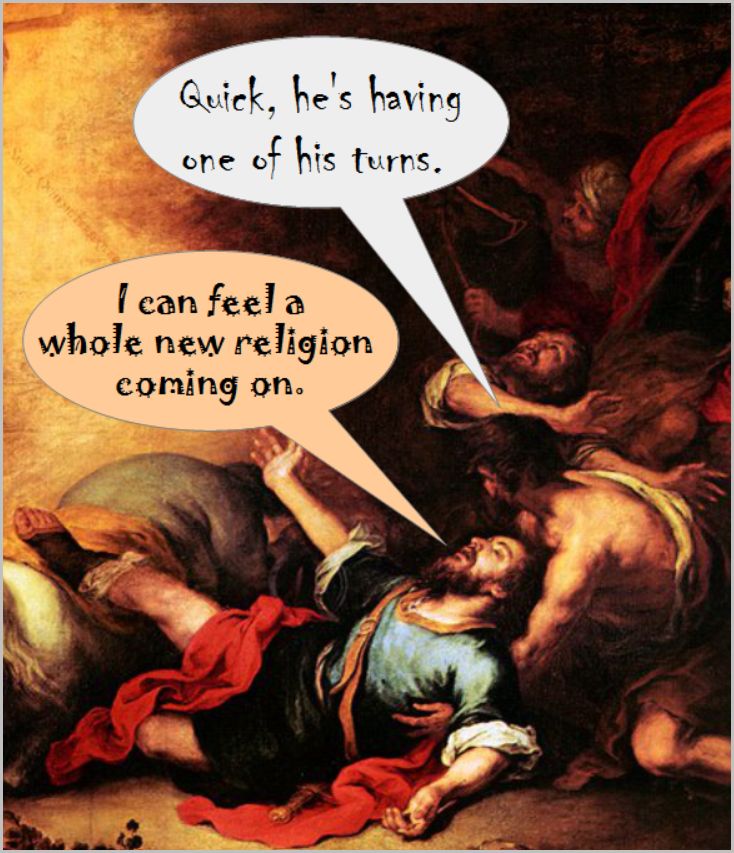
Spontaneous Conversion

st-paul-conversionThe missionaries pressed on into the Amazonian jungle. They were now in uncharted territory. No-one had ever been this far in. And then, sounds from somewhere not too distant; human sounds, human voices – singing even. The missionary troupe emerged into the clearing to an amazing sight. Groups of Amazonian natives gathered together, a rudimentary cross in front of them, towards which they were undeniably directing their worship. These people, whose existence had hitherto been unknown, and who had never before encountered Westerners, were Christians!

Weeks later once basic communication had been established, the tribe’s chief priest and the head missionary communed together. The priest explained how, long ago in the past, his ancestors had recognised God’s presence in the incredible world around them and had opened their hearts to him. As a result – Miracle of Miracles! – God sent them a vision of Christ himself, much as he had to St Paul and the other disciples, and the whole tribe came to believe in Jesus. Ever since then, the tribe had worshipped the one true God and his only son, that same Jesus Christ.

“Amazing,” said the missionary, “so it looks like St Paul was absolutely right when he said God reveals himself in nature and speaks to our hearts to make himself known to us. It’s not as if we ever needed the Bible, or to go round telling people how to be saved. God is more than capable of doing it for himself. Praise the Lord and pass the communion wine!”

What a story! And it happened time and time again as the world was opened up by explorers and missionaries.

Or maybe not. Definitely not, in fact. But it should have happened if what Paul says in Romans 1.18-21 is right, as Ken Ham believes it to be:

For the wrath of God is revealed from heaven against all ungodliness and wickedness of those who by their wickedness suppress the truth. For what can be known about God is plain to them, because God has shown it to them. Ever since the creation of the world his eternal power and divine nature, invisible though they are, have been understood and seen through the things he has made. So they are without excuse; for though they knew God, they did not honour him as God or give thanks to him, but they became futile in their thinking, and their senseless minds were darkened.

If God is so obvious in the world that (supposedly) he created and if we humans can see and understand him through it, then why do Christians need to proselytise? Why doesn’t God make his personal presence felt just that tiny bit more clearly – with the odd ‘revelation’ like the one he provided Paul, say – so that people come to believe in him more fully? And by ‘him’, of course, I mean the proper God – the Jesus one. Why does he leave it so that folk seemingly pick up on the special vibes he’s placed in their hearts but then worship a ‘counterfeit’ god, like Allah or Jah or, back in Paul’s day, Zeus? Why doesn’t he provide revelations like he used to, to ensure everyone knows just who it is who’s standing at the door knocking?

If he did that, if God did indeed plant clues to his presence both around us and in us as Paul says he does, then the Bible wouldn’t be needed to convert people. But that’s not what we find, which is that the Bible is essential in perpetuating the God-myth. We wouldn’t even be aware of Paul’s ridiculous claims if they were not preserved in that ramshackle collection of writings.

The indoctrination of others is utterly reliant on two things and two things only. Not God-in-nature or inner prompting or visions, but on ‘the scriptures’ and those who are driven to spread the Jesus-meme. Now does that not strike you as odd? It strikes me as something entirely human, with nothing supernatural about it. If people have to be told, evangelised to and indoctrinated into Christianity, then it can hardly be the case that they see the one true God in nature or have an intuitive feel for him. If that were the case, then we would have discovered hitherto unknown groups of humans who already knew of him and the nonsensical clutter of beliefs that surround him. And we haven’t. Ever.

Christians’ Favourite Delusions 33: Atheists know in their hearts that God exists

DenyTwo tried cliches trotted out by evangelising (i.e. aggressive) Christians are that ‘atheism is a religion‘ and that in their ‘heart of hearts atheists know there really is a god’. Ken Ham of Answers In Genesis is fond of both assertions, as are other equally desperate promoters of unsupportable beliefs. We’ll come to the first in a later post, but here’s how Ham expresses the second:

They (atheists) know in their hearts that God exists, but they are actively suppressing this belief in unrighteousness (Romans 1:18). They fight so hard against a God that they claim doesn’t even exist because they know that He really does! We need to pray that, instead of fighting against God, these lost individuals will repent and put their faith and trust in Christ and in what He did for them.

Romans 1.18 that he cites says: For the wrath of God is revealed from heaven against all ungodliness and wickedness of those who by their wickedness suppress the truth.

Assuming Paul is saying here what Ham claims he is (it’s doubtful from this verse alone) both he and his hero are demonstrably wrong – as they are about so much. The evidence suggests that while young children look for meaning and assume agency, they do not necessarily attribute these to a god until they are taught to do so by others. The god they then come to acknowledge is the one already prevalent in their social environment. In a predominantly Christian context, they will come to be acquainted with – and may go on to develop a full-blown belief in – the interpretation of the Christian God common within their particular culture.

It is the same for conversion generally. You are more likely to be a Mormon in Salt Lake City, a Roman Catholic in East Timor. If raised in a Jewish environment, it’s more likely you’ll subscribe to YHWH; in an Islamic one, an interpretation of Allah; Buddha – not strictly speaking a god – in a Buddhist one. Statistically, those who adopt a religion and a belief in a god, almost always opt for that which is prevalent in the society into which they are born. This is not god ‘writing a knowledge of himself’ in their hearts, it is a cultural, human phenomenon.

Ham and others see this as evidence for their belief that we all have some sort of ‘god-shaped hole‘ in our psyche that we can just as easily fill with false gods as with the real one (theirs). But this is a shift in the argument; it’s not now that God makes himself known to everyone but that we all find a need for a god. This is not the same thing, nor is it true. Certainly humans have a history of creating gods to explain the strange, magnificent and sometimes hostile universe in which we find ourselves; but this does not mean these many gods exist, as Ham would be the first to admit (c’mon, there’s only one real God – his.) It means only that the human brain seeks pattern and meaning, and has often drawn the wrong conclusions in its quest for them. The gods – and God – are part of these wrong conclusions.

And what of Ham’s assertion that atheists deny their awareness of God because of ‘unrighteousness’ – because, he implies, we just want to live a life of rampant ‘sin’? Well, I admit, I like a bit of a sin as much as the next man, but that’s not why I’m an atheist. I’m an atheist because, like most others, I find no evidence for gods or God either in my ‘heart’, nor in the way the world works nor in collections of iron age stories. Morality doesn’t come into making this assessment. In any case, those who buy into a god don’t have a monopoly on ‘righteousness’, as their weak morals, judgemental attitudes and destructive behaviour regularly demonstrate. More than this, and as Ham admits, Christians are only concerned about others because the Bible says they should be: ‘The reason I care about poverty,’ he says, ‘is because God’s Word instructs me to care, and all humans are made in the image of God as God’s Word tells me.’ This is not righteousness, nor a morality that comes from any real concern for fellow human beings.

Finally, atheists don’t, as Ham claims, ‘fight so hard against’ a non-existent God that we secretly believe in. We oppose Christians and other purveyors of supernatural nonsense when they try to impose their irrational beliefs on others, when they condemn fellow human beings, seek to control them and try to limit their rights in the name of God and the cause of ‘righteousness’.

So, no, don’t condescend, Christians, to tell us we all know that there’s a God that we wilfully ignore. You’re wrong, and I’ll show you even more reasons why you are, next time.

There Is No God. And Here’s Why

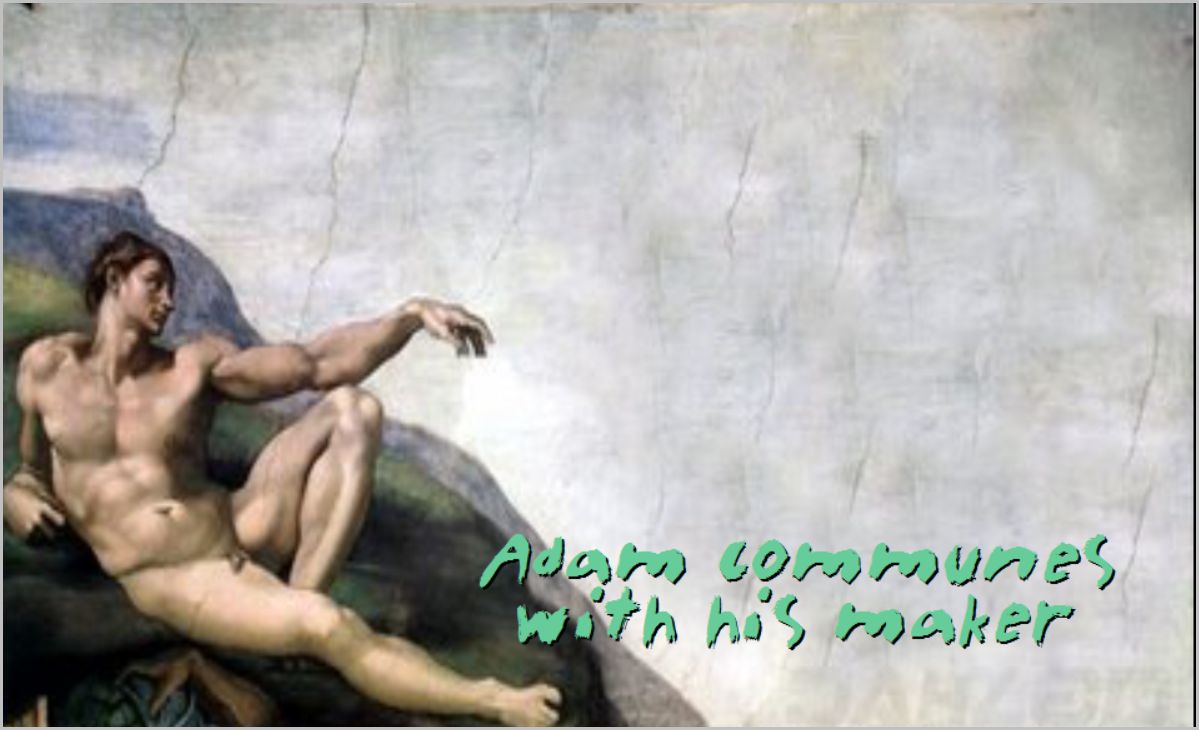
adamSometimes I wonder why I continue writing this blog. There seems to be little that can shake believers from their delusions; what I write here doesn’t appear to be it. When they do respond it’s to tell me that I’m in for a shock when, after my death, I stand in front of the the throne of God and have to give an account of myself. I’ll not be smiling then, they tell me. They’re right, I won’t be. Not because of any ‘judgement’, but because dead people don’t smile. Not of their own volition anyway.

Christians can’t seem to see the ludicrousness of their post-mortem proposals. Religion, all religion, is wrong about most things at most levels; it denies death, which does exist, and replaces it with fantasies about supernatural beings, eternal life and judgements, none of which does. Christianity offers false promises, failed prophecies and an impossible morality, which Christians themselves can’t even manage. By and large they don’t even try to (see previous posts on all of this) yet they stick uncritically, unthinkingly, blindly to the fantasy elements of their ‘faith’ because they’re frightened of their own extinction and want to live forever. Christianity deceitfully promises them that they will – the ultimate false promise.

So let’s cut to the chase. There is no God. This is an indisputable fact, though believers will dispute it anyway. Even now, any Christians who are reading this will be muttering something about the fool saying in his heart there is no God; another tired, cliched response, which I’ve already considered here. But there is no God, not because of any foolishness on my part but because of the evidence. Or rather the absence of it. There is no evidence there is anything other than the physical universe or that life came about as the result of anything other than physical processes (it is not the case that scientists do not know how life emerged from non-life; they do and it did) or that humans evolved by any means other than blind, mindless natural selection. God is not required to explain any of this; not necessary to explain anything at all to do with life, the universe and ‘why there is something rather than nothing’. That being the case, we can know for certainty that he wasn’t in any way involved.

Let’s take a more down-to-Earth parallel to illustrate the point: we do not need to resort to stories of the tooth fairy to explain dentistry. I’m guessing that even Christians would agree with this; the tooth fairy has no part in matters of dental hygiene, orthodontist training or even the payment sometimes made by indulgent parents when their child’s tooth falls out. Trying to force the tooth fairy into any of these scenarios is not only entirely unnecessary, it’s erroneous and unhelpful. Dentistry is far better explained without reference to a mythical sprite. The tooth fairy not being needed, we can safely conclude that she doesn’t actually exist; she is a figment invented for children intended to take the away the pain of tooth loss, nothing more.

So it is with God in explanations into which he too is shoe-horned. He’s not needed, he’s superfluous to requirements. That being so, we can similarly conclude that he isn’t real either. A being that isn’t needed to explain anything is one that doesn’t exist.

This is not, note, a rejection of a figure who, even now, is sitting up in the sky somewhere feeling sad or angry because we’re ‘shaking our fist’ at him. If that’s what you’re seeing, you’re still believing in God, even if it is one you might be in the process of rejecting. It’s worse than that, Jim (or better): there is no super-being in the sky, or anywhere else. The universe is devoid of gods and of God; it always has been and always will be. There are none to be found because there are none there; not your pet god, nor those of other faiths, ancient or modern. None. There is only the physical universe itself and for the brief time we are here in it, we are lucky to be here in it. Which is more than any god has ever managed.

All gods must pass

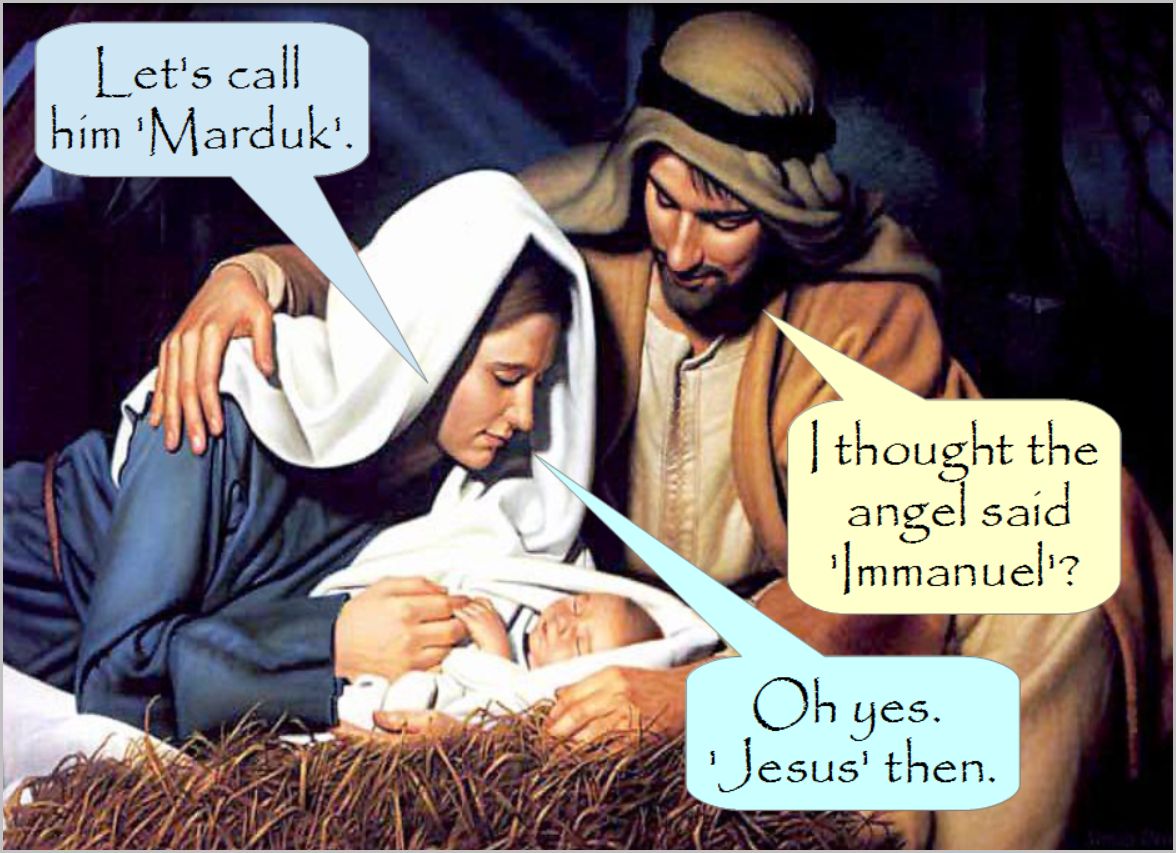
MardukIf human beings were suddenly wiped from the earth through, say, an Ebola pandemic, what would be left of us? What would become of all the things we’ve invented and created? What would happen to language, mathematics, science, literature, medicine, art, agriculture, architecture, democracy, industry, capitalism, civilisation, education, marriage, religion?

They’d all cease, most of them immediately. Remnants of others would survive for a little while before being reclaimed by nature. The surviving flora and fauna, the weather, climates, oceans, land masses would carry on just as before. Indeed, without humans around to abuse it both carelessly and deliberately, the rest of nature would flourish. Reproduction, evolution and the great cycles of life would continue unimpeded.

Which tells us what? That all of our accomplishments and preoccupations, from language and mathematics to marriage and religion are entirely human-made. When we go, they go. And nothing left behind will care. Our religions, all 4,200 of them, will disappear over night and with them their gods; Yahweh, Allah, Vishna will no longer exist, just as Marduk, Anu and Enlil no longer exist.

You’ve never heard of Marduk, Anu and Enlil? Of course not; this particular holy trinity were among the gods of ancient Babylon, a civilisation that existed two thousand years before the Christian God was even thought of. Their worshippers believed in them as enthusiastically as some people now believe in Jesus. For Babylonians, Anu, Enlil and Lord Marduk, the King of the Gods, were just as real, powerful and caring as Christ and Allah are for believers today.

But Enlil, Anu and Marduk have gone. From our vantage point we know they didn’t exist in the first place. They were nothing more than the product of ancient people’s imaginations. That didn’t stop those same people from having real faith in the three of them, praying to them and knowing in their hearts that they were being watched over by them. But as their civilisation fell, the Babylonians discovered that Marduk and company weren’t there to defend and preserve them. When, in 539 BCE, Babylon finally ceased to exist, so too did its mighty gods.

And so will the mighty gods of our own era. Either when a pandemic destroys us or when we destroy ourselves, or even when – as unlikely as it might seem – we come to our senses and abandon belief in made-up things.

However it happens, there will be no repercussions. Yahweh, Christ, Allah and Vishnu will not smite the Earth in their wrath at our abandonment of them. They will, instead, pass silently from history just as Marduk, Anu, Osiris, Zeus and Woden did before them.

If you still cling to human-made deities – and they’re all human-made – why wait? Why not be ahead of the game and let go of them now? Allow your pet god to go gently into that good night. You’ll not miss him, and he certainly won’t miss you. How can he? He’s not real, after all.

 
This post was prompted by Sapiens: A Brief History Of Humankind by Yuval Noah Harari.


Respect?

HebdoI could so easily take offence at this. (The caption reads ‘But who wants the English in Europe?’)

How far should we respect religious beliefs? I would suggest, not at all. The multitude of religions that exist in the world, not least the big five – Christianity, Islam, Buddhism, Hinduism and Judaism – are all built on mythologies that require belief in supernatural beings, highly improbable events and meaningless rituals. There is no evidence these beings exist or have ever existed, no evidence the improbable events ever occurred and none that the rituals lead to results of any sort.

Most religions have their revered teacher, prophet or saviour who died centuries or millennia ago, and about whom stories are told that cannot possibly be true. How can any thinking person respect the idea that one of these figures rose from the dead? Or that another flew to heaven on a winged horse? Or another grew a jewel tree from a toothpick? These stories deserve as much respect as other ancient tales – like the one about the man who killed a one-eyed giant or the dude who returned to life after being hacked to death and eaten. The preposterous stories told by today’s religions are of the same order.

For this reason, as well as many others – not least how religion causes some of its adherents to act and relate to others – religion is not above criticism. Indeed, there is a moral imperative to criticise world views based on far-fetched stories, especially when they cause some who subscribe to them to discriminate against others, advocate murder and  take it upon themselves to carry out executions like the ones we’ve seen in Paris this week. I’ve written before about how, while most religious believers are not themselves extremists, it is moderate believers who sustain the culture responsible for those who are. Fanatics, extremists and terrorists do not spontaneously create themselves; they emerge from mosques, churches, synagogues and temples. As Bill Maher said about Islam this week, ‘when there’s this many bad apples, there’s something wrong with the orchard.’

While some have argued that the magazine Charlie Hebdo provoked Muslim extremists to attack it with its satirical drawings of Muhammed (among many other religious ‘leaders’) it is absurd to suggest that publishing provocative pictures automatically leads to murder, as if the perpetrators have no choice in the matter. Of course they do. Caricatures of the pope have also appeared on the magazine’s cover and, as bizarre as the Catholic church is, it has not responded to these depictions with violence.

There is, in any case, a good argument to be made that offence can’t be given, only taken. While no doubt there are Muslims who don’t find rather poorly drawn, largely unfunny cartoons of Muhammed offensive, there are those who choose to. (Just like I could choose to take offence at the cover above.) But provocation, whatever the context, is no defence and no excuse for the slaughter, violence or incarceration of those with whom we’re offended.

The religious need to grow up and put away childish things; to stop taking offence so readily, insisting they’re being persecuted when they’re not and constantly assuming they and they alone have the right to mete out punishment. Is the god each religion claims for itself so weak and feeble he cannot look after himself, his standards and his reputation?

Well of course he can’t, because he doesn’t exist. Every god there has ever been, from Osiris to Christ, from Zeus to Allah has been a human invention. And if no god exists, then neither do his standards and reputation, nor his prophets and teachers, his Sons and emissaries; they’re all largely made up too. No-one should be punished for failing to respect the figments of primitive people’s imagination. It is beholden on all of us who have indeed put away such childish things, to disregard the sensibilities of those who subscribe to and peddle puerile nonsense and point out as often as we can that not only does the Emperor have no clothes but there’s not even an Emperor. Only then can the world work towards being free from the tyranny of religion.

Simplistic maybe, but the alternative is to continue tolerating the intolerable. And look where that’s getting us.

Who Ya Gonna Call?

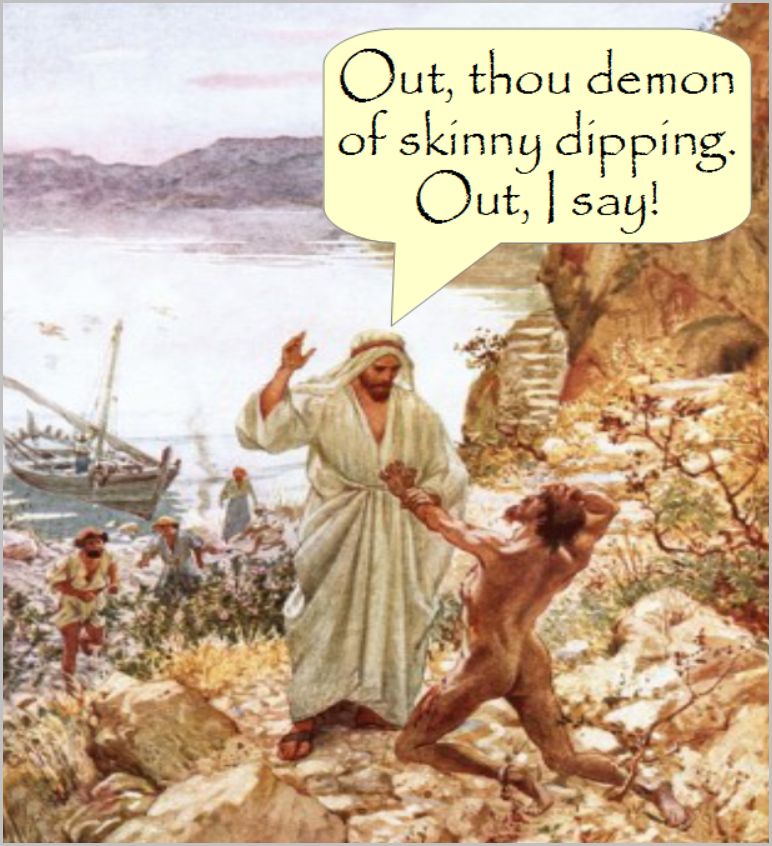
DemonAnd when they came to the crowd, a man came up to him and, kneeling before him, said, “Lord, have mercy on my son, for he is an epileptic and he suffers terribly. For often he falls into the fire, and often into the water. And I brought him to your disciples, and they could not heal him.” And Jesus answered, “O faithless and twisted generation, how long am I to be with you? How long am I to bear with you? Bring him here to me.” And Jesus rebuked the demon, and it came out of him, and the boy was healed instantly. (Matthew 17.14-20)

Do you believe in spirits and demons? When you’re ill, do you visit the nearest exorcist or do you take yourself off to the doctor or hospital? Of course, most Christians (but by no means all) have more faith in the medical profession than they do in the wingnuts who’d tell them their ailment was the result of demonic activity and command the demon to leave in the name of Jesus.

Why? Because, even Christians know, in spite of what they might tell you, what causes disease and illness. They know what cures them too; and it has nothing to do with Jesus. ‘The Son of God’ is among the wingnuts when it comes to believing unclean spirits are at the root of human ailments and behaviour (Mark 5.1-8; Matthew 8.28-34; Matthew 12.43-45; Luke 4.33-36; Luke 8.29 etc.)

In spite of the fact there’s absolutely no evidence that demons exist, Jesus thought that invisible supernatural creatures were responsible for conditions like epilepsy. Like everyone at the time he thought that if these unclean spirits could be driven out, then the condition would be ‘cured’. Some follow in his misguided footsteps today; the Catholic church has an entire coven of exorcists, and charlatans like the Reverend Bob Larson make a living driving out the demons of pride, lust, homosexuality and greed from stooges and the gullible (except of course they don’t.)

If you’re a Christian, you should believe in demons and unholy spirits; you believe everything Jesus uttered was true, don’t you?

Of course, Jesus was a product of the pre-scientific era in which he lived; his ignorance might be excusable if it wasn’t offered up as God’s Truth. All that Jesus’ belief in devils and unclean spirits demonstrates is that he was very much a man of his time – evidence, if more were needed, that he wasn’t remotely divine. Unless, of course, the God he also believed in was as ignorant of the causes of illness and human behaviour as he was.

But next time you’re unwell, Christian, or you’re feeling a mite greedy or lustful, don’t go to the doctor’s. Don’t even ask the Lord for forgiveness. Have a little faith and, in the name of Jesus, command that hell-spawned demon within you to leave. See how that works out for you.


Update: New this week in ‘It Can All Be Blamed On Demons’:

Right-wing American broadcaster, Bryan Fischer, claims unarmed black teenager killed by cop was in fact possessed by a ‘homicidal demon’.

Tele-evangelist Pat Robertson asserts playing Dungeons and Dragons leads to demon possession.

Thank you, Lord, for your endorsement of fantasist rubbish like this.


This week in the wacky world of religion…

AtrocitiesBecause my invisible super-being is better than yours, this week I’ve:

murdered you at prayer;

beheaded you as an infidel;

denied you an education;

raped your girls and young women;

committed brutal acts of terrorism;

denigrated LGBT people;

flogged you and imprisoned you.

…And all because of my invisible super-being. Isn’t he wonderful?

As for me, I’m just glad I don’t have an imaginary god if this is the kind of thing he tells his followers to get up to.

The Great Escape

EscapingSometimes I miss my religion. I miss my days of thinking I knew what life was all about, of living in accordance with God’s will, of believing I was in a relationship with Jesus. It was comfortable and secure, and maybe a little bit anxiety inducing too: what was God telling me to sort out in my life now? What sin had I not confessed? How had I let him down this time?

My faith defined my life for me, set its parameters, told me what to believe about other aspects of life – like the role of men and the place of women, parenthood, abortion, homosexuality, evolution, the end of the world (always coming soon! You need to be ready for it!) – and defined my values. God would guide me when making decisions in life, which may be why I made so many bad ones, and even gave me a special set of spiritual words with which to talk about him. I don’t mean speaking in tongues, though there was that, but words like ‘saved’, ‘redeemed’, ‘born again’, ‘witness’ ‘rapture’, ‘seeking the Lord’. (Now there’s a blog post; the surrealism of Christian-speak.)

There was an entire sub-culture to enjoy too; Christian music (some of it – certainly not all of it – as good as anything in the ‘world’), hymns and choruses to sing, devotional books, Bible study notes to tell you what the scriptures really meant, magazines (Buzz, anyone?), conventions like Spring Harvest and Filey where you could go for a spiritual charge (buzz, anyone?) and hear what the Lord had to say to his people – usually that he expected more of them. Church too, of course, which was the means of reinforcing collective beliefs and ensuring conformity, and where there were friends and some really genuine people (some difficult people too, but they probably weren’t ‘real’ Christians.)

Most of all I miss the cosy, fuzzy feeling that came from being a Christian. This was generated by the sure and certain knowledge that I was saved and Jesus loved me. However things might appear, God was in control; everything happened for a reason, which he knew about even if I didn’t. What’s more, and best of all, he would welcome me and everyone else who was genuinely born-again into Heaven when we died. What more could I want?

How about:

  • a healthy dose of reality;
  • shedding a false persona to be the person I was meant to be;
  • using my brain to have views and values of my own;
  • recognising that the Bible is wrong about so much;
  • understanding we have relationships with living people not long dead ‘prophets’;
  • coming to terms with the fact that there’s no-one out there listening to our every thought and answering our prayers;
  • embracing the fact that life is gloriously random and messy;
  • accepting myself and everyone else as they are (also random and messy);
  • knowing this life is all there is, and
  • enjoying everything it makes possible.

Would I change any of this to return to the delusional comfort and stability of Faith? Certainly not. Any belief system that puts mythical beings ahead of real people and espouses principles that its adherents would kill or die for, is, I now see, inherently wicked. As we witness each and every day now, all of the world’s major religions – including Christianity – are inclined towards the heartless extremism that belief in the supernatural engenders. I want nothing to do with them, other than speaking out against them whenever and wherever possible.


Our touchy Loving Father is pissed off (again)

DoctorIn 1665, the great plague overtook London and killed about a sixth of its population. The church and other authorities believed the plague was a punishment from God for the sins of those who lived in the city.

Such a view is understandable among people who lived in a pre-scientific era (just) and had no other way of explaining natural phenomena other than from a religious perspective. Their ignorance is perhaps forgiveable.

Speed forward to 2014 and the outbreak of the Ebola virus in Liberia and other parts of Africa. Ebola causes an incurable disease with a 90% fatality rate. And guess what? Those of arrested development, whose thinking is still stuck in the seventeenth century, attribute it to God. More than that, they predict a plague on a scale next to which the 1665 plague looks like little more than a minor skin irritation. And all because of the sins of other people (naturally). According to Liberian church leaders:

God is angry with Liberia. Ebola is a plague. Liberians have to pray and seek God’s forgiveness over the corruption and immoral acts (such as homosexualism, etc.) that continue to penetrate our society. As Christians, we must repent and seek God’s forgiveness.

The usual suspects – atheists, secularists, those pesky homosexuals, pornography, abortionists and women who have abortions – are bringing the judgement of God to Africa, and far more importantly, according to American evangelical leaders, to America itself. There’s an even a lunatic fringe there who welcome it:

Everybody who stands up and embraces sodomy, BE THOU CURSED WITH EBOLA! Cursed be ye for embracing this!’

rants Harlem Pastor James Manning.

As ever God’s judgement, if that’s what we’re dealing with, will be indiscriminate. It will strike down the weak, the elderly, the vulnerable, and, yes, Christian missionaries (the two American medics who have contracted the disease are just that.) Because God’s like that; when he’s in his Hulk-smash mode, he doesn’t care who gets in his way.

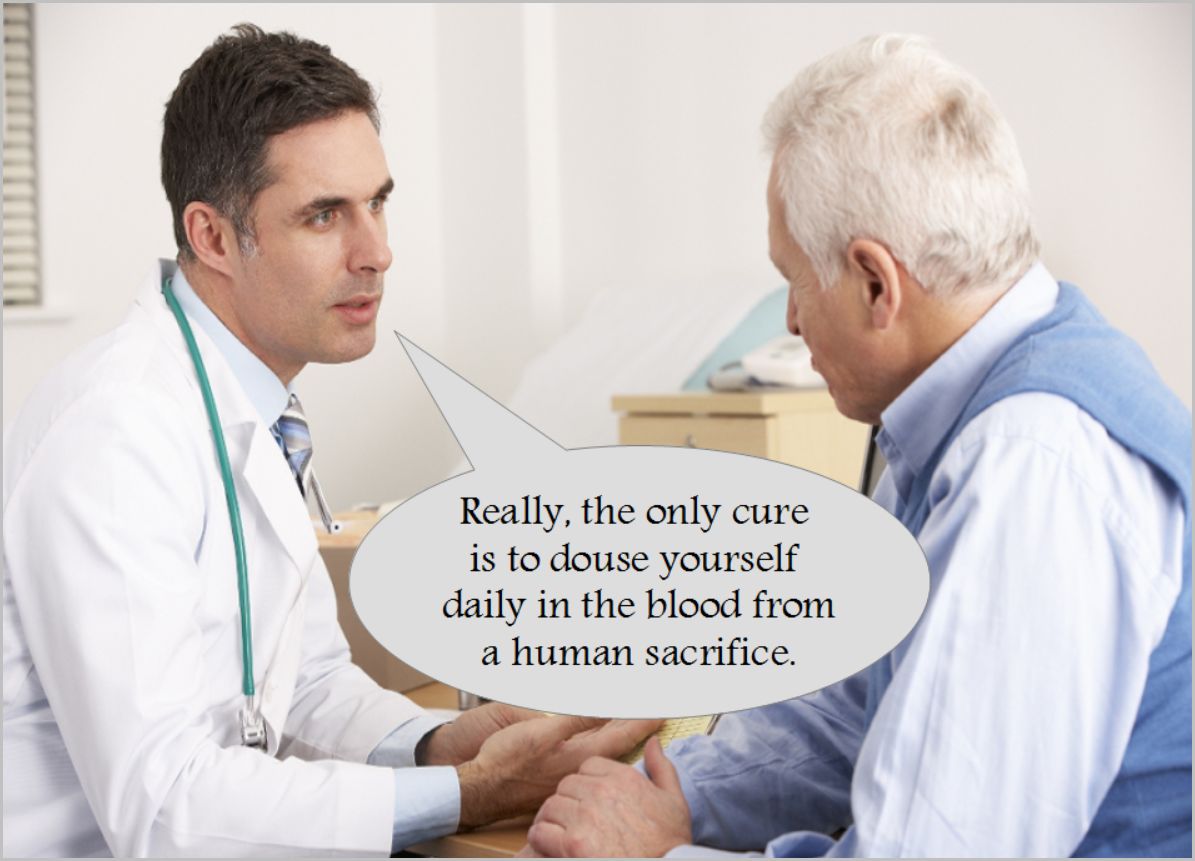
There is a cure though. Just as the scientifically illiterate in 1665 thought prayer would spare them from the plague, the way to survive the coming Ebola pandemic is, according to Pastor Rick Wiles, to be covered in the blood of Jesus:

Now this Ebola epidemic could become a global pandemic and that’s another name for plague. It may be the great attitude adjustment that I believe is coming. Ebola could solve America’s problems with atheism, homosexuality, sexual promiscuity, pornography, and abortion…
If Ebola becomes a global plague, you better make sure the blood of Jesus is upon you. You better make sure you been marked by the angels so that you are protected by God. If not, you may be a candidate to meet the Grim Reaper.

Yes, only true believers who have the blood of a long dead Jewish preacher ‘upon’ them, and angels hovering over their heads, will survive the coming plague (so those Christian missionaries are safe after all – they needn’t bother with the medical care they’re currently receiving back in the States).

This isn’t even seventeenth century thinking; it’s straight from the bronze age.

Will there be a world-wide Ebola plague? It seems unlikely, but who knows; life is more precarious than we sometimes like to admit. If there is, it won’t be because a vengeful, pissed-off God is inflicting it on us… because there’s no such entity. Nor is there a nice, loving, daddy God either – but then he doesn’t figure in this particular scenario anyway.

In spite of what the Bible promises (James 5.14-15), there’s no supernatural protection from Ebola, nor from any other disease. The poor souls who died of the plague in seventeenth century England found that out the hard way. Praying to God and sloshing about in the blood of Jesus, metaphorically or otherwise, protects no-one.