Idiotic Stuff Jesus Said 12: My words will never pass away

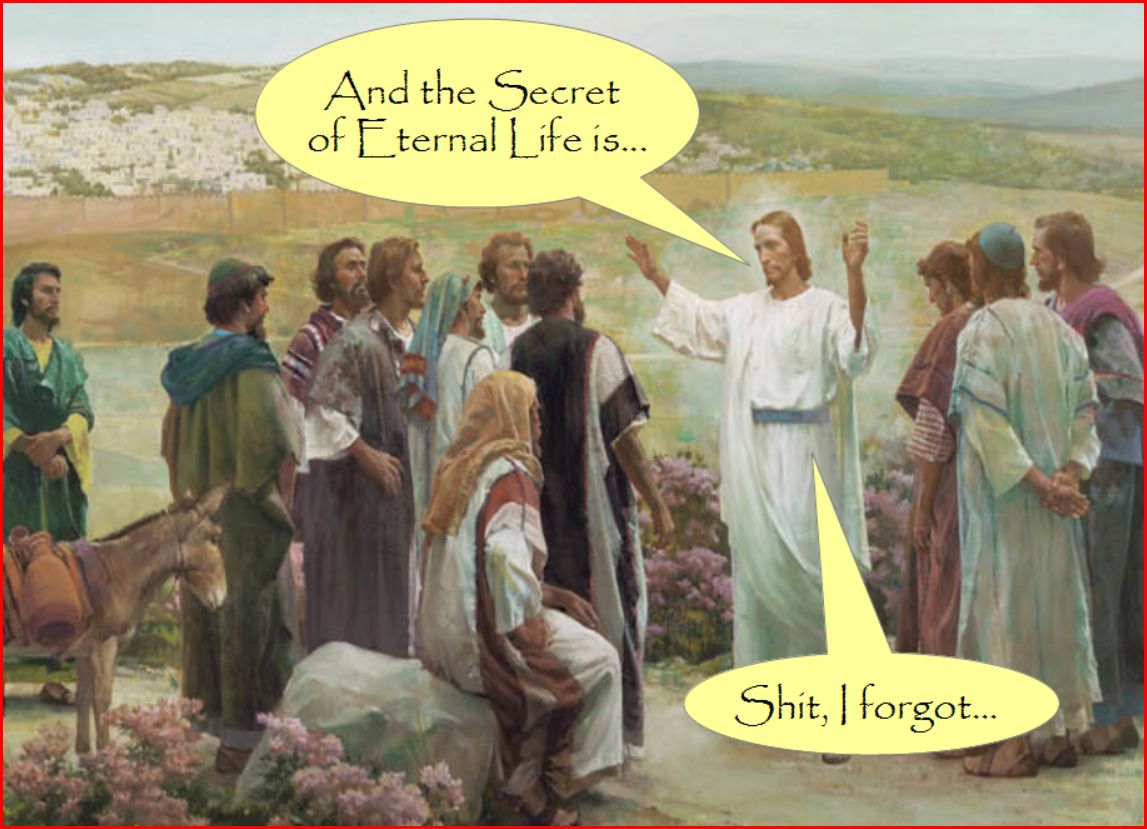
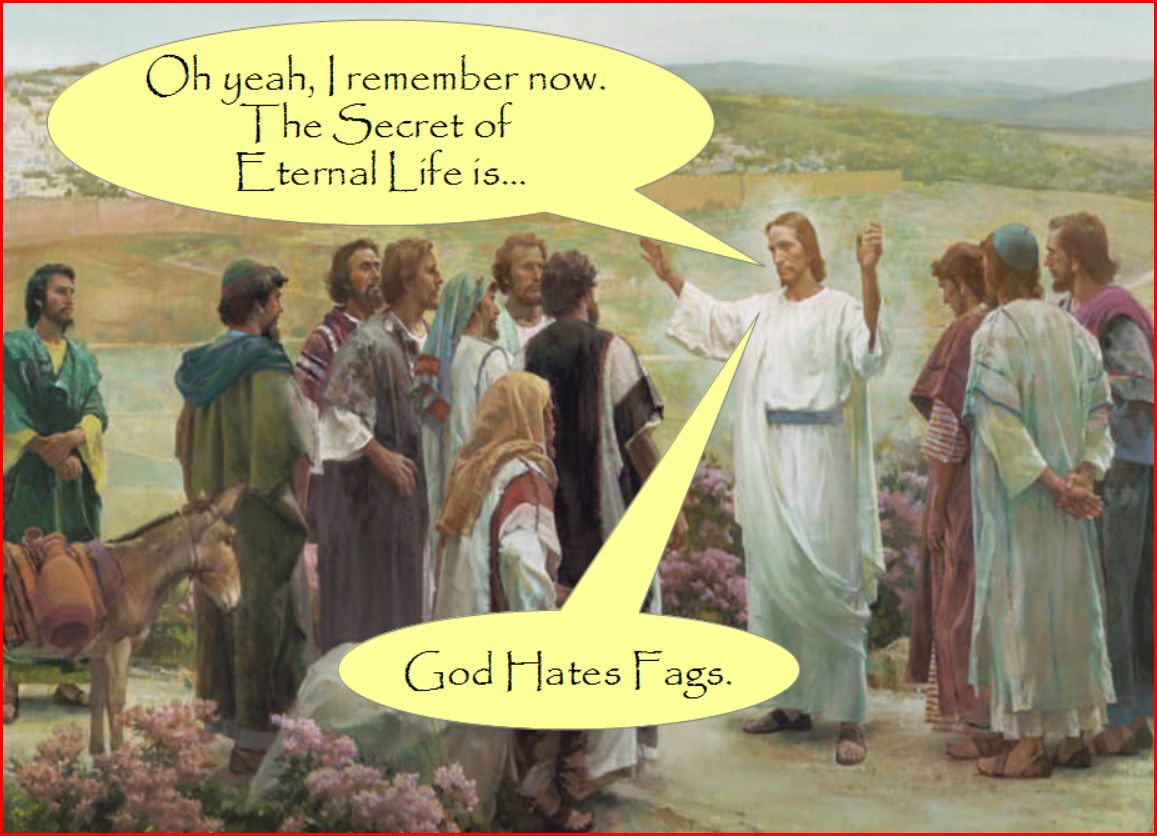
AndersonThe premise of my first ‘Jesus’ book* is that while Christians profess to believe in Jesus, they choose to ignore most of what he taught while he was alive. While they claim a vapid super-hero Christ as personal saviour, they replace what the human Jesus had to say with words of their own choosing. In reality, they have about as much time for Jesus’ ‘eternal words’ as the average non-believer or atheist. You don’t have to look very far to see how much his words have already ‘passed away’:

Jesus said, ‘Don’t judge so that you won’t be judged’ (Matthew 7.1). Our representative Christian says, ‘LGBT people are filthy and wrong.’

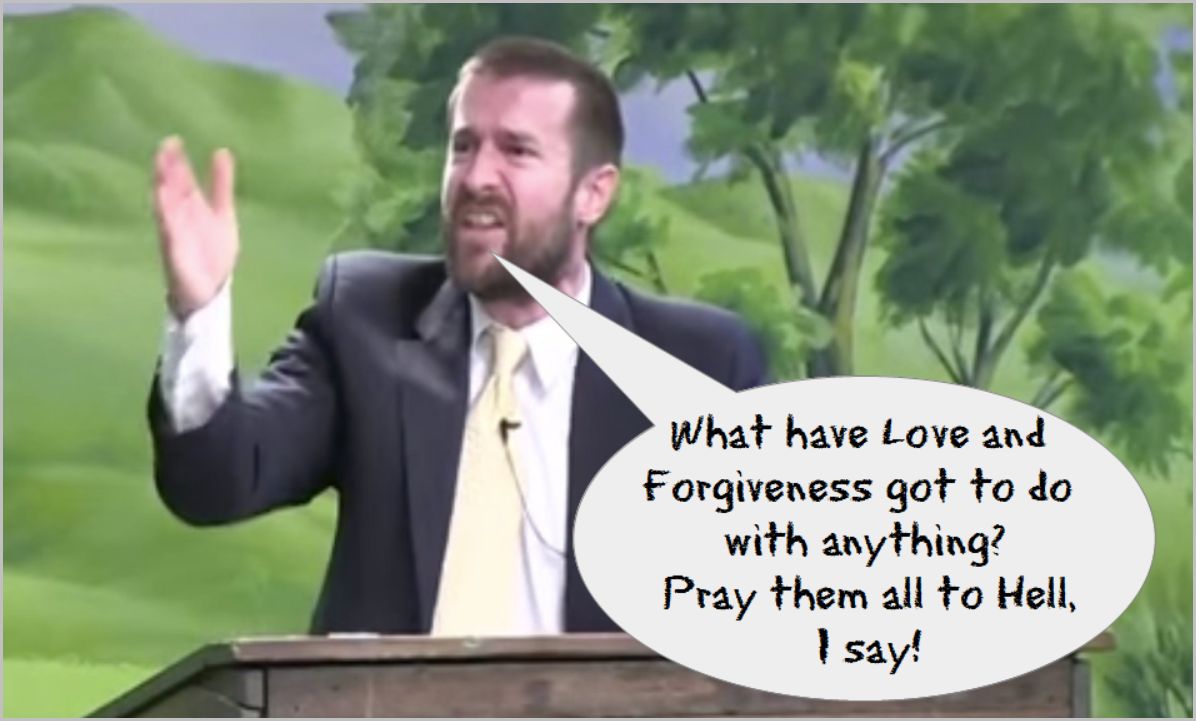
Jesus said ‘Love your enemies, pray for those who persecute you’ (Matthew 5.44). Our representative Christian says, ‘I’m gonna pray a transgender person dies and goes to Hell.’

Jesus said, ‘Love your neighbour as yourself’ (Mark 12.31). The Christian says, ‘The way to show love is to tell other people they’re going to Hell.’

Jesus said, ‘sell all you have and give to the poor’ (Mark 10.21). The Christian is concerned about where to buy jewellery: ‘…somewhere other than Tiffany’s, because Tiffany’s is gay friendly.’

Jesus said, ‘Forgive those who sin against you so you can be forgiven yourself’ (Matthew 6.14). Our believer rants, ‘LGBT people should be executed.’

Jesus said, ‘Don’t commit adultery and don’t get divorced’ (Matthew 5.27-28 and 19.9). Significant numbers of Christians , including our own Stephen Green, say, ‘that doesn’t apply to me.’

See what I mean? Christians regard the words of their saviour, not as having everlasting value, but as if they’re nothing more than worthless bits of fluff. Even if God were real, every word of the Bible true, every aspect of the Great Salvation Plan genuine, it wouldn’t change the fact that believers treat as optional almost everything Jesus commanded and live as if he never had.


* Why Christians Don’t Do What Jesus Tells Them To …And What They Believe Instead is available from Amazon worldwide (UK here, US here) but not, alas, from Tiffany’s.

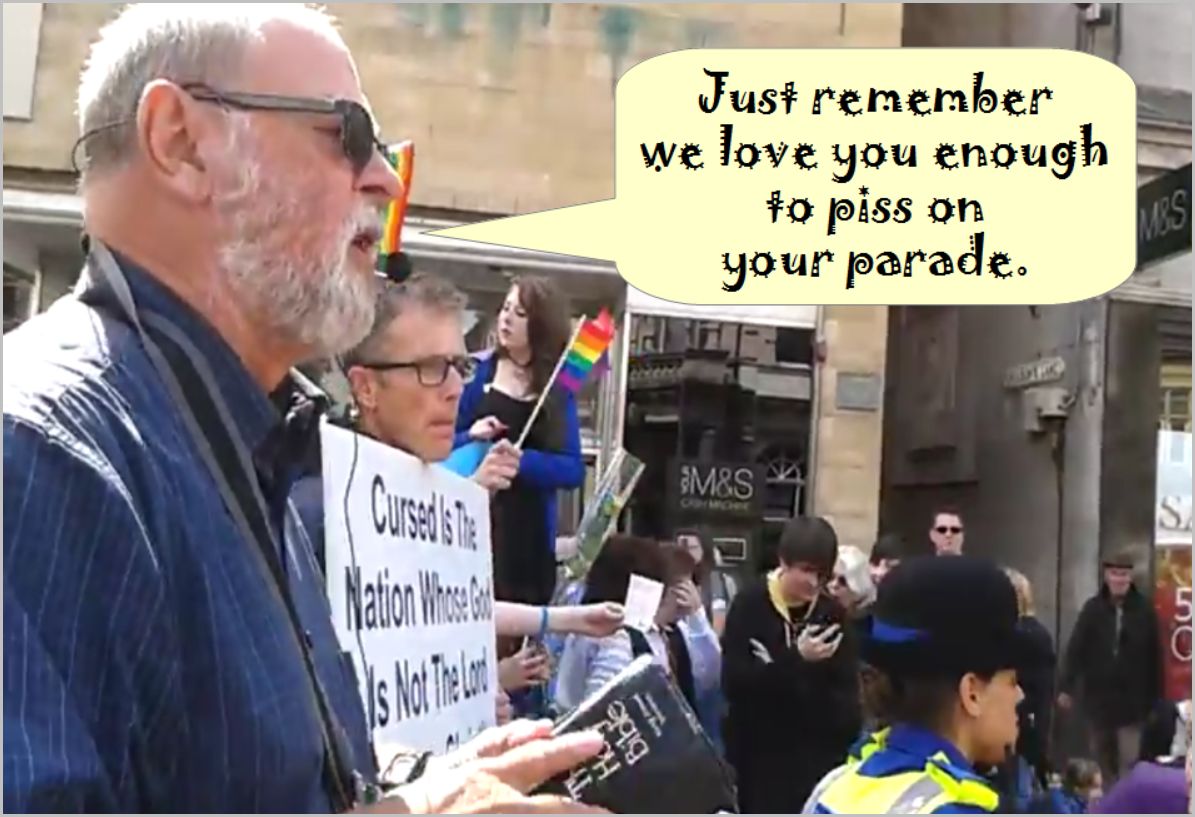
The picture shows the deplorable Pastor Steven Anderson (linked above). He knows better than Jesus ever did.


Christians’ Favourite Delusions 33: Atheists know in their hearts that God exists

DenyTwo tried cliches trotted out by evangelising (i.e. aggressive) Christians are that ‘atheism is a religion‘ and that in their ‘heart of hearts atheists know there really is a god’. Ken Ham of Answers In Genesis is fond of both assertions, as are other equally desperate promoters of unsupportable beliefs. We’ll come to the first in a later post, but here’s how Ham expresses the second:

They (atheists) know in their hearts that God exists, but they are actively suppressing this belief in unrighteousness (Romans 1:18). They fight so hard against a God that they claim doesn’t even exist because they know that He really does! We need to pray that, instead of fighting against God, these lost individuals will repent and put their faith and trust in Christ and in what He did for them.

Romans 1.18 that he cites says: For the wrath of God is revealed from heaven against all ungodliness and wickedness of those who by their wickedness suppress the truth.

Assuming Paul is saying here what Ham claims he is (it’s doubtful from this verse alone) both he and his hero are demonstrably wrong – as they are about so much. The evidence suggests that while young children look for meaning and assume agency, they do not necessarily attribute these to a god until they are taught to do so by others. The god they then come to acknowledge is the one already prevalent in their social environment. In a predominantly Christian context, they will come to be acquainted with – and may go on to develop a full-blown belief in – the interpretation of the Christian God common within their particular culture.

It is the same for conversion generally. You are more likely to be a Mormon in Salt Lake City, a Roman Catholic in East Timor. If raised in a Jewish environment, it’s more likely you’ll subscribe to YHWH; in an Islamic one, an interpretation of Allah; Buddha – not strictly speaking a god – in a Buddhist one. Statistically, those who adopt a religion and a belief in a god, almost always opt for that which is prevalent in the society into which they are born. This is not god ‘writing a knowledge of himself’ in their hearts, it is a cultural, human phenomenon.

Ham and others see this as evidence for their belief that we all have some sort of ‘god-shaped hole‘ in our psyche that we can just as easily fill with false gods as with the real one (theirs). But this is a shift in the argument; it’s not now that God makes himself known to everyone but that we all find a need for a god. This is not the same thing, nor is it true. Certainly humans have a history of creating gods to explain the strange, magnificent and sometimes hostile universe in which we find ourselves; but this does not mean these many gods exist, as Ham would be the first to admit (c’mon, there’s only one real God – his.) It means only that the human brain seeks pattern and meaning, and has often drawn the wrong conclusions in its quest for them. The gods – and God – are part of these wrong conclusions.

And what of Ham’s assertion that atheists deny their awareness of God because of ‘unrighteousness’ – because, he implies, we just want to live a life of rampant ‘sin’? Well, I admit, I like a bit of a sin as much as the next man, but that’s not why I’m an atheist. I’m an atheist because, like most others, I find no evidence for gods or God either in my ‘heart’, nor in the way the world works nor in collections of iron age stories. Morality doesn’t come into making this assessment. In any case, those who buy into a god don’t have a monopoly on ‘righteousness’, as their weak morals, judgemental attitudes and destructive behaviour regularly demonstrate. More than this, and as Ham admits, Christians are only concerned about others because the Bible says they should be: ‘The reason I care about poverty,’ he says, ‘is because God’s Word instructs me to care, and all humans are made in the image of God as God’s Word tells me.’ This is not righteousness, nor a morality that comes from any real concern for fellow human beings.

Finally, atheists don’t, as Ham claims, ‘fight so hard against’ a non-existent God that we secretly believe in. We oppose Christians and other purveyors of supernatural nonsense when they try to impose their irrational beliefs on others, when they condemn fellow human beings, seek to control them and try to limit their rights in the name of God and the cause of ‘righteousness’.

So, no, don’t condescend, Christians, to tell us we all know that there’s a God that we wilfully ignore. You’re wrong, and I’ll show you even more reasons why you are, next time.

It only encourages them

HealDear Believer,

Let us be direct. We have to tell you, out of love, that we can never serve you in our restaurants, never teach you in our colleges, never supply you with goods we make, never sell you items from our shops. Why? Because of your fake faith.

Your belief in a mythical figure and in eternal life is a sin against the intellect. More than this, it causes you to act in mean-spirited, unloving ways. We cannot endorse such abhorrent, evil practices.

So if you come into our restaurants, classrooms, shops or offices wearing a cross or talking about your faith or praying, you will be turned away. We do this only because it breaks our hearts to see you lost in your delusion and to witness the damage you do to other people as a result of your beliefs.

It is our fervent wish, dear “Christian” friend, that by doing this we can lead you to abandon the illusory path you have chosen so that you may reclaim both your intelligence and humanity.

We hope you understand that all we say and all we intend to do, we do out of love and in the spirit of truth.

faithlessly,

The Freethinkers

What do you think? Too judgemental? Too much of a generalisation? Tars all Christians with the same brush? Unforgiving? Moralistic?

You’re right…

The original version of this letter is a long-winded, sanctimonious diatribe by right-wing Christian, Matt Barber. You can find the full thing at this link, but here are the highlights:

Dear homosexual,

…Let us be direct. According to the unequivocal moral precepts of biblical Christianity, explicit throughout both the Old and New Testaments, your homosexual behavior is sin. Sin is evil. Homosexual behavior is the central, defining characteristic of your counterfeit “gay marriage.” Therefore, “gay marriage” is evil. Christians are obligated to avoid sin – to “do no evil”…

It really is that simple. This is why, as faithful Christians (apostate “Christians” notwithstanding), we will never have anything whatsoever to do with your pagan, sin-based “same-sex wedding” rituals.

We will not bake your fake wedding cake.
We will not arrange your fake wedding flowers.
We will not take your fake wedding pictures.
We will not host your fake wedding reception.

We will not do these things because to do these things is to disobey God. It is to aid you in your sin, to cause you to stumble, which, in and of itself, is to layer sin upon sin…

We’re telling you no because we love you with the love of Christ. But understand this: As we are so commanded, we must, and do, hate the evil conduct by which you define your identity… what you do is wrong. Period. Full stop….

Dear “gay” friend, you will one day realize, hopefully before it becomes too late, that you are not only on the wrong side of history, you are on the wrong side of eternity.

It breaks our hearts to see you there.

And so we refuse to help send you.

Sincerely,

The Christians

Yes, definitely unforgiving and judgemental. Presumptuous too: Matt Barber speaks for all Christians? He writes and signs his letter in your name. Who appointed him to do that?

Arrogant in deciding we’re all sinners, gay people more than any. The whole sin thing is a specifically Christian mindset which – surprise, surprise – not all of us subscribe to, not least because it has little purchase in the real world.

Hypocritical that he condemns everyone, gay people more than any, but conveniently ignores the parts of his saviour’s teaching that says ‘don’t judge unless you want to be judged’ (Matthew 7.1). What does it feel like, Christians, when the tables are turned? Those of you, like Barber, who sit in judgement of others merit judgement in return. This is a sound Biblical principle, every bit as much as, or even more than, the ‘principles’ you use to condemn your ‘gay friends’ as ‘evil’. JC himself said so.

Ignorant too, of the scriptures that say ‘give to all who ask’ (JC again, in Luke 6.30-36). They don’t say, anywhere, ‘refuse to do anything for a group of people you don’t approve of.’ As Christians you’re not given that option, no matter how much you twist unrelated verses to endorse the position you’ve already chosen to take.

No, Christians like Barber who stand on ‘principles’ like these, who think they know the mind of Jesus while ignoring the very words he said are unchristian, unforgiving, unbiblical, arrogant and, whatever they may claim to the contrary, unloving. How attractive they make their faith seem.

What Jesus should have said…

KnockLists are the thing, aren’t they. It’s time we had some on this here blog thingy.

List 1. 10 things Christians pretend Jesus didn’t say:

1. Treat others as you like to be treated (Matthew 7.12)

2. Forgive so that you’ll be forgiven (Matthew 6.14)

3. Don’t judge unless you want to be judged (Matthew 7.1)

4. Sell all you have and give it to the poor (Mark 10.21)

5. Turn the other cheek (Luke 6.29)

6. Go the extra mile (Matthew 5.41)

7. Give to all who ask and lend without expecting anything back (Luke 6.30 & 35)

8. Love your neighbour as much as yourself (Matthew 22.39)

9. Love your enemies (Luke 6.27)

10. Don’t worry about the future (Matthew 6.34)

If Christians followed these injunctions, what a very different world it would be. Instead, what do we get..?

List 2. 10 things Christians think Jesus should have said, but didn’t (with a few examples):

1. Show love for others by telling them what sinners they are (1, 2)

2. Stand on principle as much as you can (1, 2, 3).

3. Take easy offence (1, 2)

4. See persecution everywhere (1, 2, 3, 4)

5. Sue those who upset you (1, 2)

6. Demonise those who don’t share your world view (1, 2, 3, 4)

7. Hate homosexuals and oppose same-sex marriage (1, 2, 3)

8. Set yourself up as defender of God’s standards (1, 2)

9. Argue endlessly about points of doctrine (1, 2)

10. Obsess about the future and the state of the world (1, 2, 3)

This is the Christianity we’ve got. Well done, o righteous ones, for perverting Jesus’ radical (and yes, ridiculously impossible) message into this unsavoury concoction of mean-spirited self-centredness. It’s what he wouldn’t have wanted.


Why_Christians_Don't_Cover_for_KindleMy book Why Christians Don’t do What Jesus Tells Them To …And What They Believe Instead looks at how Christians ignore most of what Jesus says in favour of a Christianity of their own making. You can find it here in the UK, here in the US and on Kindle. Go on. You know you want it.


What Christians Believe: Part Two

AscensionHi, Thea Lojan here talking about the creed. Here’s what else it says, following on from last time:

I believe Jesus ascended into heaven and is seated on the right hand of God and will come to judge the living and the dead. As I was saying, Jesus could do amazing things. He could, like, beam up into the sky and out into space – that’s what ‘ascended’ means. Amazing. And he is coming back to judge the Earth, just like he promised. I know he said he’d be back real soon, like while his disciples were still alive, but to God a minute is like a thousand years so a few years can be anything like a million, or something like that. We shouldn’t take it literally when he said he’d be back while his friends were still around, though the Bible is, without a doubt, the literal Word of God.

Anyway, when he returns Jesus is going to send those who don’t believe in him to Hell, where they’ll suffer eternal torment for, like, forever and ever, amen. And he’ll take people who are saved, like me, back to Heaven with him. I can’t actually find the bit in the Bible where he says he’ll be taking me to Heaven, but I have faith so I’m sure he will.

Just a thought, but why doesn’t this creed mention the Bible, and how it’s the ineffable and literal Word of God? You’d think it would, wouldn’t you.

I believe in the Holy Spirit, the holy Catholic Church and the communion of saints. Definitely. The Holy Spirit is like the feeling of God that you get when you’re being blessed. You can’t see it – though it’s actually a ‘him’ because God is a ‘him’ – but it’s there, helping you make decisions, like whether you should buy a new car or install a heated pool in the yard. You definitely get a sense of him then. In my experience, he’s never let me down. He always guides me right.

I’m less sure of the holy Catholic Church because of course we’re not all Catholics and nor should we be when Catholics have got everything so wrong. But the pastor at church says it just means ‘the Body of Christ’ here, the same as ‘the communion of saints’ does, though that makes you wonder why we’ve got it in there twice. The communion of saints means all worshippers everywhere being united and working together. So, yes, I totally believe that because, that’s what we do as Christians; we all love each other. I don’t accept any of those lies that some people put about that there’s, like, 41,000 different kinds of churches. I don’t think God would let that happen, do you?

I believe in the forgiveness of sins. Yes I surely do, for God has forgiven my sins through the redeeming blood of the Lord Jesus Christ, his son. And if they’re really, really sorry I can forgive the sins of others, except of course if they’re, like, homosexuals. It really grosses me out to think about what so-called “gay” people do with each other. It’s unforgivable and even the Lord doesn’t forgive it. But my sins, yes, he forgives those.

The resurrection of the body and the life everlasting. Well, I already covered this. This is another repeat. What this really means is that everyone whose sins are forgiven and have been saved will go to live with God in Heaven after they die. Isn’t that amazing? Just think, whatever happens to your body all the time you’re dead, even if it’s been burnt or has rotted away to nothing, God will repair it and make it good as new. And then you’ll live forever in Heaven, because that’s what it means when it says ‘the life everlasting’. Even if I still can’t find that bit in my Bible.

Well, that’s it. That’s my creed, and what Christians everywhere believe. It was written, in fact, by the apostles, that’s Jesus’ friends, way back when he was still alive or just after. If you were to give your life to the Lord – and you really should if you want live forever in Heaven – then it’s what you’d believe too. Isn’t that, like, really, literally incredible?

Jesus or Paul?

Nicodemus

Jesus is asked a few times in the gospels about how a person can find eternal life – like that’s the most obvious things to ask a travelling snake-oil salesman. Maybe it is, I don’t know. It was in the first century anyway, if the gospels are to be believed.

Jesus gives a variety of answers in the three earliest gospels: in Matthew 19.17 it’s ‘keep the commandments’ – those terrible, brutal laws I talked about last time. In Mark 12.30-31 he says the way to eternal life is to love God with all your heart and soul, and your neighbour as yourself. In other places he tells his audience that if you want to be forgiven by God then first you must forgive others (Matthew 6.14); if you want God’s compassion then first you must be compassionate (Matthew 25:31-46); if you don’t want to be judged, then you shouldn’t judge others (Luke 6.37).

Jesus is particularly fond of this kind of measure-for-measure salvation; it’s the lynch-pin of his good news – do unto others as you would have God do unto you. And almost every time he mentions it, he connects it with the Law and commandments.

Never does he say, anywhere in the gospels, that if you want to gain eternal life, or find favour with God, or be saved, then what you have to do is believe in the redemptive power of his own imminent death. Even when he could have done so, when he could have worked a little bit of Christian dogma into his teaching, he doesn’t. And that’s strange really, when you consider that Paul’s brand of Christianity – the one that’s come down to us today – is built entirely on the idea that the death and resurrection of Christ is the only thing can save us from God’s wrath.

Paul’s alternative gospel, which is expounded in Romans and summarised in Galatians 3.10-13, goes something like this:

Paul looks at the old Jewish Law and says, ‘actually it’s impossible. None of us can keep it. We’re all under a death sentence for some tiny infringement of it, because any and all infringements lead to the death penalty. But,’ he goes on, ‘Christ has taken that penalty for us by dying in our place. So although the law demands we should die and then suffer for eternity, we won’t, because he died for us. Then he rose again, just as those who believe in him will.’ That last bit – about believers rising from the dead – really doesn’t follow from his premise that the Law is impossible, but this is Paul talking, a man with only a passing acquaintance with logic. He doesn’t, either, have any evidence that Jesus took the penalty for the rest of humankind – he made that bit up too.

And that, in a nutshell – I do mean nut shell – is Paul’s ‘good news’. It bears no relation to the good news that Jesus preaches in the synoptic gospels. Admittedly, the Jesus who wanders his way through the first three gospels is for the most part a pre-death Jesus. You could argue, as a result, that he wouldn’t talk about redemption through his death before it had happened… but then again, why not? He talks about all sorts of other things he thinks are going to happen after he dies and rises again; he’s going to return pretty damn soon in a blaze of glory, through the clouds with an army of angels; heaven and earth are going to pass away; God is going to unleash his kingdom on the new earth.

But in spite of these mad speculations, he doesn’t mention even once in the synoptic gospels that people can be saved merely by accepting that he has paid – or will pay – the penalty for their infringements of the law, their sins if you will. Never. All the more odd when you consider that Mark, Matthew and Luke were putting their gospels together long after Paul preached his particular brand of salvation. Yet they don’t put this message into Jesus’ mouth, nor do they add it to the narrative.

It’s just not there.

So… were the gospel writers not aware of it? If they did know of it, was it that they didn’t like it? Did they know, in fact, that Paul’s formula didn’t square with what Jesus himself had said, or what they at least believed he’d said?

Whatever it was, the result is there are two conflicting versions of the ‘good news’ in the New Testament: Paul’s and Jesus’. One is easier than the other; in Paul’s plan all you have to do is believe. The other is difficult (and if we’re honest, really only designed for Jesus’ fellow Jews); it entails things like forgiving repeatedly, showing compassion, putting others first, turning the other cheek and, especially, following the six hundred and odd commandments that make up the Law.

So guess which one Christians today prefer.

Here’s a clue: it’s not Jesus’ gospel – the one without the magical incantation but with the barbaric Jewish law. But if, as Christians believe, Jesus was the Son of God – maybe even God himself – then why do they always accept Paul’s reinterpretation over and above everything their Lord said? Why do they disregard all that Jesus demands of those who would follow him, and take instead Paul’s easy path?

In the end, though, what Jesus and Paul (as well as the gospel writers and different factions of the early church) are in dispute about is the highly improbable and the absolutely impossible. It doesn’t matter whether they thought you could gain ‘eternal life’ by obeying the commandments or by letting someone else take your punishment for you; humans do not live forever. Just because a zealous first-century preacher thought they could does not make it so. Just because a different fanatic from roughly the same time believed it doesn’t make it happen either. There’s no evidence any human has ever, after this brief earthly existence, gone on to live forever. Equally, there’s no evidence that a deity exists, so those rules that are so important, in different ways, to Jesus and Paul can’t have originated with him. They’re man-made too.

So, with no God and no eternal life, Jesus and Paul might as well have been discussing whether the tooth fairy wears a pink dress or a green dress. What does it matter when she doesn’t exist?

How much more were they wrong about?

How long you got?

God’s Blunt Instruments

CultI get so tired of how Christians think they should show ‘love’ to others. They’ve got clear instructions in their holy book about how to do this but as with so many of their beliefs, they by-pass the commands of their saviour, to come up with their own, less costly ways of ‘loving’ their neighbour.

The righteous will (say), ‘Lord, when did we see you hungry and feed you, or thirsty and give you something to drink? When did we see you a stranger and invite you in, or needing clothes and clothe you? When did we see you sick or in prison and go to visit you?’

“The King will reply, ‘Truly I tell you, whatever you did for one of the least of these brothers and sisters of mine, you did for me.’ (Matthew 25.38-40)

Christians, however, have decided that the best way to show love is not to do what Jesus says but instead to call out others’ ‘sin’, to rant about how lost they are and how they’d be so much better if they adopted the same beliefs as Christians themselves.

I’ve experience of this in my own life. ‘While you’re a sinner of the worst kind,’ I’ve been told, ‘I love you enough to tell you about Jesus’ –

As if I’ve never heard about Jesus before;

As if there’s any credence to the entirely religious concept of ‘sin’;

As if this kind of emotional blackmail equates in any way with love.

In case you’ve been lucky enough to avoid it yourself, there’s plenty of this kind of stuff online too: try here or here or here or here for starters. As Matt Barber, who modestly describes himself as ‘an instrument of God’s truth’, puts it, ‘all we, all you, as faithful Christians can do is to speak truth in love and pray that those truths plant a seed that bears fruit in the hardened hearts of lost souls.’

Oh yes, it’s all done in the name of ‘love’ – and the cherry-picked bits of ‘God’s truth’ that appeal to the self-righteous.

Of course, gay people get more than their fair share of this brand of Christian love™. There’s no sign of the unconditional love of which Jesus speaks for the ‘sodomites’ regularly trashed by Christian Voice (Stephen Green’s choice of phrase, not mine) and those ‘mired’ in ‘the homosexual lifestyle’ (no, I don’t know what it is either) invented by the likes of Matt Barber and others who mistake their prejudices for truth and their bigotry for love.

Christians just don’t seem to get it that their ‘witness’ doesn’t consist of judging and condemning the rest of us for our ‘sin’, accosting us with ‘God’s truth’ and telling us how they love us really, even though they don’t show it.

It is – or should be – about action; doing and showing love unconditionally and sacrificially. How do we know this? Because their saviour says so. And until we see this, Christians, you’ll forgive us, won’t you, for not taking very seriously your claims to be instruments of God’s truth nor your empty rhetoric about ‘love’.


The words in the speech bubble above are Bill Muehlenberg’s, another of God’s self-appointed tools. Even Jesus, who was not averse to unpleasantness, didn’t spout the vitriol that some of today’s Men of God™ delight in. In any case, doesn’t Muehlenberg’s claim describe Christianity so much more accurately than it does ‘homosexualism’, whatever that is? Just try replacing the term with ‘Christianity’ and you’ll see. Bill doesn’t know a cult when he’s in one. (Well, he wouldn’t, would he.) And don’t you just love his mismatched pronouns?

Here Be Dragons

dragonChrist The White does battle with the dragon of Revelation 12

Over on Answers in Genesis, one of Ken Ham’s drones is arguing for the existence of dragons. They are, he or she tells us triumphantly, mentioned in the Bible, so they must really have existed.

As we already know, the Bible has more than its fair share of nonsense, but to insist it provides evidence of mythical creatures is to take its credibility to a new low. Don’t Christians care they do this to their magic book? After all, their faith relies almost entirely on the Bible, alongside their own emotional responses to it (no kiddin’, they say this is ‘the Holy Spirit’.)

Christians spend so much time arguing for the Bible’s daftest excesses – the world being created in six days, Jesus returning soon, homosexuality being just the worst sin ever and now dragons – that they haven’t any time left to read what it has to say about how they should be living their lives.

You mean forgiving others, feeding the hungry, giving everything away, not judging (in case you’re judged in return), being compassionate, going the extra mile, turning the other cheek, giving to all who ask and blessing your enemies is in the Bible? Jeez, I never knew.

Yeah, but it’s all secondary to dragons and damning others. ‘By their fruits shall ye know them,’ says Jesus of his followers in Matthew 7.16-20. Turns out there’s no fruit, just a wide assortment of nuts.

The Most Important Words In The Bible

EternalLife1Some parts of the Bible are more important than others. A few verses have a prominence far greater than all the other parts of God’s Word™ and are far more authoritative. To obey these few verses alone guarantees one’s status as a true, born-again Christian.

I can announce that today I will be revealing which the verses are that matter more than all the rest.

There are only about three of them, one in the Old Testament, and two in the New. It’s possible there are a couple of others hidden away somewhere but they’re a little more obscure and don’t, as a result, give us the clarity we’ve come to expect from God’s Word™.

More ink has been spilt, or in recent times, more keyboards bashed, to pound out the implications of these verses than almost any others in the Good Book. Check out any Christian blog, any church web-site and the chances are you will find multiple postings and even entire sections dedicated to these three special verses. You could start looking here or here or here or here… There are sermons about them too and even protests and counter-protests, so important are they.

So, you might be wondering, are these the verses that tell us to love our neighbour as ourselves? Are they the ones that say we should turn the other cheek? To attend to the log in our own eye before pointing out the speck in someone else’s?

No, it’s none of these. In fact, The Most Important Words In The Bible are not ones uttered by Jesus who failed, inexplicably, to recognise their importance. Maybe they’re the words of St Paul then, about love being the most important thing or how to gain eternal life? No, it’s not those either. Only modern Christians have been able to recognise fully the significance of The Most Important Words.

And they are – fanfare from the Heavenly Host, please –

Leviticus 18.22 (duplicated in Leviticus 20.13):
You shall not lie with a male as with a woman; it is an abomination.

Romans 1.26-27
…God gave them up to degrading passions. Their women exchanged natural intercourse for unnatural, and in the same way also the men, giving up natural intercourse with women, were consumed with passion for one another. Men committed shameless acts with men and received in their own persons the due penalty for their error.

1 Corinthians 6.9-10 (plagiarised in 1 Timothy 1.9-10)
Fornicators, idolaters, adulterers, male prostitutes, sodomites, thieves, the greedy, drunkards, revilers, robbers – none of these will inherit the kingdom of God.

So now you know. The Most Important Words In The Bible are these, the verses condemning gay people. These are what Christians prioritise, write about and rant about more than any others. Not ‘forgive others if you want to be forgiven’, not ‘don’t judge’, not ‘give to all who ask’… but the ‘sin’ of homosexuality.

It’s irrelevant, apparently, that Jesus himself has nothing to say about same-sex relationships; irrelevant that, even in the verses where he touches on homosexuality, Paul lists a whole load of other ‘sins’ that Christians themselves are known to indulge in from time to time. No. The Bible is not, you see, about salvation, not about witnessing to non-believers – it’s about homosexuality and what a dreadful thing it is. Today’s Christians, having isolated these few verses, know this and so have their priorities straight.

Never mind that the Bible isn’t really God’s Word (see my previous two posts); never mind it has other things to say besides a few mentions of homosexuality; never mind that it demands a great deal of Christians themselves, which, naturally, they ignore – today’s believers know what Christianity is really about.EternalLife2

Unbelievable: Why, despite everything, Christianity makes absolutely no sense whatsoever.

Spufford2

There’s no real reason to believe in God.

 
Who says so? Francis Spufford in his book Unapologetic: Why, Despite Everything, Christianity Can Still Make Surprising Emotional Sense. Francis does believe though, because sometimes when he’s alone – specially after a tiff with his wife or while sitting quietly in church – he gets a funny feeling. And this feeling is so funny, as in weird, that it can only be God. Or so Frank says, slipping in as many four letter words as he can, just to show he’s not a namby-pamby sort of believer. (He’s especially proud of his new term for ‘sin’: ‘the Human Propensity to Fuck things Up’, or HPtFtU for short.)

 
What’s more, even though there are a hundred and one reasons to think there isn’t a God, at least not one who cares about us (think pain, suffering, death, evolution and his complete lack of interest in his creation, all of which Frank’s acknowledges) he nevertheless wants to say that he does believe because, you know… feelings.

 
That’s not all. This God Frank’s decided to believe in as result of feeling funny, is the Christian God. He could’ve turned out to be Allah or Zeus or Ra, but he isn’t, because Frank feels he’s the Christian God, for no other reason than he wants him to be. Then, in a final leap of faith, he decides that Yeshua, as he insists on calling Jesus, is the walking embodiment of this God, and he rewrites the gospel story so that it fits with the funny feeling that kick-started his delusion in the first place.

 
And so we have it from the horse’s mouth; a Christian who’s proud to admit there’s nothing remotely rational or empirical about believing in God. Faith, he confirms, is no more than some very human, very peculiar feelings that lead you merrily down whichever garden path you choose to take.